REVIEW 2 major objections 4 minor 17 references
Meson spectrum in $QCD_2$ revisited
T0 review · 2 major / 4 minor · reviewed 2026-08-14 · deepseek-v4-flash
Pith's one-line read The paper claims that Lorentz-invariant VSR-type terms recently added to QCD2 leave the meson spectrum unchanged: the gluon term vanishes in light-cone gauge, the quark term only shifts the effective quark mass to $\widetilde M_a^2 =…
desk verdict The paper's central claim that the VSR gluon term vanishes in light-cone gauge is wrong—it is exactly the mg regulator—so the 'null result' only survives for the quark term; the finite-mg spectra are physical effects of the new term. read the letter →
The pith
A machine-rendered reading of the paper's core claim, the machinery that carries it, and where it could break.
The reading
What carries the argument
The load-bearing object is the null vector $n = (1,1)$, which transforms with a phase under two-dimensional Lorentz transformations and therefore permits VSR-style terms. In light-cone coordinates the VSR quark propagator develops a piece proportional to $\gamma^-$, and the coupling vertex is also $i g \gamma^-$; the paper argues that this shared gamma structure makes the new term drop out of every relevant diagram. The remaining machinery is the gluon-mass regulator: the self-energy becomes $\Sigma(p_-) = \frac{g^2}{\pi m_g} \arctan(p_-/m_g)$, and the generalized integral equation (21) contains an $\arctan$ term whose divergence cancels the principal-value regulator exactly, leaving the standard 't Hooft integral equation (26) as the $m_g \to 0$ limit.
What would settle it
Compute the loop contribution of a non-ladder diagram, such as a crossed-ladder or vertex correction, containing one $\gamma^-$ insertion from the VSR quark propagator with the same $\gamma^-$ vertices; a nonzero result would show the cancellation is incomplete and the spectrum shifts beyond the quark-mass redefinition.
Extended reading notes
Core claim
On the paper's own terms, the discovery is that the new Lorentz-invariant VSR terms do not modify the meson spectrum of QCD2 at all, except through a redefinition of the quark mass. The VSR gluon mass term vanishes in the light-cone gauge because $n \cdot A = 0$ sets $A_- = 0$, and the VSR quark term does not contribute to the ladder diagrams because its $\gamma^-$ factor is absorbed by the same $\gamma^-$ structure at the gauge vertex. What remains is a corrected denominator mass $\widetilde M_a^2 = M_a^2 + m^2$, so the generalized Bethe-Salpeter equation reduces exactly to the standard 't Hooft equation in the limit where the gluon regulator mass is removed.
Load-bearing premise
The load-bearing premise is that every $\gamma^-$ insertion from the VSR quark propagator cancels against the $\gamma^-$ vertex, so that no VSR piece survives in any diagram.
Editorial extensions
If this is right
- Meson eigenvalues follow exactly the same integral equation as in the standard model, with quark masses replaced by $\widetilde M_a^2 = M_a^2 + m^2$; any VSR effect is absorbed into a mass shift.
- A nonzero gluon regulator mass changes the eigenvalues, but as $m_g \to 0$ the arctangent divergence cancels the principal-value cutoff and the standard 't Hooft result is returned.
- The VSR gluon mass term vanishes in light-cone gauge in two dimensions, so the gluon contribution can only become visible in higher dimensions.
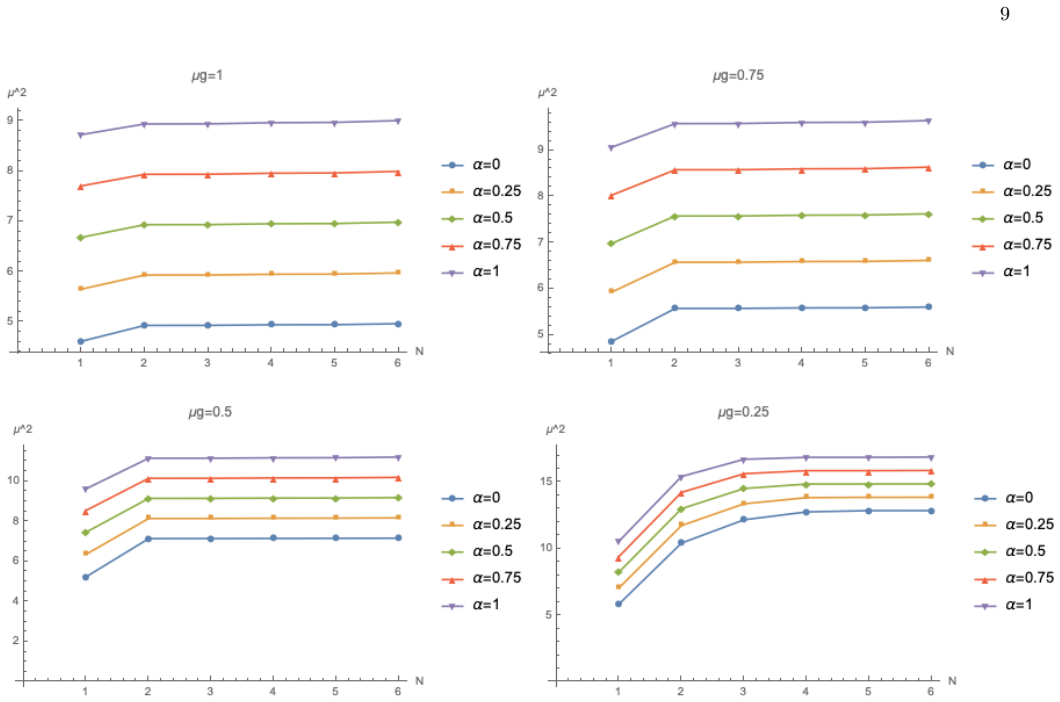
- With fixed nonzero $m_g$, the endpoint behavior remains $\phi(x) \sim x$ at $x = 0$ and $x = 1$, and the computed spectrum does not show a Regge trajectory.
Reading between the lines
- The cancellation argument is checked in the ladder approximation; a natural extension is to test a non-ladder diagram with a single $\gamma^-$ insertion, where a nonzero gamma trace would produce a genuine VSR correction beyond the mass shift.
- Because the VSR quark term is indistinguishable from an ordinary mass shift, two-dimensional meson spectroscopy cannot constrain the VSR parameter $m$ by itself; only the higher-dimensional generalization of the gluon term could produce distinctive effects.
- The gluon regulator mass works as a pure infrared cutoff, but the paper's concluding suggestion invites interpreting it as an effective mass whose physical origin a future model might explain.
Signed reviews
Editorial analysis
A structured set of objections, weighed in public.
Referee Report
Summary. This manuscript computes the meson spectrum of two-dimensional QCD in the large-N limit, incorporating Lorentz-invariant VSR-like nonlocal terms proposed in the authors' earlier work: a fermionic term proportional to m^2 /n·D and a gauge-field term proportional to m_g^2 (n^α F_{μα})(n·D)^{-2}(n^β F^{μβ}). Working in light-cone coordinates and light-cone gauge, the paper claims that the VSR gluon term vanishes in this gauge, that the VSR quark term only produces a mass shift M̃_a^2 = M_a^2 + m^2, and that the remaining calculation reduces to the standard 't Hooft equation once a gluon mass regulator is removed. The authors derive a generalized integral equation (21), solve it numerically in a sine basis, present eigenvalues for various μ_g and α, and show that in the μ_g→0 limit the 't Hooft equation (26) is recovered.
Significance. If the central claim were correct, the paper would establish a compact and useful null result: the new VSR terms in QCD2 leave the meson spectrum unchanged apart from a renormalization of quark masses. The numerical solution of the generalized integral equation is transparent and the limiting check against the known 't Hooft result is valuable. The quark-sector cancellation is indeed valid in the ladder kernel, since γ^-γ^-=0 kills the VSR numerator between two γ^- vertices. However, the claimed vanishing of the VSR gluon term in light-cone gauge is incorrect on direct evaluation, so the paper's main conclusion is not supported. The calculation still has value as an exercise with a gluon-mass regulator, but the manuscript would need substantial reframing to be correct.
major comments (2)
- [Section III, paragraph after Eq. (4)] The claim that the m_g^2 term 'in these coordinates is zero' is not correct. In light-cone gauge with n^+ = √2 and n^- = 0, the condition n·A = 0 sets A_+ = 0 while A_- remains nonzero, and the only nonvanishing field strength is F_{+-} = ∂_+ A_-. Then n^α F_{μα} = √2 F_{-+} = -√2 ∂_+ A_- and n^β F^{μβ} = √2 F^{-+} = √2 ∂_+ A_-, so the quadratic part of the VSR gauge term in Eq. (4) is proportional to m_g^2 (∂_+ A_-)(∂_+^{-2})(∂_+ A_-), i.e., a nonzero A_- mass term, not zero. Consequently Eq. (10) omits a physical m_g-dependent contribution, and the gluon propagator i/((k_-)^2 + m_g^2) used in Eqs. (11) and (17) is precisely the propagator of this VSR gluon mass term. The conclusion in Section VI that the new terms 'do not modify anything, except a different mass for the quark' therefore fails for m_g ≠ 0; the m_g→0 limit in Eq. (26) simply sets the VSR gluon parameter to zero.
- [Sections IV and VI, Eqs. (11) and (21)] The manuscript uses the symbol m_g in two incompatible roles. In Eq. (4) it is introduced as the physical VSR gluon mass; after asserting that this term vanishes in light-cone gauge, Eq. (11) reintroduces 'a mass term for the gluon as a regulator' with the same symbol. If the Section III assertion were correct, the regulator would be external to the VSR theory and Table II would say nothing about VSR effects; if, as shown above, the assertion is false, then the regulator is the VSR gluon mass itself and the eigenvalue dependence on μ_g in Table II is a genuine modification of the theory. Either reading contradicts the abstract's statement that the new VSR terms do not affect the meson spectrum.
minor comments (4)
- [Section III, LCG paragraph] The sentence 'In the LCC it means A_- = A_+ = 0' is confusing: the gauge condition n·A = 0 fixes A_+ = 0, while A_- must be nonzero for F_{+-} = ∂_+ A_- and for the propagator i/(k_-)^2. Please correct this typo.
- [Section IV, Eq. (24)] Equation (24) is not an identity as printed: the right-hand side differs from the left by the term 2φ/λ. This appears to be a compressed pole subtraction; please rewrite the relation explicitly.
- [Section III, Feynman rules paragraph] The statement that the VSR numerator in the quark propagator decouples because the vertex has the same γ matrix is correct for the ladder kernel, since γ^-γ^- = 0, but a one-line gamma-algebra demonstration would make the argument easier to verify.
- [Abstract and Conclusions] The abstract and conclusions should clarify whether m_g is a technical regulator or the VSR gluon mass; the current text conflates the two, and the phrase 'these new terms does not affect' should be 'do not affect'.
Circularity Check
No significant circularity is present: the central null result follows from a gamma-algebra cancellation and a coordinate-gauge assertion, benchmarked against 't Hooft's independent equation in the mg→0 limit.
full rationale
The derivation chain is self-contained. The VSR phase property of the null vector n=(1,1) is re-derived in Section II (Λn=e^θ n), so the citation to the authors' prior work [8] is not load-bearing. The quark VSR numerator is removed by the identity γ^-γ^-=0 at the vertices, leaving the denominator mass shift M_ea^2=M_a^2+m^2; this is a derived cancellation, not a fitted input. The generalized integral equation (21) is then solved numerically, and the mg→0 limit is shown to reduce Eq. (21) to 't Hooft's Eq. (26), an independent external benchmark; no parameter is tuned to force that agreement. The only unsupported assertion is 'we notice the term with m_g^2 in these coordinates is zero' (Section III, after Eq. (4)). This premise is not derived and, if false, would undermine the null result, but the conclusion 'these new terms do not modify anything' is not used to justify the premise. It is therefore a correctness risk rather than a circular reduction. The paper's self-citations ([8], [12], [15], [16]) define the VSR framework but do not carry the load of the calculation. No circular step is exhibited.
Assumptions & free parameters
free parameters (2)
- VSR quark mass parameter m =
not fitted
- Gluon regulator mass m_g (dimensionless μg) =
0 in the physical limit; illustrative values 0.25, 0.5, 0.75, 1
assumptions (4)
- domain assumption In two dimensions, the null vector n=(1,1) transforms with a phase under proper Lorentz transformations, and VSR-like ratios built from n·(...) are Lorentz invariant.
- standard math In light-cone gauge, the nonlocal gluon VSR mass term (n^α F_{μα})(n·D)^{-2}(n^β F^{μβ}) vanishes identically.
- domain assumption The gamma^- piece of the VSR quark propagator does not contribute to the diagrams because the gauge vertex is also gamma^-.
- standard math The singular kernel in the mg→0 limit is regularized by a principal-value split with λ=2mg/π that cancels the divergent arctan term.
invented entities (2)
-
VSR nonlocal quark mass term (i m^2/2) nslash/(n·D)
-
VSR nonlocal gluon mass term (m_g^2/2)(n^α F_{μα})(n·D)^{-2}(n^β F^{μβ})
Cite this review
Pith. "Pith review of Meson spectrum in $QCD_2$ revisited." pith.science (2026). https://pith.science/paper/JFEZJJRS
@misc{pith2026190807660,
  author       = {Pith},
  title        = {Pith review of: Meson spectrum in $QCD_2$ revisited},
  year         = {2026},
  howpublished = {\url{https://pith.science/paper/JFEZJJRS}},
  note         = {Machine review of arXiv:1908.07660}
}
abstract
Recently it has been shown that in two dimensions is possible to add new Lorentz invariant terms built with fractions containing the null vector $n= (1, 1)$. In this work, we have computed the meson spectrum following the 't Hooft model in $QCD_2$ incorporating these new kinds of terms. We found these new terms does not affect the meson spectrum. We have computed the 't Hooft model with a new regulator. We have introduced a gluon mass and we have recovered the 't Hooft result when this parameter is set to zero.
Figures


Reference graph
Works this paper leans on
-
[1]
A Planar Diagram Theory for Strong Interactions,
G. ’t Hooft, “A Planar Diagram Theory for Strong Interactions,” Nucl. Phys. B 72, 461 (1974)
work page 1974
-
[2]
A Two-Dimensional Model for Mesons,
G. ’t Hooft, “A Two-Dimensional Model for Mesons,” Nucl. Phys. B 75, 461 (1974)
work page 1974
-
[3]
Two-Dimensional Yang-Mills Theory: A Model of Quark Confinement,
C. G. Callan, Jr., N. Coote and D. J. Gross, “Two-Dimensional Yang-Mills Theory: A Model of Quark Confinement,” Phys. Rev. D 13, 1649 (1976)
work page 1976
-
[4]
Hadron Scattering in Two-Dimensional QCD. 1. Formalism and Leading Order Calculations,
R. C. Brower, J. R. Ellis, M. G. Schmidt and J. H. Weis, “Hadron Scattering in Two-Dimensional QCD. 1. Formalism and Leading Order Calculations,” Nucl. Phys. B 128, 131 (1977)
work page 1977
-
[5]
Meson-Baryon Scattering in QCD_2 for any Coupling
J. R. Ellis, Y. Frishman and M. Karliner, “Meson baryon scattering in QCD(2) for any coupling,” Phys. Lett. B 566, 201 (2003) [hep-ph/0305292]
work page Pith review arXiv 2003
-
[6]
Scattering and Resonances in QCD_2
Y. Frishman and M. Karliner, “Scattering and resonances in QCD in two-dimensions,” Phys. Lett. B 541, 273 (2002) Erratum: [Phys. Lett. B 562, 367 (2003)] [hep-ph/0206001]
work page Pith review arXiv 2002
-
[7]
Heavy flavor decays, OPE and duality in two-dimensional ’t Hooft model,
I. I. Y. Bigi, M. A. Shifman, N. Uraltsev and A. I. Vainshtein, “Heavy flavor decays, OPE and duality in two-dimensional ’t Hooft model,” Phys. Rev. D 59, 054011 (1999) [hep-ph/9805241]
arXiv 1999
-
[8]
Schwinger Model \`a la Very Special Relativity
J. Alfaro and A. Soto, “Schwinger Model ` a la Very Special Relativity,” arXiv:1907.06273 [hep-th]
work page Pith review arXiv 1907
Show all 17 references
-
[9]
Very special relativity,
A. G. Cohen and S. L. Glashow, “Very special relativity,” Phys. Rev. Lett. 97, 021601 (2006) hep-ph/0601236
2006 arXiv
-
[10]
A Lorentz-Violating Origin of Neutrino Mass?,
A. G. Cohen and S. L. Glashow, “A Lorentz-Violating Origin of Neutrino Mass?,” hep-ph/0605036
-
[11]
SIM(2)-invariant Modifications of Electrodynamic Theory,
S. Cheon, C. Lee and S. J. Lee, “SIM(2)-invariant Modifications of Electrodynamic Theory,” Phys. Lett. B 679, 73 (2009) [arXiv:0904.2065 [hep-th]]
2009 arXiv
-
[12]
Electroweak standard model with very special relativity,
J. Alfaro, P. Gonzalez and R. Avila, “Electroweak standard model with very special relativity,” Phys. Rev. D 91, 105007 (2015) Addendum: [Phys. Rev. D 91, no. 12, 129904 (2015)] [arXiv:1504.04222 [hep-ph]]
2015 arXiv
-
[13]
Realization of Cohen-Glashow Very Special Relativity on Noncommutative Space- Time,
M. M. Sheikh-Jabbari and A. Tureanu, “Realization of Cohen-Glashow Very Special Relativity on Noncommutative Space- Time,” Phys. Rev. Lett. 101, 261601 (2008) [arXiv:0806.3699 [hep-th]]
2008 arXiv
-
[14]
Very Special Relativity as a background field theory,
A. Ilderton, “Very Special Relativity as a background field theory,” Phys. Rev. D94, no. 4, 045019 (2016) [arXiv:1605.04967 [hep-th]]
2016 arXiv
-
[15]
Non Abelian Fields in Very Special Relativity,
J. Alfaro and V. O. Rivelles, “Non Abelian Fields in Very Special Relativity,” Phys. Rev. D 88, 085023 (2013) [arXiv:1305.1577 [hep-th]]. 10 FIG. 3: Plot of ϕ(x) for the first five eigenvalues using N = 30 considering α = 0 and the different values of µg
2013 arXiv
-
[16]
On the photon mass in Very Special Relativity,
J. Alfaro and A. Soto, “On the photon mass in Very Special Relativity,” arXiv:1901.08011 [hep-th]
1901 arXiv
-
[17]
Limits on the mass of the gluon,
F. J. Yndurain, “Limits on the mass of the gluon,” Phys. Lett. B 345, 524 (1995)
1995
Reviewed August 14, 2026 · model on record in the stance chip above.
Discussion (0). Continue with ORCID to comment.