REVIEW 2 major objections 6 minor 33 references
On the effects of an impurity in an Ising-$XXZ$ diamond chain on the thermal entanglement, on the quantum coherence and on the quantum teleportation
T0 review · 2 major / 6 minor · reviewed 2026-08-14 · deepseek-v4-flash
Pith's one-line read A single impurity plaquette can boost entanglement, coherence, and teleportation fidelity in a spin chain.
desk verdict Local impurity in an Ising-XXZ diamond chain plausibly tunes entanglement, coherence and teleportation fidelity; two typos in key formulas are the real defects, not the physics. read the letter →
The pith
A machine-rendered reading of the paper's core claim, the machinery that carries it, and where it could break.
The reading
What carries the argument
The load-bearing object is the transfer-matrix solution of the chain: the partition function is reduced to powers of a $2\times2$ matrix built from Boltzmann weights of each plaquette, with the impurity entering as one modified transfer matrix $\tilde W$ in the product. The pivot is the thermodynamic-limit reduced density operator of the impurity dimer, $\tilde\rho_{k,l}=(A_{k,l}+B_{k,l})/M$, obtained by keeping only the dominant eigenvalue $\Lambda_+$ of the host transfer matrix. This density matrix is an X-shaped two-qubit state whose off-diagonal element $\tilde\rho_{2,3}$ feeds directly into both the concurrence and the $l_1$-norm coherence formulas, and whose diagonal elements determine the teleportation channel's output fidelity.
What would settle it
Reduce the model on finite rings of $N=4$ and $N=6$ cells with one impurity, enumerate all Ising spin configurations numerically, and compute the impurity dimer's reduced density matrix; if the finite-size results do not converge to the thermodynamic-limit formula, or if $\mathrm{tr}(\tilde\rho)\neq1$ under the printed expression, the enhancement claim fails.
Extended reading notes
Core claim
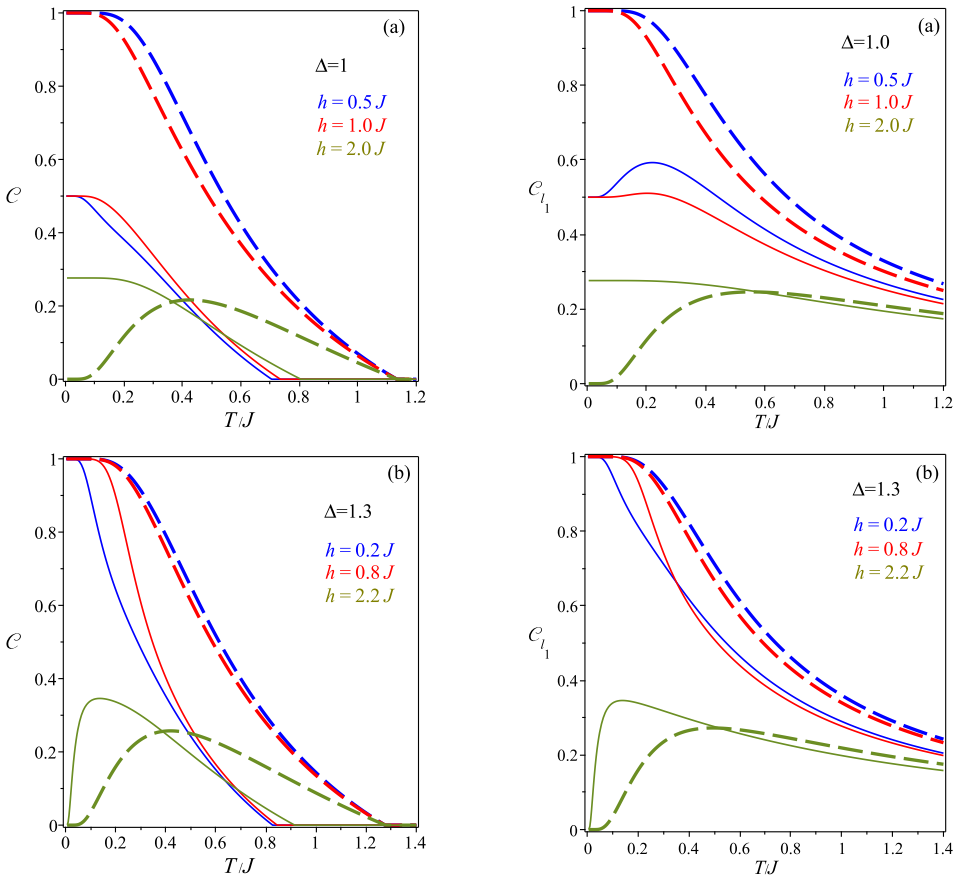
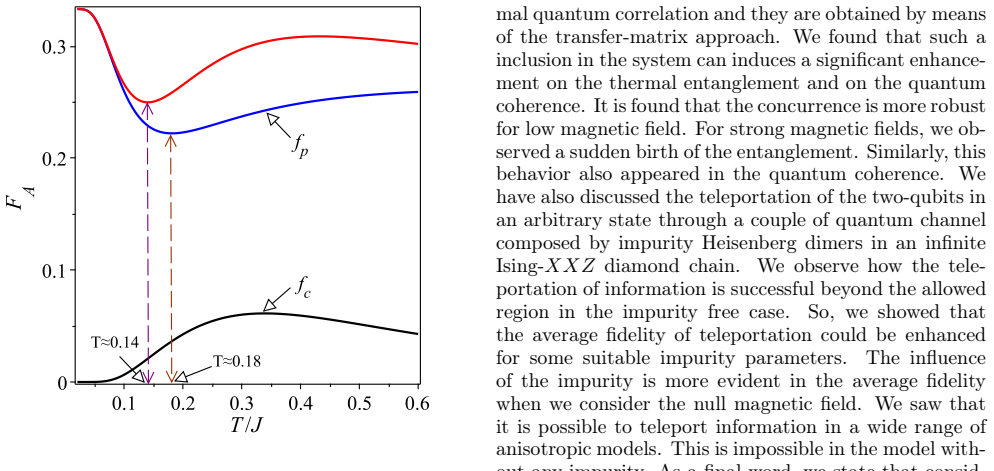
The central claim is that inserting one impurity plaquette—with XXZ dimer coupling $\tilde J=J(1+\alpha)$, anisotropy $\tilde\Delta=\Delta(1+\gamma)$, and Ising coupling $\tilde J_1=J_1(1+\eta)$—into an otherwise uniform Ising-XXZ diamond chain improves the thermal quantum resources of the chain. Using the transfer-matrix solution, the authors derive the thermodynamic-limit reduced density operator $\tilde\rho(T)$ of the impurity dimer, whose off-diagonal element $\tilde\rho_{2,3}$ controls both concurrence $C(\tilde\rho)=2\max\{|\tilde\rho_{2,3}|-\sqrt{\tilde\rho_{1,1}\tilde\rho_{4,4}},0\}$ and coherence $C_{l_1}=2|\tilde\rho_{2,3}|$. For parameters $\alpha=0$, $\gamma=0.8$, $\eta=-0.8$, the paper finds that weak-field concurrence becomes maximal where the pristine chain is only partially entangled, threshold temperatures rise (to $T/J\approx1.26$ at $\Delta=1.3$), strong fields produce sudden birth of entanglement and coherence with a re-entrant D-E-D transition, and average teleportation fidelity exceeds the classical bound $2/3$ in regions where the impurity-free model cannot teleport. The paper also decomposes the average fidelity into population and coherence contributions, $F_A=f_p+f_c$, to explain its non-monotonic temperature dependence.
Load-bearing premise
All later results rest on the thermodynamic-limit reduction of the impurity dimer's density matrix to $\tilde\rho_{k,l}=(A_{k,l}+B_{k,l})/M$ (the paper prints this as $A_{k,l}+B_{k,l}/M$), so if that reduction is unjustified for the impurity geometry, or the formula is read literally, the predicted enhancements do not follow.
Editorial extensions
If this is right
- With the chosen impurity parameters ($\alpha=0$, $\gamma=0.8$, $\eta=-0.8$), weak-field thermal concurrence of the impurity dimer becomes maximal where the pristine dimer is only partially entangled.
- The entanglement threshold temperature rises to $T/J\approx1.26$ for $\Delta=1.3$, and the $l_1$-norm coherence is similarly more persistent at higher temperatures.
- For strong fields ($h/J=2.0$ and $2.2$) the impurity produces sudden birth of both entanglement and coherence, together with a re-entrant transition from disentangled to entangled to disentangled regions as temperature increases.
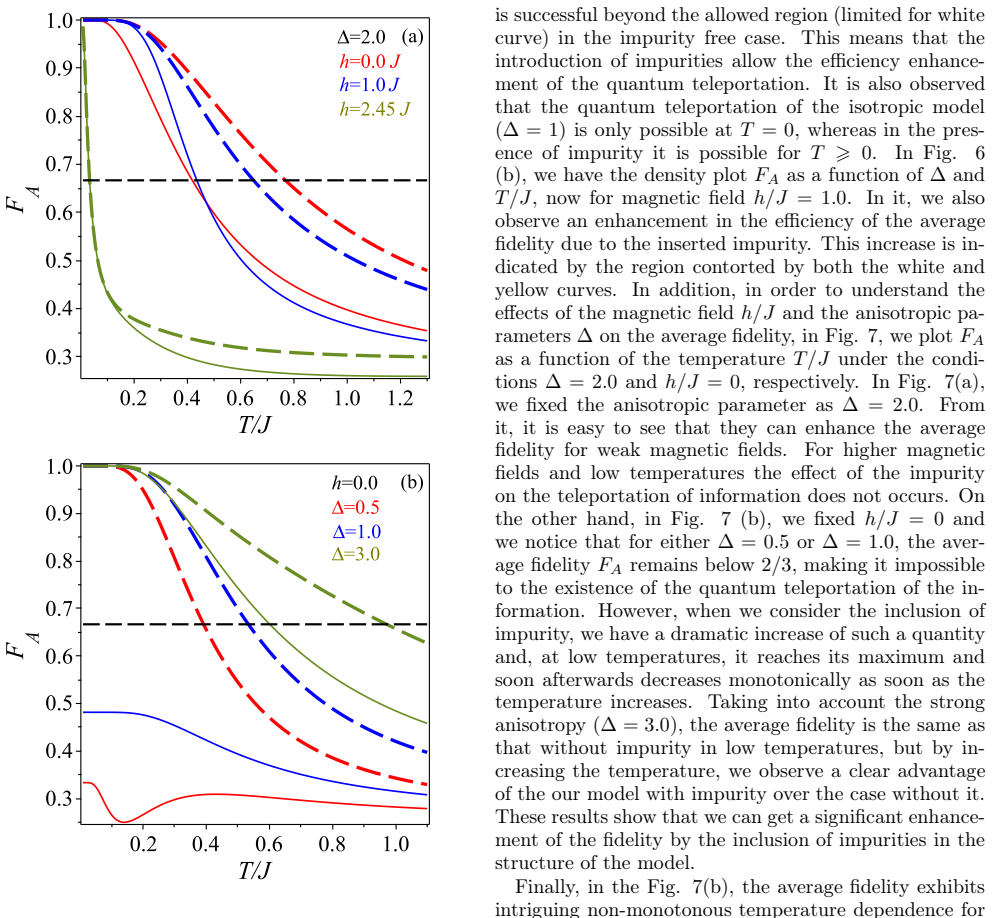
- Average teleportation fidelity exceeds the classical threshold $2/3$ over a wide range of anisotropy and temperature where the impurity-free chain fails, including finite temperature at the isotropic point $\Delta=1$.
- The average fidelity's non-monotonic temperature dependence (for example $\Delta=0.5$, $h=0$) is explained by competition between the population-driven term $f_p$ and the coherence-driven term $f_c$.
Reading between the lines
- The authors do not optimize the impurity parameters; the same analytic formulas could be scanned over $(\alpha,\gamma,\eta)$ to find the best trade-off among concurrence, coherence, and teleportation fidelity at a given temperature and field.
- Because the split of $F_A$ into $f_p$ and $f_c$ is explicit, the non-monotonic fidelity could be used as a direct probe of coherence dynamics: measure the two-qubit density matrix and compare the separate population and coherence contributions.
- The same transfer-matrix reduction should apply to other decorated spin chains with a single modified plaquette, suggesting the impurity-enhancement mechanism may be generic rather than specific to the diamond geometry.
- The strong-field sudden-birth and re-entrant D-E-D transition imply that temperature can switch entanglement on and off twice; if confirmed in finite systems, this could serve as a thermally controlled resource valve.
Signed reviews
Editorial analysis
A structured set of objections, weighed in public.
Referee Report
Summary. The manuscript studies a spin-1/2 Ising-XXZ diamond chain in which one plaquette is replaced by an impurity with modified couplings ~J=J(1+α), ~Δ=Δ(1+γ), and ~J1=J1(1+η). The authors construct a transfer-matrix solution for the partition function and derive the thermal reduced density matrix of the impurity dimer in the thermodynamic limit. Using this state, they compute Wootters concurrence, l1-norm coherence, and the fidelity of teleporting an entangled input state through the dimer channel. The main claim is that, for a representative impurity parameter set (α=0, γ=0.8, η=-0.8), the impurity enhances thermal entanglement, quantum coherence, and average teleportation fidelity compared with the pristine chain, and it can induce re-entrant entanglement as a function of temperature at strong fields.
Significance. The result, if correct, is of interest because it shows that a local modification of couplings in an exactly solvable spin chain can act as a tuner for entanglement, coherence, and teleportation resources. The transfer-matrix derivation is self-contained, the thermodynamic-limit reduction is standard, and the plotted quantities are obtained from explicit analytical formulas rather than from numerical fits. The comparison between the pristine and impurity cases is clearly quantified in Figs. 2, 3, 6, and 7. The paper's main weakness at present is not the physics but the reproducibility: the central density-matrix formula is misprinted, and without the corrected parenthesization the figures cannot be reproduced from the text.
major comments (2)
- [Sec. III B, Eq. (22)] The reduced density matrix formula is printed as rho_{k,l} = A_{k,l} + B_{k,l}/M, which is dimensionally inconsistent and cannot have trace one. The correct thermodynamic-limit expression, obtained from Eq. (21), is rho_{k,l} = (A_{k,l} + B_{k,l})/M. This is confirmed by the fact that summing A_{k,l}+B_{k,l} over the diagonal gives M, so tr(rho)=1 as the text states. All later results for concurrence, l1-norm coherence, and teleportation fidelity use this density matrix, so the printed misparenthesization prevents a reader from reproducing any of the figures. Please correct Eq. (22) and, ideally, include the explicit matrix elements rho_{1,1}, rho_{2,2}, rho_{2,3}, and rho_{4,4} or a normalization check.
- [Sec. V, output concurrence] The formula for the output concurrence is stated as Cout = 2 max{2 rho_{2,3}^2 C_in - 2 |rho_{2,2}| |rho_{1,1}-rho_{4,4}|, 0}. For the X-shaped output state in Eq. (26), the correct expression is Cout = 2 max{2 rho_{2,3}^2 C_in - 2 |rho_{2,2}| (rho_{1,1}+rho_{4,4}), 0}. The printed version uses a difference of diagonal elements instead of their sum, so it can predict a nonzero concurrence in cases where the standard X-state expression is zero. This error does not affect the average fidelity in Eq. (28), but it should be corrected because it is a stated analytical result of the paper.
minor comments (6)
- [Abstract and Introduction] The abstract says 'in a Ising-XXZ diamond chain'; this should be 'in an Ising-XXZ diamond chain'. Similar grammar issues appear throughout, such as 'measurement by the concurrence'.
- [Sec. IV and Figs. 2, 3, 6, 7] The enhancement claim is demonstrated for only one impurity parameter triple (alpha=0, gamma=0.8, eta=-0.8); no figure shows the dependence on alpha, gamma, or eta themselves. The abstract's statement that the resources 'can be controlled and tuned' by tailoring the impurity parameters is therefore stronger than what is displayed. Please add at least one panel varying an impurity parameter, or soften the wording.
- [Fig. 4 caption] The caption says the phase diagram is shown as a function of both Delta and the threshold temperature T_th/J, but panel (a) is described with Delta=1.0 fixed. Please clarify which quantity is plotted on each axis and whether the curves are boundaries in the Delta-T plane or fixed-Delta cuts.
- [Eq. (27)] The factor written as sin^2 theta / 2 should be typeset as (sin^2 theta)/2 to avoid confusion with sin^2(theta/2).
- [Sec. III B] Reference [12] appears in the bibliography but is not cited in the text; please check the citation list.
- [Reproducibility] No numerical data or code are provided. Since the paper rests on closed-form expressions, an appendix with the explicit matrix elements and a consistency check at alpha=gamma=eta=0 (recovering the known impurity-free result) would greatly improve reproducibility.
Circularity Check
No significant circularity: the exact transfer-matrix derivation is self-contained, and the reported impurity effects are demonstrations, not fitted predictions.
full rationale
The paper's central derivation is self-contained. The reduced density matrix of the impurity dimer is obtained explicitly from the transfer-matrix formalism: Eq. (16) defines the thermal average over Ising configurations, Eqs. (17)-(21) perform the transfer-matrix diagonalization, and the thermodynamic-limit expression for the matrix elements follows from retaining the dominant eigenvalue Lambda_+ of the host transfer matrix. The printed formula after Eq. (21), '~rho_{k,l} = A_{k,l} + B_{k,l}/M', is missing parentheses: the intended expression is (A_{k,l} + B_{k,l})/M, as is evident from the definitions of A, B, M and from the statement that tr(~rho)=1. This is a reproducibility defect (a typographical error), not a circular step: the intended formula is analytically justified and is not equivalent to any of the target quantities. The concurrence, l1-norm coherence, and average teleportation fidelity are then computed from this reduced density matrix using standard definitions (Wootters concurrence, l1-norm of coherence, standard teleportation through a mixed-state channel), with no parameter fitted to the reported enhancement. The paper builds on earlier work by the same group, especially Refs. [15, 19, 24], and cites its own prior results for context and for the transfer-matrix approach, but the load-bearing derivation is reproduced in the present text rather than merely imported. The choice of impurity parameters (alpha=0, gamma=0.8, eta=-0.8) is a demonstration of tunability, not a prediction claimed to be derived from first principles. A secondary typo appears in Section V, where the output concurrence uses |~rho_{1,1} - ~rho_{4,4}| instead of the correct |~rho_{1,1} + ~rho_{4,4}| for an X-state; this does not change the average-fidelity formula, Eq. (28), which is stated correctly. These typographical issues affect reproducibility but do not constitute circular reasoning, so the circularity burden is low.
Assumptions & free parameters
free parameters (3)
- α (impurity XXZ coupling shift) =
0
- γ (impurity anisotropy shift) =
0.8
- η (impurity Ising coupling shift) =
-0.8
assumptions (4)
- standard math The transfer-matrix method and the thermodynamic limit N→∞ with only the largest eigenvalue Λ_+ retained (Sec. III, Eqs. 13-14).
- domain assumption The nodal spins are classical Ising spins, and the interstitial spins are quantum Heisenberg spins (Sec. II).
- domain assumption The impurity is localized at a single cell and does not perturb the host beyond its coupling parameters (Sec. II).
- domain assumption The two-qubit channel for teleportation is the thermal reduced state of one impurity dimer, and the standard depolarizing channel formula applies (Sec. V).
Cite this review
Pith. "Pith review of On the effects of an impurity in an Ising-$XXZ$ diamond chain on the thermal entanglement, on the quantum coherence and on the quantum teleportation." pith.science (2026). https://pith.science/paper/ROHNDITA
@misc{pith2026190807677,
  author       = {Pith},
  title        = {Pith review of: On the effects of an impurity in an Ising-$XXZ$ diamond chain on the thermal entanglement, on the quantum coherence and on the quantum teleportation},
  year         = {2026},
  howpublished = {\url{https://pith.science/paper/ROHNDITA}},
  note         = {Machine review of arXiv:1908.07677}
}
abstract
The effects of an impurity plaquette on the thermal quantum correlations measurement by the concurrence, on the quantum coherence quantified by the recently proposed $l_{1}$-norm of coherence and on the quantum teleportation in a Ising-$XXZ$ diamond chain are discussed. Such an impurity is formed by the XXZ interaction between the interstitial Heisenberg dimers and the nearest-neighbor Ising coupling between the nodal and interstitial spins. All the interaction parameters are different from those of the rest of the chain. By tailoring them, the quantum entanglement and quantum coherence can be controlled and tuned. Therefore, the quantum resources -- thermal entanglement and quantum coherence -- of the model exhibit a clear performance improvement in comparison to the original model without impurities. We also demonstrate that the quantum teleportation can be tuned by its inclusion. The thermal teleportation is modified in significant way as well, and a strong increase in average fidelity is observed. We furnish the exact solution by the use of the transfer-matrix method.
Figures


Figures from the paper (4 more)


Reference graph
Works this paper leans on
-
[1]
A. Streltsov, H. Kampermann, S. Wolk, M. Gessner, D. Bruβ , New J. Phys. 20, 053058 (2018)
work page 2018
-
[2]
Streltsov, G
A. Streltsov, G. Adesso, M. B. Plenio, Rev. Mod. Phys. 89, 041003 (2017)
2017
-
[3]
C. H. Bennett, G. Brassard, C. Crepeau, C. Jozsa, A. Peres, W. K. Wootters, Phys. Rev. Lett. 70, 1895 (1993)
work page 1993
-
[4]
C. H. Bennett and D. P. Di Vincenzo, Nature 404, 247 (2000)
work page 2000
- [5]
-
[6]
C. Radhakrishnan, M. Parthasarathy, S. Jambulingam, T. Byrnes, Sci. Rep. 7, 13865 (2017)
work page 2017
- [7]
-
[8]
W. Wu, J. Xu, Phys. Lett. A 381, 239 (2017)
work page 2017
Show all 33 references
-
[9]
Streltsov, U
A. Streltsov, U. Singh, H. S. Dhar, M. N. Bera, G. Adesso, Phys. Rev. Lett. 115, 020403 (2015)
2015
-
[10]
G. L. Kamta, A. F. Starace, Phys. Rev. Lett. 88, 107901 (2002); M. C. Amesen, S. Bose, V. Vedral, Phys. Rev. Lett. 87, 017901 (2001); X. G. Wang, Phys. Rev. A, 64, 012313 (2001); J. Maziero, H. C. Guzman, L. C. Céleri, M. S. Sarandy, R. M. Serra, Phys. Rev. A 82, 012106 (2010)...
2002
-
[11]
Yeo, Phys Rev
Y. Yeo, Phys Rev. A, 66, 062312 (2002); G. F. Zhang, Phys. Rev. A 75, 034304 (2007)
2002
-
[12]
Kikuchi, Y
H. Kikuchi, Y. Fujii, M. Chiba, S. Mitsudo, T. Idehara, Physica B 329, 967 (2003)
2003
-
[13]
Jascur, J
M. Jascur, J. Strecka, J. Magn. Magn. Matter. 272, 984 (2004); O. Rojas, S. M. de Souza, V. Ohanyan, M. Khur- shudyan, Phys. Rev. B 83, 094430 (2011)
2004
-
[14]
Rojas, S
O. Rojas, S. M. de Souza, V. Ohanyan, M. Khurshudyan, Phys. Rev. B 83, 094430 (2011); L. Gálisová, Phys. Sta- tus Solidi B 250, 187 (2013); O. Rojas, S. M. de Souza, Phys. Lett. A 375, 1295 (2011)
2011
-
[15]
Rojas, M
O. Rojas, M. Rojas, N. S. Ananikian, S. M. de Souza, Phys. Rev. A 86, 042330 (2012)
2012
-
[16]
W. W. Cheng, X. Y. Wang, Y. B. Sheng, L. Y. Gong, S. M. Yhao, J. M. Liu, Sci. Rep. 7, 42360 (2017)
2017
-
[17]
Torrico, M
J. Torrico, M. Rojas, S. M. de Souza, O. Rojas, N. S. Ananikian, Europhys. Lett. 108, 50007 (2014); J. Tor- rico, M. Rojas, M. S. S. Pereira, J. Strecka, M. L. Lyra, Phys. Rev. B 93, 014428 (2016). 9
2014
-
[18]
Rojas, M
O. Rojas, M. Rojas, S. M. de Souza, J. Torrico, J. Strecka, M. L. Lyra, Physica A 486, 367 (2017)
2017
-
[19]
Impurities play an important role in solid state physics [20]
discussed the entangled state teleportation through a couple of quantum channels composed of XXZ dimers in an Ising-XXZ diamond chain. Impurities play an important role in solid state physics [20]. Even a small defect may changes the physical prop- erties of the quantum system...
-
[20]
Rojas, S
M. Rojas, S. M. de Souza, Onofre Rojas, Ann. Phys. 377, 506 (2017)
2017
-
[21]
Falk, Phys
H. Falk, Phys. Rev. 151, 304 (1966); J. Stolze, M. Vogel, Phys. Rev. B 61, 4026 (2000)
1966
-
[22]
Fukuhara, A
T. Fukuhara, A. Kantian, M. Endres, M. Cheneau, P. Schauβ , S. Hild, D. Bellem, U. Schollw ¨ock, T. Giamarchi, C. Gross, I. Bloch, S. Kuhr, Nature Physics 9, 235 (2013)
2013
-
[23]
Huang, T
X. Huang, T. Si, Z. Yang, Physica B 462, 25 (2015); X. Xi, S. Hao, W. Chen, R. Yue, Phys. Lett. 297, 291 (2002); T. J. G. Apollaro, F. Plastina, L. Banchi, A. Cuccoli, R. Vaia, P. Verrucchi, M. Paternostro, Phys. Rev. A 88, 052336 (2013)
2015
-
[24]
H. Fu, A. I. Solomon, X. Wang, J. Phys. A: Math. Gen. 35, 4293 (2002); W. W. Cheng, Y. X. Huang, T. K. Liu, H. Li, Physica E 39, 150 (2007); S. Li, J. Xu, Phys Lett. A 334, 109 (2005)
2002
-
[25]
I. M. Carvalho, O. Rojas, S. M. de Souza, M. Rojas, Quantum Inf. Process. 18, 134 (2019)
2019
-
[26]
R. J. Baxter, Exactly Solved Models in Statistical Me- chanics. Academic, New York (1982)
1982
-
[27]
S. Hill, W. K. Wootters, Phys. Rev. Lett. 78, 5022 (1997)
1997
-
[28]
W. K. Wootters, Phys. Rev. Lett. 80, 2245 (1998)
1998
-
[29]
Baumgratz, M
T. Baumgratz, M. Cramer, M. B. Plenio, Phys. Rev. Lett. 113, 140401 (2014)
2014
-
[30]
Bowen, S
G. Bowen, S. Bose, Phys. Rev. Lett. 87, 267901 (2001)
2001
-
[31]
Peres, Phys
A. Peres, Phys. Rev. Lett. 77, 1413 (1996)
1996
-
[32]
Jozsa, J
R. Jozsa, J. Mod. Opt. 41, 2315 (1994)
1994
-
[33]
Shumacher, Phys
B. Shumacher, Phys. Rev. A 54, 2614 (1996). 10
1996
Reviewed August 14, 2026 · model on record in the stance chip above.
Discussion (0). Continue with ORCID to comment.