REVIEW 4 major objections 7 minor 26 references
Prime-Index Parametrization for Total Neutrino-Nucleon Cross Sections and {\it{pp}} Cross Sections
T0 review · 4 major / 7 minor · reviewed 2026-08-14 · deepseek-v4-flash
Pith's one-line read Prime-index lookup tables reproduce neutrino-nucleon cross sections over six decades, and a twin-prime ratio yields the pp rise.
desk verdict A curve fit dressed as a prime-number discovery; the IceCube agreement is statistically weak and the pp 'explanation' leans on an unproven conjecture. read the letter →
The pith
A machine-rendered reading of the paper's core claim, the machinery that carries it, and where it could break.
The reading
What carries the argument
The central object is the prime-index relation: the $n$th prime $p(n)$ as a function of its rank $n$, used as a lookup table in which $n$ is taken to be the particle energy in MeV (or GeV for $pp$) and $p(n)$ times a fitted coefficient gives the cross section. The paper also uses the twin-prime companion (TPC), the composite number sandwiched between a twin-prime pair, whose ratio to its index, times 0.25, gives the $pp$ cross section; it is tied to the twin-prime asymptotic $\pi_2(x)\sim 2C_2\,x/(\ln x)^2$, which supplies the $(\ln x)^2$ factor. The normalization constants 0.70, 0.26, 0.48, 0.69, and 0.25 are what convert prime magnitudes into physical cross-section units, and they are fixed by matching available data.
What would settle it
Measure or extract the neutrino-nucleon charged-current cross section at a single energy near 1 PeV; the method expects roughly ten times the Standard Model value at that energy, so a measurement near the Standard Model prediction would refute the high-energy extrapolation. In the same spirit, an updated IceCube sample with several times the current exposure that finds events above 0.5 PeV consistent with the Standard Model estimate rather than the $11\pm3.3$ prediction would settle the claim.
Extended reading notes
Core claim
The central claim is that the sequence of primes, read through their positional indices, is a ready-made parametrization of neutrino-nucleon cross sections: with energy in MeV as the index and the prime itself as the unnormalized cross section, charged-current neutrino and antineutrino cross sections are obtained simply by multiplying by 0.70 and 0.26 respectively, in units of $10^{-42}\,\mathrm{cm}^2$. The paper asserts that this prime-index method reproduces measured neutrino and antineutrino total cross sections over six decades of energy and, applied to the published IceCube muon-neutrino data, predicts $11\pm3.3$ events above 0.5 PeV compared with $9\pm3$ observed and $1\pm1$ from the Standard Model. It further claims that the total $pp$ cross section's $(\ln s)^2$ rise is explained by the twin-prime companion ratio, with the index as energy in GeV and the ratio times 0.25 matching data, thereby tying the logarithmic-squared form to the twin-prime asymptotic.
Load-bearing premise
The load-bearing premise is that the fitted normalization constants (0.70, 0.26, 0.48, 0.69, 0.25) remain valid outside the energy ranges where they were set, so the high-energy extrapolations and the IceCube event count inherit them; the $pp$ side also leans on the twin-prime asymptotic, which is a conjecture rather than a theorem.
Editorial extensions
If this is right
- Any neutrino experiment with a known energy spectrum can obtain cross-section estimates from a precomputed prime table without integrating structure functions.
- For IceCube, the method favors a neutrino-nucleon cross section at PeV energies well above the Standard Model value, so a larger exposure should see an event rate above 0.5 PeV closer to 11 than to 1.
- At ultra-high energies near $10^{12}$ GeV, the prime-index extrapolation gives cross sections roughly a million times larger than Standard Model predictions, implying strong Earth-absorption effects that would be absent in the Standard Model.
- The $pp$ analysis asserts that the total $pp$ cross section's logarithmic-squared rise follows from the density of twin primes, connecting a particle-physics regularity to a number-theoretic asymptotic.
Reading between the lines
- Because the index is assigned to the energy only after choosing MeV as the unit, the same data could be fit with a different normalization if energies were expressed in GeV; the method's reach therefore depends on that unit choice plus the fitted constants, not on a derived dynamical law.
- If a larger IceCube sample settles near the Standard Model rate, the constants would have to become energy-dependent, which would leave the low- and mid-energy interpolation intact but remove the high-energy extrapolation.
- The same construction could be tested on neutral-current neutrino data: equation (7) fixes the CC/(CC+NC) ratio near 0.7, so a precise measurement of that ratio at PeV energies would be a separate check of the method.
- The $pp$ explanation inherits the status of the twin-prime asymptotic, which is a conjecture rather than a theorem; a different true growth rate for twin-prime counts would decouple the $(\ln s)^2$ form from the number-theoretic ratio.
Signed reviews
Editorial analysis
A structured set of objections, weighed in public.
Referee Report
Summary. The manuscript proposes an empirical mapping between prime numbers and their indices and neutrino-nucleon cross sections: taking the prime's index as the neutrino energy in MeV, the cross section in units of 10^-42 cm^2 is 0.70 times the prime for neutrinos and 0.26 times the prime for antineutrinos. The author claims this reproduces charged-current cross-section data from MeV to PeV energies. For IceCube events above 0.5 PeV, the paper reports 11 ± 3.3 expected events from the prime-index method versus 9 ± 3 observed events, compared with 1 ± 1 from the Standard Model. A normalization of 0.48, the average of 0.70 and 0.26, is used for muon neutrinos, and 0.69 is used for cascade data. The paper further claims that a twin-prime companion ratio, multiplied by 0.25, reproduces total pp cross sections and 'explains' the (ln s)^2 growth first proposed by Heisenberg. The text itself states that the estimates are empirically driven and are not intended as replacements for physics-based approaches.
Significance. If the prime-index mapping were a genuine out-of-sample predictor across six decades, it would be a striking empirical curiosity. As it stands, however, the five normalization constants (0.70, 0.26, 0.48, 0.69, and 0.25) are all fixed to the data they are later said to reproduce, so the agreement shown in Figs. 1-4 is not independent evidence. No uncertainties are assigned to these constants, no goodness-of-fit statistic is reported, and the IceCube comparison has overlapping error bars and depends on flux assumptions. The pp section builds on the Hardy-Littlewood twin-prime conjecture rather than an established theorem. The paper is honest about its empirical character and calls the cascade normalization a 'first step approximation,' but these caveats point to the central weakness: the claims reduce to curve fitting with free parameters. The only concrete forward-looking statement is a qualitative appeal to a future 10 km^3 detector; no quantitative prediction or decision threshold is given.
major comments (4)
- [Sec. 3, Eq. (6), Fig. 1] The claimed six-decade agreement is by construction. The model output is sigma = 0.70 * p_n for neutrinos and 0.26 * p_n for antineutrinos, with n equal to the energy in MeV and p_n the n-th prime; the constants 0.70 and 0.26 are chosen so that the prime sequence lines up with the data in Fig. 1, and no derivation fixes them. Since p_n ~ n ln n, the functional form is sigma(E) = c E ln E, and with one free constant c it is unsurprising that a smooth curve can be matched to a monotone data set. The paper reports no chi-square, no residuals, and no uncertainty on c, so the statement in Sec. 3 that the method provides a 'quick and accurate estimate ... over many decades of energy scales' is quantitatively unsupported.
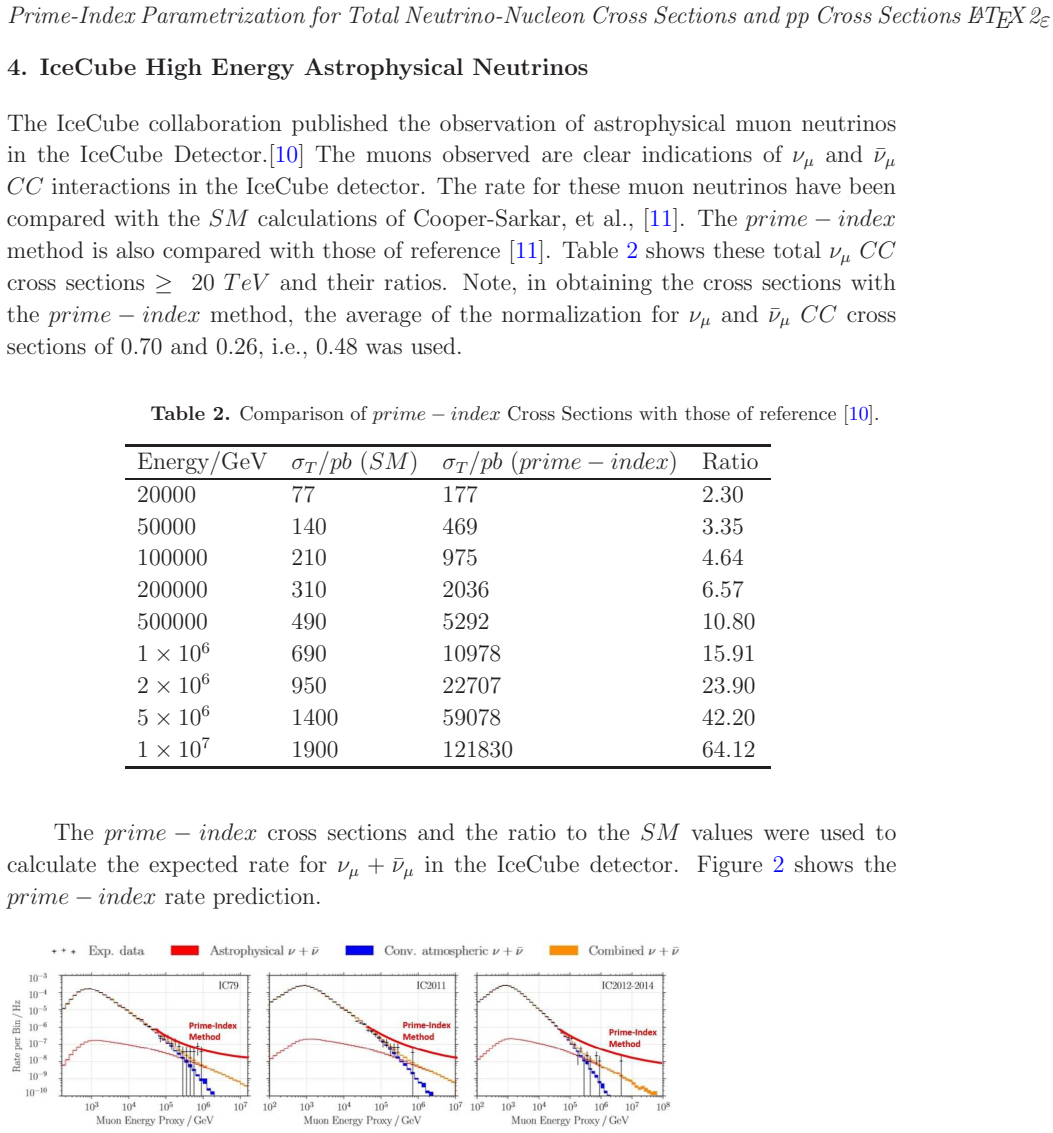
- [Sec. 4, Table 3] The IceCube event comparison is not an out-of-sample test. The normalization 0.48 used for the muon-neutrino rate is the average of the two lower-energy fitted constants, 0.70 and 0.26, so it inherits the earlier fits. The expected rate is obtained by scaling the SM rate by the cross-section ratio; to the extent that the SM rate is normalized using the same IceCube event sample to determine the astrophysical flux, the same events are used both to fix the flux and to test the cross-section enhancement. Even taken at face value, 11 ± 3.3 versus 9 ± 3 is a sub-one-sigma difference, not 'strong evidence' as claimed in Sec. 4, and the stated ±3.3 is only Poisson counting with no propagation of the uncertainty in the fitted normalization constants.
- [Sec. 4, Eq. (7), Fig. 3] The cascade-data comparison is admitted to be circular. The text states that the 0.69 normalization factor 'should be only considered as a first step approximation' until more IceCube data are available, meaning the constant is adjusted to make the curve match Fig. 3. Agreement obtained by fixing the overall normalization in this way carries no evidential weight, and the relationship between the factor 0.7 in Eq. (7) and the 0.69 used for Fig. 3 is not explained.
- [Sec. 5, Eq. (10), Fig. 4] The pp 'explanation' is not an explanation. Equation (10) is the Hardy-Littlewood twin-prime asymptotic, which is a conjecture, not a theorem; the Brun bound cited immediately before it gives only an upper bound of the form C N/(ln N)^2, not an asymptotic equality. The (ln s)^2 dependence is therefore assumed rather than derived, and the TPC ratio is multiplied by 0.25 'to normalize it to the experimental data' (Fig. 4 caption). Thus the level of agreement in Fig. 4 is set by a fitted constant, and the paper does not explain Heisenberg's parametrization.
minor comments (7)
- [Abstract] The abstract contains a typo ('prim e numbers'), and the manuscript uses a nonstandard apostrophe in 'Gauss′s'.
- [Sec. 3] The statement that Eq. (6) introduces 'a 22% error at low energies and about 7% error at high energies' refers to the accuracy of the prime-index approximation itself, not to a comparison with measured cross sections; the two types of error should not be conflated.
- [Sec. 4, Table 2] Table 2 would be clearer if it stated which neutrino species (nu_mu and antinu_mu) and which target (isoscalar nucleon) are assumed, and whether radiative corrections are included in the SM cross sections.
- [Sec. 5, Eq. (10)] In Eq. (10), the phrase 'x is a pair of twin primes' is imprecise: x is the upper limit of the counting function pi_2(x), not a pair of primes.
- [Sec. 5] The term 'Twin Prime Companion (TPC)' is used without a formal definition; the text says only that it is the composite sandwiched between a pair of twin primes, so a reader cannot reproduce the ratio plotted in Fig. 4.
- [Figs. 2 and 3] Figs. 2 and 3 are reproductions of published IceCube figures with curves superimposed; without the underlying numerical data or a description of how the published curves were digitized, readers cannot independently verify the comparisons.
- [Sec. 3] The text refers to a '10−km3 upgrade' to IceCube; the notation should be '10 km^3'.
Circularity Check
The prime-index 'predictions' inherit their normalization constants from the same measured cross sections and IceCube data they are claimed to reproduce; the pp curve is normalized to data with an arbitrary 0.25 factor.
-
fitted input called prediction
[Sec. 3, Fig. 1]
"For example, at a neutrino energy of 19 MeV which is the index of the prime number 67, the cross section is 0.70 × 67 or ≈ 47 ab, i.e. ≈ 47 × 10−42 cm2. ... For antineutrinos, the second column is multiplied by 0.26 to produce the cross sections also in ab."
The cross-section estimate is defined as the prime value multiplied by 0.70 or 0.26. These constants are chosen so that the prime curve overlays the measured neutrino and antineutrino cross sections shown in Fig. 1. Since the normalization is selected to match those data, the agreement in Fig. 1 is a restatement of the fit rather than an independent prediction of the prime-index relation.
-
fitted input called prediction
[Sec. 4, Table 2 and Summary]
"in obtaining the cross sections with the prime − index method, the average of the normalization for νµ and ¯νµ CC cross sections of 0.70 and 0.26, i.e., 0.48 was used. ... With the available published astrophysical muon neutrinos the prime − index method predicts 11 ± 3.3 events vs. the observed 9 ± 3 events."
The 0.48 normalization used for the IceCube muon-neutrino rate is just the average of the two constants fitted to lower-energy neutrino and antineutrino cross-section data. The quoted 11-event expectation is the SM rate scaled by the ratio sigma_PI/sigma_SM, with sigma_PI built from this fitted normalization. Thus the event count is the fitted model evaluated at IceCube energies, not an out-of-sample test of the prime-index mechanism.
2 more flagged steps
-
fitted input called prediction
[Sec. 4, after Eq. (7), Fig. 3]
"The normalization factors used in this paper for high energy astrophysical neutrinos are 0.48 and 0.69 for the data in figures 2 and 3, respectively. ... Hence, the use of the above normalization factors should be only considered as a first step approximation until further analyses of the IceCube data provide a larger dataset."
The factor 0.69 used for the cascade-data comparison in Fig. 3 is chosen as a 'first step approximation' for that same cascade dataset. The prime-index curve is multiplied by this fitted constant before being superimposed on the data, so the visual agreement is established by construction rather than by any content of the prime-index relation.
-
renaming known result
[Sec. 5, Eq. (10) and Fig. 4]
"π2(x) ∼ 2C2 x/(ln x)2 (10) ... Note, the ratio of the TPC to the index has been multiplied by 0.25 to normalize it to the experimental data."
For the pp cross section, the 'explanation' imports the twin-prime asymptotic formula (Eq. 10), which already contains the (ln x)^2 factor being invoked, and then multiplies the resulting ratio by an arbitrary constant 0.25 chosen to normalize it to the experimental pp data. The paper therefore restates the Hardy-Littlewood asymptotic as a 'Twin Prime Companion' ratio and supplies the overall scale from the data, rather than deriving the (ln s)^2 behavior from an independent principle.
full rationale
The paper is openly described as an empirical parametrization, but several of its advertised successes are circular. The prime-index cross section is defined as 0.70 or 0.26 times a prime whose index equals the neutrino energy, with the constants adjusted to match measured cross sections; hence Fig. 1's agreement is a display of the fit. The IceCube muon-neutrino expectation uses the average fitted normalization 0.48, so the 11 versus 9 event comparison is not an independent prediction. The cascade comparison in Fig. 3 is even more directly circular: the normalization factor 0.69 is described as a first-step approximation for that same dataset, so the curve is normalized to the data it is claimed to reproduce. For the pp section, the 0.25 multiplier is explicitly fitted to the data and the (ln s)^2 shape is imported from the Hardy-Littlewood twin-prime asymptotic, which already contains that functional form. The remaining non-fitted content is the prime-number-theorem shape p_i ~ i ln i, but with free normalization constants the model is functionally sigma(E) ~ c E ln E over the fitted range. There is no self-citation chain forcing the result, and the paper does disclose the empirical nature of the constants, so the circularity is substantial but not total: score 6.
Assumptions & free parameters
free parameters (5)
- Neutrino CC normalization factor =
0.70
- Antineutrino CC normalization factor =
0.26
- IceCube muon neutrino normalization factor =
0.48
- IceCube cascade normalization factor =
0.69
- pp normalization factor =
0.25
assumptions (3)
- standard math Prime Number Theorem: π(p) ~ p/ln p and the inverse asymptotic p_i ~ i ln i.
- domain assumption Hardy-Littlewood twin-prime asymptotic: π2(x) ~ 2 C2 x/(ln x)^2.
- domain assumption The observed IceCube high-energy event rate is dominated by astrophysical neutrinos and can be converted to a cross-section estimate assuming roughly equal neutrino and antineutrino fluxes.
invented entities (1)
-
Twin Prime Companion (TPC)
Cite this review
Pith. "Pith review of Prime-Index Parametrization for Total Neutrino-Nucleon Cross Sections and {\it{pp}} Cross Sections." pith.science (2026). https://pith.science/paper/XHSKGQNC
@misc{pith2026190807695,
  author       = {Pith},
  title        = {Pith review of: Prime-Index Parametrization for Total Neutrino-Nucleon Cross Sections and \itpp Cross Sections},
  year         = {2026},
  howpublished = {\url{https://pith.science/paper/XHSKGQNC}},
  note         = {Machine review of arXiv:1908.07695}
}
abstract
A prime number based parametrization for total neutrino-nucleon cross section is presented. The method employs the relation between prime numbers and their indices to reproduce neutrino cross sections for neutrino energies from the $MeV$ to the $PeV$ regions where experimental data are available. This prime-index relation provides estimates of the neutrino-nucleon cross sections valid across many decades of neutrino energy scales. The $PeV$ data are from the recently published astrophysical $\nu_\mu + \bar \nu_\mu$ rates in the IceCube detector as well as neutrino-nucleon cross section measurements. A similar method has been employed for high energy $pp$ cross sections which explains the $(\ln s)^{2}$ parametrization first proposed by Heisenberg.
Figures


Figures from the paper (1 more)

Reference graph
Works this paper leans on
-
[1]
The choice of ener gy regions is motivated by neutrino production sources
Introduction Neutrino-nucleon and/or neutrino-nucleus cross section experim ents are divided into three categories; low, medium and high energies. The choice of ener gy regions is motivated by neutrino production sources. The low energy regime in cludes reactor, geoneutrinos and supernova ( SN ) neutrinos constituting neutrinos below ≈ 10 M eV for reactor...
-
[2]
Prime numbers are a class of integers that are only divisible by themselves and one
Primes and their Indices In this paper, we propose to estimate the total neutrino nucleon c ross sections by using the relation between prime numbers and their indices. Prime numbers are a class of integers that are only divisible by themselves and one. By this definitio n, the number one itself is not considered a prime number. Some prime numbers and t he...
-
[3]
Mathematically, it is a formidable task to determine if a number is prime. Finding primes is usually done by the use of the sieve theory which is designed Prime-Index Parametrization for Total Neutrino-Nucleon Cross Sections and pp Cross Sections LATEX 2ε3 T able 1. Some prime numbers with their positional indices Index Prime 1 2 2 3 . . 8 19 . . 19 67 . ...
-
[4]
Results and Discussions In this paper, we use relations between primes and their indices and t win primes (a pair of primes which differ by 2, such as 11, 13 or 107, 109) and their indice s to estimate total CC and N eutral Current (N C) neutrino-nucleon cross sections and total pp cross sections. Note, these estimates are empirically driven and no t to be...
-
[5]
IceCube High Energy Astrophysical Neutrinos The IceCube collaboration published the observation of astrophys ical muon neutrinos in the IceCube Detector.[ 10] The muons observed are clear indications of νµ and ¯νµ CC interactions in the IceCube detector. The rate for these muon ne utrinos have been compared with the SM calculations of Cooper-Sarkar, et al...
-
[6]
69 for the data in figures 2 and 3, respectively
48 and 0 . 69 for the data in figures 2 and 3, respectively. These factors assume that the data which were obtained with various neutrino and antineutrino flav ors have roughly the same flux. This is only true for more statistically significant measu rements. The abovesaid overall measurements are obtained with limited statistics and each energy bin contain e...
-
[7]
Total pp Cross Section The total square of energy s in the Center of Mass (CM) frame can be written as; s = 2MpE + Mp 2 (8) At high energies where E ≫ Mp, we may neglect the term Mp 2; √ s = √ 2MpE. (9) The suggestion, originally by Heisenberg[ 13], proposed a universal logarithmic increase in the pp cross sections of the form (ln s)2. We note here that a...
-
[8]
Summary In summary, the total neutrino and antineutrino cross sections f ollow very closely the increase in the magnitude of primes as a function of their positional in dices. Neutrino and antineutrino nucleon total CC cross sections are estimated by the magnitude of the prime numbers over six (6) decades of neutrino energy where e xperimental data are av...
Show all 26 references
-
[9]
This represents the neutrino-nucleon cross section in ab
70. This represents the neutrino-nucleon cross section in ab. For antineutrinos, the second column is multiplied by 0 . 26 to reproduce the cross sections in ab. At very high energies, the prime −index method tends to indicate increases in neutrino-nucleon cross Prime-Index Pa...
-
[10]
Aartsen M G et al [IceCube Collaboration] 2013 Science342 920
2013
-
[11]
Vogel P 1999 (Preprint nucl-th/9901027) WEIN98
1999 arXiv
-
[12]
Reno Mary Hall 2005 Nucl Phys Proc Suppl 143 407 (Preprint hep-ph/0410109v1)
2005 arXiv
-
[13]
Formaggio J A and Zeller G P 2012 Rev Mod Phys 84.3 1307
2012
-
[14]
Vogel P and Beacom J F 1999 Phys Rev D 60 053003
1999
-
[15]
Strumia A and Vissani F 2003 Phys Lett B 564 42
2003
-
[16]
Tanabashi M et al (Particle Data Group) 2018 Phys Rev D 98 030001 Prime-Index Parametrization for Total Neutrino-Nucleon Cross Sections and pp Cross Sections LATEX 2ε9
2018
-
[17]
Gandhi R et al 1996 Astro Part Phys 52 81
1996
-
[18]
Kuzmin K S and Naumow V A private communication 2015 The data points were extracted by K. S. Kuzmin, V. V. Lyubushkin and V. A. Naumow from digitization of p ublished figures. Some of the data are also in the Durham Reaction Database. The digit ization does not exactly coincide...
2015
-
[19]
Aartsen M G et al 2016 [IceCube Collaboration], Astrophys J 833 no. 1,3
2016
-
[20]
Cooper-Sarkar A, Mertsch P, Sarkar S, 2011 JHEP 08 042
2011
-
[21]
Aartsen M G et al 2014 [IceCube Collaboration] arxiv.org/abs/1412.5106
2014 arXiv
-
[22]
Heisenberg W 1952 Z Phys 133 65, and Heisenberg W 1975, Fourteenth Int Cosm Ray Conference 11, Munchen 3461-3474
1952
-
[23]
Brun V 1915 ”Uber das Goldbachsche Gesetz und die Anzahl der Primzahlpaare”, Archiv for Mathematik of Naturvidenskab (in German), 34(8) 3-19
1915
-
[24]
On the Expression of a Number as a Sum of Primes.” Acta Math 44 1-70
Hardy G H and Littlewood J E 1923 ”Some Problems of ’Partitio Nume rorum.’ III. On the Expression of a Number as a Sum of Primes.” Acta Math 44 1-70
1923
-
[25]
Fazely Ali R 1996 Spring Southeastern Sectional Meeting of the American Mathematical Society, Baton Rouge, LA, April 19-21, Meeting No. 911
1996
-
[26]
Fazely Ali R 2013, Ultimate Mathematics, Lulu Press, Morrisville, NC USA 11
2013
Reviewed August 14, 2026 · model on record in the stance chip above.
Discussion (0). Continue with ORCID to comment.