REVIEW 2 major objections 6 minor 58 references
Tensor Methods for Generating Compact Uncertainty Quantification and Deep Learning Models
T0 review · 2 major / 6 minor · reviewed 2026-08-14 · deepseek-v4-flash
Pith's one-line read A survey positions low-rank tensor factorization as the shared mechanism for cutting simulation cost and compressing neural networks.
desk verdict A serviceable invited survey of tensor methods for UQ and deep-learning compression; no new results, and some self-cited numbers need scrutiny, but it does what a survey should. read the letter →
The pith
A machine-rendered reading of the paper's core claim, the machinery that carries it, and where it could break.
The reading
What carries the argument
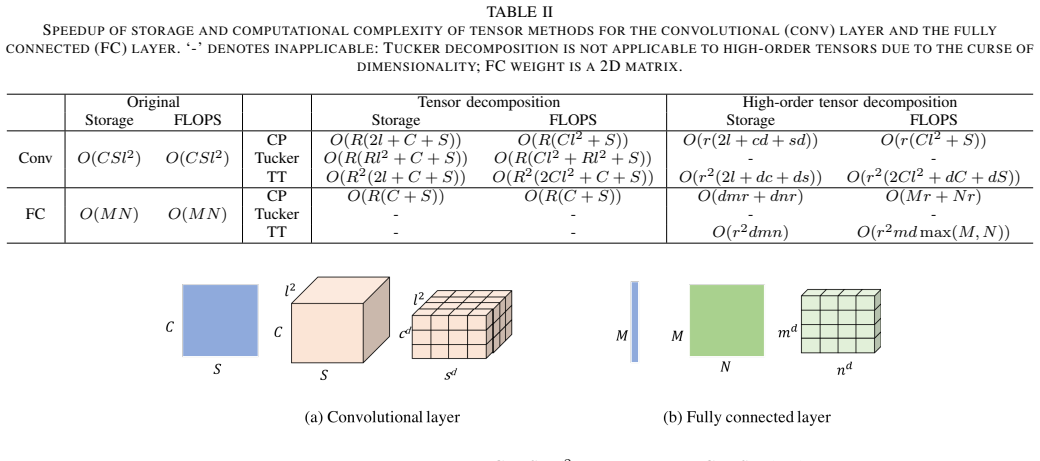
The load-bearing objects are three tensor factorizations—CP (a sum of rank-one outer products), Tucker (a small core tensor multiplied by orthogonal factor matrices), and tensor-train (a chain of three-dimensional cores)—plus tensor completion, which recovers missing entries by minimizing the fit on observed entries subject to a low-rank constraint. These formats replace a d-dimensional array with a product of small factors, so storage drops from exponential in d to a sum of small factor terms; the same factorizations, applied to neural-network weight tensors, yield the parameter and flop reductions collected in the paper's complexity tables. Tensor completion is what makes the uncertainty-quantification gains possible: only a few simulation samples are needed because the recovery problem is constrained to a low-rank set.
What would settle it
Take one of the paper's target problems, such as a circuit-simulation output tensor over random parameters, and compute the tensor-train reconstruction error as the ranks grow; if the relative error does not drop below a few percent until the ranks approach the full tensor dimensions, the low-rank assumption fails and the claimed sample and memory savings would not hold.
Extended reading notes
Core claim
The paper's central claim is that low-rank tensor factorization is a single practical tool for building compact models in two settings that look very different: expensive simulation-driven uncertainty analysis and memory-limited deep learning. In the first setting, stochastic spectral methods require many simulation samples that grow exponentially with the number of random parameters; tensor completion reconstructs the full sample tensor from a small subset, and tensor-train methods compress high-dimensional integration. In the second setting, the weight arrays of convolution and fully connected layers are folded into high-order tensors and represented in CP, Tucker, or tensor-train formats, either after training or during training; a Bayesian tensorized neural network treats the tensor-train cores as random variables and automatically selects ranks. The paper organizes these results into concrete storage and flop-complexity tables and argues that the same low-rank mechanism underlies both families of gains.
Load-bearing premise
The paper's case stands or falls on arrays of simulation outputs, measured variation maps, and trained network weights being approximately low-rank; without that hidden structure, tensor decomposition and completion cannot recover the missing data or compress the weights.
Editorial extensions
If this is right
- In uncertainty quantification, tensor completion can replace the full grid of stochastic-collocation simulations with a small sampled subset, making problems with dozens of random parameters (the paper cites up to 57) tractable without dense Monte Carlo.
- In variability modeling, Bayesian tensor completion can predict full-die spatial variation maps from about 10% of the measurement sites, reducing chip-testing cost.
- In deep learning, tensorized convolution and fully connected layers cut storage and arithmetic by replacing a dense weight array with CP, Tucker, or tensor-train factors, with the paper quantifying parameter and FLOP counts.
- For deployment, the train-then-compress path and the train-compact-from-scratch path both produce models that fit memory-limited hardware; the Bayesian tensorized network selects ranks during training and reports compression ratios between 7.4 times and 137 times.
Reading between the lines
- Not in the paper: the same low-rank completion logic could be applied hierarchically, treating outputs of subsystems as random inputs, to push the 184-parameter MEMS/IC example toward even larger systems.
- Not in the paper: automatic rank selection could double as an interpretability tool, since the effective tensor-train ranks per layer reveal which layers are inherently low-dimensional and therefore safe to compress aggressively.
- Not in the paper: if low-rank structure is absent, the framework's own recovery problem would fail to fit, so measuring the reconstruction-error decay of tensor completion across a range of ranks on new data would provide a direct checklist before committing to tensorized training.
Signed reviews
Editorial analysis
A structured set of objections, weighed in public.
Referee Report
Summary. This invited survey paper reviews tensor decomposition and completion methods for constructing compact models in two application areas: uncertainty/variability analysis in electronic design automation and deep neural network compression. It introduces CP, Tucker, and tensor-train decompositions, formulates the tensor completion problem as a low-rank constrained least-squares problem in Eq. (3), and then surveys applications in stochastic collocation, hierarchical uncertainty quantification, spatial variation pattern prediction, and tensorized neural network inference and training. The paper also presents a complexity comparison in Table II and highlights the authors' own Bayesian tensorized neural network with automatic rank determination, reporting 0.5% relative error at 10% samples for variation prediction and 7.4x-137x compression for neural networks.
Significance. If the survey is reliable, it provides a useful high-level overview of how tensor methods can reduce simulation and memory costs, and it offers a clear taxonomy of tensorized neural networks (inference vs. training, fixed vs. automatic rank). The paper names a broad set of primary references, and Table II gives a quick side-by-side complexity comparison that is valuable for practitioners. However, the most striking quantitative claims are taken from the authors' own prior work and are not substantiated with experimental context, and the paper does not discuss the conditions under which the underlying low-rank assumption holds. These limitations make the survey more useful as an entry point than as a stand-alone evidence base for the abstract's strong cost-reduction claims.
major comments (2)
- [III.C and IV.D] The quantitative evidence underlying the abstract's central claims is thin and self-cited. In Section III.C, the paper states that the Bayesian tensor completion method achieves "around 0.5% relative errors with only 10% testing samples" based on reference [40]. In Section IV.D, it reports "7.4x to 137x compression ratios" based on reference [56], which is the authors' own arXiv preprint. Neither result is accompanied by problem dimensions, dataset characteristics, tensor ranks, baseline methods, or the accuracy of the compressed models. Because these numbers are load-bearing for the claims that tensor methods significantly reduce simulation/measurement cost and compress neural networks, please either (a) provide these experimental details, or (b) clearly state that the numbers are reported from the cited papers and direct the reader to the specific tables/figures that support them.
- [II, Eq. (3), and IV.C] The entire framework depends on the premise that the relevant tensors are approximately low-rank, as encoded by the set M in Eq. (3) and by the compressibility of weight tensors in Section IV.C, but the paper never states when this premise is plausible or when tensor completion can succeed. In particular, the nonconvex problem in Eq. (3) requires conditions such as incoherence and sufficient sampling, and the reported compression ratios depend on ranks that are either fixed in advance or inferred. For a survey aimed at practitioners, please add a paragraph in Section II (or in the relevant application sections) discussing these conditions and pointing to the analyses in the cited works, so that readers can judge when the claimed cost reductions apply.
minor comments (6)
- [IV.A] The sentence "Lebedev et al. [48] firstly applied CP tensor factorization to compress large-scale neural networks with fully connected layers" misdescribes the cited paper, which is about speeding up convolutional neural networks via CP-decomposition. Please correct the description to refer to convolutional layers, or adjust the historical statement.
- [Table II] The fully connected layer row uses the notation C and S for CP storage and FLOPS, but C and S are not defined for fully connected layers; they should be M and N (the input and output dimensions of W). Please also clarify the ambiguous notation "cd", "sd", "dc", "ds", and "dmr" in the high-order tensor decomposition columns, either with subscripts or with explicit sums such as r(2l + d(c+s)).
- [IV.C] The sentence "For the convolutional layer, we only counts the computational costs of a l x l x C block" contains a grammar error and is unclear; please rephrase, e.g., "For the convolutional layer, we count only the computational cost of processing an l x l x C input block."
- [Table II] The table states that Tucker decomposition is "not applicable to high-order tensors due to the curse of dimensionality." Tucker decomposition is applicable to high-order tensors, but the core tensor size grows exponentially with the number of modes. Please rephrase to say that Tucker is impractical for very high-order tensors because of the exponential growth of the core.
- [IV.D] The claim that the method in [56] is the "first Bayesian tensorized neural network" is an overclaim that would require a careful literature search to justify. Please soften the wording to "a Bayesian tensorized neural network" or restrict the claim to the specific setting of automatic rank selection via Stein variational gradient descent.
- [II] The caption of Fig. 1 reads "Several popular tensor compositions"; it should be "Several popular tensor decompositions".
Circularity Check
No significant circularity: the survey's claims are conditional on explicitly stated low-rank assumptions, and its quantitative and complexity statements come from external experiments or direct parameterization counts, not from a fitted input renamed as a prediction.
full rationale
This paper is a survey rather than a derivation-to-fit chain. Its central claim—that tensor methods can produce compact models—is explicitly conditional: the abstract says 'By exploiting possible low-rank tensor factorization,' and Eq. (3) defines tensor completion as a minimization over a low-rank manifold M. The paper never represents the low-rank property as a derived conclusion; it is an openly stated modeling assumption. The storage and FLOP reductions in Table II are direct complexity counts for CP, Tucker, and tensor-train parameterizations, and they are true by the parameterization itself, not by a circular fit. The UQ and deep-learning results are reported from prior work, including the authors' own [40] and [56]; these are descriptions of external experiments and previously proposed algorithms, not conclusions forced by normalization, definitions, or a fitting procedure. The paper even notes the difficulty of rank determination ('Exactly determining a tensor rank in general is NP-hard [47]'), acknowledging rather than hiding a key limitation. No equation in the paper is shown to be equivalent by construction to its own input, and no fitted parameter is renamed as a prediction. The presence of self-citations is a normal feature of a survey and does not amount to a circular reduction when the cited claims are reports of external experiments. Therefore, no significant circularity is found.
Assumptions & free parameters
free parameters (1)
- tensor rank R (CP/Tucker/TT ranks)
assumptions (4)
- domain assumption Low-rank approximation of the target data tensors is valid.
- domain assumption The system output admits a truncated generalized polynomial chaos expansion.
- domain assumption Bayesian tensor completion and Stein variational gradient descent yield reliable posteriors for automatic rank determination.
- standard math Tensor rank determination is NP-hard.
Cite this review
Pith. "Pith review of Tensor Methods for Generating Compact Uncertainty Quantification and Deep Learning Models." pith.science (2026). https://pith.science/paper/7U3M5YI6
@misc{pith2026190807699,
  author       = {Pith},
  title        = {Pith review of: Tensor Methods for Generating Compact Uncertainty Quantification and Deep Learning Models},
  year         = {2026},
  howpublished = {\url{https://pith.science/paper/7U3M5YI6}},
  note         = {Machine review of arXiv:1908.07699}
}
read the original abstract
Tensor methods have become a promising tool to solve high-dimensional problems in the big data era. By exploiting possible low-rank tensor factorization, many high-dimensional model-based or data-driven problems can be solved to facilitate decision making or machine learning. In this paper, we summarize the recent applications of tensor computation in obtaining compact models for uncertainty quantification and deep learning. In uncertainty analysis where obtaining data samples is expensive, we show how tensor methods can significantly reduce the simulation or measurement cost. To enable the deployment of deep learning on resource-constrained hardware platforms, tensor methods can be used to significantly compress an over-parameterized neural network model or directly train a small-size model from scratch via optimization or statistical techniques. Recent Bayesian tensorized neural networks can automatically determine their tensor ranks in the training process.
Figures


Reference graph
Works this paper leans on
-
[40]
Prediction of multi-dimensional spatial variation data via bayesian tensor completion,
J. Luan and Z. Zhang, “Prediction of multi-dimensional spatial variation data via bayesian tensor completion,” IEEE Transactions on Computer- Aided Design of Integrated Circuits and Systems , 2019
work page 2019
-
[56]
Bayesian tensorized neural networks with automatic rank selection,
C. Hawkins and Z. Zhang, “Bayesian tensorized neural networks with automatic rank selection,” arXiv preprint arXiv:1905.10478 , 2019
arXiv 1905
-
[42]
Bayesian cp factorization of incomplete tensors with automatic rank determination,
Q. Zhao, L. Zhang, and A. Cichocki, “Bayesian cp factorization of incomplete tensors with automatic rank determination,” IEEE trans. Pattern analysis and machine intelligence , vol. 37, no. 9, pp. 1751– 1763, 2015
work page 2015
-
[1]
The expression of a tensor or a polyadic as a sum of products,
F. L. Hitchcock, “The expression of a tensor or a polyadic as a sum of products,” Journal of Mathematics and Physics , vol. 6, no. 1-4, pp. 164–189, 1927
1927
-
[2]
Tensor completion for estimating missing values in visual data,
J. Liu, P. Musialski, P. Wonka, and J. Ye, “Tensor completion for estimating missing values in visual data,” IEEE transactions on pattern analysis and machine intelligence , vol. 35, no. 1, pp. 208–220, 2012
2012
-
[3]
Tensor decompositions for signal processing applica- tions: From two-way to multiway component analysis,
A. Cichocki, D. Mandic, L. De Lathauwer, G. Zhou, Q. Zhao, C. Caiafa, and H. A. Phan, “Tensor decompositions for signal processing applica- tions: From two-way to multiway component analysis,” IEEE Signal Processing Magazine, vol. 32, no. 2, pp. 145–163, 2015
2015
-
[4]
Tensor decomposition for signal processing and machine learning,
N. D. Sidiropoulos, L. De Lathauwer, X. Fu, K. Huang, E. E. Papalex- akis, and C. Faloutsos, “Tensor decomposition for signal processing and machine learning,” IEEE Transactions on Signal Processing , vol. 65, no. 13, pp. 3551–3582, 2017
2017
-
[5]
A quadratic penalty method for hypergraph matching,
C. Cui, Q. Li, L. Qi, and H. Yan, “A quadratic penalty method for hypergraph matching,” Journal of Global Optimization , vol. 70, no. 1, pp. 237–259, 2018
work page 2018
Show all 58 references
-
[6]
Predictd parallel epigenomics data imputation with cloud-based tensor decomposition,
T. J. Durham, M. W. Libbrecht, J. J. Howbert, J. Bilmes, and W. S. Noble, “Predictd parallel epigenomics data imputation with cloud-based tensor decomposition,” Nature communications, vol. 9, no. 1, p. 1402, 2018
2018
-
[7]
Some mathematical notes on three-mode factor analysis,
L. R. Tucker, “Some mathematical notes on three-mode factor analysis,” Psychometrika, vol. 31, no. 3, pp. 279–311, 1966
1966
-
[8]
Tensor-train decomposition,
I. V . Oseledets, “Tensor-train decomposition,” SIAM Journal on Scien- tific Computing, vol. 33, no. 5, pp. 2295–2317, 2011
2011
-
[9]
Tensor networks for dimensionality reduction and large-scale optimization: Part 1 low-rank tensor decompositions,
A. Cichocki, N. Lee, I. Oseledets, A.-H. Phan, Q. Zhao, D. P. Mandic et al. , “Tensor networks for dimensionality reduction and large-scale optimization: Part 1 low-rank tensor decompositions,” Foundations and Trends R© in Machine Learning , vol. 9, no. 4-5, pp. 249–429, 2016
2016
-
[10]
Tensor networks for dimensionality reduction and large-scale optimization: Part 2 applications and future perspectives,
A. Cichocki, A.-H. Phan, Q. Zhao, N. Lee, I. Oseledets, M. Sugiyama, D. P. Mandic et al., “Tensor networks for dimensionality reduction and large-scale optimization: Part 2 applications and future perspectives,” Foundations and Trends R© in Machine Learning, vol. 9, no. 6, pp....
2017
-
[11]
Exact tensor completion using t-svd,
Z. Zhang and S. Aeron, “Exact tensor completion using t-svd,” IEEE Transactions on Signal Processing, vol. 65, no. 6, pp. 1511–1526, 2016
2016
-
[12]
Tensor decompositions and applications,
T. G. Kolda and B. W. Bader, “Tensor decompositions and applications,” SIAM review, vol. 51, no. 3, pp. 455–500, 2009
2009
-
[13]
Fasthenry: A multipole- accelerated 3-d inductance extraction program,
M. Kamon, M. J. Tsuk, and J. K. White, “Fasthenry: A multipole- accelerated 3-d inductance extraction program,” IEEE Transactions on Microwave theory and techniques , vol. 42, no. 9, pp. 1750–1758, 1994
1994
-
[14]
Fastcap: A multipole accelerated 3-d capaci- tance extraction program,
K. Nabors and J. White, “Fastcap: A multipole accelerated 3-d capaci- tance extraction program,” IEEE Trans. CAD of Integrated Circuits and Systems, vol. 10, no. 11, pp. 1447–1459, 1991
1991
-
[15]
A precorrected-fft method for elec- trostatic analysis of complicated 3-d structures,
J. R. Phillips and J. K. White, “A precorrected-fft method for elec- trostatic analysis of complicated 3-d structures,” IEEE Trans. CAD of Integrated Circuits and Systems , vol. 16, no. 10, pp. 1059–1072, 1997
1997
-
[16]
K. S. Kundert, J. K. White, and A. L. Sangiovanni-Vincentelli, Steady- state methods for simulating analog and microwave circuits , 2013, vol. 94
2013
-
[17]
Parallel circuit simulation: A historical perspective and recent developments,
P. Li et al. , “Parallel circuit simulation: A historical perspective and recent developments,” Foundations and Trends R© in Electronic Design Automation, vol. 5, no. 4, pp. 211–318, 2012
2012
-
[18]
A trajectory piecewise-linear approach to model order reduction and fast simulation of nonlinear circuits and micromachined devices,
M. Rewienski and J. White, “A trajectory piecewise-linear approach to model order reduction and fast simulation of nonlinear circuits and micromachined devices,” IEEE Transactions on computer-aided design of integrated circuits and systems , vol. 22, no. 2, pp. 155–170, 2003
2003
-
[19]
A multiparameter moment-matching model-reduction approach for gen- erating geometrically parameterized interconnect performance models,
L. Daniel, O. C. Siong, L. S. Chay, K. H. Lee, and J. White, “A multiparameter moment-matching model-reduction approach for gen- erating geometrically parameterized interconnect performance models,” IEEE Transactions on Computer-Aided Design of Integrated Circuits and Systems,...
2004
-
[20]
PRIMA: passive reduced- order interconnect macromodeling algorithm,
A. Odabasioglu, M. Celik, and L. T. Pileggi, “PRIMA: passive reduced- order interconnect macromodeling algorithm,” in Proc. Intl. Conf. Computer-aided design, 1997, pp. 58–65
1997
-
[21]
Practical, fast monte carlo statistical static timing analysis: why and how,
A. Singhee, S. Singhal, and R. A. Rutenbar, “Practical, fast monte carlo statistical static timing analysis: why and how,” in Proc. Int. Conf. Computer-Aided Design, 2008, pp. 190–195
2008
-
[22]
Stochastic testing method for transistor-level uncertainty quantification based on generalized polynomial chaos,
Z. Zhang, T. A. El-Moselhy, I. A. M. Elfadel, and L. Daniel, “Stochastic testing method for transistor-level uncertainty quantification based on generalized polynomial chaos,” IEEE Trans. Computer-Aided Design Integr. Circuits Syst., vol. 32, no. 10, pp. 1533–1545, Oct. 2013
2013
-
[23]
Stochastic testing simulator for integrated circuits and MEMS: Hierarchical and sparse techniques,
Z. Zhang, X. Yang, G. Marucci, P. Maffezzoni, I. M. Elfadel, G. Karni- adakis, and L. Daniel, “Stochastic testing simulator for integrated circuits and MEMS: Hierarchical and sparse techniques,” in Proc. IEEE Custom Integrated Circuits Conf. San Jose, CA, Sept. 2014, pp. 1–8
2014
-
[24]
Stochastic modeling of nonlinear circuits via SPICE-compatible spectral equiva- lents,
P. Manfredi, D. V . Ginste, D. D. Zutter, and F. Canavero, “Stochastic modeling of nonlinear circuits via SPICE-compatible spectral equiva- lents,” IEEE Trans. Circuits Syst. I: Regular Papers , vol. 61, no. 7, pp. 2057–2065, July 2014
2014
-
[25]
Model reduction and simulation of nonlinear circuits via tensor decomposition,
H. Liu, L. Daniel, and N. Wong, “Model reduction and simulation of nonlinear circuits via tensor decomposition,” IEEE Trans. CAD of Integrated Circuits and Systems , vol. 34, no. 7, pp. 1059–1069, 2015
2015
-
[26]
STA VES: Speedy tensor-aided volterra-based electronic simulator,
H. Liu, X. Y . Xiong, K. Batselier, L. Jiang, L. Daniel, and N. Wong, “STA VES: Speedy tensor-aided volterra-based electronic simulator,” in Proc. ICCAD, 2015, pp. 583–588
2015
-
[27]
Tensor train accelerated solution of volume integral equation for 2-d scattering problems and magneto-quasi-static characterization of multiconductor transmission lines,
Z. Chen, S. Zheng, and V . I. Okhmatovski, “Tensor train accelerated solution of volume integral equation for 2-d scattering problems and magneto-quasi-static characterization of multiconductor transmission lines,”IEEE Transactions on Microwave Theory and Techniques, vol. 67, ...
2019
-
[28]
The Wiener-Askey polynomial chaos for stochastic differential equations,
D. Xiu and G. E. Karniadakis, “The Wiener-Askey polynomial chaos for stochastic differential equations,” SIAM J. Sci. Comp., vol. 24, no. 2, pp. 619–644, Feb 2002
2002
-
[29]
High-order collocation methods for differential equations with random inputs,
D. Xiu and J. S. Hesthaven, “High-order collocation methods for differential equations with random inputs,” SIAM Journal on Scientific Computing, vol. 27, no. 3, pp. 1118–1139, 2005
2005
-
[30]
Ghanem and P
R. Ghanem and P. Spanos, Stochastic finite elements: a spectral ap- proach. Springer-Verlag, 1991
1991
-
[31]
Stochastic collocation with non- Gaussian correlated parameters via a new quadrature rule,
C. Cui, M. Gershman, and Z. Zhang, “Stochastic collocation with non- Gaussian correlated parameters via a new quadrature rule,” in Proc. IEEE Conf. EPEPS . San Jose, CA, Oct. 2018, pp. 57–59
2018
-
[32]
Stochastic collocation with non-Gaussian cor- related process variations: Theory, algorithms and applications,
C. Cui and Z. Zhang, “Stochastic collocation with non-Gaussian cor- related process variations: Theory, algorithms and applications,” IEEE Trans. Components, Packag. and Manufacturing Tech., vol. 9, no. 7, pp. 1362 – 1375, July 2019
2019
-
[33]
Uncertainty quantification of electronic and photonic ICs with non-Gaussian correlated process variations,
——, “Uncertainty quantification of electronic and photonic ICs with non-Gaussian correlated process variations,” in Proc. Intl. Conf. Computer-Aided Design. San Diego, CA, Nov. 2018, pp. 1–8
2018
-
[34]
High-dimensional uncertainty quantification of electronic and photonic IC with non-Gaussian correlated process variations,
——, “High-dimensional uncertainty quantification of electronic and photonic IC with non-Gaussian correlated process variations,” IEEE Trans. CAD of Integrated Circuits and Systems , 2019
2019
-
[35]
A big-data approach to handle process variations: Uncertainty quantification by tensor recovery,
Z. Zhang, T.-W. Weng, and L. Daniel, “A big-data approach to handle process variations: Uncertainty quantification by tensor recovery,” in IEEE Workshop on Signal and Power Integrity , 2016, pp. 1–4
2016
-
[36]
Big-data tensor recovery for high-dimensional uncertainty quan- tification of process variations,
——, “Big-data tensor recovery for high-dimensional uncertainty quan- tification of process variations,” IEEE Trans. Components, Packaging and Manufacturing Technology, vol. 7, no. 5, pp. 687–697, 2017
2017
-
[37]
Enabling high-dimensional hierarchical uncertainty quantification by ANOV A and tensor-train decomposition,
Z. Zhang, I. Osledets, X. Yang, G. E. Karniadakis, and L. Daniel, “Enabling high-dimensional hierarchical uncertainty quantification by ANOV A and tensor-train decomposition,” IEEE Trans. CAD of Inte- grated Circuits and Systems , vol. 34, no. 1, pp. 63 – 76, Jan 2015
2015
-
[38]
Global sensitivity analysis using low-rank tensor approximations,
K. Konakli and B. Sudret, “Global sensitivity analysis using low-rank tensor approximations,” Reliability Engineering & System Safety , vol. 156, pp. 64–83, 2016
2016
-
[39]
Reliability analysis of high-dimensional models using low-rank tensor approximations,
——, “Reliability analysis of high-dimensional models using low-rank tensor approximations,” Probabilistic Engineering Mechanics , vol. 46, pp. 18–36, 2016
2016
-
[41]
Virtual probe: a statistical framework for low-cost silicon characteriza- tion of nanoscale integrated circuits,
W. Zhang, X. Li, F. Liu, E. Acar, R. A. Rutenbar, and R. D. Blanton, “Virtual probe: a statistical framework for low-cost silicon characteriza- tion of nanoscale integrated circuits,” IEEE Trans. CAD Integr. Circuits Syst., vol. 30, no. 12, pp. 1814–1827, 2011
2011
-
[43]
Comparing biases for minimal network construction with back-propagation,
S. J. Hanson and L. Y . Pratt, “Comparing biases for minimal network construction with back-propagation,” in Advances in neural information processing systems, 1989, pp. 177–185
1989
-
[44]
Keeping neural networks simple by minimizing the description length of the weights,
G. Hinton and D. Van Camp, “Keeping neural networks simple by minimizing the description length of the weights,” in Proc. ACM Conf. on Computational Learning Theory . Citeseer, 1993
1993
-
[45]
Distilling the knowledge in a neural network,
G. Hinton, O. Vinyals, and J. Dean, “Distilling the knowledge in a neural network,” arXiv preprint arXiv:1503.02531 , 2015
2015 arXiv
-
[46]
Exploiting linear structure within convolutional networks for efficient evaluation,
E. L. Denton, W. Zaremba, J. Bruna, Y . LeCun, and R. Fergus, “Exploiting linear structure within convolutional networks for efficient evaluation,” in NIPS, 2014, pp. 1269–1277
2014
-
[47]
Tensor rank is np-complete,
J. H ˚astad, “Tensor rank is np-complete,” Journal of Algorithms, vol. 11, no. 4, pp. 644–654, 1990
1990
-
[48]
Speeding-up convolutional neural networks using fine-tuned cp- decomposition,
V . Lebedev, Y . Ganin, M. Rakhuba, I. Oseledets, and V . Lempit- sky, “Speeding-up convolutional neural networks using fine-tuned cp- decomposition,” in Int. Conf. Learning Representations , 2015
2015
-
[49]
Ultimate tensorization: compressing convolutional and fc layers alike,
T. Garipov, D. Podoprikhin, A. Novikov, and D. Vetrov, “Ultimate tensorization: compressing convolutional and fc layers alike,” arXiv preprint arXiv:1611.03214, 2016
2016 arXiv
-
[50]
Compression of deep convolutional neural networks for fast and low power mobile applications,
Y .-D. Kim, E. Park, S. Yoo, T. Choi, L. Yang, and D. Shin, “Compression of deep convolutional neural networks for fast and low power mobile applications,” arXiv preprint arXiv:1511.06530 , 2015
2015 arXiv
-
[51]
One time is not enough: iterative tensor decomposition for neural network compression,
J. Gusak, M. Kholyavchenko, E. Ponomarev, L. Markeeva, I. Oseledets, and A. Cichocki, “One time is not enough: iterative tensor decomposition for neural network compression,” arXiv preprint arXiv:1903.09973 , 2019
1903 arXiv
-
[52]
Tensorizing neural networks,
A. Novikov, D. Podoprikhin, A. Osokin, and D. P. Vetrov, “Tensorizing neural networks,” in Advances in neural information processing systems, 2015, pp. 442–450
2015
-
[53]
Tucker tensor layer in fully connected neural networks,
G. G. Calvi, A. Moniri, M. Mahfouz, Z. Yu, Q. Zhao, and D. P. Mandic, “Tucker tensor layer in fully connected neural networks,” arXiv preprint arXiv:1903.06133, 2019
1903 arXiv
-
[54]
Compressing recurrent neural network with tensor train,
A. Tjandra, S. Sakti, and S. Nakamura, “Compressing recurrent neural network with tensor train,” in Int. Joint Conf. Neural Networks , 2017, pp. 4451–4458
2017
-
[55]
Tensor decomposition for compressing recurrent neural network,
——, “Tensor decomposition for compressing recurrent neural network,” in Int. Joint Conf. Neural Networks , 2018, pp. 1–8
2018
-
[57]
Tensor contraction layers for parsimonious deep nets,
J. Kossaifi, A. Khanna, Z. Lipton, T. Furlanello, and A. Anandkumar, “Tensor contraction layers for parsimonious deep nets,” in Proc. Com- puter Vision and Pattern Recognition Workshops , 2017, pp. 26–32
2017
-
[58]
Stein variational gradient descent: A general pur- pose bayesian inference algorithm,
Q. Liu and D. Wang, “Stein variational gradient descent: A general pur- pose bayesian inference algorithm,” in Advances in neural information processing systems, 2016, pp. 2378–2386
2016
Reviewed August 14, 2026 · model on record in the stance chip above.
Discussion (0). Continue with ORCID to comment.