REVIEW 3 major objections 4 minor 22 references
Fine-tuning BERT for Joint Entity and Relation Extraction in Chinese Medical Text
T0 review · 3 major / 4 minor · reviewed 2026-08-14 · deepseek-v4-flash
Pith's one-line read Task-specific attention masks in BERT jointly extract Chinese medical entities and relations, beating the joint Bi-LSTM baseline by 1.65 and 1.22 F1 points.
desk verdict A plausible little trick for steering BERT's attention on joint NER+RC, but the headline numbers don't survive contact with the paper's own hyperparameter table. read the letter →
The pith
A machine-rendered reading of the paper's core claim, the machinery that carries it, and where it could break.
The reading
What carries the argument
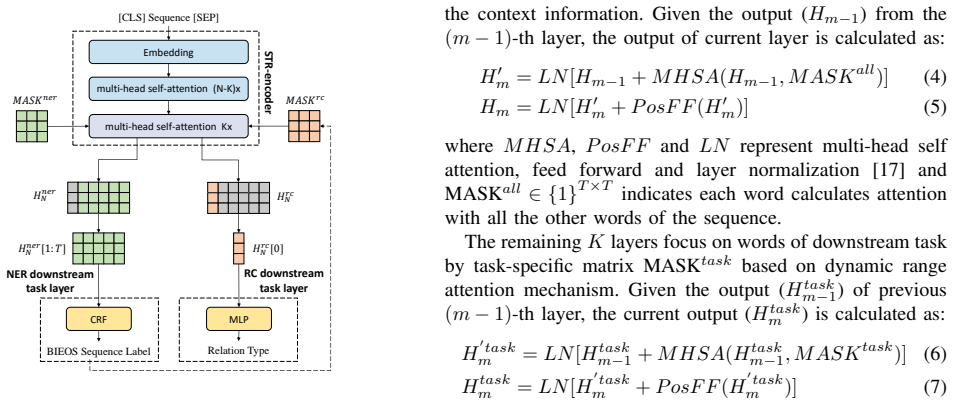
The central object is the STR-encoder (shared task representation encoder): a BERT model where the last K of N self-attention layers are gated by task-specific MASK matrices, so NER and RC receive different context-dependent representations from the same parameters. Its job is to let one pre-trained transformer body serve both subtasks in joint training—the first N-K layers compute unrestricted context, the last K layers focus attention according to the task, and the downstream heads are a CRF for entity tags and a two-layer MLP for relation types.
What would settle it
Run the same joint model on the same data with the configuration fixed before any labels are seen—declare which K and which MASK_rc (Eq. (13) or Eq. (14)) produced the headline numbers—and check whether NER F1=96.89 and RC F1=88.51 reproduce; Section V-A reports RC F1 between 91.46 and 92.18 for the same task, so the headline result needs a single consistent configuration to be meaningful.
Extended reading notes
Core claim
The paper's central claim is that controlling which tokens attend to which tokens in the last K layers of BERT produces task-specific representations good enough for joint entity and relation extraction, and that this beats previous joint learning on a real clinical corpus. The dynamic range attention mechanism keeps the first N-K layers free to build context, then applies MASK_ner (all tokens attend to all tokens) for entity recognition and one of two MASK_rc matrices for relation classification: Eq. (13) leaves the two entity spans free to use context while the [CLS] token attends only to them, and Eq. (14) restricts [CLS], entity 1, and entity 2 to attend only to one another. The authors report that the resulting STR-encoder, fine-tuned jointly with a CRF head for NER and an MLP head for RC, reaches 96.89% NER F1 and 88.51% RC F1 with predicted entities, and that joint training itself adds 0.52 and 0.82 F1 points over training the two tasks separately.
Load-bearing premise
The load-bearing premise is that the headline F1 numbers come from a fixed, pre-specified evaluation of one model configuration on this private hospital dataset; if the reported gains were selected from the best of several hyperparameter settings, or if the dataset's removal of 85% of 'No Relation' pairs changes the ranking, the claimed advantage over the baseline may not hold.
Editorial extensions
If this is right
- Joint learning is what makes the gains: training NER and RC separately loses 0.52 F1 on NER and 0.82 F1 on RC, so the shared STR-encoder is carrying joint features, not just a stronger backbone.
- The relation head is the bottleneck: RC F1 drops from 96.44% with gold entities to 88.51% with predicted entities, so relation accuracy tracks entity-recognition errors.
- There is no single best configuration: K=6 with MASK_rc Eq. (13) maximizes NER at 96.77%, while K=4 with Eq. (14) maximizes RC at 92.18%, so the two hyperparameters trade off against each other.
- The model can be initialized from an off-the-shelf pre-trained BERT checkpoint because the STR-encoder does not change BERT's structure, only the masks on the last layers.
Reading between the lines
- The same last-K masking recipe is a general way to give two joint tasks different attention spans without forking the encoder; it could be tested on other paired tasks such as aspect extraction with sentiment classification or event trigger with argument labeling.
- Because the dataset discards 85% of 'No Relation' pairs, the reported relation F1 is measured on an artificially balanced distribution; keeping the true ratio in a deployment test would likely lower F1 and should be checked before assuming the gain transfers.
- The open interaction between K and MASK_rc noted in the paper means a user of the model should tune both hyperparameters on a development split for each new corpus; the optimal K and mask for this angiography data may not transfer to other medical texts.
Signed reviews
Editorial analysis
A structured set of objections, weighed in public.
Referee Report
Summary. The paper proposes a joint entity and relation extraction model for Chinese medical text that integrates BERT as a shared encoder through a dynamic range attention mechanism. In the last K layers of BERT, task-specific mask matrices (MASK_ner and two variants of MASK_rc) constrain the attention range, yielding separate representations for NER and RC while sharing parameters. NER is decoded with a CRF head and RC with an MLP over the [CLS] vector, and the two losses are summed. On a private corpus of coronary angiography reports from Shuguang Hospital, the authors report NER F1 of 96.89% and RC-with-predicted-entities F1 of 88.51%, claiming improvements of 1.65 and 1.22 points over a Joint-Bi-LSTM baseline. Additional experiments analyze the effect of K and the two MASK_rc definitions and compare joint versus separate training.
Significance. The underlying idea is simple and potentially useful: keep the pretrained BERT weights intact and steer the last K layers with task-specific attention masks, which is a lightweight way to obtain task-specific representations in a shared encoder. The paper is explicit about the equations for the masks and losses, and the joint-learning ablation in Section V-B gives some evidence that joint training helps both tasks. If the reported numbers are reproducible and internally consistent, the method would be a reasonable practical contribution for Chinese clinical text. However, the evaluation as reported is not internally consistent: the headline RC number in Table IV cannot be reconciled with any configuration in Table V, and no plain-fine-tuned-BERT baseline is tested, so the specific contribution of the dynamic-range attention mechanism is not demonstrated. These issues block acceptance in the current form.
major comments (3)
- [Section IV-C, Table IV; Section V-A, Table V] Table V reports RC with Predicted Entities F1 values between 91.46 and 92.18 for all six combinations of K and MASK_rc, whereas Table IV reports 88.51 for the same metric in the proposed model. The text does not state whether Table V is computed on development or test data, nor which K and MASK_rc produced Table IV. The gap of 3.0-3.7 points is more than twice the claimed 1.22-point improvement over Joint-Bi-LSTM, so the headline comparison is unverifiable. Please state the evaluation protocol explicitly, report test-set numbers for the selected configuration, and make clear whether Table V is a development-set or test-set result.
- [Section III-C and Section IV-C] The proposed model is BERT plus task-specific masks plus CRF/MLP heads, yet the comparisons are only against Bi-LSTM-based baselines. A plain fine-tuned BERT model with the same two downstream heads and the same joint loss is needed to isolate the contribution of the dynamic-range attention mechanism; without it, the reported gains may be due entirely to pre-training. Please add this baseline (or explain why it is not appropriate) and report it together with Table IV and the ablation.
- [Section IV-A and Section IV-C] The evaluation rests on a small private dataset (2,136 entities, 4,194 relations) from a single hospital, and all results are reported as single runs without error bars or significance tests. Given the claimed margins of only 1.22 and 1.65 F1 points, a few mislabeled instances or an unlucky split could change the conclusion. Please report the actual split sizes, the number of sentences, and variability over multiple random seeds, and ideally release the data or code.
minor comments (4)
- [Table II] Table II labels the Bi-LSTM baseline as [18], but the surrounding text and the reference list identify this baseline as [20]; please correct the citation.
- [Section V-B] The text says 'independently compare the NRE and RC tasks'; this should read 'NER and RC tasks'.
- [Section III-C3, Eq. (13)] The set expression 'P_CLS, EN1, EN2' in Eq. (13) is ambiguous; writing it as 'P_CLS ∪ P_EN1 ∪ P_EN2' would make the union explicit.
- [Table I] Table I would benefit from the total number of sentences and the split counts after the 85% 'No Relation' removal, since the current statistics cannot be used to understand class balance or evaluation size.
Circularity Check
No circularity: the paper's claim is an empirical F1 improvement of a BERT-based joint model against external and same-group baselines; no derivation reduces to its inputs.
full rationale
The paper's central claim is an empirical F1 improvement on a private coronary angiography corpus using a BERT variant whose last K layers receive task-specific attention masks. Sections III and IV contain no derivation of a predicted quantity from a fitted parameter or from a self-citation. The MASK matrices in Eqs. (13) and (14) are defined from entity positions and the [CLS] token, independent of the reported F1 values, and the STR-encoder is an architectural modification tested empirically rather than an ansatz imported from prior work by citation. Baselines include both same-group methods (RDCNN [21], RCN [13]) and external methods (Bi-LSTM [20], CNN [23], Joint-Bi-LSTM [4]), so the self-citations are not load-bearing: the comparison does not reduce to the authors' own prior results. The inconsistency between Table IV (RC F1 88.51) and Table V (RC F1 91.46-92.18) is a reproducibility and configuration-reporting concern, not circularity: it may stem from different evaluation splits or undisclosed hyperparameter selection, but the claim is not logically equivalent to its own inputs. Pretrained BERT weights are standard external resources, and the attention-mask modification is tested against held-out data. No uniqueness theorem, self-referential definition, or fitted-then-predicted quantity is used. Therefore no significant circularity is present.
Assumptions & free parameters
free parameters (3)
- K (segmentation point) =
2, 4, or 6; not specified for main results
- MASK_rc variant =
Eq. (13) or Eq. (14)
- No Relation discard ratio =
85%
assumptions (4)
- domain assumption Google's pre-trained Chinese BERT parameters provide useful representations for the target domain.
- domain assumption The Shuguang Hospital angiography text annotations are correct and complete.
- standard math Attention masking as described in Eqs. (2)-(3) controls context in the intended way.
- standard math CRF and MLP downstream layers follow standard formulations.
Cite this review
Pith. "Pith review of Fine-tuning BERT for Joint Entity and Relation Extraction in Chinese Medical Text." pith.science (2026). https://pith.science/paper/R4453LIV
@misc{pith2026190807721,
  author       = {Pith},
  title        = {Pith review of: Fine-tuning BERT for Joint Entity and Relation Extraction in Chinese Medical Text},
  year         = {2026},
  howpublished = {\url{https://pith.science/paper/R4453LIV}},
  note         = {Machine review of arXiv:1908.07721}
}
read the original abstract
Entity and relation extraction is the necessary step in structuring medical text. However, the feature extraction ability of the bidirectional long short term memory network in the existing model does not achieve the best effect. At the same time, the language model has achieved excellent results in more and more natural language processing tasks. In this paper, we present a focused attention model for the joint entity and relation extraction task. Our model integrates well-known BERT language model into joint learning through dynamic range attention mechanism, thus improving the feature representation ability of shared parameter layer. Experimental results on coronary angiography texts collected from Shuguang Hospital show that the F1-score of named entity recognition and relation classification tasks reach 96.89% and 88.51%, which are better than state-of-the-art methods 1.65% and 1.22%, respectively.
Figures
Reference graph
Works this paper leans on
-
[1]
T. D. Gunter and N. P. Terry, “The emergence of national electronic health record architectures in the united states and australia: models, costs, and questions,”Journal of Medical Internet Research, vol. 7, no. 1, p. e3, 2005
work page 2005
-
[2]
Joint extraction of entities and relations based on a novel tagging scheme,
S. Zheng, F. Wang, H. Bao, Y . Hao, P. Zhou, and B. Xu, “Joint extraction of entities and relations based on a novel tagging scheme,” in Proceedings of the 55th Annual Meeting of the Association for Computational Linguistics (Volume 1: Long Papers) . Vancouver, Canada: Association for Computational Linguistics, Jul. 2017, pp. 1227– 1236
work page 2017
-
[3]
Joint type inference on entities and relations via graph convolutional networks,
C. Sun, Y . Gong, Y . Wu, M. Gong, D. Jiang, M. Lan, S. Sun, and N. Duan, “Joint type inference on entities and relations via graph convolutional networks,” in Proceedings of the 57th Conference of the Association for Computational Linguistics , 2019, pp. 1361–1370
work page 2019
-
[4]
Joint entity and relation extraction based on a hybrid neural network,
S. Zheng, Y . Hao, D. Lu, H. Bao, J. Xu, H. Hao, and B. Xu, “Joint entity and relation extraction based on a hybrid neural network,” Neurocomputing, vol. 257, pp. 59–66, 2017
work page 2017
-
[5]
Fine-Grained Named Entity Recognition using ELMo and Wikidata
C. Dogan, A. Dutra, A. Gara, A. Gemma, L. Shi, M. Sigamani, and E. Walters, “Fine-grained named entity recognition using elmo and wikidata,” arXiv preprint arXiv:1904.10503 , 2019
work page Pith review arXiv 1904
-
[6]
Improving Relation Extraction by Pre-trained Language Representations
C. Alt, M. H ¨ubner, and L. Hennig, “Improving relation extraction by pre-trained language representations,” arXiv preprint arXiv:1906.03088, 2019
work page Pith review arXiv 1906
-
[7]
BERT: Pre- training of deep bidirectional transformers for language understanding,
J. Devlin, M.-W. Chang, K. Lee, and K. Toutanova, “BERT: Pre- training of deep bidirectional transformers for language understanding,” in Proceedings of the 2019 Conference of the North American Chapter of the Association for Computational Linguistics: Human Language Technologies, Volume 1 (Long and Short Papers) . Minneapolis, Minnesota: Association for ...
2019
-
[8]
V . Krishnan and V . Ganapathy. (2005) Named entity recognition. [Online]. Available: http://cs229.stanford.edu/proj2005/ KrishnanGanapathy-NamedEntityRecognition.pdf
work page 2005
Show all 22 references
-
[9]
Automatic recognition of disorders, findings, pharmaceuticals and body structures from clinical text: An annotation and machine learning study,
M. Skeppstedt, M. Kvist, G. H. Nilsson, and H. Dalianis, “Automatic recognition of disorders, findings, pharmaceuticals and body structures from clinical text: An annotation and machine learning study,” Journal of Biomedical Informatics , vol. 49, pp. 148–158, 2014
2014
-
[10]
Incorporating dictionaries into deep neural networks for the chinese clinical named entity recognition,
Q. Wang, Y . Zhou, T. Ruan, D. Gao, Y . Xia, and P. He, “Incorporating dictionaries into deep neural networks for the chinese clinical named entity recognition,” Journal of Biomedical Informatics , vol. 92, p. 103133, 2019
2019
-
[11]
Utd: Classifying semantic relations by combining lexical and semantic resources,
B. Rink and S. Harabagiu, “Utd: Classifying semantic relations by combining lexical and semantic resources,” in Proceedings of the 5th International Workshop on Semantic Evaluation . Association for Computational Linguistics, 2010, pp. 256–259
2010
-
[12]
Kernel methods for relation extraction,
D. Zelenko, C. Aone, and A. Richardella, “Kernel methods for relation extraction,” Journal of Machine Learning Research , vol. 3, no. Feb, pp. 1083–1106, 2003
2003
-
[13]
Automatic severity classification of coronary artery disease via recurrent capsule network,
Q. Wang, J. Qiu, Y . Zhou, T. Ruan, D. Gao, and J. Gao, “Automatic severity classification of coronary artery disease via recurrent capsule network,” in 2018 IEEE International Conference on Bioinformatics and Biomedicine (BIBM). IEEE, 2018, pp. 1587–1594
2018
-
[15]
Incremental joint extraction of entity mentions and relations,
Q. Li and H. Ji, “Incremental joint extraction of entity mentions and relations,” in Proceedings of the 52nd Annual Meeting of the Association for Computational Linguistics (Volume 1: Long Papers), 2014, pp. 402– 412
2014
-
[16]
A neural joint model for entity and relation extraction from biomedical text,
F. Li, M. Zhang, G. Fu, and D. Ji, “A neural joint model for entity and relation extraction from biomedical text,” BMC Bioinformatics, vol. 18, no. 1, p. 198, 2017
2017
-
[17]
Attention is all you need,
A. Vaswani, N. Shazeer, N. Parmar, J. Uszkoreit, L. Jones, A. N. Gomez, Ł. Kaiser, and I. Polosukhin, “Attention is all you need,” in Advances in Neural Information Processing Systems , 2017, pp. 5998–6008
2017
-
[18]
Bidirectional lstm-crf models for sequence tagging,
Z. Huang, W. Xu, and K. Yu, “Bidirectional lstm-crf models for sequence tagging,” arXiv preprint arXiv:1508.01991 , 2015
2015 arXiv
-
[19]
A strategy on selecting performance metrics for classifier evaluation,
Y . Liu, Y . Zhou, S. Wen, and C. Tang, “A strategy on selecting performance metrics for classifier evaluation,” International Journal of Mobile Computing and Multimedia Communications (IJMCMC) , vol. 6, no. 4, pp. 20–35, 2014
2014
-
[20]
Character-level neural network for biomedical named entity recognition,
M. Gridach, “Character-level neural network for biomedical named entity recognition,” Journal of Biomedical Informatics , vol. 70, pp. 85– 91, 2017
2017
-
[21]
Chinese clinical named entity recognition using residual dilated convolutional neural network with conditional random field,
J. Qiu, Y . Zhou, Q. Wang, T. Ruan, and J. Gao, “Chinese clinical named entity recognition using residual dilated convolutional neural network with conditional random field,” IEEE Transactions on NanoBioscience , 2019
2019
-
[22]
Relation extraction from clinical texts using domain invariant convolutional neural network,
S. Sahu, A. Anand, K. Oruganty, and M. Gattu, “Relation extraction from clinical texts using domain invariant convolutional neural network,” in Proceedings of the 15th Workshop on Biomedical Natural Language Processing. Berlin, Germany: Association for Computational Linguis- t...
2016
-
[23]
Relation extraction: Perspective from convolutional neural networks,
T. H. Nguyen and R. Grishman, “Relation extraction: Perspective from convolutional neural networks,” in Proceedings of the 1st Workshop on Vector Space Modeling for Natural Language Processing, 2015, pp. 39– 48
2015
Reviewed August 14, 2026 · model on record in the stance chip above.
Discussion (0). Continue with ORCID to comment.