REVIEW 3 major objections 4 minor 3 references
Pure spin current in a robust pigment-red film
T0 review · 3 major / 4 minor · reviewed 2026-08-14 · deepseek-v4-flash
Pith's one-line read Thermally evaporated pigment-red PTCDA films transmit a pure spin current at room temperature, with an estimated spin diffusion length of about 30 nm.
desk verdict A solid, incremental spin-pumping/ISHE demonstration for PTCDA, with a spin diffusion length that should be taken as indicative, not established. read the letter →
The pith
A machine-rendered reading of the paper's core claim, the machinery that carries it, and where it could break.
The reading
What carries the argument
The central mechanism is spin pumping from a ferromagnetic Ni80Fe20 layer under ferromagnetic resonance, combined with inverse spin-Hall detection in a palladium layer. In the Pd/PTCDA/Ni80Fe20 tri-layer, the resonance drives a pure spin current into the PTCDA; at the palladium interface the spin current is converted into a charge-current electric field $E \propto \theta_{\mathrm{SHE}} J_s \times \sigma$, and the measured voltage is fit using the symmetric Lorentzian term $V_{\mathrm{Sym}}\Gamma^2/((H-H_{\mathrm{FMR}})^2+\Gamma^2)$. The decay of $V_{\mathrm{Sym}}$ with PTCDA thickness is then fit to an exponential to extract the spin diffusion length $\lambda_s \approx 30$ nm.
What would settle it
Measure the ferromagnetic-resonance absorption amplitude at each PTCDA thickness and replot the symmetric voltage normalized by absorbed power; if the thickness series no longer follows a single exponential decay, the 30 nm estimate is unsupported even though spin transport itself may still occur.
Extended reading notes
Core claim
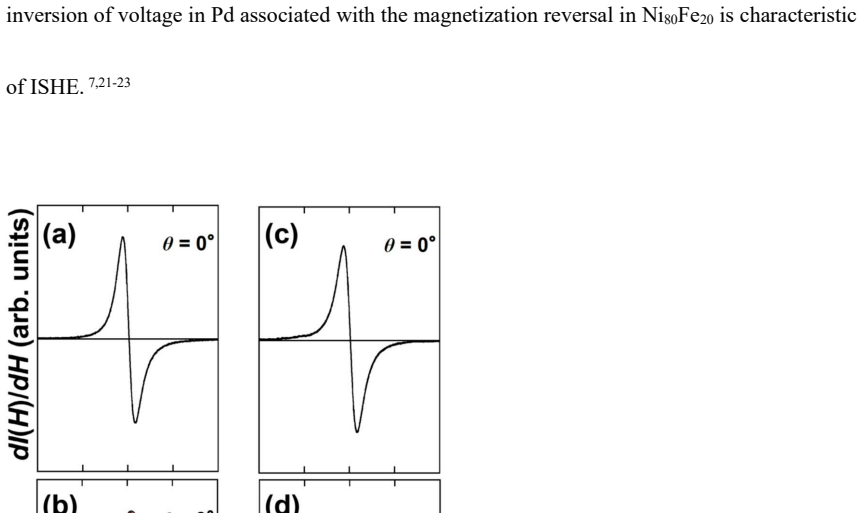
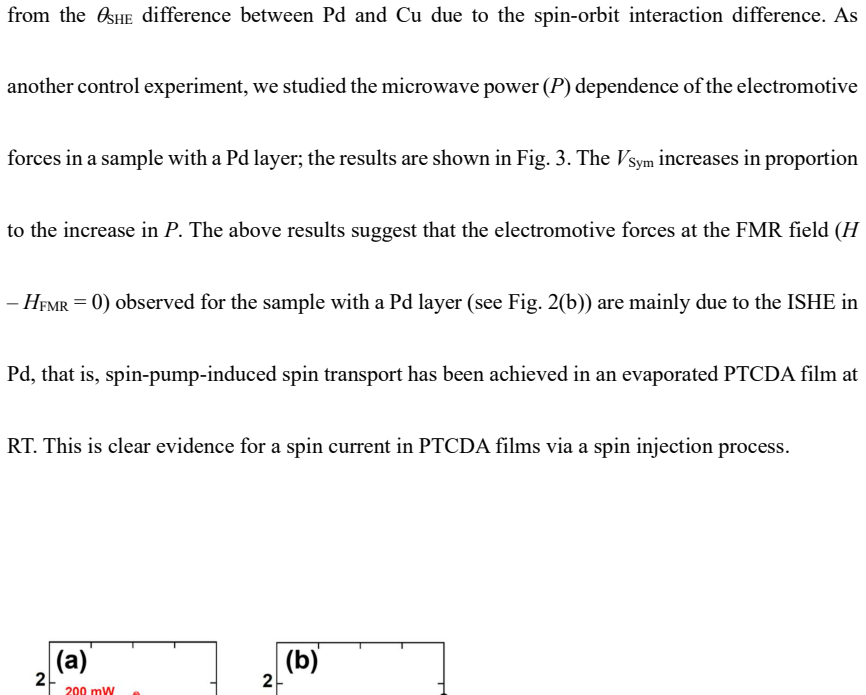
The authors report clear evidence for a pure spin current propagating through a thermally evaporated PTCDA film at room temperature. In a Pd/PTCDA/Ni80Fe20 stack, ferromagnetic resonance in Ni80Fe20 pumps a spin current into the PTCDA layer, the spin current diffuses across the PTCDA, and the palladium layer converts it into a charge current via the inverse spin-Hall effect, producing an electromotive force $E \propto \theta_{\mathrm{SHE}} J_s \times \sigma$. The sign inversion of the voltage between magnetic-field angles of 0 and 180 degrees and the linear microwave-power dependence identify the signal as inverse spin-Hall detection, while the copper control sample shows only a very small voltage because copper has weak spin-orbit coupling. From the thickness dependence of the symmetric voltage component, the spin diffusion length in PTCDA is estimated to be about 30 nm at room temperature.
Load-bearing premise
The 30 nm spin diffusion length rests on the assumption that the spin current decays exponentially through the PTCDA film, without correcting the thickness series for changes in ferromagnetic-resonance absorption or interface effects.
Editorial extensions
If this is right
- PTCDA films can function as both a durable protection layer and a spin-transport layer in spintronic devices, because spin transport is observed in thermally evaporated films at room temperature.
- A spin diffusion length near 30 nm places PTCDA in the same range as other evaporated molecular films such as pentacene, TIPS-pentacene, C60, C84, and Alq3, making it a practical candidate for molecular spintronics.
- Because PTCDA tolerates standard fabrication conditions such as sputtering, future device stacks could integrate it as a robust spin-transport spacer without special processing restrictions.
- The observed thickness dependence sets a design scale: PTCDA layers up to tens of nanometers can still transmit spin current, which is enough for proposed molecular spin devices.
Reading between the lines
- If PTCDA's photoconductivity can be used to gate the spin current, the same tri-layer geometry might enable light-controlled spin transport; the paper does not demonstrate this.
- The 30 nm value is likely a lower bound: the rough PTCDA surface may allow Ni and Fe atoms to penetrate the film during deposition, shortening the effective decay length, so a cleaner interface could yield a larger intrinsic spin diffusion length.
- The spin-pump plus inverse spin-Hall method could be applied to other perylene derivatives to test whether molecular packing and crystallinity control spin diffusion length, as suggested by comparisons with pentacene.
- A direct comparison between PTCDA and CuPc films in the same measurement geometry would clarify whether the two pigments have comparable spin transport properties, since the paper compares values obtained by different evaluation methods.
Signed reviews
Editorial analysis
A structured set of objections, weighed in public.
Referee Report
Summary. The manuscript reports spin transport in thermally evaporated perylene-3,4,9,10-tetracarboxylic dianhydride (PTCDA) films at room temperature, studied in Pd/PTCDA/Ni80Fe20 trilayers. A spin-pump-induced pure spin current is injected from the Ni80Fe20 layer, propagates through the PTCDA film, and is detected as an inverse spin-Hall effect (ISHE) voltage in the Pd layer. The authors report a spin diffusion length of approximately 30 nm in PTCDA, obtained by fitting an exponential decay to the PTCDA thickness dependence of the symmetric ISHE voltage. The central qualitative claim is that the sign-inverted voltage, the weak signal in a Cu control, and the linear microwave-power dependence constitute clear evidence for pure spin current transport in PTCDA.
Significance. If the qualitative spin-transport claim holds, this is a useful contribution to molecular spintronics: it extends spin-pumping-based spin transport studies to a robust, thermally evaporable pigment-red molecule and provides a comparison with other organic spin-transport materials. The strongest features are the sign inversion of the ISHE voltage on reversing the magnetization, the control experiment with a Cu layer showing a much smaller signal, and the linear power dependence of the symmetric voltage, all of which support the existence of a pure spin current flowing through the PTCDA film. The quantitative spin diffusion length, however, is less secure because it rests on an unnormalized exponential fit to a small thickness series without independent verification of the decay mechanism. The paper's overall significance is moderate: the qualitative demonstration is valuable, but the headline quantitative parameter (λ_s ≈ 30 nm) requires additional support or appropriately softened claims.
major comments (3)
- [Fig. 4 and pages 9-10] The extraction of the spin diffusion length λ_s ≈ 30 nm relies on the assumption of an exponential decay of the spin current in the PTCDA film, but this assumption is not independently justified. The thickness series is not normalized by the FMR absorption amplitude or by 4πM_s, even though Fig. 4(a) shows that 4πM_s decreases with increasing d. Because the spin-pumping voltage is proportional to the microwave absorption and to the interface spin-mixing conductance, a d-dependent change at the Py/PTCDA interface or in the FMR excitation condition can produce a decaying V_Sym without any diffusive spin loss inside the PTCDA film. Consequently, the fitted λ_s ≈ 30 nm is not uniquely determined by the data.
- [Page 11, discussion of surface roughness] The authors themselves note that the rough PTCDA surface likely causes Ni and Fe penetration into the film during sample preparation. If Ni and Fe atoms penetrate the PTCDA layer, the effective transport channel may be a contaminated PTCDA/NiFe mixture rather than pristine PTCDA. This directly affects the attribution of the measured λ_s to the intrinsic spin diffusion length of PTCDA, so the claim that the 30 nm value characterizes PTCDA is not fully supported.
- [Fig. 4(b), exponential fit] The thickness dependence of V_Sym is fitted with an exponential decay using only a small number of thickness points (15-60 nm), without error bars, without sample-to-sample repeats, and without testing an alternative model such as an interface-limited decay or a two-channel diffusion process. As a result, the 30 nm value is not robust to model choice, and the paper's quantitative conclusion in the abstract and summary is overstated relative to the evidence presented.
minor comments (4)
- [Fig. 1 caption] The caption of Fig. 1 refers to 'the spin current generated in the pentacene film', but the film studied is PTCDA; this is a copy-editing error that should be corrected.
- [Section II, sample preparation] The deposition order and layer sequence are described, but it would be helpful to state explicitly the stacking order (substrate/Pd/PTCDA/Ni80Fe20) once in a single clear sentence, since the abstract and figure caption describe the same structure in slightly different ways.
- [Eq. (3) and Fig. 2] The paper does not provide quantitative error estimates for the fitted V_Sym values or for the FMR damping constant Γ. Adding error bars and a statement of the fitting procedure would improve the reliability of the reported thickness dependence.
- [General] There are minor typographical issues, such as the use of '' and other special characters that are not rendered cleanly in the text, and some awkward phrasing (e.g., 'the d of 30 nm'). These do not affect the scientific content but should be edited for clarity.
Circularity Check
No significant circularity: the central spin-transport claim rests on independent controls, and the 30 nm spin diffusion length is an explicitly fitted parameter, not a prediction derived from its own inputs.
full rationale
The central claim—spin-pump-induced pure spin current propagating through PTCDA and detected as an inverse spin-Hall voltage in Pd—rests on independent experimental evidence: sign inversion of the voltage with magnetization orientation, a Cu-layer control showing vanishing ISHE signal, and linear microwave-power dependence of VSym. None of these observations is defined in terms of the conclusion that a pure spin current exists in PTCDA. The quantitative spin diffusion length (λ_s ≈ 30 nm) is obtained by fitting the d-dependence of VSym under the explicitly stated "assumption of an exponential decay of the spin current in the PTCDA film" (pages 9–10, Fig. 4). This is an honest parameter estimation, not a derived prediction or a renamed input; the paper calls it an "estimation" rather than a parameter-free result. The citations [4–7,21] for the exponential-decay assumption include two papers from the same group (refs. 7 and 21), but this is a standard modeling assumption also used by external groups (refs. 4–6,11), and the existence of spin transport does not depend on it. Concerns that the thickness series is not normalized by FMR absorption amplitude, and the page-11 note that rough PTCDA surface morphology may cause Ni/Fe penetration, affect the accuracy and robustness of the λ_s estimate, not the circularity of the argument. No load-bearing reduction of the paper's conclusions to its inputs by construction was found.
Assumptions & free parameters
free parameters (2)
- Spin diffusion length lambda_s =
~30 nm at room temperature
- FMR damping constant Gamma =
56 Oe
assumptions (3)
- ad hoc to paper The spin current injected from Ni80Fe20 decays exponentially in the PTCDA film with a single characteristic length lambda_s.
- domain assumption The symmetric component of the voltage at FMR is due to the inverse spin-Hall effect in Pd, while the antisymmetric component arises from the anomalous Hall effect and parasitic effects.
- standard math The Kittel formula with the gyromagnetic ratio gamma = 1.86 x 10^7 G^-1 s^-1 is valid for Ni80Fe20.
Cite this review
Pith. "Pith review of Pure spin current in a robust pigment-red film." pith.science (2026). https://pith.science/paper/EIZK6I7K
@misc{pith2026190807730,
  author       = {Pith},
  title        = {Pith review of: Pure spin current in a robust pigment-red film},
  year         = {2026},
  howpublished = {\url{https://pith.science/paper/EIZK6I7K}},
  note         = {Machine review of arXiv:1908.07730}
}
read the original abstract
We report the spin current properties in a pigment-red (perylene-3,4,9,10-tetracarboxylic dianhydride: PTCDA) film prepared by thermal evaporation. In a palladium(Pd)/PTCDA/Ni80Fe20 tri-layer sample, a pure spin-current is generated in the PTCDA layer by the spin-pumping of the Ni80Fe20. The spin current is absorbed into the Pd layer, converted into a charge current with the inverse spin-Hall effect in Pd, and detected as an electromotive force. This is clear evidence for the pure spin current in a PTCDA film, and it is confirmed that a PTCDA film is useful not only as a robust protection layer material but also as a spintronic material.
Figures

Figures from the paper (1 more)

Reference graph
Works this paper leans on
-
[1]
1M. Shiraishi and T. Ikoma, Physica E 43, 1295 (2011). 2Z.H. Xiong, Di Wu, Z.V. Vardeny, and J. Shi, Nature 427, 821 (2004). 3M. Ohishi, M. Shiraishi, R. Nouchi, T. Nozaki, T. Shinjo, and Y. Suzuki, Jpn. J. Appl. Phys. 46, L605 (2007). 4S. Watanabe, K. Ando, K. Kang, S. Mooser, Y. Vaynzof, H. Kurebayashi, E. Saitoh, and H
work page 2011
-
[2]
Sirringhaus, Nature Phys. 10, 308 (2014). 5S.W. Jiang, S. Liu, P. Wang, Z. Z. Luan, X. D. Tao, H. F. Ding, and D. Wu, Phys. Rev. Lett. 115, 086601 (2015). 6M. Kimata, D. Nozaki, Y. Niimi, H. Tajima, and Y. Otani, Phys. Rev. B 91, 224422 (2015). 7Y. Tani, Y. Teki, and E. Shikoh, Appl. Phys. Lett. 107, 242406 (2015). 8Y. Tani, T. Kondo, Y. Teki, and E. Shik...
work page 2014
-
[3]
Wei, F.-H. Chang, H.-J. Lin, W.-C. Chiang, and M.-T. Lin, Appl. Phys. Lett. 104, 083301 (2014). 18V. Bulović, P. Tian, P. E. Burrows, M. R. Gokhale, S. R. Forrest, and M. E. Thompson, Appl. Phys. Lett. 70, 2954 (1997). 19S. Mizukami, Y. Ando, and T. Miyazaki, Phys. Rev. B 66, 104413 (2002). 20Y. Tserkovnyak, A. Brataas, and G.E.W. Bauer, Phys. Rev. Lett. ...
work page 2014
Reviewed August 14, 2026 · model on record in the stance chip above.
Discussion (0). Continue with ORCID to comment.