REVIEW 3 major objections 4 minor 3 cited by
Blast Waves from Magnetar Flares and Fast Radio Bursts
T0 review · 3 major / 4 minor · reviewed 2026-08-14 · deepseek-v4-flash
Pith's one-line read The paper argues that a blast wave driven by a magnetar flare into its own cold wind can emit a millisecond GHz radio burst that survives induced scattering, with linear polarization fixed by the rotation axis.
desk verdict Solid theory paper with a real soft spot: the induced-scattering survival claim rests on derivations deferred to 'elsewhere,' and that needs to be fixed before the central claim is fully load-bearing. read the letter →
The pith
A machine-rendered reading of the paper's core claim, the machinery that carries it, and where it could break.
The reading
What carries the argument
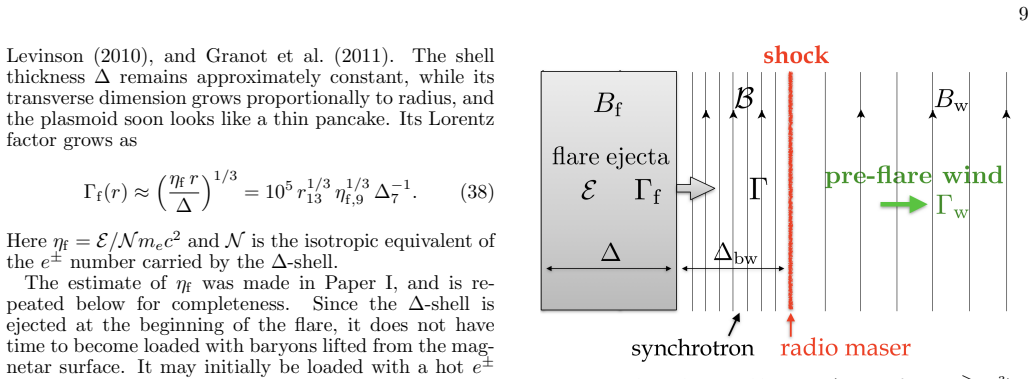
The load-bearing mechanism is the shock maser. At the blast wave in a strongly magnetized wind, the upstream electron-positron plasma arrives in the blast frame as a cold beam with Lorentz factor $\Gamma_{\rm rel}\approx\Gamma/2\Gamma_w$ and begins to gyrate; this ring in momentum space is unstable to bunching and radiates semi-coherent electromagnetic waves near the Larmor frequency, mostly in the extraordinary mode. Only waves emitted within a narrow cone $\sin\theta<\sigma_w^{-1/2}$ ahead of the shock escape, giving Doppler factor $D\approx 2\Gamma$ and a GHz peak $\nu_{\rm peak}=(\xi/\pi)(e/m_ec)(L_w/cr^2)^{1/2}\,\Gamma/\Gamma_w$. The same machinery sets the efficiency $\epsilon\sim 10^{-3}/\sigma_w$ and the induced-scattering survival condition $\eta>50$, so it simultaneously determines the burst's spectrum, luminosity, polarization, and whether it can escape.
What would settle it
Measure, for a repeating fast radio burst with a known host and rotation measure, the polarization angle across many bursts and the frequency-time drift in single high-resolution bursts: the model predicts a constant intrinsic polarization angle after Faraday correction and a strictly downward drift with $\nu_{\rm peak}\propto t_{\rm obs}^{-1}$ then $\propto t_{\rm obs}^{-3/4}$, with GHz durations below about 1 ms. Observing significant circular polarization, rotation of the polarization angle between bursts, or an upward spectral drift would falsify the central claim.
Extended reading notes
Core claim
At the center of the paper is a single engine: a giant flare on a young magnetar ejects an ultra-relativistic magnetic plasmoid, which drives a blast wave through the magnetar's own cold, helical-B wind. At radii near $r\sim 10^{14}$ cm the shock runs with Lorentz factor $\Gamma_{\rm sh}\gtrsim 10^4$, and the Larmor-mediated shock transition acts as a maser that converts a small fraction of the dissipated energy into coherent radio waves. The paper claims these waves emerge at GHz frequencies in observer time $\lesssim 1$ ms, survive induced Compton scattering for wind energies per particle $\eta\gtrsim 50$, possess linear polarization tied to the rotation axis, and sweep downward in frequency as the blast decelerates. This is presented as a working explanation of repeating fast radio bursts such as FRB 121102.
Load-bearing premise
The engine requires that the wind ahead of the flare be cold, fast, and magnetically dominated, with energy per particle rest mass $\eta$ between roughly $10^2$ and $10^4$ and above about 50; this upstream state is estimated from pair-loading arguments rather than measured, and heating or day-timescale ion pollution of the wind would suppress the maser and destroy the burst.
Editorial extensions
If this is right
- The model predicts GHz bursts with observed durations under about one millisecond and a strictly downward frequency drift, with the drift law changing from $\nu\propto t_{\rm obs}^{-1}$ to $\nu\propto t_{\rm obs}^{-3/4}$ around the deceleration radius.
- It predicts a constant linear polarization angle across repeated bursts once Faraday rotation is corrected, set by the magnetar's rotation axis.
- It predicts that induced Compton scattering will not suppress the burst as long as the wind energy-per-rest-mass $\eta$ exceeds roughly 50, which the paper estimates holds for $\eta\sim 10^2$ to $10^4$.
- It predicts frequent weak bursts and rare strong ones, with a total radio energy budget consistent with repeaters such as FRB 121102.
- It predicts roughly one-second optical flashes at up to nearly supernova-Ia luminosity when a blast wave strikes the wind bubble left by a previous flare, at a rate far below the fast radio burst rate.
Reading between the lines
- If the mechanism is right, the same engine can produce both repeating and apparently non-repeating fast radio bursts, because a burst is seen only when the plasmoid is ejected in the direction of the observer inside a narrow beaming cone.
- The model implies that a young magnetar's burst activity should be intermittent on day timescales: a flare within roughly a day after an ion-ejecting flare encounters polluted, hot wind and should produce no radio burst, so burst rate should anti-correlate with very recent giant-flare activity.
- The predicted optical-flash channel gives an independent way to discover hyper-active magnetars: all-sky optical transient surveys could catch the short supernova-like flashes even when the radio beam points away from Earth.
- Measurements of the fixed polarization angle from many bursts of one repeater would let observers reconstruct the magnetar's rotation axis on the sky; deviations from constancy would cleanly separate intrinsic engine properties from propagation effects in the host galaxy.
Signed reviews
Editorial analysis
A structured set of objections, weighed in public.
Referee Report
Summary. The paper proposes that giant magnetic flares on young magnetars eject ultra-relativistic magnetic plasmoids, which drive blast waves into the pre-flare rotationally powered e± wind. It argues that the resulting Larmor-mediated shock maser in the cold helical-B zone of the wind produces FRB-like GHz bursts at radii r ~ 10^14 cm with observer-frame durations below 1 ms, linear polarization fixed by the magnetar rotation axis, downward frequency drift, and possible sub-ms periodicity. The paper also derives constraints from induced Compton scattering, predicts optical flashes when a blast wave strikes the tail of a previous flare, compares with the competing Metzger et al. (2019) model, and discusses FRB host-galaxy locations.
Significance. If the model holds, it provides a single coherent engine for important FRB observables: duration, frequency, spectral drift, polarization, repetition, and energetics are derived from one blast-wave scenario rather than fitted to FRB data. The anchoring of the maser efficiency and spectral peak factor to external PIC simulations (Plotnikov & Sironi 2019) is a concrete strength, as is the paper's explicit discussion of parameter uncertainties in the wind power, particle flux, and plasmoid properties. The model makes falsifiable predictions, including a constant polarization position angle set by the spin axis, a frequency-dependent burst duration, and optical flashes in repeaters. Its main weakness is that the induced-scattering survival claim, which is central to the model's distinguishability, is carried by two calculations explicitly deferred to future work.
major comments (3)
- [§7.1, Eqs. (104)–(107) and (113)–(115)] The inside-beam induced Compton scattering result is load-bearing for abstract claim (2) and for the η > 50 condition in Eq. (115), but the numerical prefactor α ≈ 3 × 10^-2 is asserted rather than derived, with the derivation deferred to 'elsewhere.' Equation (107) inherits this coefficient through the factor 8α/π, and Eq. (113) directly controls the threshold in Eq. (115). Because the wind parameter range in Eq. (16) is η ~ 10^2–10^4, a factor-of-few change in α could move the threshold across the lower end of that range and invalidate the survival claim exactly in the regime the model needs. The derivation must be supplied, or a published reference provided, before the survival claim is accepted.
- [§7.2, Eqs. (116)–(121)] The outside-beam induced scattering condition is also deferred: the text states that 'a detailed calculation, which will be presented elsewhere, confirms the following simple estimate' before Eq. (117). The exponential gain in Eq. (117) and the radius limit in Eq. (121) are used as quantitative constraints, so this is a second load-bearing component of abstract claim (2). Moreover, Section 8.2 concedes that for observationally typical soft FRB spectra the role of outside-beam scattering is 'less certain.' The caveat about nonlinear spectral evolution in Section 7.2 does not replace the missing derivation.
- [§4.3 and §8.2] The model requires the pre-explosion wind to be a cold, ultra-relativistic, magnetically dominated e± flow with η > 50; Section 8.2 states that pollution of the wind by slow ion ejecta more often than about once per day would make the model problematic. Because hyper-active magnetars are invoked to flare frequently, the coexistence of frequent flaring and a clean pre-flare wind is a nontrivial assumption, especially for repeaters such as FRB 121102 with episode intervals shorter than a day. The paper acknowledges this tension but does not quantify how often the ion-ejection threshold is exceeded; I regard this as a parameter-sensitivity concern rather than an internal inconsistency.
minor comments (4)
- [§3.1, near Eq. (25)] The text says 'Using Equations (22) and (22)' when Equation (25) is evidently intended; please correct the cross-reference.
- [§5.3, text after Eq. (66)] The phrase 'The estimate (88) is valid' refers to an equation introduced several sections later; it should refer to Eq. (66) in this section.
- [§8.1, item (8)] The statement that 'the predicted spectral slope d ln E_FRB/d ln ν changes from −1 to −2' is ambiguous: Equation (91) gives dE_FRB/d ln ν, so the stated slope appears to describe the energy per unit frequency rather than dE/d ln ν; please clarify the notation.
- [§6.5 and §8.1, item (9)] The summary prediction of a constant linear polarization angle is stronger than the body of Section 6.5, which notes that 3D simulations are still needed and that propagation effects may convert linear to circular polarization; the caveat should accompany the summary claim.
Circularity Check
No circular reduction: predictions are derived from stated wind/flare inputs and independent simulation results; deferred induced-scattering calculations are verification gaps, not tautological inputs.
full rationale
The derivation chain is not circular. The engine is explicitly conditional: 'Hyper-active magnetars (HAMs) are hypothetical objects,' and the quantitative inputs used throughout (Lw normalized to 10^39 erg/s, particle flux to 10^42 s^-1, eta ~ 10^2-10^4, explosion energy E ~ 10^44 erg, plasmoid thickness Delta ~ 10^7 cm) are adopted as representative magnetar parameters in Sections 2.3 and 4.1, not fitted to FRB observables. The maser peak factor xi and efficiency eps are imported from independent kinetic simulations (Plotnikov & Sironi 2019; Gallant et al. 1992), so the predicted GHz frequency, luminosity, drift, duration, and polarization are calculated consequences rather than restatements of the inputs. Self-citations to Paper I supply the hypothetical HAM/blast-wave scenario, but no FRB property is inserted into the equations and then recovered as a prediction; observational comparisons in Section 8.1 are consistency checks, not calibration. The one genuine evidentiary gap is that the induced-scattering survival claim rests on two calculations deferred to later papers: Section 7.1 says 'The derivation will be given elsewhere, and here we state the results in a simple intuitive form,' and Section 7.2 says 'A detailed calculation, which will be presented elsewhere, confirms the following simple estimate.' If the coefficient alpha or the exponential gain differed by a factor of a few, the threshold in Equation (115) could move substantially. That is an omitted-proof and correctness risk, not a circular reduction, because the deferred coefficients are not chosen to reproduce the paper's conclusion and the rest of the model would still be independently testable against FRB data. Overall, no step in the paper reduces by construction to its own inputs.
Assumptions & free parameters
free parameters (10)
- Pre-flare wind power Lw =
1e39 erg/s
- Pre-flare particle outflow rate Ndot =
1e42 s^-1
- Wind energy per unit rest mass eta =
100 to 10000
- Plasmoid isotropic energy E =
1e44 erg
- Plasmoid thickness parameter tau = Delta/c =
1e-3 s
- e± loading product zeta M =
implicitly normalized to Ndot ~ 1e42 s^-1
- Maser efficiency epsilon =
1e-3 / sigma_w
- Maser spectral peak factor xi =
about 3
- Rotation period P =
about 1 s
- Ion ejecta energy Et =
greater than 1e44 erg
assumptions (6)
- domain assumption Hyper-active magnetars younger than about one century exist and flare frequently.
- domain assumption The magnetar wind is force-free with Lorentz factor Gamma_w about 3 eta^(1/3) and magnetization sigma_w about 0.3 eta^(2/3).
- domain assumption The pre-flare wind has power Lw about 1e39 erg/s and particle flux Ndot about 1e42 s^-1.
- domain assumption The shock maser efficiency epsilon about 1e-3 / sigma_w measured in PIC simulations extends to sigma_w values of order tens to hundreds.
- ad hoc to paper The induced Compton scattering formulas in Section 7 are correct.
- domain assumption Giant flare ion ejecta follow the velocity distribution of Equation (20), with xi about 2 for the homologous tail.
invented entities (3)
-
Hyper-active magnetars (HAMs)
-
Ultra-relativistic magnetic plasmoid with E about 1e44 erg and thickness Delta about 1e7 cm
-
Hot wind bubble behind the previous flare's ion tail
Cite this review
Pith. "Pith review of Blast Waves from Magnetar Flares and Fast Radio Bursts." pith.science (2026). https://pith.science/paper/QVTYABPK
@misc{pith2026190807743,
  author       = {Pith},
  title        = {Pith review of: Blast Waves from Magnetar Flares and Fast Radio Bursts},
  year         = {2026},
  howpublished = {\url{https://pith.science/paper/QVTYABPK}},
  note         = {Machine review of arXiv:1908.07743}
}
abstract
Magnetars younger than one century are expected to be hyper active. Besides winds powered by rotation they generate frequent magnetic flares, which launch powerful blast waves into the wind. These internal shocks act as masers producing fast (millisecond) radio bursts (FRBs) with the following properties. (1) GHz radio emission occurs at radii $r\sim 10^{14}$ cm and lasts $\lesssim 1$ ms in observer's time. (2) Induced scattering in the surrounding wind does not suppress the radio burst. (3) The emission has linear polarization set by the magnetar rotation axis. (4) The emission drifts to lower frequencies during the burst, and its duration broadens at lower frequencies. (5) Blast waves in inhomogeneous winds may emit variable bursts; periodicity might appear on sub-ms timescales if the magnetar rotates with $\sim 1$ s period. However, the observed FRB structure is likely changed by lensing effects during propagation through the host galaxy. (6) The FRBs from magnetars are expected to repeat, with rare strong bursts (up to $\sim 10^{43}$ erg) or more frequent weak bursts. (7) When a repeating flare strikes the wind bubble in the tail of a previous flare, the FRB turns into a bright optical flash. Its luminosity may approach that of a supernova Ia and last seconds. The rate of these optical flashes in the universe is much lower than the FRB rate, however it may exceed the supernova rate. Locations of hyper-active magnetars in their host galaxies depend on how they form: magnetars created in supernovae explosions will trace star formation regions, and magnetars formed in mergers of compact objects will be offset. The merger magnetars are expected to be most energetic and particularly hyper-active.
Figures


Figures from the paper (3 more)


Forward citations
Cited by 3 Pith papers
-
Interaction of Strong Electromagnetic Waves with Unmagnetized Pair Plasmas
The propagation length of strong electromagnetic waves through unmagnetized pair plasmas scales as ε_p^{-2/3}, where ε_p combines wave strength and frequency, verified by kinetic simulations.
-
Synchrotron Emission from Cooled Particle Distributions
New analytic fitting functions for synchrotron emission and absorption from radiatively and adiabatically cooled power-law and thermal electron distributions, validated against numerical integrals and a GRB afterglow model.
-
Unified kinetic theory of induced scattering: Compton, Brillouin, and Raman processes in magnetized electron and positron pair plasma
In strongly magnetized pair plasma, induced Compton and Brillouin scattering dominate in ordinary/neutral modes, while stimulated Raman scattering is enabled in a charged mode with growth rate (t_R)^-1 = a_e (omega0/o...
Reference graph
Works this paper leans on
- [1]
-
[2]
W., Deller, A
Bannister, K. W., Deller, A. T., Phillips, C., et al. 2019, Science, 365, 565
2019
-
[3]
Beloborodov, A. M. 2009, ApJ, 703, 1044 —. 2013a, ApJ, 777, 114 —. 2013b, ApJ, 762, 13 —. 2017a, ApJ, 843, L26 —. 2017b, ApJ, 838, 125
work page 2009
- [4]
- [5]
- [6]
-
[7]
Bogovalov, S. V. 1999, A&A, 349, 1017
1999
- [8]
Show all 61 references
-
[9]
Carrasco, F., Vigan` o, D., Palenzuela, C., & Pons, J. A. 2019, MNRAS, 484, L124
2019
-
[10]
Cerutti, B., & Beloborodov, A. M. 2017, Space Sci. Rev., 207, 111
2017
-
[11]
Cerutti, B., & Philippov, A. A. 2017, A&A, 607, A134
2017
-
[12]
Y., & Beloborodov, A
Chen, A. Y., & Beloborodov, A. M. 2014, ApJ, 795, L22
2014
-
[13]
2019, MNRAS, 487, 5753
Connor, L. 2019, MNRAS, 487, 5753
2019
-
[14]
D., & Rees, M
Coppi, P., Blandford, R. D., & Rees, M. J. 1993, MNRAS, 262, 603
1993
-
[15]
M., Wasserman, I., Hessels, J
Cordes, J. M., Wasserman, I., Hessels, J. W. T., et al. 2017, ApJ, 842, 35
2017
-
[16]
Coroniti, F. V. 1990, ApJ, 349, 538
1990
-
[17]
Drenkhahn, G., & Spruit, H. C. 2002, A&A, 391, 1141
2002
-
[18]
C., & Thompson, C
Duncan, R. C., & Thompson, C. 1992, ApJ, 392, L9
1992
-
[19]
M., Kouveliotou, C., Gelfand, J
Gaensler, B. M., Kouveliotou, C., Gelfand, J. D., et al. 2005, Nature, 434, 1104
2005
-
[20]
A., Hoshino, M., Langdon, A
Gallant, Y. A., Hoshino, M., Langdon, A. B., Arons, J., & Max, C. E. 1992, ApJ, 391, 73
1992
-
[21]
D., Lyubarsky, Y
Gelfand, J. D., Lyubarsky, Y. E., Eichler, D., et al. 2005, ApJ, 634, L89
2005
-
[22]
Goldreich, P., & Julian, W. H. 1969, ApJ, 157, 869 —. 1970, ApJ, 160, 971
1969
-
[23]
1992, ApJ, 395, 250
Goldreich, P., & Reisenegger, A. 1992, ApJ, 395, 250
1992
-
[24]
S., & Spitkovsky, A
Granot, J., Komissarov, S. S., & Spitkovsky, A. 2011, MNRAS, 411, 1323
2011
-
[25]
B., et al
Granot, J., Ramirez-Ruiz, E., Taylor, G. B., et al. 2006, ApJ, 638, 391
2006
-
[26]
2019, ApJ, 876, 74
Gruzinov, A., & Levin, Y. 2019, ApJ, 876, 74
2019
-
[27]
2019, ApJ, 877, 53
Hakobyan, H., Philippov, A., & Spitkovsky, A. 2019, ApJ, 877, 53
2019
-
[28]
Hessels, J. W. T., Spitler, L. G., Seymour, A. D., et al. 2019, ApJ, 876, L23
2019
-
[29]
1991, Physics of Fluids B, 3, 818
Hoshino, M., & Arons, J. 1991, Physics of Fluids B, 3, 818
1991
-
[30]
2017, ApJ, 840, 52 —
Iwamoto, M., Amano, T., Hoshino, M., & Matsumoto, Y. 2017, ApJ, 840, 52 —. 2018, ApJ, 858, 93
2017
-
[31]
M., & Beloborodov, A
Kaspi, V. M., & Beloborodov, A. M. 2017, ARA&A, 55, 261
2017
-
[32]
Katz, J. I. 2016, ApJ, 826, 226
2016
-
[33]
G., Lyubarsky, Y., & Petri, J
Kirk, J. G., Lyubarsky, Y., & Petri, J. 2009, in Astrophysics and Space Science Library, Vol. 357, Astrophysics and Space Science Library, ed. W. Becker, 421
2009
-
[34]
2017, MNRAS, 468, 2726
Kumar, P., Lu, W., & Bhattacharya, M. 2017, MNRAS, 468, 2726
2017
-
[35]
B., Arons, J., & Max, C
Langdon, A. B., Arons, J., & Max, C. E. 1988, Phys. Rev. Lett., 61, 779
1988
-
[36]
J., Abruzzo, M
Law, C. J., Abruzzo, M. W., Bassa, C. G., et al. 2017, ApJ, 850, 76
2017
-
[37]
2010, ApJ, 720, 1490
Levinson, A. 2010, ApJ, 720, 1490
2010
-
[38]
2008, ApJ, 682, 1443 —
Lyubarsky, Y. 2008, ApJ, 682, 1443 —. 2014, MNRAS, 442, L9
2008
-
[39]
2001, ApJ, 562, 494
Lyubarsky, Y., & Eichler, D. 2001, ApJ, 562, 494
2001
-
[40]
Lyubarsky, Y., & Kirk, J. G. 2001, ApJ, 547, 437
2001
-
[41]
2010, Phys
Lyutikov, M. 2010, Phys. Rev. E, 82, 056305
2010
-
[42]
P., Shannon, R
Macquart, J. P., Shannon, R. M., Bannister, K. W., et al. 2019, ApJ, 872, L19
2019
-
[43]
Margalit, B., & Metzger, B. D. 2018, ApJ, 868, L4
2018
-
[44]
D., Margalit, B., & Sironi, L
Metzger, B. D., Margalit, B., & Sironi, L. 2019, MNRAS, 485, 4091
2019
-
[45]
Michel, F. C. 1969, ApJ, 158, 727 —. 1971, Comments on Astrophysics and Space Physics, 3, 80 —. 1973, ApJ, 180, L133
1969
-
[46]
Michilli, D., Seymour, A., Hessels, J. W. T., et al. 2018, Nature, 553, 182
2018
-
[47]
2016, MNRAS, 461, 1498
Murase, K., Kashiyama, K., & M´ esz´ aros, P. 2016, MNRAS, 461, 1498
2016
-
[48]
M., Barthelmy, S., Gehrels, N., et al
Palmer, D. M., Barthelmy, S., Gehrels, N., et al. 2005, Nature, 434, 1107
2005
-
[49]
M., & Hui, L
Parfrey, K., Beloborodov, A. M., & Hui, L. 2013, ApJ, 774, 92 Petroff, E., Hessels, J. W. T., & Lorimer, D. R. 2019, A&A Rev., 27, 4
2013
-
[50]
A., Spitkovsky, A., & Cerutti, B
Philippov, A. A., Spitkovsky, A., & Cerutti, B. 2015, ApJ, 801, L19
2015
-
[51]
2019, MNRAS, 485, 3816
Plotnikov, I., & Sironi, L. 2019, MNRAS, 485, 3816
2019
- [52]
-
[53]
X., Macquart, J.-P., McQuinn, M., et al
Prochaska, J. X., Macquart, J.-P., McQuinn, M., et al. 2019, Science, 366, 231
2019
-
[54]
2019, Nature, 572, 352
Ravi, V., Catha, M., D’Addario, L., et al. 2019, Nature, 572, 352
2019
-
[55]
Spruit, H. C. 2008, in American Institute of Physics Conference
2008
-
[56]
P., Kaspi, V
Tendulkar, S. P., Kaspi, V. M., & Patel, C. 2016, ApJ, 827, 59
2016
-
[57]
P., Bassa, C
Tendulkar, S. P., Bassa, C. G., Cordes, J. M., et al. 2017, ApJ, 834, L7
2017
-
[58]
2008, ApJ, 688, 499 —
Thompson, C. 2008, ApJ, 688, 499 —. 2017, ApJ, 844, 162
2008
-
[59]
Thompson, C., & Duncan, R. C. 2001, ApJ, 561, 980
2001
-
[60]
K., & Ravi, V
Vedantham, H. K., & Ravi, V. 2019, MNRAS, 485, L78
2019
-
[61]
B., & Rees, M
Wilson, D. B., & Rees, M. J. 1978, MNRAS, 185, 297 Zel’Dovich, Y. B., & Levich, E. V. 1969, Soviet Journal of Experimental and Theoretical Physics, 28, 1287
1978
Reviewed August 14, 2026 · model on record in the stance chip above.
Discussion (0). Continue with ORCID to comment.