REVIEW 2 major objections 5 minor 114 references
Cooling reshapes the electron distribution behind shocks, and this paper shows that the resulting synchrotron emission and absorption coefficients can be captured by closed-form fitting functions accurate to about a percent.
Reviewed by Pith at T0; open to challenge. T0 means a machine referee read the full paper against a public rubric. the ladder, T0–T4 →
T0 review · deepseek-v4-flash
2026-08-02 06:07 UTC pith:HF2JBJTT
load-bearing objection Useful, practical fitting functions for cooled synchrotron coefficients, but the absorption coefficient has a dropped boundary term that needs to be quantified or justified before I'd trust it in the self-absorbed regime. the 2 major comments →
Synchrotron Emission from Cooled Particle Distributions
The pith
A machine-rendered reading of the paper's core claim, the machinery that carries it, and where it could break.
Core claim
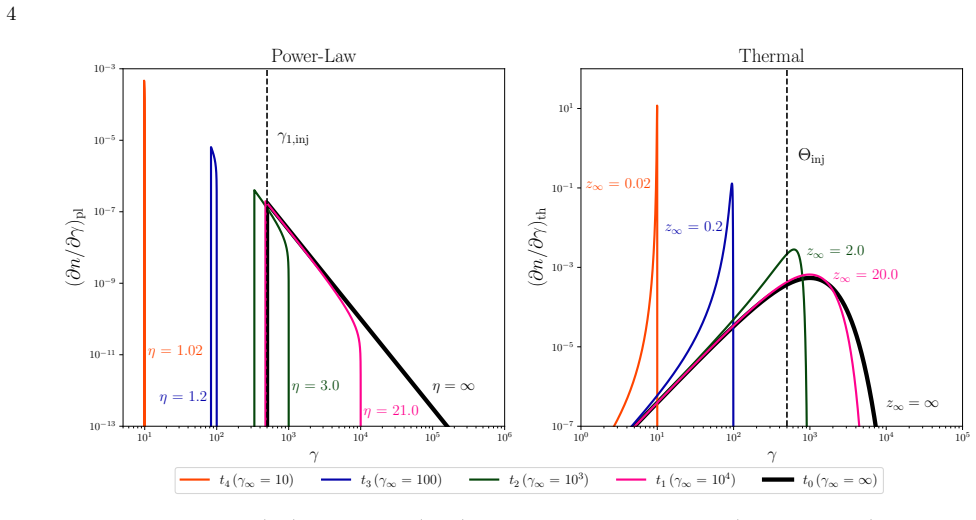
The paper's central claim is that the synchrotron radiation coefficients of a cooled, impulsively injected electron population can be written analytically. Starting from the cooling equation for an electron Lorentz factor and the resulting mapping from injected to cooled energy, the authors obtain explicit cooled distribution functions for a power-law and a relativistic Maxwellian injection. From these they derive dimensionless integrals for emissivity and absorption, and then produce fitting functions (Eqs. 33, 52, 79, 80) that stitch together exact low-frequency limits, an intermediate-frequency plateau, and steepest-descent high-frequency tails using sigmoid switches. The fits are validat
What carries the argument
The central object is the cooled distribution function, which acquires a smooth cutoff factor (1−γ/γ∞)^{p−2} for power laws and an analogous factor for thermal distributions, rather than a sharp cut at the maximum Lorentz factor. The fitting functions are assembled from three asymptotic pieces: an exact low-frequency limit expressed with hypergeometric functions, a flat intermediate-frequency plateau, and a high-frequency exponential tail obtained by a modified steepest-descent expansion of a strongly asymmetric integrand. Sigmoid functions blend the pieces. The novel feature relative to previous sharp-cutoff treatments is the smooth (1−γ/γ∞) factor, which changes the high-frequency behavior
Load-bearing premise
The derivation of the absorption coefficient ignores a Dirac-delta boundary term produced by the discontinuous drop of the distribution at the minimum Lorentz factor, and the fits inherit this approximation.
What would settle it
A numerical integration of the full absorption integral including the boundary term at the cutoff, evaluated for η near 1.1 and low frequencies, should agree with Equation (42) to the claimed accuracy; a disagreement larger than the reported errors would show the fits are incomplete.
If this is right
- Full-volume afterglow codes can replace per-cell numerical integrations with these analytic fits, cutting computational cost while retaining cooling physics.
- The same fits apply to any impulsively injected cooling distribution, so they extend to other synchrotron transients such as LFBOTs and jetted tidal disruption events.
- One-zone models can be calibrated by ray-averaging these local coefficients, giving a principled bridge between simplified and full-volume treatments.
- The comparison to chopped-off distributions quantifies when a sharp cutoff is acceptable (large η, low frequency) and when it is not (small η, high frequency), providing guidance for simpler modeling.
- The perpendicular-pitch-angle analogues extend the formalism to scenarios with a strong background magnetic field.
Where Pith is reading between the lines
- If the fits are as accurate as claimed, parameter-estimation codes that run many afterglow models could adopt them to include cooling consistently at negligible overhead, potentially shifting inferred shock microphysics.
- The weakest spot is the absorption boundary term at the minimum Lorentz factor; checking it numerically in the self-absorbed regime for η near 1.1 would tell whether the worst-case 56% error is intrinsic to the fitting strategy or to a missing physical term.
- The thermal fits assume no re-thermalization downstream; extending them to include a heating term would break the closed-form structure, so a useful test is to compare against a kinetic-equation solve when Coulomb heating is non-negligible.
- The steepest-descent error at very high frequencies is exponentially suppressed, so it is likely safe for observable bands, but a reader using these fits in the far Wien tail should treat large-y points with caution.
Editorial analysis
A structured set of objections, weighed in public.
Referee Report
Summary. The paper derives analytic fitting functions for synchrotron emissivity and absorption coefficients from impulsively injected electron populations that cool by synchrotron and adiabatic losses. For a power-law injection (Eq. 11) it constructs fits J_pl and A_pl (Eqs. 33 and 52) by joining exact low-frequency hypergeometric limits, intermediate-frequency constants, and steepest-descent high-frequency tails via sigmoid interpolation. For a relativistic Maxwellian injection (Eq. 12) it constructs J_th and A_th (Eqs. 79 and 80) using confluent-hypergeometric low-frequency limits and a fitted saddle-point approximation. The fits are compared with direct numerical integrals (Figs. 2–6) and with a GRB afterglow spectrum (Fig. 7), reporting typical percent-level errors with worst-case values around 56% for A_pl near η=1.14. Appendices provide perpendicular pitch-angle versions of the fitting functions.
Significance. If the claimed accuracy holds, these functions offer a practical and fast substitute for local numerical integrations in full-volume afterglow models. The paper's strengths are the careful asymptotic derivations (hypergeometric and steepest-descent limits), the explicit reporting of worst-case errors, the inclusion of perpendicular pitch-angle fits, and the end-to-end test against the Granot & Sari (2002) spectrum. The main caveat is that the fitted absorption coefficient omits a boundary term that the paper itself acknowledges in footnote 7 to be order-unity at low frequencies; the accompanying validation does not exercise the self-absorbed regime. The fitting functions involve many calibrated constants, and the quoted accuracy is in-sample, so independent confirmation is limited. Nevertheless, the central product—closed-form cooled radiation coefficients—is potentially valuable for emission codes.
major comments (2)
- [§3.2, Eq. 42; §3.2.2; footnote 7 in §3.4] The fitted absorption coefficient A_pl omits the Dirac-delta boundary term from the lower cutoff. Eq. 42 defines A_pl, and §3.2.2 states that boundary terms at x1 and x∞ are ignored, an approximation described as valid for η≫1. Footnote 7, however, says that at low frequencies the discontinuity at γ1 produces an order-unity difference in the absorption coefficient and necessitates an extra term proportional to the Dirac delta. These statements are in tension: the low-frequency branch χp (Eq. 43) is derived from the same boundary-term-free A_pl and is exactly the regime where the omitted term matters. The §5 afterglow test is slow cooling with ν_sa<ν_m and therefore does not exercise the self-absorbed regime. As written, Eq. 52 may fit a quantity that is not the physical absorption coefficient. Please either include the boundary term in the fitted quantity and refit, or restrict the domai
- [§3.3, Tables 1–3] The constants in Tables 1–3 and in Eqs. 31–39, 50–58, and 81–87 are calibrated against the same numerical integrals to which the fits are compared in Figs. 2–6. The reported mean errors are therefore interpolation errors, not independent predictive accuracy. The only semi-independent test, Fig. 7, is limited to slow-cooling spectra. Please state explicitly that the accuracy claims are based on in-sample comparisons, and if possible add a cross-validation or a parameter set outside the calibration region. This does not invalidate the fits, but the abstract and §3.3 should not be read as establishing independent verification.
minor comments (5)
- [§3.1.2 and §3.2.2] The text repeatedly says 'for η≪1' when discussing the intermediate-frequency regime. Since η≡γ∞/γ1 is always ≥1, this should read 'η−1≪1' or 'η close to 1'.
- [Tables 1–2, §3.1.4 and §3.2.3] The text refers to 4th-order polynomials in p, but the displayed sums run to j=5 (Σ_{j=0}^5). The table columns contain ℵ0–ℵ4, so the equations should read Σ_{j=0}^4.
- [Figure 2 caption, §3.3, Figure 3 caption] The reported maximum errors are inconsistent: Figure 2 caption says 58.2% and 56.4%; §3.3 says 56.4%; Figure 3 caption says 55.9%. Please clarify whether these are pointwise maxima or mean relative errors and make the numbers consistent.
- [§4.2, Eq. 78] The saddle-point fitting function z_s,fitted contains unexplained numerical constants (e.g., 2.7×10^4) and exponents. Since the accuracy of the thermal fits is exponentially sensitive to this function, please provide the fitting procedure, the error of this fit, or a reference/separate code release.
- [§4 and §6] Typos and wording: 'analgously' should be 'analogously' in §4; 'allow a for a quick' should be 'allow for a quick' in §1. Please proofread.
Circularity Check
No load-bearing circularity: the fitting constants are trained on the numerical integrals they reproduce, but the physical limits are independently derived and the central application is checked against the external Granot & Sari (2002) benchmark.
full rationale
The derivation chain is self-contained in the relevant sense. The cooled distribution functions (Eqs. 11-12) are closed-form solutions of the stated cooling ODE (Eq. 3). The emission and absorption integrals (Eqs. 18, 41-42, 60, 62) are the standard synchrotron coefficients applied to those distributions. The asymptotic limits (Eqs. 19-22, 43-46, 65-68) are obtained by hypergeometric evaluation or steepest descent, not by assuming the final fitted forms. The final fitting functions blend these limits with sigmoidal switches whose constants are explicitly fitted to numerical evaluations of the same exact integrals; the text says the forms were 'chosen to minimize error' and reports in-sample agreement in Figures 2-5. That is honest curve-fitting validation, not a prediction forced by construction, because the physical content (the asymptotic limits) is derived independently. The paper's external check in Figure 7 inserts the fits into the authors' full-volume code (Ferguson & Margalit 2026, a self-citation) but compares to Granot & Sari (2002), an independent analytic benchmark, with <10% error; that comparison is not forced by the fit construction, so the self-citation is not load-bearing. The Dirac-delta boundary-term issue flagged in §3.2.2 and footnote 7 is a genuine scope limitation: 'Any contribution from boundary terms at x1 or x∞ is ignored here' versus the footnote's statement that the γ1 discontinuity 'necessitates the inclusion of an extra term proportional to the Dirac delta.' The §5 check uses ν_sa < ν_m and therefore does not validate the absorption fits in the self-absorbed regime where the omitted boundary term matters. This weakens external support for A_pl but is an acknowledged physical/completeness caveat, not a circular derivation. Overall, no load-bearing circularity; score 0.
Axiom & Free-Parameter Ledger
free parameters (7)
- Power-law sigmoid coefficients a_i(p), b_i(p) (Tables 1 and 2) =
20 + 20 polynomial coefficients ℵ_j in p
- Perpendicular pitch-angle coefficients a⊥_i(p), b⊥_i(p) (Table 3) =
45 polynomial coefficients
- Power-law sigmoid shape constants α_i, β_i (Eqs 36-39, 55-58) =
explicit functions of p and η
- Thermal interpolation constants λ_i, μ_i, ρ, ζ, κ (Eqs 81-87) =
empirical functions of z∞
- Saddle-point fit z_s,fitted (Eq 78) =
2.7e4 / y0^4, exponents -2.019 and -0.495
- Transition frequency y_t (Eq 64) and its auxiliary κ =
smooth-min function of z∞
- Approximate synchrotron functions F̃, F, H̃, H (Eqs B13-B19) =
empirical fits from Aharonian et al. (2010)
axioms (7)
- standard math Relativistic synchrotron emissivity and absorption formulas (Rybicki & Lightman 1979), including pitch-angle averaging and the F/H functions.
- domain assumption Electrons cool only via synchrotron and adiabatic losses, with no inverse-Compton (Y=0), no re-thermalization/heating after injection, and no synchrotron self-absorption heating.
- domain assumption Impulsive injection of electrons at the shock front; the particle number in a fluid element is conserved and the mapping from injection to cooled Lorentz factor is one-to-one (Eq 2).
- domain assumption Injected distributions are a power-law with p>2 and γ≫1, or a relativistic Maxwellian; non-relativistic cyclo-synchrotron emission is ignored.
- domain assumption For the GRB application, the post-shock hydrodynamics is the Blandford-McKee self-similar solution (Appendix A).
- ad hoc to paper The discontinuity in the hybrid power-law+thermal distribution at γ1 is sub-leading and can be neglected, including the Dirac-delta boundary term in the absorption coefficient.
- standard math The steepest-descent formula (Eq 28) and the expanded saddle-point approximations apply in the high-frequency regime.
read the original abstract
Synchrotron emitting electrons can lose energy (`cool') through various processes including radiative losses (e.g., synchrotron or inverse-Compton cooling) and adiabatic expansion. Such cooling will shift electrons in energy-space and therefore change the electron distribution function. This in turn alters the nature of synchrotron emission and absorption from these electrons. In past literature these effects have typically been considered using either simplified one-zone frameworks, or using numerical methods as part of more accurate local modeling. In this work we extend the latter `local' treatment by deriving analytic expressions that are both accurate and more computationally efficient than previous numerical approaches. Considering two concrete cases of injected power-law and thermal electron distribution functions, we derive analytic fitting functions for the resulting emission and absorption coefficients including the effects of cooling. These fitting functions can be applied to synchrotron afterglow modeling from a variety of astrophysical sources, such as gamma-ray bursts (GRBs), luminous fast blue optical transients (LFBOTs), and jetted tidal disruption events (TDEs).
Figures


Reference graph
Works this paper leans on
-
[1]
Searching for the radio remnants of short-duration gamma-ray bursts. , keywords =. doi:10.1093/mnras/staa3241 , archivePrefix =. 2008.03659 , primaryClass =
Pith/arXiv arXiv 2008
-
[2]
Constraining the Long-lived Magnetar Remnants in Short Gamma-Ray Bursts from Late-time Radio Observations. , keywords =. doi:10.3847/1538-4357/ab6b24 , archivePrefix =. 1912.00399 , primaryClass =
Pith/arXiv arXiv 1912
-
[3]
Jets in Gamma-Ray Bursts. , keywords =. doi:10.1086/312109 , archivePrefix =. astro-ph/9903339 , primaryClass =
-
[4]
On the diversity of magnetar-driven kilonovae. , keywords =. doi:10.1093/mnras/stac2609 , archivePrefix =. 2205.14159 , primaryClass =
-
[5]
The radio and X-ray emission from type II supernovae. , keywords =. doi:10.1086/160167 , adsurl =
-
[6]
Radio transients from stellar tidal disruption by massive black holes. , keywords =. doi:10.1111/j.1365-2966.2011.19188.x , archivePrefix =. 1102.1429 , primaryClass =
arXiv 2011
-
[7]
Evolution of Nonradiative Supernova Remnants. , keywords =. doi:10.1086/313176 , adsurl =
-
[8]
Thermal Electrons in Mildly Relativistic Synchrotron Blast Waves. , keywords =. doi:10.3847/2041-8213/ac3d97 , archivePrefix =. 2111.00012 , primaryClass =
Pith/arXiv arXiv 2041
-
[9]
Images and Spectra from the Interior of a Relativistic Fireball. , keywords =. doi:10.1086/306884 , archivePrefix =. astro-ph/9806192 , primaryClass =
-
[10]
Synchrotron Self-Absorption in Gamma-Ray Burst Afterglow. , keywords =. doi:10.1086/308052 , archivePrefix =. astro-ph/9808007 , primaryClass =
-
[11]
The Astrophysical Journal , abstract =
Margalit, Ben and Quataert, Eliot , title =. The Astrophysical Journal , abstract =. 2024 , month =. doi:10.3847/1538-4357/ad8b47 , url =
-
[12]
Physics of Fluids , keywords =
Fluid dynamics of relativistic blast waves. Physics of Fluids , keywords =. doi:10.1063/1.861619 , adsurl =
-
[13]
Luminous Millimeter, Radio, and X-Ray Emission from ZTF 20acigmel (AT 2020xnd). , keywords =. doi:10.3847/1538-4357/ac4e97 , archivePrefix =. 2110.05490 , primaryClass =
-
[14]
Synchrotron Self-Absorption in Radio Supernovae. , keywords =. doi:10.1086/305676 , adsurl =
-
[15]
A Mildly Relativistic Outflow from the Energetic, Fast-rising Blue Optical Transient CSS161010 in a Dwarf Galaxy. , keywords =. doi:10.3847/2041-8213/ab8cc7 , archivePrefix =. 2003.10503 , primaryClass =
Pith/arXiv arXiv 2041
-
[16]
CSS 161010: A Luminous Fast Blue Optical Transient with Broad Blueshifted Hydrogen Lines. , keywords =. doi:10.3847/1538-4357/ad89a5 , archivePrefix =. 2408.04698 , primaryClass =
-
[17]
The acceleration of cosmic rays in shock fronts - I. , keywords =. doi:10.1093/mnras/182.2.147 , adsurl =
-
[18]
Particle acceleration by astrophysical shocks. , keywords =. doi:10.1086/182658 , adsurl =
-
[19]
, year = 1987, month = oct, volume =
Particle acceleration at astrophysical shocks: A theory of cosmic ray origin. , year = 1987, month = oct, volume =. doi:10.1016/0370-1573(87)90134-7 , adsurl =
-
[20]
Particle Acceleration in Relativistic Collisionless Shocks: Fermi Process at Last?. , keywords =. doi:10.1086/590248 , archivePrefix =. 0802.3216 , primaryClass =
-
[21]
Particle Acceleration in Relativistic Magnetized Collisionless Pair Shocks: Dependence of Shock Acceleration on Magnetic Obliquity. , keywords =. doi:10.1088/0004-637X/698/2/1523 , archivePrefix =. 0901.2578 , primaryClass =
-
[22]
Acceleration of Particles at the Termination Shock of a Relativistic Striped Wind. , keywords =. doi:10.1088/0004-637X/741/1/39 , archivePrefix =. 1107.0977 , primaryClass =
-
[23]
Simultaneous Acceleration of Protons and Electrons at Nonrelativistic Quasiparallel Collisionless Shocks. , keywords =. doi:10.1103/PhysRevLett.114.085003 , archivePrefix =. 1412.0672 , primaryClass =
-
[24]
Particle acceleration in high Mach number shocks
Kinetic simulations of mildly relativistic shocks - I. Particle acceleration in high Mach number shocks. , keywords =. doi:10.1093/mnras/stz232 , archivePrefix =. 1809.10809 , primaryClass =
-
[25]
An Embedded X-Ray Source Shines through the Aspherical AT 2018cow: Revealing the Inner Workings of the Most Luminous Fast-evolving Optical Transients. , keywords =. doi:10.3847/1538-4357/aafa01 , archivePrefix =. 1810.10720 , primaryClass =
-
[26]
AT2018cow: A Luminous Millimeter Transient. , keywords =. doi:10.3847/1538-4357/aaf473 , archivePrefix =. 1810.10880 , primaryClass =
-
[27]
A very luminous jet from the disruption of a star by a massive black hole. , keywords =. doi:10.1038/s41586-022-05465-8 , archivePrefix =. 2211.16530 , primaryClass =
-
[28]
A Possible Relativistic Jetted Outburst from a Massive Black Hole Fed by a Tidally Disrupted Star. Science , keywords =. doi:10.1126/science.1207150 , archivePrefix =. 1104.3257 , primaryClass =
-
[29]
Relativistic jet activity from the tidal disruption of a star by a massive black hole. , keywords =. doi:10.1038/nature10374 , archivePrefix =. 1104.4787 , primaryClass =
-
[30]
Thermal Electrons in Gamma-Ray Burst Afterglows. , keywords =. doi:10.3847/1538-4357/aa8268 , archivePrefix =. 1706.01885 , primaryClass =
-
[31]
A Semianalytic Afterglow with Thermal Electrons and Synchrotron Self-Compton Emission. , keywords =. doi:10.3847/1538-4357/ac2f43 , archivePrefix =. 2109.07687 , primaryClass =
-
[32]
Signatures of a Maxwellian component in shock-accelerated electrons in GRBs. , keywords =. doi:10.1111/j.1365-2966.2009.15454.x , archivePrefix =. 0905.1970 , primaryClass =
arXiv 2009
- [33]
-
[34]
Spectra and Light Curves of Gamma-Ray Burst Afterglows. , keywords =. doi:10.1086/311269 , archivePrefix =. astro-ph/9712005 , primaryClass =
-
[35]
The Shape of Spectral Breaks in Gamma-Ray Burst Afterglows. , keywords =. doi:10.1086/338966 , archivePrefix =. astro-ph/0108027 , primaryClass =
-
[36]
Energy-conserving Relativistic Corrections to Strong-shock Propagation. , keywords =. doi:10.3847/1538-4357/ab29e6 , archivePrefix =. 1905.11991 , primaryClass =
Pith/arXiv arXiv 1905
-
[37]
Hybrid Thermal-Nonthermal Synchrotron Emission from Hot Accretion Flows. , keywords =. doi:10.1086/309396 , archivePrefix =. astro-ph/0004195 , primaryClass =
-
[38]
Advection-dominated Accretion Flows in the Kerr Metric. I. Basic Equations. , keywords =. doi:10.1086/305521 , archivePrefix =. astro-ph/9705117 , primaryClass =
-
[39]
Thermal electrons in the radio afterglow of relativistic tidal disruption event ZTF22aaajecp/AT2022cmc. arXiv e-prints , keywords =. doi:10.48550/arXiv.2506.13618 , archivePrefix =. 2506.13618 , primaryClass =
-
[40]
The Formation of a Blast Wave by a Very Intense Explosion. I. Theoretical Discussion. Proceedings of the Royal Society of London Series A , year = 1950, month = mar, volume =. doi:10.1098/rspa.1950.0049 , adsurl =
arXiv 1950
-
[41]
Journal of Applied Mathematics and Mechanics , year = 1946, month = jan, volume =
Propagation of strong shock waves. Journal of Applied Mathematics and Mechanics , year = 1946, month = jan, volume =
1946
-
[42]
Day-time-scale variability in the radio light curve of the Tidal Disruption Event AT2022cmc: confirmation of a highly relativistic outflow. , keywords =. doi:10.1093/mnras/stad344 , archivePrefix =. 2301.12770 , primaryClass =
-
[43]
Synchrotron afterglow model for AT 2022cmc: jetted tidal disruption event or engine-powered supernova?. , keywords =. doi:10.1093/mnras/stad1182 , archivePrefix =. 2301.11939 , primaryClass =
-
[44]
The Afterglow, Energetics, and Host Galaxy of the Short-Hard Gamma-Ray Burst 051221a. , keywords =. doi:10.1086/506429 , archivePrefix =. astro-ph/0601455 , primaryClass =
-
[45]
Handbook of Supernovae , year = 2017, editor =
Thermal and Non-thermal Emission from Circumstellar Interaction. Handbook of Supernovae , year = 2017, editor =. doi:10.1007/978-3-319-21846-5_34 , adsurl =
-
[46]
A Decade of Short-duration Gamma-Ray Burst Broadband Afterglows: Energetics, Circumburst Densities, and Jet Opening Angles. , keywords =. doi:10.1088/0004-637X/815/2/102 , archivePrefix =. 1509.02922 , primaryClass =
-
[47]
Gamma-Ray Burst Afterglow Broadband Fitting Based Directly on Hydrodynamics Simulations. , keywords =. doi:10.1088/0004-637X/749/1/44 , archivePrefix =. 1110.5089 , primaryClass =
-
[48]
Gamma-Ray Burst Afterglows in the Multimessenger Era: Numerical Models and Closure Relations. , keywords =. doi:10.3847/1538-4357/ab93cf , archivePrefix =. 1909.11691 , primaryClass =
Pith/arXiv arXiv 1909
-
[49]
The Koala: A Fast Blue Optical Transient with Luminous Radio Emission from a Starburst Dwarf Galaxy at z = 0.27. , keywords =. doi:10.3847/1538-4357/ab8bcf , archivePrefix =. 2003.01222 , primaryClass =
Pith/arXiv arXiv 2003
-
[50]
The X-Ray and Radio Loud Fast Blue Optical Transient AT2020mrf: Implications for an Emerging Class of Engine-driven Massive Star Explosions. , keywords =. doi:10.3847/1538-4357/ac7a41 , archivePrefix =. 2112.00751 , primaryClass =
-
[51]
Radiative processes in astrophysics
-
[52]
Detectable radio flares following gravitational waves from mergers of binary neutron stars. , keywords =. doi:10.1038/nature10365 , archivePrefix =. 1102.1020 , primaryClass =
-
[53]
The electromagnetic signals of compact binary mergers. , keywords =. doi:10.1093/mnras/stt037 , archivePrefix =. 1204.6242 , primaryClass =
-
[54]
Mass ejection from neutron star mergers: different components and expected radio signals. , keywords =. doi:10.1093/mnras/stv620 , archivePrefix =. 1501.01986 , primaryClass =
-
[55]
Radio flares of compact binary mergers: the effect of non-trivial outflow geometry. , keywords =. doi:10.1093/mnras/stv1550 , archivePrefix =. 1503.06218 , primaryClass =
-
[56]
Shock within a shock: revisiting the radio flares of NS merger ejecta and gamma-ray burst-supernovae. , keywords =. doi:10.1093/mnras/staa1486 , archivePrefix =. 2004.13028 , primaryClass =
Pith/arXiv arXiv 2004
-
[57]
Modelling kilonova afterglows: Effects of the thermal electron population and interaction with GRB outflows. , keywords =. doi:10.1093/mnras/stad175 , archivePrefix =. 2208.01558 , primaryClass =
-
[58]
Gamma-Ray Burst Jets in Circumstellar Material: Dynamics, Breakout, and Diversity of Transients. , keywords =. doi:10.3847/1538-4357/addd13 , archivePrefix =. 2503.16242 , primaryClass =
-
[59]
The afterglow of a relativistic shock breakout and low-luminosity GRBs. , keywords =. doi:10.1093/mnras/stv011 , archivePrefix =. 1407.4475 , primaryClass =
-
[60]
, year = 1998, month = oct, volume =
Radio emission from the unusual supernova 1998bw and its association with the -ray burst of 25 April 1998. , year = 1998, month = oct, volume =. doi:10.1038/27139 , adsurl =
doi:10.1038/27139 1998
-
[61]
A fast X-ray transient from a weak relativistic jet associated with a type Ic-BL supernova. Nature Astronomy , keywords =. doi:10.1038/s41550-025-02571-1 , archivePrefix =. 2410.02315 , primaryClass =
-
[62]
Radio Observations of a Sample of Broad-line Type IC Supernovae Discovered by PTF/IPTF: A Search for Relativistic Explosions. , keywords =. doi:10.3847/0004-637X/830/1/42 , archivePrefix =. 1512.01303 , primaryClass =
-
[63]
Relativistic Shock Breakouts A Variety of Gamma-Ray Flares: From Low-luminosity Gamma-Ray Bursts to Type Ia Supernovae. , keywords =. doi:10.1088/0004-637X/747/2/88 , archivePrefix =. 1106.2556 , primaryClass =
-
[64]
Superluminal motion of a relativistic jet in the neutron-star merger GW170817. , keywords =. doi:10.1038/s41586-018-0486-3 , archivePrefix =. 1806.09693 , primaryClass =
-
[65]
A Decline in the X-Ray through Radio Emission from GW170817 Continues to Support an Off-axis Structured Jet. , keywords =. doi:10.3847/2041-8213/aad637 , archivePrefix =. 1805.02870 , primaryClass =
Pith/arXiv arXiv 2041
-
[66]
Evidence for X-Ray Emission in Excess to the Jet-afterglow Decay 3.5 yr after the Binary Neutron Star Merger GW 170817: A New Emission Component. , keywords =. doi:10.3847/2041-8213/ac504a , archivePrefix =. 2104.02070 , primaryClass =
Pith/arXiv arXiv 2041
-
[67]
jetsimpy: A Highly Efficient Hydrodynamic Code for Gamma-Ray Burst Afterglow. , keywords =. doi:10.3847/1538-4365/ad4d9d , archivePrefix =. 2402.19359 , primaryClass =
-
[68]
Radio Transients from Gamma-Ray Bursters. , keywords =. doi:10.1086/187102 , archivePrefix =. astro-ph/9307024 , primaryClass =
-
[69]
Optical and Long-Wavelength Afterglow from Gamma-Ray Bursts. , keywords =. doi:10.1086/303625 , archivePrefix =. astro-ph/9606043 , primaryClass =
-
[70]
How to Tell a Jet from a Balloon: A Proposed Test for Beaming in Gamma-Ray Bursts. , keywords =. doi:10.1086/310876 , archivePrefix =. astro-ph/9705163 , primaryClass =
-
[71]
The Dynamics and Light Curves of Beamed Gamma-Ray Burst Afterglows. , keywords =. doi:10.1086/307907 , archivePrefix =. astro-ph/9903399 , primaryClass =
-
[72]
Constraints on long-lived remnants of neutron star binary mergers from late-time radio observations of short duration gamma-ray bursts. , keywords =. doi:10.1093/mnras/stt2010 , archivePrefix =. 1310.4506 , primaryClass =
-
[73]
Testing the Magnetar Model via a Late-time Radio Observations of Two Macronova Candidates. , keywords =. doi:10.3847/2041-8205/819/2/L22 , archivePrefix =. 1601.01692 , primaryClass =
Pith/arXiv arXiv 2041
-
[74]
Radio Constraints on Long-lived Magnetar Remnants in Short Gamma-Ray Bursts. , keywords =. doi:10.3847/0004-637X/831/2/141 , archivePrefix =. 1607.00416 , primaryClass =
-
[75]
A Late-time Radio Survey of Short Gamma-ray Bursts at z < 0.5: New Constraints on the Remnants of Neutron-star Mergers. , keywords =. doi:10.3847/1538-4357/abb407 , archivePrefix =. 2006.07434 , primaryClass =
Pith/arXiv arXiv 2006
-
[76]
A model for fast extragalactic radio bursts. , keywords =. doi:10.1093/mnrasl/slu046 , archivePrefix =. 1401.6674 , primaryClass =
-
[77]
Fast radio bursts as synchrotron maser emission from decelerating relativistic blast waves. , keywords =. doi:10.1093/mnras/stz700 , archivePrefix =. 1902.01866 , primaryClass =
Pith/arXiv arXiv 1902
-
[78]
Implications of a Fast Radio Burst from a Galactic Magnetar. , keywords =. doi:10.3847/2041-8213/abac57 , archivePrefix =. 2005.05283 , primaryClass =
Pith/arXiv arXiv 2041
-
[79]
Constraints on the engines of fast radio bursts. , keywords =. doi:10.1093/mnras/staa1036 , archivePrefix =. 1911.05765 , primaryClass =
Pith/arXiv arXiv 1911
-
[80]
The Most Luminous Known Fast Blue Optical Transient AT 2024wpp: Unprecedented Evolution and Properties in the X-rays and Radio. arXiv e-prints , keywords =. doi:10.48550/arXiv.2509.00952 , archivePrefix =. 2509.00952 , primaryClass =
discussion (0)
Sign in with ORCID, Apple, or X to comment. Anyone can read and Pith papers without signing in.