REVIEW 3 major objections 6 minor 83 references
Planetary systems in a star cluster I: the Solar system scenario
T0 review · 3 major / 6 minor · reviewed 2026-08-14 · deepseek-v4-flash
Pith's one-line read Model open clusters eject 0.3%–5.3% of planets from Solar-system-like hosts within 50 Myr, while Jupiter shields the inner planets unless a star hits it directly.
desk verdict Solid simulation study with new Solar-system escape fractions; dense-cluster numbers rest on a nearest-neighbor-only approximation that should be tested, and conclusion (vi) needs fixing. read the letter →
The pith
A machine-rendered reading of the paper's core claim, the machinery that carries it, and where it could break.
The reading
What carries the argument
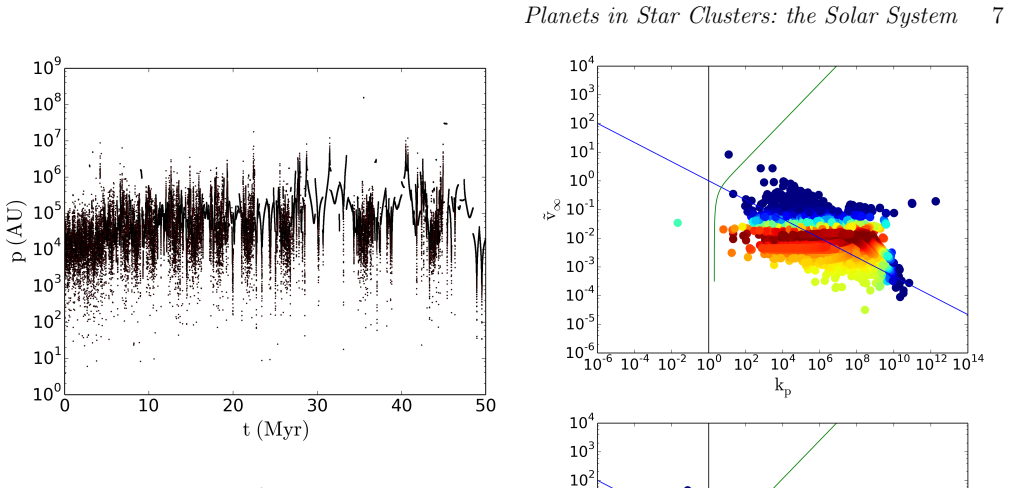
The carrying mechanism is the dimensionless encounter strength $k_p \approx (p/a_p)^{3/2}$, which compares a passing star's periastron distance $p$ to a planet's semi-major axis $a_p$: smaller $k_p$ means a stronger perturbation. Because the stellar tide falls as $r^{-3}$, the paper models each planetary system under the tidal force of only its nearest neighbouring star, while the cluster itself is evolved separately and the planets interact with each other through a full N-body integration. The encounter-strength scale converts cluster dynamics into per-planet perturbation rates, and it is what makes Jupiter (massive, moderately close in) a barrier while Uranus and Neptune (light, far out) are the first to go.
What would settle it
Re-run the densest model (10,000 stars, $r_{\rm vir}=1$ pc, $Q=0.5$) with the tidal force of every cluster star included instead of only the nearest neighbour, and compare the total escape fraction and the per-planet escape rates. If the 5.3% all-planet escape fraction shifts by more than the stated $0.6\%$ uncertainty, or if terrestrial ejections no longer require a prior Jupiter perturbation, the paper's central mechanism is contradicted by the simulation design itself.
Extended reading notes
Core claim
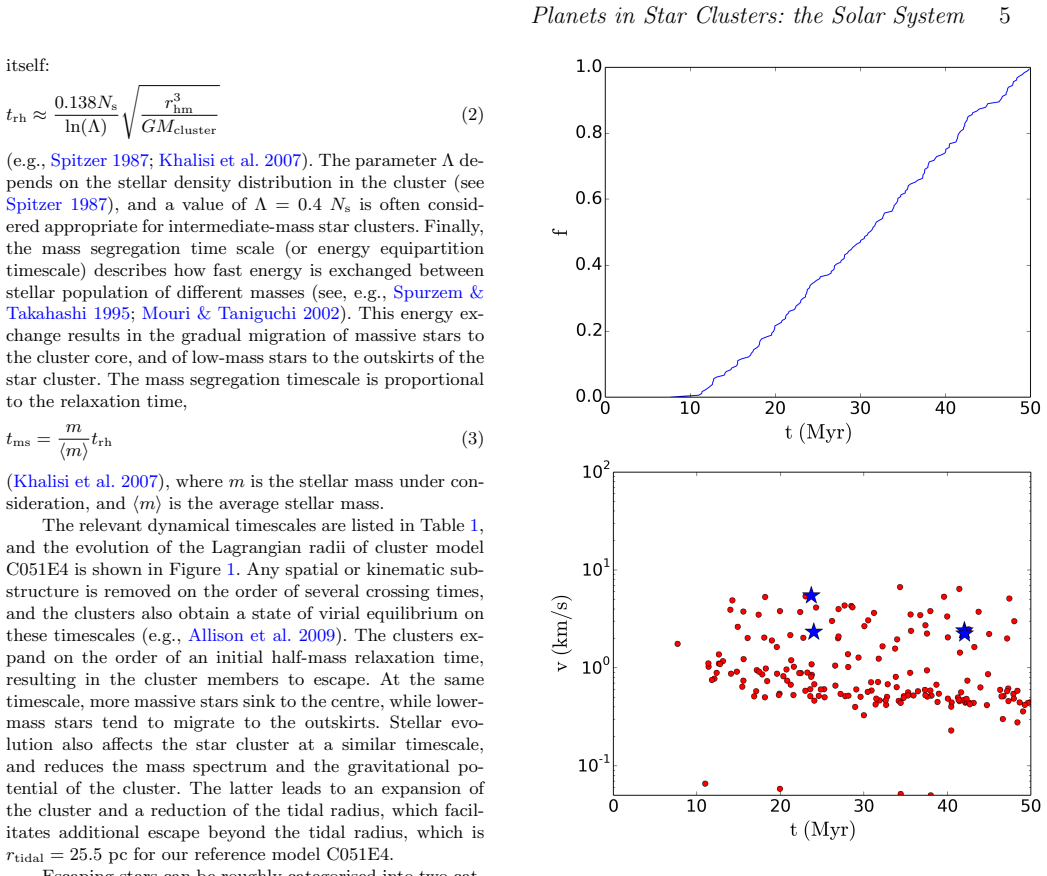
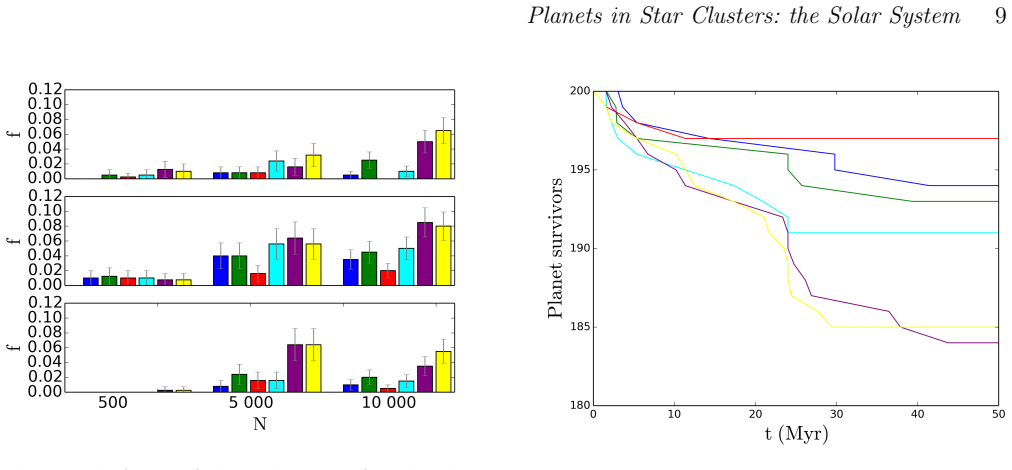
The paper claims that in clusters with initial virial radii of 1 pc and 500–10,000 stars, the fate of a Solar-system analogue over 50 Myr is set mostly by rare close stellar encounters, and that the response splits along mass and semi-major axis. Uranus and Neptune escape most often, either directly when an encounter throws an ice giant out, or indirectly when a flyby excites their eccentricities and planet-planet scattering finishes the job tens of millions of years later. Jupiter escapes least often because it is massive enough that only a direct stellar encounter can eject it, and while Jupiter stays on a quiet orbit it shields Earth and Mars. In low-density clusters this shielding protects habitable-zone planets; in high-density clusters, a perturbed Jupiter becomes the agent that destabilizes and ejects the terrestrial planets. Systems that leave the cluster at low speed typically leave intact, while fast escapes are preceded by disruption, which the paper reads as a hint that the Solar system, if it formed in a cluster, left it slowly.
Load-bearing premise
The entire calculation hangs on the assumption that the only stellar influence worth modeling is the tidal force of the nearest neighbouring star; if the accumulated pulls of many distant cluster stars, or the cluster's smooth potential, matter in the densest clusters, the quoted escape fractions and the Jupiter-barrier picture could change.
Editorial extensions
If this is right
- A Solar-system analogue that forms in a low-density cluster will usually keep all six planets for at least 50 Myr, with the outer ice giants as the dominant loss channels.
- Terrestrial-planet survival is tied to Jupiter: if a stellar encounter leaves Jupiter's orbit intact, Earth and Mars are protected even when Uranus and Neptune are ejected.
- Escape events can be delayed by tens of millions of years, so a cluster that has already dispersed can still be the source of free-floating planets from systems that were perturbed long before.
- Clusters that start in virial equilibrium are the harshest for planetary survival, while sub- and super-virial clusters expand quickly and reduce encounter rates.
- Identical initial planetary systems become observably diverse after 50 Myr of cluster processing, offering a dynamical explanation for the spread of exoplanet architectures.
Reading between the lines
- The nearest-neighbour-only approximation leaves a numerical avenue open: including all cluster-member tidal forces in the densest models could raise escape fractions and weaken the Jupiter-barrier effect; this is a test the paper does not perform.
- A testable extension of the barrier picture is that exoplanet systems without a gas-giant shield should show systematically different inner-planet loss rates in cluster environments than Solar-system analogues.
- The delayed-ejection channel implies that free-floating planets can appear around a cluster long after the encounter that destabilized them, so the age of a free-floating planet need not match the age of the last close encounter.
Signed reviews
Editorial analysis
A structured set of objections, weighed in public.
Referee Report
Summary. The paper studies the dynamical evolution of Solar-system-like planetary systems (Earth, Mars, Jupiter, Saturn, Uranus, Neptune) embedded in star clusters with N=500, 5,000, and 10,000 stars, virial ratios Q=0.4, 0.5, and 0.6, evolved for 50 Myr. Cluster dynamics is computed with NBODY6++GPU and planetary dynamics with REBOUND, coupled by interpolating the nearest neighbouring star as the only external perturber of each planetary system. The main quantitative results are per-planet escape fractions (e.g., 1.5%-8.5% in the reference model C051E4, Table 3), the overall range 0.3%-5.3%, the observation that Jupiter is the least likely planet to escape and often acts as a dynamical barrier for the terrestrial planets, and the conclusion that planetary systems escaping the cluster at low speed tend to remain intact. The paper also characterises most encounters as tidal, hyperbolic, and adiabatic, and reports delayed planetary ejections occurring up to tens of Myr after a stellar encounter.
Significance. If the results survive the methodological checks below, the paper provides useful quantitative predictions for the dynamical processing of Solar-system analogues in star clusters: per-planet escape fractions, delayed ejections, and a falsifiable 'Jupiter barrier' mechanism that can be compared with exoplanet surveys and cluster observations. Strengths include the use of well-established integrators (REBOUND, NBODY6++GPU), an isolated-system control run (Figure 6) showing that internal dynamics alone does not produce ejections, well-specified Plummer/Kroupa initial conditions, and explicit binomial error bars on escape statistics. The escape fractions are direct simulation outputs rather than results of fitting to target outcomes, which is a further strength. The paper also clearly acknowledges the omission of primordial binaries and of Mercury and Venus as simplifying assumptions.
major comments (3)
- [§3.2, Tables 3–4, and Conclusion (vii)] The central escape fractions and the Jupiter-barrier conclusion rest on modelling only the instantaneous nearest neighbouring star as an external perturber of each planetary system. The r^-3 scaling of the tidal acceleration makes this plausible in sparse environments, but in the N=10,000, rvir=1 pc models the smooth cluster tidal field and the second and third neighbours can jointly contribute a substantial fraction (tens of per cent) of the nearest-neighbour tidal term. The assertion in §3.2.1 that the three-body assumption is good 'in the majority of cases' is not quantified, and no control calculation is provided with the full cluster tidal field or with several neighbours included. Because the quoted escape fractions are small (Table 3: 1.5%-8.5% per planet), unmodelled perturbations of this order could change individual planet escape counts by factors of order two and alter the inferred protective role of Jupiter. I request either a control run with a full cluster tidal field (or at least the first few neighbours) or a quantitative estimate of the neglected terms in the dense models.
- [§2.3 and Table 3] A planet is counted as an escaper when its eccentricity relative to the host star exceeds 0.995, which is below the parabolic limit e=1 and does not verify that the planet is actually unbound. A planet with 0.995<e<1 is formally bound and could return to pericentre, yet it would already be counted as an escaper and removed from the bound population. Since the per-planet escape fractions are small (e.g., Jupiter 1.5%, Uranus 8.5%), this threshold choice can change the reported rates and the relative ordering on which the Jupiter-barrier interpretation is based. Please provide a sensitivity test using e>1 or actual hyperbolic detection, and report how many events have eccentricity in the interval (0.995, 1] at the time of removal.
- [§2.1–§2.2, Tables 1–3] The paper refers to an 'ensemble' but does not state the number of independent star-cluster realisations per model. Table 1 lists Nhosts=25, 125, or 200 planet-hosting stars, which appears to be the number of planetary systems within one Plummer realisation of each model. The error bars in Tables 2 and 3 therefore appear to be within-cluster binomial uncertainties and do not include cluster-to-cluster variance from different random realisations of the same (N, Q) model. Given the small number of escape events and the stochastic nature of cluster evolution and encounters, the trends in Figure 7 and the global 0.3%-5.3% range could shift with different cluster realisations. Please state explicitly how many independent cluster simulations were performed; if it is one per model, add several independent realisations for at least a subset of models and quantify the realisation-to-realisation scatter.
minor comments (6)
- [Eq. (10)] The definition of the encounter strength parameter contains an internal inconsistency: the first expression uses (p/ap)^3 while the approximation in the same equation and the subsequent text use (p/ap)^{3/2}, consistent with Eq. (13). Please correct the exponent and check the related expression in Eq. (15).
- [Conclusion (vi)] The conclusion states that the retention rate increases with semi-major axis, but §3.4.1 and Figure 7 show that escape rates increase with semi-major axis; the word should presumably be 'decreases'.
- [Abstract] The abstract contains a duplicated sentence: 'We investigate the evolution of planetary systems in star clusters' immediately follows 'Here, we numerically explore the evolution of planetary systems similar to our own Solar system in star clusters.'
- [Figure 7 caption] The caption does not define the error bars; please state explicitly that they are 1-sigma binomial uncertainties (or describe the statistic used).
- [§3.2] The phrase 'a set of seventh-order septic splines' is redundant because 'septic' already means seventh-order; please rephrase.
- [Table 3 heading] The heading 'Fraction of escapers among all the planets that were initially present in the planetary systems anymore at time 50 Myr' is ungrammatical; please rephrase for clarity.
Circularity Check
No significant circularity: escape fractions are simulation outputs, not fitted or definitionally derived quantities.
full rationale
The paper's central quantitative claims, the per-planet escape fractions (Table 3, 1.5% for Jupiter to 8.5% for Uranus in C051E4) and the overall ranges of 0.3%–5.3%, are direct outputs of N-body integrations in REBOUND coupled to NBODY6++GPU through the LonelyPlanets pipeline. No parameter is fitted to the escape fractions, and no analytic expression for the escape rate is derived from an input that already contains the answer. The encounter-strength formalism (kp, v_infinity, tidal/adiabatic boundaries) is taken from the independent literature (Heggie & Rasio 1996; Spurzem et al. 2009; Heggie 2006), and is used to characterise encounters rather than to predict the escape counts. The nearest-neighbour-only tidal model is inherited from Cai et al. (2017), which includes co-authors of the present paper, but this is a methodological choice with stated limitations, not a result that is made true by definition. The paper explicitly acknowledges the approximation and its idealisations: 'we only model the effect of the nearest neighbour, following the approach of Cai et al. (2017)' and notes that 'in the majority of the cases this is a good assumption.' It even brackets the two neglected contributions (other cluster stars and planet-planet forces during the encounter) and runs an isolated-planetary-system control to establish that the cluster perturbations, not internal dynamics, drive the observed evolution. The Jupiter-barrier conclusion (vii) is an interpretation of the ensemble outcomes, supported by the measured correlation between perturbed-Jupiter events and terrestrial-planet ejections; it is not imposed by construction. There is no self-definitional step, no fitted input relabelled as a prediction, no load-bearing uniqueness theorem imported from the authors' prior work, and no renaming of a known result presented as new. The paper is therefore self-contained with respect to circularity, and any concerns about the nearest-neighbour approximation belong to modelling accuracy or robustness, not to circularity of the derivation.
Assumptions & free parameters
free parameters (2)
- Planet escape eccentricity threshold e_esc =
0.995
- Star cluster escape radius factor =
2 r_tidal
assumptions (5)
- domain assumption Planetary bodies are test particles; their gravity does not affect stellar dynamics
- domain assumption Only the nearest neighboring star perturbs a planetary system at any time
- domain assumption Stellar encounters are isolated hyperbolic orbits; no primordial binaries
- domain assumption Cluster initial conditions are idealized Plummer models without gas, rotation, or substructure
- domain assumption The present-day Solar system with Mercury and Venus removed represents the initial planetary configuration
Cite this review
Pith. "Pith review of Planetary systems in a star cluster I: the Solar system scenario." pith.science (2026). https://pith.science/paper/MFAR25HR
@misc{pith2026190807747,
  author       = {Pith},
  title        = {Pith review of: Planetary systems in a star cluster I: the Solar system scenario},
  year         = {2026},
  howpublished = {\url{https://pith.science/paper/MFAR25HR}},
  note         = {Machine review of arXiv:1908.07747}
}
read the original abstract
Young stars are mostly found in dense stellar environments, and even our own Solar system may have formed in a star cluster. Here, we numerically explore the evolution of planetary systems similar to our own Solar system in star clusters. We investigate the evolution of planetary systems in star clusters. Most stellar encounters are tidal, hyperbolic, and adiabatic. A small fraction of the planetary systems escape from the star cluster within 50 Myr; those with low escape speeds often remain intact during and after the escape process. While most planetary systems inside the star cluster remain intact, a subset is strongly perturbed during the first 50 Myr. Over the course of time, 0.3 % - 5.3 % of the planets escape, sometimes up to tens of millions of years after a stellar encounter occurred. Survival rates are highest for Jupiter, while Uranus and Neptune have the highest escape rates. Unless directly affected by a stellar encounter itself, Jupiter frequently serves as a barrier that protects the terrestrial planets from perturbations in the outer planetary system. In low-density environments, Jupiter provides protection from perturbations in the outer planetary system, while in high-density environments, direct perturbations of Jupiter by neighbouring stars is disruptive to habitable-zone planets. The diversity amongst planetary systems that is present in the star clusters at 50 Myr, and amongst the escaping planetary systems, is high, which contributes to explaining the high diversity of observed exoplanet systems in star clusters and in the Galactic field
Figures

Figures from the paper (8 more)




Reference graph
Works this paper leans on
-
[1]
, " * write output.state after.block = add.period write newline
ENTRY address archivePrefix author booktitle chapter doi edition editor eprint howpublished institution journal key month note number organization pages publisher school series title misctitle type volume year version url label extra.label sort.label short.list INTEGERS output.state before.all mid.sentence after.sentence after.block FUNCTION init.state.co...
-
[2]
write newline
" write newline "" before.all 'output.state := FUNCTION format.doi doi empty "" "doi:" doi * if FUNCTION format.url url empty "" new.block "" url * "" * if FUNCTION format.eprint eprint empty "" archivePrefix empty "" archivePrefix ":" * if eprint field.or.null * if FUNCTION format.pid eprint empty format.doi format.eprint if FUNCTION n.dashify 't := "" t...
-
[3]
]&<h^l+Mu l'
thebibliography [1] 20pt to REFERENCES 6pt =0pt 10pt plus 3pt =0pt =0pt =1pt plus 1pt =0pt =0pt -12pt =13pt plus 1pt =20pt =13pt plus 1pt \@M =10000 =-1.0em =0pt =0pt 0pt =0pt =1.0em @enumiv\@empty 10000 10000 `\.\@m \@noitemerr \@latex@warning Empty `thebibliography' environment \@ifnextchar \@reference \@latexerr Missing key on reference command Each re...
2016
-
[4]
Aarseth S. J., 1999, @doi [Celest. Mech. Dyn. Astron.] 10.1023/A:1008390828807 , http://adsabs.harvard.edu/abs/1999CeMDA..73..127A 73, 127
-
[5]
J., 2010, Gravitational N-Body Simulations
Aarseth S. J., 2010, Gravitational N-Body Simulations . Cambridge Monographs on Mathematical Physics
work page 2010
-
[6]
C., 2010, @doi [ ] 10.1146/annurev-astro-081309-130830 , http://adsabs.harvard.edu/abs/2010ARA
Adams F. C., 2010, @doi [ ] 10.1146/annurev-astro-081309-130830 , http://adsabs.harvard.edu/abs/2010ARA
-
[7]
Allison R. J., Goodwin S. P., Parker R. J., de Grijs R., Portegies Zwart S. F., Kouwenhoven M. B. N., 2009, @doi [ ] 10.1088/0004-637X/700/2/L99 , http://adsabs.harvard.edu/abs/2009ApJ...700L..99A 700, L99
-
[8]
Belczynski K., Kalogera V., Bulik T., 2002, @doi [ ] 10.1086/340304 , http://adsabs.harvard.edu/abs/2002ApJ...572..407B 572, 407
doi:10.1086/340304 2002
Show all 83 references
-
[9]
Princeton University Press
Binney J., Tremaine S., 2008, Galactic Dynamics: Second Edition . Princeton University Press
2008
-
[10]
X., Meiron Y., Kouwenhoven M., Assmann P., Spurzem R., 2015, ApJ, 219, 12
Cai M. X., Meiron Y., Kouwenhoven M., Assmann P., Spurzem R., 2015, ApJ, 219, 12
2015
-
[11]
X., Kouwenhoven M
Cai M. X., Kouwenhoven M. B. N., Portegies Zwart S. F., Spurzem R., 2017, @doi [ ] 10.1093/mnras/stx1464 , http://adsabs.harvard.edu/abs/2017MNRAS.470.4337C 470, 4337
2017 doi
-
[12]
X., Portegies Zwart S., van Elteren A., 2018, @doi [ ] 10.1093/mnras/stx3064 , http://adsabs.harvard.edu/abs/2018MNRAS.474.5114C 474, 5114
Cai M. X., Portegies Zwart S., van Elteren A., 2018, @doi [ ] 10.1093/mnras/stx3064 , http://adsabs.harvard.edu/abs/2018MNRAS.474.5114C 474, 5114
2018 doi
-
[13]
X., Portegies Zwart S., Kouwenhoven M
Cai M. X., Portegies Zwart S., Kouwenhoven M. B. N., Spurzem R., 2019, arXiv e-prints, http://adsabs.harvard.edu/abs/2019arXiv190302316C
2019
-
[14]
E., 1999, @doi [ ] 10.1046/j.1365-8711.1999.02379.x , http://adsabs.harvard.edu/abs/1999MNRAS.304..793C 304, 793
Chambers J. E., 1999, @doi [ ] 10.1046/j.1365-8711.1999.02379.x , http://adsabs.harvard.edu/abs/1999MNRAS.304..793C 304, 793
1999
-
[15]
X., Spurzem R., Kouwenhoven M
Flammini Dotti F., Cai M. X., Spurzem R., Kouwenhoven M. B. N., 2018, arXiv e-prints, http://adsabs.harvard.edu/abs/2018arXiv181112660F
2018
-
[16]
S., Hori Y., 2019, @doi [ ] 10.1051/0004-6361/201834677 , https://ui.adsabs.harvard.edu/abs/2019A&A...624A.110F 624, A110
Fujii M. S., Hori Y., 2019, @doi [ ] 10.1051/0004-6361/201834677 , https://ui.adsabs.harvard.edu/abs/2019A&A...624A.110F 624, A110
2019 doi
-
[17]
S., Portegies Zwart S., 2015, @doi [ ] 10.1093/mnras/stv293 , http://adsabs.harvard.edu/abs/2015MNRAS.449..726F 449, 726
Fujii M. S., Portegies Zwart S., 2015, @doi [ ] 10.1093/mnras/stv293 , http://adsabs.harvard.edu/abs/2015MNRAS.449..726F 449, 726
2015 doi
-
[18]
S., Saitoh T
Fujii M. S., Saitoh T. R., Portegies Zwart S. F., 2012, Apjl, 753, 12
2012
-
[20]
Giersz M., Spurzem R., 2003, @doi [ ] 10.1046/j.1365-8711.2003.06717.x , http://adsabs.harvard.edu/abs/2003MNRAS.343..781G 343, 781
2003
-
[21]
S., 2012, @doi [ ] 10.1111/j.1365-2966.2011.20250.x , http://adsabs.harvard.edu/abs/2012MNRAS.420.3264G 420, 3264
Girichidis P., Federrath C., Allison R., Banerjee R., Klessen R. S., 2012, @doi [ ] 10.1111/j.1365-2966.2011.20250.x , http://adsabs.harvard.edu/abs/2012MNRAS.420.3264G 420, 3264
2012
-
[22]
P., Whitworth A
Goodwin S. P., Whitworth A. P., 2004, @doi [ ] 10.1051/0004-6361:20031529 , http://adsabs.harvard.edu/abs/2004A
2004 doi
-
[23]
Gould A., et al., 2014, @doi [Science] 10.1126/science.1251527 , http://adsabs.harvard.edu/abs/2014Sci...345...46G 345, 46
2014 doi
-
[24]
V., Gualandris A., Portegies Zwart S., 2009, @doi [ ] 10.1111/j.1365-2966.2009.14809.x , http://adsabs.harvard.edu/abs/2009MNRAS.396..570G 396, 570
Gvaramadze V. V., Gualandris A., Portegies Zwart S., 2009, @doi [ ] 10.1111/j.1365-2966.2009.14809.x , http://adsabs.harvard.edu/abs/2009MNRAS.396..570G 396, 570
2009
-
[25]
Hao W., Kouwenhoven M. B. N., Spurzem R., 2013, @doi [MNRAS] 10.1093/mnras/stt771 , 433, 867
2013 doi
-
[26]
C., 2006, Gravitational Scattering
Heggie D. C., 2006, Gravitational Scattering . University of Turku, p. 20
2006
-
[27]
C., Rasio F
Heggie D. C., Rasio F. A., 1996, MNRAS, 282, 1064
1996
-
[28]
Hester J., Healy K., Desch S., 2004, AAS, 36, 1516
2004
-
[29]
A., 2005, STScI Symposium Series, http://adsabs.harvard.edu/abs/2005astro.ph.11083H 19, 20
Hillenbrand L. A., 2005, STScI Symposium Series, http://adsabs.harvard.edu/abs/2005astro.ph.11083H 19, 20
2005
-
[30]
R., Pols O
Hurley J. R., Pols O. R., Tout C. A., 2000, @doi [ ] 10.1046/j.1365-8711.2000.03426.x , http://adsabs.harvard.edu/abs/2000MNRAS.315..543H 315, 543
2000
-
[31]
R., Tout C
Hurley J. R., Tout C. A., Pols O. R., 2002, @doi [ ] 10.1046/j.1365-8711.2002.05038.x , http://adsabs.harvard.edu/abs/2002MNRAS.329..897H 329, 897
2002
-
[33]
R., Tout C
Hurley J. R., Tout C. A., Pols O. R., 2013b, BSE: Binary Star Evolution , Astrophysics Source Code Library ( @eprint ascl 1303.014 )
-
[34]
R., Pols O
Hurley J. R., Pols O. R., Tout C. A., 2013a, SSE: Single Star Evolution , Astrophysics Source Code Library ( @eprint ascl 1303.015 )
-
[35]
Khalisi E., Amaro-Seoane P., Spurzem R., 2007, @doi [ ] 10.1111/j.1365-2966.2006.11184.x , http://adsabs.harvard.edu/abs/2007MNRAS.374..703K 374, 703
2007
-
[36]
L., 2007, ApJ, 670, 747
Kobulnicky H., Fryer C. L., 2007, ApJ, 670, 747
2007
-
[37]
Kokubo E., Yoshinaga K., Makino J., 1998, @doi [ ] 10.1046/j.1365-8711.1998.01581.x , http://adsabs.harvard.edu/abs/1998MNRAS.297.1067K 297, 1067
1998
-
[38]
Kouwenhoven M. B. N., Brown A. G. A., Zinnecker H., Kaper L., Portegies Zwart S. F., 2005, @doi [ ] 10.1051/0004-6361:20048124 , http://adsabs.harvard.edu/abs/2005A
2005 doi
-
[39]
Kouwenhoven M. B. N., Brown A. G. A., Portegies Zwart S. F., Kaper L., 2007, @doi [ ] 10.1051/0004-6361:20077719 , http://adsabs.harvard.edu/abs/2007A
2007 doi
-
[40]
Kroupa P., 2001, @doi [ ] 10.1046/j.1365-8711.2001.04022.x , http://adsabs.harvard.edu/abs/2001MNRAS.322..231K 322, 231
2001
-
[41]
J., Lada E
Lada C. J., Lada E. A., 2003, @doi [ ] 10.1146/annurev.astro.41.011802.094844 , http://adsabs.harvard.edu/abs/2003ARA
2003 arXiv
-
[42]
Lamers H. J. G. L. M., Gieles M., Portegies Zwart S. F., 2005, @doi [ ] 10.1051/0004-6361:20041476 , http://adsabs.harvard.edu/abs/2005A
2005 doi
-
[43]
W., 2006, in Backer D
Looney L. W., 2006, in Backer D. C., Moran J. M., Turner J. L., eds, Astronomical Society of the Pacific Conference Series Vol. 356, Revealing the Molecular Universe: One Antenna is Never Enough. p. 177
2006
-
[44]
B., Church R
Malmberg D., de Angeli F., Davies M. B., Church R. P., Mackey D., Wilkinson M. I., 2007, @doi [ ] 10.1111/j.1365-2966.2007.11885.x , http://adsabs.harvard.edu/abs/2007MNRAS.378.1207M 378, 1207
2007
-
[45]
B., Heggie D
Malmberg D., Davies M. B., Heggie D. C., 2011, @doi [ ] 10.1111/j.1365-2966.2010.17730.x , http://adsabs.harvard.edu/abs/2011MNRAS.411..859M 411, 859
2011
-
[46]
A., 2008, in Vesperini E., Giersz M., Sills A., eds, IAU Symposium Vol
Mardling R. A., 2008, in Vesperini E., Giersz M., Sills A., eds, IAU Symposium Vol. 246, Dynamical Evolution of Dense Stellar Systems. pp 199--208, @doi 10.1017/S1743921308015615
2008 doi
-
[47]
W., Vanderburg A., et al 2018, ApJ, 136, 25
Mayo A. W., Vanderburg A., et al 2018, ApJ, 136, 25
2018
-
[48]
453, Advances in Computational Astrophysics: Methods, Tools, and Outcome
McMillan S., Portegies Zwart S., van Elteren A., Whitehead A., 2012, in Capuzzo-Dolcetta R., Limongi M., Tornamb \`e A., eds, Astronomical Society of the Pacific Conference Series Vol. 453, Advances in Computational Astrophysics: Methods, Tools, and Outcome. p. 129
2012
-
[49]
J., 1993, @doi [Celest
Mikkola S., Aarseth S. J., 1993, @doi [Celest. Mech. Dyn. Astron.] 10.1007/BF00695714 , http://adsabs.harvard.edu/abs/1993CeMDA..57..439M 57, 439
1993 doi
-
[50]
J., 1998, @doi [NewA] 10.1016/S1384-1076(98)00018-9 , http://adsabs.harvard.edu/abs/1998NewA....3..309M 3, 309
Mikkola S., Aarseth S. J., 1998, @doi [NewA] 10.1016/S1384-1076(98)00018-9 , http://adsabs.harvard.edu/abs/1998NewA....3..309M 3, 309
1998 doi
-
[51]
Mouri H., Taniguchi Y., 2002, @doi [ ] 10.1086/343851 , http://adsabs.harvard.edu/abs/2002ApJ...580..844M 580, 844
2002 doi
-
[52]
Olczak C., Kaczmarek T., Harfst S., Pfalzner S., Portegies Zwart S., 2012, ApJ, 756, 15
2012
-
[53]
J., Wright N
Parker R. J., Wright N. J., Goodwin S. P., Meyer M. R., 2014, @doi [ ] 10.1093/mnras/stt2231 , http://adsabs.harvard.edu/abs/2014MNRAS.438..620P 438, 620
2014 doi
-
[54]
I., van Elteren A., de Vries N., McMillan S
Pelupessy F. I., van Elteren A., de Vries N., McMillan S. L. W., Drost N., Portegies Zwart S. F., 2013, VizieR Online Data Catalog, http://adsabs.harvard.edu/abs/2013yCat..35570084P 355
2013
-
[55]
B., Kouwenhoven M
Perets H. B., Kouwenhoven M. B. N., 2012, @doi [ ] 10.1088/0004-637X/750/1/83 , http://adsabs.harvard.edu/abs/2012ApJ...750...83P 750, 83
2012 doi
-
[56]
C., 1911, @doi [ ] 10.1093/mnras/71.5.460 , http://adsabs.harvard.edu/abs/1911MNRAS..71..460P 71, 460
Plummer H. C., 1911, @doi [ ] 10.1093/mnras/71.5.460 , http://adsabs.harvard.edu/abs/1911MNRAS..71..460P 71, 460
1911 doi
-
[57]
Portegies Zwart S., 2011, AMUSE: Astrophysical Multipurpose Software Environment , Astrophysics Source Code Library ( @eprint ascl 1107.007 )
2011
-
[58]
F., 2016, @doi [ ] 10.1093/mnras/stv2831 , http://adsabs.harvard.edu/abs/2016MNRAS.457..313P 457, 313
Portegies Zwart S. F., 2016, @doi [ ] 10.1093/mnras/stv2831 , http://adsabs.harvard.edu/abs/2016MNRAS.457..313P 457, 313
2016 doi
-
[59]
AAS, @doi 10.1088/978-0-7503-1320-9
Portegies Zwart S., McMillan S., 2018, Astrophysical Recipes; The art of AMUSE . AAS, @doi 10.1088/978-0-7503-1320-9
2018 doi
-
[60]
Portegies Zwart S., Pelupessy I., van Elteren A., Wijnen T. P. G., Lugaro M., 2018, @doi [ ] 10.1051/0004-6361/201732060 , http://adsabs.harvard.edu/abs/2018A
2018 doi
-
[61]
Portell de Mora J., Garc \' a-Berro E., Estepa C., Casta \ n eda J., Clotet M., 2011, in High-Performance Computing in Remote Sensing. p. 818305, @doi 10.1117/12.898203
2011 doi
-
[62]
Pu B., Lai D., 2018, @doi [ ] 10.1093/mnras/sty1098 , http://adsabs.harvard.edu/abs/2018MNRAS.478..197P 478, 197
2018 doi
-
[63]
Rein H., Liu S.-F., 2012, @doi [ ] 10.1051/0004-6361/201118085 , http://adsabs.harvard.edu/abs/2012A
2012 doi
-
[64]
Roy A., Haddow M., 2003, Celest. Mech. Dyn. Astron., http://adsabs.harvard.edu/abs/2003CeMDA..87..411R 87, 411
2003
-
[65]
Sabbi E., et al., 2012, @doi [ ] 10.1088/2041-8205/754/2/L37 , http://adsabs.harvard.edu/abs/2012ApJ...754L..37S 754, L37
2012 doi
-
[66]
Shara M., Hurley J., Mardling R., 2016, ApJ, 816, 8
2016
-
[67]
Shatsky N., Tokovinin A., 2002, @doi [ ] 10.1051/0004-6361:20011542 , http://adsabs.harvard.edu/abs/2002A
2002 doi
-
[68]
Princeton University Press
Spitzer L., 1987, Dynamical evolution of globular clusters . Princeton University Press
1987
-
[69]
Spurzem R., 1999, Journal of Computational and Applied Mathematics, http://adsabs.harvard.edu/abs/1999JCoAM.109..407S 109, 407
1999
-
[70]
Spurzem R., Giersz M., 1996, @doi [ ] 10.1093/mnras/283.3.805 , http://adsabs.harvard.edu/abs/1996MNRAS.283..805S 283
1996 doi
-
[71]
Spurzem R., Takahashi K., 1995, @doi [ ] 10.1093/mnras/272.4.772 , http://adsabs.harvard.edu/abs/1995MNRAS.272..772S 272, 772
1995 doi
-
[72]
C., Lin D
Spurzem R., Giersz M., Heggie D. C., Lin D. N. C., 2009, @doi [ ] 10.1088/0004-637X/697/1/458 , http://adsabs.harvard.edu/abs/2009ApJ...697..458S 697, 458
2009 doi
-
[73]
791, Jets From Young Stars V
Tapamo H., 2009, in Gracia J., de Colle F., Downes T., eds, Lecture Notes in Physics, Berlin Springer Verlag Vol. 791, Jets From Young Stars V. p. 3, @doi 10.1007/978-3-642-03370-4_1
2009 doi
-
[74]
Thies I., Kroupa P., Theis C., 2005, @doi [ ] 10.1111/j.1365-2966.2005.09644.x , http://adsabs.harvard.edu/abs/2005MNRAS.364..961T 364, 961
2005
-
[75]
Thompson S., et al., 2018, ApJ, 235, 49
2018
-
[76]
Vinncke K., Pfalzner S., 2018, ApJ, 868, 14
2018
-
[77]
Wang L., Kouwenhoven M. B. N., Zheng X., Church R. P., Davies M. B., 2015a, @doi [ ] 10.1093/mnras/stv542 , http://adsabs.harvard.edu/abs/2015MNRAS.449.3543W 449, 3543
-
[78]
Wang L., Spurzem R., Aarseth S., Nitadori K., Berczik P., Kouwenhoven M. B. N., Naab T., 2015b, @doi [MNRAS] 10.1093/mnras/stv817 , 450, 4070
-
[79]
Wang L., et al., 2016, @doi [ ] 10.1093/mnras/stw274 , http://adsabs.harvard.edu/abs/2016MNRAS.458.1450W 458, 1450
2016 doi
-
[80]
Yoshinaga K., Kokubo E., Makino J., 1999, @doi [ ] 10.1006/icar.1999.6098 , http://adsabs.harvard.edu/abs/1999Icar..139..328Y 139, 328
1999
-
[81]
Zheng X., Kouwenhoven M. B. N., Wang L., 2015, @doi [ ] 10.1093/mnras/stv1832 , http://adsabs.harvard.edu/abs/2015MNRAS.453.2759Z 453, 2759
2015 doi
-
[82]
de Grijs R., 2009, @doi [ ] 10.1007/s10509-009-0100-0 , http://adsabs.harvard.edu/abs/2009Ap
2009 doi
-
[83]
P., Kouwenhoven M
de Grijs R., Goodwin S. P., Kouwenhoven M. B. N., Kroupa P., 2008, @doi [ ] 10.1051/0004-6361:200810251 , http://adsabs.harvard.edu/abs/2008A
2008 doi
-
[84]
X., McMillan S
van Elteren A., Portegies Zwart S., Pelupessy I., Cai M. X., McMillan S. L. W., 2019, @doi [ ] 10.1051/0004-6361/201834641 , https://ui.adsabs.harvard.edu/abs/2019A&A...624A.120V 624, A120
2019 doi
-
[85]
write newline
" write newline "" before.all 'output.state := FUNCTION fin.entry write newline FUNCTION new.block output.state before.all = 'skip after.block 'output.state := if FUNCTION new.sentence output.state after.block = 'skip output.state before.all = 'skip after.sentence 'output.stat...
Reviewed August 14, 2026 · model on record in the stance chip above.
Discussion (0). Continue with ORCID to comment.