REVIEW 4 major objections 5 minor 70 references
The Physical Origin of the Venus Low Atmosphere Chemical Gradient
T0 review · 4 major / 5 minor · reviewed 2026-08-14 · deepseek-v4-flash
Pith's one-line read Neither molecular diffusion nor phase separation can build Venus's deep nitrogen gradient; the required CO2 flux instead matches diffuse volcanic degassing seen on Earth.
desk verdict A solid negative result on molecular diffusion and phase separation in Venus's deep atmosphere, paired with a volcanic-flux suggestion that does not survive contact with the paper's own mass budget. read the letter →
The pith
A machine-rendered reading of the paper's core claim, the machinery that carries it, and where it could break.
The reading
What carries the argument
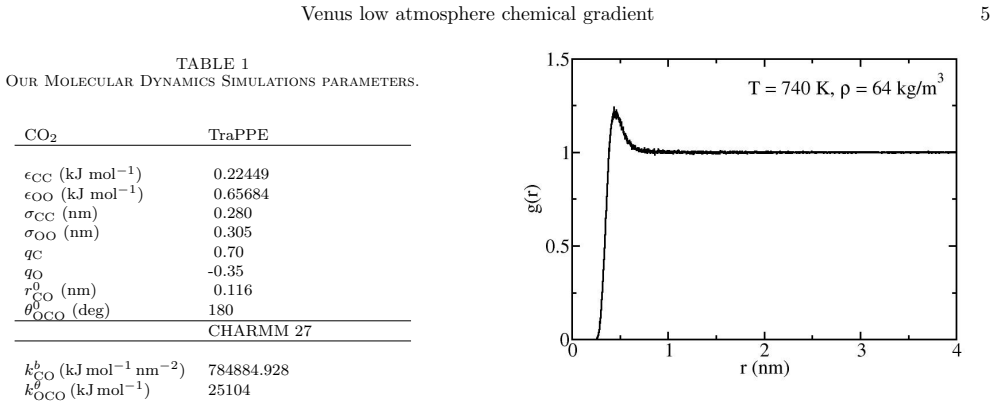
The argument is carried by the steady-state diffusion equation for a binary supercritical mixture, written as a flux with three terms: Fickean concentration diffusion, pressure diffusion that can segregate species by gravity, and thermal diffusion (the Soret effect). The paper integrates this equation along the measured Venus pressure–temperature profile, using an equation of state for CO2–N2 to evaluate fugacity and partial molar volume, and supplements the result with molecular dynamics simulations that supply independent CO2 and N2 diffusion coefficients and the radial distribution function of the fluid. The load-bearing comparison is timescale: diffusion would need roughly $10^{13}$ to $10^{14}$ seconds to build a gradient, while the atmospheric circulation re-homogenizes the deep layers in about $2\times 10^{8}$ seconds, so no diffusive mechanism can survive. This timescale argument, together with the absence of cluster formation in the simulated fluid, is what forces the paper toward an external source rather than an intrinsic one.
What would settle it
Re-analyze the VeGa-2 descent measurements of atmospheric composition below 7 km with full instrumental calibration and independently reconstruct the nitrogen altitude profile; if the recovered gradient is much smaller than $\sim 5\,\mathrm{ppm\,m^{-1}}$, the volcanic-flux explanation is unnecessary. Alternatively, a lander measuring surface CO2 flux directly would test the required $8\times 10^{-4}\,\mathrm{mol\,m^{-2}\,s^{-1}}$; finding a flux orders of magnitude lower would falsify the degassing scenario.
Extended reading notes
Core claim
On the paper's own terms, the central discovery is that the proposed nitrogen gradient cannot arise from any intrinsic property of the CO2–N2 supercritical fluid in Venus's deep atmosphere. Integrating the steady-state diffusion equation along the VeGa-2 pressure–temperature profile gives a nitrogen gradient near $0.6\,\mathrm{ppm\,m^{-1}}$, about an order of magnitude below the proposed $\sim 5\,\mathrm{ppm\,m^{-1}}$, and even the non-ideal equation of state does not change this because the Venusian atmosphere lies far from the binary critical point where the relevant derivative vanishes. Molecular dynamics gives diffusion coefficients around $10^{-6}\,\mathrm{m^{2}\,s^{-1}}$, making the diffusion timescale roughly $1.6$ to $16$ Myr, while the deep atmosphere is homogenized by circulation in about $2\times 10^{8}$ seconds. Phase separation is dismissed on both theoretical and experimental grounds: the fluid's radial distribution function shows gas-like behavior with no CO2 clustering, and the laboratory reports of strong separation are not confirmed by other measurements. What would suffice is an external CO2 input of about $8\times 10^{-4}\,\mathrm{mol\,m^{-2}\,s^{-1}}$, comparable to diffuse volcanic emissions measured on Earth, so the paper concludes that volcanic degassing is the most plausible origin.
Load-bearing premise
The load-bearing premise is that the VeGa-2 measurements really show a nitrogen gradient of about $\sim 5\,\mathrm{ppm\,m^{-1}}$ in the lowest 7 km; the paper states this conditional and does not independently re-derive the gradient from the raw probe data, so if that gradient is an artifact of the measurement or its processing, the entire explanatory problem and the volcanic conclusion collapse.
Editorial extensions
If this is right
- If the proposed gradient is real, molecular diffusion and phase separation cannot account for it, so future models of Venus's deep atmosphere should not invoke fluid separation as the explanation.
- Sustaining the gradient requires a crustal CO2 flux on the order of $8\times 10^{-4}\,\mathrm{mol\,m^{-2}\,s^{-1}}$, a value consistent with diffuse volcanic degassing seen in terrestrial volcanic systems.
- The deep-atmosphere nitrogen gradient, if confirmed, would be evidence of present-day volcanic or crustal activity on Venus, independent of the debate over catastrophic versus steady resurfacing.
- An outgassing rate near $10^{-3}\,\mathrm{mol\,m^{-2}\,s^{-1}}$ would double the mass of Venus's atmosphere in under 10,000 years, so the fate of the released CO2 is an unsolved problem the paper leaves open.
Reading between the lines
- The reality of the $\sim 5\,\mathrm{ppm\,m^{-1}}$ gradient is the load-bearing observation; an independent re-analysis of the VeGa-2 descent data, or a new in-situ profile below 7 km, would settle whether the volcanic explanation is required at all.
- If diffuse crustal degassing is the cause, the same flux should leave detectable marks elsewhere, such as local enrichments of trace volcanic gases or thermal anomalies, though the paper does not model those signatures.
- The terrestrial flux comparison suggests a testable scaling: because Earth's volcanic CO2 output has varied over geologic time, Venus's gradient strength might likewise vary with resurfacing epoch, so a present-day measurement could be an upper bound rather than a steady-state value.
- The paper's own balance implies that a sustained flux at the required level cannot be recycled by escape or chemistry, so the mechanism needs either a buffering reservoir in the crust or a short-lived current episode of degassing.
Signed reviews
Editorial analysis
A structured set of objections, weighed in public.
Referee Report
Summary. The paper addresses the proposed ~5 ppm m^-1 vertical gradient of molecular nitrogen in the deep atmosphere of Venus, inferred from VeGa-2 probe data, and asks which physical processes could produce it. It first tests intrinsic mechanisms: molecular diffusion under ideal and non-ideal equations of state, and phase separation or droplet formation. Using a CO2-N2 equation of state and molecular dynamics simulations, the authors find that diffusion yields a nitrogen gradient of ~0.6 ppm m^-1, an order of magnitude smaller than the proposed value, and that the diffusion timescale is ~10^13-10^14 s, far exceeding the ~2x10^8 s dynamical mixing time. The MD radial distribution functions show no clustering, and the authors argue that phase separation is unlikely for Venus's deep-atmosphere conditions. They then consider an extrinsic origin: a crustal release of CO2 that would dilute N2 near the surface, estimating a minimum flux F_CO2,min ~8x10^-4 mol m^-2 s^-1 over the dynamical timescale, and comparing it with terrestrial diffuse volcanic degassing (e.g., Roaring Mountain median ~2.7x10^-4 mol m^-2 s^-1), suggesting a volcanic source. The paper acknowledges, but does not resolve, that such an average flux would double the mass of the Venus atmosphere in less than 10,000 years with no known sink.
Significance. The intrinsic-mechanism analysis is a solid and valuable negative result: the ideal and non-ideal diffusion models are mutually consistent, the MD simulations give diffusion coefficients around 10^-6 m^2 s^-1 and gas-like g(r) with no cluster formation, and the derived timescales robustly rule out molecular diffusion and phase separation as origins of the proposed gradient. If the gradient is real, this is an important constraint. However, the positive claim of a volcanic origin is not established in the present form: the flux estimate is compared to local terrestrial hot-spot measurements, but the paper extends it to a global average, and its own mass-budget statement directly undermines the conclusion. The paper would be significant if it were revised to clearly separate the robust negative result from a carefully qualified extrinsic hypothesis, with a quantitative treatment of the CO2 budget and the local versus global nature of the observed gradient.
major comments (4)
- [Section 3] The positive conclusion for a volcanic origin is not supported by the mass budget: the paper's own statement that an average outgassing rate of ~10^-3 mol m^-2 s^-1 would double the mass of the Venus atmosphere in less than 10,000 years, with neither atmospheric escape nor chemistry able to compensate, applies directly to the estimated F_CO2,min ~8x10^-4 mol m^-2 s^-1 if that flux is treated as a global average; the doubling time for F_CO2,min is actually closer to 10^3 years. Because the terrestrial fluxes cited (e.g., the Roaring Mountain median, 2.7x10^-4 mol m^-2 s^-1) are local hot-spot measurements, they cannot justify a 'global diffuse release' hypothesis. The manuscript must either restrict the claim to a local source at the VeGa-2 landing site and then discuss source area and plume structure, or identify a viable CO2 sink or a transient-formation scenario; without this, the 'similar effect at work on Venus' conclusion is an order-of-magnitude inconsistency rather than a supported inference.
- [Section 3] The flux estimate F_CO2,min ~8x10^-4 mol m^-2 s^-1 is presented as a deterministic number with no uncertainty budget. It is the ratio of an assumed column density of N2 (1.6x10^5 mol m^-2, itself based on the assumed initial uniform profile) to an assumed dynamical timescale (tau_dyn ~2x10^8 s), and both inputs carry substantial systematic uncertainty that is not propagated. The subsequent comparison to terrestrial fluxes spans more than two orders of magnitude (Yellowstone average ~3x10^-6 mol m^-2 s^-1 versus the Roaring Mountain median 2.7x10^-4 mol m^-2 s^-1), so the statement that the needed flux is 'not so different' from terrestrial values requires a quantitative error analysis. In addition, the quoted Roaring Mountain flux '10^3 g m^-2 s^-1' is numerically inconsistent with the stated 2.7x10^-4 mol m^-2 s^-1 (by a factor of roughly 10^5), suggesting a typographical error that should be corrected.
- [Section 3] The turbulent-mixing scenario for a crustal CO2 source is asserted rather than demonstrated. The paper invokes the similarity of gaseous turbulent jets to argue that the CO2 abundance from a local injection would 'firmly decrease with altitude, possibly yielding to the proposed gradient,' but it does not compute the concentration profile in the Venus deep atmosphere or show that a surface source can sustain a nearly linear ~5 ppm m^-1 N2 gradient over 7 km. Given the short dynamical homogenization time (tau_dyn ~2x10^8 s), it is not obvious that a localized source would produce the observed vertical structure; a full boundary-layer or plume model is needed to make the extrinsic mechanism quantitative. This is a load-bearing gap in the only positive mechanism the paper offers.
- [Section 1] The entire explanatory problem and the derived flux estimate are conditional on the reality of the N2 gradient proposed by Lebonnois & Schubert (2017), but the paper does not independently verify the VeGa-2 data analysis that underlies that gradient; it only notes in the introduction that the gradient is 'if accepted as real.' The abstract and title, however, present the volcanic suggestion without this caveat. The authors should either provide an independent re-analysis of the probe data or explicitly and prominently state that all quantitative conclusions are conditional on an unconfirmed measurement, since the positive conclusion would collapse if the gradient is an artifact of the measurement.
minor comments (5)
- [Title page] The subject headings list 'Planets and satellites: individual: Titan' but the paper is about Venus; this should be corrected to 'Planets and satellites: individual: Venus'.
- [References] The reference for Werner & Brantley (2003) is given as 'Icarus, 4, 1061'; this paper appears in Geochemistry, Geophysics, Geosystems, 4(7), 1061, and the citation should be corrected so readers can locate it.
- [Section 2.1] The molecular dynamics production run is described as spanning 1 ns, but the method of computing the mean-squared displacement and its statistical error (e.g., number of blocks, time origins, inclusion of the 100 ns equilibration phase) is not specified; please provide these details to justify the reported uncertainties and allow reproduction.
- [Section 2.2] The Stokes settling calculation uses a droplet diameter of D1 ~ 1 mm, but the paper does not discuss why this value is representative; since the detailed analysis later finds no droplet-formation mechanism, the settling timescale is a purely illustrative exercise and should be labeled as such in the text.
- [Section 2.1] The notation for the thermal diffusion ratio appears inconsistently as 'kT 1,2' in Eq. (1) and 'kT,12' in Eq. (4); please unify the notation.
Circularity Check
No significant circularity: the paper's diffusion, phase-separation, and flux estimates are conditional calculations built on an externally proposed gradient, not a derivation that returns its own inputs.
full rationale
The derivation chain is self-contained. Section 2 integrates the steady-state diffusion equations (Eqs. 1-4) with VeGa-2 P/T profiles and the Duan et al. EoS to obtain an equilibrium N2 gradient of about 0.6 ppm/m, which is then compared with, not fitted to, the proposed 5 ppm/m. The MD simulations compute diffusion coefficients and radial distribution functions from standard force fields, and the resulting timescales (1.6-16 Myr) are compared with the dynamical mixing time taken from Lebonnois & Schubert (2017). In Section 3, F_CO2,min ~ 8e-4 mol m-2 s-1 is explicitly a back-of-envelope required flux (1.6e5 mol m-2 of N2 replaced over tau_dyn ~ 2e8 s), not a quantity fitted to the gradient; the terrestrial volcanic comparison is an analogy used to assess plausibility, not a derivation of the gradient. The proposed gradient itself is an external input from Lebonnois & Schubert (2017) and is treated conditionally ('If accepted as real'), so the paper does not derive it from its own conclusions. The paper itself flags the decisive limitation in Sec. 3: 'an average outgassing rate around 10^-3 mol m^-2 s^-1 would lead to the doubling of the mass of the Venus atmosphere in less than 10,000 Earth years,' with neither escape nor chemistry able to compensate. That is a serious plausibility objection to the volcanic suggestion, but it is an internal consistency problem, not circularity. No equation or fitted parameter is equivalent by construction to the claims being made.
Assumptions & free parameters
free parameters (1)
- Droplet diameter D1 =
1 mm (assumed)
assumptions (7)
- domain assumption The proposed N2 gradient (~5 ppm m-1) in the lower 7 km of Venus's atmosphere is real.
- domain assumption The VeGa-2 pressure-temperature profile (Lorenz et al. 2018) represents the deep Venus atmosphere.
- domain assumption The Duan et al. (1996) equation of state accurately models CO2-N2 mixtures under supercritical Venus conditions.
- domain assumption The TraPPE and CHARMM27 force fields, with Lorentz-Berthelot mixing rules, accurately represent CO2-N2 interactions at the simulated densities and temperatures.
- domain assumption The GCM homogenization timescale tau_dyn ~ 2e8 s (Lebonnois & Schubert 2017) is the relevant timescale for destroying or sustaining a composition gradient in the deep atmosphere.
- ad hoc to paper Before the hypothesized CO2 release, the N2 mole fraction was constant at 0.035 from the ground to 7000 m, and CO2 substitutes for N2 molecule-by-molecule.
- ad hoc to paper Turbulent mixing of crustal CO2 would produce an altitude-decreasing concentration profile consistent with the observed gradient.
Cite this review
Pith. "Pith review of The Physical Origin of the Venus Low Atmosphere Chemical Gradient." pith.science (2026). https://pith.science/paper/RBVLK4NQ
@misc{pith2026190807781,
  author       = {Pith},
  title        = {Pith review of: The Physical Origin of the Venus Low Atmosphere Chemical Gradient},
  year         = {2026},
  howpublished = {\url{https://pith.science/paper/RBVLK4NQ}},
  note         = {Machine review of arXiv:1908.07781}
}
read the original abstract
Venus shares many similarities with the Earth, but concomitantly, some of its features are extremely original. This is especially true for its atmosphere, where high pressures and temperatures are found at the ground level. In these conditions, carbon dioxide, the main component of Venus' atmosphere, is a supercritical fluid. The analysis of VeGa-2 probe data has revealed the high instability of the region located in the last few kilometers above the ground level. Recent works have suggested an explanation based on the existence of a vertical gradient of molecular nitrogen abundances, around 5 ppm per meter. Our goal was then to identify which physical processes could lead to the establishment of this intriguing nitrogen gradient, in the deep atmosphere of Venus. Using an appropriate equation of state for the binary mixture CO2-N2 under supercritical conditions, and also molecular dynamics simulations, we have investigated the separation processes of N2 and CO2 in the Venusian context. Our results show that molecular diffusion is strongly inefficient, and potential phase separation is an unlikely mechanism. We have compared the quantity of CO2 required to form the proposed gradient with what could be released by a diffuse degassing from a low volcanic activity. The needed fluxes of CO2 are not so different from what can be measured over some terrestrial volcanic systems, suggesting a similar effect at work on Venus.
Figures


Reference graph
Works this paper leans on
-
[1]
J., Murtola, T., Schulz, R., et al
Abraham, M. J., Murtola, T., Schulz, R., et al. 2015, SoftwareX, 1-2, 19
work page 2015
-
[2]
P., Licciardi, A., Piccinini, D., et al
Agostinetti, N. P., Licciardi, A., Piccinini, D., et al. 2017, Sci. Rep., 7, doi:10.1038/s41598-017-15118-w
-
[3]
2017, in LPI Contributions, Vol
Bellan, J. 2017, in LPI Contributions, Vol. 2061, 15th Meeting of the Venus Exploration and Analysis Group (VEXAG), 8005
work page 2017
-
[4]
Bird, R. B., Stewart, W. E., & Lightfoot, E. N., eds. 1960, Transport Phenomena (John Wiley and Sons, New York)
work page 1960
-
[5]
Bjelkmar, P., Larsson, P., Cuendet, M. A., Bess, B., & Lindahl, E. 2010, J. Chem. Theory Comput., 6, doi:10.1021/ct900549r
-
[6]
Bjonnes, E. E., Hansen, V. L., James, B., & Swenson, J. B. 2012, Icarus, 217, 451
work page 2012
-
[7]
Bolmatov, D., Brazhkin, V. V., & Trachenko, K. 2013, Nat. Commun., 4, doi:10.1038/ncomms3331
-
[8]
Bolmatov, D., Zav’yalov, D., & Zhernenkov, M. 2014, J. Phys. Chem. Lett., 5, 2785
work page 2014
Show all 70 references
-
[9]
V., Head, J
Bondarenko, N. V., Head, J. W., & Ivanov, M. A. 2010, Geophys. Res. Lett., 37, L23202
2010
-
[10]
N., & Trachenko, K
Tsiok, E. N., & Trachenko, K. 2013, Phys. Rev. Lett., 111, doi:10.1103/PhysRevLett.111.145901
2013 doi
-
[11]
Scopigno, T. 2017, J. Phys. Chem. Lett., 8, 4995
2017
-
[12]
2002, Applied Turbulence Modelling in Marine Waters, 1st edn
Burchard, H. 2002, Applied Turbulence Modelling in Marine Waters, 1st edn. (Berlin, Heidelberg: Springer-Verlag)
2002
-
[13]
R., Sawyer, G
Burton, M. R., Sawyer, G. M., & Granieri, D. 2013, 454, 323
2013
-
[14]
Chapman, S., & Cowling, T. G. 1970, The Mathematetical Theory of Non-Uniform Gases (Cambridge University Press, Cambridge)
1970
-
[15]
R., & Dimotakis, P
Dowling, D. R., & Dimotakis, P. E. 1990, J. Fluid Mech., 218, 109
1990
-
[16]
Duan, Z., Møller, N., & Weare, J. H. 1996, Geochim. Cosmochim. Ac., 60, 1209
1996
-
[17]
Espanani, R., Miller, A., Busick, A., Hendry, D., & Jacoby, W. 2016, J. CO 2 Util., 14, 67
2016
-
[18]
Fassett, C. I. 2016, Journal of Geophysical Research (Planets), 121, 1900 Garc´ ıa-S´ anchez, F., Eliosa-Jim´ enez, G., Silva-Oliver, G., & God´ ınez-Silva, A. 2007, J. Chem. Thermodynamics, 39, 893
2016
-
[19]
2017, arXiv e-prints, arXiv:1703.09010
Ghail, R., Wilson, C., Widemann, T., et al. 2017, arXiv e-prints, arXiv:1703.09010
2017 arXiv
-
[20]
C., Wilson, C., Galand, M., et al
Ghail, R. C., Wilson, C., Galand, M., et al. 2012, Exp. Astron., 33, 337
2012
-
[21]
2000, AlChE J., 46, 883
Ghorayeb, K., & Firoozabadi, A. 2000, AlChE J., 46, 883
2000
-
[22]
2011, Energy Procedia, 4, 3778
Goos, E., Riedel, U., Zhao, L., & Blum, L. 2011, Energy Procedia, 4, 3778
2011
-
[23]
2013, in Towards Understanding the Climate of Venus — Applications of Terrestrial Models to Our Sister Planet, ed
Grinspoon, D. 2013, in Towards Understanding the Climate of Venus — Applications of Terrestrial Models to Our Sister Planet, ed. L. Bengtsson, R.-M. Bonnet, D. Grinspoon, S. Koumoutsaris, S. Lebonnois, & D. Titov, Vol. 11 (New-York: Springer), 266–290
2013
-
[24]
Grinspoon, D. H. 1997, Venus Revealed: A New Look Below the Clouds of Our Mysterious Twin Planet, 1st edn. (Addison Wesley)
1997
-
[25]
Heidaryan, E., Hatami, T., Rahimi, M., & Moghadasi, J. 2011, J. Supercrit. Fluids, 56, 144
2011
-
[26]
N., , Wickramathilaka, M., Espanani, R., & Jacoby, W
Hendry, D., Miller, A, W. N., , Wickramathilaka, M., Espanani, R., & Jacoby, W. 2013, J. CO 2 Util., 3-4, 37
2013
-
[27]
2018, Geophys
Ilyinskaya, E., Mobbs, S., Burton, R., et al. 2018, Geophys. Res. Lett., 45, 10,332
2018
-
[28]
G., & Zahnle, K
Korycansky, D. G., & Zahnle, K. J. 2005, Planet. Space Sci., 53, 695
2005
-
[29]
2008, Geology, 36, 615
Koschinsky, A., Garbe-Sch¨ onberg, D., Sander, S., et al. 2008, Geology, 36, 615
2008
-
[30]
Krasnopolsky, V. A. 2013, Icarus, 225, 570 Le Roy, R. J., Huang, Y., & Jary, C. 2006, J. Chem. Phys., 125, doi:10.1063/1.2354502
2013 doi
-
[31]
2017, Nat
Lebonnois, S., & Schubert, G. 2017, Nat. Geosci., 10, 473
2017
-
[32]
2019, Icarus, submitted
Lebonnois, S., Schubert, G., Kremic, T., et al. 2019, Icarus, submitted
2019
-
[33]
S., Mogul, R., Smith, D
Limaye, S. S., Mogul, R., Smith, D. J., et al. 2018, Astrobiology, 18, 1181
2018
-
[34]
D., Crisp, D., & Huber, L
Lorenz, R. D., Crisp, D., & Huber, L. 2018, Icarus, 305, 277 Macias P´ erez, J. R. 2010, Master’s thesis, Instituto Polit´ ecnico Nacional – Escuala Superior de Indenier´ ıa Qu´ ımica e Industrias
2018
-
[35]
Malcuit, R. J. 2015, The Twin Sister Planets Venus and Earth: Why are they so different?, 1st edn. (Springer International Publishing), doi:10.1007/978-3-319-11388-3
2015 doi
-
[36]
Mancinelli, R. L. 1996, Adv. Space Res., 18, 241
1996
-
[37]
C., Horton, B
McKenzie, F. C., Horton, B. K., Loomis, S. E., et al. 2016, Science, 352, 444
2016
-
[38]
Mohagheghian, E., Bahadori, A., & James, L. A. 2015, J. Supercrit. Fluids, 101, 140
2015
-
[39]
S., & Obukhov, A
Monin, A. S., & Obukhov, A. M. 1954, Tr. Akad. Nauk. SSSR Geophiz. Inst., 24(151)
1954
-
[40]
A., & Sagan, C
Morowitz, H. A., & Sagan, C. 1967, Nature, 215, 1259
1967
-
[41]
S., & Senol, D
Myerson, A. S., & Senol, D. 1984, AlChE J., 30, 1004
1984
-
[42]
Obidi, O. C. 2014, PhD thesis, Imperial College London
2014
-
[43]
R., Mojzsis, S
Papineau, E. R., Mojzsis, S. J., & Marty, B. 2005, Chem Geol., 216, doi:10.1016/j.chemgeo.2004.10.009
2005 doi
-
[44]
2018, Geophys
Persson, M., Futaana, Y., Fedorov, A., et al. 2018, Geophys. Res. Lett., 45, 10
2018
-
[45]
J., Raubertas, R
Phillips, R. J., Raubertas, R. F., Arvidson, R. E., et al. 1992, J. Geophys. Res., 97, 15 Potoff, J. J., & Siepmann, J. I. 2001, AlChE J., 47, 1676
1992
-
[46]
R., & Klett, J
Pruppacher, H. R., & Klett, J. D., eds. 2010, Microphysics of Clouds and Precipitation (Springer Netherlands), doi:10.1007/978-0-306-48100-0
2010 doi
-
[47]
T., Ma, P
Raju, M., Banuti, D. T., Ma, P. C., & Ihme, M. 2017, Sci. Rep., 7, doi:10.1038/s41598-017-03334-3
2017 doi
-
[48]
Ree, F. H. 1986, J. Chem. Phys., 84, doi:10.1063/1.449895
1986 doi
-
[49]
2013, Planet
Romeo, I. 2013, Planet. Space Sci., 87, 157
2013
-
[50]
1967, Nature, 216, 1198
Sagan, C. 1967, Nature, 216, 1198
1967
-
[51]
H., & Lacey, W
Sage, B. H., & Lacey, W. N. 1939, Trans. of the AIME, 132, 143
1939
-
[52]
R., Mourier, P., Gaude, M
Sassiat, P. R., Mourier, P., Gaude, M. H., & Rosset, R. H. 1987, Anal. Chem., 59, 1164
1987
-
[53]
G., Strom, R
Schaber, G. G., Strom, R. G., Moore, H. J., et al. 1992, J. Geophys. Res., 97, 13
1992
-
[54]
Bullock, M. A. 2004, Astrobiology, 4, 11
2004
-
[55]
2005, Geophys
Segura, A., & Navarro-Gonzalez, R. 2005, Geophys. Res. Lett., 32, 1
2005
-
[56]
V., Markiewicz, W
Shalygin, E. V., Markiewicz, W. J., Basilevsky, A. T., et al. 2015, Geophys. Res. Lett., 42, 4762
2015
-
[57]
G., Bryk, T., Gorelli, F
Simeoni, G. G., Bryk, T., Gorelli, F. A., et al. 2010, Nat. Phys., 6, 503
2010
-
[58]
E., Stofan, E
Smrekar, S. E., Stofan, E. R., Mueller, N., et al. 2010, Science, 328, 605 Venus low atmosphere chemical gradient 9
2010
-
[59]
C., Sutter, B., Freissinet, C., et al
Stern, J. C., Sutter, B., Freissinet, C., et al. 2015, PNAS, 112, 4245
2015
-
[60]
G., Schaber, G
Strom, R. G., Schaber, G. G., & Dawsow, D. D. 1994, J. Geophys. Res., 99, 10
1994
-
[61]
V., & Hoard, J
Tartar, H. V., & Hoard, J. L. 1930, J. Am. Chem. Soc., 52
1930
-
[62]
1993, Multicomponent Mass Transfer, Wiley Series in Chemical Engineering (Wiley)
Taylor, R., & Krisna, R. 1993, Multicomponent Mass Transfer, Wiley Series in Chemical Engineering (Wiley)
1993
-
[63]
2007, PhD thesis, Standford University
Thomas, O. 2007, PhD thesis, Standford University
2007
-
[64]
V., & Bolmatov, D
Trachenko, K., Brazhkin, V. V., & Bolmatov, D. 2014, Phys. Rev. E., 89, 032126 van Konynenburgand, P. H., & Scott, R. L. 1980, Philos. Trans. Royal Soc. A, 298, 495
2014
-
[65]
2013, Phys
Vollmer, M., & M¨ ollmann, K.-P. 2013, Phys. Teach., 51, 400
2013
-
[66]
2003, Icarus, 4, 1061
Werner, C., & Brantley, S. 2003, Icarus, 4, 1061
2003
-
[67]
F., Jacob Stang, H
Westman, S. F., Jacob Stang, H. G., Løvseth, S. W., et al. 2006, Fluid Phase Equilib., 409, 207
2006
-
[68]
R., & Chang, P
Wilke, C. R., & Chang, P. 1955, AlChE J., 1, 264
1955
-
[69]
Woods, A. W. 2010, Annu. Rev. Fluid Mech., 42, 391
2010
-
[70]
G., & Biblarz, O
Zucker, R. G., & Biblarz, O. 2002, Fundamentals of gas dynamics (Wiley & Sons) We thank Dr. Christian Bouchot, Professor at the Instituto Polit´ ecnico Nacional (Mexico), for helpful scientific discussions. The present research was supported by the Programme National de Plan´ e...
2002
Reviewed August 14, 2026 · model on record in the stance chip above.
Discussion (0). Continue with ORCID to comment.