REVIEW 3 major objections 5 minor 66 references
The ${\gamma^* \gamma^* \to \eta_c (1S,2S)}$ transition form factors for spacelike photons
T0 review · 3 major / 5 minor · reviewed 2026-08-14 · deepseek-v4-flash
Pith's one-line read The paper claims that the double-virtual $\eta_c$ transition form factor does not factorize into single-virtual pieces; at large $Q^2$ it depends only on the average virtuality, with the breaking ratio reaching about 2.2.
desk verdict The double-virtual eta_c form factor is genuinely new and the derivation is clean, but the headline factorization-breaking measure is under-quantified across potentials and the omega-independence is at least partly built into the narrow nonrelativistic LFWF. read the letter →
The pith
A machine-rendered reading of the paper's core claim, the machinery that carries it, and where it could break.
The reading
What carries the argument
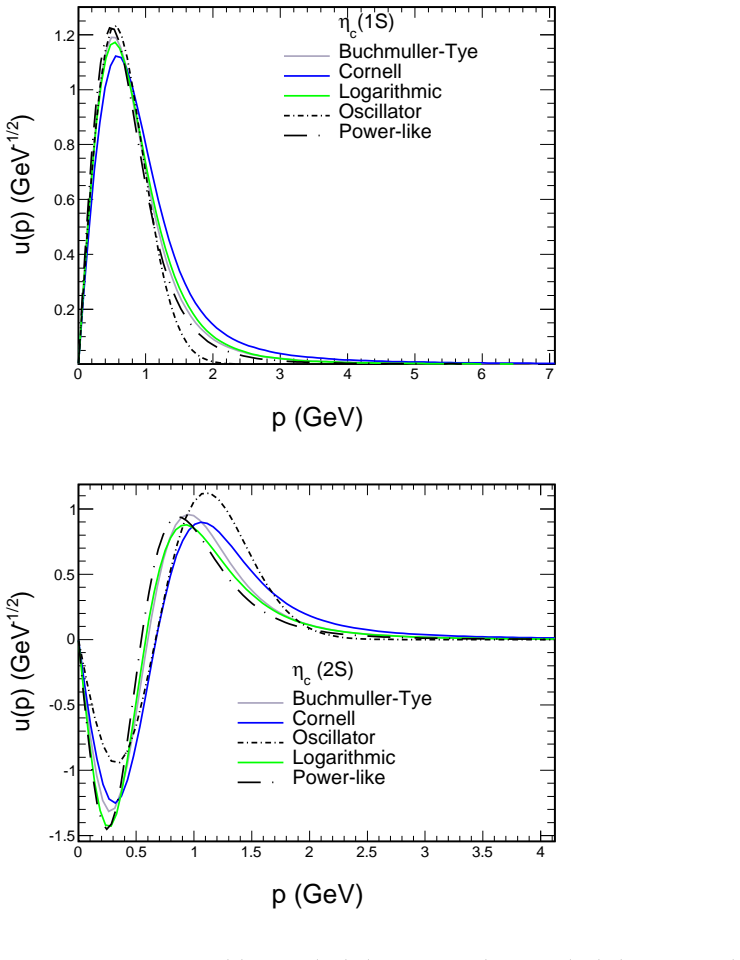
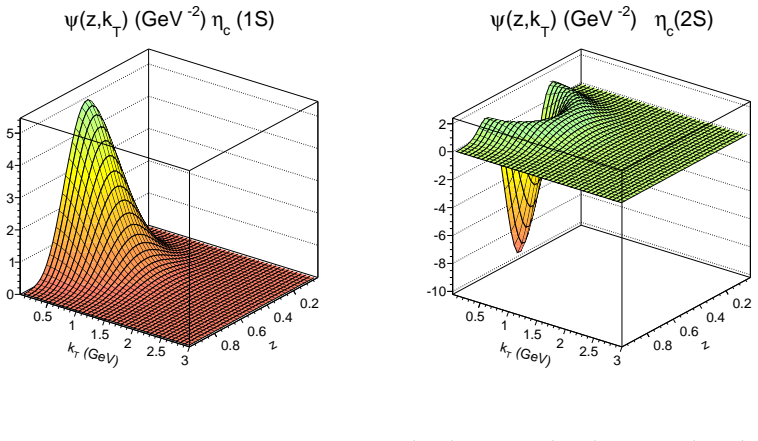
The load-bearing object is the light-front radial wave function $\psi(z,k)$ obtained from the Terentev mapping. In practice, the rest-frame momentum $p$ of the quark is related to the light-front variables by $\mathbf p^2=\frac14(M_{c\bar c}^2-4m_c^2)$ and $p_z=(z-\frac12)M_{c\bar c}$, with $\psi(z,k)=\frac{\pi}{\sqrt{2M_{c\bar c}}}\frac{u(p)}{p}$. This one mapping converts all five potential-model Schrödinger wave functions into the same light-front representation, and the hard-scattering integral (2.40) turns them into the form factor. The factorization-breaking measure $R$ defined in Eq. (3.3) quantifies how far the result is from the factorized form $\tilde F(Q_1^2,0)\tilde F(0,Q_2^2)$.
What would settle it
Measure the double-tag $e^+e^-\to e^+e^-\eta_c$ form factor at fixed average virtuality $(Q_1^2+Q_2^2)/2$ while varying the asymmetry $(Q_1^2-Q_2^2)/(Q_1^2+Q_2^2)$; the paper predicts almost no change, whereas a factorized vector-meson-dominance model predicts a visible dependence. Alternatively, recompute the same five potentials with a fully covariant light-front wave function instead of the Terentev mapping; if the ratio $R$ changes substantially, the model-independence claim would fail.
Extended reading notes
Core claim
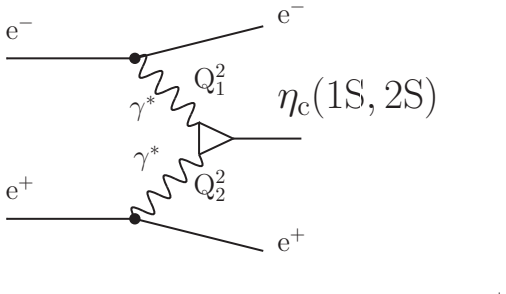
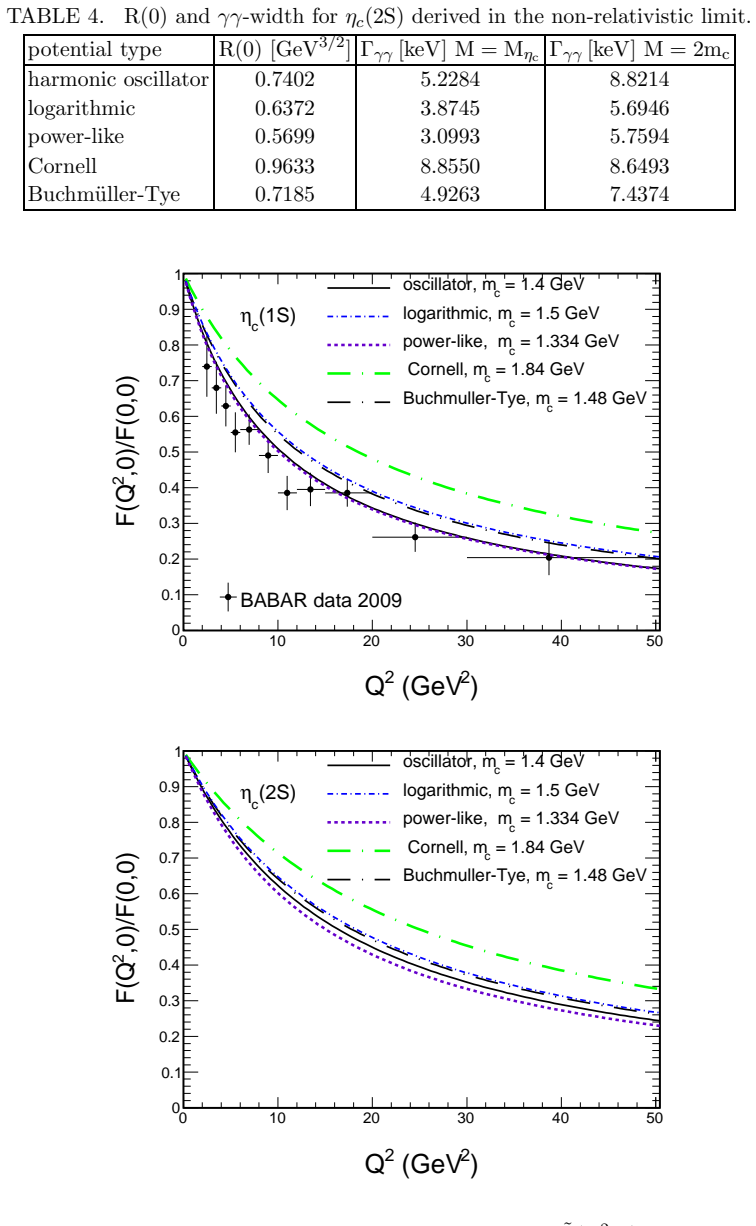
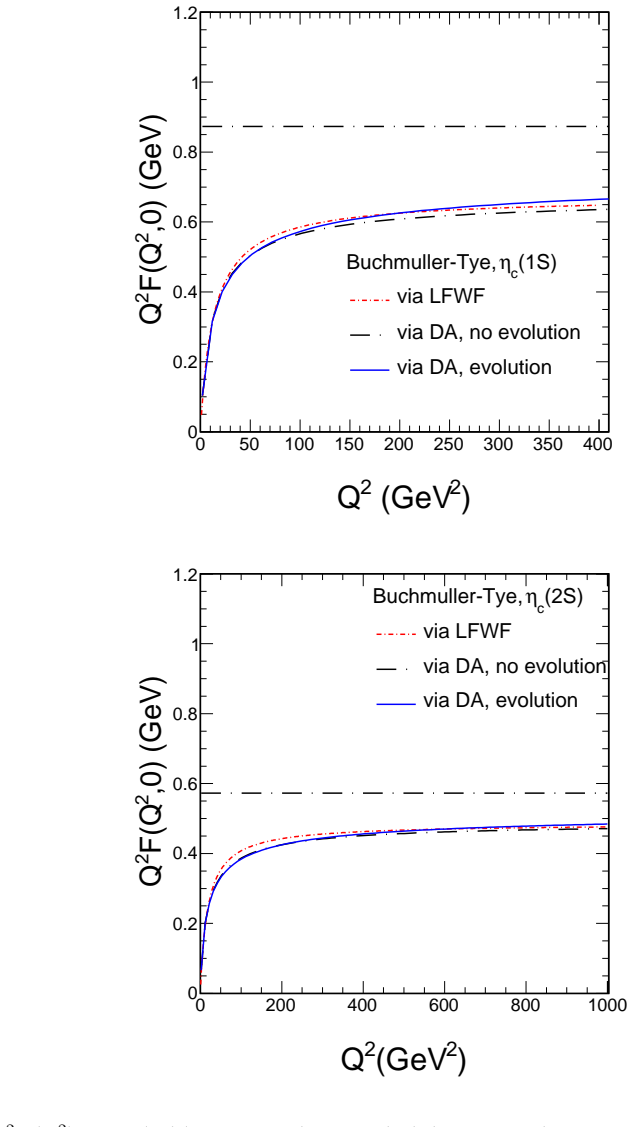
The paper claims that for two spacelike photons, the transition form factor $F(Q_1^2,Q_2^2)$ of $\eta_c(1S)$ and $\eta_c(2S)$ is strongly factorization-breaking, with the ratio $R=\tilde F(Q_1^2,Q_2^2)/[\tilde F(Q_1^2,0)\tilde F(0,Q_2^2)]$ rising to about 2.2 for the ground state and being nearly identical for five potential-model wave functions. The explicit light-front representation is obtained by convoluting a hard $\gamma^*\gamma^*\to c\bar c$ amplitude with a wave function $\psi(z,k)$, \[ F($Q_1^{2}$,$Q_2^{2}$)=$e_c^{2}$\sqrt{N_c}\,4m_c\int\frac{dz\,dk}{z(1-z)8\$pi^{2}$}\psi(z,k)\left\{\frac{1-z}{\sqrt{($k^{2}$-$m_c^{2}$-z(1-z)$Q_1^{2}$-(1-z)^$2Q_2^{2}$)^2+$4k^{2}$($m_c^{2}$+z(1-z)$Q_1^{2}$)}}+\frac{z}{\sqrt{($k^{2}$-$m_c^{2}$-z(1-z)$Q_1^{2}$-$z^{2}$$Q_2^{2}$)^2+$4k^{2}$($m_c^{2}$+z(1-z)$Q_1^{2}$)}}\right\}, \] where $\psi(z,k)$ comes from the Terentev mapping of the rest-frame Schrödinger wave function. The normalized form factor is almost independent of the asymmetry parameter $(Q_1^2-Q_2^2)/(Q_1^2+Q_2^2)$, so $F$ scales with $(Q_1^2+Q_2^2)/2$. The single-virtual limit reproduces the shape of existing data, while $Q^2F(Q^2)$ does not approach the Brodsky-Lepage value $\frac{8}{3}f_{\eta_c}$; the paper argues that QCD evolution of the distribution amplitude is negligible below 100 GeV$^2$.
Load-bearing premise
The load-bearing premise is that the Terentev mapping from the nonrelativistic rest-frame wave function to the light-front wave function is accurate enough for charmonium, whose internal quark momentum is only moderately nonrelativistic, so the predicted size and shape of the factorization breaking depend on that mapping.
Editorial extensions
If this is right
- For $\eta_c(1S)$, the factorization-breaking ratio $R$ rises to about 2.2 at large $Q_1^2,Q_2^2$, so a product of single-virtual form factors underestimates the double-virtual form factor by more than a factor of two.
- The form factor is nearly determined by the average virtuality; changing the asymmetry at fixed average moves $F$ very little, in contrast to factorized vector-meson-dominance models.
- The Brodsky-Lepage asymptotic plateau $Q^2F(Q^2)\to \frac{8}{3}f_{\eta_c}$ is not reached below $Q^2\approx 50$ GeV$^2$, and QCD evolution of the distribution amplitude changes the result negligibly below 100 GeV$^2$.
- For $\eta_c(2S)$, the factorization breaking is weaker, reaching about 1.8 in the explored virtuality range, and the approach to asymptotics is even slower.
- Because the $\gamma^*\gamma^*\to\eta_c$ amplitude is the same as $g^*g^*\to\eta_c$ up to color factors, future double-tag measurements would also constrain $\eta_c$ production at hadron colliders.
Reading between the lines
- If the near-flat dependence on asymmetry survives, double-tag data will cleanly distinguish light-front potential models from factorized parametrizations, because the latter predict a visible dependence on asymmetry.
- The similarity of $R$ across five potentials hints that the breaking is driven mainly by the hard quark propagators and the narrow peak of the wave function near $z=1/2$, rather than by the long-distance potential; varying the width of the wave function in transverse momentum would test this.
- Applying the same construction to the bottomonium analogue would separate kinematic effects from relativistic corrections: a similar $R$ would point to kinematics, while a smaller $R$ would expose the relativistic corrections already present in charmonium.
Signed reviews
Editorial analysis
A structured set of objections, weighed in public.
Referee Report
Summary. The paper derives a light-front wave function (LFWF) representation of the gamma* gamma* -> eta_c(1S,2S) transition form factor F(Q1^2,Q2^2) for two spacelike photons. The LFWFs are obtained by solving the Schroedinger equation for five different c-cbar potentials and converting the rest-frame momentum-space wave functions to light front via the Terentev prescription. The authors compare the single-virtual limit to BaBar data for eta_c(1S), discuss the delayed onset of the Brodsky-Lepage asymptotic behavior, present two-dimensional distributions of F(Q1^2,Q2^2), and introduce a factorization-breaking ratio R(Q1^2,Q2^2). The central claims are that factorization is strongly broken, that R is almost model independent across the five potentials, and that the form factor scales approximately with Qbar^2 = (Q1^2+Q2^2)/2, with almost no dependence on the asymmetry parameter omega.
Significance. If the advertised model independence holds, the paper provides a concrete, falsifiable prediction for double-tag measurements at Belle II: the gamma* gamma* -> eta_c form factor depends mainly on the average virtuality Qbar^2 and not on the virtuality asymmetry. The derivation from Eq. (2.38) to Eq. (2.40) is transparent, the normalization is checked against the two-photon decay width, and the comparison with BaBar data is a genuine forward calculation with no parameters fitted to the transition form factor itself. The main weakness is that the headline claims of model independence and Qbar^2 scaling rest on a shared nonrelativistic LFWF construction and are not quantitatively demonstrated across the potentials.
major comments (3)
- [Section III.B, Fig. 9] The abstract's claim that factorization breaking is "almost model independent" is not supported by the presented evidence. Only the Buchmueller-Tye potential is plotted in Fig. 9, and the text states "The factorization breaking pattern looks very similar for different potentials (not shown explicitly here)" without quantification. Since this is a central claim, please show R(Q1^2,Q2^2), or a projection such as R as a function of Qbar^2 at fixed omega, for all five potentials, and quantify the spread across potentials. Without this, the headline claim is an assertion rather than a demonstrated result.
- [Section II.A, Eqs. (2.12)-(2.20), and Eq. (2.40)] The Terentev prescription is stated to be valid for weakly bound nonrelativistic systems, but charmonium is only moderately nonrelativistic, with typical p/m_c around 0.3-0.5. Because all five potentials are converted through the same nonrelativistic mapping, the resulting LFWFs are all sharply peaked at z approximately 1/2. Inserting z approximately 1/2 into Eq. (2.40) makes the denominators depend mainly on Q1^2+Q2^2, so the claimed Qbar^2 scaling and near-omega-independence are largely enforced by the construction rather than emerging independently from the dynamics. The five-potential scan cannot expose this limitation because it varies only the shape of u(p) within the same ansatz. Please add a quantitative discussion of the sensitivity of R(Q1^2,Q2^2) and of the omega-dependence to a broader z-distribution, for example by comparing with a relativistic treatment or by varying m_c over a wider range, and qualify the model-independence claim accordingly.
- [Section III.B, Eq. (3.3)] The factorization-breaking ratio R is defined using the single-virtual form factors F(Q1^2,0) and F(0,Q2^2) computed in the same model. While this is a sensible normalization, it means that model dependence in the single-virtual form factor largely cancels in R. The statement that R is almost model independent should therefore be accompanied by a statement about how much of the model dependence is removed by this normalization, and the residual spread across potentials should be shown explicitly. Otherwise the reader cannot distinguish a genuine dynamical prediction from a consequence of the ratio construction.
minor comments (5)
- [Section II.C, Eqs. (2.38) and (2.40)] The notation switches between Q_i^2 = -q_i^2 at the beginning of Section II and q1^2, q2^2 in the final form factor expressions. Please state explicitly that q_i^2 in Eqs. (2.38) and (2.40) denotes the spacelike virtuality Q_i^2, or introduce a consistent sign convention, to avoid confusion in the denominators.
- [Section III.B] The sentence "The factorization breaking pattern looks very similar for different potentials (not shown explicitly here)" should either be replaced by a quantitative statement with a figure or removed, since it is precisely the evidence needed for the main claim.
- [Fig. 5 caption] The phrase "rate of approaching" should be "rate of approach" or "approach to."
- [References] Reference [14] is written as "Phys. Rev. D97, 0094034 (2018)"; the article number appears to be a typo and should read 094034.
- [Section III.B, paragraph before Fig. 7] The sentence "The reader is asked to notice much broader range of Q^2 in the figure compared to that in previous figures" is informal and should be rephrased.
Circularity Check
No significant circularity: the transition form factor and factorization-breaking ratio are derived from Schrödinger wave functions with published potentials; the only self-citation (Ref. [20]) supplies independent, reproducible input.
full rationale
The paper's central results—the double-virtual transition form factor F(Q1^2,Q2^2), the weak dependence on the asymmetry parameter ω, the Qbar^2 scaling, and the factorization-breaking measure R—are computed by inserting light-front wave functions, obtained from rest-frame Schrödinger wave functions for five published c-cbar potentials, into a standard hard-scattering convolution formula (Eq. (2.38)/(2.40)). No parameter is fitted to the BaBar data; the BaBar comparison is a check, not an input. The factorization-breaking ratio R is constructed directly from the computed F values, so its behavior is an output, not a fitted quantity. The near independence of Qbar^2 and the weak ω-dependence arise because the nonrelativistic wave functions are sharply peaked at z=1/2, but that is model dynamics rather than circularity: the full integral in Eq. (2.40) still contains nontrivial z and k dependence, and the extent of ω-independence is a falsifiable prediction. The only self-citation is Ref. [20], by a co-author, used for the Schrödinger-solution wave functions; however, those are obtained from established external potentials and a standard differential equation, not from a conclusion equivalent to the target form factor. The paper explicitly notes discrepancies with the measured two-photon width and the need for a modified quark mass for better BaBar agreement, which further indicates the calculation is not rigged to reproduce data. Concerns about the Terentev nonrelativistic mapping or the unquantified 'almost model independent' claim are correctness or robustness issues, not circularity.
Assumptions & free parameters
free parameters (10)
- charm quark mass, harmonic oscillator potential =
1.4 GeV
- charm quark mass, Cornell potential =
1.84 GeV
- charm quark mass, logarithmic potential =
1.5 GeV
- charm quark mass, power-law potential =
1.334 GeV
- charm quark mass, Buchmueller-Tye potential =
1.48 GeV
- harmonic oscillator frequency omega =
0.3 GeV = (M2S - M1S)/2
- Cornell potential parameters (k, a) =
k=0.52, a=2.34 GeV^-1
- Logarithmic potential parameters =
V = -0.6635 GeV + (0.733 GeV) log(r * 1 GeV)
- Power-law potential parameters =
V = -6.41 GeV + (6.08 GeV)(r * 1 GeV)^0.106
- Buchmueller-Tye potential parameters =
k=0.153 GeV^2, lambda=0.406 GeV, Lambda_MS=0.509 GeV
assumptions (5)
- domain assumption Terentev prescription maps rest-frame Schroedinger wave functions to light-front wave functions.
- domain assumption Pure c-cbar valence Fock state dominance for eta_c.
- domain assumption Perturbative hard-scattering formula applies even at vanishing photon virtualities.
- domain assumption Schroedinger equation with phenomenological c-cbar potentials gives the charmonium wave function.
- domain assumption Bose symmetry of the transition form factor under Q1^2 and Q2^2 exchange.
Cite this review
Pith. "Pith review of The ${\gamma^* \gamma^* \to \eta_c (1S,2S)}$ transition form factors for spacelike photons." pith.science (2026). https://pith.science/paper/RSJQ3M2W
@misc{pith2026190807802,
  author       = {Pith},
  title        = {Pith review of: The $\gamma^* \gamma^* \to \eta_c (1S,2S)$ transition form factors for spacelike photons},
  year         = {2026},
  howpublished = {\url{https://pith.science/paper/RSJQ3M2W}},
  note         = {Machine review of arXiv:1908.07802}
}
abstract
We derive the light-front wave function (LFWF) representation of the $\gamma^* \gamma^* \to \eta_c(1S)\,,\eta_c(2S)$ transition form factor $F(Q_1^2, Q_2^2)$ for two virtual photons in the initial state. For the LFWF, we use different models obtained from the solution of the Schr\"odinger equation for a variety of $c \bar c$ potentials. We compare our results to the BaBar experimental data for the $\eta_c(1S)$ transition form factor, for one real and one virtual photon. We observe that the onset of the asymptotic behaviour is strongly delayed and discuss applicability of the collinear and/or massless limit. We present some examples of two-dimensional distributions for $F (Q_1^2,Q_2^2)$. A factorization breaking measure is proposed and factorization breaking effects are quantified and shown to be almost model independent. Factorization is shown to be strongly broken, and a scaling of the form factor as a function of $\bar Q^2 = (Q_1^2 + Q_2^2)/2$ is obtained.
Figures
Figures from the paper (6 more)




Reference graph
Works this paper leans on
-
[1]
V. L. Chernyak and S. I. Eidelman, Prog. Part. Nucl. Phys. 80, 1 (2014) [arXiv:1409.3348 [hep-ph]]
arXiv 2014
-
[2]
for two virtual photons in the initial state. For the LFWF, w e use different models obtained from the solution of the Schr¨ od inger equation for a variety of c¯c potentials. We compare our results to the BaBar experimenta l data for the ηc(1S) transition form factor, for one real and one virtual photon. We observe t hat the onset of the asymptotic behavi...
-
[3]
above is the object of interest in this paper. It is normalized such that the two-photon decay-width of the meson is o btained from Γ(ηc →γγ ) = π 4α2 emM 3 ηc |F (0, 0)|2. (2.2) For further calculation it is useful to choose a frame in which incoming photon four-momenta have the form q1 =q+ 1n+ +q1⊥,q 2 =q− 2n− +q2⊥. (2.3) Here n± = 1√ 2 (1, 0, 0, ±1), (...
-
[4]
The normalizing function N is N (z, k) = (∑ λ ¯λ Γ λ ¯λ (z, k)Γ ∗ λ ¯λ (z, k) ) 1/ 2 = √ 2 √ k2 +m2 c z(1 −z) = √ 2Mc¯c. (2.16) Then, if we take the meson state to obey the canonical relativistic n ormalization ⟨ηc;P ′ +, P ′|ηc;P+, P ⟩ = 2P+(2π)3δ(P ′ + −P+)δ(2)(P ′ − P ), (2.17) the radial light-front wave function φ(z, k) will be normalized as ∫ 1 0 dz...
-
[5]
(2.38) and then to perform the integration over the azimuthal angle of k
= e2 c √ Nc 4mc · ∫ dzd2k z(1 −z)16π3ψ(z, k) { 1 −z (k − (1 −z)q2)2 +z(1 −z)q2 1 +m2 c + z (k +zq2)2 +z(1 −z)q2 1 +m2 c } . (2.38) and then to perform the integration over the azimuthal angle of k. Using ∫ 2π 0 dφ 2π 1 A +B cosφ = 1√ A2 −B2, (2.39) 2 We have dropped the terms ∝ Ψ ∗ +− + Ψ ∗ − +, which vanish for the pseudoscalar state, see Eq. (2.15). 8 w...
-
[6]
(2.40) This form puts into evidence, that the invariant form factor F (Q2 1,Q 2
= e2 c √ Nc 4mc · ∫ dzkdk z(1 −z)8π2ψ(z, k) { 1 −z√ (k2 −m2 c −z(1 −z)q2 1 − (1 −z)2q2 2)2 + 4k2(m2 c +z(1 −z)q2 1) + z √ (k2 −m2 c −z(1 −z)q2 1 −z2q2 2)2 + 4k2(m2 c +z(1 −z)q2 1) } . (2.40) This form puts into evidence, that the invariant form factor F (Q2 1,Q 2
-
[7]
Notice that by the Bose-symmetry, the form factor must be a symmetric function of Q2 1,Q 2
is a function of Q2 1 = q2 1 and Q2 2 = q2 2 only. Notice that by the Bose-symmetry, the form factor must be a symmetric function of Q2 1,Q 2
-
[8]
This is evidently not obvious from the representations Eq. (2.38) or Eq. (2.40), as the integrand is manifestly asymmetric in q1, q2. However, as will be demonstrated below by the numerical results, our represen tation has the required symmetry. In particular, in the limit of one on-shell photon, one mus t have, that F (Q2) ≡ F (Q2, 0) = F (0,Q 2), and th...
Show all 66 references
-
[9]
(2.46) Still another interesting limit exists, namely at very large Q2 i , the k-smearing becomes unimportant, and one can neglect k in the hard matrix element of Eq
= e2 c √ Nc 4√ πMηc 1 Q2 1 +Q2 2 +M 2 ηc R(0). (2.46) Still another interesting limit exists, namely at very large Q2 i , the k-smearing becomes unimportant, and one can neglect k in the hard matrix element of Eq. (2.38). Then only the LFWF appears under the k integral, and th...
-
[10]
(2.47) The DA is conveniently normalized as ∫ 1 0 dzϕ (z,µ 2
= 1 z(1 −z) √Nc 4mc 16π3 ∫ d2kθ(µ2 0 − k2)ψ(z, k). (2.47) The DA is conveniently normalized as ∫ 1 0 dzϕ (z,µ 2
-
[11]
= 1, (2.48) so that we can extract the so-called decay constant fηc from the integral over z in Eq. (2.47). The transition form factor simplifies to F (Q2 1,Q 2
-
[12]
(2.49) This representation is valid in the limit of large photon virtualities Q2 1,Q 2 2
= e2 cfηc · ∫ 1 0 dz { (1 −z)ϕ(z,µ 2 0) (1 −z)2Q2 1 +z(1 −z)Q2 2 +m2 c + zϕ (z,µ 2 0) z2Q2 1 +z(1 −z)Q2 2 +m2 c } . (2.49) This representation is valid in the limit of large photon virtualities Q2 1,Q 2 2. III. NUMERICAL RESUL TS In this Section we will present our results for...
-
[13]
A popular model for the transition form factor is based on the vector meson dominance app roach (see e.g
= F (Q2 1,Q 2 2) F (0, 0) , (3.1) 10 which nicely quantifies the deviation from point-like coupling. A popular model for the transition form factor is based on the vector meson dominance app roach (see e.g. Ref. [21]), and reads ˜F (Q2 1,Q 2
-
[14]
(3.2) It features a factorized dependence on the photon virtualities, w hich we expect to be broken
= M 2 J/ Ψ Q2 1 +M 2 J/ Ψ · M 2 J/ Ψ Q2 2 +M 2 J/ Ψ . (3.2) It features a factorized dependence on the photon virtualities, w hich we expect to be broken. In our analysis, we will quantify the factorization breaking of the tr ansition form factor by estimating the quantity defi...
-
[15]
= ˜F (Q2 1,Q 2 2) ˜F (Q2 1, 0) ˜F (0,Q 2 2) . (3.3) A. c¯c wave functions of ηc(1S) and ηc(2S) Our wave functions u(p) were obtained by Fourier transform from the r-dependent c¯c wave functions obtained as a solution of the Schr¨ odinger equation with different, realistic, pote...
1970
-
[16]
To investigate the scaling properties, we show the transition form factor as a function of the variables ω = Q2 1 −Q2 2 Q2 1 +Q2 2 and ¯Q2 = Q2 1 +Q2 2 2
As an example in Fig.8 we again show our results for the Buchm¨ uller-Tye potential. To investigate the scaling properties, we show the transition form factor as a function of the variables ω = Q2 1 −Q2 2 Q2 1 +Q2 2 and ¯Q2 = Q2 1 +Q2 2 2 . (3.8) One can see that F (and ~F ) i...
-
[17]
The factorization breaking pattern looks very similar for different potentials (not sho wn explicitly here)
= R(Q2 1, 0) = 1. The factorization breaking pattern looks very similar for different potentials (not sho wn explicitly here). 17 )2 (GeV2Q 0 50 100 150 200 250 300 350 400 ,0) (GeV)2F(Q2Q 0 0.2 0.4 0.6 0.8 1 1.2 (1S)cηBuchmuller-Tye, via LFWF via DA, no evolution via DA, evolu...
-
[18]
and (ω, ¯Q2) for the Buchm¨ uller-Tye potential for illustration, other potentials discussed in the present paper behave similarly. )2 (GeV 1 2 Q 0 10 20 30 40 50 ) 2(GeV2 2Q 01020304050 1 1.5 2 2.5 (1S)cη), 2 2,Q2 1R(Q )2 (GeV 12 Q 0 10 20 30 40 50 )2(GeV2 2Q 01020304050 1 1....
-
[19]
Theory of hot matter and relativistic heavy-ion co llisions
for Buchm¨ uller- Tye potential; left panel - ηc(1S), right panel - ηc(2S)). 19 IV. CONCLUSIONS The description of transition form factors is directly related to our understanding of the structure of bound states in QCD. In the present paper we have s tudied the transition for...
2014
-
[20]
A. V. Radyushkin, JINR-P2-10717 (Dubna, 1977), [hep-ph /0410276]; A. V. Efremov and A. V. Radyushkin, Theor. Math. Phys. 42, 97 (1980) [Teor. Mat. Fiz. 42, 147 (1980)]; Phys. Lett. 94B, 245 (1980)
1980
-
[21]
G. P. Lepage and S. J. Brodsky, Phys. Lett. 87B, 359 (1979)
1979
-
[22]
V. L. Chernyak and A. R. Zhitnitsky, Phys. Rept. 112, 173 (1984)
1984
-
[23]
Jegerlehner, Springer Tracts Mod
F. Jegerlehner, Springer Tracts Mod. Phys. 274, pp.1 (2017)
2017
- [24]
-
[25]
N. G. Stefanis, S. V. Mikhailov and A. V. Pimikov, Few Body Syst. 56, no.6-9, 295 (2015). [arXiv:1411.0528 [hep-ph]]
2015 arXiv
- [26]
-
[27]
Feldmann, P
T. Feldmann, P. Kroll and B. Stech, Phys. Lett. B 449, 339 (1999) doi:10.1016/S0370- 2693(99)00085-4 [hep-ph/9812269]
1999 arXiv
-
[28]
F. g. Cao and T. Huang, Phys. Rev. D 59, 093004 (1999) [hep-ph/9711284]
1999 arXiv
-
[29]
Dudek and R.G
J.J. Dudek and R.G. Edwards, Phys. Rev. Lett. 97, 172001 (2006)
2006
-
[30]
Chen et al
T. Chen et al. (CLQCD collaboration), Eur. Phys. J. C 76, 358 (2016)
2016
-
[31]
F. Feng, Y. Jia and W.-L. Sang, Phys. Rev. Lett. 115, 222001 (2015)
2015
-
[32]
Wang, X.G
S.Q. Wang, X.G. Wu, W.-L. Sang and S.J. Brodsky, Phys. Re v. D97, 0094034 (2018)
2018
-
[33]
Lucha and D
W. Lucha and D. Melikhov, Phys. Rev. D86, 016001 (2012)
2012
-
[34]
J. Chen, M. Ding, L. Chang and Y.-X. Liu, Phys. Rev. D 95. 016010 (2017)
2017
-
[35]
Geng and C.C
C.Q. Geng and C.C. Lih, Eur. Phys. J C73, 2505 (2013)
2013
-
[36]
H. Y. Ryu, H. M. Choi and C. R. Ji, Phys. Rev. D 98, no.3, 034018 (2018) [arXiv:1804.08287 [hep-ph]]
2018 arXiv
-
[37]
J. P. Lees et al. [BaBar Collaboration], Phys. Rev. D 98, no.11, 112002 (2018)
2018
- [38]
-
[39]
J. P. Lees et al. [BaBar Collaboration], Phys. Rev. D 81, 052010 (2010) [arXiv:1002.3000 [hep-ex]]
2010 arXiv
-
[40]
V. N. Gribov, Y. L. Dokshitzer and J. Nyiri, Camb. Monogr . Part. Phys. Nucl. Phys. Cosmol. 27 (2012)
2012
-
[41]
S. D. Glazek and J. Mlynik, Phys. Rev. D 74, 105015 (2006) [hep-th/0606235]
2006 arXiv
-
[42]
Gutsche, V
T. Gutsche, V. E. Lyubovitskij, I. Schmidt and A. Vega, P hys. Rev. D 90, no.9, 096007 (2014) [arXiv:1410.3738 [hep-ph]]
2014 arXiv
-
[43]
Y. Li, P. Maris and J. P. Vary, Phys. Rev. D 96, no.1, 016022 (2017) [arXiv:1704.06968 [hep-ph]]
2017 arXiv
-
[44]
M. V. Terentev, Sov. J. Nucl. Phys. 24, 106 (1976) [Yad. Fiz. 24, 207 (1976)]
1976
-
[45]
Melosh, Phys
H.J. Melosh, Phys. Rev. D 9, 1095 (1974)
1974
-
[46]
Jaus, Phys
W. Jaus, Phys. Rev. D 41, 3394 (1990)
1990
-
[47]
Eichten, S
E. Eichten, S. Godfrey, H. Mahlke and J. L. Rosner, Rev. M od. Phys. 80, 1161 (2008) [hep-ph/0701208]
2008 arXiv
-
[48]
M. B. Voloshin, Prog. Part. Nucl. Phys. 61, 455 (2008) [arXiv:0711.4556 [hep-ph]]
2008 arXiv
-
[49]
Eichten, K
E. Eichten, K. Gottfried, T. Kinoshita, K.D. Lane and T. M. Yan, Phys. Rev. D 21, 203 (1980). 21
1980
-
[50]
Eichten, K
E. Eichten, K. Gottfried, T. Kinoshita, K.D. Lane and T. M. Yan, Phys. Rev. D 17, 3090 (1978); Erratum: [Phys. Rev. D 21, 313 (1980)]
1978
-
[51]
Quigg and J.L
C. Quigg and J.L. Rosner, Phys. Lett. B 71, 153 (1977)
1977
-
[52]
Martin, Phys
A. Martin, Phys. Lett. B 93, 338 (1980)
1980
-
[53]
Martin, CERN-TH-2876, C80-03-09-25
A. Martin, CERN-TH-2876, C80-03-09-25
-
[54]
Barik and S.N
N. Barik and S.N. Jena, Phys. Lett. B 97, 265 (1980)
1980
-
[55]
Buchm¨ uller and S.H.H
W. Buchm¨ uller and S.H.H. Tye, Phys. Rev. D 24, 132 (1981)
1981
-
[56]
G. P. Lepage and S. J. Brodsky, Phys. Rev. D 22, 2157 (1980)
1980
-
[57]
Ebert, R
D. Ebert, R. N. Faustov and V. O. Galkin, Mod. Phys. Lett. A 18, 601 (2003) [hep-ph/0302044]
2003 arXiv
-
[58]
V. A. Novikov, L. B. Okun, M. A. Shifman, A. I. Vainshtein , M. B. Voloshin and V. I. Za- kharov, Phys. Rept. 41, 1 (1978)
1978
-
[59]
Tanabashi et al
M. Tanabashi et al. [Particle Data Group], Phys. Rev. D 98, no.3, 030001 (2018)
2018
-
[60]
K. W. Edwards et al. [CLEO Collaboration], Phys. Rev. Lett. 86, 30 (2001) [hep-ex/0007012]
2001 arXiv
-
[61]
Ong, Phys
S. Ong, Phys. Rev. D 52, 3111 (1995)
1995
-
[62]
Diehl, P
M. Diehl, P. Kroll and C. Vogt, Eur. Phys. J. C 22, 430 (2001)
2001
-
[63]
Kroll and K
P. Kroll and K. Passek-Kumericki, Phys. Lett. B 793, 195 (2019) [arXiv:1903.06650 [hep-ph]]
2019 arXiv
-
[64]
Butenschoen, Z
M. Butenschoen, Z. G. He and B. A. Kniehl, Phys. Rev. Lett . 114, no. 9, 092004 (2015)
2015
-
[65]
H. Han, Y. Q. Ma, C. Meng, H. S. Shao and K. T. Chao, Phys. Re v. Lett. 114, no.9, 092005 (2015)
2015
-
[66]
H. F. Zhang, Z. Sun, W. L. Sang and R. Li, Phys. Rev. Lett. 114, no. 9, 092006 (2015) 22
2015
Reviewed August 14, 2026 · model on record in the stance chip above.
Discussion (0). Continue with ORCID to comment.