REVIEW 4 major objections 5 minor 47 references
An Optimized Quantum Maximum or Minimum Searching Algorithm and its Circuits
T0 review · 4 major / 5 minor · reviewed 2026-08-14 · deepseek-v4-flash
Pith's one-line read Optimized quantum min–max search replaces its probabilistic inner search with Grover–Long exact search, pushing success probability near 100 percent when the solution ratio is known.
desk verdict Useful engineering on top of a known combination, but the near-100% success claim needs the estimator and the success condition fixed before it is published as-is. read the letter →
The pith
A machine-rendered reading of the paper's core claim, the machinery that carries it, and where it could break.
The reading
What carries the argument
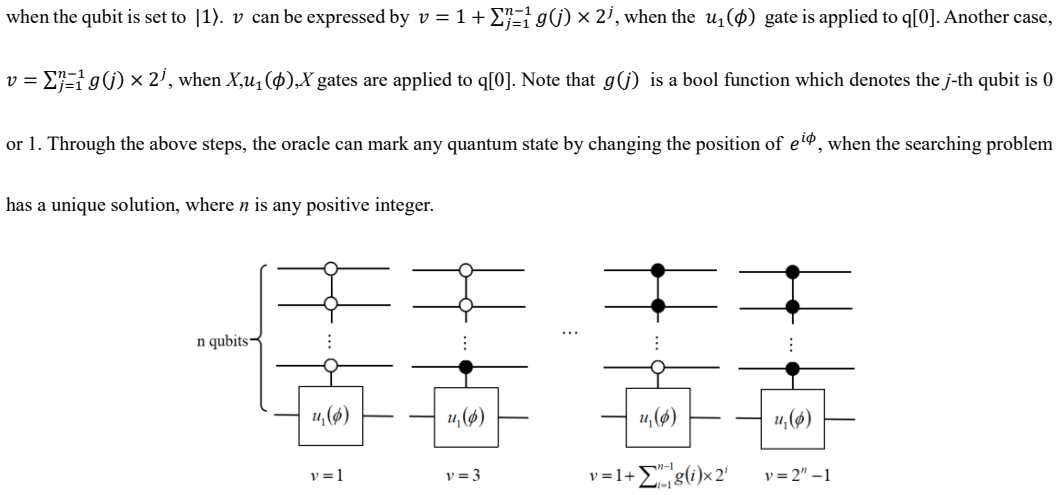
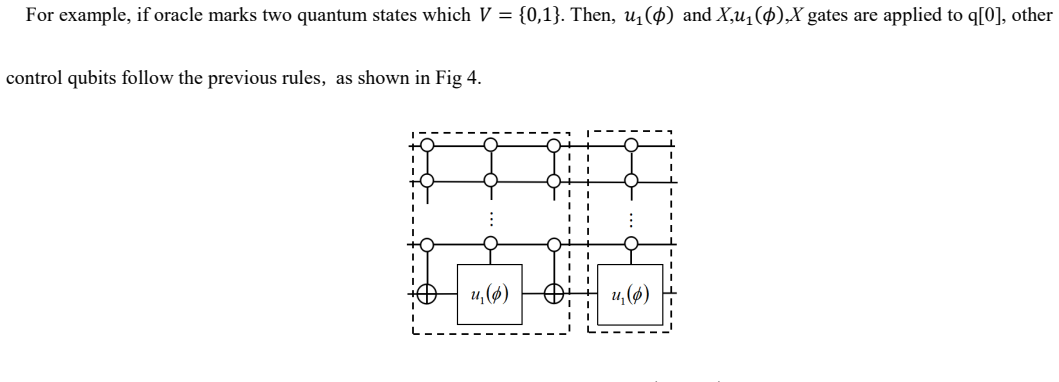
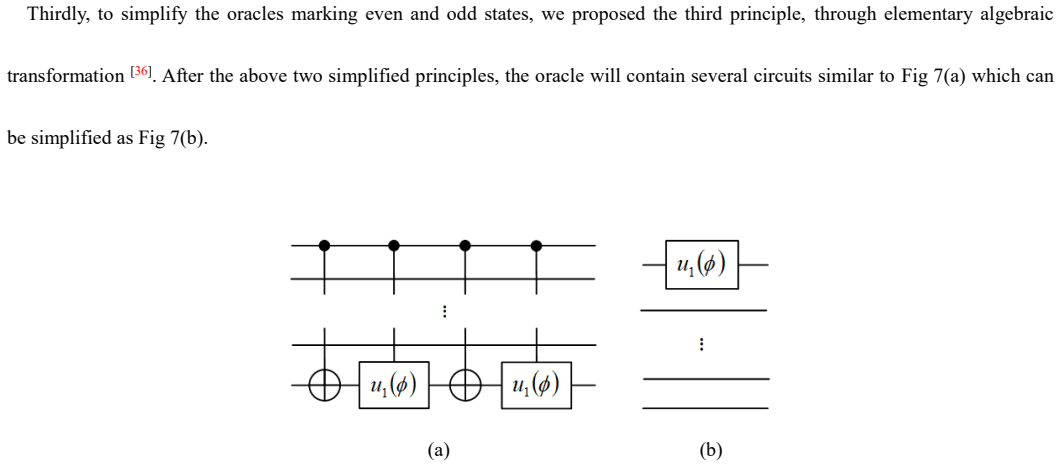
The load-bearing object is the Grover–Long operator: a single Grover iteration in which the conditional phase shifts in the oracle and the $I_0$ operator are replaced by rotations through an adjustable angle $\phi = 2\arcsin(\sin(\pi/(4J+2))/\sin\beta)$, with $\sin\beta = \sqrt{M/N}$. When $J$ satisfies the lower bound from the paper, measuring the register yields one of the marked states with zero theoretical failure. The paper derives $J$ and $\phi$ from estimated values $\tilde{M}$ and $\tilde{N}$, constructs the diagonal phase-shift operator $I_0 = \mathrm{diag}[e^{i\phi},1,\ldots,1]$, builds oracles that mark individual or threshold-marked basis states, and then applies three simplification principles to lower the cost of controlled-phase gates. This machinery is what turns a probabilistic amplitude-amplification subroutine into a deterministic one while preserving the quadratic speedup.
What would settle it
Run QUMMSA on a database whose values occupy only a small fraction of the $2^n$ code space (e.g., 6 qubits with 10 distinct values spanning the range) and count how often the Grover–Long measurement returns a value above the current threshold; the paper's own contour map predicts an elevated failure rate in that regime, which would contradict the near-100% success claim if the method is used without the sampling refinement.
Extended reading notes
Core claim
The paper's central claim is that the earlier quantum min–max search DHA can be rebuilt on the Grover–Long operator, a version of Grover's iteration in which the usual phase inversion is replaced by an adjustable rotation through an angle determined by the estimated ratio of marked values to database size. With an iteration count $J$ satisfying $J \geq \lfloor (\pi/2 - \beta)/\beta \rfloor + 1$, where $\sin\beta = \sqrt{M/N}$, the search returns a marked value with zero theoretical failure rate. The paper then computes these parameters from estimates $\tilde{M} = d_0 + 1$ and $\tilde{N} = 2^n$, provides explicit quantum circuits for the phase-shift operator and for oracles marking one or many values, and gives three simplification rules that reduce the number of multi-qubit controlled gates. Compared with the repetition-based inner search of DHA, the QUMMSA has a deterministic iteration count and a worst-case success probability in the main loop of $1 - (1/2)^c$ for a constant $c$, which approaches 1 as $c$ grows.
Load-bearing premise
The central assumption is that the estimated ratio of marked values to database size, taken from a uniform filling of the code space, is close to the true ratio; if the database is sparse or non-uniform, the Grover–Long parameters are wrong and the near-100% success claim relies on sampling refinements that are not part of the main algorithm.
Editorial extensions
If this is right
- If the ratio $\tilde{M}/\tilde{N}$ is close to the true ratio, the inner Grover–Long search succeeds with probability close to 1, so the full min–max algorithm inherits a near-deterministic success behavior.
- Replacing the random stopping rule of DHA with a fixed constant $c$ gives an exponential improvement in the worst-case failure rate of the outer loop, $1/2^c$.
- The simplified oracle circuits reduce the number of two-qubit controlled gates for marking $2^m$ consecutive states from $2^{n+m-1}$ to $2^{n-m-1}$, which directly lowers the gate load for threshold oracles used in min/max search.
- The complexity analysis implies that QUMMSA prepares about $\log_2 N$ initial states instead of $\log_2^2 N$, so the advantage over DHA grows as the database size increases.
Reading between the lines
- The real bottleneck of the method is estimation, not search: if a user supplies a good rank estimate for the current threshold from a small sample, the same Grover–Long circuit becomes near-deterministic; the paper's own sampling formula suggests such a pre-processing step, though it is not integrated into the pseudocode.
- Because the estimated fraction $\tilde{M}/\tilde{N}$ is derived from a uniform filling of the code space, the method's success on sparse real-world tables will depend strongly on how well the empirical cumulative distribution matches that assumption; the paper's contour map shows the failure rate climbing away from the diagonal.
- The three circuit simplifications are not specific to min/max finding and could be reused for any oracle that marks values below or above a threshold, such as range queries or top-$k$ selection.
- A fully practical version of the algorithm would need a certified procedure that estimates $M/N$ with bounded error before running the quantum search; the paper leaves this as a separate step, so a combined classical-sampling-plus-quantum-search pipeline is the natural next development.
Editorial analysis
A structured set of objections, weighed in public.
Referee Report
Summary. The paper proposes QUMMSA, a variant of Dürr–Høyer quantum minimum/maximum search. QUMMSA replaces the probabilistic quantum exponential searching subroutine with the Grover–Long exact search algorithm, sets the Grover–Long phase and iteration parameters from estimates M̃ and Ñ of the number of marked items and database size, terminates the outer loop after a constant c repetitions instead of DHA's threshold, and gives explicit circuit constructions for the phase operator I0 and oracles together with three simplification rules. The authors report a two-qubit experiment on IBMQ Yorktown comparing Grover–Long with QESA, a six-qubit numerical simulation for a 36-item excerpt of Titanic passenger ages, a failure-rate analysis for both subroutines, and a complexity comparison with DHA. The central advertised advantage is that the success probability can approach 100% when the ratio M/N is known accurately, while the circuit costs are lower than DHA for large databases.
Significance. Conditional on its assumptions, the paper's central idea is sound: replacing QESA with Grover–Long is a natural way to make the inner search deterministic, and the reported circuit constructions, simplification rules, and hardware demonstration are useful and transparent. The paper includes detailed circuit diagrams for I0 and oracles, three simplification principles, and full data tables for the Titanic example, which facilitate reproduction. I found no sign of circular reasoning or outcome-dependent parameter fitting. However, the strongest advertised claims—near-100% success and complexity advantage—currently rest on an estimator whose accuracy is not proved, and the 6-qubit validation is compromised by a wrong success condition. These are fixable, but they need to be corrected before the claims can be accepted.
major comments (4)
- [Section 4.2, text before Fig. 11] The success condition for the minimum-search simulation is stated as "If d1 ≥ d0, the algorithm is thought to operate successfully", but the oracle constructed for minimum search marks all values ≤ d0. A correct minimum-search success condition is d1 ≤ d0. As written, the 6-qubit validation may count measurements above d0 as successes, so the reported comparison with QESA in Section 4.2 does not support the claimed advantage for minimum search.
- [Section 5.1, Eq. (14) and Fig. 13] The near-100% success claim depends on M̃/Ñ closely approximating M/N, but the implemented estimator M̃ = d0 + 1, Ñ = 2^n (Section 4.2) is exact only when all code states in [0, 2^n − 1] hold data values and the data are uniform. Hypothesis (6) explicitly permits zero-amplitude basis states, and the Titanic excerpt stores only 36 values in a 64-state 6-qubit code space, so M̃ can systematically exceed the true number of marked items. The paper gives no quantitative bound on the Grover-Long failure rate as a function of the estimation error, and the sampling estimator in Eq. (14) is not inserted into Algorithm 1; hence the abstract's "close to 100%" claim and the complexity comparison in Eq. (21) are not established.
- [Section 5.2, Eq. (21) and Fig. 15] The total failure probability ε enters the final complexity formula, but it is never derived from the outer-loop parameter c and the Grover-Long parameter error; Fig. 15 fixes ε = 0.1 without justification. The two failure contributions in Section 5.1 are analyzed separately, so the paper does not prove the overall QUMMSA failure probability or the claimed complexity advantage over DHA for large databases.
- [Section 3.1, Eq. (1)] For the general case N < 2^n admitted by Hypothesis (6), the preparation operator W that creates the uniform superposition over the N occupied basis states is not constructed and no circuit for it is given, despite Hypothesis (5) assigning it cost log2(N). Without such a construction, the claim in Section 3 of a general design method for QUMMSA circuits and the complexity accounting in Section 5.2 are incomplete.
minor comments (5)
- [Section 5.1] The sentence "Therefore, we assume that each orthonormal basis state stores a data value" appears twice verbatim in the paragraph before Eq. (13); the duplicate should be removed.
- [Section 4.2] The text refers to "Fig 10(a)" when discussing the theoretical failure rate of Grover-Long algorithm, but the relevant panels appear in Fig. 12; the figure cross-references should be renumbered.
- [References] References [25] and [26] are identical entries for Vandersypen et al.; one should be removed or replaced with a distinct citation.
- [Appendix B, Table 2] The column header "Name Age After Encoding" repeats inside the table, and the column alignment is inconsistent; the table should be reformatted so each data column has a single clear header.
- [Throughout] There are several typographical errors: "donates" in the Fig. 14 caption should be "denotes", "combing" in Section 6 should be "combining", and "Durr, Hoyer's" should be "Dürr–Høyer's".
Circularity Check
No significant circularity: the algorithm's parameters come from an explicit estimation assumption and external Grover-Long theory, not from fitting the claimed success.
full rationale
The paper's central derivation is self-contained in the relevant sense. QUMMSA replaces DHA's QESA with the Grover-Long algorithm, whose phase and iteration parameters are taken from the external Refs. [16,17] (Eqs. (3)-(4)); the paper does not redefine those parameters in terms of its own success metric. The estimator M̃ = d0+1, Ñ = 2^n (Section 4.2, before Fig. 11, and Section 5.1) is explicitly introduced as an assumption for databases with no prior knowledge, and the paper then quantifies the resulting failure rate as a function of the gap between M̃/Ñ and M/N (Fig. 13 and Eqs. (C5)-(C7)). This is a robustness analysis, not a fitted parameter relabeled as a prediction. The sampling-based improvement in Section 5.1 is conditional ('As long as P̃(x) ≈ P(x), we can calculate the parameters of Grover-Long algorithm, accurately'), and the complexity comparison in Section 5.2 uses the same openly stated M0 ≈ N/2 and ε = 0.1 assumptions. No equation reduces to itself by construction, and the paper's load-bearing references (Grover-Long, DHA, Boyer et al.) are external prior work, not self-citations. The paper's own caveats about rising failure rates for large databases are limitations rather than circularity; the possibly inverted success criterion d1 ≥ d0 in Section 4.2 and the unintegrated sample-size estimator are correctness/soundness gaps, not circular reasoning.
Assumptions & free parameters
free parameters (3)
- c =
positive integer, user-chosen
- M̃ =
d0 + 1
- Ñ =
2^n
assumptions (5)
- domain assumption Grover-Long search has zero failure rate when M/N is known exactly and the phase is chosen by formula (3).
- domain assumption Each data value is stored in a distinct orthonormal basis state with amplitude 1/sqrt(N) and unused states have amplitude 0.
- ad hoc to paper The estimated database distribution is uniform over [0, 2^n - 1], so M̃/Ñ approximates M/N.
- domain assumption The output of Grover-Long is uniformly distributed over marked states, so the expected number of main loops is log2 N and the stopping rule analysis holds.
- ad hoc to paper The classical sample size formula h = Z^2 sigma^2 / E^2 applies to quantum database estimation.
Cite this review
Pith. "Pith review of An Optimized Quantum Maximum or Minimum Searching Algorithm and its Circuits." pith.science (2026). https://pith.science/paper/VYY64XG4
@misc{pith2026190807943,
  author       = {Pith},
  title        = {Pith review of: An Optimized Quantum Maximum or Minimum Searching Algorithm and its Circuits},
  year         = {2026},
  howpublished = {\url{https://pith.science/paper/VYY64XG4}},
  note         = {Machine review of arXiv:1908.07943}
}
read the original abstract
Finding a maximum or minimum is a fundamental building block in many mathematical models. Compared with classical algorithms, Durr, Hoyer's quantum algorithm (DHA) achieves quadratic speed. However, its key step, the quantum exponential searching algorithm (QESA), which is based on Grover algorithm, is not a sure-success algorithm. Meanwhile, quantum circuits encounter the gate decomposition problem due to variation of the scale of data. In this paper, we propose an optimized quantum algorithm for searching maximum and minimum, based on DHA and the optimal quantum exact search algorithm. Furthermore, we provide the corresponding quantum circuits, together with three equivalent simplifications. In circumstances when we can exactly estimate the ratio of the number of solutions M and the searched space N, our method can improve the successful probability close to 100%. Furthermore, compared with DHA, our algorithm shows an advantage in complexity with large databases and in the gate complexity of constructing oracles. Experiments have been executed on an IBM superconducting processor with two qubits, and a practical problem of finding the minimum from Titanic passengers' age was numerically simulated. Both showed that our optimized maximum or minimum performs more efficiently compared with DHA. Our algorithm can serve as an important subroutine in various quantum algorithms which involves searching maximum or minimum.
Figures


Figures from the paper (7 more)




Reference graph
Works this paper leans on
-
[23]
Grover L K. Fixed-point quantum search[J]. Physical Review Letters, 2005, 95(15): 150501. 23
work page 2005
-
[1]
Cisco forecasts that 77 EB data traffic will be generated per month by 2022 [1]
Introduction In the era of data explosion, computing devices have to process more and more data with higher speed and better efficiency. Cisco forecasts that 77 EB data traffic will be generated per month by 2022 [1]. But the computing power of classical computers tends to reach its upper limit. It is urgent to find a new way to process large-scale data. ...
work page 2022
-
[2]
The problem is to find the maximum or minimum from 𝐷
The QUMMSA Problem: Let 𝐷 be an unsorted database with 𝑁 items. The problem is to find the maximum or minimum from 𝐷 . For convenience, we only present the minimum searching algorithm as an example. The maximum searching algorithm can be achieved similarly. 4 Core idea: Exploiting the Grover-Long algorithm, we can find 𝑀(𝑀 ≥ 1) solutions from the unsorted...
-
[3]
General circuits and three equivalent simplified principles 3.1 Review of Grover-Long algorithm The initial state can be prepared by 𝑊 operator, which can be described as formula(1): |𝛹⟩ = 𝑊|0⨂𝑛⟩ = 1 √𝑁 ∑ |𝑖⟩𝑁−1 𝑖=0 = √ 𝑀 𝑁 |𝛹𝑔𝑜𝑜𝑑⟩ + √ 𝑁−𝑀 𝑁 |𝛹𝑏𝑎𝑑⟩ (1) Where |Ψgood⟩ stores solutions which we want to find and |Ψbad⟩ stores other values; 𝑁 is the database s...
-
[4]
Experiment and simulation In this section, we compare the key step of DHA (with QESA) and QUMMSA (with Grover-Long) firstly by a 2-qubit experiment based on a superconducting processor. Besides, a 6 -qubit nume rical simulation was conducted to show how QUMMSA can efficiently solve a minimum finding problem based on a real data set (passenger age (excerpt...
-
[5]
Performance We explain the performance of QUMMSA from two aspects: the failure rate and the complexity. Specifical ly, we propose two methods to reduce the failure rate and compare the complexity of DHA and our algorithm. 5.1 Failure rate In this section, the failure rate can be contributed by two parts:
-
[6]
The failure rate of Grover-Long algorithm caused by the unknown number of solutions. 17
-
[7]
The failure rate in the main loop caused by the selection of the interrupt condition
Show all 47 references
-
[8]
If we want to obtain the exact value of 𝛽, 𝐽, 𝜙, we must know 𝑀 𝑁
The failure rate of Grover-Long algorithm For convenience, we only present the minimum value searching algorithm as an example. If we want to obtain the exact value of 𝛽, 𝐽, 𝜙, we must know 𝑀 𝑁. But not all quantum states store a data value. When a random value 𝑑0 is obtained,...
-
[9]
We can obtain 𝑑1, less than or equal to 𝑑0
The failure rate of main loop This part of the failure rate is due to the fact that we don’t know when to end the main loop. We can obtain 𝑑1, less than or equal to 𝑑0. But we don’t know 𝑑1 whether is the minimum value. If we finish the main loop too early, then we only obtain...
-
[10]
Based on Grover -Long algorithm, we proposed QUMMSA, which is an improved version of DHA
Conclusions In summary, we demonstrate the advantage of the quantum algorithm for finding maximum or minimum value to alleviate some of the challenges brought by the rapidly increasing amount of data. Based on Grover -Long algorithm, we proposed QUMMSA, which is an improved ve...
-
[11]
Cisco Visual Networking Index: Global Mobile Data Traffic Forecast Update 2016–2021 White Paper, Feb. 2017. [Online]
2016
-
[12]
Quantum algorithm design: Techniques and applications
Shao, Changpeng, Yang Li, and Hongbo Li. " Quantum algorithm design: Techniques and applications." Journal of Systems Science and Complexity 32.1(2019):375-452
2019
-
[13]
Quantum theory, the Church –Turing principle and the universal quantum computer[J]
Deutsch D. Quantum theory, the Church –Turing principle and the universal quantum computer[J]. Proceedings of the Royal Society of London. A. Mathematical and Physical Sciences, 1985, 400(1818): 97-117
1985
-
[14]
Rapid solution of problems by quantum computation[J]
Deutsch D, Jozsa R. Rapid solution of problems by quantum computation[J]. Proceedings of the Royal Society of London. Series A: Mathematical and Physical Sciences, 1992, 439(1907): 553-558
1907
-
[15]
Polynomial-time algorithms for prime factorization and discrete logarithms on a quantum computer[J]
Shor P W. Polynomial-time algorithms for prime factorization and discrete logarithms on a quantum computer[J]. SIAM review, 1999, 41(2): 303-332
1999
-
[16]
A fast quantum mechanical algorithm for database search[C]// Proc
Grover L K. A fast quantum mechanical algorithm for database search[C]// Proc. of the 28th annual ACM Symp. on Theory of Computing. New York, USA:ACM Press, 1996. 6: 212-219
1996
-
[17]
Quantum mechanics helps in searching for a needle in a haystack[J]
Grover L K. Quantum mechanics helps in searching for a needle in a haystack[J]. Physical review letters, 1997, 79(2): 325
1997
-
[18]
Quantum computers can search rapidly by using almost any transformation[J]
Grover L K. Quantum computers can search rapidly by using almost any transformation[J]. Physical Review Letters, 1998, 80(19): 4329
1998
-
[19]
Exactness of the original Grover search algorithm[J]
Diao Z. Exactness of the original Grover search algorithm[J]. Physical Review A, 2010, 82(4): 044301
2010
-
[20]
Grover’s quantum search algorithm for an arbitrary initial amplitude distribution[J]
Biham E, Biham O, Biron D, et al. Grover’s quantum search algorithm for an arbitrary initial amplitude distribution[J]. Physical Review A, 1999, 60(4): 2742
1999
-
[21]
Analysis of generalized Grover quantum search algorithms using recursion equations[J]
Biham E, Biham O, Biron D, et al. Analysis of generalized Grover quantum search algorithms using recursion equations[J]. Physical Review A, 2000, 63(1): 012310
2000
-
[22]
Arbitrary phases in quantum amplitude amplification[J]
Høyer P. Arbitrary phases in quantum amplitude amplification[J]. Physical Review A, 2000, 62(5): 052304
2000
-
[24]
Phase matching in quantum searching[J]
Long G L, Li Y S, Zhang W L, et al. Phase matching in quantum searching[J]. Physics Letters A, 1999, 262(1): 27-34
1999
-
[25]
Phase matching condition for quantum search with a generalized initial state[J]
Long G L, Li X, Sun Y . Phase matching condition for quantum search with a generalized initial state[J]. Physics Letters A, 2002, 294(3-4): 143-152
2002
-
[26]
Grover algorithm with zero theoretical failure rate
Long, Gui-Lu. "Grover algorithm with zero theoretical failure rate." Physical Review A 64.2 (2001): 022307
2001
-
[27]
Tight bounds on quantum searching[J]
Boyer M, Brassard G, Høyer P, et al. Tight bounds on quantum searching[J]. Fortschritte der Physik: Progress of Physics, 1998, 46(4‐5): 493-505
1998
-
[28]
Quantum counting[C]//International Colloquium on Automata, Languages, and Programming
Brassard G, Høyer P, Tapp A. Quantum counting[C]//International Colloquium on Automata, Languages, and Programming. Springer, Berlin, Heidelberg, 1998: 820-831
1998
-
[29]
Quantum amplitude amplification and estimation[J]
Brassard G, Hoyer P, Mosca M, et al. Quantum amplitude amplification and estimation[J]. Contemporary M athematics, 2002, 305: 53-74
2002
-
[30]
Quantum search with certainty based on modified Grover algorithms: optimum choice of parameters[J]
Toyama F M, Van Dijk W, Nogami Y . Quantum search with certainty based on modified Grover algorithms: optimum choice of parameters[J]. Quantum information processing, 2013, 12(5): 1897 -1914
2013
-
[31]
Highlighting the mechanism of the quantum speedup by time -symmetric and relational quantum mechanics[J]
Castagnoli G. Highlighting the mechanism of the quantum speedup by time -symmetric and relational quantum mechanics[J]. Foundations of Physics, 2016, 46(3): 360-381
2016
-
[32]
A quantum algorithm for finding the minimum[J]
Durr C, Hoyer P. A quantum algorithm for finding the minimum[J]. arXiv preprint quant-ph/9607014, 1996
1996 arXiv
-
[33]
A new quantum algorithm for solving the minimum searching problem[J]
Kowada L A B, Lavor C, Portugal R, et al. A new quantum algorithm for solving the minimum searching problem[J]. International Journal of Quantum Information, 2008, 6(03): 427-436
2008
-
[34]
Experimental implementation of fa st quantum searching[J]
Chuang I L, Gershenfeld N, Kubinec M. Experimental implementation of fa st quantum searching[J]. Physical review letters, 1998, 80(15): 3408
1998
-
[35]
Implementation of a three -quantum-bit search algorithm[J]
Vandersypen L M K, Steffen M, Sherwood M H, et al. Implementation of a three -quantum-bit search algorithm[J]. Applied Physics Letters, 2000, 76(5): 646-648
2000
-
[36]
Implementation of a three -quantum-bit search algorithm[J]
Vandersypen L M K, Steffen M, Sherwood M H, et al. Implementation of a three -quantum-bit search algorithm[J]. Applied Physics Letters, 2000, 76(5): 646-648. 24
2000
-
[37]
Demonstration of two -qubit algorithms with a superconducting quantum processor[J]
DiCarlo L, Chow J M, Gambetta J M, et al. Demonstration of two -qubit algorithms with a superconducting quantum processor[J]. Nature, 2009, 460(7252): 240
2009
-
[38]
Implementation of Grover ’s quantum search algorithm in a scalable system[J]
Brickman K A, Haljan P C, Lee P J, et al. Implementation of Grover ’s quantum search algorithm in a scalable system[J]. Physical Review A, 2005, 72(5): 050306
2005
-
[39]
Demon stration of a small programmable quantum computer with atomic qubits[J]
Debnath S, Linke N M, Figgatt C, et al. Demon stration of a small programmable quantum computer with atomic qubits[J]. Nature, 2016, 536(7614): 63
2016
-
[40]
Complete 3-qubit Grover search on a programmable quantum computer[J]
Figgatt C, Maslov D, Landsman K A, et al. Complete 3-qubit Grover search on a programmable quantum computer[J]. Nature communications, 2017, 8(1): 1918
2017
-
[41]
Experimental one-way quantum computing[J]
Walther P, Resch K J, Rudolph T, et al. Experimental one-way quantum computing[J]. Nature, 2005, 434(7030): 169
2005
-
[42]
Demonstration of blind quantum computing[J]
Barz S, Kashefi E, Broadbent A, et al. Demonstration of blind quantum computing[J]. science, 2012, 335(6066): 303 -308
2012
-
[43]
Elementary gates for quantum computation[J]
Barenco A, Bennett C H, Cleve R, et al. Elementary gates for quantum computation[J]. Physical review A, 1995, 52(5): 3457
1995
-
[44]
Fully microwave -tunable universal gates in superconducting qubits with linear couplings and fixed transition frequencies[J]
Rigetti C, Devoret M. Fully microwave -tunable universal gates in superconducting qubits with linear couplings and fixed transition frequencies[J]. Physical Review B, 2010, 81(13): 134507
2010
-
[45]
Supervised learning with quantum -enhanced feature spaces[J]
Havlíček V , Córcoles A D, Temme K, et al. Supervised learning with quantum -enhanced feature spaces[J]. Nature, 2019, 567(7747): 209
2019
-
[46]
Quantum Computation and Quantum Information: 10th Anniversary[J]
Nielsen M A, Chuang I L. Quantum Computation and Quantum Information: 10th Anniversary[J]. 2011
2011
-
[47]
Mathematical statistics with applications[M]
Wackerly D, Mendenhall W, Scheaffer R L. Mathematical statistics with applications[M]. Cengage Learning, 2014. Appendix A In this section, we present some parameters of IBM quantum superconducting processor. It is shown in Table 1. Table 1 Some parameters of IBM quantum superc...
2014
Reviewed August 14, 2026 · model on record in the stance chip above.
Discussion (0). Continue with ORCID to comment.