REVIEW 3 major objections 7 minor 10 references
An improved muon track reconstruction for IceCube
T0 review · 3 major / 7 minor · reviewed 2026-08-14 · deepseek-v4-flash
Pith's one-line read SegmentedSplineReco models stochastic muon energy losses and improves IceCube's muon angular resolution by about 20% at 1 PeV and up to a factor of two on starting tracks.
desk verdict A solid short proceeding that does one thing well—explicit stochastic-loss modeling in muon track reconstruction—but overreaches when it equates median ΔΨ gains with point-source discovery potential. read the letter →
The pith
A machine-rendered reading of the paper's core claim, the machinery that carries it, and where it could break.
The reading
What carries the argument
The load-bearing object is the segmented track hypothesis: the muon trajectory is approximated by a chain of electromagnetic cascades at fixed spacing (10 m by default), each treated as an independent Cherenkov light source. The total photon arrival-time distribution at a DOM is the weighted sum $p(t)=\sum_{j=0}^{n} w_j p_j(t)$, with weights proportional to expected photon counts $\lambda_j$ taken from high-dimensional B-spline tables fitted to ray-traced Monte Carlo simulations. The direction is found by maximizing one of three likelihood variants, with the first-hit-per-DOM version (c) performing best; exact gradient and Hessian evaluation enables joint energy and vertex optimization and new uncertainty estimators.
What would settle it
Run SegmentedSplineReco on the same Monte Carlo samples with a much finer cascade spacing (for example 2 m) and with iterative refitting of cascade energies throughout the track optimization; if the median angular error does not improve relative to SplineReco, the reported 10% and 20% gains are artifacts of the fixed-loss approximation rather than genuine modeling gains.
Extended reading notes
Core claim
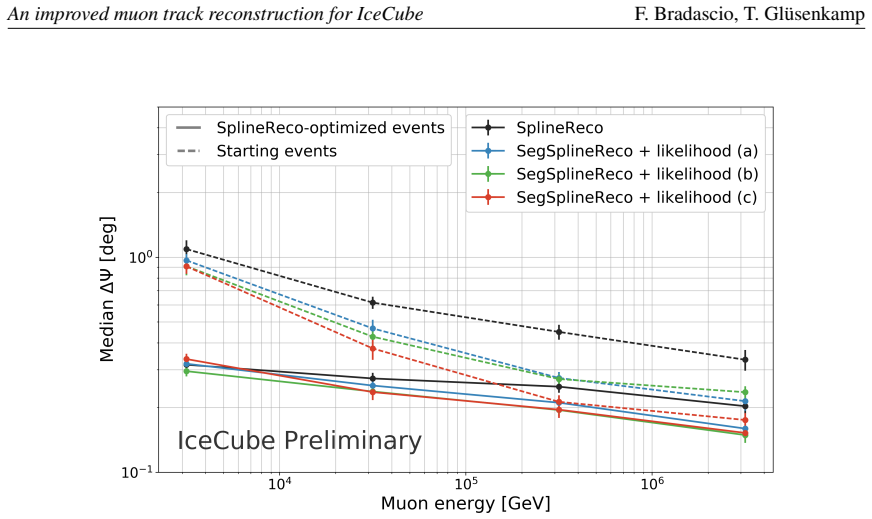
On the paper's own terms, the central claim is that explicitly modeling stochastic energy losses as a superposition of cascade sources in the photon arrival-time PDF yields a better muon direction estimate than the prevailing SplineReco method. The new reconstruction, SegmentedSplineReco, optimizes the track by maximizing a likelihood built from a weighted sum of cascade, noise, and optionally minimum-ionizing-track PDFs. On a sample selected for SplineReco quality, it improves median angular resolution by about 10% at 100 TeV and 20% at 1 PeV; on geometrically selected starting tracks the improvement reaches a factor of two, largely because the initial hadronic shower is captured by the segmented model.
Load-bearing premise
The method assumes that a fixed 10 m cascade spacing, with energies fitted only once before track optimization, approximates the true stochastic muon energy-loss profile closely enough; if this approximation is poor, the claimed resolution gains shrink.
Editorial extensions
If this is right
- IceCube muon-neutrino point-source searches should become more sensitive if the new reconstruction replaces SplineReco, since the same events get smaller and better-calibrated directional uncertainties.
- The reconstruction should improve existing event selections that relied on SplineReco quality cuts, including the selection that produced the reported 3.5σ excess from the direction of TXS 0506+056.
- Starting tracks, which include a substantial initial hadronic cascade, gain the most from the new model, so future Southern-sky analyses using starting tracks should see the largest resolution gains.
- The new uncertainty estimators (MCMC sampling and Hessian inversion) show flatter pull distributions with energy and a lower failure rate than the standard paraboloid method, making per-event error estimates more reliable.
- The computational cost of gradient-based optimization is about twice as fast as before, while Hessian-based covariance estimation adds nearly no overhead, making the method practical for large IceCube event samples.
Reading between the lines
- The gains reported with fixed 10 m cascade spacing and pre-fitted energies may be a lower bound: the authors explicitly note that iterative refitting of energies and spacing should improve the likelihoods that depend most on model accuracy, so a fully iterative version could be expected to push resolution further.
- The same segmented-cascade machinery is not IceCube-specific; other Cherenkov neutrino detectors with different geometries and ice models could adopt it, provided they have Monte-Carlo-derived photon arrival tables for cascades.
- If applied early in event selection rather than after SplineReco-based cuts, the reconstruction should retain more high-energy events with large stochastic losses, changing the composition and energy distribution of point-source samples.
- The Hessian-based covariance estimate marginalizing over all energy-loss parameters could serve as a prototype for jointly estimating energy and direction uncertainties in cascade-only or hybrid events.
Signed reviews
Editorial analysis
A structured set of objections, weighed in public.
Referee Report
Summary. This paper presents SegmentedSplineReco, a maximum-likelihood muon track reconstruction for IceCube in which stochastic energy losses are modeled by electromagnetic cascades spaced at 10 m along the track, with photon arrival time PDFs obtained from spline-interpolated simulation tables. The implementation includes three likelihood variants, exact gradient/Hessian support, and two new per-event angular-uncertainty estimators based on MCMC sampling and Hessian inversion. Using Monte Carlo truth as the benchmark, the authors compare the median angular resolution ΔΨ with that of the standard SplineReco method on two simulated samples: 'SplineReco-optimized' events selected by NDir/LDir quality cuts, and geometrically selected starting tracks. They report improvements of about 10% at 100 TeV and 20% at 1 PeV on the first sample, up to a factor of two on starting events, and qualitatively flatter pull behavior for the new uncertainty estimators. The paper concludes that these improvements translate into better point-source discovery potential for IceCube.
Significance. If the reported resolution gain is real, this is a valuable contribution to IceCube's point-source program, and the paper has several strengths: the headline number is measured against Monte Carlo truth rather than a quantity fitted into the likelihood, the median errors are bootstrapped, three likelihood formulations are compared, and the Hessian-based uncertainty estimator is computationally attractive. The work is a short conference proceeding, so the absence of a full systematics study is understandable. However, the paper's point-source motivation is not yet established: no sensitivity or discovery-potential calculation is presented, and the paper itself reports that the per-event uncertainty σΨ remains underestimated even with the new estimators. The MC-truth benchmark avoids circularity in the resolution comparison, but the fixed 10 m cascade spacing and the SplineReco-based event selection deserve robustness checks before the quantitative claims are taken as final.
major comments (3)
- [Sec. 1 and Sec. 5] Section 1 states that improving angular resolution 'directly translates into a better discovery potential' and Section 5 repeats that the resolution gain implies improved sensitivity for point-source searches. This inference is not supported by the paper. IceCube point-source analyses use an unbinned likelihood in which each event contributes with its per-event directional uncertainty σΨ, and the sensitivity depends on the full distribution of (ΔΨ, σΨ), including tails and the calibration of σΨ. The paper reports only the median ΔΨ, and Figure 2 shows that σΨ is still underestimated by the new estimators. Without a sensitivity calculation or at least a quantitative argument using the per-event errors, the central astrophysical motivation remains unverified. Please either add such an analysis or explicitly separate the measured resolution gain from its anticipated impact on discovery potential.
- [Sec. 4, Fig. 1] The quoted 10-20% improvement is obtained on 'SplineReco-optimized' events that must pass NDir/LDir cuts based on SplineReco quality parameters. Because these cuts were designed to select events where SplineReco performs well, they may preferentially exclude events with large stochastic energy losses, which are exactly the events where SegmentedSplineReco should show the largest gain. The conclusion's extrapolation that 'a similar improvement is expected' for existing analysis selections such as the TXS 0506+056 sample is therefore not directly supported by the data shown. The authors should either apply the new reconstruction to an existing final selection (or a representative proxy) or quantify how the resolution gain varies as a function of the NDir/LDir cuts.
- [Sec. 4, paragraph 1] The method's key free parameter is the 10 m cascade spacing, and the energy losses are fitted once with the extended likelihood (b) using the SplineReco seed before the track is optimized. The paper provides no stability check with respect to this spacing, and it explicitly notes that for starting tracks the SplineReco seed is often far off, leading to a strongly biased energy-loss model. It is therefore unclear whether the quoted improvements are robust to the choice of spacing and to the one-shot fitting procedure, or whether they are conditional on this particular initialization. A sensitivity scan over spacing (e.g., 5 m, 10 m, 20 m) and, where feasible, an iterative energy/track refit would substantially strengthen the claim.
minor comments (7)
- [Sec. 1] In the sentence 'muons mostly loose energy stochastically', 'loose' should be 'lose'.
- [Sec. 2, Eq. (2.1) area] The charge notation is inconsistent: q_i is defined as the charge of a hit, while the extended likelihood uses q_k for the total charge per DOM. Please define both quantities explicitly.
- [Fig. 2 caption] The phrase 'divided by the estimated angular difference' should read 'divided by the estimated angular uncertainty (σΨ)'.
- [Sec. 4] The statement that 'the parentheses contain the successful reconstruction count' is unclear; please describe what the numbers in the parentheses of Figure 2 represent or include them explicitly in the caption.
- [Sec. 4] The bootstrap procedure used for the median errors is not described; please state the number of bootstrap resamples and the resampling unit (e.g., events).
- [Sec. 3, Method 1] The MCMC settings are given only as 'a few thousand steps' with no burn-in or convergence diagnostics; please provide the actual parameters or cite the sampler defaults used.
- [Sec. 4 and Sec. 5] The paper says the new methods 'fail less often' but gives no quantitative failure rates for the Old method, Method 1, or Method 2; please report these numbers or soften the claim.
Circularity Check
No significant circularity: the resolution gain is validated against Monte Carlo truth and not built into the likelihood model.
full rationale
The central claim, a 10-20% improvement in median angular resolution, is an empirical benchmark against Monte Carlo truth, which is external to the reconstruction's likelihood. SegmentedSplineReco's photon arrival-time PDFs come from spline tables fitted to simulated photon propagation, but the angular resolution curve is not among the fitted quantities; the method could have failed to beat SplineReco. The 10 m cascade spacing and once-fitted cascade energies are acknowledged modeling approximations, and the paper admits in Section 4 that per-event uncertainties are still underestimated and that iterative fitting would improve results. These are limitations of the model, not reductions of the reported prediction to its inputs. Citations to prior IceCube work supply standard photon PDFs and the paraboloid error estimator, but they are not used to assert the new improvement, and no uniqueness theorem or author-imported constraint forces the outcome. No equation in the paper defines the measured angular resolution into existence, and no parameter is fitted to the resolution curve. The conclusion that improved median resolution 'directly translates' into better discovery potential is an extrapolation beyond the presented evidence, but that is a correctness and scope concern, not circularity.
Assumptions & free parameters
free parameters (1)
- Cascade segment spacing =
10 m
assumptions (4)
- domain assumption Photon arrival time PDFs for cascades and minimum ionizing muons are accurately obtained from high-dimensional splines fitted to MC simulations with photon ray-tracing.
- domain assumption The total photon arrival PDF is a weighted sum of independent cascade, muon, and noise PDFs (Eq. 2.1).
- domain assumption A muon's stochastic energy losses can be represented by discrete electromagnetic cascades along the track.
- domain assumption Monte Carlo simulation accurately models detector response, ice properties, and muon physics.
Cite this review
Pith. "Pith review of An improved muon track reconstruction for IceCube." pith.science (2026). https://pith.science/paper/SPYJUX76
@misc{pith2026190807961,
  author       = {Pith},
  title        = {Pith review of: An improved muon track reconstruction for IceCube},
  year         = {2026},
  howpublished = {\url{https://pith.science/paper/SPYJUX76}},
  note         = {Machine review of arXiv:1908.07961}
}
read the original abstract
IceCube is a cubic-kilometer Cherenkov telescope operating at the South Pole. One of its main objectives is to detect astrophysical neutrinos and identify their sources. High-energy muon neutrinos are identified through the secondary muons produced via charge current interactions with the ice. The present best-performing directional reconstruction of the muon track is a maximum likelihood method which uses the arrival time distribution of Cherenkov photons registered by the experiment's photomultipliers. A known systematic shortcoming of the prevailing method is to assume a continuous energy loss along the muon track. This contribution discusses a generalized Ansatz where the expected arrival time distribution is parametrized by a stochastic muon energy loss pattern. This more realistic parametrization of the muon energy loss profile leads to an improvement of about 20% to the muon angular resolution of IceCube.
Figures

Reference graph
Works this paper leans on
-
[1]
write newline
" write newline "" before.all 'output.state := FUNCTION blank.sep after.quote 'output.state := FUNCTION fin.entry output.state after.quoted.block = 'skip 'add.period if write newline FUNCTION new.block output.state before.all = 'skip output.state after.quote = after.quoted.block 'output.state := after.block 'output.state := if if FUNCTION new.sentence out...
-
[2]
IceCube Collaboration, M. G. Aartsen et al. , JINST 12, 03 P03012 (2017)
work page 2017
-
[3]
IceCube Collaboration, M. G. Aartsen et al. , The Astrophysical Journal 835, 151 (2017)
work page 2017
-
[4]
IceCube Collaboration,
-
[5]
IceCube Collaboration, M. G. Aartsen et al. , Nucl. Instrum. Meth. A524, 169-194 (2004)
work page 2004
-
[6]
Schatto, PhD thesis, Universit\"at Mainz (2014)
K. Schatto, PhD thesis, Universit\"at Mainz (2014)
work page 2014
-
[7]
N. Whitehorn, J. van Santen and S. Lafebre, Comput. Phys. Commun. 184, 2214-2220 (2013)
work page 2013
- [8]
Show all 10 references
-
[9]
Foreman-Mackey et al., PASP 125, 306-312 (2013)
2013
-
[10]
IceCube Collaboration, M. G. Aartsen et al. , Science 361, 6398 eaat1378 (2018)
2018
Reviewed August 14, 2026 · model on record in the stance chip above.
Discussion (0). Continue with ORCID to comment.