REVIEW 6 major objections 7 minor 24 references
Hebbian Graph Embeddings
T0 review · 6 major / 7 minor · reviewed 2026-08-14 · deepseek-v4-flash
Pith's one-line read The paper claims that a minimal Hebbian update rule—propagating Gaussian-perturbed embeddings along edges with annealed variance—learns node embeddings that beat node2vec, GF, SDNE, HOPE, LE, and VGAE on reconstruction and link prediction…
desk verdict A simple, plausibly useful iterative embedding method that is not currently backed by enough evidence to support its headline claims; the link-prediction protocol needs clarification before any comparison is taken seriously. read the letter →
The pith
A machine-rendered reading of the paper's core claim, the machinery that carries it, and where it could break.
The reading
What carries the argument
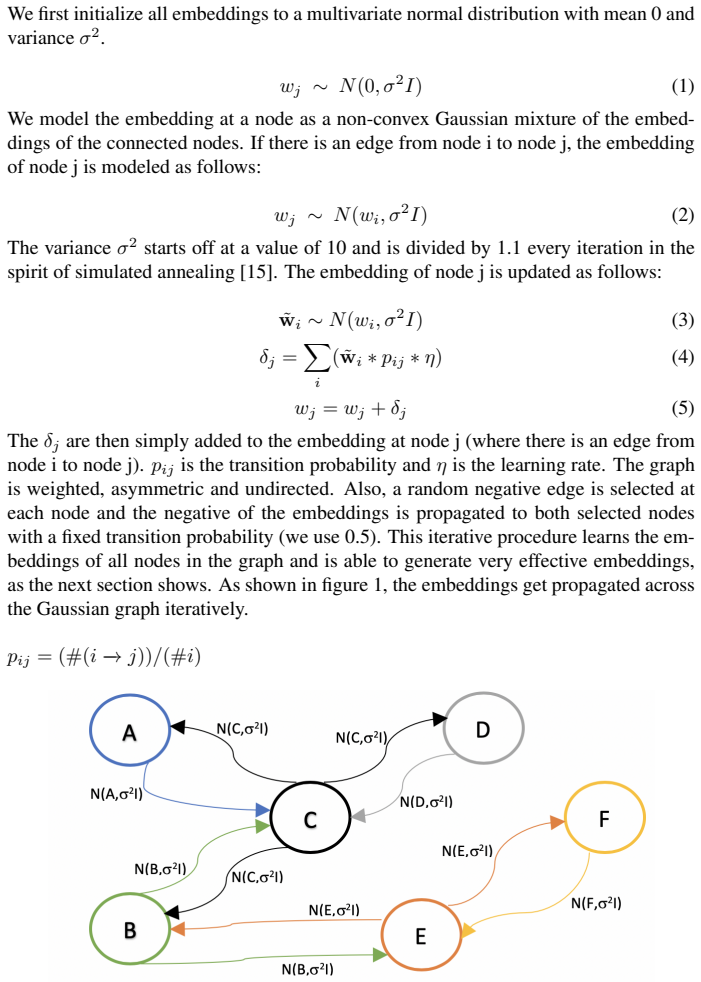
The load-bearing object is the Hebbian update in Equations 3-5 (Algorithm 1): for each directed edge $i\to j$, draw a Gaussian perturbation $\tilde{w}_i \sim \mathcal{N}(w_i, \sigma^2 I)$, then add $\delta_j = \sum_i \tilde{w}_i p_{ij} \eta$ to $w_j$, with a random negative edge contributing the negated vector at probability 0.5. The variance $\sigma^2$ starts at 10 and is divided by 1.1 each iteration, the annealing that the authors take from simulated annealing. This rule carries entire embedding vectors—rather than labels or scalars—across the graph, so repeated iterations propagate information beyond immediate neighbors. It is the mechanism that produces the claimed gains: no loss function, no deep network, and no shared memory among the edge updates, which is what makes the method embarrassingly parallel.
What would settle it
Re-run node2vec, GF, SDNE, HOPE, LE, and VGAE on AstroPh, BlogCatalog, and HepTh at 200 dimensions with identical 10% edge holdouts and 1024-node MAP sampling; if the reported gaps in Tables 1 and 5 shrink to near zero, the paper's central empirical claim fails.
Extended reading notes
Core claim
The central claim is that the iterative update of Algorithm 1 produces embeddings whose mean average precision on reconstruction and link prediction exceeds that of node2vec, GF, SDNE, HOPE, and LE on AstroPh, BlogCatalog, and HepTh, and whose average precision exceeds VGAE on all four small link-prediction benchmarks (Power, PB, USAir, C.Ele) and SEAL on one of those four. The authors model the embedding of each node, in effect, as a non-convex Gaussian mixture of the embeddings of its neighbors: at each iteration the noisy version of each neighbor's vector is added, weighted by the transition probability, and the variance is reduced by a factor of 1.1 until the graph settles. They also report that the same 10-iteration procedure, implemented on Apache Spark, achieves a hit rate of 30-31% at top-10 recommendations on a held-out user sample in a 200,000-node, 13.1-billion-edge retail item graph. The paper's discovery, on its own terms, is that this minimal errorless associative rule is effective at scale.
Load-bearing premise
The reported advantage rests on MAP and average-precision numbers being directly comparable across tables even though Hebbian embeddings run at 200 dimensions while the baselines are reported at 256, and without evidence that the 10% holdout, the 1024-node MAP sampling, and hyperparameters match the baseline protocols.
Editorial extensions
If this is right
- If the comparisons are accurate, a 10-iteration, learning-rate-1.0 Hebbian pass is a cheaper and simpler replacement for node2vec-style random-walk training on reconstruction and link-prediction tasks.
- Because the update is just vector addition over edges, any large graph that fits a distributed data structure can be embedded; the authors directly demonstrate this on a 200,000-node, 13.1-billion-edge item graph.
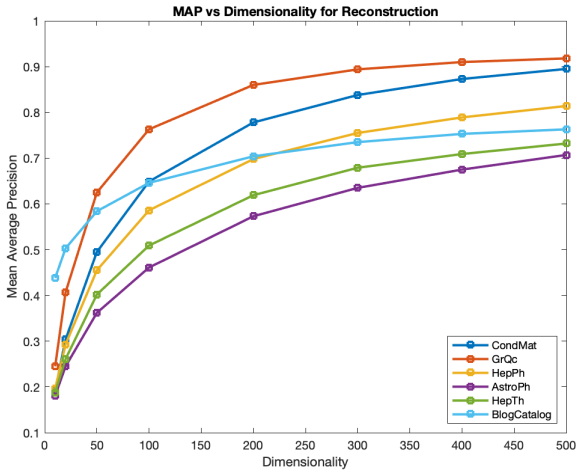
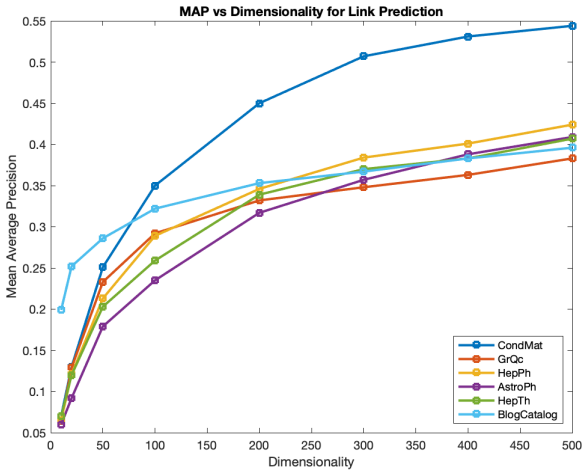
- Higher dimensionalities (up to 500 in the tables) monotonically improve MAP, so the method converts extra compute into better embeddings without architectural changes.
- The negative-edge sampling step means the method does not merely smooth the graph; it also separates unrelated nodes, a design feature the authors identify as part of the update.
Reading between the lines
- If the update is viewed as a randomized asynchronous power iteration, the convergence rate and the claimed benefit of annealing likely depend on the spectral gap of the transition matrix; a testable corollary is that graphs with slow mixing need more iterations or slower variance reduction.
- The reported monotone MAP gains with dimensionality suggest a relatively smooth embedding landscape; a natural extension is to test the same rule on directed, signed, or temporal graphs where symmetric baselines are known to degrade.
- The negative-sample term, fixed at probability 0.5, resembles noise contrastive estimation; ablating it would reveal how much of the separation comes from repulsion rather than from Hebbian attraction.
Signed reviews
Editorial analysis
A structured set of objections, weighed in public.
Referee Report
Summary. The paper proposes "Hebbian Graph Embeddings" (HGE), an iterative, message-passing algorithm in which each node embedding is repeatedly updated by adding noise-perturbed embeddings of its neighbors, scaled by transition probabilities, with an annealing schedule that reduces the variance over iterations. The authors report reconstruction and link-prediction mean average precision (MAP) on AstroPh, BlogCatalog, HepTh and further datasets, compare against node2vec, GF, SDNE, HOPE, LE, VGAE, and SEAL, and describe a large-scale retailer recommender experiment with 200,000 nodes and 13.1 billion edges. The core claim is that this simple, embarrassingly parallel update rule produces embeddings that outperform state-of-the-art graph embedding methods on link prediction and reconstruction while scaling to very large graphs.
Significance. If the empirical claims held under a fully matched protocol, the contribution would be significant: an extremely simple, parameter-light, parallelizable embedding update rule with competitive or better performance than much more complex methods, plus a demonstration on an industrial-scale graph. The paper is also honest about its exploratory character and does not oversell the theory: the Gaussian-mixture framing is presented as a model rather than a proof. However, the paper's load-bearing empirical comparison is currently only partially supported. The key assets are the algorithmic simplicity and the breadth of datasets, but the link-prediction protocol ambiguity and the lack of matched baselines mean that the claimed superiority over existing methods is not yet established.
major comments (6)
- [§3.3, Algorithm 1, Eq. (7), Tables 5, 6, 8] The link-prediction protocol is not fully specified: the text says 'We keep 10% of the edges as a held out test set' but never states that these held-out edges are removed from the graph before Algorithm 1 runs. Since Algorithm 1 takes the full graph as input and Eq. (7) propagates embeddings over all edges, the reported MAP on the held-out edges could be measuring reconstruction of seen edges rather than prediction of unseen edges. If the held-out edges are not masked, the comparison to node2vec, GF, SDNE, HOPE, LE, and VGAE is invalidated. The authors must state explicitly that test edges are removed before training and, ideally, give the exact masking step in the pseudocode.
- [§3.3, Tables 5, 6, 7] The SOTA comparisons are not matched on protocol. The paper compares 200-dimensional Hebbian embeddings against numbers taken from [2] and [8] at 256 dimensions (node2vec, GF, SDNE, HOPE, LE) or at unspecified dimensions (SEAL, VGAE), with no evidence that the train/test split, the 1024-node sampling for MAP, the graph preprocessing, or the evaluation code are identical. Empirical claims of 'outperforming' state-of-the-art methods require either running the baselines under the same code base or at least justifying that the quantities in Tables 1, 5, and 6 are directly comparable. As written, the gaps in Tables 5 and 6 may be protocol artifacts, and the central claim is therefore only partially supported.
- [§3.2, Table 4] The recommender-system result is presented without any baseline: the 31.1% HitRate@10 on a 200,000-node, 13.1-billion-edge graph is not compared to any other embedding method, to a random recommendation, or to the currently deployed system. The metric itself is also only loosely defined (one random item from a user's history is selected and a top-10 list is computed; it is not stated whether the seed item is excluded, how the co-viewing graph is thresholded, or how many users are in the test set). Since the conclusion includes 'applied to generate relevant recommendations for a large retailer', this industrial claim needs at least a minimal baseline and a precise metric definition.
- [§3.1, §3.3, Tables 2 and 8] All reported MAP numbers appear to be single-run point estimates. The algorithm has randomized initialization (Eq. (1)), randomized noise (Eq. (6)), and randomized negative-edge sampling, so the absence of variance estimates, number of runs, or standard errors makes it difficult to assess whether the differences between HGE and the baselines are statistically meaningful or even stable across seeds. This is especially relevant for the claims of superiority in Tables 1 and 5, where the reported margins are often smaller than what one would expect from run-to-run noise.
- [§2, Eq. (2) and Eqs. (3)-(5)] The Gaussian-mixture formulation is not providing independent theoretical support: Eq. (2) essentially restates the update rule by saying that each neighbor embedding is drawn from a Gaussian centered at the current node embedding, but the algorithm then averages these draws through Eq. (7). This framing does not by itself imply convergence, boundedness, or any optimality property, so it should not be presented as a theoretical grounding. A short analysis of what the update minimizes (if anything) or a discussion of when the iterative averaging converges would be more useful than the mixture interpretation.
- [§3.3, Tables 6 and 7] The run-time comparison in Table 7 is not apples-to-apples: the HGE numbers include Apache Spark initialization and resource allocation, while SEAL and VGAE are run in a different environment, and no hardware/software details are provided for either side. The claim that HGE is 'much faster' than SEAL on Power but 'slower' on USAir and C.Ele is a useful observation, but it cannot be interpreted as a scalability result without specifying the cluster configuration and the baseline implementation details.
minor comments (7)
- [§2, Algorithm 1] The phrase 'The graph is weighted, asymmetric and undirected' is confusing: a graph can be weighted and directed, or weighted and undirected, but 'asymmetric' typically implies directedness. The authors should clarify whether edges are directed or whether the asymmetry refers only to the transition probabilities p_ij.
- [§2, Eqs. (4)-(7)] The negative-edge sampling step (random negative edge, transition probability 0.5) is described in the text but is missing from Algorithm 1. Any reader implementing the algorithm from the pseudocode would omit a component that is likely important for link prediction, so it should be included in the pseudocode or in a separate step.
- [§3.3] 'As in [2], we sample 1024 nodes for calculation of the MAP' should specify whether the sampling is done on the training edges only, and whether the same sampled node set is used across all methods. This detail is needed for reproducibility.
- [§3.2, Table 4] The text says '10% of the users are held out as the test set' but the hit-rate metric is computed per item, not per user. The relationship between the user-level split and the item-level evaluation should be explained more carefully.
- [§3.1] The claim that 'the learning rate does not affect the results in any significant way' is not supported by any table or figure. Either remove this assertion or add a small sensitivity experiment in the supplementary material.
- [§4] In the sentence 'Its a useful experiment of error-free (errorless) learning on graphs', there is a missing apostrophe ('It's') and the term 'error-free' should be used consistently with the earlier discussion of errorless learning.
- [References] References [23] and [24] are mentioned in the conclusion as possible comparisons but are not used in the experiments; either cite them in the introduction as related work or remove them from the comparison sentence.
Circularity Check
Link-prediction section never removes the held-out 10% of edges from G before Algorithm 1; as written, Eq. (7) trains on the test edges, so Tables 5/8 report reconstruction, and Eq. (2) merely restates the update.
-
fitted input called prediction
[Section 3.3 ('Results on Link Prediction'), Algorithm 1 Eq. (7), Tables 5 and 8]
"Link Prediction is the task of trying to predict a link between two nodes that were not part of the training data... We keep 10% of the edges as a held out test set... Algorithm 1 ... 2: Inputs: Weighted, asymmetric and undirected graph ... wj ← wj + η w˜ipij (7)"
The paper defines link prediction as predicting edges 'not part of the training data' and reconstruction as using the entire graph with no train/test separation. Section 3.3 says only that 10% of edges are kept as a held-out test set; it never states that those edges are removed from G before Algorithm 1 runs. Algorithm 1's input is the full graph, and Eq. (7) updates wj by summing over Adj(i), so any held-out edge left in G contributes to the embedding of both endpoints. Under a literal reading, the MAP and average-precision values on the chosen 10% of edges are computed on training edges: the 'prediction' is equivalent to retrieving the input adjacency, i.e., reconstruction.
-
self definitional
[Section 2, Eq. (2) versus Eqs. (3)-(5) and Algorithm 1 Eq. (7)]
"We model the embedding at a node as a non-convex Gaussian mixture of the embeddings of the connected nodes. If there is an edge from node i to node j, the embedding of node j is modeled as follows: wj ∼ N (wi,σ 2I) (2)"
Eq. (2) is offered as the model, but the algorithm immediately implements it as the update: draw w˜i from N(wi, σ2I) and add η w˜i pij to wj. The Gaussian-mixture statement is therefore a probabilistic paraphrase of the Hebbian update, not an independent constraint from which the update is derived. It adds no falsifiable content beyond the update rule itself. This is circular framing rather than circular evidence, and it is not the load-bearing part of the paper: the empirical comparisons do not rely on Eq. (2) being an independent theorem.
full rationale
Score 6 reflects the load-bearing link-prediction section. As written, Section 3.3 defines a held-out set but never removes it from the graph fed to Algorithm 1, and Eq. (7) sums over exactly those edges. Executed literally, every positive test edge is present during training, so Tables 5, 6, and 8 measure reconstruction of seen adjacency rather than prediction of unseen links; that is the one place where a central claim reduces to its own input. The reconstruction experiments (Tables 1-3) are not circular: they intentionally use the full graph without train/test separation, and the 1024-node sampling follows the protocol of the cited survey, so those numbers remain a valid independent empirical result. The large-retailer hit-rate is an internal demonstration with no external baseline; the same missing-removal ambiguity applies to the 10% held-out users because the co-viewing graph is described before the user split, but this result is not used to argue superiority over prior methods. Eq. (2)'s Gaussian-mixture language does restate the update rule, a mild self-definitional framing, and is recorded as a separate step. There is no self-citation chain and no imported uniqueness theorem, so the circularity is concentrated in the unstated link-prediction protocol rather than in the mathematical derivation itself.
Assumptions & free parameters
free parameters (6)
- Initial variance sigma^2 =
10
- Variance reduction factor tau =
1.1
- Number of iterations N =
10
- Learning rate eta =
1.0
- Negative-edge transition probability =
0.5
- Embedding dimensionality K =
200 (headline); 10-500 explored
assumptions (4)
- ad hoc to paper Iterative linear propagation of noisy embeddings produces stable, informative vectors.
- domain assumption Transition probabilities pij = #(i->j)/#i encode semantic relatedness.
- domain assumption Inner product between learned embeddings is a valid similarity score.
- domain assumption Benchmark numbers from [2] and [8] are protocol-comparable to the authors' runs.
Cite this review
Pith. "Pith review of Hebbian Graph Embeddings." pith.science (2026). https://pith.science/paper/Z5EPUW7N
@misc{pith2026190808037,
  author       = {Pith},
  title        = {Pith review of: Hebbian Graph Embeddings},
  year         = {2026},
  howpublished = {\url{https://pith.science/paper/Z5EPUW7N}},
  note         = {Machine review of arXiv:1908.08037}
}
read the original abstract
Representation learning has recently been successfully used to create vector representations of entities in language learning, recommender systems and in similarity learning. Graph embeddings exploit the locality structure of a graph and generate embeddings for nodes which could be words in a language, products of a retail website; and the nodes are connected based on a context window. In this paper, we consider graph embeddings with an error-free associative learning update rule, which models the embedding vector of node as a non-convex Gaussian mixture of the embeddings of the nodes in its immediate vicinity with some constant variance that is reduced as iterations progress. It is very easy to parallelize our algorithm without any form of shared memory, which makes it possible to use it on very large graphs with a much higher dimensionality of the embeddings. We study the efficacy of proposed method on several benchmark data sets and favorably compare with state of the art methods. Further, proposed method is applied to generate relevant recommendations for a large retailer.
Figures
Reference graph
Works this paper leans on
-
[2]
Graph embedding techniques, applications, and performance: A survey
Palash Goyal and Emilio Ferrara. Graph embedding techniques, applications, and performance: A survey. Knowledge-Based Systems, 151:78–94, 2018
2018
-
[8]
Link prediction based on graph neural networks
Muhan Zhang and Yixin Chen. Link prediction based on graph neural networks. In Advances in Neural Information Processing Systems , pages 5165–5175, 2018. 10 Figure 3: Mean Average Precision for Link Prediction with Varying Dimensionality
work page 2018
-
[1]
A comprehen- sive survey of graph embedding: Problems, techniques, and applications
Hongyun Cai, Vincent W Zheng, and Kevin Chen-Chuan Chang. A comprehen- sive survey of graph embedding: Problems, techniques, and applications. IEEE Transactions on Knowledge and Data Engineering , 30(9):1616–1637, 2018
work page 2018
-
[3]
node2vec: Scalable feature learning for net- works
Aditya Grover and Jure Leskovec. node2vec: Scalable feature learning for net- works. In Proceedings of the 22nd ACM SIGKDD international conference on Knowledge discovery and data mining , pages 855–864. ACM, 2016. 9 Table 8: Mean Average Precision (MAP) results for network embeddings for Link Prediction (10% randomly chosen edges are held out as the test...
work page 2016
-
[4]
Dynamic probabilistic models for latent feature propagation in social networks
Creighton Heaukulani and Zoubin Ghahramani. Dynamic probabilistic models for latent feature propagation in social networks. In International Conference on Machine Learning, pages 275–283, 2013
work page 2013
-
[5]
Spread of information through a population with socio- structural bias: I
Anatol Rapoport. Spread of information through a population with socio- structural bias: I. assumption of transitivity. The bulletin of mathematical bio- physics, 15(4):523–533, 1953
work page 1953
-
[6]
The pager- ank citation ranking: Bringing order to the web
Lawrence Page, Sergey Brin, Rajeev Motwani, and Terry Winograd. The pager- ank citation ranking: Bringing order to the web. Technical report, Stanford Info- Lab, 1999
work page 1999
-
[7]
Textrank: Bringing order into text
Rada Mihalcea and Paul Tarau. Textrank: Bringing order into text. InProceedings of the 2004 conference on empirical methods in natural language processing , pages 404–411, 2004
work page 2004
Show all 24 references
-
[9]
Variational graph auto-encoders
Thomas N Kipf and Max Welling. Variational graph auto-encoders. arXiv preprint arXiv:1611.07308, 2016
2016 arXiv
-
[10]
Distributed large-scale natural graph factorization
Amr Ahmed, Nino Shervashidze, Shravan Narayanamurthy, Vanja Josifovski, and Alexander J Smola. Distributed large-scale natural graph factorization. In Pro- ceedings of the 22nd international conference on World Wide Web , pages 37–48. ACM, 2013
2013
-
[11]
Structural deep network embedding
Daixin Wang, Peng Cui, and Wenwu Zhu. Structural deep network embedding. In Proceedings of the 22nd ACM SIGKDD international conference on Knowledge discovery and data mining , pages 1225–1234. ACM, 2016
2016
-
[12]
Asymmet- ric transitivity preserving graph embedding
Mingdong Ou, Peng Cui, Jian Pei, Ziwei Zhang, and Wenwu Zhu. Asymmet- ric transitivity preserving graph embedding. In Proceedings of the 22nd ACM SIGKDD international conference on Knowledge discovery and data mining , pages 1105–1114. ACM, 2016
2016
-
[13]
Laplacian eigenmaps and spectral techniques for embedding and clustering
Mikhail Belkin and Partha Niyogi. Laplacian eigenmaps and spectral techniques for embedding and clustering. In Advances in neural information processing systems, pages 585–591, 2002
2002
-
[14]
Nonlinear dimensionality reduction by locally linear embedding
Sam T Roweis and Lawrence K Saul. Nonlinear dimensionality reduction by locally linear embedding. science, 290(5500):2323–2326, 2000. 11
2000
-
[15]
Optimization by simu- lated annealing
Scott Kirkpatrick, C Daniel Gelatt, and Mario P Vecchi. Optimization by simu- lated annealing. science, 220(4598):671–680, 1983
1983
-
[16]
The Organization of Behavior
Donald Olding Hebb. The Organization of Behavior. Wiley & Sons, 1949
1949
-
[17]
Hebbian learning and predictive mirror neurons for actions, sensations and emotions
Christian Keysers and Valeria Gazzola. Hebbian learning and predictive mirror neurons for actions, sensations and emotions. Philosophical Transactions of the Royal Society B: Biological Sciences , 369(1644):20130175, 2014
2014
-
[18]
Network-oriented modeling
Jan Treur. Network-oriented modeling. Springer, 2016
2016
-
[19]
Efficient estimation of word representations in vector space
Tomas Mikolov, Kai Chen, Greg Corrado, and Jeffrey Dean. Efficient estimation of word representations in vector space. arXiv preprint arXiv:1301.3781, 2013
2013 arXiv
-
[20]
How far can you go with hebbian learning, and when does it lead you astray? Processes of change in brain and cognitive development: Attention and performance xxi , 21:33–69, 2006
James L McClelland. How far can you go with hebbian learning, and when does it lead you astray? Processes of change in brain and cognitive development: Attention and performance xxi , 21:33–69, 2006
2006
-
[21]
Gem: A python package for graph embedding methods
Palash Goyal and Emilio Ferrara. Gem: A python package for graph embedding methods. J. Open Source Software, 3(29):876, 2018
2018
-
[22]
Poincar ´e embeddings for learning hier- archical representations
Maximillian Nickel and Douwe Kiela. Poincar ´e embeddings for learning hier- archical representations. In Advances in neural information processing systems , pages 6338–6347, 2017
2017
-
[23]
Hyper- bolic recommender systems
Tran Dang Quang Vinh, Yi Tay, Shuai Zhang, Gao Cong, and Xiao-Li Li. Hyper- bolic recommender systems. arXiv preprint arXiv:1809.01703, 2018
2018 arXiv
-
[24]
Scalable hyperbolic recommender sys- tems
Benjamin Paul Chamberlain, Stephen R Hardwick, David R Wardrope, Fabon Dzogang, Fabio Daolio, and Sa´ul Vargas. Scalable hyperbolic recommender sys- tems. arXiv preprint arXiv:1902.08648, 2019. 12
1902 arXiv
Reviewed August 14, 2026 · model on record in the stance chip above.
Discussion (0). Continue with ORCID to comment.