REVIEW 2 major objections 3 minor 19 references
Tidal circularization of gaseous planets orbiting white dwarfs
T0 review · 2 major / 3 minor · reviewed 2026-08-14 · deepseek-v4-flash
Pith's one-line read This paper establishes that a gas giant scattered close to a white dwarf undergoes chaotic f-mode tidal evolution only when its orbital pericentre lies within about twice the white dwarf's Roche radius, and that this chaotic phase can…
desk verdict Useful, honest application of the Vick et al. chaotic-tidal map to white-dwarf planets; the u<2 activation threshold and Eq. (38) hold up, but the 'destroys ice giants' headline overstates a proxy the authors themselves hedge. read the letter →
The pith
A machine-rendered reading of the paper's core claim, the machinery that carries it, and where it could break.
The reading
What carries the argument
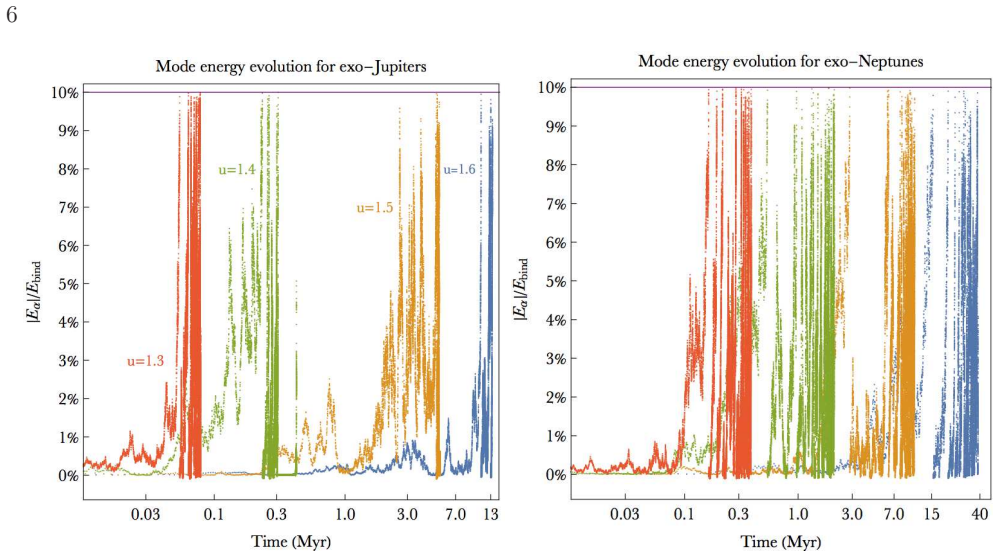
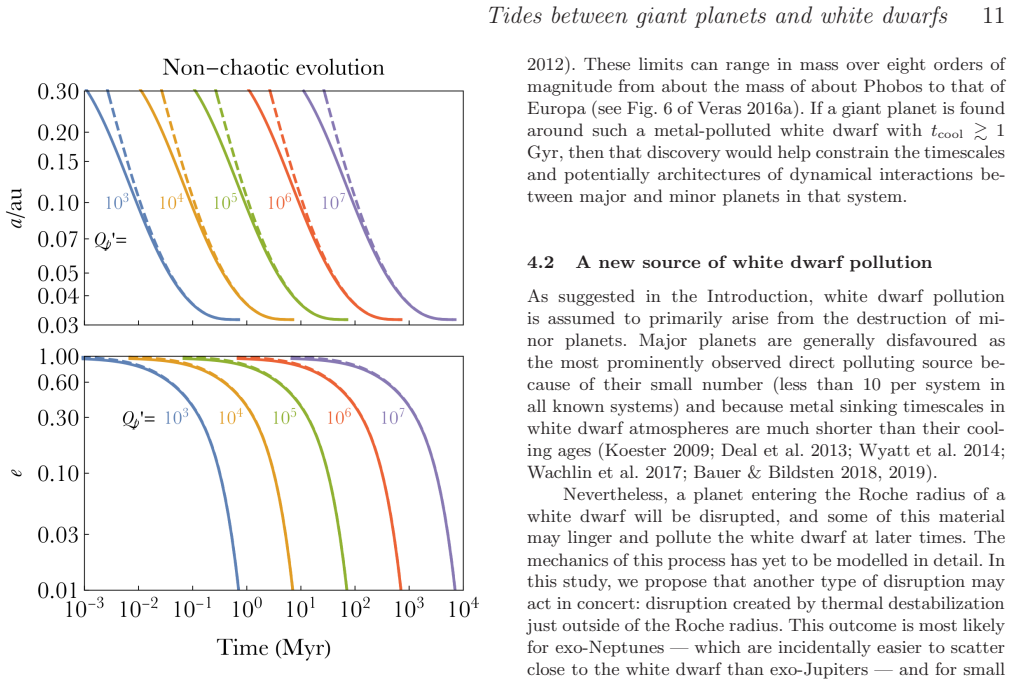
The central object is the dimensionless pericentre $u = r_p/r_{\rm Roche}$, measured against the white dwarf's Roche radius for a fluid planet. The machinery is an iterative map for chaotic f-mode tides: at each pericentre passage the dominant quadrupolar mode of a polytropic planet exchanges energy with the orbit, the mode amplitude is carried forward, and when the mode energy reaches $E_{\rm max} = 0.1 E_{\rm bind}$ the energy is thermalized and the mode reset. This map yields $\tau_{\rm chaos}$ and the planet's orbital state when chaos ends. The non-chaotic regime then uses the equilibrium weak-friction tidal equations with a constant modified quality factor $Q'_p$, and the empirical formula for $\tau_{\rm non-chaos}$ carries the argument through its steep $u^{13/2}$ scaling: both whether chaotic evolution turns on and how long circularization takes are controlled by this single pericentre ratio.
What would settle it
A structural calculation of a Neptune-mass planet repeatedly absorbing 0.1 of its binding energy per event would settle the destruction claim; if it survives ten events by inflating or radiating the heat away, the new pollution channel fails. Observationally, a giant planet around a white dwarf whose measured cooling age $t_{\rm cool}$ is shorter than the sum $\tau_{\rm chaos} + \tau_{\rm non-chaos}$ for any $Q'_p$ within the allowed range would falsify the timescale framework.
Extended reading notes
Core claim
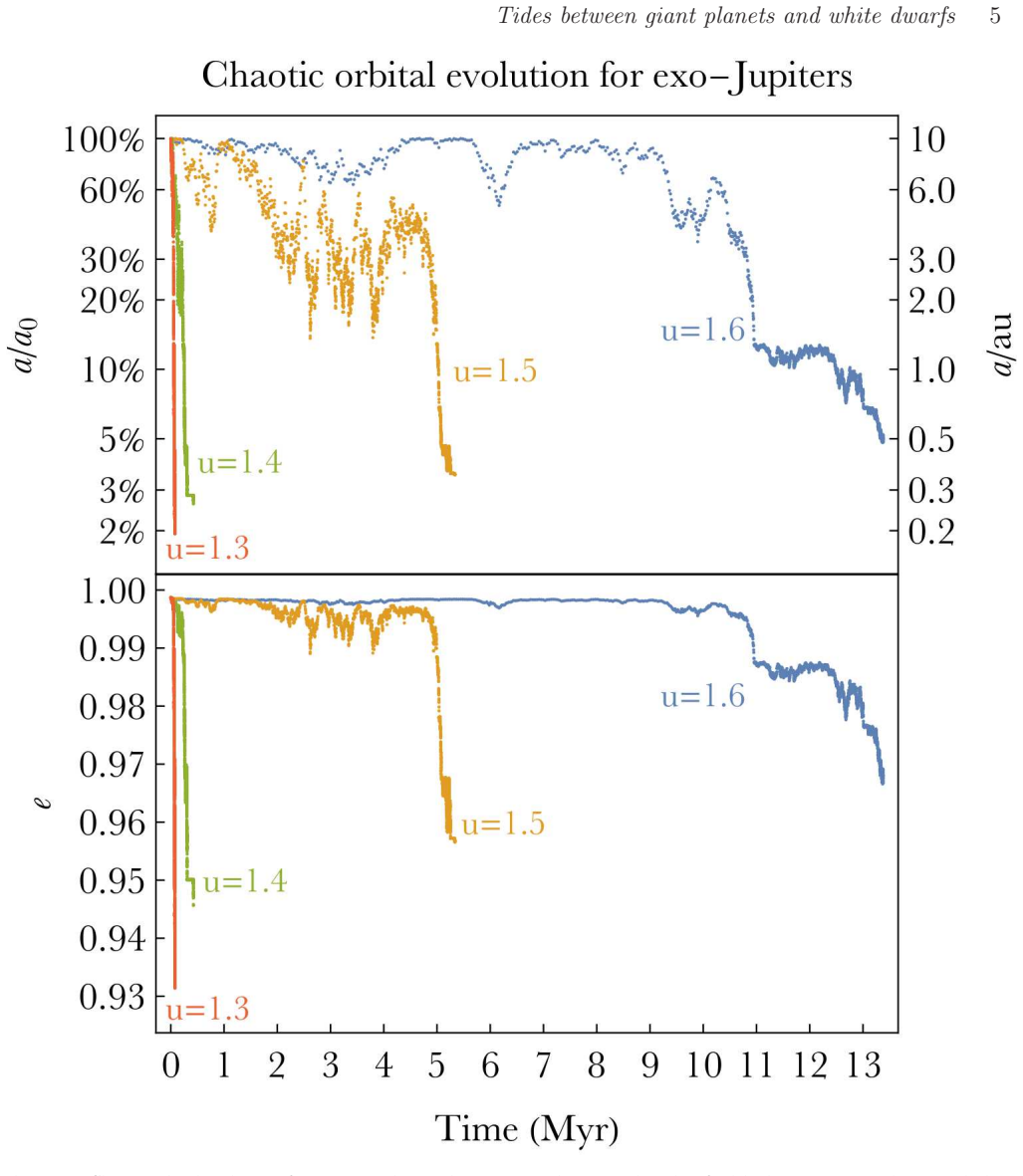
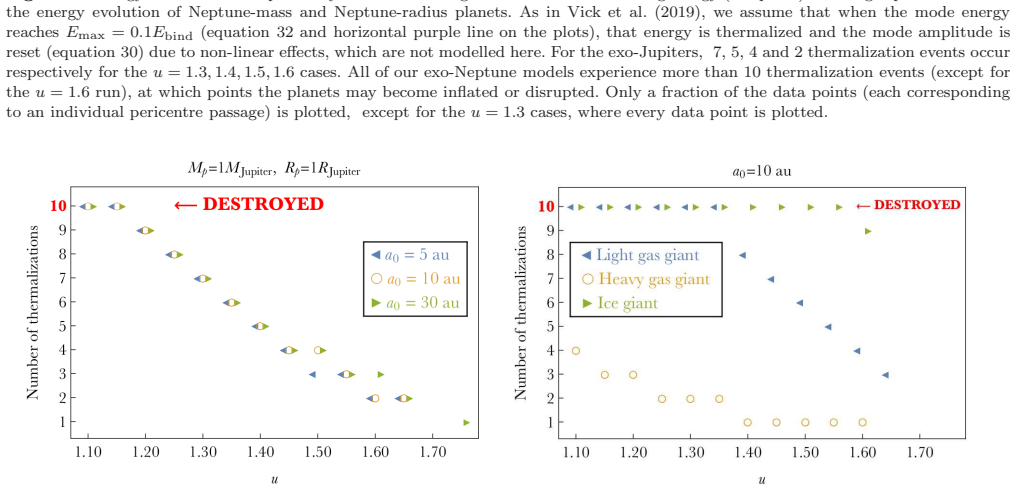
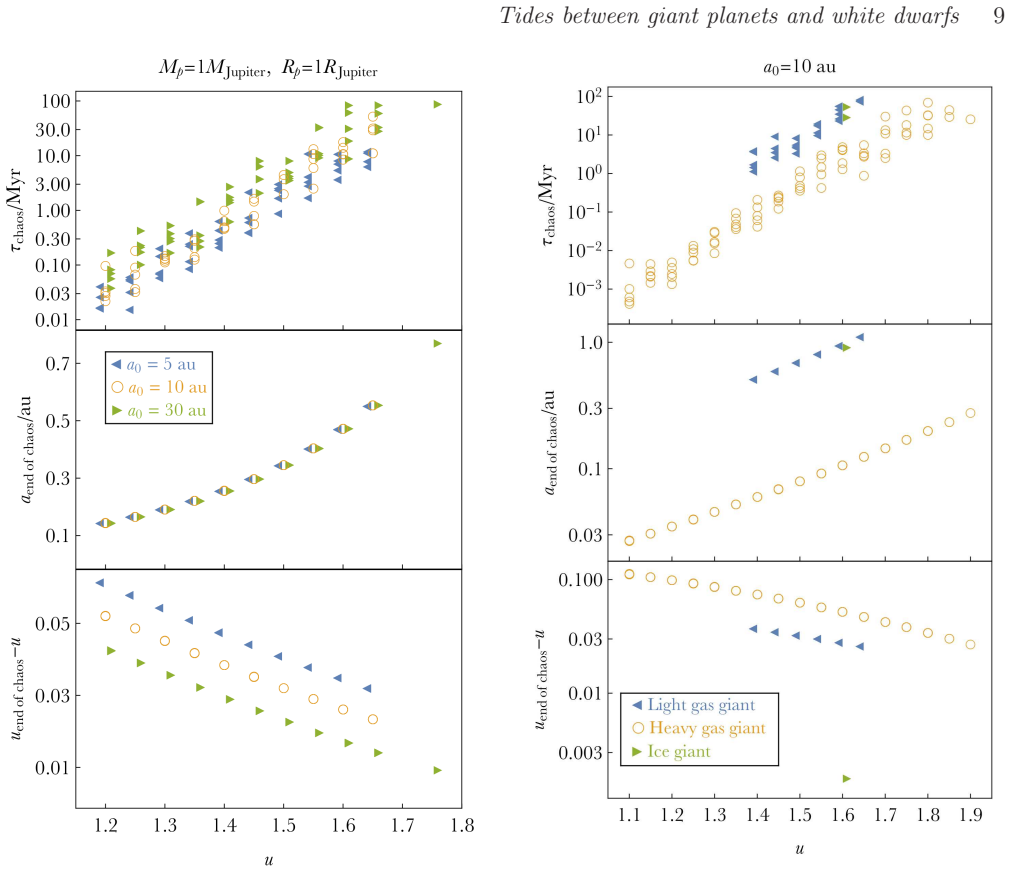
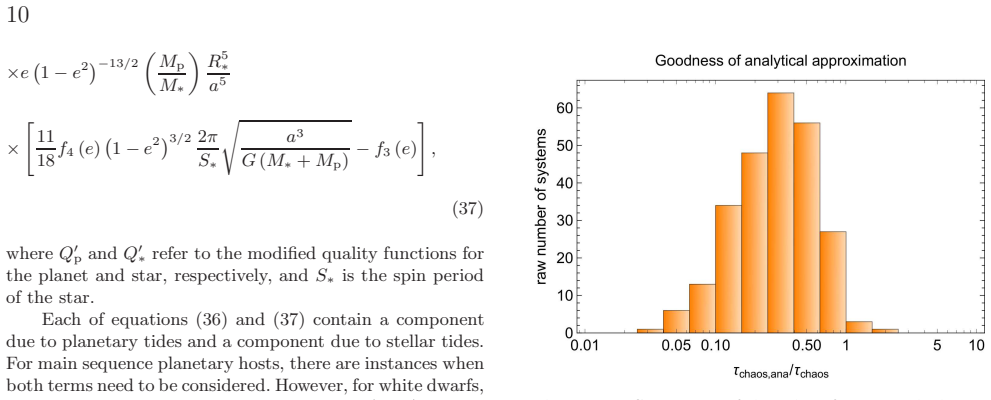
On the paper's own terms, the discovery is a phase-space map of tidal migration for giant planets around white dwarfs. Using a single-mode iterative map for the quadrupolar f-mode, the paper finds that chaotic f-mode excitation, and the rapid orbital shrinkage it causes, occurs only for initial pericentres $u = r_p/r_{\rm Roche}$ between roughly 1.1 and 2.0. Within that window, the number of thermalization events (mode energy capped at 10% of the binding energy and then reset) grows steeply as $u$ shrinks, and Neptune-mass planets typically exceed ten events—the paper's adopted disruption threshold—whereas Jupiter-mass planets suffer fewer than ten. After chaos ends at an eccentricity still near 0.9, weakly dissipative equilibrium tides take over, and the paper derives the empirical circularization timescale $$\tau_{\rm non-chaos} \approx 37.4\,{\rm Myr}\, $u^{{13/2}}$ \left(\frac{Q'_p}{$10^{6}$}\right) \left(\frac{M_p}{M_{\rm Jup}}\right)^{-2/3} \left(\frac{\rho_p}{1\,{\rm g/$cm^{3}$}}\right)^{-1/2},$$ accurate to a few percent across the plausible phase space. Combining the two regimes with the inequality $t_{\rm cool} > t_{\rm sca} + \tau_{\rm chaos} + \tau_{\rm non-chaos}$ means an observed white-dwarf cooling age converts into coupled upper bounds on the scattering epoch and on the planetary tidal quality factor.
Load-bearing premise
The load-bearing premise is that ten thermalization events, each depositing roughly a tenth of the planet's binding energy, are enough to destroy or fatally restructure an ice giant; the paper itself says whether it would slowly inflate or be disrupted is unclear, and no structural model backs the threshold.
Editorial extensions
If this is right
- A measured white-dwarf cooling age $t_{\rm cool}$ gives an upper bound on the sum $t_{\rm sca} + \tau_{\rm chaos} + \tau_{\rm non-chaos}$, so a detected close-in giant planet dates the gravitational scattering that put it there.
- At early cooling ages ($t_{\rm cool} \sim 10$ Myr), the bound becomes tight: the scattering must have occurred within the first ten million years of white-dwarf life, and the planetary tidal quality factor $Q'_p$ must be small enough to circularize the orbit within that time.
- For old white dwarfs ($t_{\rm cool} \sim 1$ Gyr) the same argument cannot constrain the tides, but a giant planet orbiting a metal-polluted white dwarf would still constrain the dynamical interactions between major and minor planets in that system.
- The chaotic and non-chaotic regimes can be treated almost independently: $\tau_{\rm chaos}$ is largely insensitive to planet mass, density, and radius, while $\tau_{\rm non-chaos}$ varies by orders of magnitude with those quantities.
- Ice giants that enter the chaotic regime as they approach a white dwarf can be thermally destroyed before reaching the Roche radius, providing a new channel for white-dwarf metal pollution, including volatile-rich or oxygen-rich pollution.
Reading between the lines
- If the deposited mode energy is radiated away efficiently near the planet's surface rather than stored in the interior (one possibility the paper notes), the ice-giant destruction channel would weaken; a structural model with realistic radiative cooling would decide.
- Because $\tau_{\rm non-chaos} \propto u^{13/2}$, even a coarse measurement of a planet's current pericentre makes the circularization timescale a sharp probe of $Q'_p$: small errors in $u$ translate into large changes in the inferred dissipation.
- White-dwarf systems may serve as a cleaner laboratory for high-eccentricity migration than main-sequence hot Jupiters, because the white-dwarf cooling age provides an absolute clock and disc migration is largely ruled out for planets scattered in after the white dwarf forms.
- A targeted search for young white dwarfs with cooling ages near ten million years and close giant planets would be the sharpest test of the paper's coupled timescale inequality.
Signed reviews
Editorial analysis
A structured set of objections, weighed in public.
Referee Report
Summary. This paper models the post-scattering tidal evolution of gaseous planets around white dwarfs by combining a chaotic f-mode iterative map taken from Vick et al. (2019) with a weak-friction equilibrium-tide calculation. The authors compute the duration of the chaotic phase across a grid of planet masses, densities, initial semimajor axes, and pericentre distances, and find that chaotic f-mode excitation activates only when the initial pericentre is within about twice the white-dwarf Roche radius (u ≲ 2). They show that chaotic evolution shrinks the semimajor axis substantially while leaving u nearly unchanged, and they provide an empirical formula (Eq. 38) for the subsequent circularization timescale. They also argue that energy deposition during chaotic mode thermalization can restructure or destroy ice giants, providing a new white-dwarf pollution channel, while leaving gas giants intact.
Significance. If the u < 2 activation threshold and the circularization timescale formula hold, the paper offers a practical framework for combining a measured white-dwarf cooling age with the orbit of a discovered giant planet to bound the scattering epoch and the planetary tidal quality factor. The use of a deterministic iterative map and the explicit propagation of the chaotic phase make the orbital part of the calculation reproducible, and the authors are careful to label Eq. (38) as empirical and to state many of their simplifications. The central destruction claim, however, depends on an unmodeled thermalization-to-disruption assumption and is therefore not established at the same level as the orbital timescales.
major comments (2)
- [Section 2.5.2, Eqs. (30)-(32), Figs. 2-3] The headline claim that chaotic tides 'easily restructures or destroys ice giants but not gas giants' rests on the assumption that ten thermalization events, each depositing E_max - E_resid ≈ 0.1 E_bind, constitute disruption. No structural, thermal, or hydrodynamical model is used to convert this deposited energy into inflation or breakup, and the authors themselves state that 'whether the planet would slowly inflate or be disrupted is unclear' (Section 2.5.2). Because the abstract and Section 4.2 present this destruction as a new white-dwarf pollution channel, this is a load-bearing point. I recommend either replacing the destruction language with a clear 'may become inflated or disrupted' hedge throughout, or adding a quantitative energy-budget model (e.g., comparing the thermalization rate to the radiative cooling time, or a simple envelope-inflation calculation) to justify a disruption threshold.
- [Section 3, Eq. (38)] Equation (38) is presented as accurate to within a few per cent over the entire plausible phase space, but the fitting procedure, residuals, and range of validity are not shown in the text. Since this formula is one of the main tools for observational constraints, please provide the underlying numerical data or an appendix with the fit and its scatter, and state explicitly that the quoted accuracy is with respect to the simplified constant-Q'_p model rather than to a full frequency-dependent tide calculation.
minor comments (3)
- [Fig. 3 caption] The phrase 'A total of 10 thermalization events may disrupt the planet, which we denote here as destroyed' conflates a modeling criterion with a physical outcome; since the paper itself is uncertain about the planet's response, the caption should say 'assumed to be destroyed in our criterion' or similar.
- [Abstract and Section 5] The Summary appropriately hedges with 'may become inflated or disrupted', but the Abstract and Section 4.2 use stronger language ('destroys', 'thermal destruction'); please harmonize the wording to match the actual level of model support.
- [Section 3, Eqs. (36)-(37)] The stellar-tide terms are retained in Eqs. (36)-(37) even though the text immediately justifies neglecting them; consider moving the full equations to an appendix or deleting the stellar terms after the justification to improve readability.
Circularity Check
Destruction claim is definitional: Fig. 3 labels 'destroyed' as 10 thermalization events while the text concedes the structural outcome is unclear, so the abstract's 'destroys ice giants' restates the counting threshold as a physical result; the u<2 activation condition and Eq. (38) remain independent.
-
self definitional
[Section 2.5.2, Figure 3 caption, Abstract]
"Hence, 10 thermalization events (assuming no energy is radiated away) would deposit enough energy in the planet's interior to substantially alter its structure. Whether the planet would slowly inflate or be disrupted is unclear... A total of 10 thermalization events may disrupt the planet, which we denote here as "destroyed"."
The model never computes structural disruption; 'destroyed' is defined in the Figure 3 caption as 'a total of 10 thermalization events.' The abstract then asserts that chaotic f-mode evolution 'easily restructures or destroys ice giants,' so the destruction result is the definitional counting threshold restated as a physical outcome. The paper itself says 'whether the planet would slowly inflate or be disrupted is unclear,' confirming that no independent physical model converts the deposited energy into breakup. Planets are labeled destroyed exactly when the input proxy is satisfied, making the headline destruction claim equivalent to its own definition rather than a derived result.
full rationale
The bulk of the tidal calculation is not circular. The chaotic activation and termination criteria (Eqs. 13 and 34) are imported from the iterative map of Vick et al. (2019), whose authors do not overlap with the present paper, and they are applied to a new white-dwarf parameter space; the u<2 activation result is a computed consequence, not a fitted output. Eq. (38) is explicitly labeled an empirical formula fitted to the paper's own integrations, so it is a disclosed compression of the model rather than a hidden fit to the target observable. The paper's self-citations to Veras et al. are contextual (scattering histories, solid-body tides) and are not load-bearing for the new computation. The one genuinely definitional step is the destruction claim: Figure 3 defines 'destroyed' as ten thermalization events, while Section 2.5.2 admits 'whether the planet would slowly inflate or be disrupted is unclear,' and the abstract converts that threshold into 'destroys ice giants.' That specific claim is forced by the label, not by the dynamics; the rest of the paper's constraints on scattering epoch and tidal quality factor remain independent of this proxy, which is why the score is partial rather than maximal.
Assumptions & free parameters
free parameters (5)
- Q'_p (modified planetary tidal quality factor) =
10^3 to 10^7
- Disruption threshold (number of thermalization events) =
10 events
- Mode energy cap E_max =
0.1 E_bind
- Residual mode energy E_resid =
0.001 E_bind
- Coefficient in circularization formula =
37.4 Myr
assumptions (5)
- domain assumption Single f=2 mode approximation is valid for the relevant pericentre range.
- domain assumption Chaotic tidal map and activation/stopping criteria of Vick et al. 2019 are correct when scaled to WD parameters.
- domain assumption Equilibrium weak-friction tides (Hut 1981) with pseudosynchronous rotation and constant Q'_p govern the non-chaotic regime.
- domain assumption A white dwarf of 0.6 M_sun is representative for the surveyed systems.
- ad hoc to paper Ten thermalization events correspond to destruction.
Cite this review
Pith. "Pith review of Tidal circularization of gaseous planets orbiting white dwarfs." pith.science (2026). https://pith.science/paper/OLDX3CH5
@misc{pith2026190808052,
  author       = {Pith},
  title        = {Pith review of: Tidal circularization of gaseous planets orbiting white dwarfs},
  year         = {2026},
  howpublished = {\url{https://pith.science/paper/OLDX3CH5}},
  note         = {Machine review of arXiv:1908.08052}
}
read the original abstract
A gas giant planet which survives the giant branch stages of evolution at a distance of many au and then is subsequently perturbed sufficiently close to a white dwarf will experience orbital shrinkage and circularization due to star-planet tides. The circularization timescale, when combined with a known white dwarf cooling age, can place coupled constraints on the scattering epoch as well as the active tidal mechanisms. Here, we explore this coupling across the entire plausible parameter phase space by computing orbit shrinkage and potential self-disruption due to chaotic f-mode excitation and heating in planets on orbits with eccentricities near unity, followed by weakly dissipative equilibrium tides. We find that chaotic f-mode evolution activates only for orbital pericentres which are within twice the white dwarf Roche radius, and easily restructures or destroys ice giants but not gas giants. This type of internal thermal destruction provides an additional potential source of white dwarf metal pollution. Subsequent tidal evolution for the surviving planets is dominated by non-chaotic equilibrium and dynamical tides which may be well-constrained by observations of giant planets around white dwarfs at early cooling ages.
Figures
Figures from the paper (3 more)
Reference graph
Works this paper leans on
-
[1]
Adams, F. C., & Bloch, A. M. 2013, ApJL, 777, L30 Alcock, C., Fristrom, C. C., & Siegelman, R. 1986, ApJ, 302, 462 Alexander, M. E. 1973, Ap&SS, 23,
work page 2013
-
[14]
Petrovich, C., & Mu˜ noz, D. J. 2017, ApJ, 834, 116 Raddi, R., G¨ ansicke, B. T., Koester, D., et al. 2015, MN- RAS, 450, 2083 Rao S., et al., 2018, A&A, 618, A18 Rowan, D. M., Tucker, M. A., Shappee, B. J., et al. 2019, MNRAS, 486, 4574 Sandhaus, P. H., Debes, J. H., Ely, J., et al. 2016, ApJ, 823, 49 Schleicher, D. R. G., & Dreizler, S. 2014, A&A, 563, ...
work page 2017
-
[18]
Wickramasinghe, D. T., Farihi, J., Tout, C. A., Ferrario, L., & Stancliffe, R. J. 2010, MNRAS, 404, 1984 Wu, Y. 2005, ApJ, 635, 688 Wu, Y. 2018, AJ, 155,
work page 2010
-
[93]
Hut, P. 1981, A&A, 99, 126 Ivanov, P. B., & Papaloizou, J. C. B. 2004, MNRAS, 347,
work page 1981
-
[96]
Bear, E., & Soker, N. 2011, MNRAS, 414, 1788 c© 2019 RAS, MNRAS 000, 1–14 Tides between giant planets and white dwarfs 13 Bonsor, A., & Wyatt, M. 2010, MNRAS, 409, 1631 Bonsor, A., Mustill, A. J., & Wyatt, M. C. 2011, MNRAS, 414, 930 Bonsor, A., & Veras, D. 2015, MNRAS, 454, 53 Bou´ e, G., Figueira, P., Correia, A. C. M., & Santos, N. C. 2012, A&A, 537, L...
arXiv 2011
-
[118]
Wyatt, M. C., Farihi, J., Pringle, J. E., & Bonsor, A. 2014, MNRAS, 439, 3371 Xu, S., & Jura, M. 2012, ApJ, 745, 88 Xu, S., Ertel, S., Wahhaj, Z., et al. 2015, A&A, 579, L8 Xu, S., Zuckerman, B., Dufour, P., et al. 2017, ApJL, 836, L7 c© 2019 RAS, MNRAS 000, 1–14
work page 2014
-
[121]
2003, ApJL, 584, L91 Kepler, S
Jura, M. 2003, ApJL, 584, L91 Kepler, S. O., Pelisoli, I., Koester, D., et al. 2015, MNRAS, 446, 4078 Kepler, S. O., Pelisoli, I., Koester, D., et al. 2016, MNRAS, 455, 3413 Kleinman, S. J., Kepler, S. O., Koester, D., et al. 2013, ApJS, 204, 5 Koester, D. 2009, A&A, 498, 517 Kunitomo, M., Ikoma, M., Sato, B., Katsuta, Y., & Ida, S. 2011, ApJ, 737, 66 Liv...
arXiv 2003
-
[192]
Girven, J., Brinkworth, C. S., Farihi, J., et al. 2012, ApJ, 749, 154 Goldstein, J. 1987, A&A, 178, 283 Go´ zdziewski, K., & Migaszewski, C. 2014, MNRAS, 440,
work page 2012
Show all 19 references
-
[437]
B., & Papaloizou, J
Ivanov, P. B., & Papaloizou, J. C. B. 2007, A&A, 476,
2007
-
[459]
B., & Bildsten, L
Bauer, E. B., & Bildsten, L. 2018, ApJ, 859, L19. Bauer, E. B., & Bildsten, L. 2019, ApJ, 872,
2018
-
[482]
Vick, M., Lai, D., & Anderson, K. R. 2019, MNRAS, 484,
2019
-
[732]
2008, Science, 322,
Marois, C., Macintosh, B., Barman, T., et al. 2008, Science, 322,
2008
-
[1080]
2018, Handbook of Exoplanets, ISBN 978-3-319- 55332-0, Springer International Publishing, 24 Matsumura, S., Peale, S
Mathis, S. 2018, Handbook of Exoplanets, ISBN 978-3-319- 55332-0, Springer International Publishing, 24 Matsumura, S., Peale, S. J., & Rasio, F. A. 2010, ApJ, 725, 1995 McNeill, L. O., Mardling, R. A., & M¨ uller, B. 2019, sub- mitted to MNRAS, arXiv:1901.09045. Mestel, L. 195...
2018 arXiv
-
[1348]
M., et al
Marois, C., Zuckerman, B., Konopacky, Q. M., et al. 2010, Nature, 468,
2010
-
[2784]
A., Rappaport, S., et al
van Sluijs L., Van Eylen V., 2018, MNRAS, 474, 4603 Vanderburg, A., Johnson, J. A., Rappaport, S., et al. 2015, Nature, 526, 546 Veras, D., Wyatt, M. C., Mustill, A. J., Bonsor, A., & El- dridge, J. J. 2011, MNRAS, 417, 2104 Veras, D., Hadjidemetriou, J. D., & Tout, C. A. 2013...
2018 arXiv
-
[3140]
R., Matthews, K., Neugebauer, G., & Soifer, B
Graham, J. R., Matthews, K., Neugebauer, G., & Soifer, B. T. 1990, ApJ, 357, 216 Gurri, P., Veras, D., & G¨ ansicke, B. T. 2017, MNRAS, 464, 321 Hadjidemetriou, J. D. 1963, Icarus, 2, 440 Hamers A. S., Portegies Zwart S. F., 2016, MNRAS, 462, L84 Harrison, J. H. D., Bonsor, A....
1990
-
[3814]
R., & Clarke, F
Hogan, E., Burleigh, M. R., & Clarke, F. J. 2009, MNRAS, 396, 2074 Hogg, M. A., Wynn, G. A., & Nixon, C. 2018, MNRAS, 479, 4486 Hollands, M. A., Koester, D., Alekseev, V., Herbert, E. L., & G¨ ansicke, B. T. 2017, MNRAS, 467, 4970 Hollands, M. A., G¨ ansicke, B. T., & Koester,...
2009
-
[3939]
Nelemans, G., & Tauris, T. M. 1998, A&A, 335, L85 Nordhaus, J., & Spiegel, D. S. 2013, MNRAS, 432, 500 Ogilvie, G. I. 2014, ARA&A, 52, 171 Omarov, T. B. 1962, Izv. Astrofiz. Inst. Acad. Nauk. KazSSR, 14, 66 Payne, M. J., Veras, D., Holman, M. J., G¨ ansicke, B. T. c© 2019 RAS, ...
1998
-
[5645]
2007, ApJ, 661, 1192 Villaver, E., & Livio, M
Villaver, E., & Livio, M. 2007, ApJ, 661, 1192 Villaver, E., & Livio, M. 2009, ApJL, 705, L81 Villaver, E., Livio, M., Mustill, A. J., & Siess, L. 2014, ApJ , 794, 3 V¨ olschow, M., Banerjee, R., & Hessman, F. V. 2014, A&A, 562, A19 Voyatzis, G., Hadjidemetriou, J. D., Veras, ...
2007
Reviewed August 14, 2026 · model on record in the stance chip above.
Discussion (0). Continue with ORCID to comment.