REVIEW 4 major objections 5 minor 87 references
Characterization of an operational quantum resource in a critical many-body system
T0 review · 4 major / 5 minor · reviewed 2026-08-14 · deepseek-v4-flash
Pith's one-line read In the XY spin chain, magic appears just past the critical point and reaches its ceiling at a factorizable point, where the ground state is a product of H states.
desk verdict Solid first map of magic in the XY chain: Eq. (8) is correct, the FGS H-state source is the main prize, but Appendix A needs a patch and fitted exponents need error bars. read the letter →
The pith
A machine-rendered reading of the paper's core claim, the machinery that carries it, and where it could break.
The reading
What carries the argument
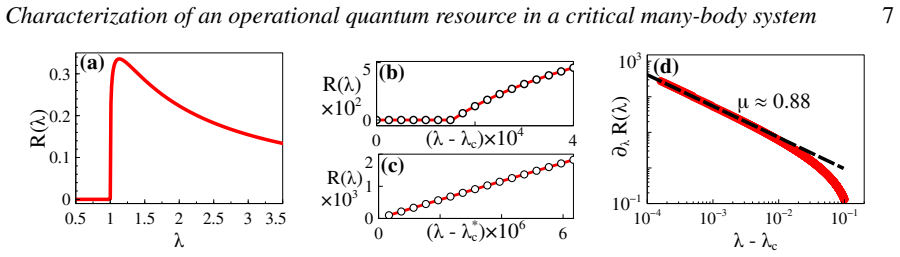
The load-bearing object is the robustness of magic (RoM), defined as the minimal $\ell^1$ excess over a stabilizer-state pseudo-mixture: $R(\rho)=\inf\{\sum_k|X_k|-1 : AX=B\}$ after fixing the Bloch-vector data. The paper's central device is a reduction valid for qubit states with $\langle\sigma_y\rangle=0$: the optimal pseudo-mixture is assumed to involve only the four stabilizer states lying in the $xz$-plane, turning the RoM into the closed form $R_\gamma(\lambda)=\max[\langle\sigma_x\rangle+\langle\sigma_z\rangle-1,0]$. That identity, combined with the exact Toeplitz-determinant solutions for the one- and two-point functions, converts the resource-theoretic problem into a one-dimensional scaling analysis. For two qubits the same reduced density matrix is fed into the RoM linear program, and the difference $Q_R=\log(1+R(\rho_{12}))-\log(1+R(\rho_1\otimes\rho_2))$ isolates the correlation-borne part of the magic.
What would settle it
Compute the RoM of a single-site reduced density matrix of the XY ground state near $\lambda^*_c$ by solving the full linear program over all six single-qubit stabilizer states, with no restriction to the $xz$-plane. If for any $\gamma$ and $\lambda$ the full optimum is strictly below $\max[\langle\sigma_x\rangle+\langle\sigma_z\rangle-1,0]$, then Eq. (8) is false and the location of the magic pseudocritical point and the extracted exponents change accordingly.
Extended reading notes
Core claim
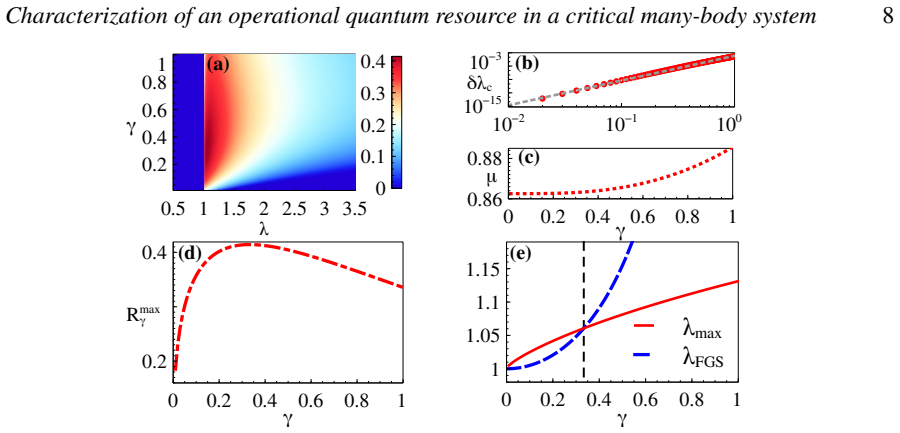
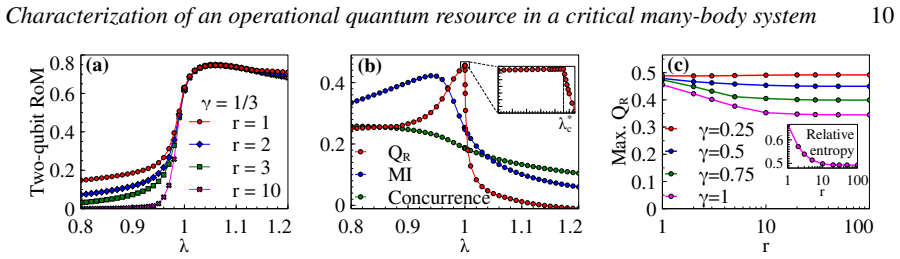
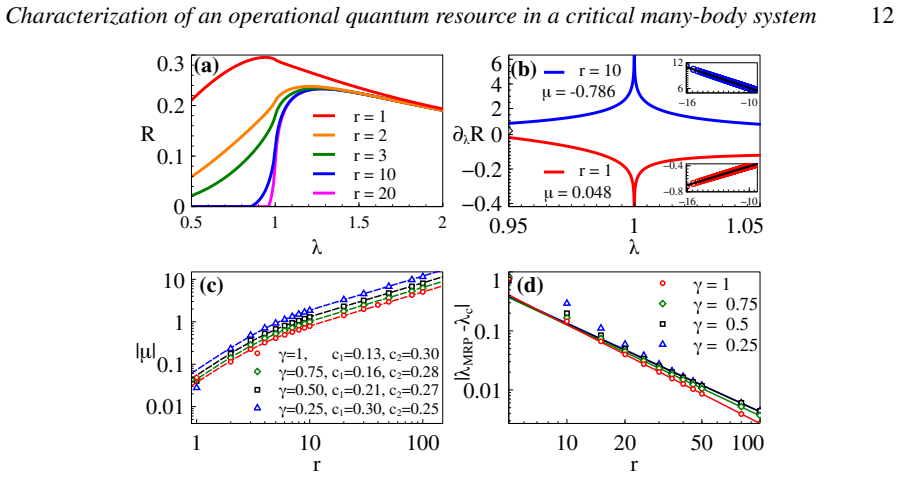
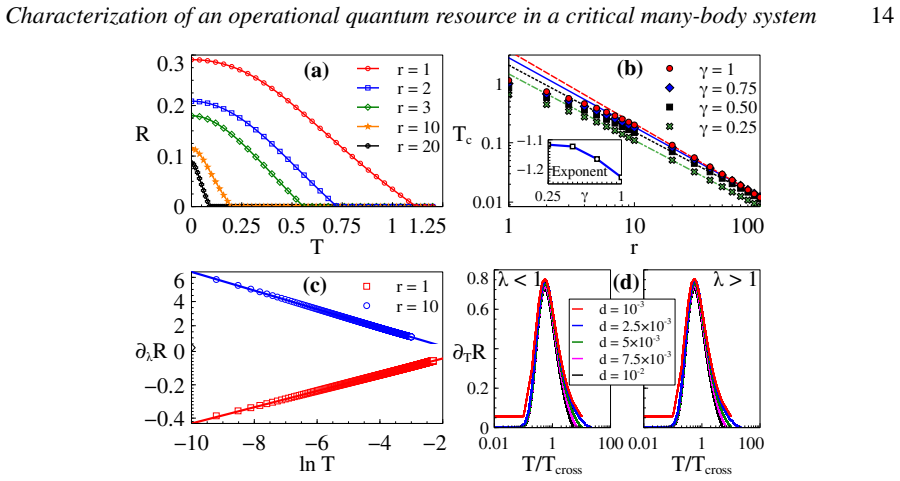
On its own terms, the paper's central claim is that the single-qubit robustness of magic in the symmetry-broken ground state of the XY chain is governed by $R_\gamma(\lambda)=\max[\langle\sigma_x\rangle+\langle\sigma_z\rangle-1,0]$. Because $\langle\sigma_x\rangle$ is the order parameter and vanishes in the disordered phase, all magic sits on the ordered side of the transition and starts at a pseudocritical point $\lambda^*_c(\gamma)$ that moves toward $\lambda_c=1$ as $\gamma\to0$. Using the exact correlation functions, the paper locates the maximal single-qubit magic at $\gamma_0=1/3$, $\lambda_0\approx1.06$, exactly the factorizable point, where the ground state is a product of $H$ states with RoM $\sqrt{2}-1$. For two qubits it defines a global magic $Q_R=\log(1+R(\rho_{12}))-\log(1+R(\rho_1\otimes\rho_2))$, whose peak is at $\lambda^*_c$ for every inter-site distance, and it shows that the two-qubit RoM persists over long distances. In the symmetry-unbroken thermal state, the first derivative of two-qubit RoM diverges logarithmically at criticality, the magic undergoes finite-temperature sudden death with $T_c\propto r^\kappa$, and the crossover at $T^*=a\,T_{\mathrm{cross}}$ delineates the quantum critical region.
Load-bearing premise
The load-bearing premise is that for a qubit with $\langle\sigma_y\rangle=0$, the optimal RoM pseudo-mixture never needs the $\left|+i\right\rangle$ and $\left|-i\right\rangle$ stabilizer states; if including them lowered the $\ell^1$ norm, the closed-form RoM and every single-qubit scaling law built on it would have to be revised.
Editorial extensions
If this is right
- At the factorizable point $\gamma_0=1/3$, $\lambda_0\approx1.06$, a spin chain in its symmetry-broken ground state yields an extensive number of unencoded $H$-type magic states, each with the maximal single-qubit RoM $\sqrt{2}-1$, and small mistuning of the Hamiltonian costs less than about 0.1 percent in fidelity.
- Magic does not flag the quantum critical point itself but a nearby magic pseudocritical point $\lambda^*_c$ slightly inside the ordered phase; the offset falls with anisotropy roughly as $\gamma^{5.55}$, so the effect is most pronounced near the Ising limit.
- The correlation-borne part of two-qubit magic, $Q_R$, peaks exactly at $\lambda^*_c$ for every inter-qubit distance and decays only slowly with distance, providing a long-range quantum-correlation probe where bipartite entanglement dies after the second neighbour.
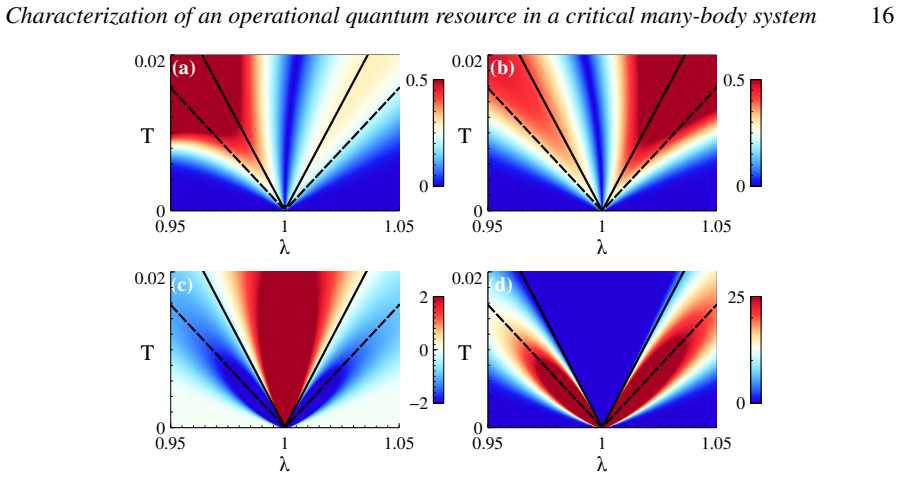
- In the symmetry-unbroken thermal state, the first derivative of two-qubit RoM diverges logarithmically at criticality, two-qubit magic suffers sudden death at finite temperature with $T_c\propto r^\kappa$, and derivatives of the RoM collapse as functions of $T/T_{\mathrm{cross}}$, tracing out the quantum critical region.
Reading between the lines
- The restricted-decomposition assumption behind the single-qubit formula is checkable with a small semidefinite program; if it holds, the same closed-form device may apply to any qubit-state model whose Bloch vector lies in a single plane, not only the XY chain.
- Because the factorizable point supplies pure $H$ states without any entanglement, the mechanism gives a concrete preparation recipe: tune an interacting spin chain to its factorizing point to mass-produce magic-state ancillae, a purpose for which such points were previously avoided.
- The distance-independent location of the global-magic maximum hints that $Q_R$ behaves like a connected correlation function of the order parameter; testing its scaling in finite-size systems could connect magic to standard critical exponents.
- The finite-temperature sudden death of magic implies a hard temperature ceiling for using condensed-matter sources as magic-state factories, and the crossover scaling $T^*=a\,T_{\mathrm{cross}}$ gives a quantitative operating bound for such sources.
Signed reviews
Editorial analysis
A structured set of objections, weighed in public.
Referee Report
Summary. The paper studies the robustness of magic (RoM) in single- and two-qubit reduced states of the transverse-field anisotropic XY spin chain. For the symmetry-broken ground state, it claims a simple closed-form expression for single-qubit RoM, R(λ) = max[⟨σx⟩ + ⟨σz⟩ − 1, 0], valid when ⟨σy⟩ = 0, and uses this to show that magic vanishes in the disordered phase, emerges at a 'magic pseudocritical point' (MPP) just inside the ordered phase, and reaches the maximal equatorial value √2−1 at the factorizable point (γ0 = 1/3, λ0 ≈ 1.06), where the ground state is a product of H states. The paper further investigates two-qubit RoM, demonstrating long-range persistence, a sharp maximum of a 'global magic' quantity at the MPP, scaling laws near criticality, finite-size scaling behavior, thermal sudden death of magic, and detection of the quantum critical region via the Gruneisen parameter. The results are obtained through a combination of analytic formulas, linear programming, and DMRG numerics.
Significance. If the results hold, the paper gives an operational resource-theoretic perspective on a classic integrable model, showing that factorizable ground states can serve as sources of pure H-type magic states for fault-tolerant quantum computation and that magic can act as a long-range probe of quantum criticality, complementing entanglement and discord. The analytic formula Eq. (8) is a useful simplification, and the identification of the factorizable point as a magic-state factory is a concrete, falsifiable prediction. The paper also provides extensive numerical evidence, including machine-checkable linear programs and DMRG data, for the scaling and thermal properties. However, the proof of the central formula in Appendix A is incomplete as written, and several numerical exponents are extracted without quantitative error estimates, which tempers the strength of the quantitative claims.
major comments (4)
- [Appendix A, Eq. (A.1)] The proof of Eq. (8) assumes that the optimal RoM pseudo-mixture for states with ⟨σy⟩ = 0 uses only the four stabilizer states |0⟩, |1⟩, |+⟩, |−⟩, without justifying why the |+i⟩ and |−i⟩ states cannot yield a lower L1 norm. This is a genuine gap in the derivation of the central formula. The result is nevertheless correct: for any decomposition that includes |±i⟩ with equal weight t (required by ⟨σy⟩ = 0), replacing them by t/2 of each of the four xz-plane states preserves the state and, by the triangle inequality, does not increase the L1 norm. Please add this argument or a reference to a complete proof.
- [Section 3.2, Figs. 4(b) and 4(c)] The claim that the global magic QR attains its maximum exactly at the MPP for all inter-site distances r is stated as an exact result, but it is supported only by DMRG numerics and a qualitative derivative-kink observation. Since this is a central result of the paper, please provide either an analytic argument for the coincidence or a more extensive numerical verification with error estimates and a scan over anisotropy γ.
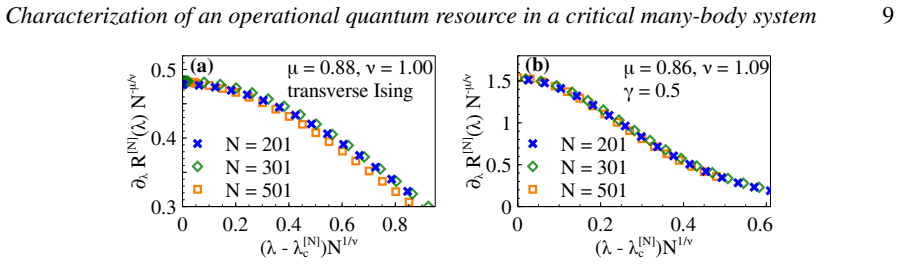
- [Section 3.1.3 and Figs. 1(d), 2(b), 2(c), 3] The finite-size scaling exponents μ and ν, as well as the infinite-chain exponents μ and the power law δλc ∼ γ^5.55, are determined by visual fits without quantitative uncertainties. Because these exponents are used to support the analytic prediction μ ≈ 1 − βx (Eq. (11)), please provide a systematic collapse analysis with error bars or at least quantitative fit-quality measures.
- [Section 3.2, Eq. (13)] The 'global magic' QR = log(1 + R(ρ12)) − log(1 + R(ρ1⊗ρ2)) is proposed as a correlation measure, but the paper does not establish that QR is nonnegative for correlated states or discuss conditions under which it could be negative. If QR can be negative, its interpretation as a measure of correlation needs qualification. Please clarify this point, either by proving nonnegativity for the states considered or by discussing the sign behavior.
minor comments (5)
- [Abstract] The phrase 'the the factorizable ground state' contains a typo and should read 'the factorizable ground state'.
- [Appendix A] The sentence 'We assume thst, the optimal decomposition...' contains a typo; it should read 'We assume that'.
- [Appendix A, case (ii)] In the argument for reducing a one-negative-coefficient decomposition, the stated RoM of the new decomposition is '2|1−µ| + 2ϵ', which appears to omit a factor of |a4|. The conclusion is unaffected, but the expression should be corrected for accuracy.
- [Section 2.1, Eq. (3)] The function g(λ) is defined as 1 in the ordered phase and 0 in the disordered phase; explicitly writing g(λ) = Θ(λ − 1) would improve clarity.
- [Section 4.2, Eq. (16)] The sudden death temperature scaling Tc ∝ r^κ is presented with fitted κ values but no error bars; adding uncertainties would strengthen the quantitative claim.
Circularity Check
No significant circularity: the central RoM formula and scaling laws are derived from explicit LP and independent analytic inputs, not from fitted or self-cited conclusions.
full rationale
The central single-qubit formula, Eq. (8), is derived through the robustness-of-magic linear program in Eq. (7) over the single-qubit stabilizer polytope. Appendix A restricts the pseudo-mixture to the four real stabilizer states, and this restriction is not proved in the text; however, it is not circular. For any state with zero y-magnetization the weights on the |+i> and |-i> stabilizer states must be equal, and those two weights can be redistributed equally among the four real states without changing normalization or the x and z expectations and without increasing the L1 norm. Hence the four-state restriction is inessential, and Eq. (8) is not equivalent to its own conclusion by construction. The magic pseudocritical point and the scaling laws in Eqs. (9)-(11) follow algebraically from the independent Barouch-McCoy expression for <sigma_x> in Eq. (3), with the externally known exponent beta_x=1/8, together with a numerically computed <sigma_z>; the fitted exponent mu about 0.88 is then compared with the independent value 1-beta_x=0.875 rather than being imposed. The factorized-state claim uses the known factorization point from the literature and computes the resulting single-qubit RoM, while the two-qubit maxima are compared with the published Howard-Campbell bound. Citations to the authors' own earlier work are background references and are not load-bearing in the derivation. The many fitted exponents, such as beta_z, mu, nu, and kappa, are characterizations of the computed quantities rather than fitted inputs renamed as predictions, and the finite-size collapse is a consistency check against the infinite-chain behavior. The only substantive weakness is the incomplete proof of the four-state restriction in Appendix A, which is an exposition or completeness gap and not a circular reduction.
Assumptions & free parameters
free parameters (6)
- beta_z (transverse magnetization scaling exponent) =
0.854 for gamma=1 to 0.892 for gamma=0.25
- K_z (transverse magnetization scaling prefactor) =
not reported numerically
- mu (derivative-of-RoM scaling exponent) =
0.88 for gamma=1, 0.86 for gamma=0.5
- nu (finite-size correlation length exponent) =
1.00 for gamma=1, 1.09 for gamma=0.5
- c1, c2 in |mu| about c1 tanh(c2 r) r^0.8 =
c1 in 0.13 to 0.30, c2 in 0.25 to 0.30 depending on gamma
- kappa (sudden death temperature exponent) =
decreases with gamma; strongest for the Ising case
assumptions (5)
- domain assumption Barouch-McCoy solution: thermodynamic-limit two-point functions of the XY chain are Toeplitz determinants, and <sigma_z> is given by an elliptic integral.
- standard math The set of single-qubit stabilizer states forms an octahedron, and RoM is the solution of the linear program in Eq. (7).
- ad hoc to paper The optimal RoM decomposition for states with <sigma_y>=0 uses only |0>, |1>, |+>, and |->, with no +/-i stabilizer states.
- domain assumption Near criticality, <sigma_x> = K_x (lambda - lambda_c)^beta_x with beta_x = 1/8 from Ref. [14], and <sigma_z> is approximately <sigma_z>_c + K_z (lambda - lambda_c)^beta_z with fitted beta_z.
- domain assumption The finite-size scaling ansatz in Sec. 3.1.3 and the quantum-critical scaling ansatze in Eqs. (18)-(19) hold for derivatives of RoM.
invented entities (1)
-
Global magic Q_R
Cite this review
Pith. "Pith review of Characterization of an operational quantum resource in a critical many-body system." pith.science (2026). https://pith.science/paper/RX64O7YM
@misc{pith2026190808058,
  author       = {Pith},
  title        = {Pith review of: Characterization of an operational quantum resource in a critical many-body system},
  year         = {2026},
  howpublished = {\url{https://pith.science/paper/RX64O7YM}},
  note         = {Machine review of arXiv:1908.08058}
}
abstract
Quantum many-body systems have been extensively studied from the perspective of quantum technology, and conversely, critical phenomena in such systems have been characterized by operationally relevant resources like entanglement. In this paper, we investigate robustness of magic (RoM), the resource in magic state injection based quantum computation schemes in the context of the transverse field anisotropic XY model. We show that the the factorizable ground state in the symmetry broken configuration is composed of an enormous number of highly magical $H$ states. We find the existence of a point very near the quantum critical point where magic contained explicitly in the correlation between two distant qubits attains a sharp maxima. Unlike bipartite entanglement, this persists over very long distances, capturing the presence of long range correlation near the phase transition. We derive scaling laws and extract corresponding exponents around criticality. Finally, we study the effect of temperature on two-qubit RoM and show that it reveals a crossover between dominance of quantum and thermal fluctuations.
Figures
Figures from the paper (4 more)
Reference graph
Works this paper leans on
-
[1]
Sachdev S 2007 Handbook of Magnetism and Advanced Magnetic Materials
2007
-
[2]
Amico L, Fazio R, Osterloh A and Vedral V 2008 Rev. Mod. Phys. 80(2) 517–576
2008
-
[3]
Bose S 2003 Phys. Rev. Lett. 91(20) 207901
2003
-
[4]
Bose S 2007 Contemporary Physics 48 13–30
2007
-
[5]
Zanardi P, Paris M G A and Campos Venuti L 2008 Phys. Rev. A 78(4) 042105
2008
-
[6]
Invernizzi C, Korbman M, Campos Venuti L and Paris M G A 2008 Phys. Rev. A 78(4) 042106
2008
-
[7]
Fr ´erot I and Roscilde T 2018 Phys. Rev. Lett. 121(2) 020402
2018
-
[8]
Degen C L, Reinhard F and Cappellaro P 2017 Rev. Mod. Phys. 89(3) 035002
work page 2017
Show all 87 references
-
[9]
Yao N Y , Jiang L, Gorshkov A V , Gong Z X, Zhai A, Duan L M and Lukin M D 2011 Phys. Rev. Lett. 106(4) 040505
2011
-
[10]
Banchi L, Bayat A, Verrucchi P and Bose S 2011 Phys. Rev. Lett. 106(14) 140501
2011
-
[11]
Correa L A, Palao J P, Adesso G and Alonso D 2013 Phys. Rev. E 87(4) 042131
2013
-
[12]
Mohammady M H, Choi H, Trusheim M E, Bayat A, Englund D and Omar Y 2018 Phys. Rev. A 97(4) 042124
2018
-
[13]
Osterloh A O F G and Fazio R 2002 Nature 416(6881) 608
2002
-
[14]
Osborne T J and Nielsen M A 2002 Phys. Rev. A 66(3) 032110
2002
-
[15]
Vidal G, Latorre J I, Rico E and Kitaev A 2003 Phys. Rev. Lett. 90(22) 227902
2003
-
[16]
Bayat A, Bose S, Sodano P and Johannesson H 2012 Phys. Rev. Lett. 109(6) 066403
2012
-
[17]
Bayat A 2017 Phys. Rev. Lett. 118(3) 036102
2017
-
[18]
Sun Z, Ma J, Lu X M and Wang X 2010 Phys. Rev. A 82(2) 022306
2010
-
[19]
Le Hur K, Doucet-Beaupr ´e P and Hofstetter W 2007 Phys. Rev. Lett. 99(12) 126801
2007
-
[20]
Sørensen E S, Chang M S, Laflorencie N and A ffleck I 2007 Journal of Statistical Mechanics: Theory and Experiment 2007 P08003–P08003
2007
-
[21]
Bayat A, Johannesson H, Bose S and Sodano P 2014 Nature Communications 5 3784
2014
-
[22]
Giampaolo S M, Adesso G and Illuminati F 2008 Phys. Rev. Lett. 100(19) 197201
2008
-
[23]
Giampaolo S M, Adesso G and Illuminati F 2009 Phys. Rev. B 79(22) 224434
2009
-
[24]
Tomasello B, Rossini D, Hamma A and Amico L 2011 EPL (Europhysics Letters) 96 27002
2011
-
[25]
Cui J, Gu M, Kwek L C, Santos M F, Fan H and Vedral V 2012 Nature Communications 3 812
2012
-
[26]
Horodecki M 2001 Quantum Information & Computation 1 3–26
2001
-
[27]
Plenio M B and Virmani S S 2014 An introduction to entanglement theory Quantum Information and Coherence (Springer) pp 173–209
2014
-
[28]
Amico L and Patan `e D 2007 Europhysics Letters (EPL) 77 17001
2007
-
[29]
Bravyi S and Kitaev A 2005 Phys. Rev. A 71(2) 022316
2005
-
[30]
Ollivier H and Zurek W H 2001 Phys. Rev. Lett. 88(1) 017901
2001
-
[31]
Henderson L and Vedral V 2001 Journal of Physics A: Mathematical and General 34 6899–6905
2001
-
[32]
Baumgratz T, Cramer M and Plenio M B 2014 Phys. Rev. Lett. 113(14) 140401 Characterization of an operational quantum resource in a critical many-body system 21
2014
-
[33]
Marvian I and Spekkens R W 2014 Nature Communications 5 3821
2014
-
[34]
Veitch V , Hamed Mousavian S A, Gottesman D and Emerson J 2014New Journal of Physics 16 013009
-
[35]
Ahmadi M, Dang H B, Gour G and Sanders B C 2018 Phys. Rev. A 97(6) 062332
2018
-
[36]
Campbell E and Browne D 2010 Phys. Rev. Lett. 104(3) 030503
2010
-
[37]
Howard M and Campbell E 2017 Phys. Rev. Lett. 118(9) 090501
2017
-
[38]
T ´oth G and G¨uhne O 2005 Phys. Rev. A 72(2) 022340
2005
-
[39]
Audenaert K M R and Plenio M B 2005 New Journal of Physics 7 170–170
2005
-
[40]
Mukhopadhyay C, Sazim S and Pati A K 2018 Journal of Physics A: Mathematical and Theoretical 51 414006
2018
-
[41]
Zhan X, Zhang X, Li J, Zhang Y , Sanders B C and Xue P 2016Phys. Rev. Lett. 116(9) 090401
-
[42]
Howard M, Wallman J, Veitch V and Emerson J 2014 Nature 510 351–355
2014
-
[43]
Albarelli F, Genoni M G, Paris M G A and Ferraro A 2018 Phys. Rev. A 98(5) 052350
2018
-
[44]
Takagi R and Zhuang Q 2018 Phys. Rev. A 97(6) 062337
2018
-
[45]
Veitch V , Ferrie C, Gross D and Emerson J 2012New Journal of Physics 14 113011
-
[46]
Mari A and Eisert J 2012 Phys. Rev. Lett. 109(23) 230503
2012
-
[47]
Jones C 2013 Phys. Rev. A 87(4) 042305
2013
-
[48]
Zheng W, Yu Y , Pan J, Zhang J, Li J, Li Z, Suter D, Zhou X, Peng X and Du J 2015 Phys. Rev. A 91(2) 022314
2015
-
[49]
Campbell E T, Anwar H and Browne D E 2012 Phys. Rev. X 2(4) 041021
2012
-
[50]
O’Gorman J and Campbell E T 2017 Phys. Rev. A 95(3) 032338
2017
-
[51]
Campbell E T and Howard M 2017 Phys. Rev. A 95(2) 022316
2017
-
[52]
Bravyi S and Haah J 2012 Phys. Rev. A 86(5) 052329
2012
-
[53]
Hastings M B and Haah J 2018 Phys. Rev. Lett. 120(5) 050504
2018
-
[54]
Krishna A and Tillich J P 2019 Phys. Rev. Lett. 123(7) 070507
2019
-
[55]
Campbell E T 2011 Phys. Rev. A 83(3) 032317
2011
-
[56]
Dawkins H and Howard M 2015 Phys. Rev. Lett. 115(3) 030501
2015
-
[57]
Lieb E, Schultz T and Mattis D 1961 Annals of Physics 16 407 – 466 ISSN 0003-4916
1961
-
[58]
Dutta A, Aeppli G, Chakrabarti B K, Divakaran U, Rosenbaum T F and Sen D 2015 Quantum Phase Transitions in Transverse Field Spin Models: From Statistical Physics to Quantum Information (Cambridge University Press)
2015
-
[59]
Barouch E, McCoy B M and Dresden M 1970 Phys. Rev. A 2(3) 1075–1092
1970
-
[60]
Barouch E and McCoy B M 1971 Phys. Rev. A 3(2) 786–804
1971
-
[61]
Pfeuty P 1970 Annals of Physics 57 79 – 90 ISSN 0003-4916
1970
-
[62]
Lidar D and Brun T 2013 Quantum Error Correction (Cambridge University Press)
2013
-
[63]
Briegel H J 2009 Cluster States (Berlin, Heidelberg: Springer Berlin Heidelberg) pp 96–105 ISBN 978-3- 540-70626-7
2009
-
[64]
Gottesman D 1998 arXiv:quant-ph/9807006
1998 arXiv
-
[65]
Heinrich M and Gross D 2019 Quantum 3 132 ISSN 2521-327X
2019
-
[66]
White S R 1992 Phys. Rev. Lett. 69(19) 2863–2866
1992
-
[67]
Pirvu B, Murg V , Cirac J I and Verstraete F 2010New Journal of Physics 12 025012
-
[68]
Schollw ¨ock U 2011 Ann. Phys. 326 96–192
2011
-
[69]
ITensor Library (version 3.0.0) http://itensor.org
-
[70]
Domb and J.L
Barber M 1983 Finite size scaling (Phase Transitions and critical phenomena, edited by C. Domb and J.L. Leibovitz vol 8) (Academic Press, London)
1983
-
[71]
McCulloch I P 2008 arXiv e-prints arXiv:0804.2509
2008 arXiv
-
[72]
Grant M and Boyd S 2014 CVX: Matlab software for disciplined convex programming, version 2.1
2014
-
[73]
Grant M and Boyd S 2008 Graph implementations for nonsmooth convex programs Recent Advances in Learning and Control Lecture Notes in Control and Information Sciences ed Blondel V , Boyd S and Kimura H (Springer-Verlag Limited) pp 95–110
2008
-
[74]
Radhakrishnan C, Parthasarathy M, Jambulingam S and Byrnes T 2016 Phys. Rev. Lett. 116(15) 150504
2016
-
[75]
Dillenschneider R 2008 Phys. Rev. B 78(22) 224413 Characterization of an operational quantum resource in a critical many-body system 22
2008
-
[76]
Sarandy M S 2009 Phys. Rev. A 80(2) 022108
2009
-
[77]
Krutitsky K V , Osterloh A and Sch¨utzhold R 2017 Scientific Reports 7 3634 ISSN 2045-2322
2017
-
[78]
Sachdev S 1999 Quantum phase transitions (Cambridge University Press, Cambridge)
1999
-
[79]
Fr ´erot I and Roscilde T 2019 Nature Communications 10 577
2019
-
[80]
Continentino M 2001 Quantum Scaling in Many Body Systems (World Scientific, Singapore)
2001
-
[81]
Zhu L, Garst M, Rosch A and Si Q 2003 Phys. Rev. Lett. 91(6) 066404
2003
-
[82]
Maziero J, Guzman H C, C ´eleri L C, Sarandy M S and Serra R M 2010 Phys. Rev. A 82(1) 012106
2010
-
[83]
Maziero J, Cleri L, Serra R and Sarandy M 2012 Physics Letters A 376 1540 – 1544 ISSN 0375-9601
2012
-
[84]
Auccaise R, C ´eleri L C, Soares-Pinto D O, deAzevedo E R, Maziero J, Souza A M, Bonagamba T J, Sarthour R S, Oliveira I S and Serra R M 2011 Phys. Rev. Lett. 107(14) 140403
2011
-
[85]
Cornelio M F, Far ´ıas O J, Fanchini F F, Frerot I, Aguilar G H, Hor-Meyll M O, de Oliveira M C, Walborn S P, Caldeira A O and Ribeiro P H S 2012 Phys. Rev. Lett. 109(19) 190402
2012
-
[86]
Paula F M, Silva I A, Montealegre J D, Souza A M, deAzevedo E R, Sarthour R S, Saguia A, Oliveira I S, Soares-Pinto D O, Adesso G and Sarandy M S 2013 Phys. Rev. Lett. 111(25) 250401
2013
-
[87]
Wang X, Wilde M M and Su Y 2019 New Journal of Physics 21 103002
2019
Reviewed August 14, 2026 · model on record in the stance chip above.
Discussion (0). Continue with ORCID to comment.