REVIEW 4 major objections 6 minor 51 references
DUAL-GLOW: Conditional Flow-Based Generative Model for Modality Transfer
T0 review · 4 major / 6 minor · reviewed 2026-08-14 · deepseek-v4-flash
Pith's one-line read DUAL-GLOW is a flow-based generative model that learns the conditional distribution of PET given MRI and reports synthetic 3D volumes that outperform GAN-based baselines on the ADNI dataset.
desk verdict The architectural idea and derivation are solid, but the empirical headline overreaches: the numbers in Table 1 don't support 'quantitatively better' without significance tests. read the letter →
The pith
A machine-rendered reading of the paper's core claim, the machinery that carries it, and where it could break.
The reading
What carries the argument
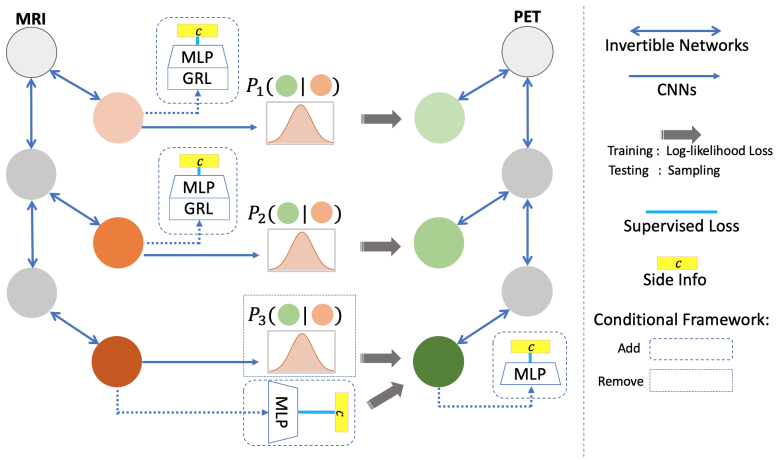
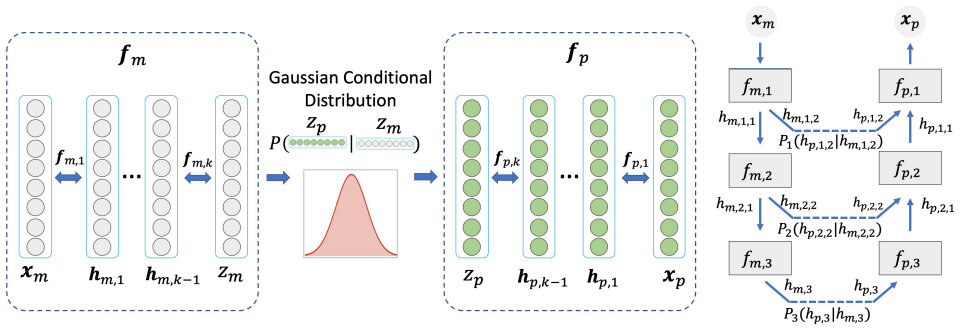
The load-bearing object is a paired-flow likelihood: two invertible affine-coupling flows with multi-scale splitting, and a relation network that parameterizes the Gaussian conditional density p(z_p|z_m) = N(z_p; mu_theta(z_m), sigma_theta(z_m)). The identity log p(x_p|x_m) = log p(z_p|z_m) + log|det(dz_p/dx_p)| lets the model train with exact log-likelihood; affine coupling makes the Jacobian log-determinant a simple sum over scale terms, and multi-scale splitting reduces computation. For side information, gradient-reversal-layer-equipped discriminators strip age or attribute signal from lower latent levels while a top-level discriminator preserves it, enforcing the assumption that only the highest level of the representation is affected by the conditioning variable.
What would settle it
Train an age predictor on the lower-level MRI latent codes of the age-conditioned model; if its accuracy is well above chance, the top-level-only assumption is violated, and similarly, replacing the Gaussian conditional with a more flexible density and showing materially better held-out conditional log-likelihood would falsify the Gaussianity assumption.
Extended reading notes
Core claim
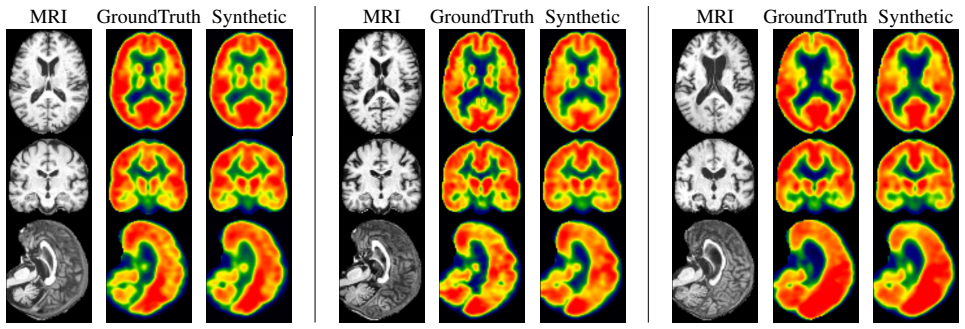
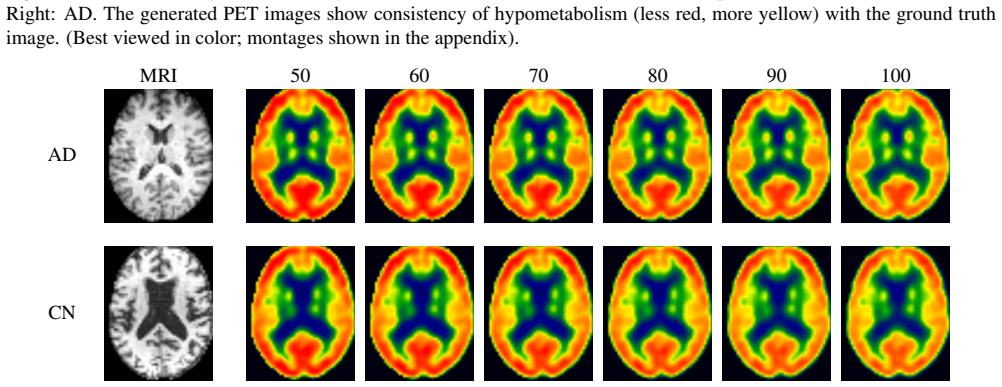
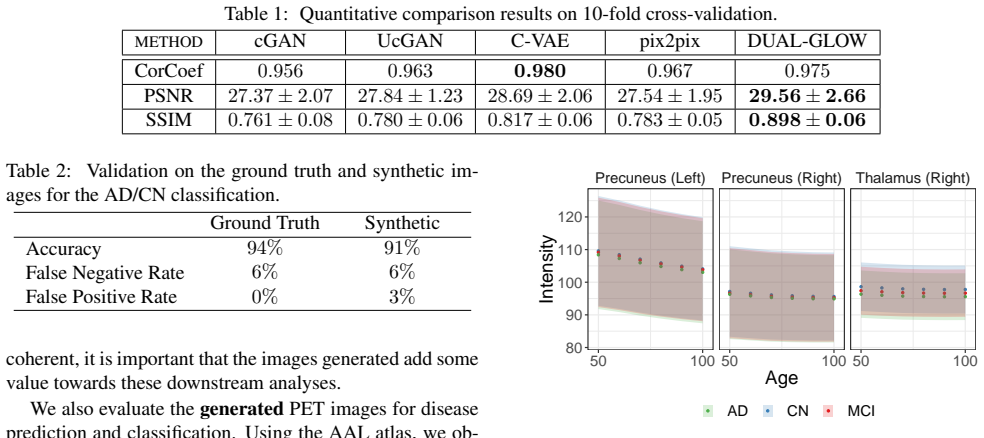
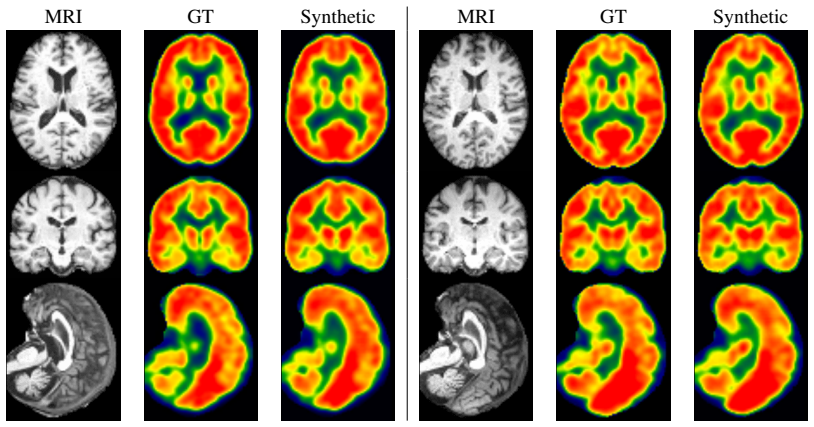
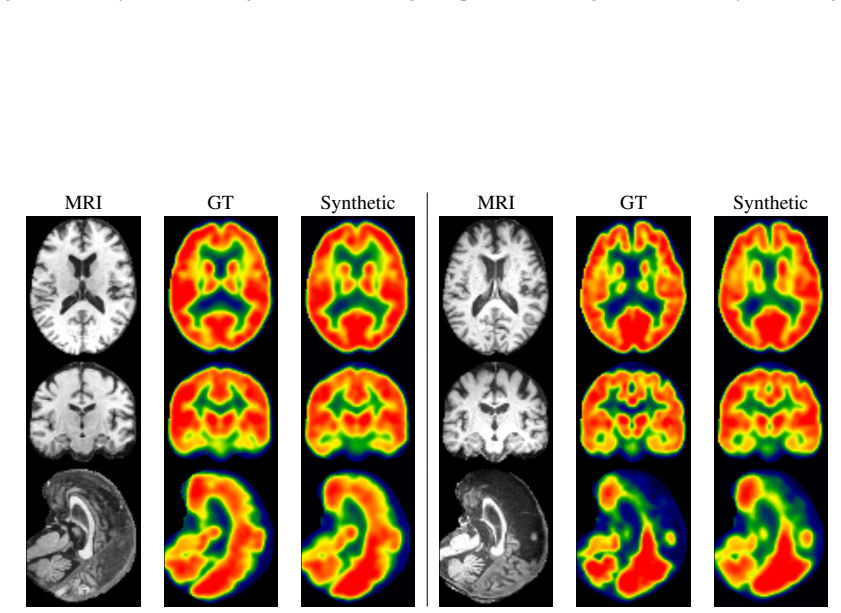
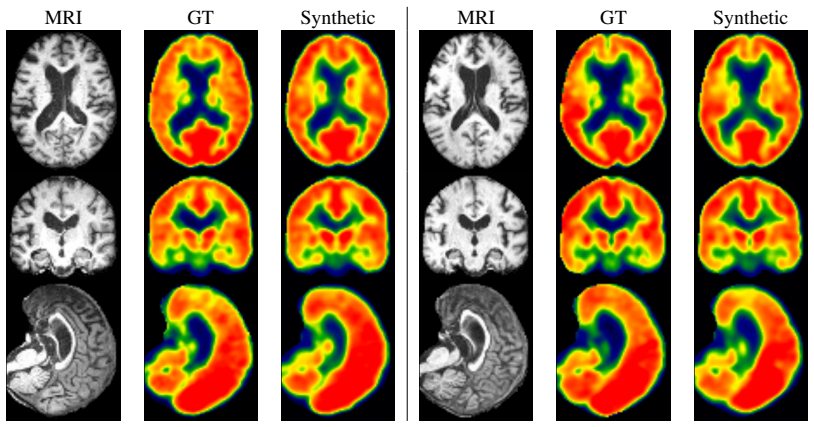
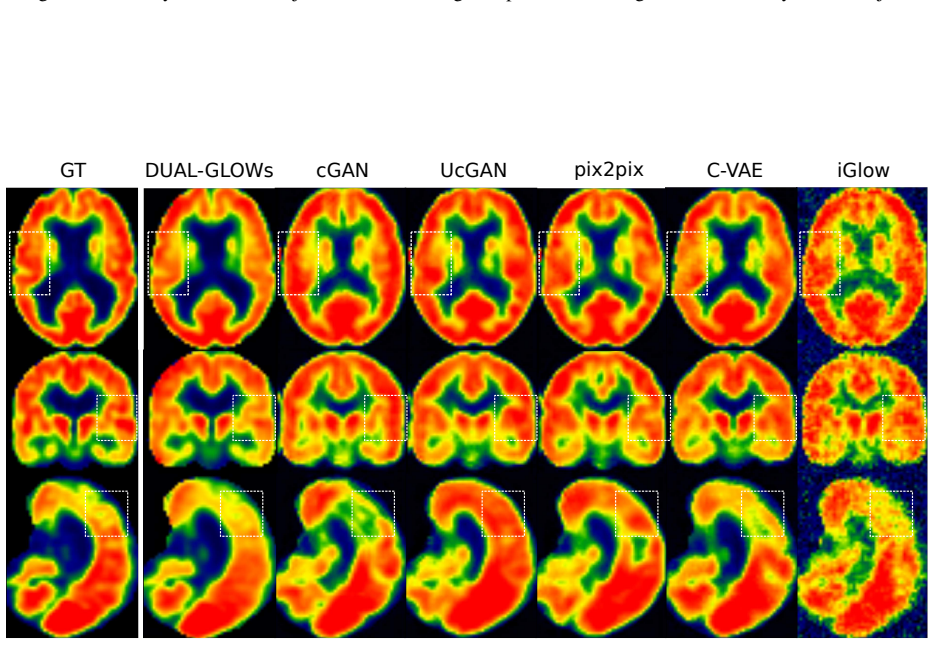
DUAL-GLOW's central claim is that the conditional distribution of PET given MRI can be learned with two normalizing flows, one mapping PET to a latent code and one mapping MRI to its own latent code, plus a relation network that predicts a Gaussian conditional density between the two latent spaces. Under the change-of-variables rule, the conditional log-likelihood of PET given MRI equals the log of this latent conditional density plus the log-determinant of the PET flow's Jacobian, and adding a regularizer on the MRI marginal gives the training objective in Eq. (12). The paper reports that on 806 ADNI MRI/PET pairs, DUAL-GLOW produces full 3D PET volumes with higher SSIM and PSNR and lower MAE than cGAN, UcGAN, C-VAE and pix2pix, and that an SVM trained on synthetic PET achieves AD/CN classification accuracy comparable to ground truth. The age-conditioned extension shows decreasing regional intensity with age, matching the expected aging-related hypometabolism.
Load-bearing premise
The whole derivation assumes that, after the two flows, the conditional density of the PET latent given the MRI latent is exactly Gaussian with mean and variance produced by neural networks, and the age-conditioning version further assumes side information lives only in the top latent level; the paper gives no direct evidence for either assumption.
Editorial extensions
If this is right
- If DUAL-GLOW is correct, MRI-to-PET synthesis can be trained by maximizing a tractable conditional likelihood rather than by adversarial or reconstruction losses, which avoids the blur and mode collapse associated with those approaches.
- Because both transformations are invertible, the same trained pair of flows provides exact latent-variable inference and lets a practitioner sample diverse PET volumes for a single MRI rather than one deterministic output.
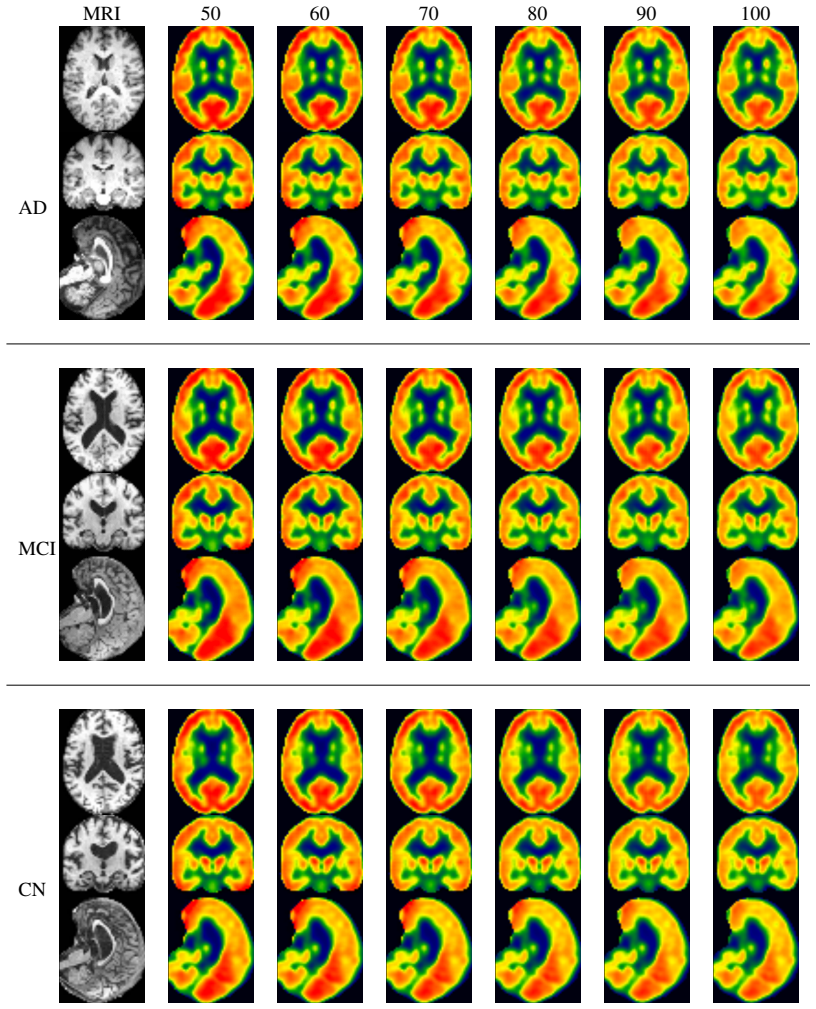
- The age-conditioned extension implies that, for a fixed MRI, PET-like hypometabolism changes with the side variable can be simulated, giving a tool for studying progression of neurodegeneration across the age range.
- Downstream diagnostic classifiers trained on synthetic PET retain most of the discriminative signal of real PET, with the paper reporting 91% versus 94% accuracy for AD/CN classification, so generated volumes could augment small cohorts in statistical analyses.
Reading between the lines
- Because the two flows are invertible, the framework could in principle run in reverse to estimate plausible MRI volumes from PET, a direction the paper does not test.
- The Gaussian conditional assumption is not directly validated; an immediate extension would be replacing p(z_p|z_m) with a conditional normalizing flow on the latent pair and measuring whether held-out conditional log-likelihood or synthesis quality improves.
- The GRL-disentanglement design could be applied to other side variables such as disease status, sex, or genotype, though the paper's wide variance bands suggest larger sample sizes are needed for reliable group comparisons.
- The relation network's Gaussian parameters provide a natural source of uncertainty: repeated sampling from p(z_p|z_m) could yield voxel-level confidence intervals for metabolism, which the paper does not report.
Signed reviews
Editorial analysis
A structured set of objections, weighed in public.
Referee Report
Summary. The paper introduces DUAL-GLOW, a normalizing-flow model for conditional MRI-to-PET synthesis. Two invertible networks map MRI and PET into latent spaces, and a relation network models the conditional density of the PET latent given the MRI latent as a Gaussian whose mean and variance are network outputs. The conditional log-likelihood is derived via the change-of-variables formula in Eqs. (8)-(12). The framework is extended to side information such as age by adding discriminators and gradient reversal layers intended to confine the effect of the covariate to the top-most latent level. Experiments on ADNI compare DUAL-GLOW with cGAN, UcGAN, C-VAE, and pix2pix using MAE, CorCoef, PSNR, and SSIM, and include an SVM classification of generated images and age-conditioned PET generation.
Significance. If the claims hold, the paper provides a useful likelihood-based alternative to GANs for medical modality transfer, with the practical advantage of exact latent inference and full 3D-volume processing. The mathematical derivation in Section 3 is clean and self-contained: Eq. (10) correctly follows from the block-diagonal Jacobian in Eq. (11), and Eq. (12) is a valid conditional-likelihood objective with a regularizer on the MRI marginal. The release of code is a concrete strength. However, the empirical support for the headline superiority claim is incomplete: no significance tests are reported, the cross-validation protocol is ambiguous, one of the four headline metrics (CorCoef) is below the C-VAE baseline, and the age-conditioning results are qualitative with wide variance bands. The significance of the paper is therefore moderate pending strengthened statistical evidence and a more measured abstract.
major comments (4)
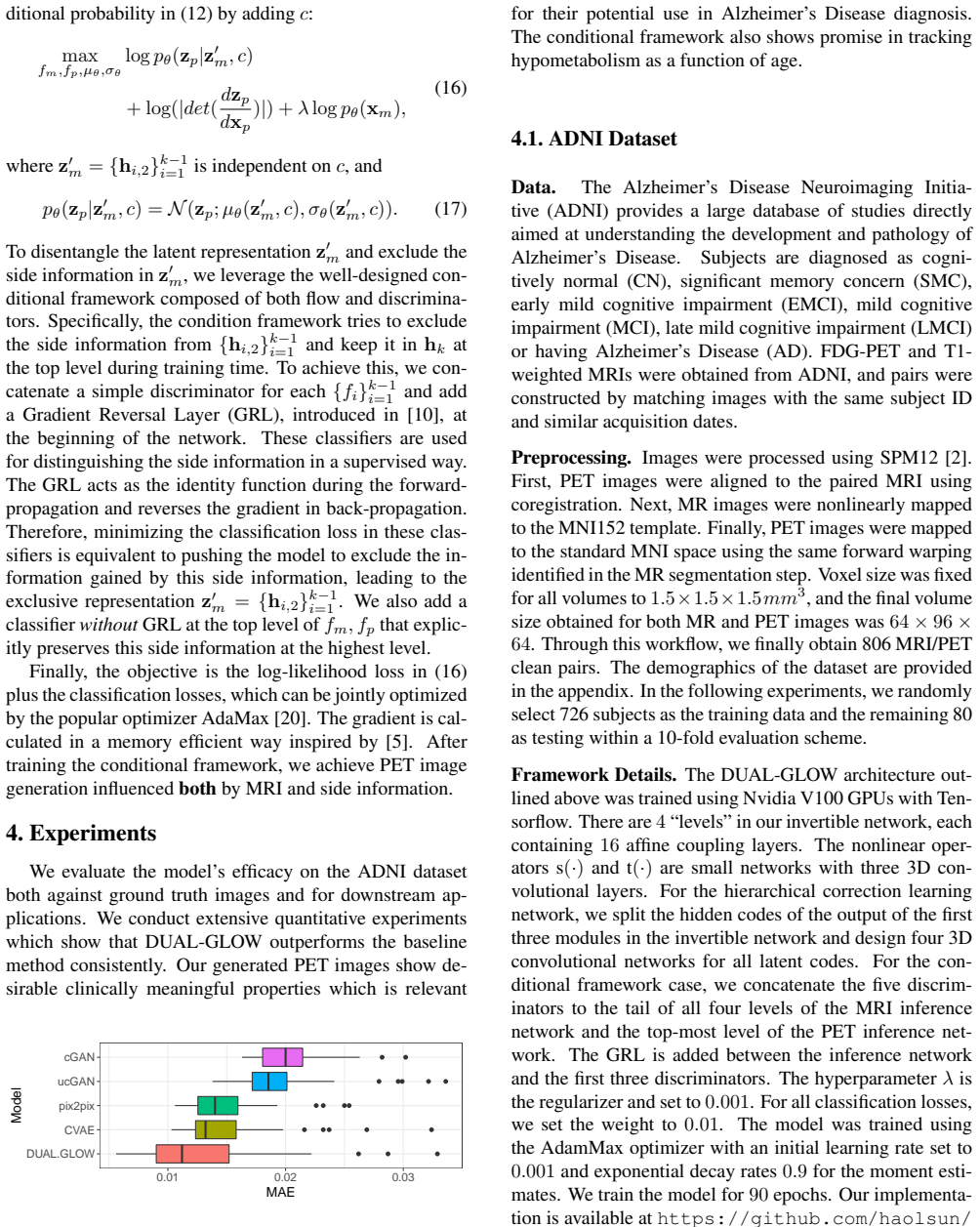
- [Section 4.2, Table 1] The abstract's claim that DUAL-GLOW is 'quantitatively better than recent works' is not supported by the reported statistics. DUAL-GLOW has CorCoef 0.975 versus C-VAE 0.980, so it is numerically worse on one of the four headline metrics. For PSNR, the means are 29.56±2.66 versus 28.69±2.06, and for SSIM 0.898±0.06 versus 0.817±0.06; the one-standard-deviation intervals for PSNR overlap substantially, and no confidence intervals, paired tests, or per-fold results are provided. Please add a properly paired significance analysis across the folds or subjects with multiple-comparison control and report effect sizes, or revise the abstract to 'comparable or better' with appropriate caveats.
- [Section 4.1] The sentence 'randomly select 726 subjects as the training data and the remaining 80 as testing within a 10-fold evaluation scheme' is ambiguous. A standard 10-fold cross-validation on 806 subjects would use test sets of roughly 80 subjects, but a single random 80-subject split is not 10-fold. Please specify exactly how many folds or splits were used, whether the same folds were used for all compared methods, and how test subjects were selected for the age-conditioning experiments; this determines the effective number of independent test evaluations and the validity of any significance statements.
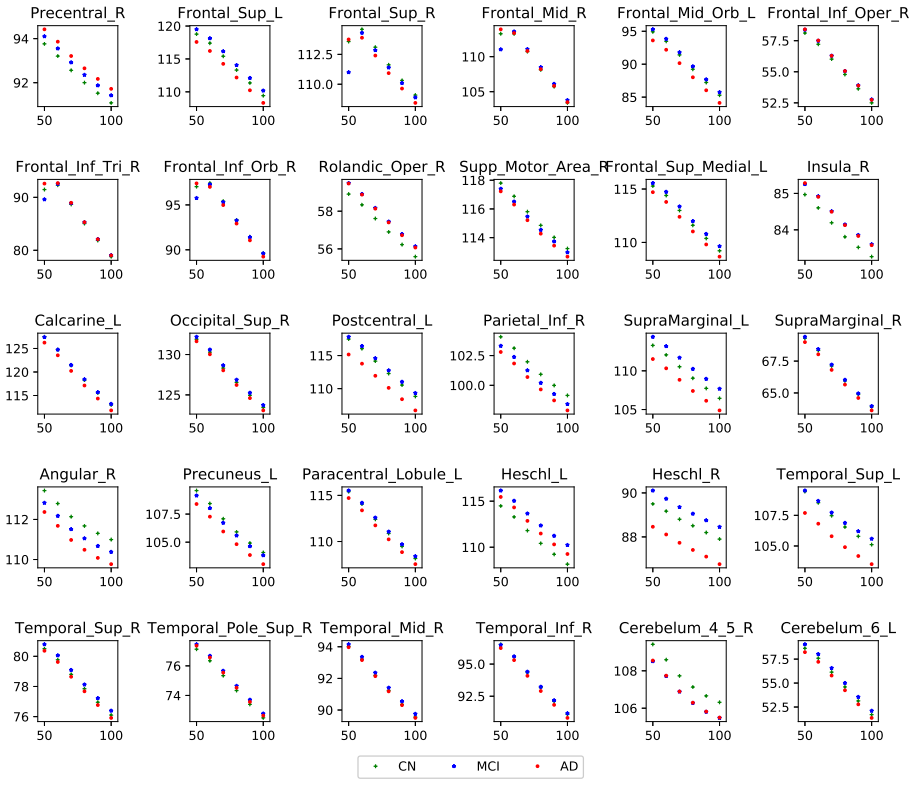
- [Section 3, 'How to condition based on side information'; Figure 7] The age-conditioning contribution rests on the assumption that side information affects only the top-most latent level and that gradient reversal removes age from the lower levels. No quantitative evidence is given that the lower-level latents are indeed age-invariant, for example via classifier accuracy on those latents before and after the gradient reversal layers. The only quantitative support is Figure 7, whose 95% bands are described by the authors as too wide for statistically sound conclusions. The abstract's statement that the model can 'capture brain FDG-PET changes as a function of age' should therefore be backed by a statistical test of the age trend with confidence intervals and a validation of the disentanglement assumption, or softened to a qualitative claim.
- [Section 3, Eq. (6)] The objective in Eq. (12) is exactly the conditional log-likelihood only under the Gaussian family pθ(zp|zm)=N(zp;µθ(zm),σθ(zm)). The paper provides no diagnostic for this assumption. Please include a residual analysis on held-out subjects, for example standardized residuals (zp−µθ(zm))/σθ(zm) compared with a standard normal, or a comparison against a more flexible conditional density, or explicitly discuss the limitation. This is a correctness-risk check on the central likelihood interpretation rather than a request for a different model.
minor comments (6)
- [Abstract and Section 4.1] The dataset size is given as 826 subjects in the abstract but 806 clean MRI/PET pairs in Section 4.1; please reconcile these numbers.
- [Section 4.1] The optimizer is called 'AdamMax' but should be 'AdaMax' to match the terminology in reference [20].
- [Figure 3 caption] The caption contains a typo: 'Spliting' should be 'Splitting'.
- [Section 4.2] The metric name 'Cor Coef' should be written consistently as 'CorCoef' as in Table 1.
- [Figure 7] The x-axis is labeled only '50 100'; please label the axis 'Age' with explicit tick values and add units.
- [Equation (15)] The notation I1:d1 is not defined; it should denote the identity matrix acting on the first d1 components.
Circularity Check
Core flow-based conditional derivation is self-contained; only the age-conditioning demonstration restates its own conditioning input.
-
fitted input called prediction
[Sec. 3, Eq. (16)-(17); Sec. 4.3 'Adjusting for Age with Conditioning'; Fig. 7]
"Training the full conditional DUAL-GLOW model, we use ground truth 'side' information (age) as the conditioning variable described above. ... As we see in Figure 7, the mean intensity values show a downward trend with age, as expected."
Age is an explicit conditioning input c in Eq. (16)-(17): the objective maximizes log pθ(zp|z′_m,c) with pθ(zp|z′_m,c)=N(zp; µθ(z′_m,c), σθ(z′_m,c)). The paper trains the full conditional DUAL-GLOW model on ground-truth age as the conditioning variable, then reports that generated ROI intensities show a downward trend with age. That trend is a property of the fitted conditional generator, not an independent derivation; the abstract's claim that the model 'capture[s] brain FDG-PET changes ... as a function of age' restates the conditioning setup rather than predicting an unseen relationship. This affects only the age-conditional demonstration; the base MRI-to-PET likelihood derivation in Eqs. (8)-(12) is self-contained.
full rationale
The central derivation is self-contained. With invertible flows fm and fp, Eq. (8)-(12) correctly factorize the conditional log-likelihood into a latent conditional log p(zp|zm), the PET-flow log-Jacobian, and a regularized MR marginal; none of these quantities is defined in terms of the target PET output beyond the ordinary likelihood construction. The relation network is a learned conditional Gaussian in latent space, an explicit modeling assumption, not a recycled result. There is no load-bearing self-citation: the cited flows (RealNVP, GLOW) and GRL are external prior work, and the authors' own listed prior papers are unrelated to modality transfer. The main empirical claim is benchmarked externally against cGAN, UcGAN, C-VAE, and pix2pix on ADNI, so it is not forced by a fitted parameter; the unsupported 'quantitatively better' wording in the abstract is a statistical/correctness concern, not a circularity one. The one mild circularity is the age-conditioning demonstration: age is fed in as the conditioning variable c in Eq. (16)-(17), and the resulting age-related decline is presented as the model capturing hypometabolism with age, which is a sanity check of the learned regression rather than an independent finding. The paper itself notes that the wide variance bands mean 'a larger sample size may be necessary to derive statistically sound conclusions,' underscoring the weakness of that particular claim. Overall, the score is low because the core synthesis result has independent content and external benchmarks.
Assumptions & free parameters
free parameters (3)
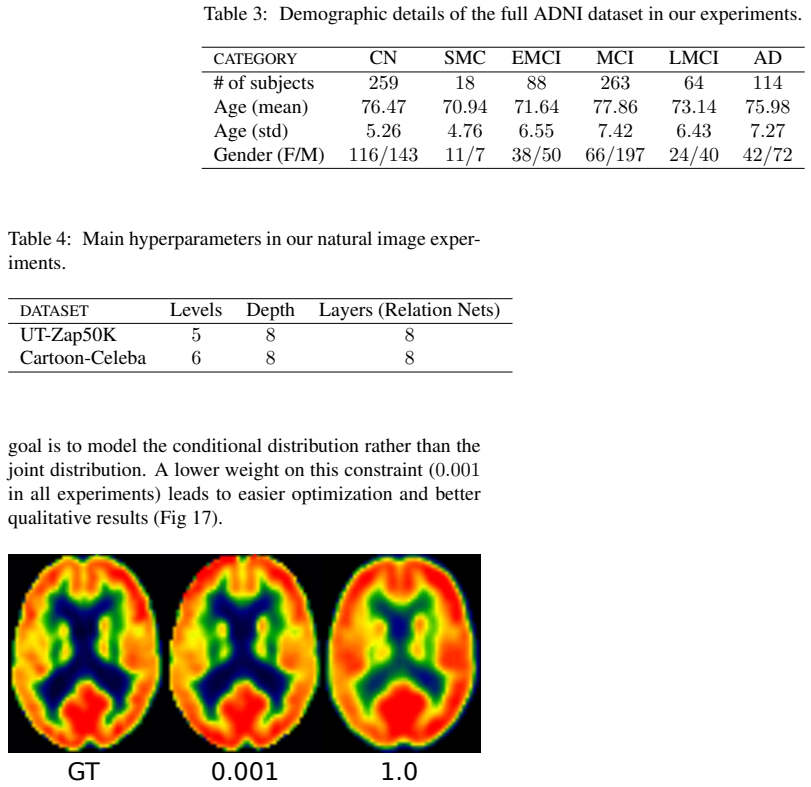
- lambda (MRI marginal regularizer weight) =
0.001
- classification loss weight =
0.01
- network depth and width =
4 levels, 16 coupling layers per level, 512 intermediate channels
assumptions (6)
- standard math Change-of-variables formula for invertible transformations holds for the flow maps.
- standard math Affine coupling layers are invertible and have tractable log-determinants.
- domain assumption Paired MRI and PET images are accurately coregistered and normalized after SPM12 preprocessing.
- domain assumption The conditional distribution of the PET latent given the MRI latent is Gaussian with neural-network mean and variance.
- ad hoc to paper Side information such as age affects only the top-most latent level and can be removed from lower levels using gradient reversal.
- domain assumption The hierarchical splitting technique preserves enough information for accurate generation.
Cite this review
Pith. "Pith review of DUAL-GLOW: Conditional Flow-Based Generative Model for Modality Transfer." pith.science (2026). https://pith.science/paper/ZHARS65T
@misc{pith2026190808074,
  author       = {Pith},
  title        = {Pith review of: DUAL-GLOW: Conditional Flow-Based Generative Model for Modality Transfer},
  year         = {2026},
  howpublished = {\url{https://pith.science/paper/ZHARS65T}},
  note         = {Machine review of arXiv:1908.08074}
}
read the original abstract
Positron emission tomography (PET) imaging is an imaging modality for diagnosing a number of neurological diseases. In contrast to Magnetic Resonance Imaging (MRI), PET is costly and involves injecting a radioactive substance into the patient. Motivated by developments in modality transfer in vision, we study the generation of certain types of PET images from MRI data. We derive new flow-based generative models which we show perform well in this small sample size regime (much smaller than dataset sizes available in standard vision tasks). Our formulation, DUAL-GLOW, is based on two invertible networks and a relation network that maps the latent spaces to each other. We discuss how given the prior distribution, learning the conditional distribution of PET given the MRI image reduces to obtaining the conditional distribution between the two latent codes w.r.t. the two image types. We also extend our framework to leverage 'side' information (or attributes) when available. By controlling the PET generation through 'conditioning' on age, our model is also able to capture brain FDG-PET (hypometabolism) changes, as a function of age. We present experiments on the Alzheimers Disease Neuroimaging Initiative (ADNI) dataset with 826 subjects, and obtain good performance in PET image synthesis, qualitatively and quantitatively better than recent works.
Figures
Figures from the paper (13 more)
Reference graph
Works this paper leans on
-
[1]
Martin Arjovsky, Soumith Chintala, and L ´eon Bottou. Wasserstein gan. arXiv preprint arXiv:1701.07875, 2017
arXiv 2017
-
[2]
John Ashburner, Gareth Barnes, C Chen, Jean Daunizeau, Guillaume Flandin, Karl Friston, Stefan Kiebel, James Kil- ner, Vladimir Litvak, Rosalyn Moran, et al. Spm12 man- ual. Wellcome Trust Centre for Neuroimaging, London, UK, 2014
work page 2014
-
[3]
Large scale gan training for high fidelity natural image synthesis
Andrew Brock, Jeff Donahue, and Karen Simonyan. Large scale gan training for high fidelity natural image synthesis. arXiv preprint arXiv:1809.11096, 2018
arXiv 2018
-
[4]
Mode regularized generative adversarial net- works
Tong Che, Yanran Li, Athul Paul Jacob, Yoshua Bengio, and Wenjie Li. Mode regularized generative adversarial net- works. arXiv preprint arXiv:1612.02136, 2016
arXiv 2016
-
[5]
Training deep nets with sublinear memory cost
Tianqi Chen, Bing Xu, Chiyuan Zhang, and Carlos Guestrin. Training deep nets with sublinear memory cost. arXiv preprint arXiv:1604.06174, 2016
arXiv 2016
-
[6]
Stargan: Unified genera- tive adversarial networks for multi-domain image-to-image translation
Yunjey Choi, Minje Choi, Munyoung Kim, Jung-Woo Ha, Sunghun Kim, and Jaegul Choo. Stargan: Unified genera- tive adversarial networks for multi-domain image-to-image translation. In Proceedings of the IEEE Conference on Com- puter Vision and Pattern Recognition , pages 8789–8797, 2018
work page 2018
-
[7]
Nice: Non-linear independent components estimation
Laurent Dinh, David Krueger, and Yoshua Bengio. Nice: Non-linear independent components estimation. arXiv preprint arXiv:1410.8516, 2014
arXiv 2014
-
[8]
Density estimation using real nvp
Laurent Dinh, Jascha Sohl-Dickstein, and Samy Ben- gio. Density estimation using real nvp. arXiv preprint arXiv:1605.08803, 2016
arXiv 2016
Show all 51 references
-
[9]
A varia- tional u-net for conditional appearance and shape generation
Patrick Esser, Ekaterina Sutter, and Bj ¨orn Ommer. A varia- tional u-net for conditional appearance and shape generation. In Computer Vision and Pattern Recognition , pages 8857– 8866, 2018
2018
-
[10]
Unsupervised domain adaptation by backpropagation
Yaroslav Ganin and Victor Lempitsky. Unsupervised domain adaptation by backpropagation. arXiv preprint arXiv:1409.7495, 2014
2014 arXiv
-
[11]
Image-to-image translation for cross-domain disentan- glement
Abel Gonzalez-Garcia, Joost van de Weijer, and Yoshua Ben- gio. Image-to-image translation for cross-domain disentan- glement. In Advances in Neural Information Processing Sys- tems, pages 1294–1305, 2018
2018
-
[12]
Generative adversarial nets
Ian Goodfellow, Jean Pouget-Abadie, Mehdi Mirza, Bing Xu, David Warde-Farley, Sherjil Ozair, Aaron Courville, and Yoshua Bengio. Generative adversarial nets. In Advances in neural information processing systems, pages 2672–2680, 2014
2014
-
[13]
Mr-based synthetic ct generation using a deep convolutional neural network method
Xiao Han. Mr-based synthetic ct generation using a deep convolutional neural network method. Medical physics , 44(4):1408–1419, 2017
2017
-
[14]
Mkl for robust multi-modality ad classification
Chris Hinrichs, Vikas Singh, Guofan Xu, and Sterling John- son. Mkl for robust multi-modality ad classification. In In- ternational Conference on Medical Image Computing and Computer-Assisted Intervention , pages 786–794. Springer, 2009
2009
-
[15]
Multimodal unsupervised image-to-image translation
Xun Huang, Ming-Yu Liu, Serge Belongie, and Jan Kautz. Multimodal unsupervised image-to-image translation. In European Conference on Computer Vision, pages 172–189, 2018
2018
-
[16]
Image-to-image translation with conditional adversar- ial networks
Phillip Isola, Jun-Yan Zhu, Tinghui Zhou, and Alexei A Efros. Image-to-image translation with conditional adversar- ial networks. In Computer Vision and Pattern Recognition, pages 1125–1134, 2017
2017
-
[17]
Prediction of standard-dose brain pet image by using mri and low-dose brain [18f] fdg pet im- ages
Jiayin Kang, Yaozong Gao, Feng Shi, David S Lalush, Weili Lin, and Dinggang Shen. Prediction of standard-dose brain pet image by using mri and low-dose brain [18f] fdg pet im- ages. Medical physics, 42(9):5301–5309, 2015
2015
-
[18]
Progressive growing of gans for improved quality, stability, and variation
Tero Karras, Timo Aila, Samuli Laine, and Jaakko Lehtinen. Progressive growing of gans for improved quality, stability, and variation. arXiv preprint arXiv:1710.10196, 2017
2017 arXiv
-
[19]
Learning to discover cross-domain relations with generative adversarial networks
Taeksoo Kim, Moonsu Cha, Hyunsoo Kim, Jung Kwon Lee, and Jiwon Kim. Learning to discover cross-domain relations with generative adversarial networks. In International Con- ference on Machine Learning, pages 1857–1865. JMLR. org, 2017
2017
-
[20]
Adam: A method for stochastic optimization
Diederik P Kingma and Jimmy Ba. Adam: A method for stochastic optimization. arXiv preprint arXiv:1412.6980 , 2014
2014 arXiv
-
[21]
Glow: Generative flow with invertible 1x1 convolutions
Durk P Kingma and Prafulla Dhariwal. Glow: Generative flow with invertible 1x1 convolutions. InAdvances in Neural Information Processing Systems, pages 10235–10244, 2018
2018
-
[22]
Diverse image-to-image translation via disentangled representations
Hsin-Ying Lee, Hung-Yu Tseng, Jia-Bin Huang, Maneesh Singh, and Ming-Hsuan Yang. Diverse image-to-image translation via disentangled representations. In European Conference on Computer Vision, pages 35–51, 2018
2018
-
[23]
Deep learning based imaging data completion for improved brain disease diag- nosis
Rongjian Li, Wenlu Zhang, Heung-Il Suk, Li Wang, Jiang Li, Dinggang Shen, and Shuiwang Ji. Deep learning based imaging data completion for improved brain disease diag- nosis. In International Conference on Medical Image Com- puting and Computer-Assisted Intervention, pages 305...
2014
-
[24]
Conditional image-to-image translation
Jianxin Lin, Yingce Xia, Tao Qin, Zhibo Chen, and Tie-Yan Liu. Conditional image-to-image translation. In Computer Vision and Pattern Recognition, pages 5524–5532, 2018
2018
-
[25]
Unsupervised image-to-image translation networks
Ming-Yu Liu, Thomas Breuel, and Jan Kautz. Unsupervised image-to-image translation networks. In Advances in Neural Information Processing Systems, pages 700–708, 2017
2017
-
[26]
Deep learning face attributes in the wild
Ziwei Liu, Ping Luo, Xiaogang Wang, and Xiaoou Tang. Deep learning face attributes in the wild. In International Conference on Computer Vision, pages 3730–3738, 2015
2015
-
[27]
Exemplar guided unsupervised image-to- image translation with semantic consistency
Liqian Ma, Xu Jia, Stamatios Georgoulis, Tinne Tuytelaars, and Luc Van Gool. Exemplar guided unsupervised image-to- image translation with semantic consistency. InInternational Conference on Learning Representations, 2019
2019
-
[28]
Dose evaluation of fast synthetic-ct generation using a generative adversarial network for general pelvis mr-only ra- diotherapy
Matteo Maspero, Mark HF Savenije, Anna M Dinkla, Pe- ter R Seevinck, Martijn PW Intven, Ina M Jurgenliemk- Schulz, Linda GW Kerkmeijer, and Cornelis AT van den Berg. Dose evaluation of fast synthetic-ct generation using a generative adversarial network for general pelvis mr-on...
2018
-
[29]
Conditional generative adversarial nets
Mehdi Mirza and Simon Osindero. Conditional generative adversarial nets. arXiv preprint arXiv:1411.1784, 2014
2014 arXiv
-
[30]
Instance-aware image-to-image translation
Sangwoo Mo, Minsu Cho, and Jinwoo Shin. Instance-aware image-to-image translation. In International Conference on Learning Representations, 2019
2019
-
[31]
Image to image transla- tion for domain adaptation
Zak Murez, Soheil Kolouri, David Kriegman, Ravi Ra- mamoorthi, and Kyungnam Kim. Image to image transla- tion for domain adaptation. In Computer Vision and Pattern Recognition, pages 4500–4509, 2018
2018
-
[32]
Medical image syn- thesis with context-aware generative adversarial networks
Dong Nie, Roger Trullo, Jun Lian, Caroline Petitjean, Su Ruan, Qian Wang, and Dinggang Shen. Medical image syn- thesis with context-aware generative adversarial networks. In International Conference on Medical Image Computing and Computer-Assisted Intervention , pages 417–425....
2017
-
[33]
Pixel recurrent neural networks
Aaron van den Oord, Nal Kalchbrenner, and Koray Kavukcuoglu. Pixel recurrent neural networks. arXiv preprint arXiv:1601.06759, 2016
2016 arXiv
-
[34]
Synthesizing missing pet from mri with cycle-consistent generative adversarial net- works for alzheimers disease diagnosis
Yongsheng Pan, Mingxia Liu, Chunfeng Lian, Tao Zhou, Yong Xia, and Dinggang Shen. Synthesizing missing pet from mri with cycle-consistent generative adversarial net- works for alzheimers disease diagnosis. In International Conference on Medical Image Computing and Computer- As...
2018
-
[35]
Varia- tional inference with normalizing flows
Danilo Jimenez Rezende and Shakir Mohamed. Varia- tional inference with normalizing flows. arXiv preprint arXiv:1505.05770, 2015
2015 arXiv
-
[36]
U- net: Convolutional networks for biomedical image segmen- tation
Olaf Ronneberger, Philipp Fischer, and Thomas Brox. U- net: Convolutional networks for biomedical image segmen- tation. In International Conference on Medical image com- puting and computer-assisted intervention , pages 234–241. Springer, 2015
2015
-
[37]
Mri to fdg-pet: Cross-modal synthesis using 3d u-net for multi-modal alzheimers classification
Apoorva Sikka, Skand Vishwanath Peri, and Deepti R Bathula. Mri to fdg-pet: Cross-modal synthesis using 3d u-net for multi-modal alzheimers classification. In Inter- national Workshop on Simulation and Synthesis in Medical Imaging, pages 80–89. Springer, 2018
2018
-
[38]
Determinants of block matrices
John R Silvester. Determinants of block matrices. The Math- ematical Gazette, 84(501):460–467, 2000
2000
-
[39]
Learning structured output representation using deep conditional gen- erative models
Kihyuk Sohn, Honglak Lee, and Xinchen Yan. Learning structured output representation using deep conditional gen- erative models. In Advances in neural information process- ing systems, pages 3483–3491, 2015
2015
-
[40]
Direct estimation of spinal cobb angles by structured multi-output regression
Haoliang Sun, Xiantong Zhen, Chris Bailey, Parham Ra- soulinejad, Yilong Yin, and Shuo Li. Direct estimation of spinal cobb angles by structured multi-output regression. In International Conference on Information Processing in Med- ical Imaging, pages 529–540. Springer, 2017
2017
-
[41]
Learning deep match kernels for image-set classification
Haoliang Sun, Xiantong Zhen, Yuanjie Zheng, Gongping Yang, Yilong Yin, and Shuo Li. Learning deep match kernels for image-set classification. In Computer Vision and Pattern Recognition, pages 3307–3316, 2017
2017
-
[42]
Perceptual adversarial networks for image-to-image transformation
Chaoyue Wang, Chang Xu, Chaohui Wang, and Dacheng Tao. Perceptual adversarial networks for image-to-image transformation. IEEE Transactions on Image Processing , 27(8):4066–4079, 2018
2018
-
[43]
Mix and match networks: encoder-decoder alignment for zero- pair image translation
Yaxing Wang, Joost van de Weijer, and Luis Herranz. Mix and match networks: encoder-decoder alignment for zero- pair image translation. In Proceedings of the IEEE Con- ference on Computer Vision and Pattern Recognition, pages 5467–5476, 2018
2018
-
[44]
Deep mr to ct synthesis using unpaired data
Jelmer M Wolterink, Anna M Dinkla, Mark HF Savenije, Pe- ter R Seevinck, Cornelis AT van den Berg, and Ivana Iˇsgum. Deep mr to ct synthesis using unpaired data. InInternational Workshop on Simulation and Synthesis in Medical Imaging , pages 14–23. Springer, 2017
2017
-
[45]
Opti- mum template selection for atlas-based segmentation
Minjie Wu, Caterina Rosano, Pilar Lopez-Garcia, Cameron S Carter, and Howard J Aizenstein. Opti- mum template selection for atlas-based segmentation. NeuroImage, 34(4):1612–1618, 2007
2007
-
[46]
Holistically-nested edge de- tection
Saining Xie and Zhuowen Tu. Holistically-nested edge de- tection. In International Conference on Computer Vision , pages 1395–1403, 2015
2015
-
[47]
Fine-grained visual compar- isons with local learning
Aron Yu and Kristen Grauman. Fine-grained visual compar- isons with local learning. In Computer Vision and Pattern Recognition, Jun 2014
2014
-
[48]
Semantic jitter: Dense su- pervision for visual comparisons via synthetic images
Aron Yu and Kristen Grauman. Semantic jitter: Dense su- pervision for visual comparisons via synthetic images. In International Conference on Computer Vision, Oct 2017
2017
-
[49]
Unpaired image-to-image translation using cycle- consistent adversarial networks
Jun-Yan Zhu, Taesung Park, Phillip Isola, and Alexei A Efros. Unpaired image-to-image translation using cycle- consistent adversarial networks. In International Conference on Computer Vision, pages 2223–2232, 2017
2017
-
[50]
To- ward multimodal image-to-image translation
Jun-Yan Zhu, Richard Zhang, Deepak Pathak, Trevor Dar- rell, Alexei A Efros, Oliver Wang, and Eli Shechtman. To- ward multimodal image-to-image translation. In Advances in Neural Information Processing Systems , pages 465–476, 2017. 10
2017
-
[51]
lev- els
Appendix In this supplement, We provide extensive additional de- tails regarding the neuroimaging experiments and some the- oretical analysis. 6.1. The ADNI dataset Data used in the experiments for this work were ob- tained directly from the Alzheimers Disease Neuroimaging Ini...
2003
Reviewed August 14, 2026 · model on record in the stance chip above.
Discussion (0). Continue with ORCID to comment.