REVIEW 2 major objections 3 minor 7 references
Next-level composite fermions
T0 review · 2 major / 3 minor · reviewed 2026-08-14 · deepseek-v4-flash
Pith's one-line read Graphene double-layer fractional quantum Hall states are explained by composite fermions that bind vortices from both layers.
desk verdict A clear, honest News-and-Views piece on two-component composite fermions in double-layer graphene; it breaks no new ground but owns its limitations, including the unexplained 3/7 state. read the letter →
The pith
A machine-rendered reading of the paper's core claim, the machinery that carries it, and where it could break.
The reading
What carries the argument
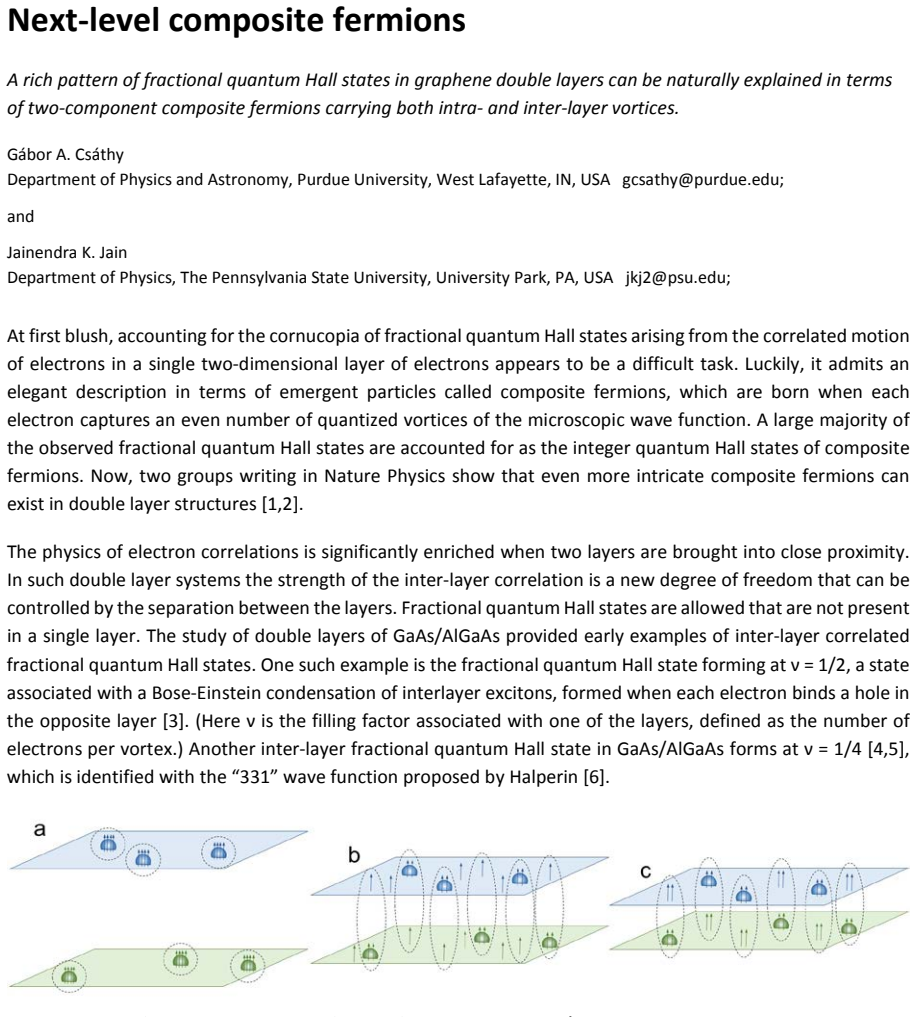
The machinery is the two-component composite fermion construction, a generalization in which each electron captures an even number of quantized vortices from its own layer and an additional one or two vortices from the opposite layer. Only unattached vortices contribute an effective magnetic field felt by composite fermions, so states with different vortex partitions become integer quantum Hall states or Fermi seas of composite fermions. This construction supplies quantitative predictions for Hall and drag responses, and the comparison of those predictions with the graphene double-layer data is what carries the paper's central claim.
What would settle it
A concrete check: measure the drag Hall resistance in a graphene double layer at ν=2/5 and compare it with the value predicted for composite fermions carrying one interlayer and two intralayer vortices; a clear disagreement would falsify that assignment. More generally, if drag Hall conductances across the predicted family of fillings matched the single-layer composite-fermion values, the two-component construction would not be needed.
Extended reading notes
Core claim
On the paper's own terms, the central discovery is that the rich set of fractional quantum Hall states seen in graphene double layers is naturally accounted for by two-component composite fermions—particles formed when each electron captures both intra-layer and inter-layer vortices. In this picture, the observed incompressible states at fillings such as ν=2/5 are integer quantum Hall states of composite fermions with a definite vortex partition, and the agreement of measured Hall resistances in drag and drive configurations with the predicted values identifies which vortices are attached to which layer. The experiments also reveal the ν=3/7 state, which does not correspond to integer composite-fermion filling once interlayer vortex binding is included; the paper interprets this as evidence for further correlations among composite fermions, a theoretical challenge it leaves open.
Load-bearing premise
The load-bearing premise is that the drag and drive transport measurements in the two graphene experiments unambiguously show that composite fermions bind interlayer vortices in the specific configurations the theory predicts; if those signatures instead come from a different interlayer-correlated state, the central claim loses its support.
Editorial extensions
If this is right
- If the interpretation is right, the ν=2/5 state in graphene double layers is a two-component composite fermion state with one interlayer and two intralayer vortices, identifiable by its drive and drag Hall resistances.
- The observed ν=3/7 state would require composite fermions at effective filling 3/2, which is not an integer quantum Hall state; the gap must come from interlayer exciton condensation or Cooper-like pairing.
- The family of incompressible states seen in the Corbino-geometry graphene double-layer measurements expands the known fractional quantum Hall phase diagram into a new regime controlled by layer separation and density imbalance.
- If the two-component composite fermion organizing principle holds, it predicts further interlayer-correlated states at other fillings where the same total filling can be reached by different vortex partitions.
Reading between the lines
- One testable extension is to map the full vortex-partition phase diagram: at fillings where the same electron filling admits two different intra- and interlayer vortex distributions, the theory predicts distinct drag Hall conductances, and density-imbalance sweeps could decide between them.
- The ν=3/7 state, if it is a paired composite-fermion state, could support non-Abelian quasiparticles; a search for pairing signatures, for example in thermal transport or quasiparticle interference, would test that speculation.
- A broader implication is that layer separation acts as an independent tuning knob for vortex attachment, effectively adding a new axis to the fractional quantum Hall phase diagram that is not available in single-layer systems.
Signed reviews
Editorial analysis
A structured set of objections, weighed in public.
Referee Report
Summary. This manuscript is a commentary by Csáthy and Jain on two experimental papers (Liu et al. and Li et al., both in Nature Physics) reporting fractional quantum Hall (FQH) states in closely spaced graphene double layers. The commentary argues that the observed rich pattern of incompressible states, together with Coulomb drag and layer-imbalance measurements, can be naturally understood within a two-component composite fermion (CF) framework in which electrons bind both intra- and inter-layer vortices. The authors emphasize experimental innovations (boron nitride barriers, graphite gates, Corbino geometry) that enabled the measurements. They highlight the state at ν = 2/5 as a clear example of the predicted two-component CF construction, while explicitly acknowledging that the ν = 3/7 state does not follow from the integer quantum Hall effect of composite fermions and requires further correlations such as inter-layer exciton condensation or Cooper-like pairing. The commentary concludes by suggesting future directions opened by these experiments.
Significance. If the interpretation advanced here is correct, the manuscript identifies two-component composite fermions as the organizing principle for interlayer-correlated FQH states in double layers, extending the highly successful single-component CF paradigm to a new class of systems. The commentary is timely and provides a clear, accessible synthesis of two significant experimental papers. It is also commendably candid in flagging the ν = 3/7 state as an unexplained exception and in noting that a quantitative theory for the half-integer effective CF fillings remains lacking. At the same time, the manuscript contains no new derivations or quantitative comparisons; its value lies entirely in the accuracy and soundness of its interpretive claims. The main concern is that the abstract overstates the explanatory power of the two-component CF construction relative to the body's more careful caveats.
major comments (2)
- [Abstract and the paragraph beginning 'These experiments also show...'] The abstract states that "A rich pattern of fractional quantum Hall states in graphene double layers can be naturally explained in terms of two-component composite fermions" but the body explicitly limits this claim: "Most of these are in excellent agreement with the pattern expected from two component composite fermions," and then reports that the ν = 3/7 state "does not follow" from the CF construction, requiring "further correlations" such as inter-layer exciton condensation or Cooper-like pairing. As written, the abstract is inconsistent with the body and overstates the theory's reach. Please revise the abstract to say that most of the observed states are naturally explained, with the 3/7 state identified as an open challenge.
- [The paragraph beginning 'Coulomb drag experiments...' and the sentence 'drag and drive experiments show that composite…] The manuscript states as an established fact that drag and drive experiments show interlayer vortex binding. The number of vortices bound by a composite fermion is not a directly measurable quantity; it is an inference from transport signatures such as Hall resistances and drag responses. The text does give one concrete example (ν = 2/5), but for the general claim it relies entirely on the experimental interpretation in refs. [1,2]. Because the central claim of the commentary—that two-component composite fermions exist and bind inter-layer vortices—rests on this inference, the commentary should explicitly specify which measured quantities in which states are considered to establish the vortex binding (as done for ν = 2/5), or clearly state that the assignment is an interpretation proposed by the experimental papers and accepted by the authors, rather than a direct measurement. This would make the evidential chain transparent to the reader.
minor comments (3)
- [Paragraph beginning 'Now, Liu and colleagues...'] The phrase "while also revealing surprising behaviour not anticipated by theory" is vague; it would be helpful to name the specific behavior, i.e., the incompressible states at ν = 3/7 that fall outside the integer CF scheme.
- [References [1] and [2]] References [1] and [2] are given only as DOIs with no journal name, volume, or year; many readers expect a full citation format, even in a commentary.
- [Figure 1 caption] The caption mentions composite fermions in panel b producing an FQH state because ν_CF = 1, but does not define the symbol ν_CF in the caption; it is defined later in the text, but a brief definition in the caption would help readability.
Circularity Check
No significant circularity: the commentary's interpretation rests on independent experimental reports and an admittedly incomplete theory; self-citation by the theory's coauthor is normal and not load-bearing in a reductionist sense.
full rationale
This is a News & Views commentary, not a derivation paper. It contains no equations, no fitted parameters, and no uniqueness theorem that would force a particular conclusion by construction. The central interpretive claim, that two-component composite fermions carrying intra- and inter-layer vortices can explain the observed quantum Hall states in graphene double layers, is supported by two independent experimental papers ([1], [2]) and by a prior theoretical construction ([7]). Reference [7] is coauthored by one of the present authors, so this is a case of self-citation, but it is not circular in the technical sense: the theory predates the experiments, makes parameter-free assignments of composite-fermion fillings, and is not fitted to the data being discussed. The commentary explicitly acknowledges a limitation that cuts against any charge of forced consistency: for the observed ν=3/7 state, the two-component composite-fermion construction gives ν_CF=3/2, 'Naively, a fractional quantum Hall state is not expected at this filling factor,' and the gap is attributed to unspecified further correlations, with the admission that 'A quantitative account of this physics remains a challenge for theory.' Thus the paper does not claim that every observed state reduces to the construction; it flags exactly the state that is not explained. There is no exhibited reduction of a prediction to an input, no fitted parameter renamed as a prediction, and no load-bearing argument that depends solely on a self-citation. The self-citation is real but minor and non-load-bearing, so the appropriate circularity score is 1.
Assumptions & free parameters
assumptions (3)
- domain assumption The two-component composite fermion construction of ref [7] correctly describes interlayer correlated FQH states in double layers.
- domain assumption The experimental transport and drag measurements of refs [1,2] are accurate and correctly interpreted as evidence of interlayer vortex binding.
- domain assumption The integer quantum Hall effect of composite fermions at integer filling factors nu_CF produces incompressible states.
Cite this review
Pith. "Pith review of Next-level composite fermions." pith.science (2026). https://pith.science/paper/YV4ZIPVP
@misc{pith2026190808079,
  author       = {Pith},
  title        = {Pith review of: Next-level composite fermions},
  year         = {2026},
  howpublished = {\url{https://pith.science/paper/YV4ZIPVP}},
  note         = {Machine review of arXiv:1908.08079}
}
read the original abstract
A rich pattern of fractional quantum Hall states in graphene double layers can be naturally explained in terms of two-component composite fermions carrying both intra- and inter-layer vortices.
Figures
Reference graph
Works this paper leans on
-
[1]
X. Liu, Z. Hao, K. Watanabe, T. Taniguchi, B.I. Halperin, and P.Kim https://doi.org/10.1038/s41567-019-0546-0
-
[2]
J.I.A. Li, Q. Shi, Y. Zeng, K. Watanabe, T. Taniguchi, J. Hone, C.R. Dean https://doi.org/10.1038/s41567-019-0547-z
-
[3]
J. P. Eisenstein, Ann. Rev. Cond. Matt. Phys. 5, 159 (2014)
work page 2014
-
[4]
Y.W. Suen, L. Engel, M.B. Santos, M. Shayegan, and D.C. Tsui, Phys. Rev. Lett. 68, 1379 (1992)
work page 1992
-
[5]
J.P. Eisenstein, G.S. Boebinger, L.N. Pfeiffer, K.W. West, and S.He, Phys. Rev. Lett. 68, 1383 (1992)
work page 1992
-
[6]
B. I. Halperin, Helv. Acta Physica 56, 75 (1983)
work page 1983
-
[7]
V. W. Scarola and J.K. Jain, Phys. Rev. B 64, 085313 (2001)
work page 2001
Reviewed August 14, 2026 · model on record in the stance chip above.
Discussion (0). Continue with ORCID to comment.