REVIEW 3 major objections 6 minor 27 references
Skyrme Functional with Tensor Terms from ab initio Calculations: Results for the Spin-Orbit Splittings
T0 review · 3 major / 6 minor · reviewed 2026-08-14 · deepseek-v4-flash
Pith's one-line read A new Skyrme functional, SAMi-T, determines its tensor terms from ab initio neutron-proton drop pseudodata rather than from experimental single-particle levels.
desk verdict A genuinely new way to constrain tensor couplings, but the 'without ambiguities' claim needs more support than this proceedings paper provides. read the letter →
The pith
A machine-rendered reading of the paper's core claim, the machinery that carries it, and where it could break.
The reading
What carries the argument
The central object is the spin-orbit single-particle potential in Hartree-Fock theory, \($U_q^{{(s.o.)}}$(r)=\frac{1}{2}\left[W_0\nabla\rho+W'_0\nabla\rho_q\right]+\left[\$\alpha$ J_q+\$\beta$ J_{1-q}\right]\), where \(J\) is the spin-orbit density. The coefficients split into central and tensor parts, with \(\alpha_T=\frac{5}{12}U\) and \(\beta_T=\frac{5}{24}(T+U)\), so the two tensor parameters \(T\) and \(U\) enter linearly in the spin-orbit potential. The argument is carried by using the relative evolution of spin-orbit splittings in neutron-proton drops from RBHF to fix \(T\) and \(U\), while the remaining SAMi-T parameters follow the established SAMi fitting protocol.
What would settle it
Repeat the RBHF neutron-proton drop calculation with a different high-quality bare nucleon-nucleon interaction, such as a charge-dependent Bonn potential or a chiral interaction. If the extracted \(T\) and \(U\) from the relative spin-orbit splitting evolution differ substantially from the Bonn A values, the claimed unambiguous tensor constraint fails; if they stay close, the SAMi-T tensor parameters pass a model-dependence test.
Extended reading notes
Core claim
The central claim is that the tensor part of a Skyrme functional can be constrained directly by ab initio pseudodata: the relative change of spin-orbit splittings in neutron-proton drops as the particle numbers vary carries information about the tensor force, and because RBHF starts from a bare nucleon-nucleon interaction fitted to nucleon-nucleon scattering, that information contains no free parameter and no particle-vibration coupling. Consequently, the paper fits only the relative changes, not the absolute values of the splittings, and obtains a functional whose tensor parameters are claimed to be well constrained. The paper then shows that SAMi-T describes the spin-orbit splittings of finite nuclei at least as well as SAMi, and better for spin-saturated nuclei, while preserving the parent functional's description of ground and excited states.
Load-bearing premise
The load-bearing premise is that the RBHF calculation with the Bonn A interaction gives an unambiguous extraction of the tensor strength from the relative change of spin-orbit splittings in neutron-proton drops, so that those changes are not affected by other parts of the interaction or by the external confining field.
Editorial extensions
If this is right
- If SAMi-T is correct, tensor parameters in Skyrme functionals no longer need to be fit to experimental single-particle energies, removing a known source of ambiguity.
- The functional can be used for unified descriptions of ground-state and collective excitation properties across the nuclear chart, including charge-exchange resonances, without re-adjusting the tensor terms.
- The comparison implies that a Skyrme functional without tensor terms underestimates spin-orbit splittings in spin-saturated nuclei like \(^{16}\)O and \(^{40}\)Ca, and that a tensor-constrained functional fixes this mismatch.
- The fitting strategy can be repeated with other ab initio inputs or bare interactions to assign a model-dependence uncertainty to the tensor strength.
Reading between the lines
- The paper does not explore model dependence, but repeating the RBHF drop calculation with a different bare interaction and comparing the fitted \(T\) and \(U\) would directly quantify the uncertainty of the tensor constraint.
- Because only relative changes in spin-orbit splittings are fitted, one consequence the authors leave implicit is that absolute single-particle spectra from RBHF are not yet trusted for this purpose; extending the method to constrain central terms would require better absolute pseudodata.
- A natural testable extension is to use SAMi-T to predict spin-orbit splittings in exotic, neutron-rich nuclei where no experimental data exist and later confront those predictions with measurements.
- The paper's logic suggests that earlier functionals whose tensor terms were fitted to experimental levels may have absorbed particle-vibration coupling into effective parameters; a comparison of SAMi-T with those functionals in open-shell or heavy nuclei would test that implication.
Signed reviews
Editorial analysis
A structured set of objections, weighed in public.
Referee Report
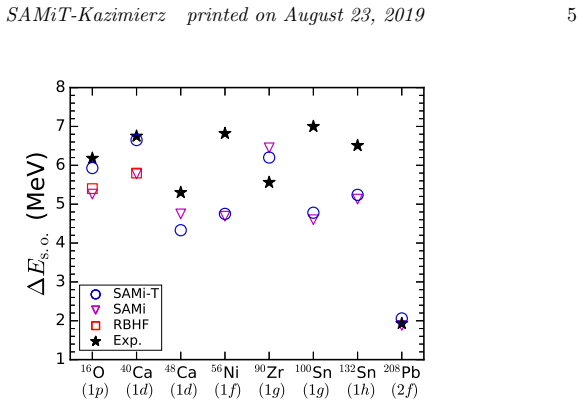
Summary. This paper presents a new Skyrme energy density functional, SAMi-T, whose tensor parameters are determined by fitting to the evolution of spin-orbit (SO) splittings in neutron-proton drops calculated with relativistic Brueckner-Hartree-Fock (RBHF) theory using the Bonn A interaction. The motivation is that RBHF pseudodata lack particle-vibration coupling (PVC), allowing an extraction of the tensor force that the authors claim is free of the ambiguities affecting fits to experimental single-particle levels. The paper reports proton SO splittings for 16O, 40Ca, 48Ca, 56Ni, 90Zr, 100Sn, 132Sn, and 208Pb, comparing SAMi-T with SAMi, RBHF, and experiment. It also states that SAMi-T describes ground-state and excited-state properties, with details deferred to a companion paper.
Significance. If the claim that RBHF pseudodata can pin down the Skyrme tensor terms without ambiguity holds, this would be a valuable step toward ab initio-guided energy density functionals with improved predictive power. The idea of using pseudo-observables rather than experimental single-particle levels to constrain the tensor channel is original and worth pursuing. The paper also shows a clear physical mechanism: refitting spin-orbit strengths to compensate for tensor effects in spin-unsaturated nuclei improves SO splittings in spin-saturated nuclei. However, the manuscript itself provides no quantitative sensitivity analysis, no error bars, and does not demonstrate the uniqueness of the tensor extraction; these limitations materially weaken the central claim as presented.
major comments (3)
- [Sec. 3, Eqs. (5)-(7)] The claim that the tensor parameters are 'well constrained' and extracted 'without ambiguities' because RBHF pseudodata contain no PVC is not established. The spin-orbit potential (5) depends on W0, W0', and on α = α_c + α_T, β = β_c + β_T, where α_c and β_c are central-exchange combinations of t1,t2,x1,x2. Fitting only the relative evolution of SO splittings in neutron-proton drops (as stated in Sec. 3) can constrain sums of central, spin-orbit, and tensor terms, but the uniqueness of T and U separately is not shown. The manuscript does not reproduce the fitting protocol or demonstrate that the extracted T and U are stable under variation of the central parameters within the SAMi protocol; it only states that the RBHF information 'shall be reliable in this sense.' This is a load-bearing assertion that requires either a proof of identifiability or a sensitivity analysis, neither of which appears here.
- [Fig. 1 and Sec. 3] The only nuclei where SAMi-T improves over SAMi are 16O and 40Ca, which are spin-saturated and therefore receive no tensor contribution; the improvement is attributed to larger W0 and W0' resulting from fitting to the same 90Zr and 208Pb SO splittings used in SAMi. The nuclei that actually test the tensor channel (48Ca, 56Ni, 100Sn, 132Sn) show SAMi-T and SAMi both below the experimental data, and 90Zr both above, with no quantitative measure of agreement. The figure therefore does not demonstrate that the tensor terms improve SO splittings; it demonstrates only a readjustment of the spin-orbit sector. To support the claim that SAMi-T 'can describe well ... spin-orbit splittings,' the authors should provide numerical deviations with uncertainties or a sensitivity analysis.
- [Sec. 3, text near 'there is no free parameter'] The sentence 'As the ab initio RBHF calculation starts with the bare nuclear force which is fitted to nucleon-nucleon scattering, there is no free parameter and the information of tensor force by RBHF shall be reliable in this sense' does not justify reliability: a parameter-free bare interaction does not guarantee that the approximate RBHF many-body solution (or the restricted Skyrme form) isolates the tensor contribution. The paper should state explicitly which many-body approximations are used (e.g., no three-body forces, Dirac-Hartree approximation) and, if possible, assess the dependence on the choice of Bonn potential or on the external confining potential used for the drops.
minor comments (6)
- [Abstract] The phrase 'does not contain beyond mean-field effect' should be 'does not contain beyond-mean-field effects' for grammatical correctness.
- [Sec. 2, Eq. (5) discussion] The phrase 'among the others' after the SAMi functional reference is vague; specify that the SAMi parameterization treats W0 and W0' as independent parameters.
- [Fig. 1 caption] The orbital labels in parentheses (e.g., '(1p) (1d)') are not defined; clarify that they denote the pair of orbitals whose splitting is plotted (e.g., 1p3/2 - 1p1/2).
- [Fig. 1] Experimental data are shown without error bars; state whether the error bars are smaller than the symbol size or add them to the figure.
- [Sec. 3, text near 'the tensor terms (α and β) been reduce'] There are typos: 'been reduce' should be 'have reduced', and 'SAMi-T need larger SO terms' should be 'SAMi-T needs larger SO terms'.
- [Sec. 3, 'shall be reliable'] The phrase 'shall be reliable' should be rephrased as 'should be reliable' or 'is reliable' to avoid the modal's prescriptive tone.
Circularity Check
No significant circularity: tensor terms are fit to independent RBHF pseudodata; calibrated SO points are disclosed.
full rationale
The central chain in this paper is: (i) RBHF with the bare Bonn A interaction produces spin-orbit splitting evolution in neutron-proton drops without particle-vibration coupling; (ii) the tensor terms of SAMi-T are fitted to that RBHF pseudodata, not to the experimental single-particle levels used for later comparison; and (iii) the resulting functional is then applied to finite nuclei. Since the fit target is the RBHF pseudodata, the finite-nucleus spin-orbit splittings shown in Fig. 1 are not forced by construction. The only two nuclei in Fig. 1 that are also calibration points, 90Zr and 208Pb, are explicitly identified in the text: 'both SAMi-T and SAMi have fitted to the SO splittings of 90Zr and 208Pb'. The paper uses those points to explain the similarity between SAMi-T and SAMi, not to claim an independent prediction. The independent content includes 16O and 40Ca, where SAMi-T improves on SAMi, as well as the GMR/GDR/GTR/SDR results quoted from the companion paper. The self-citations to Refs. [19-24,26] are normal and do not form a circular load-bearing chain: the RBHF pseudodata are parameter-free ab initio results based on the bare nucleon-nucleon interaction, so they constitute external evidence rather than a restatement of the fitted Skyrme parameters. The paper's 'without ambiguities' claim is an identifiability and accuracy assertion about the absence of PVC contamination and about the relative-change fitting protocol; it is not a logical reduction of the output to the input. The skeptic's concern that central and spin-orbit terms could partially absorb the same signal is a legitimate correctness or identifiability caveat, but it is not demonstrated circularity. No equation in the paper defines the tensor strengths in terms of the experimental SO splittings being predicted, and no fitted parameter is renamed as a prediction. Therefore the paper's derivation is self-contained in the sense relevant to circularity analysis.
Assumptions & free parameters
free parameters (3)
- Central Skyrme parameters (t0,x0,t1,x1,t2,x2,t3,x3,gamma) =
Not tabulated in this paper; determined by SAMi fitting protocol (Ref. [26])
- Spin-orbit coupling strengths W0 and W0' =
Not tabulated in this paper; fitted following SAMi protocol using, among other data, SO splittings of 90Zr and 208Pb
- Tensor parameters T and U (equivalently alpha_T and beta_T) =
Not tabulated in this paper; determined by fitting RBHF SO splitting evolution in neutron-proton drops
assumptions (5)
- domain assumption Skyrme energy density functional form with two-body tensor term, Eqs. (1)-(2), is an adequate representation of nuclear interactions.
- domain assumption RBHF calculations of neutron-proton drops with the Bonn A interaction provide pseudodata free of beyond-mean-field effects such as particle-vibration coupling.
- domain assumption The relative change of SO splittings with particle number in the drops isolates the tensor force contribution and can be used to determine T and U.
- ad hoc to paper W0' can be treated as an independent parameter instead of being equal to W0.
- standard math Hartree-Fock variational principle produces the single-particle equations used to compute spin-orbit splittings.
Cite this review
Pith. "Pith review of Skyrme Functional with Tensor Terms from ab initio Calculations: Results for the Spin-Orbit Splittings." pith.science (2026). https://pith.science/paper/BFXZEZLB
@misc{pith2026190808090,
  author       = {Pith},
  title        = {Pith review of: Skyrme Functional with Tensor Terms from ab initio Calculations: Results for the Spin-Orbit Splittings},
  year         = {2026},
  howpublished = {\url{https://pith.science/paper/BFXZEZLB}},
  note         = {Machine review of arXiv:1908.08090}
}
read the original abstract
A new Skyrme functional including tensor terms is presented. The tensor terms have been determined by fitting the results of relativistic Brueckner-Hartree-Fock (RBHF) studies on neutron-proton drops. Unlike all previous studies, where the tensor terms were usually determined by fitting to experimental data of single-particle levels, the pseudodata calculated by RBHF does not contain beyond mean-field effect such as the particle-vibration coupling and, therefore, can provide information on the tensor term without ambiguities. The obtained new functional, named SAMi-T, can describe well ground-state properties such as binding energies, radii, spin-orbit splittings and, at the same time, the excited state properties such as those of the Giant Monopole Resonance (GMR), Giant Dipole Resonance (GDR), Gamow-Teller Resonance (GTR), and Spin-Dipole Resonance (SDR).
Figures
Reference graph
Works this paper leans on
-
[24]
Skyrme functional with tensor terms from \textit{ab initio} calculations of neutron-proton drops
Shihang Shen, Gianluca Col` o, and Xavier Roca-Maza. Skyrme fu nctional with tensor terms from ab initio calculations. arXiv:1810.09691, 2018
work page Pith review arXiv 2018
-
[1]
Self-consistent mean- field models for nuclear structure
Michael Bender and Paul-henri Heenen. Self-consistent mean- field models for nuclear structure. Rev. Mod. Phys. , 75(1):121–180, 2003
work page 2003
-
[2]
Relativistic Density Functional for Nuclear Structure
Jie Meng, editor. Relativistic Density Functional for Nuclear Structure . World Scientific Pub., 2016
work page 2016
-
[3]
X. Roca-Maza and N. Paar. Nuclear equation of state from grou nd and col- lective excited state properties of nuclei. Prog. Part. Nucl. Phys. , 101:96–176, 2018
work page 2018
-
[4]
Tensor interaction in mean-fi eld and density functional theory approaches to nuclear structure
Hiroyuki Sagawa and Gianluca Col` o. Tensor interaction in mean-fi eld and density functional theory approaches to nuclear structure. Prog. Part. Nucl. Phys., 76(0):76–115, 2014
work page 2014
-
[5]
D Vautherin and D. M. Brink. Hartree-Fock Calculations with Skyr me’s In- teraction. I. Spherical Nuclei. Phys. Rev. C , 5(3):626–647, 1972
work page 1972
-
[6]
J.D D. Walecka. A theory of highly condensed matter. Ann. Phys. (N. Y). , 83(2):491–529, 1974
work page 1974
-
[7]
J. Decharg´ e and D. Gogny. Hartree-Fock-Bogolyubov calcula tions with the D1 effective interaction on spherical nuclei. Phys. Rev. C , 21(4):1568–1593, 1980
work page 1980
Show all 27 references
-
[8]
Jiang , R Lewis, A Parikh, P D Parker, K E Rehm, S Sinha, and J S Thomas
J P Schiffer, S J Freeman, J A Caggiano, C Deibel, A Heinz, C.-L. Jiang , R Lewis, A Parikh, P D Parker, K E Rehm, S Sinha, and J S Thomas. Is th e 6 SAMiT-Kazimierz printed on August 23, 2019 Nuclear Spin-Orbit Interaction Changing with Neutron Excess? Phys. Rev. Lett., 92(16)...
2019
-
[9]
Evolution of Nuclear Shells due to the Tensor Force
Takaharu Otsuka, Toshio Suzuki, Rintaro Fujimoto, Hubert Gra we, and Yoshi- nori Akaishi. Evolution of Nuclear Shells due to the Tensor Force. Phys. Rev. Lett., 95(23):232502, 2005
2005
-
[10]
B. A. Brown, T. Duguet, T. Otsuka, D. Abe, and T. Suzuki. Ten sor interaction contributions to single-particle energies. Phys. Rev. C , 74(6):061303, 2006
2006
-
[11]
Col` o, H Sagawa, S Fracasso, and P.F
G. Col` o, H Sagawa, S Fracasso, and P.F. Bortignon. Spinorbit s plitting and the tensor component of the Skyrme interaction. Phys. Lett. B , 646(5-6):227–231, 2007
2007
-
[12]
D M Brink and Fl. Stancu. Evolution of nuclear shells with the Skyrm e density dependent interaction. Phys. Rev. C , 75(6):064311, 2007
2007
-
[13]
Ten sor part of the Skyrme energy density functional: Spherical nuclei
T Lesinski, M Bender, K Bennaceur, T Duguet, and J Meyer. Ten sor part of the Skyrme energy density functional: Spherical nuclei. Phys. Rev. C , 76(1):014312, 2007
2007
-
[14]
E volution of nuclear shell structure due to the pion exchange potential
WenHui Long, Hiroyuki Sagawa, Jie Meng, and Nguyen Van Giai. E volution of nuclear shell structure due to the pion exchange potential. EPL (Europhysics Lett., 82(1):12001, 2008
2008
-
[15]
Col` o, N
G. Col` o, N. Van Giai, P. F. Bortignon, and R. A. Broglia. Escape a nd spreading properties of charge-exchange resonances in 208Bi. Phys. Rev. C , 50(3):1496–1508, 1994
1994
-
[16]
Gamow-Telle r response within Skyrme random-phase approximation plus particle- vibration coupling
Y F Niu, G Col` o, M Brenna, P F Bortignon, and J Meng. Gamow-Telle r response within Skyrme random-phase approximation plus particle- vibration coupling. Phys. Rev. C , 85(3):034314, 2012
2012
-
[17]
E. V. Litvinova and A. V. Afanasjev. Dynamics of nuclear single- particle structure in covariant theory of particle-vibration coupling: From light to superheavy nuclei. Phys. Rev. C , 84(1):014305, 2011
2011
-
[18]
A. V. Afanasjev, S. E. Agbemava, D. Ray, and P. Ring. Neutro n drip line: Single-particle degrees of freedom and pairing properties as sourc es of theo- retical uncertainties. Phys. Rev. C , 91(1):014324, 2015
2015
-
[19]
Relativistic Brueckner–Hartree–Fock Theo ry for Finite Nuclei
Shi-Hang Shen, Jin-Niu Hu, Hao-Zhao Liang, Jie Meng, Peter Ring , and Shuang-Quan Zhang. Relativistic Brueckner–Hartree–Fock Theo ry for Finite Nuclei. Chinese Phys. Lett. , 33(10):102103, 2016
2016
-
[20]
Fully self-consistent relativistic Brueckner-Hartree-Fock theor y for finite nu- clei
Shihang Shen, Haozhao Liang, Jie Meng, Peter Ring, and Shuang quan Zhang. Fully self-consistent relativistic Brueckner-Hartree-Fock theor y for finite nu- clei. Phys. Rev. C , 96(1):014316, 2017
2017
-
[21]
Relativistic Brueckner-Hartree-Fock theory for neutron drops
Shihang Shen, Haozhao Liang, Jie Meng, Peter Ring, and Shuang quan Zhang. Relativistic Brueckner-Hartree-Fock theory for neutron drops . Phys. Rev. C , 97(5):054312, 2018
2018
-
[22]
Effects of tensor forces in nuclear spinorbit splittings from ab initio c alcula- tions
Shihang Shen, Haozhao Liang, Jie Meng, Peter Ring, and Shuang quan Zhang. Effects of tensor forces in nuclear spinorbit splittings from ab initio c alcula- tions. Phys. Lett. B , 778:344–348, 2018
2018
-
[23]
Spin symmetry in the Dirac sea derived from the bare nucleonnucleon inter- action
Shihang Shen, Haozhao Liang, Jie Meng, Peter Ring, and Shuang quan Zhang. Spin symmetry in the Dirac sea derived from the bare nucleonnucleon inter- action. Phys. Lett. B , 781:227–231, 2018. SAMiT-Kazimierz printed on August 23, 2019 7
2018
-
[25]
Stancu, D
Fl. Stancu, D. M. Brink, and H. Flocard. The tensor part of Sky rme’s inter- action. Phys. Lett. B , 68(2):108, 1977
1977
-
[26]
Roca-Maza, G
X. Roca-Maza, G. Col` o, and H. Sagawa. New Skyrme interactio n with im- proved spin-isospin properties. Phys. Rev. C , 86(3):031306, 2012
2012
-
[27]
Machleidt
R. Machleidt. Advances in Nuclear Physics , volume 19. Springer US, Boston, MA, 1989
1989
Reviewed August 14, 2026 · model on record in the stance chip above.
Discussion (0). Continue with ORCID to comment.