REVIEW 3 major objections 5 minor 45 references
Interplay between band structure and Hund's correlation to increase T$_{c}$ in FeSe
T0 review · 3 major / 5 minor · reviewed 2026-08-14 · deepseek-v4-flash
Pith's one-line read FeSe superconductivity is controlled by the dxy band position and Hund's coupling J.
desk verdict A serious computational study that plausibly identifies dxy proximity and Hund's J as key controls on FeSe superconductivity, but the headline interface result hangs on an untested Se height. read the letter →
The pith
A machine-rendered reading of the paper's core claim, the machinery that carries it, and where it could break.
The reading
What carries the argument
The central machinery is QSGW++, a four-tier chain: QSGW (quasiparticle self-consistent GW) builds the one-particle Hamiltonian and captures nonlocal charge correlations; DMFT (dynamical mean-field theory) with a continuous-time quantum Monte Carlo impurity solver adds local spin fluctuations; a Bethe-Salpeter equation constructed from the DMFT local vertex and nonlocal bubbles yields the spin and charge susceptibilities; and the linearized Eliashberg equation turns those susceptibilities into the leading superconducting eigenvalue λ. The load-bearing ingredients for the paper's conclusion are the orbital-resolved mass renormalization 1/Z and scattering rate Γ, the intensity and dispersion of Im χ(q,ω) at q = (1/2,1/2), and the cRPA-derived values of U and J for each geometry.
What would settle it
Measure the selenium height in the FeSe/SrTiO3 interface with sub-0.01 Å precision (for example by surface-extended X-ray absorption fine structure or low-energy electron diffraction) and recompute the dxy band position at that height. If dxy sits more than about 100 meV below the Fermi level in the actual interface, the predicted λ = 0.34 would drop toward the monolayer value, falsifying the claim that dxy proximity is what restores superconductivity.
Extended reading notes
Core claim
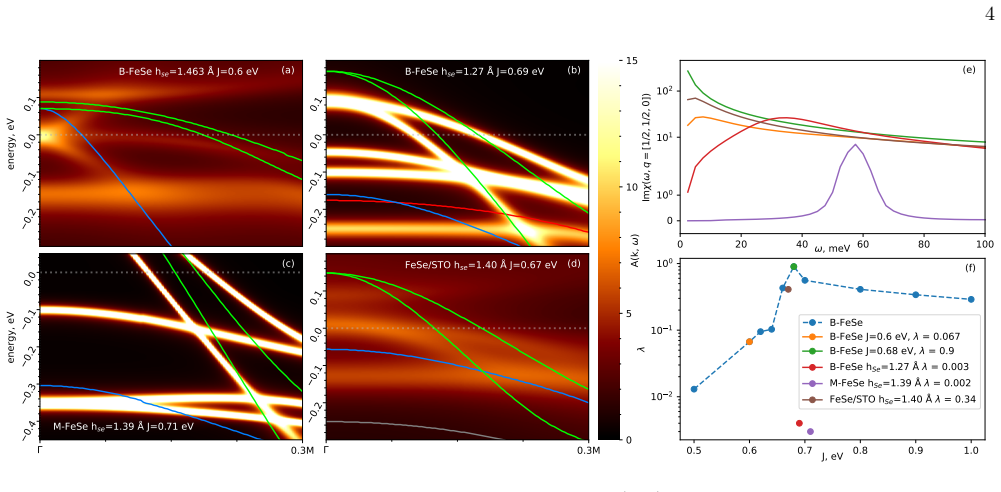
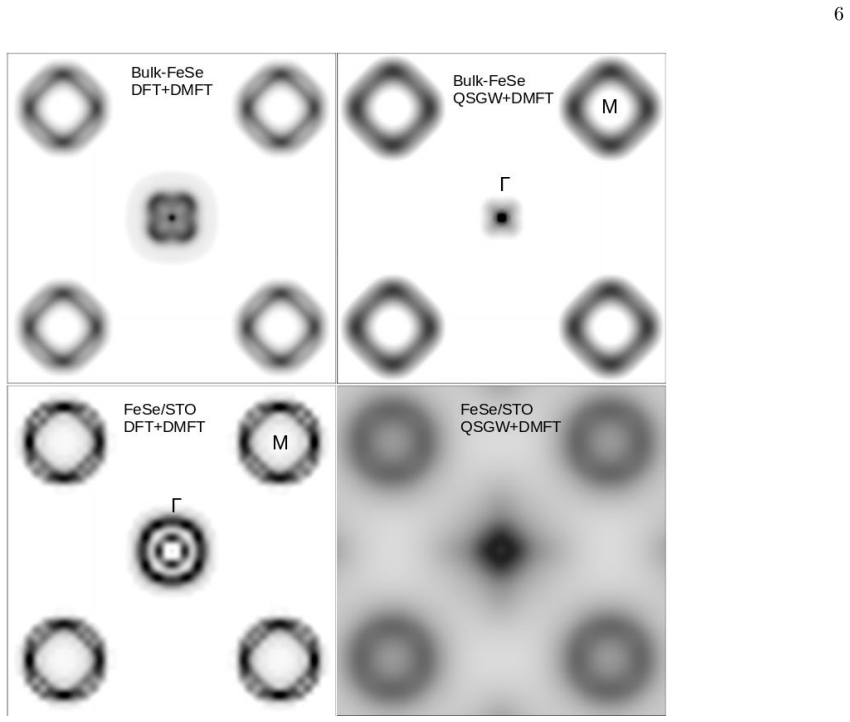
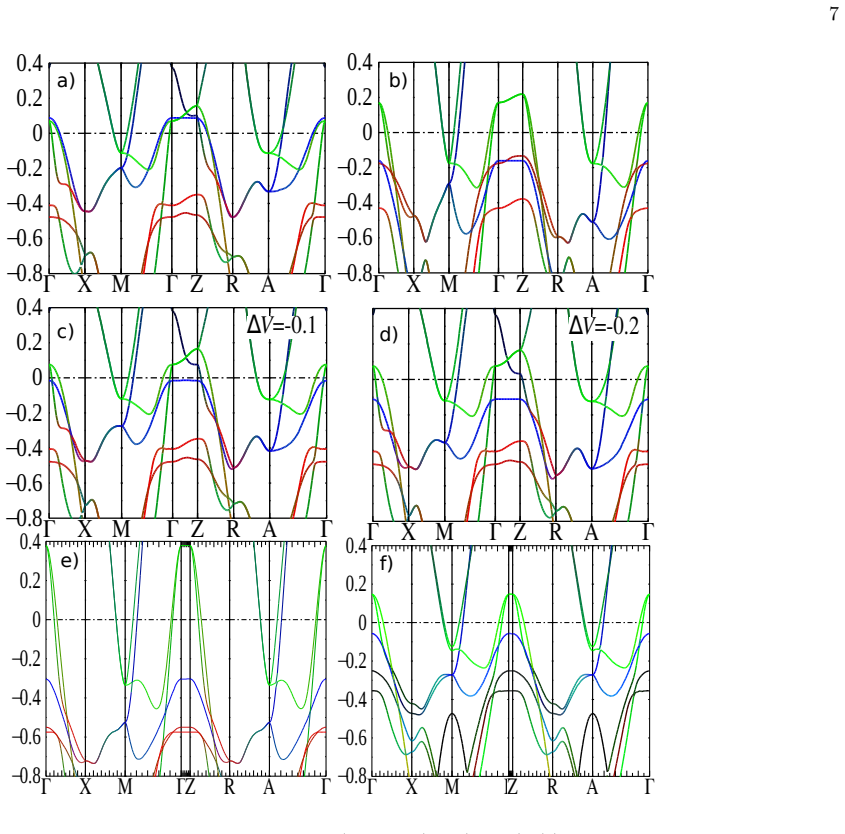
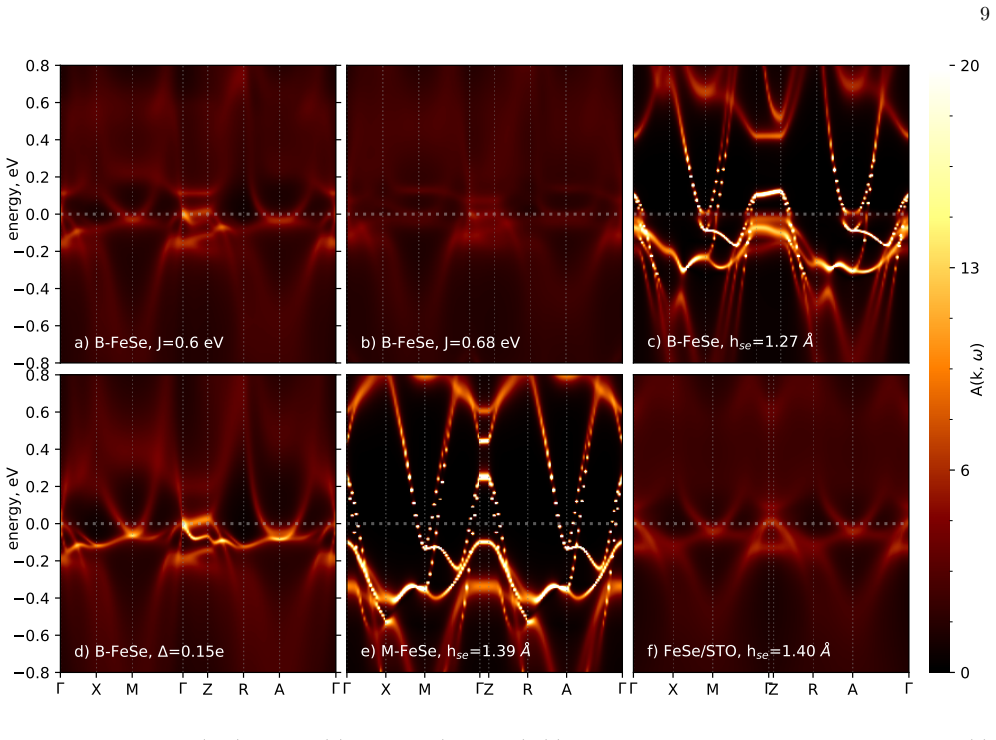
Using a four-tier ab initio method that combines quasiparticle self-consistent GW with dynamical mean-field theory, a Bethe-Salpeter treatment of two-particle response, and an Eliashberg solution of the pairing instability, the paper finds that the superconducting eigenvalue λ is controlled by the interplay of band structure and Hund's correlation. The Fe dxy orbital is the most strongly renormalized and incoherent of the five d orbitals, and it dominates the pairing glue as long as it lies near the Fermi energy. The glue itself is the imaginary part of the spin susceptibility Im χ(q,ω) concentrated near the antiferromagnetic wavevector (1/2,1/2): when J is raised from the ab initio 0.60 eV to 0.68 eV, the susceptibility sharpens and λ jumps from 0.067 to 0.9. Conversely, when the Fe–Se bond length is shortened so that dxy drops well below EF, the system becomes a coherent Fermi liquid with negligible spin fluctuations and λ ≈ 0. The same mechanism differentiates the two monolayer cases: in free-standing M-FeSe the dxy band is pushed about 300 meV below EF and λ = 0.002, while on SrTiO3 it returns to within 50–100 meV of EF, incoherence is restored, and λ = 0.34—five times the bulk value.
Load-bearing premise
The entire distinction between the superconducting interface (λ = 0.34) and the non-superconducting monolayer (λ = 0.002) rests on the assumed selenium height above the iron plane—1.39 Å for the free monolayer and 1.40 Å on SrTiO3, taken from an external structure optimization; if the real height differs by a few hundredths of an Ångström in the direction that pushes dxy below the Fermi level, the predicted enhancement collapses.
Editorial extensions
If this is right
- Because the superconducting eigenvalue λ jumps from 0.067 to 0.9 when J is tuned from 0.60 to 0.68 eV, materials that modestly increase Hund's coupling—by reducing screening—could gain an order of magnitude in Tc.
- A free-standing FeSe monolayer is predicted to be a non-superconducting good metal with dxy about 300 meV below EF; placing it on SrTiO3 restores dxy proximity and raises λ fivefold to 0.34.
- The pairing instability is dominated by the intra-orbital dxy–dxy channel, so the superconducting gap should be largest on dxy-dominated Fermi-surface sheets, as the paper notes is observed.
- Compressing the Fe–Se bond length pushes dxy below EF, suppresses spin fluctuations, and eliminates superconductivity, making the collapsed phase of FeSe a coherent Fermi liquid with λ ≈ 0.
Reading between the lines
- The paper's two-knob picture suggests a screening rule for other Hund's metals: an orbital with strong Hubbard correlations that sits near EF, plus a large J from reduced screening, is the recipe for high Tc; strain or pressure that moves that orbital away from EF will kill pairing even if J grows.
- Because the same method predicts λ = 0.34 from spin fluctuations alone, the gap to the experimental 75 K could be closed by additional mechanisms, such as electron-phonon coupling at the SrTiO3 interface; a combined calculation including phonons is a direct test of whether spin fluctuations are sufficient.
- A testable extension of the logic: electron-dope or strain bulk FeSe to move dxy closer to EF without changing J; the paper's mechanism predicts Tc should track the dxy proximity, which could be checked by ARPES plus specific-heat measurements across a doping series.
- The monolayer result implies that simply isolating an FeSe layer is not enough to enhance Tc; the substrate's role is to undo the monolayer's downward shift of dxy, so interface design should focus on orbital alignment rather than only on doping or electron-phonon coupling.
Signed reviews
Editorial analysis
A structured set of objections, weighed in public.
Referee Report
Summary. The paper uses a combined QSGW+DMFT+BSE+Eliashberg (QSGW++) framework with cRPA-derived U and J to study superconductivity in bulk FeSe, a free-standing monolayer (M-FeSe), and a monolayer on SrTiO3 (M-FeSe/STO). The central claim is that the superconducting pairing eigenvalue lambda is controlled by two conditions: the Fe 3dxy orbital must lie close to the Fermi level, and the Hund's coupling J must be large enough to produce incoherent 'bad metal' behavior. The authors show that bulk FeSe has strong low-energy spin fluctuations near q=(1/2,1/2), that these fluctuations are dominated by dxy, and that small increases in J strongly enhance lambda. They then argue that in M-FeSe the dxy band is pushed below EF, killing the spin fluctuations and reducing lambda to 0.002, whereas in M-FeSe/STO the substrate restores dxy near EF, giving lambda=0.34, which they interpret as explaining the high observed Tc. They also study reduced Se height and electron doping as controlled perturbations around the ab initio reference.
Significance. If the central claim holds, the paper provides a unified orbital-specific mechanism for superconductivity across bulk, monolayer, and interface FeSe: Hund's coupling and the proximity of dxy to EF control the intensity of low-energy antiferromagnetic spin fluctuations, which in turn control the pairing eigenvalue. The work has notable strengths: the cRPA values of U and J are not fitted to Tc; the J-scan is presented explicitly as a sensitivity study rather than a fit; the computed Im chi(q,omega) is benchmarked against inelastic neutron scattering in a companion study; and the orbital-resolved dxy dominance of the pairing glue is a concrete, falsifiable prediction consistent with ARPES and STM observations. The qualitative picture is coherent and internally consistent. However, the quantitative claims, especially the 'five-fold enhancement' for M-FeSe/STO, are fragile because lambda is extremely sensitive to the Se height h and to J, and no uncertainty or robustness analysis is provided for the interface geometry.
major comments (3)
- [Main text (paragraph 'We consider 5-ML slab...') and Fig. 2(d)] The central contrast between M-FeSe/STO (lambda=0.34) and free-standing M-FeSe (lambda=0.002) rests on the Se height h being 1.40 Å vs 1.39 Å, both taken from Ref. [44], but no sensitivity analysis is performed for the interface. The paper itself states about h: 'Its value is critical, as we have seen in the bulk case, and we cannot rely on DFT for it.' The bulk h-scan already shows the danger (Table II: h=1.463 Å gives lambda=0.067; h=1.27 Å gives lambda=0.003). A shift of a few hundredths of an Ångström in M-FeSe/STO, in the direction that pushes dxy below EF, could reduce lambda by more than an order of magnitude and erase the qualitative distinction between the interface and the monolayer. Please add a controlled sweep of h for M-FeSe/STO (and ideally for M-FeSe) around the adopted values, using the same cRPA U,J and QSGW++ pipeline, or provide an error estimate for h from the DFT+DMFT relaxation.
- [Fig. 2(f) and Table II] The quantitative values of lambda are extremely sensitive to J: bulk FeSe goes from lambda=0.067 at J=0.60 eV to lambda=0.9 at J=0.68 eV (Table II and Fig. 2(f)). The cRPA J values are quoted without uncertainty (J=0.60, 0.67, 0.69, 0.71 eV for the four systems), and a 0.01-0.02 eV uncertainty in the interface J would change the reported M-FeSe/STO lambda=0.34 by a large factor. The qualitative trend (larger J increases low-energy Im chi and lambda up to a maximum) is supported, but the headline quantitative claim 'five times larger than bulk' is not robust unless accompanied by a J-sensitivity grid for the interface or an error estimate on cRPA J. Please either provide such a grid or soften the quantitative claim to a qualitative statement.
- [Main text, paragraph on M-FeSe/STO results] The calculation fails to suppress the dxz,yz hole pockets that are absent in ARPES; the paper states this suppresses lambda by only 6%, but the supporting calculation is not shown. If the Fermi surface topology is wrong, the spin susceptibility and Eliashberg eigenvalue could be affected beyond 6%. Please document how the 6% estimate was obtained (e.g., by explicitly removing those pockets or shifting bands) and show the resulting chi(q,omega) and lambda for that modified Fermi surface.
minor comments (5)
- [References] Reference [44] is spelled 'Mandal' in the reference list but 'Mondal' in the main text (two occurrences); please unify the spelling.
- [References] Several references have incomplete bibliographic data or nonstandard formatting: [9] 'L. Sponza and et al', [10] lacks volume/page/article number, [13] 'E. Gull and et al.', and [46] appears twice. Please bring them into journal style.
- [Tables I and II] The units 'A0' in Tables I and II should be 'Å', and the M-FeSe J value in Table I is given as 0.7 rather than 0.70 eV; please make the precision consistent with the other entries.
- [Abstract] The sentence 'Our study opens a paradigm for a unified understanding what controls Tc' is missing a preposition; it should read 'understanding of what controls Tc'.
- [Figure 2 caption] In the caption of Fig. 2, the phrase 'while in (b) and (c)dxy is pushed far below EF : and the system has properties similar to a normal Fermi liquid' contains a colon and spacing error; please correct the punctuation.
Circularity Check
No circularity: the calculated λ values are outputs of QSGW+DMFT+BSE with cRPA-derived U and J; the J excursions are an explicit sensitivity study, and the Se-height inputs are taken from an external DFT+DMFT structure calculation.
full rationale
The paper's derivation chain is self-contained rather than circular. The interaction parameters U and J are obtained from constrained RPA starting from the QSGW one-particle Hamiltonian, and the superconducting eigenvalues λ for bulk FeSe, the monolayer, and the STO interface are computed outputs of the DMFT+BSE+Eliashberg machinery. The paper does not fit U, J, or any parameter to the target λ or Tc; instead it varies J and the Fe-Se height around the ab initio point as an explicit parametric sensitivity study. The authors cite their own previous work to establish the method's fidelity, including benchmarks against neutron scattering and superconductivity in other Hund's metals, but the central FeSe claims are computed here and are not obtained by importing the conclusion through a self-citation. The acknowledged sensitivity of the interface result to the assumed Se height h=1.40 Å is a structural-robustness concern and a limitation, not circularity, because h is an externally supplied input rather than a quantity defined by or fitted to the pairing eigenvalue. No step in the paper reduces by construction to its own inputs, and therefore the appropriate circularity score is 0.
Assumptions & free parameters
free parameters (3)
- Hund's coupling J (scan variable) =
0 to 1 eV; ab initio reference 0.60 eV (bulk), 0.67-0.71 eV for monolayer/interface from cRPA
- Se height h (structural input) =
1.39 Å (M-FeSe), 1.40 Å (M-FeSe/STO), from Ref [44]
- Doping potential shift ΔV and background charge Q =
ΔV = -0.1 eV with Q=0.155e; ΔV=-0.2 eV with Q=0.211e
assumptions (4)
- domain assumption The QSGW+DMFT+BSE+Eliashberg (QSGW++) framework accurately captures the superconducting pairing kernel for FeSe.
- domain assumption The local DMFT vertex with nonlocal bubble diagrams is sufficient for spin-fluctuation-mediated pairing.
- domain assumption The linearized Eliashberg equation in the BCS low-energy approximation determines the relative superconducting instability.
- domain assumption Structural parameters from Ref [44] are correct for the monolayer and interface.
Cite this review
Pith. "Pith review of Interplay between band structure and Hund's correlation to increase T$_{c}$ in FeSe." pith.science (2026). https://pith.science/paper/QUBUNEQX
@misc{pith2026190808136,
  author       = {Pith},
  title        = {Pith review of: Interplay between band structure and Hund's correlation to increase T$_c$ in FeSe},
  year         = {2026},
  howpublished = {\url{https://pith.science/paper/QUBUNEQX}},
  note         = {Machine review of arXiv:1908.08136}
}
abstract
FeSe is classed as a Hund's metal, with a multiplicity of $d$ bands near the Fermi level. Correlations in Hund's metals mostly originate from the exchange parameter \emph{J}, which can drive a strong orbital selectivity in the correlations. The Fe-chalcogens are the most strongly correlated of the Fe-based superconductors, with $d_{xy}$ the most correlated orbital. Yet little is understood whether and how such correlations directly affect the superconducting instability in Hund's systems. By applying a recently developed high-fidelity \emph{ab initio} theory, we show explicitly the connections between correlations in $d_{xy}$ and the superconducting critical temperature $T_{c}$. Starting from the \emph{ab initio} results as a reference, we consider various kinds of excursions in parameter space around the reference to determine what controls $T_{c}$. We show small excursions in $J$ can cause colossal changes in $T_{c}$. Additionally we consider changes in hopping by varying the Fe-Se bond length in bulk, in the free standing monolayer M-FeSe, and M-FeSe on a SrTiO$_{3}$ substrate (M-FeSe/STO). The twin conditions of proximity of the $d_{xy}$ state to the Fermi energy, and the strength of $J$ emerge as the primary criteria for incoherent spectral response and enhanced single- and two-particle scattering that in turn controls $T_{c}$. Using constrained RPA, we show further that FeSe in monolayer form (M-FeSe) provides a natural mechanism to enhance $J$. We explain why M-FeSe/STO has a high $T_{c}$, whereas M-FeSe in isolation should not. Our study opens a paradigm for a unified understanding what controls $T_{c}$ in bulk, layers, and interfaces of Hund's metals by hole pocket and electron screening cloud engineering.
Figures

Figures from the paper (4 more)


Reference graph
Works this paper leans on
-
[1]
A. Georges, L. d. Medici, and J. Mravlje, Ann. Rev. Cond. Matt Phys. 4, 137 (2013)
work page 2013
-
[2]
The more incoherent the A(k, ω) is the more intense is the Im χ(q = ( 1 2, 1 2, 0),ω )
is directly related to the presence of the Fe-d xy state at Fermi energy and its incoherence. The more incoherent the A(k, ω) is the more intense is the Im χ(q = ( 1 2, 1 2, 0),ω ). suppressed and diffused relative to the ab initio case (compare Fig. 6( a) to Fig. 6( d)). This results in Tc decreasing from 9 K to 6 K. These parametric studies isolating the...
-
[3]
Z. P. Yin, K. Haule, and G. Kotliar, Phys. Rev. B 86, 195141 (2012)
work page 2012
- [4]
-
[5]
Z. Yin, K. Haule, and G. Kotliar, Nature materials 10, 932 (2011)
2011
- [6]
-
[7]
M. Yi, Y. Zhang, Z.-X. Shen, and D. Lu, npj Quantum Materials 2, 57 (2017)
work page 2017
-
[8]
Qing-Yan and et al., Chinese Physics Letters 29, 037402 (2012)
work page 2012
Show all 45 references
-
[9]
Ge and et al., Nature materials 14, 285 (2015)
J.-F. Ge and et al., Nature materials 14, 285 (2015)
2015
-
[10]
Sponza and et al, Phys
L. Sponza and et al, Phys. Rev. B 95, 041112 (2017)
2017
-
[11]
Pashov and et al., Computer Physics Communications (2019)
D. Pashov and et al., Computer Physics Communications (2019)
2019
-
[12]
Kotani, M
T. Kotani, M. van Schilfgaarde, and S. V. Faleev, Phys. Rev. B 76, 165106 (2007)
2007
-
[13]
Gull and et al., Reviews of Modern Physics 83, 349 (2011)
E. Gull and et al., Reviews of Modern Physics 83, 349 (2011)
2011
-
[14]
Georges, G
A. Georges, G. Kotliar, W. Krauth, and M. J. Rozen- berg, Reviews of Modern Physics 68, 13 (1996)
1996
-
[15]
Acharya, C
S. Acharya, C. Weber, E. Plekhanov, D. Pashov, A. Tara- 10 phder, and M. van Schilfgaarde, Phys. Rev. X 8, 021038 (2018)
2018
-
[16]
Baldini and et
E. Baldini and et. al, Proceedings of the National Academy of Sciences 117, 6409 (2020)
2020
-
[17]
Park, Ph.D
H. Park, Ph.D. thesis, Rutgers University-Graduate School-New Brunswick (2011)
2011
-
[18]
Z. Yin, K. Haule, and G. Kotliar, Nature Physics 10, 845 (2014)
2014
-
[19]
Acharya, D
S. Acharya, D. Pashov, C. Weber, H. Park, L. Sponza, and M. van Schilfgaarde, Communications Physics 2 (2019), 10.1038/s42005-019-0254-1
2019 doi
-
[20]
Acharya, D
S. Acharya, D. Pashov, F. Jamet, and M. van Schilf- gaarde, Phys. Rev. Lett. 124, 237001 (2020)
2020
-
[21]
Boehnke, H
L. Boehnke, H. Hafermann, M. Ferrero, F. Lechermann, and O. Parcollet, Physical Review B 84, 075145 (2011)
2011
-
[22]
Tomczak and et al., The European Physical Journal Special Topics 226, 2565 (2017)
J. Tomczak and et al., The European Physical Journal Special Topics 226, 2565 (2017)
2017
-
[23]
Aryasetiawan, M
F. Aryasetiawan, M. Imada, A. Georges, G. Kotliar, S. Biermann, and A. Lichtenstein, Physical Review B 70, 195104 (2004)
2004
-
[24]
S ¸a¸ sıo˘ glu, C
E. S ¸a¸ sıo˘ glu, C. Friedrich, and S. Bl¨ ugel, Phys. Rev. B 83, 121101 (2011)
2011
-
[25]
Acharya, D
S. Acharya, D. Pashov, and M. van Schilfgaarde, arXiv preprint arXiv:2005.07729 (2020)
2020 arXiv
-
[26]
Wang and et al., Nature communications 7, 12182 (2016)
Q. Wang and et al., Nature communications 7, 12182 (2016)
2016
-
[27]
M. C. Rahn, R. A. Ewings, S. J. Sedlmaier, S. J. Clarke, and A. T. Boothroyd, Phys. Rev. B 91, 180501 (2015)
2015
-
[28]
Dasari, S
N. Dasari, S. R. K. C. S. Yamijala, M. Jain, T. S. Das- gupta, J. Moreno, M. Jarrell, and N. S. Vidhyadhiraja, Phys. Rev. B 94, 085143 (2016)
2016
-
[29]
E. M. Nica, R. Yu, and Q. Si, npj Quantum Materials 2, 24 (2017)
2017
-
[30]
J. M. Tomczak, M. van Schilfgaarde, and G. Kotliar, Phys. Rev. Lett. 109, 237010 (2012)
2012
-
[31]
J. W. Lynn and P. Dai, Physica C: Superconductivity 469, 469 (2009)
2009
-
[32]
Kreisel, P
A. Kreisel, P. J. Hirschfeld, and B. M. Andersen, Sym- metry 12, 1402 (2020)
2020
-
[33]
Iyo and et al., The Journal of Physical Chemistry Letters 10, 1018 (2019)
A. Iyo and et al., The Journal of Physical Chemistry Letters 10, 1018 (2019)
2019
-
[35]
Haule and G
K. Haule and G. L. Pascut, Phys. Rev. B 94, 195146 (2016)
2016
-
[36]
Xiang, F
Y.-Y. Xiang, F. Wang, D. Wang, Q.-H. Wang, and D.-H. Lee, Phys. Rev. B 86, 134508 (2012)
2012
-
[37]
B. Li, Z. W. Xing, G. Q. Huang, and D. Y. Xing, Journal of Applied Physics 115, 193907 (2014)
2014
-
[38]
Li and G
F. Li and G. A. Sawatzky, Phys. Rev. Lett. 120, 237001 (2018)
2018
-
[39]
Liu and et al., Nature communications 3, 1 (2012)
D. Liu and et al., Nature communications 3, 1 (2012)
2012
-
[40]
Zhang and et al., Phys
Y. Zhang and et al., Phys. Rev. Lett. 117, 117001 (2016)
2016
-
[41]
Ye and et al., arXiv preprint arXiv:1512.02526 (2015)
Z. Ye and et al., arXiv preprint arXiv:1512.02526 (2015)
2015 arXiv
-
[42]
Schrodi, A
F. Schrodi, A. Aperis, and P. M. Oppeneer, Phys. Rev. B 102, 014502 (2020)
2020
-
[43]
R. S. Kumar, Y. Zhang, S. Sinogeikin, Y. Xiao, S. Ku- mar, P. Chow, A. L. Cornelius, and C. Chen, The Jour- nal of Physical Chemistry B 114, 12597 (2010)
2010
-
[45]
Mandal, P
S. Mandal, P. Zhang, S. Ismail-Beigi, and K. Haule, Phys. Rev. Lett. 119, 067004 (2017)
2017
-
[47]
Q. Han, H. T. Dang, and A. Millis, Physical Review B 93, 155103 (2016)
2016
-
[48]
Haule, Physical Review B 75, 155113 (2007)
K. Haule, Physical Review B 75, 155113 (2007)
2007
Reviewed August 14, 2026 · model on record in the stance chip above.
Discussion (0). Continue with ORCID to comment.