REVIEW 2 major objections 4 minor 11 references
A Neural Network for Semi-Supervised Learning on Manifolds
T0 review · 2 major / 4 minor · reviewed 2026-08-14 · deepseek-v4-flash
Pith's one-line read The paper claims that a two-layer feed-forward Hebbian network can do semi-supervised learning on manifold-structured data in an online stream without constructing an explicit adjacency graph, because a single output neuron propagates…
desk verdict A clean Hebbian label-propagation rule on top of a pre-fit manifold tiling, but the online full-network claim is not actually tested. read the letter →
The pith
A machine-rendered reading of the paper's core claim, the machinery that carries it, and where it could break.
The reading
What carries the argument
The machinery that carries the argument is the combination of a manifold-tiling first layer and a single Hebbian output neuron. Manifold tiling replaces the adjacency graph: each channel responds to a localized patch of the manifold, and overlapping patches create correlations that stand in for graph edges. The output neuron then runs the update of Eqs. (7)–(8), $y_t = \operatorname{clip}(\mu w^\top h_t + z_t)$ and $w \leftarrow \frac{t}{t+1} w + \frac{1}{t+1} y_t h_t$, which in expectation performs a Laplacian-style diffusion of the weight vector over that implicit graph (Eq. 13). The 'silent' label channel is what makes the learning semi-supervised: most of the time $z_t=0$, so the neuron's output is purely the smoothed prediction, and the Hebbian update is driven by unlabeled data.
What would settle it
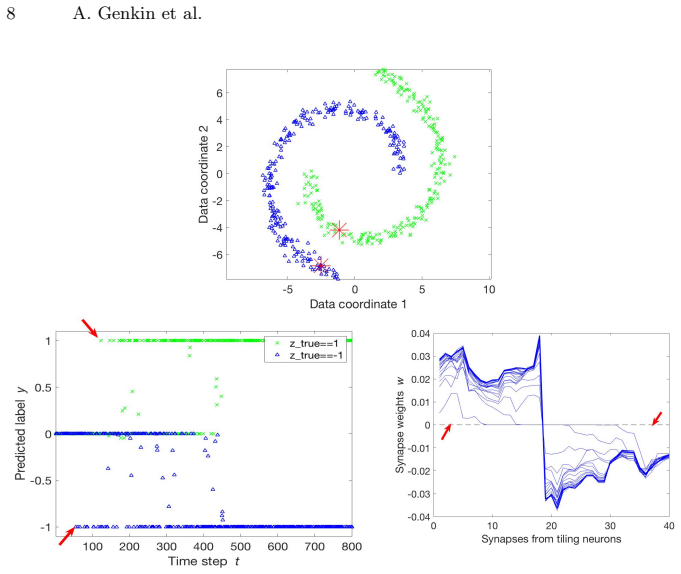
Train the full two-layer network online from random initialization on the two-moons dataset, presenting points one at a time and inserting two labeled points early in the stream; if the tiling layer's ongoing updates prevent the clean weight diffusion seen in Fig. 2 (for example, if classification accuracy on a held-out set stays near chance or the weights do not separate into the two moon-correlated groups), the claim that the network performs online semi-supervised learning as a whole would be refuted.
Extended reading notes
Core claim
The paper's central claim is that label information can diffuse across a data manifold without a stored adjacency graph, using only a two-layer network with local Hebbian updates. The first layer, taken from the manifold-tiling algorithm, produces a sparse vector $h_t$ whose components are overlapping receptive fields on the manifold; correlations between channels then encode nearness. The second layer is a single neuron updated by $y_t = \operatorname{clip}(\mu w^\top h_t + z_t)$ and $w \leftarrow \frac{t}{t+1} w + \frac{1}{t+1} y_t h_t$, where $z_t$ is the occasionally revealed label. When $z_t=0$, the output is $\mu w^\top h_t$, and the expected weight update becomes $E(\Delta w_i) = \eta(\mu \sum_j s_{ij} w_j - w_i)$ with $s_{ij}=E(h_i h_j)$, which is exactly a diffusion of weights over the tiling-channel graph—the same kind of smoothing a graph Laplacian enforces, but computed online without storing any past inputs. The paper shows experimentally that this suffices to separate classes that are non-linearly separable in input space using as few as one labeled example per class.
Load-bearing premise
The load-bearing premise is that the manifold-tiling layer and the classifier layer can be learned together in the same online stream; the experiments only feed the classifier with tiling features computed beforehand, so if the tiling must be learned simultaneously, the i.i.d. analysis of label diffusion (Eq. 13) and the reported accuracy gains are not guaranteed to hold.
Editorial extensions
If this is right
- If the central claim is right, semi-supervised learning becomes fully online: the network never stores past data points and can process data streams of unlimited length.
- Both layers use only local Hebbian/anti-Hebbian plasticity, so the architecture is a candidate model for how biological neural circuits could learn from a continuous sensory stream with rare reinforcement signals.
- The experiments indicate that an online, memoryless algorithm can match or beat an offline semi-supervised SVM once the manifold is smooth, and can beat the offline method early in the stream, the regime where semi-supervised learning is most valuable.
- Because every new input updates the weights immediately, the network can adapt when the manifold shape or the label assignment drifts over time.
- The label-diffusion view in Eq. (13) suggests the method is a streaming analog of Laplacian label propagation, so existing theory and algorithms for graph-based semi-supervised learning may transfer to the online setting.
Reading between the lines
- The paper's own experiments always precompute the tiling layer before the classification stream starts; a natural next test, not reported in the paper, is to train both layers jointly online and check whether label propagation persists while the tiling weights are still moving.
- If the first layer is itself Hebbian and unsupervised, the same architecture should transfer to other input modalities such as audio, text, or spike trains, provided a suitable tiling representation can be learned; this is an untested extension, not a claim of the paper.
- Because $s_{ij}$ is the Gramian of the tiling channels, the two-layer network may be implementing an online, memoryless kernel classifier whose kernel is learned from data rather than fixed in advance.
- The paper compares against logistic regression and a Laplacian-regularized linear SVM only; whether the network competes with modern deep semi-supervised methods on larger benchmarks remains open, so the practical scope beyond synthetic manifolds is unestablished.
Signed reviews
Editorial analysis
A structured set of objections, weighed in public.
Referee Report
Summary. The paper proposes a two-layer feed-forward neural network for semi-supervised learning on manifolds in an online setting. The first layer is a manifold-tiling network (from prior work by the same group) that maps input points to sparse channel activities; the second layer is a single Hebbian neuron that combines a silent label channel with the manifold representation. The learning rules are derived from a similarity-preserving objective, leading to the online updates in Eqs. (7)-(8). The authors report experiments on two synthetic manifolds ('two moons' and a Swiss-roll chessboard) showing label propagation from a few labeled points, and they compare the online semi-supervised algorithm with an online supervised logistic regression and an offline Laplacian-regularized SVM. Section 5 relates the algorithm's dynamics to graph Laplacian diffusion and studies the imbalance of the resulting partitions.
Significance. If fully supported, the paper would contribute a biologically plausible, local, Hebbian algorithm for online semi-supervised learning that avoids explicit graph construction, a genuine advantage for streaming and neural settings. The derivation of the second-layer updates from an explicit objective, the local nature of the learning rules, and the experimental demonstration of label propagation on non-linearly separable manifolds are clear strengths. The discussion of the minimum-cut versus normalized-cut behavior is also thoughtful. However, the central advertised property—unlimited online processing by the full two-layer network—is not actually demonstrated because the first-layer tiling is precomputed in all experiments and the theoretical analysis assumes a fixed tiling distribution. This gap materially limits the current significance of the work.
major comments (2)
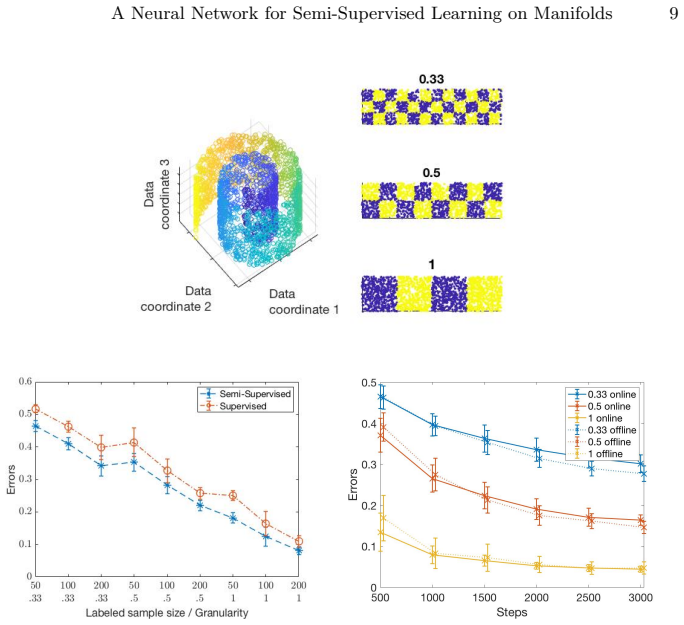
- [§4, Numerical Experiments] The experiments do not exercise the full two-layer online system. Both the 'two moons' and Swiss-roll comparisons feed a precomputed tiling representation (e.g., 'the output of tiling with 200 neurons') into the classifiers, and the first-layer weights W and b from Eq. (4) are not updated in the same stream. Consequently, the abstract and introduction's claim that the network 'can process unlimited-size datasets in online setting' is not actually supported by the reported results. To substantiate the central claim, the authors should either run an experiment in which both layers are trained jointly on a streaming input, or explicitly restrict the online claim to the second layer given a fixed manifold tiling.
- [§5, Eq. (13)] The label-diffusion analysis assumes that the tiling outputs h_t are i.i.d. from a fixed distribution and that S_ij = E(h_i h_j) is constant. If the first layer is also updated online (as the network description implies), the distribution of h_t becomes nonstationary and the correlation graph becomes time-dependent, so the expectation argument in Eq. (13) no longer describes the algorithm's behavior. The theoretical justification for label propagation therefore covers only the second layer with a fixed first layer, leaving the full two-layer online system without a supporting analysis. This is a load-bearing gap because the paper's headline contribution is the online, graph-free operation of the complete network.
minor comments (4)
- [§3, Eq. (10)] Equation (10) contains an extra closing parenthesis: it should read y_t = tanh(µ w_t^T h_t + z_t).
- [§4, Parameter selection] The text repeatedly states that µ and the logistic-regression learning rate are 'selected for best results of each algorithm,' but it does not report the selected values or any sensitivity analysis. Adding a table of chosen parameters and their range would improve reproducibility and help the reader judge the robustness of the comparisons.
- [§4, Two-moons experiment] The two-moons demonstration is only qualitative; reporting classification accuracy or error rates over repeated runs, as done for the Swiss-roll experiment, would make the motivating example more convincing.
- [§4, Offline comparison] The offline baseline is a linear SVM with a Laplacian penalty on the tiling components, described as a 'twist' in a footnote. Since this is not the standard graph Laplacian SSL formulation on the data points, the comparison should be described in the main text and its suitability justified there.
Circularity Check
No circularity: Eq. (6) is algebraically equivalent to Eq. (5), and the online update (8) is an unforced running average; the self-cited manifold tiling is a building block, not a smuggled conclusion.
full rationale
The derivation chain is self-contained. The semi-supervised objective (5) is exactly equivalent to the auxiliary-variable form (6): minimizing (6) over w gives w = (1/T)Σ_t y_t h_t, and substitution recovers (5) up to the constant factor 1/(2T). The online updates (7)-(8) are the natural online counterpart of that optimization (a projection step for y_t followed by a running average for w), not a fitted quantity renamed as a prediction. The Laplacian relation in Eq. (13) is a post-hoc expectation calculation about the derived algorithm: starting from y_t = µ w^T h_t and the update (8), E(∆w_i) = η(µΣ_j E(h_i h_j)w_j - w_i), which defines s_ij as a correlation and interprets it as an adjacency matrix; this is analysis of the algorithm, not an input that the algorithm was built to satisfy. The only notable reliance on earlier work is the manifold-tiling first layer from [8], a self-citation by overlapping authors, but that layer is used as a pre-existing building block; the paper's new claim about semi-supervised label propagation is proven by its own equations and does not reduce to [8]. The experiments feed a pre-computed tiling output into both classifiers, which is an empirical limitation of the full online claim, but it is not a circularity in the mathematical derivation.
Assumptions & free parameters
free parameters (2)
- µ (regularization coefficient) =
1000 (two moons), 10 (square experiment); selected for best results on Swiss roll
- Manifold-tiling hyperparameters (threshold α, step sizes γ_h, γ_u, γ_V, learning rate η, number of channels) =
40 channels for two moons, 200 for Swiss roll; α and step sizes not reported
assumptions (3)
- domain assumption Data lie on a low-dimensional manifold, and points nearby on the manifold tend to have the same label.
- domain assumption The manifold-tiling network of [8] produces overlapping localized receptive fields whose correlations reflect manifold adjacency and which do not overlap across separated manifolds of different classes.
- ad hoc to paper The alternating online updates (7)-(8) track the solution of the batch objective (5).
Cite this review
Pith. "Pith review of A Neural Network for Semi-Supervised Learning on Manifolds." pith.science (2026). https://pith.science/paper/NQGJAP4X
@misc{pith2026190808145,
  author       = {Pith},
  title        = {Pith review of: A Neural Network for Semi-Supervised Learning on Manifolds},
  year         = {2026},
  howpublished = {\url{https://pith.science/paper/NQGJAP4X}},
  note         = {Machine review of arXiv:1908.08145}
}
read the original abstract
Semi-supervised learning algorithms typically construct a weighted graph of data points to represent a manifold. However, an explicit graph representation is problematic for neural networks operating in the online setting. Here, we propose a feed-forward neural network capable of semi-supervised learning on manifolds without using an explicit graph representation. Our algorithm uses channels that represent localities on the manifold such that correlations between channels represent manifold structure. The proposed neural network has two layers. The first layer learns to build a representation of low-dimensional manifolds in the input data as proposed recently in [8]. The second learns to classify data using both occasional supervision and similarity of the manifold representation of the data. The channel carrying label information for the second layer is assumed to be "silent" most of the time. Learning in both layers is Hebbian, making our network design biologically plausible. We experimentally demonstrate the effect of semi-supervised learning on non-trivial manifolds.
Figures

Figures from the paper (1 more)

Reference graph
Works this paper leans on
-
[1]
In: Advances in neural information processing systems, pp
Ando, R.K., Zhang, T.: Learning on graph with laplacian regularization. In: Advances in neural information processing systems, pp. 25–32 (2007). doi: 10.7551/mitpress/7503.003.0009
-
[2]
Journal of machine learning research 7(Nov), 2399–2434 (2006)
Belkin, M., Niyogi, P., Sindhwani, V.: Manifold regularization: A geometric frame- work for learning from labeled and unlabeled examples. Journal of machine learning research 7(Nov), 2399–2434 (2006)
work page 2006
-
[3]
In: Semi-Supervised Learning, chap
Bengio, Y., Delalleau, O., Le Roux, N.: Label propagation and quadratic crite- rion. In: Semi-Supervised Learning, chap. 11. MIT Press (2006). doi: 10.7551/ mitpress/9780262033589.001.0001
arXiv 2006
-
[4]
In: Joint European Conference on Machine Learning and Knowledge Discovery in Databases, pp
Goldberg, A.B., Li, M., Zhu, X.: Online manifold regularization: A new learning setting and empirical study. In: Joint European Conference on Machine Learning and Knowledge Discovery in Databases, pp. 393–407. Springer, Berlin, Heidelberg (2008). doi: 10.1007/978-3-540-87479-9_44
-
[5]
Pehlevan, C., Chklovskii, D.: A normative theory of adaptive dimensionality reduc- tion in neural networks. In: C. Cortes, N.D. Lawrence, D.D. Lee, M. Sugiyama, R. Garnett (eds.) Advances in Neural Information Processing Systems 28, pp. 2269–2277. Curran Associates, Inc. (2015)
work page 2015
-
[6]
Neural Comput 27, 1461–1495 (2015)
Pehlevan, C., Hu, T., Chklovskii, D.: A hebbian/anti-hebbian neural network for linear subspace learning: A derivation from multidimensional scaling of streaming data. Neural Comput 27, 1461–1495 (2015). doi: 10.1162/neco_a_00745
-
[7]
Pehlevan, C., Sengupta, A.M., Chklovskii, D.B.: Why do similarity matching ob- jectives lead to hebbian/anti-hebbian networks? Neural computation30(1), 84–124 (2018). doi: 10.1162/neco_a_01018
-
[8]
Sengupta, A., Pehlevan, C., Tepper, M., Genkin, A., Chklovskii, D.: Manifold-tiling localized receptive fields are optimal in similarity-preserving neural networks. In: S. Bengio, H. Wallach, H. Larochelle, K. Grauman, N. Cesa-Bianchi, R. Garnett (eds.) Advances in Neural Information Processing Systems 31, pp. 7080–7090. Cur- ran Associates, Inc. (2018)
work page 2018
Show all 11 references
-
[9]
IEEE Transactions on Pattern Analysis and Machine Intelligence 22(8) (2000)
Shi, J., Malik, J.: Normalized cuts and image segmentation. IEEE Transactions on Pattern Analysis and Machine Intelligence 22(8) (2000). doi: 10.1109/cvpr. 1997.609407
2000
-
[10]
In: Advances in neural information processing systems, pp
Yu, K., Zhang, T., Gong, Y.: Nonlinear learning using local coordinate coding. In: Advances in neural information processing systems, pp. 2223–2231 (2009)
2009
-
[11]
In: Proceedings of the 20th International conference on Machine learning (ICML-03), pp
Zhu, X., Ghahramani, Z., Lafferty, J.D.: Semi-supervised learning using gaussian fields and harmonic functions. In: Proceedings of the 20th International conference on Machine learning (ICML-03), pp. 912–919 (2003)
2003
Reviewed August 14, 2026 · model on record in the stance chip above.
Discussion (0). Continue with ORCID to comment.