REVIEW 3 major objections 5 minor 108 references
X-ray Intra-day Variability of the TeV Blazar Mrk 421 with Suzaku
T0 review · 3 major / 5 minor · reviewed 2026-08-14 · deepseek-v4-flash
Pith's one-line read Suzaku's long stares at Mrk 421 show its soft and hard X-ray bands varying in lockstep with zero lag, implying one emission region.
desk verdict A careful but conventional timing analysis of three Suzaku observations; the new timing products are worth refereeing, but the zero-lag claim is resolution-limited and the 'continuous' description overstates the actual exposure. read the letter →
The pith
A machine-rendered reading of the paper's core claim, the machinery that carries it, and where it could break.
The reading
What carries the argument
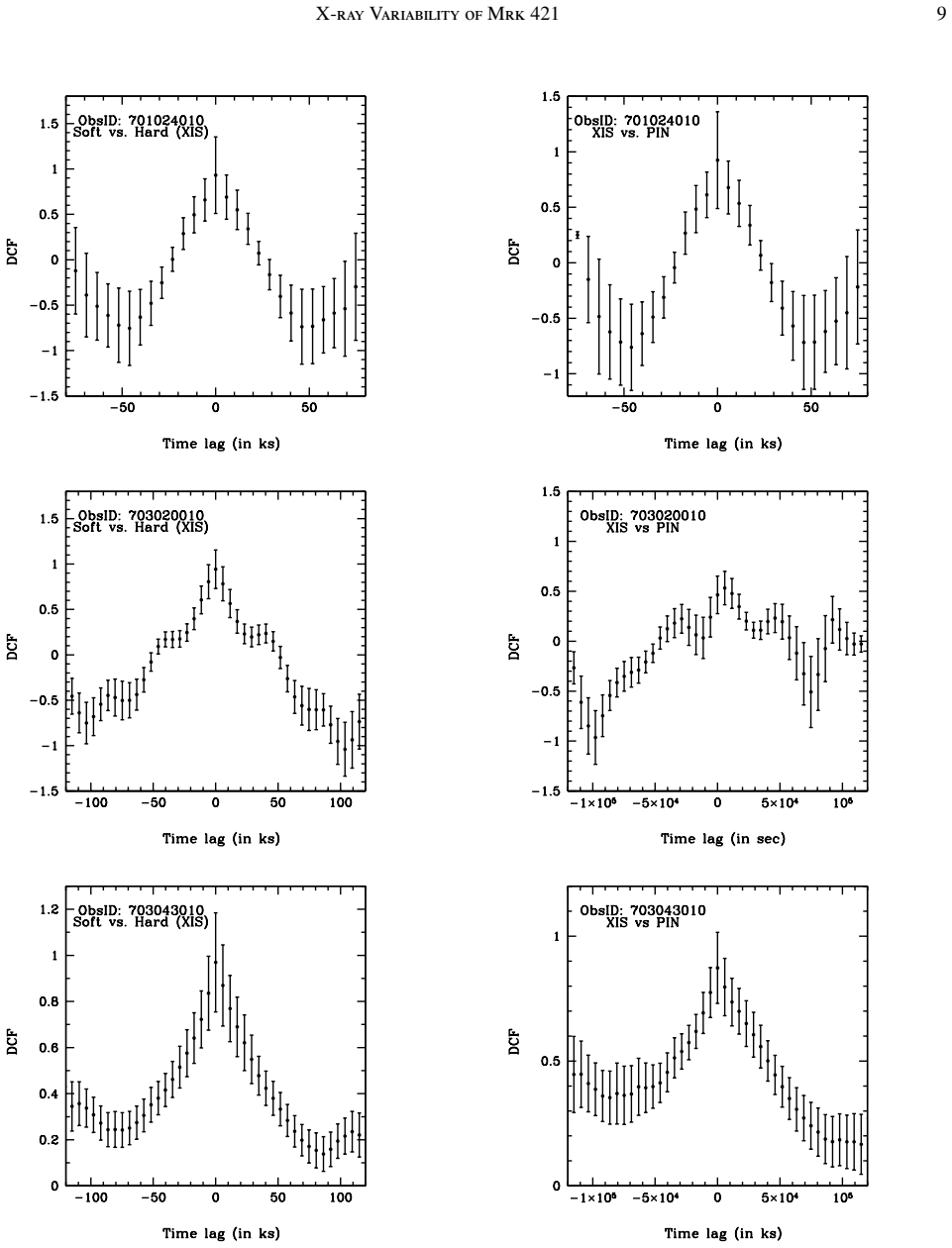
The Discrete Correlation Function (DCF) is the central tool: it correlates the soft and hard X-ray light curves, bins the correlation in time, and fits a Gaussian to read off the lag at peak correlation. Applied to light curves binned to Suzaku's 5752-second orbital period, it returns zero-lag peaks for all three observations, which is the load-bearing evidence for cospatial emission. Supporting machinery includes the fractional rms variability amplitude, the weighted variability timescale $\tau_{\rm var}$ derived from the log-flux slope, hardness ratios, and power spectral density fits that characterize the red noise.
What would settle it
Rebin the same Suzaku XIS event lists into time bins of 1–2 kiloseconds, inside the 5752-second orbit, and recompute the DCF between the 0.8–1.5 keV and 1.5–8 keV bands; a resolved nonzero lag or a decorrelated soft-hard relation on those short timescales would contradict the paper's zero-lag, single-zone conclusion.
Extended reading notes
Core claim
The central claim is that, in all three Suzaku pointings, the soft and hard X-ray emissions of Mrk 421 are cospatial and emitted by the same population of leptons. The evidence is that the DCF between 0.8–1.5 keV and 1.5–8 keV peaks at lags consistent with zero (0.65 ± 3.87, 0.18 ± 1.32, and 1.04 ± 1.23 ks for the three observations), and the XIS-versus-PIN DCF is also consistent with zero lag once the gappy December 2008 pointing is read with its large uncertainty. The hard bands are more variable than the soft bands, and the hardness ratio tracks the light curve so the source is harder when brighter. The shortest weighted variability timescale is 18.58 ks, from the 12–60 keV PIN band of the April 2006 pointing.
Load-bearing premise
The load-bearing assumption is that Mrk 421 did not vary strongly within a single 5752-second Suzaku orbit, so binning each orbit into one light-curve point does not smooth away shorter-timescale soft-hard lags.
Editorial extensions
If this is right
- A single-zone synchrotron model with one electron population can account for the observed 0.8–60 keV intra-day variability, without needing energy-dependent delays between soft and hard emission.
- The harder-when-brighter trend implies that spectral variability tracks flux variability, consistent with repeated diffusive-shock acceleration and synchrotron cooling of freshly injected electrons.
- The red-noise PSD slopes (from about $-1.4$ to $-3.1$) and the absence of a $3\sigma$ quasi-periodic oscillation mean the roughly 100-hour 2008 May light curve shows stochastic, not strictly periodic, variability.
- The shortest variability timescale of 18.58 ks, with Doppler factors of 21–50, puts the emitting region size near $(1.1{-}2.7)\times 10^{16}$ cm and implies a magnetic field lower bound $B \ge 0.07\,\nu_{19}^{-1/3}$ G for a Doppler factor of 25.
- If the fastest variations arose very close to the black hole, the implied black hole mass is about $4\times 10^{8}$ solar masses; if the same perturbations are Doppler-boosted in the jet, masses of roughly $8\times 10^{9}$ to $2\times 10^{10}$ solar masses would be consistent.
Reading between the lines
- The zero-lag conclusion is only tested at the 5752-second binning; sub-orbit lags shorter than one Suzaku orbital period would be averaged out, so cospatiality on minute-to-hour timescales remains an open question.
- Re-binning the same Suzaku events into 1–2 kilosecond bins would give a direct check: if a soft-hard lag or decorrelation appears on shorter timescales, the single-zone reading would need revision.
- The same DCF zero-lag test could be applied to other high-synchrotron-peak blazars with long X-ray monitoring; if most show zero lags, cospatial single-zone emission would be a general property rather than a peculiarity of Mrk 421.
- The two very different black-hole mass estimates (unboosted versus Doppler-boosted) show that variability timescales alone cannot pin down the mass without knowing where the emission originates; joint radio-to-TeV monitoring could break that degeneracy.
Signed reviews
Editorial analysis
A structured set of objections, weighed in public.
Referee Report
Summary. The paper presents X-ray flux and spectral variability analyses of the three Suzaku pointed observations of the TeV blazar Mrk 421 (elapsed durations 82.0, 190.0, and 364.6 ks), using XIS (0.8–8 keV) and HXD/PIN (12–60 keV) data. The authors measure fractional rms variability amplitudes, weighted variability timescales, hardness ratios, discrete correlation functions (DCFs) between soft and hard bands, and power spectral densities. They report large-amplitude intra-day variability in all bands, DCF peaks consistent with zero lag for most band pairs, a 'harder-when-brighter' spectral trend, red-noise-dominated PSDs with slopes between -1.4 and -3.1, and use the shortest variability timescale (18.58 ks) to estimate an emission-region size, a magnetic field limit, an electron Lorentz factor, and a crude SMBH mass (~4 × 10^8 M_sun under non-Doppler assumptions). The central physical claim is that zero inter-band lags imply cospatial emission from a single population of leptons in the jet.
Significance. The manuscript uses the longest Suzaku (and reportedly the longest of any pointed X-ray) observations of a blazar and follows standard Suzaku reduction procedures; the Fvar, tau_var, DCF, and PSD calculations are internally consistent and add to the archival IDV literature on Mrk 421. If the zero-lag and harder-when-brighter results are robust, they support single-zone synchrotron interpretations for high-synchrotron-peak blazars. However, the zero-lag conclusion depends on an unverified assumption about the absence of intra-orbit variability, and the inference from zero DCF lag to 'same population' is logically stronger than the measurement alone can establish. The paper provides useful, reproducible data products, but its headline claims require revision or additional supporting tests.
major comments (3)
- [Section 2, orbital-binning assumption] The light curves are binned to exactly the Suzaku orbital period (5752 s) based on the assertion that 'we consider any discrepancy arising from this to be negligible because the source did not show large intrinsic variation within one orbit of Suzaku.' No intra-orbit variability test is presented, and each bin has only 20–60% GTI coverage, so each point is a partially filled average over a variable source. This assumption is load-bearing for the DCF zero-lag claim, the Fvar and tau_var values, and the PSD slopes. Please either (a) demonstrate that using half-orbit bins or XIS-only continuous segments yields consistent DCF centroids and quoted lags, or (b) provide a simulation quantifying how plausible sub-orbit variability would bias the measured lags and PSD slopes. Without this, the zero-lag conclusion is not independently established.
- [Abstract and Section 6, inference from zero lag] The Abstract states that the DCF results are 'showing that the emission in hard and soft bands are cospatial and emitted from the same population of leptons,' while Section 6 uses the weaker phrase 'supports the hypothesis.' A zero-lag DCF is necessary but not sufficient for a single-zone, single-population interpretation: synchronized variability could also arise from a propagating perturbation in a stratified emission region or from distinct zones modulated by a common driver. Please soften the Abstract to 'consistent with' and discuss these alternatives in Section 5, or add a direct test (e.g., checking DCF symmetry and searching for sub-bin lags with un-binned or half-orbit data).
- [Section 4, hardness-ratio analysis] The 'harder-when-brighter' conclusion is derived from visual inspection of the hardness-ratio plots (Figure 1), which are shown without error bars and without any statistical test. Because this is a stated conclusion (Section 6, bullet 4), the authors should propagate count-rate uncertainties into the HR values and report a correlation coefficient (e.g., Spearman rank) with significance for each observation. As written, the trend is plausible but not quantified.
minor comments (5)
- [Abstract and Section 4] The description of the 364.6 ks observation as 'continuous' and 'effectively continuous' is inconsistent with Table 1, which lists a common GTI of only 146.5 ks and GTI fractions of 20–60% per orbit; please rephrase to 'nearly continuous' or 'longest effective exposure.'
- [Section 3.4 and Table 3] The DCF lag uncertainties (1.3–4.0 ks) are smaller than the 5.752 ks light-curve binning; the paper should state the DCF binning used and discuss whether the Gaussian-fit errors are appropriate for strongly correlated DCF points, ideally adding a bootstrap or Monte Carlo estimate.
- [Equation (6)] Equation (6), the Fvar uncertainty, is typeset incorrectly in the manuscript (the square-root symbols are corrupted); please correct the LaTeX so the formula is readable.
- [Section 3.2] The statement that the XIS tau_var values for the first and third observations are 'basically consistent' (36.37 and 47.16 ks) is vague; a phrase like 'within a factor of ~1.3' would be more precise.
- [Figure 1 caption] The caption says 'The hardness ratios roughly follow the fluctuations of the LCs,' but this is hard to verify because the HR panels have independent y-axis scales; consider adding error bars or a common scale to make the trend visible.
Circularity Check
No circular derivation: the variability statistics and zero-lag correlation result are direct measurements of the Suzaku light curves, and adopted jet parameters are external inputs.
full rationale
The paper's central outputs—Fvar, tau_var, hardness ratios, DCF lags, and PSD slopes—are computed from the extracted Suzaku count-rate light curves with standard estimators (equations 5, 7, 10, 11-13, and the periodogram). Nothing is fitted to the target conclusion and then renamed as a prediction. The zero-lag DCF peak is a measured statistic, and the inference of cospatial emission from the same lepton population is a physical interpretation of that measurement, not an algebraic consequence of the estimator. The Doppler factor delta=25 and magnetic field B<=0.1 G are adopted from prior SED modeling and X-ray studies (e.g., Paliya et al. 2015; Pandey et al. 2017; Aggrawal et al. 2018) and are used only for order-of-magnitude jet parameter estimates; the SMBH mass estimate is explicitly labeled crude and is compared with host-galaxy determinations. Self-citations appear as contextual references to earlier observations and to the harder-when-brighter trend, not as the sole support for the central claim. The acknowledged Section 2 assumption that no large intrinsic variation occurred within one Suzaku orbit is a time-resolution limitation that could bias the DCF or PSD, but it is an assumption about source behavior rather than a reduction of the conclusion to its own input. Hence no circular step is exhibited.
Assumptions & free parameters
free parameters (2)
- Doppler factor δ =
25
- Emission region radius factor R = 5 R_S =
5
assumptions (4)
- domain assumption The HXD/PIN non-X-ray background model is accurate to about 3% and is constant on intra-day timescales.
- domain assumption The source flux is approximately constant within one 5752 s Suzaku orbit.
- domain assumption Zero-lag correlation between soft and hard X-ray bands implies co-spatial emission from the same lepton population.
- domain assumption X-ray periodogram red noise is modeled as a single power law P(f) = N f^α.
Cite this review
Pith. "Pith review of X-ray Intra-day Variability of the TeV Blazar Mrk 421 with Suzaku." pith.science (2026). https://pith.science/paper/L4LM7YPC
@misc{pith2026190808149,
  author       = {Pith},
  title        = {Pith review of: X-ray Intra-day Variability of the TeV Blazar Mrk 421 with Suzaku},
  year         = {2026},
  howpublished = {\url{https://pith.science/paper/L4LM7YPC}},
  note         = {Machine review of arXiv:1908.08149}
}
read the original abstract
We present X-ray flux and spectral analyses of the three pointed Suzaku observations of the TeV high synchrotron peak blazar Mrk 421 taken throughout its complete operational duration. The observation taken on 5 May 2008 is, at 364.6 kiloseconds (i.e., 101.3 hours), the longest and most evenly sampled continuous observation of this source, or any blazar, in the X-ray energy 0.8 - 60 keV until now. We found large amplitude intra-day variability in all soft and hard bands in all the light curves. The discrete correction function analysis of the light curves in soft and hard bands peaks on zero lag, showing that the emission in hard and soft bands are cospatial and emitted from the same population of leptons. The hardness ratio plots imply that the source is more variable in the harder bands compared to the softer bands. The source is harder-when-brighter, following the general behavior of high synchrotron peak blazars. Power spectral densities of all three light curves are red noise dominated, with a range of power spectra slopes. If one assumes that the emission originates very close to the central super massive black hole, a crude estimate for its mass, of ~ 4 * 10^{8} M_{\odot}, can be made; but if the variability is due to perturbations arising there that are advected into the jet and are thus Doppler boosted, substantially higher masses are consistent with the quickest seen variations. We briefly discuss the possible physical mechanisms most likely responsible for the observed flux and spectral variability.
Figures


Reference graph
Works this paper leans on
-
[1]
" id="W5M0MpCehiHzreSzNTczkc9d
thebibliography [1] 20pt to REFERENCES 6pt =0pt 10pt plus 3pt =0pt =0pt =1pt plus 1pt =0pt =0pt -12pt =13pt plus 1pt =20pt =13pt plus 1pt \@M =10000 =-1.0em =0pt =0pt 0pt =0pt =1.0em @enumiv\@empty 10000 10000 `\.\@m \@noitemerr \@latex@warning Empty `thebibliography' environment \@ifnextchar \@reference \@latexerr Missing key on reference command Each re...
2016
-
[2]
A., Ackermann, M., Ajello, M., et al.\ 2011, , 736, 131
Abdo, A. A., Ackermann, M., Ajello, M., et al.\ 2011, , 736, 131
2011
-
[3]
A., Aliu, E., Arlen, T., et al.\ 2011, , 738, 25
Acciari, V. A., Aliu, E., Arlen, T., et al.\ 2011, , 738, 25
2011
-
[4]
C., et al.\ 2018, , 480, 4873
Aggrawal, V., Pandey, A., Gupta, A. C., et al.\ 2018, , 480, 4873
2018
-
[5]
Aharonian, F., Akhperjanian, A., Beilicke, M., et al.\ 2003, , 410, 813
2003
-
[6]
G., Bazer-Bachi, A
Aharonian, F., Akhperjanian, A. G., Bazer-Bachi, A. R., et al.\ 2007, , 664, L71
2007
-
[7]
L., Ansoldi, S., Antonelli, L
Ahnen, M. L., Ansoldi, S., Antonelli, L. A., et al.\ 2016, , 593, A91
2016
-
[8]
A., et al.\ 2015, , 578, A22
Aleksi \'c , J., Ansoldi, S., Antonelli, L. A., et al.\ 2015, , 578, A22
2015
Show all 108 references
-
[9]
Bachev, R., Mukhopadhyay, B., & Strigachev, A.\ 2015, , 576, A17
2015
-
[10]
Balokovi \'c , M., Paneque, D., Madejski, G., et al.\ 2016, , 819, 156
2016
-
[11]
J., Ho, L
Barth, A. J., Ho, L. C., & Sargent, W. L. W.\ 2003, , 583, 134
2003
-
[12]
J., et al.\ 2016, , 222, 6
Bartoli, B., Bernardini, P., Bi, X. J., et al.\ 2016, , 222, 6
2016
-
[13]
R., & Robinson, D
Bevington, P. R., & Robinson, D. K. 2003, in Data Reduction and Error Analysis for the Physical Science
2003
-
[14]
Bhatta, G., Mohorian, M., & Bilinsky, I.\ 2018, , 619, A93
2018
-
[15]
K.\ 1995, Astronomical Data Analysis Software and Systems IV, 77, 367
Blackburn, J. K.\ 1995, Astronomical Data Analysis Software and Systems IV, 77, 367
1995
-
[16]
Blandford, R., & Eichler, D.\ 1987, , 154, 1
1987
-
[17]
D., & Rees, M
Blandford, R. D., & Rees, M. J.\ 1978, , 17, 265
1978
-
[18]
H., et al.\ 2005, , 630, 130
B a \.z ejowski, M., Blaylock, G., Bond, I. H., et al.\ 2005, , 630, 130
2005
-
[19]
Boldt, E.\ 1987, Observational Cosmology, 124, 611
1987
-
[20]
G., et al.\ 2001, , 365, L162
Brinkmann, W., Sembay, S., Griffiths, R. G., et al.\ 2001, , 365, L162
2001
-
[21]
E., den Herder, J
Brinkmann, W., Papadakis, I. E., den Herder, J. W. A., & Haberl, F.\ 2003, , 402, 929
2003
-
[22]
E., Raeth, C., Mimica, P., & Haberl, F.\ 2005, , 443, 397
Brinkmann, W., Papadakis, I. E., Raeth, C., Mimica, P., & Haberl, F.\ 2005, , 443, 397
2005
-
[23]
R., Jones, T
Burbidge, G. R., Jones, T. W., & Odell, S. L.\ 1974, , 193, 43
1974
-
[24]
J.\ 2015, Journal of Astrophysics and Astronomy, 36, 255
Calafut, V., & Wiita, P. J.\ 2015, Journal of Astrophysics and Astronomy, 36, 255
2015
-
[25]
K., & Wiita, P
Chakrabarti, S. K., & Wiita, P. J.\ 1993, , 411, 602
1993
-
[26]
M., et al.\ 2003, , 400, 487
Ciprini, S., Tosti, G., Raiteri, C. M., et al.\ 2003, , 400, 487
2003
-
[27]
Cui, W.\ 2004, , 605, 662
2004
-
[28]
Z., Zhou, S
Dai, H., Xie, G. Z., Zhou, S. B., et al.\ 2007, , 133, 2187
2007
-
[29]
2015, , 802, 133
Diltz, C., B \"o ttcher, M., & Fossati, G. 2015, , 802, 133
2015
-
[30]
O.\ 1983, Reports on Progress in Physics, 46, 973
Drury, L. O.\ 1983, Reports on Progress in Physics, 46, 973
1983
-
[31]
A., & Krolik, J
Edelson, R. A., & Krolik, J. H.\ 1988, , 333, 646
1988
-
[32]
J., Pounds, K., et al.\ 2002, , 568, 610
Edelson, R., Turner, T. J., Pounds, K., et al.\ 2002, , 568, 610
2002
-
[33]
Edelson, R., Mushotzky, R., Vaughan, S., et al.\ 2013, , 766, 16
2013
-
[34]
K., & Treves, A.\ 2002, , 569, L35
Falomo, R., Kotilainen, J. K., & Treves, A.\ 2002, , 569, L35
2002
-
[35]
H., Bond, I
Fossati, G., Buckley, J. H., Bond, I. H., et al.\ 2008, , 677, 906
2008
-
[36]
Fukazawa, Y., Mizuno, T., Watanabe, S., et al.\ 2009, , 61, S17
2009
-
[37]
A., Akerlof, C
Gaidos, J. A., Akerlof, C. W., Biller, S., et al.\ 1996, , 383, 319
1996
-
[38]
B., III, Baring, M
Garson, A. B., III, Baring, M. G., & Krawczynski, H.\ 2010, , 722, 358
2010
-
[39]
C., Lachowicz, P., & Wiita, P
Gaur, H., Gupta, A. C., Lachowicz, P., & Wiita, P. J.\ 2010, , 718, 279
2010
-
[40]
C., Strigachev, A., et al.\ 2012a, , 420, 3147
Gaur, H., Gupta, A. C., Strigachev, A., et al.\ 2012a, , 420, 3147
-
[41]
C., Strigachev, A., et al.\ 2012b, , 425, 3002
Gaur, H., Gupta, A. C., Strigachev, A., et al.\ 2012b, , 425, 3002
-
[42]
M., et al.\ 1997, , 327, 61
Ghisellini, G., Villata, M., Raiteri, C. M., et al.\ 1997, , 327, 61
1997
-
[43]
Gonz \'a lez-Mart \' n, O., & Vaughan, S.\ 2012, , 544, A80
2012
-
[44]
J.\ 1992, , 259, 109
Gopal-Krishna, & Wiita, P. J.\ 1992, , 259, 109
1992
-
[45]
J., et al.\ 2012, , 544, A37
Goyal, A., Gopal-Krishna, Wiita, P. J., et al.\ 2012, , 544, A37
2012
-
[46]
F., Lee, C.-U., Pak, S., Yim, H
Gu, M. F., Lee, C.-U., Pak, S., Yim, H. S., & Fletcher, A. B.\ 2006, , 450, 39
2006
-
[47]
C., Banerjee, D
Gupta, A. C., Banerjee, D. P. K., Ashok, N. M., & Joshi, U. C.\ 2004, , 422, 505
2004
-
[48]
C., Fan, J
Gupta, A. C., Fan, J. H., Bai, J. M., & Wagner, S. J.\ 2008, , 135, 1384
2008
-
[49]
P., Pandey, U
Gupta, S. P., Pandey, U. S., Singh, K., et al.\ 2012, , 17, 8
2012
-
[50]
A., Larionov, V
Hagen-Thorn, V. A., Larionov, V. M., Jorstad, S. G., et al.\ 2008, , 672, 40
2008
-
[51]
J.\ 1996, , 305, 42
Heidt, J., & Wagner, S. J.\ 1996, , 305, 42
1996
-
[52]
B., Blaes, O
Henisey, K. B., Blaes, O. M., & Fragile, P. C. 2012, , 761, 18
2012
-
[53]
A., Aller, H
Hughes, P. A., Aller, H. D., & Aller, M. F.\ 1985, , 298, 301
1985
-
[54]
Isobe, N., Sato, R., Ueda, Y., et al.\ 2015, , 798, 27
2015
-
[55]
C., Wiita, P
Kalita, N., Gupta, A. C., Wiita, P. J., Bhagwan, J., & Duorah, K.\ 2015, , 451, 1356
2015
-
[56]
D., Akerlof, C
Kerrick, A. D., Akerlof, C. W., Biller, S. D., et al.\ 1995, , 438, L59
1995
-
[57]
G., Rieger, F
Kirk, J. G., Rieger, F. M., & Mastichiadis, A.\ 1998, , 333, 452
1998
-
[58]
Kokubun, M., Makishima, K., Takahashi, T., et al.\ 2007, , 59, 53
2007
-
[59]
Koyama, K., Tsunemi, H., Dotani, T., et al.\ 2007, , 59, 23
2007
-
[60]
Krawczynski, H., Sambruna, R., Kohnle, A., et al.\ 2001, , 559, 187
2001
-
[61]
J., & Gupta, A
Li, Y., Hu, S., Wiita, P. J., & Gupta, A. C.\ 2018, , 478, 172
2018
-
[62]
C., Bertsch, D
Lin, Y. C., Bertsch, D. L., Chiang, J., et al.\ 1992, , 401, L61
1992
-
[63]
J., Akerlof, C
Macomb, D. J., Akerlof, C. W., Aller, H. D., et al.\ 1995, , 449, L99
1995
-
[64]
V., & Wiita, P
Mangalam, A. V., & Wiita, P. J.\ 1993, , 406, 420
1993
-
[65]
Maraschi, L., Fossati, G., Tavecchio, F., et al.\ 1999, , 526, L81
1999
-
[66]
Marcha, M. J. M., Browne, I. W. A., Impey, C. D., & Smith, P. S.\ 1996, , 281, 425
1996
-
[67]
P., & Gear, W
Marscher, A. P., & Gear, W. K.\ 1985, , 298, 114
1985
-
[68]
P.\ 2014, , 780, 87
Marscher, A. P.\ 2014, , 780, 87
2014
-
[69]
Massaro, E., Perri, M., Giommi, P., & Nesci, R.\ 2004, , 413, 489
2004
-
[70]
R., Carini, M
Miller, H. R., Carini, M. T., & Goodrich, B. D.\ 1989, , 337, 627
1989
-
[71]
Mitsuda, K., Bautz, M., Inoue, H., et al.\ 2007, , 59, S1
2007
-
[72]
C., Bachev, R., & Strigachev, A.\ 2016, , 456, 654
Mohan, P., Gupta, A. C., Bachev, R., & Strigachev, A.\ 2016, , 456, 654
2016
-
[73]
Montagni, F., Maselli, A., Massaro, E., et al.\ 2006, , 451, 435
2006
-
[74]
Nicastro, F., Mathur, S., Elvis, M., et al.\ 2005, , 629, 700
2005
-
[75]
S., B \"o ttcher, M., Diltz, C., et al.\ 2015, , 811, 143
Paliya, V. S., B \"o ttcher, M., Diltz, C., et al.\ 2015, , 811, 143
2015
-
[76]
S., Stalin, C
Paliya, V. S., Stalin, C. S., Ajello, M., & Kaur, A.\ 2017, , 844, 32
2017
-
[77]
C., & Wiita, P
Pandey, A., Gupta, A. C., & Wiita, P. J.\ 2017, , 841, 123
2017
-
[78]
M., Konopelko, A., et al.\ 1996, , 311, L13
Petry, D., Bradbury, S. M., Konopelko, A., et al.\ 1996, , 311, L13
1996
-
[79]
Pian, E., T \"u rler, M., Fiocchi, M., et al.\ 2014, , 570, A77
2014
-
[80]
W., Cawley, M
Punch, M., Akerlof, C. W., Cawley, M. F., et al.\ 1992, , 358, 477
1992
-
[81]
M., Villata, M., Capetti, A., et al.\ 2007, , 464, 871
Raiteri, C. M., Villata, M., Capetti, A., et al.\ 2007, , 464, 871
2007
-
[82]
Ravasio, M., Tagliaferri, G., Ghisellini, G., & Tavecchio, F.\ 2004, , 424, 841
2004
-
[83]
F., Badran, H
Rebillot, P. F., Badran, H. M., Blaylock, G., et al.\ 2006, , 641, 740
2006
-
[84]
B., & Lightman, A
Rybicki, G. B., & Lightman, A. P.\ 1979, New York, Wiley-Interscience, 1979. 393 p
1979
-
[85]
2016, , 456, 3929
Sadowski, A., & Narayan, R. 2016, , 456, 3929
2016
-
[86]
Sagar, R., Gopal-Krishna, Mohan, V., et al.\ 1999, , 134, 453
1999
-
[87]
Sasada, M., Mineshige, S., Yamada, S., & Negoro, H.\ 2017, , 69, 15
2017
-
[88]
T., Morris, S
Stocke, J. T., Morris, S. L., Gioia, I. M., et al.\ 1991, , 76, 813
1991
-
[89]
Takahashi, T., Abe, K., Endo, M., et al.\ 2007, , 59, 35
2007
-
[90]
Takahashi, T., Kataoka, J., Madejski, G., et al.\ 2000, , 542, L105
2000
-
[91]
Takahashi, T., Tashiro, M., Madejski, G., et al.\ 1996, , 470, L89
1996
-
[92]
M., Takahashi, T., et al.\ 2001, , 563, 569
Tanihata, C., Urry, C. M., Takahashi, T., et al.\ 2001, , 563, 569
2001
-
[93]
Tavecchio, F., Maraschi, L., & Ghisellini, G.\ 1998, , 509, 608
1998
-
[94]
Tosti, G., Fiorucci, M., Luciani, M., et al.\ 1998, , 339, 41
1998
-
[95]
Tramacere, A., Giommi, P., Perri, M., Verrecchia, F., & Tosti, G.\ 2009, , 501, 879
2009
-
[96]
Treves, A., Carangelo, N., Falomo, R., & Kotilainen, J.\ 2003, Active Galactic Nuclei: From Central Engine to Host Galaxy, 290, 621
2003
-
[97]
M., & Padovani, P.\ 1995, , 107, 803
Urry, C. M., & Padovani, P.\ 1995, , 107, 803
1995
-
[98]
Ushio, M., Stawarz, ., Takahashi, T., et al.\ 2010, , 724, 1509
2010
-
[99]
Ushio, M., Tanaka, T., Madejski, G., et al.\ 2009, , 699, 1964
2009
-
[100]
van der Klis, M.\ 1989, , 27, 517
1989
-
[101]
Vaughan, S.\ 2005, , 431, 391
2005
-
[102]
S., & Uttley, P.\ 2003, , 345, 1271
Vaughan, S., Edelson, R., Warwick, R. S., & Uttley, P.\ 2003, , 345, 1271
2003
-
[103]
Vestergaard, M.\ 2004, AGN Physics with the Sloan Digital Sky Survey, 311, 69
2004
-
[104]
J., & Witzel, A.\ 1995, , 33, 163
Wagner, S. J., & Witzel, A.\ 1995, , 33, 163
1995
-
[105]
K., & Zhang, T
Wu, X.-B., Liu, F. K., & Zhang, T. Z.\ 2002, , 389, 742
2002
-
[106]
Yamada, S., Uchiyama, H., Dotani, T., et al.\ 2012, , 64, 53
2012
-
[107]
H., Treves, A., Celotti, A., et al.\ 2002, , 572, 762
Zhang, Y. H., Treves, A., Celotti, A., et al.\ 2002, , 572, 762
2002
-
[108]
Zhu, Q., Yan, D., Zhang, P., et al.\ 2016, , 463, 4481
2016
Reviewed August 14, 2026 · model on record in the stance chip above.
Discussion (0). Continue with ORCID to comment.