REVIEW 1 major objections 4 minor 60 references
Method of regularised stokeslets: Flow analysis and improvement of convergence
T0 review · 1 major / 4 minor · reviewed 2026-08-14 · deepseek-v4-flash
Pith's one-line read This paper derives an exact decomposition of regularised stokeslet flow into a stokeslet, a source dipole, and an isotropic term, then uses it to design sign-changing blobs that recover the stokeslet flow exponentially.
desk verdict Solid theoretical analysis of regularised stokeslets with a new exact representation and improved blobs; one typo in Eq. (50) that should be fixed, but no fatal flaw. read the letter →
The pith
A machine-rendered reading of the paper's core claim, the machinery that carries it, and where it could break.
The reading
What carries the argument
The load-bearing object is the sphere representation: because a spherically symmetric blob exerts uniform force per unit area on every concentric sphere, its flow equals a superposition of the flows of translating spheres. The classical facts that a translating sphere produces exactly a stokeslet plus a source dipole outside and a uniform flow inside turn the convolution defining the regularised stokeslet into one-dimensional integrals, giving Eq. (40). The same construction yields a far-field expansion in singularity solutions, with an error bound of $O(\epsilon^{n+1}/r^{n+2})$ for blobs decaying as $r^{-n-5}$, and it identifies the non-singularity body-force flows that appear for slowly decaying blobs.
What would settle it
Implement the improved compact blob (Eqs. 48-49) in a standard regularised-stokeslet boundary-element code and compute the drag on a translating sphere for a sequence of decreasing $\epsilon$; if the error does not drop at the predicted rate, or if the negative regions produce cancellation or instability, the central practical claim fails.
Extended reading notes
Core claim
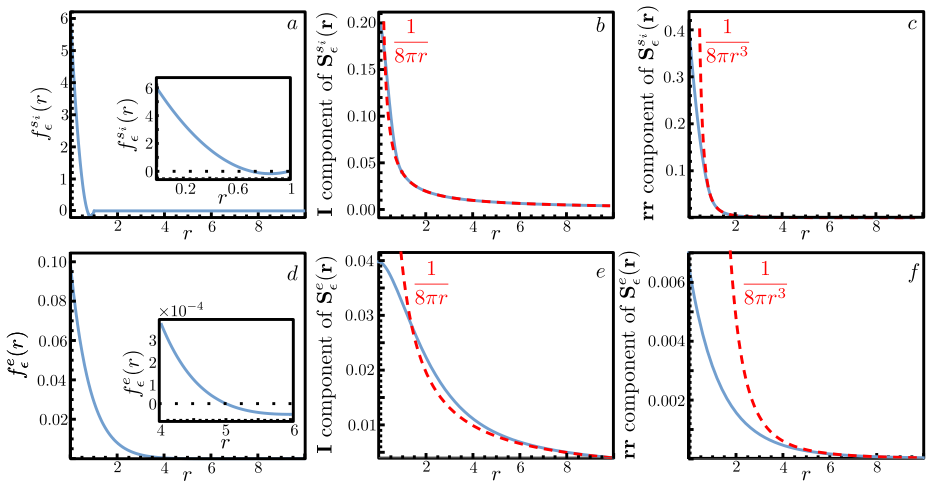
The central result is Eq. (40), an exact decomposition for any spherically symmetric regularised stokeslet: $$S_\epsilon(r)=S(r)\$int_0^{{r/\epsilon}}$4\pi $s^{2}$ f(s)\,ds+\$epsilon^{2}$ D(r)\$int_0^{{r/\epsilon}}$\frac{4\pi}{3}$s^{4}$ f(s)\,ds+\frac{2I}{3\epsilon}\int_{r/\epsilon}^\infty s f(s)\,ds.$$ Here $S(r)$ is the Oseen or stokeslet tensor and $D(r)$ is the source-dipole tensor, so the whole flow is a stokeslet, a source dipole, and an isotropic term. From this formula the paper shows that for any non-negative blob the source-dipole term is unavoidable and the far-field flow converges to the stokeslet only as $O(\epsilon^2)$. By choosing blobs with negative regions so that $\int_0^\infty r^4 f(r)\,dr=0$, the dipole term vanishes; the two blobs constructed in the paper then converge exponentially, and the compactly supported one is exactly a stokeslet outside its support.
Load-bearing premise
The load-bearing premise is that blobs with negative-force regions behave as well in numerical simulations as they do in the mathematical analysis; the paper proves the convergence properties but does not test the new blobs in a solver.
Editorial extensions
If this is right
- For any spherically symmetric blob that is everywhere non-negative, the far-field error is at best $O(\epsilon^2)$; the inevitable source-dipole term cannot be tuned away by changing the blob shape.
- Blob symmetry controls the convergence rate: generic blobs converge as $O(\epsilon)$, blobs with three reflection planes converge as $O(\epsilon^2)$, and the new sign-changing spherical blobs converge exponentially, or exactly for the compact blob outside its support.
- Near the centre of any spherical blob the flow becomes isotropic rather than stokeslet-like, so $\epsilon$ must stay small; the isotropic region contributes $O(\epsilon)$ to boundary-integral surface terms and an $\epsilon$-independent term to line integrals in regularised slender-body theories.
- Power-law blobs can be improved beyond the $\epsilon^2$ limit by combining two power-law terms, but their convergence remains polynomial, at $O(\epsilon^{n+2})$ for blobs built from $r_\epsilon^{-(n+5)}$ and $r_\epsilon^{-(n+7)}$ terms.
Reading between the lines
- An immediate next step the paper leaves open is to test the two new blobs in an actual boundary-integral or slender-body code; the negative-force regions could create cancellation, loss of positive-definiteness, or stability constraints that the mathematical analysis does not address.
- Equation (40) turns blob design into a moment problem: any prescribed stokeslet and source-dipole far field can be matched by choosing a radial blob with the right low-order moments, which suggests inverse design of regularisations for specific applications such as confined flows or swimming.
- The moment-cancellation idea should transfer to regularised force dipoles, stresslets, and wall-bounded regularisations, where the singularity basis differs and the exact sphere decomposition no longer applies; the same zero-moment condition may yield analogous accuracy gains.
- In slender-body theories, the $\epsilon$-independent isotropic line contribution could be treated as a physical model of the inner cylindrical flow rather than as discretisation error, potentially guiding the choice of $\epsilon$ as a filament radius.
Signed reviews
Editorial analysis
A structured set of objections, weighed in public.
Referee Report
Summary. This paper analyses the flow generated by regularised stokeslets for general and spherically symmetric force blobs. For spherically symmetric blobs the authors derive an exact decomposition of the flow into a stokeslet, a source dipole, and an isotropic term with coefficients given by integrals of the blob (Eq. 40). They then use this representation to characterise far-field and near-field behaviour, to show that positive spherically symmetric blobs always leave a nonzero epsilon^2 source-dipole error, and to construct two new blobs with negative regions that eliminate this term: a compact-supported blob (Eqs. 48-49) and an exponential blob (Eqs. 50-51), together with an improved power-law regularisation (Eqs. 52-53). The stated aim is to reduce the epsilon-convergence error in regularised stokeslet computations.
Significance. If the results are correct, Eq. (40) is a clean and genuinely useful exact characterisation of regularised stokeslet flows, and the identification of the epsilon^2 source dipole as an unavoidable error for positive spherically symmetric blobs is a valuable negative result. The proposed negative-region blobs are explicit, simple to implement, and constructed from conditions derived in the paper rather than fitted. The general error bound and the far-field expansion of Section IV are also substantive contributions, and the derivations are self-contained and checkable. The main defect is the incorrect normalisation in Eq. (50), which must be fixed before the exponential blob can be used as stated; the accompanying flow tensor shows the intended corrected form.
major comments (1)
- [VI.B, Eq. (50)] Eq. (50) as printed defines f_e^epsilon(r) = (5epsilon - r)/(16 pi epsilon^2) e^{-r/epsilon}. This has dimensions 1/L rather than the required 1/L^3, and its volume integral is epsilon^2, so it violates the normalisation condition Eq. (11) and is not an approximation to the identity. Consequently the corresponding regularised flow would not tend to S(r) as epsilon -> 0. The flow tensor in Eq. (51) is consistent with the normalised blob f_e^epsilon(r) = (5epsilon - r)/(16 pi epsilon^4) e^{-r/epsilon}, i.e. f(s) = (5-s)e^{-s}/(16 pi) in Eq. (40). Please correct Eq. (50) accordingly and verify the numerical constants. I would not characterise the defect as a failure of Eq. (47): the radial moment integral r^4 f(r) dr for the printed expression actually vanishes; the problem is the missing factor epsilon^2 in the normalisation.
minor comments (4)
- [II.A, after Eq. (4)] The word 'velcoity' should be 'velocity'.
- [V.B, before Eq. (43)] The word 'immeadiately' should be 'immediately'.
- [VI.B] In the heading and nearby text, 'regulation' should be 'regularisation'.
- [VI and Conclusion] The practical value of the negative-force blobs is argued from their convergence properties, but no numerical test in a boundary-integral or slender-body setting is provided. A simple demonstration (e.g., flow past a sphere or a swimming filament) would strengthen the claim that these blobs are 'ideal for numerical studies'.
Circularity Check
No significant circularity: the flow representation and improved blobs are derived from the Stokes equations and prior classical singularity results, not from their own conclusions.
full rationale
The central derivation is self-contained. Equation (40) is obtained by writing the regularised stokeslet as a convolution with the Oseen tensor, then using the classical single-layer representation for a translating sphere (Eqs. 37-39) and splitting the radial integral at r' = r; this is an exact identity, not an assumption of the result. The far-field expansion and the near-field isotropic limit follow directly from (40) and from the decay and symmetry assumptions on the blob. The improved-accuracy blobs are not fitted to the flows they are claimed to produce: the compact, exponential, and power-law blobs are constructed by imposing the normalisation (11) and the vanishing-dipole condition (47), which are conditions derived earlier in the paper, and the convergence statements then follow from those conditions. Self-citations in the paper (e.g., Cortez 2001) are contextual references to the method and are not load-bearing for the new derivation. The skeptical observation that Eq. (50) has an inconsistent denominator and violates normalisation as printed is a correctness/typographical issue, not a circular reduction, because the accompanying flow field (51) corresponds to the correctly normalised blob and the claimed exponential convergence is a mathematical consequence of the stated conditions rather than a restatement of an input.
Assumptions & free parameters
assumptions (6)
- domain assumption The incompressible Stokes equations (Eq. 1-2) govern the flow.
- domain assumption The regularisation blob f(r) is a mollifier: non-negative for standard blobs, normalised to unit integral, and decaying at least as r^{-4}.
- standard math The flow from a regularised stokeslet is given by the convolution S_epsilon = S * f_epsilon (Eq. 23).
- domain assumption For the Taylor expansion error bound, the blob must satisfy f(r) lesssim r^{-n-5} for an n-th order expansion (Sec. IV.A).
- standard math The classical solution for flow around a translating sphere (Eq. 38) is used.
- standard math Uniqueness of solutions to the Stokes equations.
Cite this review
Pith. "Pith review of Method of regularised stokeslets: Flow analysis and improvement of convergence." pith.science (2026). https://pith.science/paper/FKO7OPOO
@misc{pith2026190808153,
  author       = {Pith},
  title        = {Pith review of: Method of regularised stokeslets: Flow analysis and improvement of convergence},
  year         = {2026},
  howpublished = {\url{https://pith.science/paper/FKO7OPOO}},
  note         = {Machine review of arXiv:1908.08153}
}
read the original abstract
Since their development in 2001, regularised stokeslets have become a popular numerical tool for low-Reynolds number flows since the replacement of a point force by a smoothed blob overcomes many computational difficulties associated with flow singularities (Cortez, 2001, \textit{SIAM J. Sci. Comput.} \textbf{23}, 1204). The physical changes to the flow resulting from this process are, however, unclear. In this paper, we analyse the flow induced by general regularised stokeslets. An explicit formula for the flow from any regularised stokeslet is first derived, which is shown to simplify for spherically symmetric blobs. Far from the centre of any regularised stokeslet we show that the flow can be written in terms of an infinite number of singularity solutions provided the blob decays sufficiently rapidly. This infinite number of singularities reduces to a point force and source dipole for spherically symmetric blobs. Slowly-decaying blobs induce additional flow resulting from the non-zero body forces acting on the fluid. We also show that near the centre of spherically symmetric regularised stokeslets the flow becomes isotropic, which contrasts with the flow anisotropy fundamental to viscous systems. The concepts developed are used to { identify blobs that reduce regularisation errors. These blobs contain regions of negative force in order to counter the flows produced in the regularisation process, but still retain a form convenient for computations.
Figures


Figures from the paper (4 more)


Reference graph
Works this paper leans on
-
[1]
Cytoplasmic flows as signatures for the mechanics of mitotic positioning,
E. Nazockdast, A. Rahimian, D. Needleman, and M. Shelley, “Cytoplasmic flows as signatures for the mechanics of mitotic positioning,” Mol. Biol. Cell , vol. 28, pp. 3261–3270, 2017
work page 2017
-
[2]
The hydrodynamics of swimming microorganisms,
E. Lauga and T. Powers, “The hydrodynamics of swimming microorganisms,” Rep. Prog. Phys., vol. 72, p. 096601, 2009
work page 2009
-
[3]
Dynamics of Flexible Fibers in Viscous Flows and Fluids,
O. du Roure, A. Lindner, E. N. Nazockdast, and M. J. Shelley, “Dynamics of Flexible Fibers in Viscous Flows and Fluids,” Annu. Rev. Fluid Mech. , vol. 51, pp. 539–572, 2019
work page 2019
-
[4]
Theories of binary fluid mixtures: from phase-separation kinetics to active emulsions,
M. E. Cates and E. Tjhung, “Theories of binary fluid mixtures: from phase-separation kinetics to active emulsions,” J. Fluid Mech. , vol. 836, p. P1, 2018
work page 2018
-
[5]
Critical particle size for fractionation by deterministic lateral displacement,
D. W. Inglis, J. A. Davis, R. H. Austin, and J. C. Sturm, “Critical particle size for fractionation by deterministic lateral displacement,” Lab Chip, vol. 6, p. 655, 2006
work page 2006
-
[6]
Micro/Nanomachines: from Functionalization to Sensing and Removal,
Y. Zhang, K. Yuan, and L. Zhang, “Micro/Nanomachines: from Functionalization to Sensing and Removal,” Adv. Mater. Technol. , vol. 4, p. 1800636, 2019
work page 2019
-
[7]
E. Lauga, “Bacterial Hydrodynamics,” Annu. Rev. Fluid Mech. , vol. 48, pp. 105–130, 2016
work page 2016
-
[8]
Mammalian Sperm Motility: Observation and Theory,
E. A. Gaffney, H. Gadˆ elha, D. J. Smith, J. R. Blake, and J. C. Kirkman-Brown, “Mammalian Sperm Motility: Observation and Theory,” Annu. Rev. Fluid Mech. , vol. 43, pp. 501–528, 2011
work page 2011
Show all 60 references
-
[9]
Hydrodynamic synchronization at low Reynolds number,
R. Golestanian, J. M. Yeomans, and N. Uchida, “Hydrodynamic synchronization at low Reynolds number,” Soft Matter , vol. 7, p. 3074, 2011
2011
-
[10]
Simplified bead-chain model for direct fiber simulation in viscous flow,
T. Sasayama and M. Inagaki, “Simplified bead-chain model for direct fiber simulation in viscous flow,” J. Nonnewton. Fluid Mech. , vol. 250, pp. 52–58, 2017
2017
-
[11]
Simulating the dynamics and interactions of flexible fibers in Stokes flows,
A. Tornberg and M. J. Shelley, “Simulating the dynamics and interactions of flexible fibers in Stokes flows,” J. Comput. Phys. , vol. 196, pp. 8–40, 2004
2004
-
[12]
The Motion of Ellipsoidal Particles Immersed in a Viscous Fluid,
G. B. Jeffery, “The Motion of Ellipsoidal Particles Immersed in a Viscous Fluid,” Proc. Royal Soc. Lond. A , vol. 102, pp. 161–179, 1922
1922
-
[13]
Slender-body theory for transient heat conduc- tion: theoretical basis, numerical implementation and case studies,
K. F. Beckers, D. L. Koch, and J. W. Tester, “Slender-body theory for transient heat conduc- tion: theoretical basis, numerical implementation and case studies,” Proc. Royal Soc. Lond. A, vol. 471, p. 20150494, 2015. 28
2015
-
[14]
Kim and S
S. Kim and S. Karrila, Microhydrodynamics: Principles and Selected Applications . Butter- worth - Heinemann series in chemical engineering, Dover Publications, 2005
2005
-
[15]
The near and far of a pair of magnetic capillary disks,
L. Koens, W. Wang, M. Sitti, and E. Lauga, “The near and far of a pair of magnetic capillary disks,” Soft Matter , vol. 15, pp. 1497–1507, 2019
2019
-
[16]
Magnetic Helical Micro- and Nanorobots: Toward Their Biomedical Applications,
F. Qiu and B. J. Nelson, “Magnetic Helical Micro- and Nanorobots: Toward Their Biomedical Applications,” Engineering, vol. 1, pp. 021–026, 2015
2015
-
[17]
Green Algae as Model Organisms for Biological Fluid Dynamics.,
R. E. Goldstein, “Green Algae as Model Organisms for Biological Fluid Dynamics.,” Annu. Rev. Fluid Mech. , vol. 47, pp. 343–375, 2015
2015
-
[18]
The selective value of bacterial shape.,
K. Young, “The selective value of bacterial shape.,” Microbiol. Mol. Biol. Rev, vol. 70, pp. 660– 703, 2006
2006
-
[19]
Morphogenesis of Escherichia coli.,
N. Nanninga, “Morphogenesis of Escherichia coli.,” Microbiol. Mol. Biol. Rev , vol. 62, pp. 110– 29, 1998
1998
-
[20]
Isolation, characterization and complementation of Salmonella typhimurium chemotaxis mutants,
D. Aswad and D. Koshland, “Isolation, characterization and complementation of Salmonella typhimurium chemotaxis mutants,” J. Mol. Biol. , vol. 97, pp. 225–235, 1975
1975
-
[21]
D. S. Shah, S. L. Porter, A. C. Martin, P. A. Hamblin, and J. P. Armitage, “Fine tuning bacte- rial chemotaxis: analysis of Rhodobacter sphaeroides behaviour under aerobic and anaerobic conditions by mutation of the major chemotaxis operons and cheY genes.,” EMBO J., vol. 19, ...
2000
-
[22]
Salmonella typhimurium mutants lacking flagella or motility remain virulent in BALB/c mice.,
H. Lockman and R. Curtiss, “Salmonella typhimurium mutants lacking flagella or motility remain virulent in BALB/c mice.,” Infect Immun., vol. 58, p. 137143, 1990
1990
-
[23]
In 2001, Cortez devised the method of regularised stokeslets to overcome these computa- tional issues [41]
while boundary integrals have to deal with the integral of a divergent function [24] and thus numerical calculations require additional care to avoid any issues. In 2001, Cortez devised the method of regularised stokeslets to overcome these computa- tional issues [41]. This me...
2001
-
[24]
Hydromechanics of low-reynolds-number-flow. part 2 singu- larity method for stokes flow,
A. T.Chwang and T. Y.-T. Wu, “Hydromechanics of low-reynolds-number-flow. part 2 singu- larity method for stokes flow,” J. Fluid Mech , vol. 67, pp. 787–815, 1975
1975
-
[25]
Pozrikidis, Boundary Integral and Singularity Methods for Linearized Viscous Flow
C. Pozrikidis, Boundary Integral and Singularity Methods for Linearized Viscous Flow . Cam- bridge University Press, 1992
1992
-
[26]
Precise multipole method for calculating hydrodynamic interactions between spherical particles in the Stokes flow,
M. L. Ekiel-Jeewska and E. Wajnryb, “Precise multipole method for calculating hydrodynamic interactions between spherical particles in the Stokes flow,” Transw. Res. Netw. , vol. 37661, pp. 127–172, 2009
2009
-
[27]
A physical perspective on cytoplasmic streaming,
R. E. Goldstein and J.-W. van de Meent, “A physical perspective on cytoplasmic streaming,” Interface Focus, vol. 5, pp. 20150030–20150030, 2015
2015
-
[28]
A separated vortex ring underlies the flight of the dandelion,
C. Cummins, M. Seale, A. Macente, D. Certini, E. Mastropaolo, I. M. Viola, and N. Nakayama, “A separated vortex ring underlies the flight of the dandelion,” Nature, vol. 562, pp. 414–418, 29 2018
2018
-
[29]
The passive diffusion of Leptospira interrogans,
L. Koens and E. Lauga, “The passive diffusion of Leptospira interrogans,” Phys Biol., vol. 11, p. 066008, 2014
2014
-
[30]
The role of hydrodynamic interaction in the locomotion of microorganisms.,
M. Ramia, D. L. Tullock, and N. Phan-Thien, “The role of hydrodynamic interaction in the locomotion of microorganisms.,” Biophys. J. , vol. 65, pp. 755–78, 1993
1993
-
[31]
Microscale flow dynamics of ribbons and sheets,
T. D. Montenegro-Johnson, L. Koens, and E. Lauga, “Microscale flow dynamics of ribbons and sheets,” Soft Matter , vol. 13, pp. 546–553, 2017
2017
-
[32]
Life at low reynolds number,
E. M. Purcell, “Life at low reynolds number,” Am. J. Phys , vol. 45, pp. 3–11, 1977
1977
-
[33]
On self-propulsion of micro-machines at low Reynolds number: Purcell’s three-link swimmer,
L. E. Becker, S. A. Koehler, and H. A. Stone, “On self-propulsion of micro-machines at low Reynolds number: Purcell’s three-link swimmer,” J. Fluid Mech. , vol. 490, pp. 15–35, 2003
2003
-
[34]
Rotation of slender swimmers in isotropic-drag media,
L. Koens and E. Lauga, “Rotation of slender swimmers in isotropic-drag media,” Phys. Rev. E, vol. 93, p. 043125, 2016
2016
-
[35]
The Propulsion of Sea-Urchin Spermatozoa,
J. Gray and G. J. Hancock, “The Propulsion of Sea-Urchin Spermatozoa,” J Exp Biol. , vol. 32, pp. 802–814, 1955
1955
-
[36]
Slender-body theory for particles of arbitrary cross-section in Stokes flow,
G. K. Batchelor, “Slender-body theory for particles of arbitrary cross-section in Stokes flow,” J. Fluid Mech. , vol. 44, pp. 419–440, 1970
1970
-
[37]
Flagellar Hydrodynamics: The John von Neumann Lecture, 1975,
J. Lighthill, “Flagellar Hydrodynamics: The John von Neumann Lecture, 1975,” SIAM Rev., vol. 18, pp. 161–230, 1976
1975
-
[38]
Slender-body theory for slow viscous flow,
J. B. Keller and S. I. Rubinow, “Slender-body theory for slow viscous flow,” J. Fluid Mech. , vol. 75, pp. 705–714, 1976
1976
-
[39]
An improved slender-body theory for Stokes flow,
R. E. Johnson, “An improved slender-body theory for Stokes flow,” J. Fluid Mech. , vol. 99, pp. 411–431, 1979
1979
-
[40]
Slender-ribbon theory,
L. Koens and E. Lauga, “Slender-ribbon theory,” Phys. Fluids , vol. 28, p. 013101, 2016
2016
-
[41]
The boundary integral formulation of Stokes flows includes slender- body theory,
L. Koens and E. Lauga, “The boundary integral formulation of Stokes flows includes slender- body theory,” J. Fluid Mech. , vol. 850, p. R1, 2018
2018
-
[42]
The Method of Regularized Stokeslets,
R. Cortez, “The Method of Regularized Stokeslets,” SIAM J Sci Comput. , vol. 23, pp. 1204– 1225, 2001
2001
-
[43]
The method of regularized Stokeslets in three di- mensions: Analysis, validation, and application to helical swimming,
R. Cortez, L. Fauci, and A. Medovikov, “The method of regularized Stokeslets in three di- mensions: Analysis, validation, and application to helical swimming,” Phys. Fluids , vol. 17, p. 031504, 2005. 30
2005
-
[44]
A nearest-neighbour discretisation of the regularized stokeslet boundary integral equation,
D. J. Smith, “A nearest-neighbour discretisation of the regularized stokeslet boundary integral equation,” J. Comput. Phys. , vol. 358, pp. 88–102, 2018
2018
-
[45]
Complex fluids affect low-Reynolds number locomotion in a kinematic-dependent manner,
F. A. God´ ınez, L. Koens, T. D. Montenegro-Johnson, R. Zenit, and E. Lauga, “Complex fluids affect low-Reynolds number locomotion in a kinematic-dependent manner,” Exp. Fluids, vol. 56, p. 97, 2015
2015
-
[46]
An elastohydrodynamical simulation study of filament and spermatozoan swimming driven by internal couples,
K. Ishimoto and E. A. Gaffney, “An elastohydrodynamical simulation study of filament and spermatozoan swimming driven by internal couples,” IMA J. Appl. Math. , vol. 83, pp. 655– 679, 2018
2018
-
[47]
A regularised singularity approach to phoretic problems.,
T. D. Montenegro-Johnson, S. Michelin, and E. Lauga, “A regularised singularity approach to phoretic problems.,” Eur Phys J E , vol. 38, p. 139, 2015
2015
-
[48]
Microtransformers: controlled microscale navigation with flexible robots,
T. D. Montenegro-Johnson, “Microtransformers: controlled microscale navigation with flexible robots,” 2018. arXiv:1801.09742
2018 arXiv
-
[49]
Modeling the dynamics of an elastic rod with intrinsic curvature and twist using a regularized Stokes formulation,
S. D. Olson, S. Lim, and R. Cortez, “Modeling the dynamics of an elastic rod with intrinsic curvature and twist using a regularized Stokes formulation,” J. Comput. Phys. , vol. 238, pp. 169–187, 2013
2013
-
[50]
Modelling the fluid mechanics of cilia and flagella in reproduction and development.,
T. Montenegro-Johnson, A. Smith, D. Smith, D. Loghin, and J. Blake, “Modelling the fluid mechanics of cilia and flagella in reproduction and development.,” Eur Phys J E , vol. 35, p. 111, 2012
2012
-
[51]
A boundary element regularized stokeslet method applied to cilia- and flagella- driven flow,
D. J. Smith, “A boundary element regularized stokeslet method applied to cilia- and flagella- driven flow,” Proc. Royal Soc. Lond. A , vol. 465, pp. 3605–3626, 2009
2009
-
[52]
Computing Flows Around Microorganisms: Slender- Body Theory and Beyond,
H. Nguyen, R. Cortez, and L. Fauci, “Computing Flows Around Microorganisms: Slender- Body Theory and Beyond,” Am Math Mon. , vol. 121, p. 810, 2014
2014
-
[53]
Slender body theory for Stokes flows with regularized forces,
R. Cortez and M. Nicholas, “Slender body theory for Stokes flows with regularized forces,” Comm App Math Com Sc , vol. 7, pp. 33–62, 2012
2012
-
[54]
Propulsion of mi- croorganisms by a helical flagellum,
B. Rodenborn, C.-H. Chen, H. L. Swinney, B. Liu, and H. P. Zhang, “Propulsion of mi- croorganisms by a helical flagellum,” Proc. Natl. Acad. Sci. U.S.A. , vol. 110, pp. E338–E347, 2013
2013
-
[55]
Modeling slender bodies with the method of regularized stokeslets,
E. L. Bouzarth and M. L. Minion, “Modeling slender bodies with the method of regularized stokeslets,” J. Comput. Phys , vol. 230, pp. 3929 – 3947, 2011
2011
-
[56]
The method of images for regularized Stokeslets,
J. Ainley, S. Durkin, R. Embid, P. Boindala, and R. Cortez, “The method of images for regularized Stokeslets,” J. Comput. Phys. , vol. 227, pp. 4600–4616, 2008. 31
2008
-
[57]
A general system of images for regularized Stokeslets and other elements near a plane wall,
R. Cortez and D. Varela, “A general system of images for regularized Stokeslets and other elements near a plane wall,” J. Comput. Phys. , vol. 285, pp. 41–54, 2015
2015
-
[58]
Computation of a regularized Brinkmanlet near a plane wall,
H.-N. Nguyen, S. D. Olson, and K. Leiderman, “Computation of a regularized Brinkmanlet near a plane wall,” J. Eng. Math. , vol. 114, pp. 19–41, 2018
2018
-
[59]
M.Stein and R
E. M.Stein and R. Shakarchi, Real Analysis: Measure Theory, Integration and Hilbert Spaces , vol. 3 of Princeton Lectures in Analysis . Princeton University Press, 2005
2005
-
[60]
The method of regularized stokeslets,
R. Cortez, “The method of regularized stokeslets,” SIAM J. Sci. Comput. , vol. 23, pp. 1204– 1225, 2001. 32
2001
Reviewed August 14, 2026 · model on record in the stance chip above.
Discussion (0). Continue with ORCID to comment.