REVIEW 4 major objections 6 minor 45 references
Globally optimal registration of noisy point clouds
T0 review · 4 major / 6 minor · reviewed 2026-08-14 · deepseek-v4-flash
Pith's one-line read The paper claims that globally optimal point-cloud registration can be made noise-robust by casting it as a mixed-integer program that minimises Mahalanobis-l1 distances, outperforming global methods that ignore uncertainty.
desk verdict Useful noise-aware extension of Izatt's MIP registration, but the 'globally optimal' claim is not supported by the paper's own method. read the letter →
The pith
A machine-rendered reading of the paper's core claim, the machinery that carries it, and where it could break.
The reading
What carries the argument
The machinery is the mixed-integer program of Section III (equations 4–9): binary variables $H_{i,j}$ select correspondences, auxiliary $\beta$ and $\varphi$ variables convexify the absolute-value Mahalanobis terms, piecewise-convex sos2 constraints relax the orthogonality of the rotation matrix, and McCormick envelopes bound the bilinear products that appear in the determinant and in pose-correspondence interactions. The critical simplification is that for isotropic sensor noise $R C_i^s R^T = C_i^s$, so the Cholesky factor of the combined covariance $(C_j^m + R C_i^s R^T)$ is independent of $R$, keeping the objective linear in the variables.
What would settle it
Take a small synthetic registration instance (fewer than ten sensor points) with known ground truth and isotropic noise, and compute the true minimum of the Mahalanobis-$\ell^1$ objective by exhaustive search over all possible correspondences and a fine discretisation of rotations; if the objective value at PCR-MIP-Mah's returned pose is larger than the exhaustive minimum by more than solver tolerance, the claimed global optimality is refuted for that instance.
Extended reading notes
Core claim
The central discovery is that the Euclidean objective used in earlier global registration methods can be replaced by a Mahalanobis distance that explicitly accounts for the covariance of each sensor and model point, and that, under the assumption of isotropic sensor noise, the Mahalanobis factor is rotation-invariant, so the cost can be written as a sum of absolute values of linear functions of the pose. This turns the registration problem into a mixed-integer linear program with binary correspondence variables, outlier variables, and a linearly relaxed rotation matrix, which a standard branch-and-bound solver can in principle solve to global optimality. The paper shows experimentally that this formulation, combined with a multi-step pipeline of approximate pose estimation, noise-aware refinement, and local dense refinement, produces lower rotation and translation errors than the leading global registration methods when the data are noisy, contain outliers, or only partially overlap.
Load-bearing premise
The guarantee of global optimality rests on the unproven tightness of the piecewise-convex and McCormick relaxations of the rotation constraints, and on the approximate-pose-based correspondence band containing the true matches; the paper itself notes that using only a subset of sensor points may forfeit global optimality.
Editorial extensions
If this is right
- Global registration methods no longer have to ignore sensor noise: adding the same uncertainty model to other global optimizers could raise their accuracy in noisy regimes.
- The Mahalanobis-l1 objective provides a linear surrogate for the nonlinear squared Mahalanobis cost, so off-the-shelf MIP solvers can handle it with branch-and-bound.
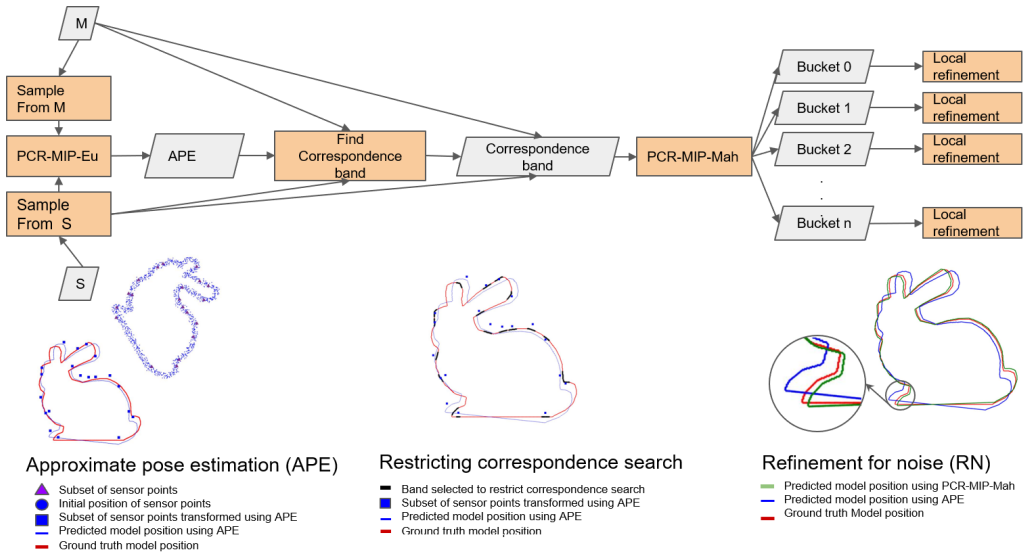
- The multi-step pipeline (APE + RN + LDR) shows that a fast approximate pose can be used to narrow the correspondence search without sacrificing accuracy, which is what makes the global formulation usable on real point clouds.
- Outlier detection falls out of the same MIP as binary variables $o_i$, so robustness to outliers and partial overlap is a byproduct of the formulation, not an extra module.
Reading between the lines
- If the relaxations of SO(3) are not tight, the MIP may return a lower bound that is unattainable; a natural test is to compare the branch-and-bound gap on standard benchmarks and see whether the returned pose is the true global optimum on small instances where exhaustive search is possible.
- The isotropic-noise assumption is what makes the Mahalanobis factor constant; extending to anisotropic sensor noise would re-introduce $R$-dependence and likely require a different convexification, but the experiments suggest the benefit of modelling uncertainty would persist.
- The 20-point heuristic for APE comes from empirical observation; one could test whether the required number scales with shape complexity or noise, which would give a principled way to size the subset.
Signed reviews
Editorial analysis
A structured set of objections, weighed in public.
Referee Report
Summary. The paper proposes a mixed-integer programming (MIP) formulation, PCR-MIP-Mah, for point-cloud registration that explicitly models anisotropic model-point and isotropic sensor-point uncertainty via Mahalanobis l1 distances. To make the problem tractable, the authors relax the SO(3) rotation constraints with piecewise-convex (sos2) and McCormick envelopes in Appendix A, restrict correspondence search to a band of Nb nearest model points around an approximate pose (Sec. III-B), and embed the MIP in a three-stage pipeline (APE, RN, LDR) that uses a small subset of sensor points (Sec. III-C). The paper claims in Sec. I that the approach 'can handle noise, outliers and partial data, while ensuring global optimality,' and supports this with synthetic and real-world experiments in Sec. IV, comparing accuracy against GoICP, PCR-MIP-Eu, ICP, and IMLP.
Significance. If the global-optimality guarantee were established, the paper would make a useful contribution by incorporating uncertainty directly into a global registration formulation and by proposing a practical multi-stage solver. The explicit use of Mahalanobis distances, the binary outlier variables, and the extension of the MIP framework of Izatt et al. are sensible ideas that merit attention. The manuscript also provides a clear description of the formulation and a substantial experimental section on synthetic and real data. However, the central advertised property—global optimality—is not supported by the presented analysis, and the paper itself concedes this in Sec. III-C. The empirical results are suggestive but not conclusive because they report single runs without error bars or statistical comparison.
major comments (4)
- [Sec. III-C, Sec. I] The global-optimality claim in the Introduction is directly contradicted by Sec. III-C, which states that because only a subset of sensor points is used in RN, 'it is possible that the solution obtained from PCR-MIP-Mah may not be globally optimal.' Since the final output is the result of the full APE+RN+LDR pipeline, the paper does not establish global optimality for the method it actually evaluates. This is a load-bearing gap: the abstract and Sec. I promise a global guarantee, but the implemented algorithm solves a subsampled surrogate problem.
- [Appendix A] The SO(3) constraints are replaced by an outer approximation: piecewise-convex sos2 constraints for u_i^T u_i and u_i^T u_j and McCormick envelopes for the determinant constraints. No proof is given that this relaxation is exact at the optimum, that a relaxed feasible solution can be projected to a valid rotation without changing the objective, or that the MIP optimum equals the true optimum of Eq. (4) over exact rotations and all correspondences. Without such a certificate, the claim that the solver finds the global optimum of the original problem is unsupported.
- [Sec. III-B, Eq. (6)-(7)] The correspondence matrix H is replaced by H' over an Nb-point band Q built from the APE pose. If the true corresponding model point for a sensor point is not in Q, the problem actually solved is a restricted surrogate rather than Eq. (4). The paper offers no theoretical or empirical analysis of how large Nb must be to contain the true correspondence under the tested noise and outlier levels, and the observation in Sec. IV-A that larger bands can worsen PCR-MIP-Mah's accuracy suggests the band restriction interacts nontrivially with the objective. This undermines any claim of global optimality even for the relaxed rotation constraints.
- [Table II, Sec. IV-A] The reported objective value for PCR-MIP-Mah (173.72 with band size 5) is below the objective value at ground truth (449.60), as the paper itself notes. This indicates that the Mahalanobis l1 objective can favor poses that are not the ground truth, so even a certified global optimum of Eq. (5) would not by itself imply accurate registration. The paper presents this as an observation without addressing its implications for the meaningfulness of the objective, which is central to the claim that global optimality of this objective yields correct poses.
minor comments (6)
- [Sec. IV-A] In the text describing Table II, the comparison list mentions 'ICP, GICP, IMLP,' but the table has separate rows for ICP and GoICP; GICP is not defined or present. Please clarify which methods are being compared.
- [Appendix A] The sentence 'we approximate the constraint on each element of R with piecewise-convex approximations []' has an empty citation. Please insert the appropriate reference (likely [7] or [44]).
- [Sec. IV] The experimental tables report single runs without error bars or repeated-trials statistics. Since the methods are stochastic or heuristic in parts (e.g., random subset selection in APE, solver termination criteria), reporting means and variances over multiple trials would strengthen the empirical claims.
- [Sec. IV-C] The reference to 'Esterpar et al.' should be 'Estepar et al.' for the generalized total-least-squares ICP work.
- [Sec. III] The notation for the Mahalanobis distance in Eq. (1) uses d^2_{i,j}, but Eq. (3) defines d^{Mah}_{i,j} as an l1 norm; the relationship between the squared distance and the l1 form is not explicitly justified. A sentence explaining that the l1 norm approximates the Cholesky-weighted distance would help clarity.
- [Sec. IV-A] The phrase 'PCR-MIP-Mah can also be interpreted as APE+RN' is confusing because APE is described as using PCR-MIP-Eu or GoICP, while PCR-MIP-Mah is the RN step; please clarify the intended interpretation.
Circularity Check
No circular derivation: the PCR-MIP-Mah objective and benchmarks are independent, with only a non-load-bearing self-citation for the APE subset size.
full rationale
The derivation is self-contained. Eq. (4) defines a Mahalanobis l1 registration objective over independent variables R, t, and correspondence matrix H; Eq. (5) is a convexified MIP with explicit constraints, and the outlier model and correspondence-band restriction are stated as engineering choices rather than as consequences of the objective. The method is evaluated against ground truth in Tables II–IV against external baselines (ICP, GoICP, IMLP, PCR-MIP-Eu) using independent synthetic and real point clouds. The only self-citations are [35] in related work and [36] for an empirical heuristic that roughly 20 sensor points suffice for APE; this heuristic is used to choose the subset size, not to define the objective or to prove global optimality, so it is not load-bearing. The paper itself concedes in Sec. III-C that using only a subset of sensor points means the solution 'may not be globally optimal,' and Appendix A's piecewise-linear and McCormick relaxations of SO(3) are outer approximations with no tightness proof; these are correctness or guarantee limitations, not circularity. The observation in Table II that the method's objective value (173.72) falls below the ground-truth objective (449.60) indicates an objective-pose mismatch or overfitting tendency, not that the objective was constructed from the target solution. Consequently, no step reduces by construction to its inputs, and no fitted parameter is renamed as a prediction.
Assumptions & free parameters
free parameters (6)
- phi_max1 =
1000
- phi_max2 =
not reported
- big-M =
10^4
- band size Nb =
5, 20, 30, 50
- APE subset size =
20
- sos2 partitions =
50
assumptions (4)
- domain assumption Sensor noise is isotropic, C_s_i = sigma_i I, so C_ij is independent of R.
- ad hoc to paper The set Q of Nb model points closest to the APE pose contains the true corresponding model point for each sensor point.
- ad hoc to paper The piecewise-convex and McCormick relaxations of SO(3) are tight enough that the relaxed MIP optimum equals the true global optimum.
- domain assumption A subset of about 20 sensor points is sufficient to obtain a near-correct approximate pose.
Cite this review
Pith. "Pith review of Globally optimal registration of noisy point clouds." pith.science (2026). https://pith.science/paper/GR5QKOB7
@misc{pith2026190808162,
  author       = {Pith},
  title        = {Pith review of: Globally optimal registration of noisy point clouds},
  year         = {2026},
  howpublished = {\url{https://pith.science/paper/GR5QKOB7}},
  note         = {Machine review of arXiv:1908.08162}
}
read the original abstract
Registration of 3D point clouds is a fundamental task in several applications of robotics and computer vision. While registration methods such as iterative closest point and variants are very popular, they are only locally optimal. There has been some recent work on globally optimal registration, but they perform poorly in the presence of noise in the measurements. In this work we develop a mixed integer programming-based approach for globally optimal registration that explicitly considers uncertainty in its optimization, and hence produces more accurate estimates. Furthermore, from a practical implementation perspective we develop a multi-step optimization that combines fast local methods with our accurate global formulation. Through extensive simulation and real world experiments we demonstrate improved performance over state-of-the-art methods for various level of noise and outliers in the data as well as for partial geometric overlap.
Figures

Figures from the paper (1 more)

Reference graph
Works this paper leans on
-
[1]
4-points congruent sets for robust pairwise surface registration
Dror Aiger, Niloy J Mitra, and Daniel Cohen-Or. 4-points congruent sets for robust pairwise surface registration. In ACM Transactions on Graphics (TOG) , volume 27, page 85. ACM, 2008
work page 2008
-
[2]
Pose Guided RGBD Feature Learning for 3D Object Pose Estimation
Vassileios Balntas, Andreas Doumanoglou, Caner Sahin, Juil Sock, Rigas Kouskouridas, and Tae-Kyun Kim. Pose Guided RGBD Feature Learning for 3D Object Pose Estimation. In Proceedings of the IEEE Conference on Computer Vision and Pattern Recognition , pages 3856– 3864, 2017
work page 2017
-
[3]
P.J. Besl and Neil D. McKay. A method for registration of 3-D shapes. IEEE Transactions on Pattern Analysis and Machine Intelligence , 14(2):239–256, Feb 1992. ISSN 0162-8828. doi: 10.1109/34.121791
-
[4]
Seth D. Billings, Emad M. Boctor, and Russell H. Tay- lor. Iterative Most-Likely Point Registration (IMLP): A Robust Algorithm for Computing Optimal Shape Align- ment. PLoS ONE , 10, 2015
work page 2015
-
[5]
Robust Euclidean alignment of 3D point sets: the trimmed iterative closest point algorithm
Dmitry Chetverikov, Dmitry Stepanov, and Pavel Krsek. Robust Euclidean alignment of 3D point sets: the trimmed iterative closest point algorithm. Image and Vision Computing, 23(3):299–309, 2005
work page 2005
-
[6]
3D object retrieval using many-to-many matching of curve skeletons
Nicu D Cornea, M Fatih Demirci, Deborah Silver, SJ Dickinson, PB Kantor, et al. 3D object retrieval using many-to-many matching of curve skeletons. In Shape Modeling and Applications, 2005 International Conference, pages 366–371. IEEE, 2005
work page 2005
-
[7]
Global inverse kinematics via mixed-integer convex optimiza- tion
Hongkai Dai, Gregory Izatt, and Russ Tedrake. Global inverse kinematics via mixed-integer convex optimiza- tion. In International Symposium on Robotics Research, Puerto V aras, Chile, pages 1–16, 2017
work page 2017
-
[8]
Au- tomatic registration of aerial imagery with untextured 3d lidar models
Min Ding, Kristian Lyngbaek, and Avideh Zakhor. Au- tomatic registration of aerial imagery with untextured 3d lidar models. In Computer Vision and Pattern Recogni- tion, 2008. CVPR 2008. IEEE Conference on , pages 1–8. IEEE, 2008
work page 2008
Show all 45 references
-
[9]
Robust generalized total least squares iterative closest point registration
Ra ´ul San Jos ´e Est ´epar, Anders Brun, and Carl-Fredrik Westin. Robust generalized total least squares iterative closest point registration. In International Conference on Medical Image Computing and Computer-Assisted Intervention, pages 234–241. Springer, 2004
2004
-
[10]
Robust registration of 2D and 3D point sets
Andrew W Fitzgibbon. Robust registration of 2D and 3D point sets. Image and Vision Computing , 21(13-14): 1145–1153, 2003
2003
-
[11]
Robust global registration
Natasha Gelfand, Niloy J Mitra, Leonidas J Guibas, and Helmut Pottmann. Robust global registration. In Symposium on geometry processing , volume 2, page 5, 2005
2005
-
[12]
Monte carlo pose estimation with quaternion kernels and the distribution
Jared Glover, Gary Bradski, and Radu Bogdan Rusu. Monte carlo pose estimation with quaternion kernels and the distribution. In Robotics: Science and Systems , volume 7, page 97, 2012
2012
-
[13]
Three- dimensional registration using range and intensity infor- mation, 1994
Rejean Baribeau Guy Godin, Marc Rioux. Three- dimensional registration using range and intensity infor- mation, 1994. URL https://doi.org/10.1117/12.189139
1994 doi
-
[14]
Sancta simplicitas-on the efficiency and achievable results of slam using icp-based incremental registration
Dirk Holz and Sven Behnke. Sancta simplicitas-on the efficiency and achievable results of slam using icp-based incremental registration. In Robotics and Automation (ICRA), 2010 IEEE International Conference on , pages 1380–1387. IEEE, 2010
2010
-
[15]
Convex relaxations of SE(2) and SE(3) for visual pose estimation
Matanya B Horowitz, Nikolai Matni, and Joel W Bur- dick. Convex relaxations of SE(2) and SE(3) for visual pose estimation. In IEEE International Conference on Robotics and Automation (ICRA) , pages 1148–1154. IEEE, 2014
2014
-
[16]
Globally Optimal Object Pose Estimation in Point Clouds with Mixed-Integer Programming
Gregory Izatt and Russ Tedrake. Globally Optimal Object Pose Estimation in Point Clouds with Mixed-Integer Programming. In International Symposium on Robotics Reesearch, 2017
2017
-
[17]
PoseNet: A convolutional network for real-time 6-DOF camera relocalization
Alex Kendall, Matthew Grimes, and Roberto Cipolla. PoseNet: A convolutional network for real-time 6-DOF camera relocalization. In IEEE International Conference on Computer Vision (ICCV) , pages 2938–2946. IEEE, 2015
2015
-
[18]
The digital michelangelo project: 3d scanning of large statues
Marc Levoy, Kari Pulli, Brian Curless, Szymon Rusinkiewicz, David Koller, Lucas Pereira, Matt Ginzton, Sean Anderson, James Davis, Jeremy Ginsberg, et al. The digital michelangelo project: 3d scanning of large statues. In Proceedings of the 27th annual conference on Computer g...
2000
-
[19]
Registra- tion of range data using a hybrid simulated annealing and iterative closest point algorithm
Jason Luck, Charles Little, and William Hoff. Registra- tion of range data using a hybrid simulated annealing and iterative closest point algorithm. In Proceedings of IEEE International Conference on Robotics and Automation , pages 3739–3744. IEEE, 2000
2000
-
[20]
Robust registration for computer-integrated orthopedic surgery: laboratory vali- dation and clinical experience
Burton Ma and Randy E Ellis. Robust registration for computer-integrated orthopedic surgery: laboratory vali- dation and clinical experience. Medical image analysis , 7(3):237–250, 2003
2003
-
[21]
Fully automatic registration of 3D point clouds
Ameesh Makadia, Alexander Patterson, and Kostas Dani- ilidis. Fully automatic registration of 3D point clouds. In Computer Vision and Pattern Recognition, 2006 IEEE Computer Society Conference on , volume 1, pages 1297–
2006
-
[22]
Point registration via effi- cient convex relaxation
Haggai Maron, Nadav Dym, Itay Kezurer, Shahar Ko- valsky, and Yaron Lipman. Point registration via effi- cient convex relaxation. ACM Transactions on Graphics (TOG), 35(4):73, 2016
2016
-
[23]
Computability of global solutions to factorable nonconvex programs: Part iconvex underes- timating problems
Garth P McCormick. Computability of global solutions to factorable nonconvex programs: Part iconvex underes- timating problems. Mathematical programming , 10(1): 147–175, 1976
1976
-
[24]
Contextual classification with functional max-margin markov networks
Daniel Munoz, J Andrew Bagnell, Nicolas Vandapel, and Martial Hebert. Contextual classification with functional max-margin markov networks. In Computer Vision and Pattern Recognition, 2009. CVPR 2009. IEEE Confer- ence on , pages 975–982. IEEE, 2009
2009
-
[25]
Kinectfusion: Real-time dense surface map- ping and tracking
Richard A Newcombe, Shahram Izadi, Otmar Hilliges, David Molyneaux, David Kim, Andrew J Davison, Push- meet Kohi, Jamie Shotton, Steve Hodges, and Andrew Fitzgibbon. Kinectfusion: Real-time dense surface map- ping and tracking. In Mixed and augmented reality (ISMAR), 2011 10th...
2011
-
[26]
Inc.,gurobi optimizer reference manual, 2015
Gurobi Optimization. Inc.,gurobi optimizer reference manual, 2015. URL: http://www. gurobi. com , 2014
2015
-
[27]
One point isometric matching with the heat kernel
Maks Ovsjanikov, Quentin M ´erigot, Facundo M ´emoli, and Leonidas Guibas. One point isometric matching with the heat kernel. In Computer Graphics F orum , volume 29, pages 1555–1564. Wiley Online Library, 2010
2010
-
[28]
Outlier robust ICP for minimizing fractional RMSD
Jeff M Phillips, Ran Liu, and Carlo Tomasi. Outlier robust ICP for minimizing fractional RMSD. In 3-D Digital Imaging and Modeling, 2007. 3DIM’07. Sixth In- ternational Conference on , pages 427–434. IEEE, 2007
2007
-
[29]
A certifiably correct algorithm for synchronization over the special Euclidean group
David M Rosen, Luca Carlone, Afonso S Bandeira, and John J Leonard. A certifiably correct algorithm for synchronization over the special Euclidean group. 12th International Workshop on Agorithmic F oundations of Robotics, 2016
2016
-
[30]
Efficient Vari- ants of the ICP Algorithm
Szymon Rusinkiewicz and Marc Levoy. Efficient Vari- ants of the ICP Algorithm. In Third International Con- ference on 3D Digital Imaging and Modeling (3DIM) , June 2001
2001
-
[31]
Fast point feature histograms (fpfh) for 3d registration
Radu Bogdan Rusu, Nico Blodow, and Michael Beetz. Fast point feature histograms (fpfh) for 3d registration. In IEEE International Conference on Robotics and Au- tomation, pages 3212–3217. IEEE, 2009
2009
-
[32]
Generalized-ICP
Aleksandr Segal, Dirk Haehnel, and Sebastian Thrun. Generalized-ICP. In Robotics: Science and Systems , volume 2, 2009
2009
-
[33]
Image registration using genetic algorithms
Fl ´avio Luiz Seixas, Luiz Satoru Ochi, Aura Conci, and D´ebora Muchaluat Saade. Image registration using genetic algorithms. In Proceedings of the 10th annual conference on Genetic and evolutionary computation , pages 1145–1146. ACM, 2008
2008
-
[34]
Techniques for fast and accurate intrasurgical registra- tion
David A Simon, Martial Hebert, and Takeo Kanade. Techniques for fast and accurate intrasurgical registra- tion. Journal of image guided surgery , 1(1):17–29, 1995
1995
-
[35]
Multiple start branch and prune filtering algorithm for nonconvex optimization
Rangaprasad Arun Srivatsan and Howie Choset. Multiple start branch and prune filtering algorithm for nonconvex optimization. In The 12th International Workshop on The Algorithmic F oundations of Robotics . Springer, 2016
2016
-
[36]
Sparse point registration
Rangaprasad Arun Srivatsan, Prasad Vagdargi, and Howie Choset. Sparse point registration. In 18th International Symposium on Robotics Research , 2017
2017
-
[37]
Real- time articulated hand pose estimation using semi- supervised transductive regression forests
Danhang Tang, Tsz-Ho Yu, and Tae-Kyun Kim. Real- time articulated hand pose estimation using semi- supervised transductive regression forests. In IEEE International Conference on Computer Vision (ICCV) , pages 3224–3231. IEEE, 2013
2013
-
[38]
A correlation-based approach to robust point set registration
Yanghai Tsin and Takeo Kanade. A correlation-based approach to robust point set registration. In European conference on computer vision , pages 558–569. Springer, 2004
2004
-
[39]
The Stanford 3D Scanning Repository
Greg Turk and Marc Levoy. The Stanford 3D Scanning Repository. Stanford University Computer Graphics Laboratory http://graphics.stanford.edu/data/3Dscanrep
-
[40]
Discriminative optimization: theory and applications to point cloud registration
Jayakorn V ongkulbhisal, Fernando De la Torre, and Joao P Costeira. Discriminative optimization: theory and applications to point cloud registration. In IEEE CVPR , 2017
2017
-
[41]
Objectnet3D: A large scale database for 3d object recognition
Yu Xiang, Wonhui Kim, Wei Chen, Jingwei Ji, Christo- pher Choy, Hao Su, Roozbeh Mottaghi, Leonidas Guibas, and Silvio Savarese. Objectnet3D: A large scale database for 3d object recognition. In European Conference on Computer Vision, pages 160–176. Springer, 2016
2016
-
[42]
Posecnn: A convolutional neural network for 6d object pose estimation in cluttered scenes
Yu Xiang, Tanner Schmidt, Venkatraman Narayanan, and Dieter Fox. Posecnn: A convolutional neural network for 6d object pose estimation in cluttered scenes. arXiv preprint arXiv:1711.00199, 2017
2017 arXiv
-
[43]
Go- ICP: Solving 3D Registration Efficiently and Globally Optimally
Jiaolong Yang, Hongdong Li, and Yunde Jia. Go- ICP: Solving 3D Registration Efficiently and Globally Optimally. In 2013 IEEE International Conference on Computer Vision (ICCV) , pages 1457–1464, Dec 2013. doi: 10.1109/ICCV .2013.184
2013 doi
-
[44]
A maximum feasible sub- system for globally optimal 3d point cloud registration
Chanki Yu and Da Young Ju. A maximum feasible sub- system for globally optimal 3d point cloud registration. Sensors, 18(2):544, 2018
2018
-
[45]
Dense scene recon- struction with points of interest
Qian-Yi Zhou and Vladlen Koltun. Dense scene recon- struction with points of interest. ACM Transactions on Graphics (ToG), 32(4):112, 2013
2013
Reviewed August 14, 2026 · model on record in the stance chip above.
Discussion (0). Continue with ORCID to comment.