REVIEW 3 major objections 6 minor 24 references
Nuclear Isotope Production by Ordinary Muon Capture Reaction
T0 review · 3 major / 6 minor · reviewed 2026-08-14 · deepseek-v4-flash
Pith's one-line read Ordinary muon capture can turn a stopped muon into a radioactive isotope with near-unity probability, yielding per-muon production rates two orders of magnitude above photon capture, and the paper demonstrates the route on natural…
desk verdict A real feasibility measurement with credible isotope identifications, but the central normalization in Table 6 is internally inconsistent the printed 99Mo yield exceeds the 100Mo muon budget so the headline per-muon rates need rework before they can be used. read the letter →
The pith
A machine-rendered reading of the paper's core claim, the machinery that carries it, and where it could break.
The reading
What carries the argument
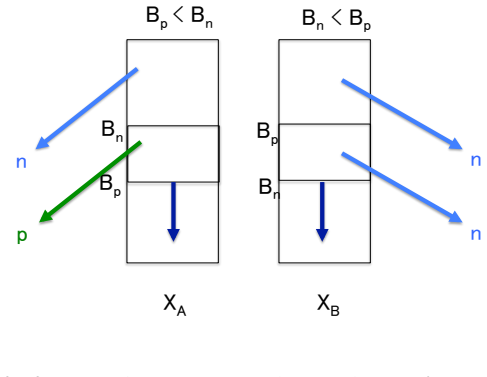
The load-bearing object is the proton-neutron emission model (PNEM), an extension of the earlier neutron emission model. The muon-capture strength $B(\mu,E)$ is written as the sum of two Breit--Wigner giant resonances, $B_1$ and $B_2$, with energies $E_{G1}=30A^{-1/5}$ MeV and $E_{G2}=75A^{-1/5}$ MeV; the first-neutron spectrum is $S(E_{n(1)})=k[E_n\exp(-E_n/T_{\rm EQ})+p E_n\exp(-E_n/T_{\rm PEQ})]$ with the pre-equilibrium fraction $p=25\%$, $T_{\rm EQ}=\sqrt{E_{\rm ex}/a}$ with $a=A/8$, and $T_{\rm PEQ}\approx 3T_{\rm EQ}$. After the first neutron, the cascade continues as equilibrium evaporation until the residue becomes neutron-bound and decays by gamma emission; proton emission is included only in the energy window where the excitation lies below the neutron separation energy but above the proton separation energy, keeping proton channels at a few percent in medium-heavy nuclei. This machinery turns the resonance strength into branching ratios to each residual isotope, and those branching ratios convert a muon flux into predicted isotope numbers and rates.
What would settle it
An absolute activation experiment on enriched $^{100}$Mo---counting stopped muons via muonic X-rays and then measuring the activities of $^{99}$Mo and $^{99m}$Tc---would settle the efficiency claim: if the measured number of radioactive atoms per stopped muon falls far below the paper's 0.5--0.1 range, the central claim fails.
Extended reading notes
Core claim
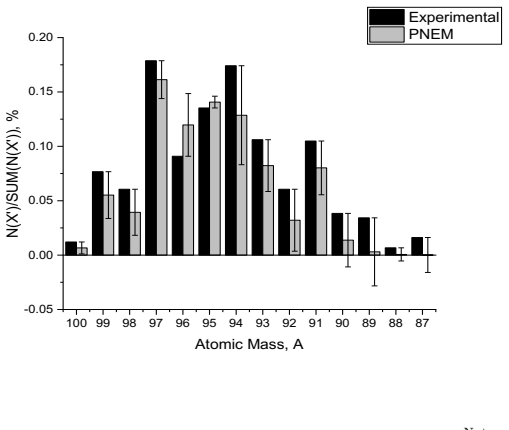
The paper's central claim is that ordinary (non-radiative) muon capture can serve as a high-yield isotope-production reaction. When a negative muon stops in a nucleus with $Z\ge 20$, capture occurs with more than 90% probability; the muon deposits about 100 MeV of excitation while the emitted neutrino carries off most of that energy, leaving the $Z-1$ daughter excited at roughly 5--50 MeV. De-excitation proceeds mostly by emission of one neutron (about 50--60% of events), with two or more neutrons and a few-percent proton branch, so the final residues are radioactive isotopes of the form $^{A-x}_{Z-1}X$. The measurement on natural molybdenum with the MuSIC beam provides the demonstration: after irradiation with about $3.5\times 10^9$ stopped muons, delayed gamma rays from many molybdenum-capture products were observed, and the summed radioactive-isotope yield of about $3.1\times 10^9$ approximates the number of stopped muons. The paper consequently states that the per-muon production rate is 0.5--0.1, two orders of magnitude above photon-capture isotope production, and estimates $N_{\rm RI}\approx 4\times 10^7$ per second for a 1 $\mu$A proton beam.
Load-bearing premise
The predictions rest on a statistical model whose parameters were fixed using earlier neutron-emission data; if those parameters do not also describe proton emission and new target nuclei, the calculated yields and rates lose their support.
Editorial extensions
If this is right
- A 1 $\mu$A proton beam feeding a MuSIC-like channel is claimed to produce about $4\times 10^7$ isotopes per second, and an upgraded 10 $\mu$A beam would scale that to roughly $4\times 10^8$ per second, so achievable muon intensities translate directly into useful isotope batches.
- Because muon capture lowers the atomic number by one, MuCIP produces isotope chains that photon and neutron capture cannot reach, for example $^{100}\mathrm{Mo}\to{}^{99}\mathrm{Nb}\to{}^{99m}\mathrm{Tc}/{}^{99}\mathrm{Mo}$, so medical technetium could be made from natural molybdenum.
- The high per-muon yield of 0.5--0.1 implies that the practical bottleneck for MuCIP is muon beam intensity rather than nuclear cross-section, so any future high-intensity muon source becomes a potential isotope-production facility.
- Thin targets of order tens of mg/cm$^2$ suffice because negative muons stop by atomic capture, giving high specific activity and allowing the muon momentum to set the depth at which isotopes are deposited.
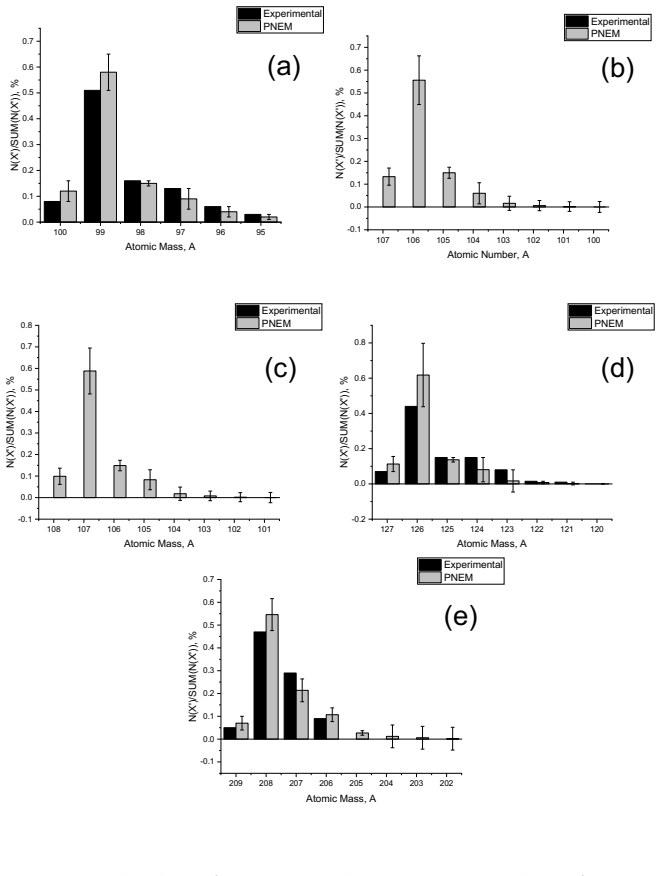
- The model's agreement with measured distributions on five nuclei suggests the one-neutron-dominant branching pattern is general, so isotope yields for other target nuclei can be estimated before any irradiation.
Reading between the lines
- If near-one-isotope-per-muon holds on all medium-heavy targets, the economics of MuCIP are set by the cost of muon beam time rather than by target material or separation chemistry; the paper does not compare costs with the reactor- and accelerator-based $^{99}$Mo/$^{99m}$Tc supply chain.
- The least-tested ingredient is the proton-emission branch, so a dedicated measurement of $^{97}$Zr from $^{98}$Mo$(\mu,p)$ or $^{89}$Zr from $^{92}$Mo would probe whether the model's few-percent proton channels hold as $Z$ changes.
- Because muon capture produces neutron-rich $Z-1$ isotopes, MuCIP could double as a tool for producing exotic neutron-rich nuclei for decay studies, an application the paper only gestures at through its isotope list.
- The near-unity yield also suggests MuCIP as a transmutation route for long-lived fission products, converting them into shorter-lived or stable species; the paper mentions transmutation only in passing and gives no quantitative estimate.
Signed reviews
Editorial analysis
A structured set of objections, weighed in public.
Referee Report
Summary. The paper reports the production of radioactive isotopes by ordinary negative muon capture (MuCIP) on a natural molybdenum target at the RCNP MuSIC beamline. Delayed gamma-ray spectroscopy identifies a number of residual nuclei, including Nb, Zr, and Y isotopes, and the medically relevant 99Mo/99mTc. The measured isotope yields are compared with a pre-equilibrium/equilibrium proton-neutron emission model (PNEM). The paper claims that the production rate per stopped muon is as high as 0.5–0.1, that essentially all stopped muons produce isotopes, and that with a full MuSIC beam one can achieve about 4×10^7 RIs per second for a 1 μA proton beam.
Significance. If the quantitative claims survive scrutiny, the paper demonstrates a new and efficient route to radioactive isotope production, complementary to photon and neutron capture, and provides experimental data on muon-capture residual nuclei that are useful for nuclear structure and applications. The isotope identification from gamma-ray spectra appears credible, and the measured yield patterns for 100Mo, 127I, and 209Bi are broadly consistent with earlier work. However, the central efficiency numbers are tied to a normalization that is internally inconsistent, and the model that supplies several of the calculated yields is not derived in the manuscript. The potential contribution is real, but the current presentation does not yet support the headline production rates.
major comments (3)
- [Section 4, Table 6] The normalization of the measured yields is inconsistent with the stated muon budget. The text says that the sum of observed RIs is about 3.1×10^9 while the number of muons stopped in plates A and B was 3.5×10^9, but the delayed-gamma measurement was performed on all four plates and the total muon stop was about 7×10^9. If the yields in Table 6 refer to all four plates, then the measured sum is only about 44% of the muon budget, which contradicts the statement that 'all muons were mainly captured into the Mo nuclei to produce Nb and other isotopes.' If, instead, the yields refer to plates A and B, the 99Mo yield of 3.8×10^8 exceeds the maximum possible number of muons captured on 100Mo, which is 0.096×3.5×10^9 = 3.4×10^8; this is impossible. This inconsistency directly affects the headline numbers: the production rate per muon and N_RI ≈ 4×10^7 s^-1. The authors must clarify which normalization applies and recompute the derived efficiencies accordingly.
- [Section 3, Eqs. (4)–(5)] The PNEM model is not derived in this manuscript. The paper defines the muon capture strength B(μ,E) as a sum of two Lorentzian resonances, but it does not show how B(μ,E) is converted into the branching ratios Br(X') that are tabulated in Tables 1–5 and used for the model entries in Table 6. The parameters (PEQ fraction p = 25%, temperature ratio b ≈ 3, resonance energies E_G1 and E_G2, widths, and relative strengths) are adopted from previous work, and no sensitivity analysis is provided. Since the model entries for 94Nb, 93Nb, and 91Nb in Table 6 are used in the text to argue that essentially all stopped muons produce RIs, the reader cannot evaluate the reliability of those extrapolations. Please present the model equations connecting B(μ,E) to the branching ratios, or explicitly state that these yields are taken from refs. [18,19] and justify their application to the new targets.
- [Section 5] The claim 'The production rate per one μ is as high as 0.5−0.1' is ambiguous and not clearly derived from the data. If it means 0.5 to 0.1 per muon, the abstract's statement of '10^{9-10} per second' is not supported by the demonstrated MuSIC flux of about 4×10^7 muons/s and appears to refer only to hypothetical future beams. The numerical efficiency is also directly tied to the normalization inconsistency described above. The authors should state precisely which quantities are measured, which are modeled, how the per-muon efficiency is defined, and how the extrapolation to 10^9–10^10 RIs/s is justified.
minor comments (6)
- [Table 6] The half-life listed for 93Nb (1.41×10^5 hr) is inconsistent with 93Nb being stable, as the text itself states in Section 4; please correct this entry.
- [Eq. (2)] The factor k(Tμ) is not defined; please give its formula, e.g., k(T) = (1 - exp(-λT))/λ, so that the decay correction during irradiation is transparent.
- [Section 4] The text refers to 'Table 5' when discussing the natural-Mo results (e.g., 'Figure 6 illustrates ... based on Table 5'); this should be Table 6.
- [Section 4] The sentence 'the 66 hr 99Nb' should read 'the 66 hr 99Mo', since 99Nb is not the 66-hour isotope; the text describes the decay product of 99Mo feeding 99mTc.
- [Section 3] The formulas for the resonance energies should be typeset as E_G1 = 30 A^{-1/5} MeV and E_G2 = 75 A^{-1/5} MeV to avoid misreading as (A-1)/5.
- [Section 5] The activity estimate of '100 GBq' for 10^10 muons/s does not follow immediately from the stated production rate; please show the calculation or qualify the estimate as a rough order-of-magnitude figure.
Circularity Check
Model parameters fitted to prior muon-capture data are re-used as 'predictions' and to fill Table 6 yields, but the measured Mo production rates are independent.
-
fitted input called prediction
[Section 2 (after Eq. 2) and Section 3 (Eqs. 4-5, text after Eq. 5)]
"Reference [17] shows that the systematic study of PEQ to EQ ratio is fixed to 25% to reproduce neutron spectra in experimental observation. ... The parameters of EG1 and EG2 as a function of A are concluded as EG1 = 30× A−1/5 MeV and EG2 = 75× A−1/5 MeV."
Br(X') in Eq. (2) is evaluated with p=25%, a value fixed in ref [17] to reproduce measured neutron spectra, and with resonance energies 'concluded' from refs [18,19], which are prior works by the same group. The model is then used to 'predict' the distributions in Tables 1-5, including the 100Mo data of ref [19] that were used to develop the model, and to calculate unmeasured long-lived yields (94Nb, 93Nb, 91Nb) in Table 6. The apparent agreement in Table 1 is therefore partly in-sample, and the calculated entries are calibrated outputs rather than independent predictions.
-
self citation load bearing
[Section 4, Table 6 (footnote b) and text after Fig. 5]
"b N(X’) obtained by calculation using PNEM. ... The sum of the number of the observed RIs given in the Table 5 and that in Figure 6 are around 3.1×10⁹, while the number of the muons stopped at the Mo plates A and B was 3.5×10⁹. Thus, the total number of the RIs, including the 94Nb with T1/2 = 2×10⁴ y and the stable 93Nb, are nearly the same as the number of the muons."
The unobserved 94Nb, 93Nb and 91Nb yields are not measured; they are taken from PNEM, whose parameters are imported from the same authors' refs [17]-[19] and were fixed against muon-capture data. The paper uses these model-filled numbers in the sentence asserting that the total RI count is nearly the same as the number of muons, so that total-accounting claim is not fully empirical. The previously stated observed sum (~3.1e9 vs 3.5e9 muons) is measured and already supports high efficiency, so this is a partial, not total, circularity.
full rationale
The paper's central feasibility claim—MuCIP on natMo produces 99Mo/99mTc and the observed RIs—is established by measured delayed γ-ray yields (Table 6, Fig. 4), not by the PNEM. The observed sum of ~3.1e9 RIs against 3.5e9 stopped muons already supports 'nearly one RI per captured muon' without model input. The circular element is confined to the model layer: p=25% was fixed in ref [17] to reproduce neutron spectra, E_G1/E_G2 were 'concluded' in the authors' prior work, and the same model is then presented as validating Tables 1-5 and supplies unmeasured yields for 94Nb, 93Nb, 91Nb in Table 6. Those calculated entries are calibrated outputs, so the 'total including 94Nb and stable 93Nb' statement is model-dependent. Still, the model is not the sole support for the paper's main experimental result; it is an interpolating tool with some external comparisons to earlier data (127I, 209Bi from ref [13]). The muon-budget inconsistency noted by a skeptic (sum including modeled entries exceeds stopped-muon count) is a normalization/correctness concern, not an additional circularity. Overall: moderate self-citation and in-sample validation, but the central measured claim retains independent content.
Assumptions & free parameters
free parameters (7)
- PEQ fraction p =
0.25
- PEQ temperature ratio b =
≈3
- Giant resonance energy E_G1 =
30 A^-1/5 MeV
- Giant resonance energy E_G2 =
75 A^-1/5 MeV
- Resonance widths Γ1, Γ2 =
not specified
- Relative resonance strengths σ1/σ2 =
not specified
- Level density parameter a =
A/8 MeV^-1
assumptions (5)
- domain assumption Ordinary muon capture on a nucleus A_ZX excites the A_(Z-1)X* nucleus via weak charged-current process, with excitation energies around 5-50 MeV.
- domain assumption The muon capture strength B(μ,E) is representable as the sum of two Lorentzian giant resonances (Eq. 4-5).
- domain assumption After the first neutron, de-excitation proceeds only through the equilibrium stage; proton emission occurs only when the excitation energy lies between the proton and neutron binding energies.
- domain assumption The muon capture probability is greater than 90% for Z ≥ 20, so essentially all stopped muons in the Mo target are captured.
- domain assumption The gamma-ray yields can be converted to isotope production numbers using known half-lives, branching ratios, and detector efficiencies, with no unlisted systematic errors.
Cite this review
Pith. "Pith review of Nuclear Isotope Production by Ordinary Muon Capture Reaction." pith.science (2026). https://pith.science/paper/QNZHKZ32
@misc{pith2026190808166,
  author       = {Pith},
  title        = {Pith review of: Nuclear Isotope Production by Ordinary Muon Capture Reaction},
  year         = {2026},
  howpublished = {\url{https://pith.science/paper/QNZHKZ32}},
  note         = {Machine review of arXiv:1908.08166}
}
abstract
Muon capture isotope production (MuCIP) using negative ordinary muon capture reactions (OMC) is used to efficiently produce various kinds of nuclear isotopes for both fundamental and applied science studies. The large capture probability of muon into a nucleus, together with the high intensity muon beam, make it possible to produce nuclear isotopes in the order of 10^{9-10} per second depending on the muon beam intensity. Radioactive isotopes (RIs) produced by MuCIP are complementary to those produced by photon and neutron capture reactions and are used for various science and technology applications. MuCIP on ^{Nat}Mo by using the RCNP MuSIC \muon beam is presented to demonstrate the feasibility of MuCIP. Nuclear isotopes produced by MuCIP are evaluated by using a pre-equilibrium (PEQ) and equilibrium (EQ) proton neutron emission model. Radioactive $^{99}$Mo isotopes and the metastable ^{99m}Tc isotopes, which are used extensively in medical science, are produced by MuCIP on ^{Nat}Mo and ^{100}Mo.
Figures

Figures from the paper (2 more)

Reference graph
Works this paper leans on
-
[1]
H. Ejiri, T. Shima, S. Miyamoto, K. Horikawa, Y. Kitagawa, Y. Asano, S. Date, Y. Ohashi, Resonant photonuclear reactions for isotope transmu- tation, J. Phys. Soc. Jpn. 80 (9) (2011) 094202. doi:10.1143/JPSJ.80. 094202
-
[2]
B. Szpunar, C. Rangacharyulu, S. Date, H. Ejiri, Estimate of production of medical isotopes by photo-neutron reaction at the canadian light source, Nucl. Instrum. Meth. A: 729 (2013) 41 – 50. doi:10.1016/j.nima.2013. 06.106
-
[3]
Ejiri, Double beta decays and neutrino masses, J
H. Ejiri, Double beta decays and neutrino masses, J. Phys. Soc. Jpn. 74 (8) (2005) 2101–2127. doi:10.1143/JPSJ.74.2101. 20
-
[4]
Ejiri, Double beta decays and neutrino nuclear responses, Prog
H. Ejiri, Double beta decays and neutrino nuclear responses, Prog. Part. Nucl. Phys. 64 (2) (2010) 249–257. doi:10.1016/j.ppnp.2009.12.021
-
[5]
H. Ejiri, Muon x gamma spectroscopy for double beta decays and astro neu- trinos, YW workshop MXG16, RCNP, Osaka University, 23-26 Sept.2016
work page 2016
-
[6]
I.H.Hashim, Muon capture reaction on 100Mo, 93Nb and 181Ta for neutrino nuclear response, YW workshop MXG16,RCNP, Osaka University, 23-26 Sept.2016
work page 2016
-
[7]
H. Ejiri, I. H. Hashim, Y. Hino, Y. Kuno, Y. Matsumoto, K. Ninomiya, H. Sakamoto, A. Sato, T. Shima, A. Shinohara, K. Takahisa, N. H. Tran, Nuclear γ rays from stopped muon capture reactions for nuclear isotope detection, Journal of the Physical Society of Japan 82 (4) (2013) 044202. doi:10.7566/JPSJ.82.044202
-
[8]
Measday, The nuclear physics of muon capture, Phys
D. Measday, The nuclear physics of muon capture, Phys. Rep. 354 (4–5) (2001) 243–409. doi:10.1016/S0370-1573(01)00012-6
Show all 24 references
-
[9]
G. R. Lucas, P. Martin, G. H. Miller, R. E. Welsh, D. A. Jenkins, R. J. Powers, A. R. Kunselman, Neutron emission following muon capture in 142Ce, 140Ce, 138Ba, and 120Sn, Phys. Rev. C 7 (1973) 1678–1686. doi: 10.1103/PhysRevC.7.1678
1973 doi
-
[10]
H. J. Evans, Gamma-rays following muon capture, Nucl. Phys. A 207 (2) (1973) 379–400. doi:10.1016/0375-9474(73)90354-0
1973 doi
-
[11]
D. F. Measday, T. J. Stocki, B. A. Moftah, H. Tam, γ rays from muon capture in 27Al and natural si, Phys. Rev. C 76 (2007) 035504. doi: 10.1103/PhysRevC.76.035504
2007 doi
-
[12]
D. F. Measday, T. J. Stocki, Comparison of muon capture in light and in heavy nuclei, AIP Conf. Proc. 947 (2007) 253–257. doi:10.1063/1. 2813812. 21
2007 doi
-
[13]
D. F. Measday, T. J. Stocki, H. Tam,γ rays from muon capture in i, au, and bi, Phys. Rev. C 75 (2007) 045501. doi:10.1103/PhysRevC.75.045501
2007 doi
-
[14]
Nagamine, Introductory Muon Science, Cambridge University Press,
K. Nagamine, Introductory Muon Science, Cambridge University Press,
-
[15]
S. Cook, R. D’Arcy, A. Edmonds, M. Fukuda, K. Hatanaka, Y. Hino, Y. Kuno, M. Lancaster, Y. Mori, T. Ogitsu, H. Sakamoto, A. Sato, N. H. Tran, N. M. Truong, M. Wing, A. Yamamoto, M. Yoshida, Delivering the world’s most intense muon beam, Phys. Rev. Accel. Beams 20 (2017) 030101...
2017 doi
-
[16]
Ejiri, M
H. Ejiri, M. J. A. de Voight, Gamma ray and electron spectroscopy in nuclear physics, Oxford Oxford Univeristy Press
-
[17]
Hashim, H
I. Hashim, H. Ejiri, F. Othman, S. Saroni, W. Amelia, S. Hamzah, K. Wei, Statistical neutron emission model for neutrino nuclear response, Vol. 156,
-
[18]
I. H. Hashim, A study of weak nuclear response by nuclear muon capture, PhD Thesis, Osaka University, 2015
2015
-
[19]
I. H. Hashim, H. Ejiri, T. Shima, K. Takahisa, A. Sato, Y. Kuno, K. Ni- nomiya, N. Kawamura, Y. Miyake, Muon capture reaction on 100Mo to study the nuclear response for double- β decay and neutrinos of astro- physics origin, Phys. Rev. C 97 (2018) 014617. doi:10.1103/PhysRevC....
2018 doi
-
[20]
Raphael, H
R. Raphael, H. Uberall, C. Werntz, Neutron emission following muon capture in 16O, Physics Letters B 24 (1) (1967) 15 – 18. doi:https: //doi.org/10.1016/0370-2693(67)90324-3
1967 doi
-
[21]
Ejiri, T
H. Ejiri, T. Shima, Resonant photonuclear isotope detection using medium- energy photon beam, Phys. Rev. ST Accel. Beams 15 (024701) (2011) 1–6. doi:10.1103/PhysRevSTAB.15.024701. 22
2011 doi
-
[22]
Nagai, Y
Y. Nagai, Y. Hatsukawa, Production of 99Mo for nuclear medicine by 100Mo(n,2n)99Mo, J. Phys. Soc. Jpn. 78 (033201) (2009) 1–4. doi: 10.1143/JPSJ.78.033201. 23
2009 doi
-
[2003]
doi:10.1017/CBO9780511470776
-
[2017]
doi:10.1051/epjconf/201715600005
Reviewed August 14, 2026 · model on record in the stance chip above.
Discussion (0). Continue with ORCID to comment.