REVIEW 4 major objections 4 minor 60 references
SEAL: Semi-supervised Adversarial Active Learning on Attributed Graphs
T0 review · 4 major / 4 minor · reviewed 2026-08-14 · deepseek-v4-flash
Pith's one-line read SEAL claims that a semi-supervised adversarial discriminator, trained in a closed loop with a graph embedding network, produces a single divergence score that selects the most informative nodes to label on attributed graphs, improving…
desk verdict A competent, honest graph active-learning method paper whose central tension—training the embedding to erase the very signal the query score reads—is acknowledged but not resolved; worth refereeing, with conditions. read the letter →
The pith
A machine-rendered reading of the paper's core claim, the machinery that carries it, and where it could break.
The reading
What carries the argument
The load-bearing mechanism is the semi-supervised adversarial discriminator with $K+1$ outputs: $K$ class probabilities plus one 'unlabeled' probability. Its output $D(x)=\sum_{k=1}^K e^{\hat l_k(x)}/(\sum_{k=1}^K e^{\hat l_k(x)}+1)$ gives the probability that node $x$ is labeled, so $1-D(x)$ is the divergence score used for querying. The discriminator is trained jointly with the graph embedding network; the embedding network minimizes a feature-matching loss that pushes the p-unlabeled distribution toward the p-labeled distribution in the discriminator's intermediate layer, which forces the discriminator to sharpen its boundary. Pool tuning (threshold $\delta$) first prunes high-confidence unlabeled nodes into the pseudo-labeled pool, shrinking the candidate set to nodes that are genuinely divergent.
What would settle it
Run SEAL on a citation network augmented with known noisy or outlier documents and compute the correlation between its divergence score and the actual accuracy gain from labeling each node. If the most divergent nodes are outliers whose labels do not help the classifier, and random labeling matches SEAL's accuracy under the same budget, the claim that divergence selects informative nodes would be refuted.
Extended reading notes
Core claim
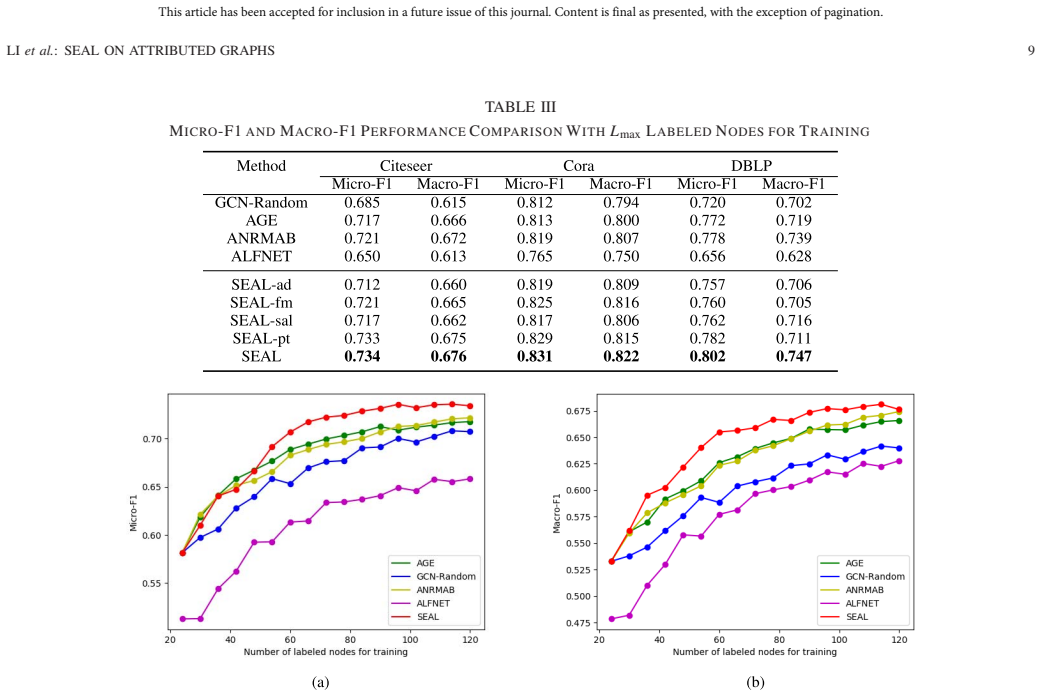
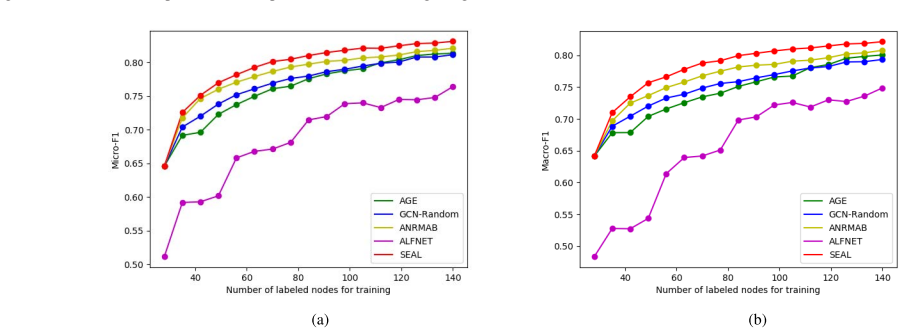
The central claim is that the divergence score $1-D(x)$, computed by a semi-supervised discriminator in a shared latent space, measures how much an unlabeled node would contribute to the classifier, and that the adversarial closed loop between the graph embedding network and the discriminator makes query selection and representation learning reinforce each other. The framework embeds all nodes with a graph convolutional network, uses pool tuning to move high-confidence unlabeled nodes into a pseudo-labeled pool, and then queries the node with maximal divergence from that pool. In the reported experiments SEAL outperforms the strongest baseline, ANRMAB, on Citeseer, Cora, and DBLP, and reaches 72.0% accuracy on Citeseer with 66 labeled nodes whereas the baseline needs about 120. The ablation studies attribute the gain to four components: the adversarial mechanism, feature matching, pool tuning, and the semi-supervised multi-output discriminator.
Load-bearing premise
The load-bearing premise is that the discriminator's divergence score $1-D(x)$ tracks how much labeling a node would improve the classifier, and that high-confidence pseudo-labeled nodes are correct often enough to keep the discriminator's reference distribution trustworthy.
Editorial extensions
If this is right
- Query scores live in a single latent space, so there is no need to weight heterogeneous strategies such as centrality, density, and entropy.
- The closed loop means each new label improves both the embedding and the discriminator, so the query strategy itself improves as labeling proceeds.
- Under a fixed labeling budget, SEAL reaches a given accuracy with fewer labels than its baselines, cutting labeling cost on the tested citation networks.
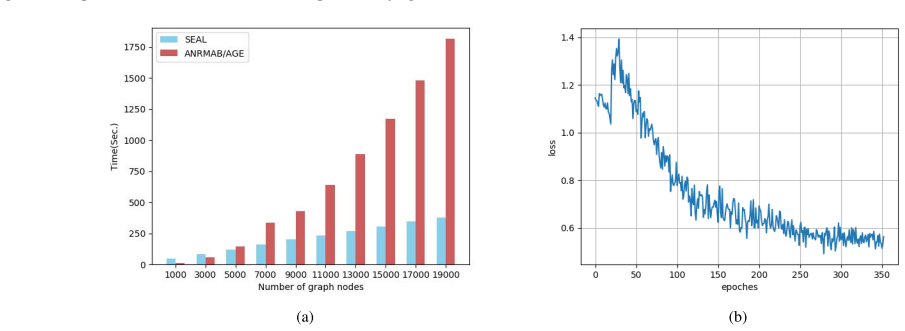
- The framework's per-iteration complexity grows linearly with the number of nodes, whereas the sorted scoring used by AGE and ANRMAB brings $O(N^2)$ overhead.
Reading between the lines
- If divergence is a faithful informativeness proxy, the same discriminator score could drive batch-mode active learning by taking the top-$k$ divergent nodes, something the paper does not test.
- The framework treats the embedding network as a GCN, but the adversarial loop is agnostic to the encoder; swapping in a graph attention network or a scalable sampling-based GNN would test whether the gain transfers.
- The pool-tuning premise implies a testable prediction: on graphs with high label noise or many outliers, high-confidence pseudo-labels will be wrong often enough to corrupt the discriminator, and SEAL's advantage over random selection should shrink.
- The divergence score resembles a measure of distribution mismatch, so similar adversarial active selection may apply to domain adaptation or dataset distillation on graphs, though the paper does not explore these.
Signed reviews
Editorial analysis
A structured set of objections, weighed in public.
Referee Report
Summary. The paper proposes SEAL, an adversarial active learning framework for node classification on attributed graphs. SEAL couples a graph convolutional embedding network with a semisupervised discriminator that outputs K+1 probabilities: K class probabilities plus one unlabeled probability. A pool-tuning step moves high-confidence unlabeled nodes into the p-labeled pool, and the divergence score div(x, L+) = 1 - D(x) from Eq. (14) is used to select the most informative unlabeled node for labeling. The two networks are trained adversarially, with the embedding network minimizing the feature discrepancy between p-labeled and p-unlabeled nodes (Eq. (5)) and the discriminator minimizing the combined supervised and unsupervised loss (Eq. (8)). Experiments on CiteSeer, Cora, DBLP, and Pubmed compare SEAL with AGE, ANRMAB, ALFNET, and GCN-Random, and report Micro-F1/Macro-F1 gains, labeling-budget curves, sensitivity analyses for the hyperparameters alpha and delta, and training-time comparisons.
Significance. If the central claim is correct, SEAL provides a unified latent-space informativeness score and a closed-loop interaction between the query engine and the classifier, which would be a useful advance over methods that linearly or bandit-combine classical query strategies. The paper has several strengths: it proposes a conceptually clean architecture, includes four ablation variants that isolate the contributions of the adversarial loop, feature matching, the semisupervised discriminator, and pool tuning, and provides a complexity analysis showing linear scaling in the number of edges and nodes. The comparison against AGE and ANRMAB is appropriate, and the labeling-budget experiments address a practically important question. However, the load-bearing premise that the discriminator's divergence score is a faithful informativeness proxy is asserted rather than established, and the empirical support is weakened by missing variance estimates and by hyperparameters tuned on the evaluation datasets. These issues are central to the paper's main claim and need to be addressed before the results can be considered reliable.
major comments (4)
- [Section IV-E and IV-G, Eq. (14)] The query score div(x, L+) = 1 - D(x) is introduced as an informativeness measure purely by intuition: no error-reduction bound, calibration analysis, or relation to classifier utility is provided. More seriously, the training objective in Eq. (5) explicitly minimizes the feature discrepancy between p-labeled and p-unlabeled nodes, i.e., it trains the embedding network to make the two distributions harder to distinguish, while Eq. (14) selects nodes based on their distinguishability. Section IV-G concedes that a perfect G would drive D toward no discriminative power and that the alternating optimization is 'not guaranteed to converge.' This means the method's training objective and its query signal are in direct tension, and the central claim that the score ranks nodes by how much labeling them improves the classifier is not supported by the arguments in the paper. To make the claim defensible, the authors should either provide a formal or empirical demonstration that 1 - D(x) tracks label utility, or run controlled experiments comparing the divergence-based selection against random selection, uncertainty sampling, and density-weighted sampling under the same GCN backbone and labeling budget. At minimum, the paper should report what happens to query quality when the adversarial loop partially or fully collapses, and should discuss how the user can detect such collapse in practice.
- [Table III and Section V-B/V-D] Section V-B states that results are averaged over 10 validation sets times 10 initial labeled sets, yet Table III reports only point estimates for Micro-F1 and Macro-F1, with no standard deviations, confidence intervals, or significance tests. The headline improvements over ANRMAB are 1.3%, 1.2%, and 2.4% Micro-F1 on CiteSeer, Cora, and DBLP; without variance information, it is impossible to tell whether these differences are meaningful or within run-to-run noise. The labeling-budget curves in Figs. 2-4 also appear to lack error bars. The authors should report standard deviations (or confidence intervals) for all main results and, ideally, paired significance tests between SEAL and each baseline using the same initial labeled sets and validation sets. If the raw per-run results are too large to include, they should be made available as supplementary material.
- [Section V-D, V-G, and V-H] The hyperparameters alpha and delta are set to 0.6 in the headline experiments (Section V-D), and Figs. 5 and 6 show sensitivity curves over delta and alpha on the same datasets (CiteSeer, Cora, DBLP) used to produce the headline results in Table III. This means the reported gains are partially selected rather than predicted: the best operating point on each dataset is chosen after observing test performance on that dataset. This is a form of tuning leakage that can inflate the apparent advantage of SEAL over baselines that use fixed hyperparameters. The authors should either fix alpha and delta on a validation split that is disjoint from the test split and from the hyperparameter exploration, or conduct a nested cross-validation procedure, and then report whether the Table III gains persist across a range of alpha and delta values rather than only at the peak of the sensitivity curves.
- [Section IV-C, Eqs. (6)-(7)] Pool tuning moves high-confidence unlabeled nodes into the p-labeled pool based on the current classifier's predicted probability P(y_hat | x) > delta. The correctness of this pseudo-labeling step is load-bearing because the discriminator's reference distribution L+ is built from these pseudo-labels; if high-confidence predictions are frequently wrong, the discriminator is trained against a distorted distribution and the divergence scores may be unreliable. The paper does not report pseudo-label accuracy on any dataset, nor does it analyze how the error rate of PT evolves with the labeling budget. The authors should report the fraction of pseudo-labeled nodes whose assigned pseudo-label matches the true label, and should include an ablation in which PT is given oracle labels (or removed, as in SEAL-pt) to quantify the sensitivity of the final performance to pseudo-label noise.
minor comments (4)
- [Section V-B] The description of the validation procedure is ambiguous: it says 'ten different validation sets' and 'repeat experiments for ten times on each validation set,' but Section V-G refers to '100 repeating tests on each threshold.' Please clarify whether the 100 runs are 10 validation sets x 10 initial labeled sets and state this explicitly in the main experimental setup.
- [Section IV-D] The optimality statement 'e^{l_j(x)} = c(x) p(y=j,x) for all j < K+1' is stated without a derivation or a precise definition of p(y=j,x) and c(x). As written, it is unclear whether p is over the joint data distribution or over a specific sampling distribution, and the claim that a perfect solution to J_unsup is also perfect for J_sup needs a supporting argument or a citation to the specific result in the referenced literature.
- [Algorithm 1, lines 4-7] The sequencing of pool tuning and discriminator updates is unclear: line 5 recomputes L+ and U- after each G update, but line 7 updates D using pools that may have been computed after the last G update. It would help to specify explicitly whether L+ and U- are recomputed before each D update or kept fixed during the inner D loop.
- [Section V-A and Table II] The paper refers to Table II for dataset statistics but does not describe the construction of the DBLP subgraph in the text, including the number of nodes, edges, class balance, or how the subgraph was extracted. These details should be reported in the text or in the table caption so that readers can judge the comparability of the datasets.
Circularity Check
Low circularity: headline Micro-F1 gains are partly selected rather than predicted because alpha and delta are tuned on the same evaluation datasets, but the core query-score derivation is definitional and self-contained.
-
fitted input called prediction
[Section V-D (Table III), with Section V-G (Fig. 5) and Section V-H (Fig. 6)]
"For SEAL, we set parameters α and δ to 0.6 for this experiment."
The paper sets α = δ = 0.6 after observing, on the same Citeseer/Cora/DBLP evaluation sets, that these values give the best Micro-F1 (Section V-G: 'SEAL achieves the best performance when δ is equal to 0.6'; Section V-H: 'reaches the peak at the point around α = 0.6'). Table III then reports SEAL's headline Micro-F1 advantages over ANRMAB using exactly these tuned values. The reported gain is therefore partially selected on the evaluation data rather than predicted by the framework. This is a mild circularity in the evaluation loop, not in the derivation of the query score.
full rationale
Apart from the hyperparameter-tuning loop above, the paper's derivation chain is self-contained: the active score div(x, L+) = 1 - D(x) (Eq. 14) is defined as the discriminator's estimated probability that a node is unlabeled (Eqs. 11-13), and the assertion that this score orders nodes by usefulness is an explicit intuition ('the more divergent an unlabeled node is from the existing labeled data, the more likely it would contribute useful information') rather than a theorem derived from label-utility or error reduction. No equation reduces the reported Micro-F1 improvements to the query score by construction, and the comparisons are against external baselines (AGE, ANRMAB, ALFNET, GCN-Random). The self-citations in the paper (e.g., [46] for the DBLP dataset) are not load-bearing. Section IV-G's concession that a perfect G would eliminate the divergence signal and that alternating optimization 'is not guaranteed to converge' is a robustness limitation, not a circular step. Thus the circularity burden is low; the main concern is that the headline gains are partly selected on the same datasets used for reporting.
Assumptions & free parameters
free parameters (3)
- alpha (adversarial loss weight) =
0.6
- delta (pool tuning threshold) =
0.6
- Network hyperparameters (lr 0.005/0.01, hidden 16/128x128xK, dropout 0.5, L2 5e-4, pretraining 300) =
learning rates 0.005/0.01; hidden 16 and 128x128xK; dropout 0.5; L2 5e-4; pretraining epochs 300
assumptions (4)
- ad hoc to paper The semisupervised discriminator's optimal solution to the combined loss has e^{l_j(x)} = c(x) p(y=j,x) for j<K+1, so J_unsup optimization also improves J_sup (Section IV-D).
- domain assumption The divergence score 1-D(x) faithfully measures how much labeling an unlabeled node would help the classifier (Section IV-E, Eq. 14).
- domain assumption High-confidence unlabeled nodes can be safely moved into the pseudo-labeled pool without introducing harmful label noise (Section IV-C, Eqs. 6-7).
- ad hoc to paper A perfect generator matching labeled and unlabeled distributions would not improve generalization, so a weaker generator is needed; alternating optimization without a convergence guarantee still yields a useful discriminator (Section IV-G).
Cite this review
Pith. "Pith review of SEAL: Semi-supervised Adversarial Active Learning on Attributed Graphs." pith.science (2026). https://pith.science/paper/WDQ2FCTS
@misc{pith2026190808169,
  author       = {Pith},
  title        = {Pith review of: SEAL: Semi-supervised Adversarial Active Learning on Attributed Graphs},
  year         = {2026},
  howpublished = {\url{https://pith.science/paper/WDQ2FCTS}},
  note         = {Machine review of arXiv:1908.08169}
}
read the original abstract
Active learning (AL) on attributed graphs has received increasing attention with the prevalence of graph-structured data. Although AL has been widely studied for alleviating label sparsity issues with the conventional non-related data, how to make it effective over attributed graphs remains an open research question. Existing AL algorithms on graphs attempt to reuse the classic AL query strategies designed for non-related data. However, they suffer from two major limitations. First, different AL query strategies calculated in distinct scoring spaces are often naively combined to determine which nodes to be labelled. Second, the AL query engine and the learning of the classifier are treated as two separating processes, resulting in unsatisfactory performance. In this paper, we propose a SEmi-supervised Adversarial active Learning (SEAL) framework on attributed graphs, which fully leverages the representation power of deep neural networks and devises a novel AL query strategy in an adversarial way. Our framework learns two adversarial components: a graph embedding network that encodes both the unlabelled and labelled nodes into a latent space, expecting to trick the discriminator to regard all nodes as already labelled, and a semi-supervised discriminator network that distinguishes the unlabelled from the existing labelled nodes in the latent space. The divergence score, generated by the discriminator in a unified latent space, serves as the informativeness measure to actively select the most informative node to be labelled by an oracle. The two adversarial components form a closed loop to mutually and simultaneously reinforce each other towards enhancing the active learning performance. Extensive experiments on four real-world networks validate the effectiveness of the SEAL framework with superior performance improvements to state-of-the-art baselines.
Figures

Figures from the paper (4 more)


Reference graph
Works this paper leans on
-
[1]
have been demonstrated to be effective in classifying many real-world networks. These algorithms rely on a sufficient number of labeled nodes provided to ensure desirable clas- sification accuracy. V ery often, however, acquiring a large quantity of node labels requires expert efforts and is very costly and time-consuming, which significantly limits the true...
work page 2020
-
[2]
We propose a novel adversarial AL framework that seamlessly incorporates AL into GNNs. Unlike previous methods that simply combine AL strategies residing at different scoring spaces, SEAL generates a unified informativeness score in a common latent space to enable instance selection, rendering the most desirable performance gains
-
[3]
To the best of our knowledge, we are the first to propose an Semisupervised Adversarial Learning (SAL) structure with multiple outputs for AL on attributed graphs. This offers an advantage that the graph embedding network and the discriminator can collaborate with each other to mutually strengthen their performance
-
[4]
The rest of this article is organized as follows
We validate our SEAL framework through extensive experiments and ablation studies on four real-world networks, demonstrating its superior performance to state-of-the-art baselines on node classification tasks. The rest of this article is organized as follows. Section II reviews the related literature. The problem statement and preliminaries are given in Se...
work page 2020
-
[5]
Taking graph G as input, the graph embedding network G(·) encodes both the labeled and unlabeled nodes into low-dimensional, latent node representations, H L and HU , respectively, with the aim to characterize their class attributes and fool the discriminator D(·) simultaneously
-
[6]
The latent node representations and their prediction probabilities are then passed to PT. PT picks a portion of nodes with high prediction certainty from the unlabeled pool U and moves them to the labeled pool L.T h e two tuned pools are named pseudo labeled (p-labeled) pool L + and pseudo unlabeled (p-unlabeled) pool U−, respectively. Correspondingly, th...
-
[7]
The discriminator network D(·) takes HL+ and HU− as input and maps them into a latent space to generate multiple outputs. These out puts not only produce the probabilities of nodes belonging to K classes but also generate a scoring function to quantify the informative- ness of unlabeled nodes with respect to the existing labeled data. The unlabeled node w...
work page 2020
-
[8]
AGE [19] and ANRMAB [20]: They are two state-of- the-art methods that combine GCN with classic AL strategies, via a linear combination of three AL query strategies (graph centrality, information density, and uncertainty sampling). ANRMAB improves AGE by dynamically adjusting the weights of different strategies based on the MAB reward. They differ from SEA...
Show all 60 references
-
[9]
This method is used to evaluate the advantages of GNN-based AL methods over traditional graph-based AL methods
ALFNET [12]: It is a traditional AL strategy that uses ICA and QBC ensemble to make instance selection. This method is used to evaluate the advantages of GNN-based AL methods over traditional graph-based AL methods. In our settings, we adapt it as a transductive semisupervised...
-
[10]
To assess the importance of different aspects of SEAL, we also compare with four variants of SEAL via ablation studies
GCN-Random [1]: It uses GCN as the classifier but randomly chooses one unlabeled node to query its label. To assess the importance of different aspects of SEAL, we also compare with four variants of SEAL via ablation studies
-
[11]
Specifically, it changes G(·)’s loss function in (5) as J G = JGCN
SEAL-ad: It is a variant of SEAL with adversarial learning obliterated. Specifically, it changes G(·)’s loss function in (5) as J G = JGCN. D(·) is still used to discriminate unlabeled from labeled nodes with loss function J D as (8), but loss of D(·) is not backpropa- gated to...
-
[12]
SEAL-fm: This method is a variant of SEAL to test the effectiveness of feature matching loss for generator G(·). Instead of minimizing feature matching loss as (5), it maximizes the log-likelihood of both labeled and unlabeled nodes to confuse D(·), which is given by J G =− Ex...
-
[13]
It is equivalent to setting α a s0i n( 8 ) , while other parameters remain the same as with SEAL
SEAL-sal: This method is another variant of SEAL that uses a cross-entropy based binary p-labeled/p-unlabeled discriminator. It is equivalent to setting α a s0i n( 8 ) , while other parameters remain the same as with SEAL
-
[14]
This is equiv- alent to setting δ to 1 in (6) and (7)
SEAL-pt: This method differs from SEAL in which it removes the operation of PT, and the generated nodes representations are directly sent to D(·). This is equiv- alent to setting δ to 1 in (6) and (7). Other parameters remain the same with SEAL. For classification, ALFNET uses ...
2020
-
[15]
Semi-supervised classification with graph convolutional networks,
T. N. Kipf and M. Welling, “Semi-supervised classification with graph convolutional networks,” in Proc. ICLR, 2017, pp. 1–13
2017
-
[16]
Active learning with extremely sparse labeled examples,
S. Sun and D. R. Hardoon, “Active learning with extremely sparse labeled examples,” Neurocomputing, vol. 73, nos. 16–18, pp. 2980–2988, Oct. 2010
2010
-
[17]
Learning and inference with constraints,
M.-W. Chang, L.-A. Ratinov, N. Rizzolo, and D. Roth, “Learning and inference with constraints,” in Proc. AAAI , 2008, pp. 1513–1518
2008
-
[18]
Heterogeneous uncertainty sampling for supervised learning,
D. D. Lewis and J. Catlett, “Heterogeneous uncertainty sampling for supervised learning,” in Machine Learning Proceedings .A m s t e r d a m , The Netherlands: Elsevier, 1994, pp. 148–156
1994
-
[19]
Toward optimal active learning through monte carlo estimation of error reduction,
N. Roy and A. McCallum, “Toward optimal active learning through monte carlo estimation of error reduction,” in Proc. ICML , vol. 2001, pp. 441–448
2001
-
[20]
Query by committee,
H. S. Seung, M. Opper, and H. Sompolinsky, “Query by committee,” in Proc. 5th Annu. Workshop Comput. Learn. Theory (COLT) , 1992, pp. 287–294
1992
-
[21]
Employing EM and pool- based active learning for text classification,
A. K. McCallumzy and K. Nigamy, “Employing EM and pool- based active learning for text classification,” in Proc. ICML , 1998, pp. 359–367
1998
-
[22]
A sequential algorithm for training text classifiers,
D. D. Lewis and W. A. Gale, “A sequential algorithm for training text classifiers,” in Proc. SIGIR. Dublin, Republic of Ireland: Springer, 1994, pp. 3–12. Authorized licensed use limited to: HEFEI UNIVERSITY OF TECHNOLOGY. Downloaded on August 06,2020 at 02:06:19 UTC from IEEE ...
1994
-
[23]
A variance minimization criterion to active learning on graphs,
M. Ji and J. Han, “A variance minimization criterion to active learning on graphs,” in Proc. AISTATS, 2012, pp. 556–564
2012
-
[24]
Towards active learning on graphs: An error bound minimization approach,
Q. Gu and J. Han, “Towards active learning on graphs: An error bound minimization approach,” in Proc. IEEE 12th Int. Conf. Data Mining, Dec. 2012, pp. 882–887
2012
-
[25]
σ -optimality for active learning on Gaussian random fields,
Y . Ma, R. Garnett, and J. Schneider, “σ -optimality for active learning on Gaussian random fields,” in Proc. NeurIPS, 2013, pp. 2751–2759
2013
-
[26]
Active learning for networked data,
M. Bilgic, L. Mihalkova, and L. Getoor, “Active learning for networked data,” in Proc. ICML, 2010, pp. 79–86
2010
-
[27]
Active class discovery and learning for networked data,
M. Fang, J. Yin, X. Zhu, and C. Zhang, “Active class discovery and learning for networked data,” in Proc. SIAM Int. Conf. Data Mining , May 2013, pp. 315–323
2013
-
[28]
Active sampling for graph-aware classification,
D. Berberidis and G. B. Giannakis, “Active sampling for graph-aware classification,” in Proc. IEEE Global Conf. Signal Inf. Process. (Glob- alSIP), Nov. 2017, pp. 648–652
2017
-
[29]
Graph attention networks,
P . V eliˇckovi´c, G. Cucurull, A. Casanova, A. Romero, P . Liò, and Y . Bengio, “Graph attention networks,” 2017, arXiv:1710.10903. [Online]. Available: http://arxiv.org/abs/1710.10903
2017 arXiv
-
[30]
Deep attributed net- work embedding by preserving structure and attribute information,
R. Hong, Y . He, L. Wu, Y . Ge, and X. Wu, “Deep attributed net- work embedding by preserving structure and attribute information,” IEEE Trans. Syst., Man, Cybern. Syst. , early access, Mar. 1, 2019, doi: 10.1109/TSMC.2019.2897152
2019
-
[31]
Link-based classification,
Q. Lu and L. Getoor, “Link-based classification,” in Proc. ICML, 2003, pp. 496–503
2003
-
[32]
Deepwalk: Online learning of social representations,
B. Perozzi, R. Al-Rfou, and S. Skiena, “Deepwalk: Online learning of social representations,” in Proc. 20th ACM SIGKDD Int. Conf. Knowl. Discovery Data Mining , 2014, pp. 701–710
2014
-
[33]
Active learning for graph embedding,
H. Cai, V . W. Zheng, and K. Che n-Chuan Chang, “Active learning for graph embedding,” 2017, arXiv:1705.05085. [Online]. Available: http://arxiv.org/abs/1705.05085
2017 arXiv
-
[34]
Active discriminative network representation learning,
L. Gao, H. Y ang, C. Zhou, J. Wu, S. Pan, and Y . Hu, “Active discriminative network representation learning,” in Proc. 27th Int. Joint Conf. Artif. Intell. , Jul. 2018, pp. 2142–2148
2018
-
[35]
Multiple-instance active learning,
B. Settles, M. Craven, and S. Ray, “Multiple-instance active learning,” in Proc. NeurIPS, 2008, pp. 1289–1296
2008
-
[36]
Scalable active learning for multiclass image classification,
A. J. Joshi, F. Porikli, and N. P . Papanikolopoulos, “Scalable active learning for multiclass image classification,” IEEE Trans. Pattern Anal. Mach. Intell. , vol. 34, no. 11, pp. 2259–2273, Nov. 2012
2012
-
[37]
Neural networks and the bias/variance dilemma,
S. Geman, E. Bienenstock, and R. Doursat, “Neural networks and the bias/variance dilemma,” Neural Comput. , vol. 4, no. 1, pp. 1–58, Jan. 1992
1992
-
[38]
Information-ba sed objective functions for active data selection,
D. J. C. MacKay, “Information-ba sed objective functions for active data selection,” Neural Comput. , vol. 4, no. 4, pp. 590–604, Jul. 1992
1992
-
[39]
An analysis of active learning strategies for sequence labeling tasks,
B. Settles and M. Craven, “An analysis of active learning strategies for sequence labeling tasks,” in Proc. Conf. Empirical Methods Natural Lang. Process. (EMNLP) , 2008, pp. 1070–1079
2008
-
[40]
Selective sampling for example-based word sense disambiguation,
A. Fujii, T. Tokunaga, K. Inui, and H. Tanaka, “Selective sampling for example-based word sense disambiguation,” Comput. Linguist. , vol. 24, no. 4, pp. 573–597, Dec. 1998
1998
-
[41]
Active learning literature survey,
B. Settles, “Active learning literature survey,” Dept. Comput. Sci., Univ. Wisconsin-Madison, Madison, WI, USA, Tech. Rep. 1648, 2009
2009
-
[42]
C. C. Aggarwal, Data Classification: Algorithms and Applications. Boca Raton, FL, USA: CRC Press, 2014
2014
-
[43]
Batch mode active learning for networked data,
L. Shi, Y . Zhao, and J. Tang, “Batch mode active learning for networked data,” ACM Trans. Intell. Syst. Technol. , vol. 3, no. 2, pp. 1–25, 2012
2012
-
[44]
Active semi-supervised learning using s ubmodular functions,
A. Guillory and J. A. Bilmes, “Active semi-supervised learning using s ubmodular functions,” 2012, arXiv:1202.3726. [Online]. Available: http://arxiv.org/abs/1202.3726
2012 arXiv
-
[45]
Label selection on graphs,
A. Guillory and J. A. Bilmes, “Label selection on graphs,” in Proc. NeurIPS, 2009, pp. 691–699
2009
-
[46]
Graph-based active learning based on label propagation,
J. Long, J. Yin, W. Zhao, and E. Zhu, “Graph-based active learning based on label propagation,” in Proc. MDAI. Catalonia, Spain: Springer, 2008, pp. 179–190
2008
-
[47]
A scalable algorithm for graph- based active learning,
W. Zhao, J. Long, E. Zhu, and Y . Liu, “A scalable algorithm for graph- based active learning,” in Proc. F AW. Changsha, China: Springer, 2008, pp. 311–322
2008
-
[48]
Combining active learning and semi-supervised learning using Gau ssian fields and harmonic functions,
X. Zhu, J. Lafferty, and Z. Ghahramani, “Combining active learning and semi-supervised learning using Gau ssian fields and harmonic functions,” in ICML workshop , vol. 3, 2003, pp. 1–8
2003
-
[49]
Data-adaptive active sampling for efficient graph-cognizant classification,
D. Berberidis and G. B. Giannakis, “Data-adaptive active sampling for efficient graph-cognizant classification,” IEEE Trans. Signal Process. , vol. 66, no. 19, pp. 5167–5179, Oct. 2018
2018
-
[50]
Combining link and content for col- lective active learning,
L. Shi, Y . Zhao, and J. Tang, “Combining link and content for col- lective active learning,” in Proc. 19th ACM Int. Conf. Inf. Knowl. Manage. (CIKM), 2010, pp. 1829–1832
2010
-
[51]
A survey on instance selection for active learning,
Y . Fu, X. Zhu, and B. Li, “A survey on instance selection for active learning,” Knowl. Inf. Syst. , vol. 35, no. 2, pp. 249–283, May 2013
2013
-
[52]
Generative adversarial nets,
I. Goodfellow, et al. , “Generative adversarial nets,” in Proc. NeurIPS , 2014, pp. 2672–2680
2014
-
[53]
Adversarial active learning for sequences labeling and generation,
Y . Deng, K. Chen, Y . Shen, and H. Jin, “Adversarial active learning for sequences labeling and generation,” in Proc. 27th Int. Joint Conf. Artif. Intell., Jul. 2018, pp. 4012–4018
2018
-
[54]
V ariational adversarial active learning,
S. Sinha, S. Ebrahimi, and T. Darrell, “V ariational adversarial active learning,” in Proc. IEEE/CVF Int. Conf. Comput. Vis. (ICCV) , Oct. 2019, pp. 5972–5981
2019
-
[55]
Improved techniques for training GANs,
T. Salimans, I. Goodfellow, W. Zaremba, V . Cheung, A. Radford, and X. Chen, “Improved techniques for training GANs,” in Proc. NeurIPS , 2016, pp. 2234–2242
2016
-
[56]
Semi- supervised learning based on generative adversarial network: A com- parison between good GAN and bad GAN approach,
W. Li, Z. Wang, J. Li, J. Polson, W. Speier, and C. Arnold, “Semi- supervised learning based on generative adversarial network: A com- parison between good GAN and bad GAN approach,” in Proc. CVPR W orkshop, 2019, pp. 1–11
2019
-
[57]
Towards principled unsupervised learning,
I. Sutskever, R. Jozefowicz, K. Gregor, D. Rezende, T. Lillicrap, and O. Vinyals, “Towards principled unsupervised learning,” 2015, arXiv:1511.06440. [Online]. Available: http://arxiv.org/abs/1511.06440
2015 arXiv
-
[58]
Good semi-supervised learning that requires a bad GAN,
Z. Dai, Z. Y ang, F. Y ang, W. W. Cohen, and R. R. Salakhutdinov, “Good semi-supervised learning that requires a bad GAN,” in Proc. NeurIPS , 2017, pp. 6510–6520
2017
-
[59]
Collective classification in network data,
P . Sen, G. Namata, M. Bilgic, L. Getoor, B. Galligher, and T. Eliassi- Rad, “Collective classification in network data,” AI Mag., vol. 29, no. 3, p. 93, Sep. 2008
2008
-
[60]
Attributed network embedding via subspace discovery,
D. Zhang, J. Yin, X. Zhu, and C. Zhang, “Attributed network embedding via subspace discovery,” Data Mining Knowl. Discovery , vol. 33, no. 6, pp. 1953–1980, Nov. 2019. Yayong Li received the master’s degree from the University of Electronic Science and Technology of China, Che...
1953
Reviewed August 14, 2026 · model on record in the stance chip above.
Discussion (0). Continue with ORCID to comment.