REVIEW 3 major objections 5 minor 58 references
New magicity $N=32$ and $34$ triggered by strong couplings between Dirac inversion partners
T0 review · 3 major / 5 minor · reviewed 2026-08-14 · deepseek-v4-flash
Pith's one-line read One repulsive orbit coupling opens both new neutron magic numbers, N=32 and N=34.
desk verdict A mechanistic, relativistic explanation of the N=32/34 magicity with a clean term-dropping test; the 46Si boundary prediction is the soft spot. read the letter →
The pith
A machine-rendered reading of the paper's core claim, the machinery that carries it, and where it could break.
The reading
What carries the argument
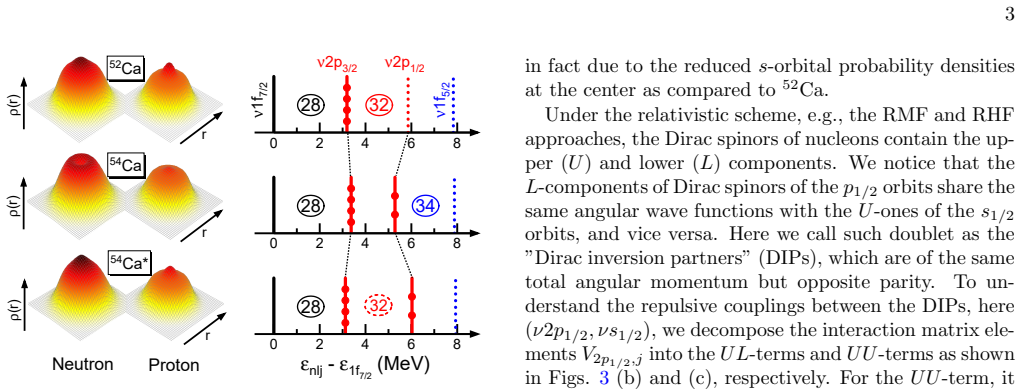
The central object is the Dirac inversion partner (DIP) pair $(s_{1/2}, p_{1/2})$: two orbits of the same total angular momentum and opposite parity whose Dirac upper and lower components share angular wavefunctions, so the upper component of one looks like the lower component of the other. The machinery is the UL-term—the Fock contribution coupling an upper component of one spinor to a lower component of another—which the paper shows is strongly repulsive for exactly this pair in the PKA1 Lagrangian. That repulsion is the control knob for the $2p$ spin-orbit splitting and for the central-density evolution that goes with it: it is responsible for the density change from $^{52}$Ca to $^{54}$Ca and for the persistence of the $N=32$ splitting along the isotopic chain.
What would settle it
Measure the first $2^{+}_{1}$ excitation energy or the two-neutron separation energy of $^{46}$Si at $N=32$: if $^{46}$Si shows a shell-like jump comparable to $^{48}$S and $^{50}$Ar, the predicted disappearance of $N=32$ magicity is wrong. Alongside that, measuring proton separation energies across the Si–S–Ar chain would test whether the $Z=16$ gap really empties the $2s_{1/2}$ orbit as the mechanism requires.
Extended reading notes
Core claim
The paper's central claim is that the same coupling that opens the $N=32$ shell in $^{52}$Ca also opens the $N=34$ shell in $^{54}$Ca, so the two magic numbers should be understood together rather than as independent shell effects. Along the $N=32$ isotonic chain, the upper–lower (UL) terms of the Dirac-inversion-partner interaction between $s_{1/2}$ and $2p_{1/2}$ dominate the evolution of the $2p$ spin-orbit splitting. Moving from $^{52}$Ca to $^{54}$Ca fills the neutron $2p_{1/2}$ orbit, turns on the strong repulsion, flattens the central density, and reduces the $2p$ splitting to a value that places the gap above $2p_{1/2}$—the $N=34$ shell. The model also predicts that $N=32$ persists through $^{48}$S, with the full proton $2s_{1/2}$ orbit sustaining the DIP repulsion, and vanishes in $^{46}$Si, where that orbit is empty.
Load-bearing premise
The prediction rests on treating all the relevant nuclei as spherical and on the single PKA1 Lagrangian with pairing; if $^{46}$Si is deformed, or if the model's $Z=16$ proton gap exaggerates the stability of the filled $2s_{1/2}$ orbit, the boundary between $^{48}$S and $^{46}$Si could be a model artifact rather than a real transition.
Editorial extensions
If this is right
- If the mechanism is correct, $N=32$ and $N=34$ are not independent shell effects but two outcomes of one repulsive $s_{1/2}$–$2p_{1/2}$ coupling, so any model missing that coupling should fail to reproduce one or both magic numbers.
- The calculation places the $N=32$ boundary at $^{48}$S: $^{50}$Ar and $^{48}$S keep the shell, $^{46}$Si loses it, a sequence that gamma-ray or mass measurements can check.
- The proton $Z=16$ subshell becomes a necessary ingredient, making $^{48}$S doubly magic in the model.
- Because the deciding UL-terms only appear in Fock-type relativistic theories, the result explains why mean-field-only relativistic models systematically miss the $N=34$ gap.
Reading between the lines
- A natural extension, not made in the paper, is to treat the mechanism as a density-feedback loop: if the central density is artificially suppressed or enhanced, the $2p$ spin-orbit splitting and the $N=32/34$ gaps should move in the opposite direction, a test that could be run in any spherical model.
- The same DIP argument should be examined in neighbouring chains where $s_{1/2}$ and $p_{1/2}$ occupations shift, for example $N=34$ isotones below $Z=20$ or $N=32$ isotones beyond calcium; the paper only asserts the $Z=16$ boundary.
- The Fock UL-repulsion is a relativistic way to encode correlations often assigned to tensor forces or three-body terms in non-relativistic treatments; a many-body calculation that decomposes its interaction into angular-momentum-coupled pieces could reveal whether the same repulsion has a common non-relativistic ancestor, but the paper does not make that comparison.
Signed reviews
Editorial analysis
A structured set of objections, weighed in public.
Referee Report
Summary. The paper studies the successive new magic numbers N=32 and N=34 in neutron-rich Ca isotopes within relativistic Hartree-Fock theory using the PKA1 Lagrangian. It identifies the strong repulsive coupling between the s1/2 and ν2p1/2 orbits, termed 'Dirac inversion partners' (DIPs), as the key mechanism that opens both subshells. The mechanism is supported by a comparison of interaction matrix elements among PKA1, PKO3, and DD-ME2, by the decomposition into UL- and UU-terms, and by a test calculation in which the repulsive UL-terms are artificially dropped in 54Ca, which destroys the N=34 shell and restores a 52Ca-like density profile. The authors further use the mechanism to predict that N=32 magicity persists until 48S but disappears in 46Si. The paper is concise, presents a falsifiable boundary prediction, and addresses a topic of current experimental interest, but it relies on a single Lagrangian and on spherical mean-field calculations without quantitative uncertainty estimates or a deformation study of the key prediction.
Significance. If the mechanism is correct, the paper offers a unified, parameter-free-in-mechanism interpretation of both new magic numbers from one coupling between Dirac inversion partners, and it gives a specific, experimentally testable boundary at 48S versus 46Si. The term-dropping test in 54Ca is a genuinely informative diagnostic, and the isotonic-boundary prediction is falsifiable. The strength of the paper is that it connects a relativistic mean-field feature (UL-terms in the Fock channel) to observed shell evolution and generates a concrete prediction. The main limitations are the model dependence of the evidence and the absence of deformed calculations for the predicted boundary isotone; these do not invalidate the mechanism but do limit the confidence with which the boundary prediction can be stated.
major comments (3)
- [Fig. 4 and the text on deformation ('the effects of deformation are not considered')] The prediction that N=32 magicity is reserved until 48S but vanishes in 46Si rests on spherical RHF+BCS calculations with the single PKA1 Lagrangian. The text's disclaimer that deformation is not considered because most of the concerned nuclei are spherical does not cover 46Si, which is a far-from-stability isotone where deformation is plausible. If 46Si is deformed, the spherical ν2p splitting and the π2s1/2 occupation argument in Fig. 4(b) would not be the determining physics, and the predicted disappearance of N=32 magicity could be a model artifact. Please provide deformed RHF(B) calculations for 46Si and neighboring isotones, or at least a quantitative estimate of the deformation energy and its effect on the N=32 gap, before stating the boundary prediction as a firm result.
- [Selection of PKA1 and Fig. 1] As acknowledged in the introduction, PKA1 was chosen because it already reproduces the successive magicity N=32 and 34 in Ref. [50]. The central comparison is therefore between a Lagrangian selected for this success and two Lagrangians that fail. This introduces a degree of circularity: the mechanism is partly an interpretation of the model's tuning rather than an independent consequence. The paper should address this directly, for example by testing whether the UL-term repulsion between (s1/2, ν2p1/2) and the 54Ca* term-dropping result are robust to parameter variations within the model family, or by showing that the same repulsion would emerge for reasonable Lagrangians that do not already reproduce the magicity.
- [Fig. 1 and systematic overestimation of S2n] The text states that S2n values are systematically overestimated by PKA1, yet the reproduction of magicity is inferred from the parallel trend and from the differences δe and Δ2n. Since δe and Δ2n are constructed from differences of S2n, the systematic error may partially cancel, but the paper provides no numerical values, no uncertainties, and no quantitative criterion for 'magicity' (for example, the size of Δ2n relative to neighboring isotones or an odd-even staggering measure). A quantitative statement would strengthen the claim that PKA1 properly reproduces the sudden drops at N=32 and N=34, and would also give readers a way to evaluate the model dependence of the subsequent mechanism analysis.
minor comments (5)
- [Conclusion] In the concluding paragraph, 'cental-depressed' should be 'central-depressed' and 'spliting' should be 'splitting'.
- [Fig. 3] The panel labels in the Fig. 3 caption are garbled ('Total54Ca(a)', 'UL-terms(b)', 'UU-terms(c)'); please format them properly as subcaptions.
- [Fig. 4] The axis label of Fig. 4(a), 'E (MeV)Proton number', needs proper spacing and formatting, and the panel (b) label 'N =32165' appears corrupted.
- [Definition of DIPs] The term 'Dirac inversion partners' is introduced verbally; an explicit expression showing the shared angular wave functions between the upper component of s1/2 and the lower component of p1/2, and vice versa, would make the definition more precise and self-contained.
- [References] In Ref. [57], the author name appears as 'Magueron' in the bibliography; please check whether it should be 'Margueron'.
Circularity Check
No significant circularity: the PKA1-based mechanism is tested by an in-model intervention and the 48S/46Si boundary is a computed, falsifiable prediction, not a refitted input.
full rationale
The paper's load-bearing steps were inspected for reductions to inputs. (1) The choice of PKA1 is justified by its known reproduction of N=32 and N=34 magicity, citing prior work including co-author W.H. Long [50]. This is a self-citation, but it is not load-bearing by itself: the present paper independently compares PKA1 S2n, delta_e, and Delta_2n values with experimental data in Fig. 1, so the model's empirical adequacy is re-demonstrated in the manuscript. (2) The central mechanistic claim, that repulsive UL-term couplings between Dirac inversion partners (s1/2 and nu2p1/2) open the N=32 and N=34 subshells, is not assumed by construction. The interaction matrix elements V_{2p1/2,j} are computed from the Lagrangian, decomposed into UL- and UU-contributions, and then tested by the 54Ca* calculation in which the repulsive UL-terms felt by s-orbits from nu2p1/2 are dropped; the disappearance of the N=34 gap in that controlled calculation is an in-model intervention, not a definitional equivalence. (3) The prediction that N=32 magicity is reserved until 48S but vanishes in 46Si is obtained from PKA1 for isotones outside the fitted data set, and the text explicitly notes the spherical approximation. That spherical, single-Lagrangian limitation is a robustness and correctness concern, not circularity: no fitted parameter is renamed as a prediction and no equation reduces to an input. No quoted equation or derivation step exhibits self-definition, fitted-input-as-prediction, author-imported uniqueness, or ansatz-by-citation. The derivation chain is therefore self-contained at the level of circularity analysis.
Assumptions & free parameters
free parameters (2)
- PKA1 effective Lagrangian parameters =
not quoted in this paper; fixed in Ref [45]
- Gogny D1S pairing parameters =
fixed in Ref [51]
assumptions (4)
- domain assumption The nuclei considered are spherical, so deformation can be neglected.
- domain assumption BCS pairing with the finite-range Gogny D1S force, with blocking for odd isotopes, is adequate.
- domain assumption PKA1 is a valid effective Lagrangian for these neutron-rich nuclei.
- ad hoc to paper Dropping the UL-terms isolates their causal role in opening N=34.
invented entities (1)
-
Dirac inversion partners (DIPs)
Cite this review
Pith. "Pith review of New magicity $N=32$ and $34$ triggered by strong couplings between Dirac inversion partners." pith.science (2026). https://pith.science/paper/BUDZHGH2
@misc{pith2026190808177,
  author       = {Pith},
  title        = {Pith review of: New magicity $N=32$ and $34$ triggered by strong couplings between Dirac inversion partners},
  year         = {2026},
  howpublished = {\url{https://pith.science/paper/BUDZHGH2}},
  note         = {Machine review of arXiv:1908.08177}
}
abstract
Inspired by recent experiments, the successive new magicity $N = 32$ and $34$ in Ca isotopes are studied within the relativistic density functional theory. It is illustrated that the strong couplings between the $s_{1/2}$ and neutron ($\nu$) $\nu2p_{1/2}$ orbits, here referred as "Dirac inversion partners" (DIPs), play a key role in opening both subshells $N = 32$ and $34$. Such strong couplings originate from the inversion similarity between the DIPs, that the upper component of the Dirac spinor of one partner shares the same orbital angular momentum as the lower component of the other, and vice versa. Following the revealed mechanism, it is predicted that the magicity $N = 32$ is reserved until $^{48}$S, but vanishes in $^{46}$Si.
Figures


Figures from the paper (1 more)

Reference graph
Works this paper leans on
-
[50]
J. J. Li, J. Margueron, W. H. Long, and N. V. Giai, Phys. Lett. B 753, 97 (2016)
work page 2016
-
[1]
M. G. Mayer, Phys. Rev. 74, 235 (1948)
1948
-
[2]
Haxel, J
O. Haxel, J. H. D. Jensen, and H. E. Suess, Phys. Rev. 75, 1766 (1949)
1949
- [3]
-
[4]
T. Motobayashi, Y. Ikeda, K. Ieki, M. Inoue, N. Iwasa, T. Kikuchi, M. Kurokawa, S. Moriya, S. Ogawa, H. Mu- rakami, et al., Phys. Lett. B 346, 9 (1995)
work page 1995
-
[5]
Ozawa, T
A. Ozawa, T. Kobayashi, T. Suzuki, K. Yoshida, and I. Tanihata, Phys. Rev. Lett. 84, 5493 (2000)
2000
-
[6]
C. R. Hoffman, T. Baumann, D. Bazin, J. Brown, G. Christian, et al., Phys. Rev. Lett. 100, 152502 (2008)
work page 2008
-
[7]
R. Kanungo, C. Nociforo, A. Prochazka, T. Aumann, D. Boutin, et al., Phys. Rev. Lett. 102, 152501 (2009)
work page 2009
Show all 58 references
-
[8]
Tshoo, Y
K. Tshoo, Y. Satou, H. Bhang, S. Choi, T. Naka- mura, Y. Kondo, S. Deguchi, Y. Kawada, N. Kobayashi, Y. Nakayama, et al., Phys. Rev. Lett. 109, 022501 (2012)
2012
-
[9]
Tanihata, H
I. Tanihata, H. Savajols, and R. Kanungo, Prog. Part. Nucl. Phys. 68, 215 (2013)
2013
-
[10]
J. I. Prisciandaro, P. F. Mantica, B. A. Brown, D. W. Anthony, M. W. Cooper, A. Garcia, D. E. Groh, A. Komives, W. Kumarasiri, and P. A. Lofy, Phys. Lett. B 510, 17 (2001)
2001
-
[11]
R. V. F. Janssens, B. Fornal, P. F. Mantica, B. A. Brown, R. Broda, P. Bhattacharyya, M. P. Carpenter, M. Cinau- 5 sero, P. J. Daly, A. D. Davies, et al., Phys. Lett. B 546, 55 (2002)
2002
-
[12]
D. C. Dinca, R. V. F. Janssens, A. Gade, D. Bazin, R. Broda, B. A. Brown, C. M. Campbell, M. P. Car- penter, P. Chowdhury, J. M. Cook, et al., Phys. Rev. C 71 (2005)
2005
-
[13]
A. Gade, R. V. F. Janssens, D. Bazin, R. Broda, B. A. Brown, et al., Phys. Rev. C 74, 021302 (2006)
2006
-
[14]
Steppenbeck, S
D. Steppenbeck, S. Takeuchi, N. Aoi, P. Doornenbal, M. Matsushita, et al., Phys. Rev. Lett. 114, 252501 (2015)
2015
-
[15]
Wienholtz, D
F. Wienholtz, D. Beck, K. Blaum, C. Borgmann, M. Bre- itenfeldt, R. B. Cakirli, S. George, F. Herfurth, J. D. Holt, M. Kowalska, et al., Nature 498, 346 (2013)
2013
-
[16]
A. T. Gallant, J. C. Bale, T. Brunner, U. Chowdhury, S. Ettenauer, A. Lennarz, D. Robertson, V. V. Simon, A. Chaudhuri, J. D. Holt, et al., Phys. Rev. Lett. 109, 032506 (2012)
2012
-
[17]
Rosenbusch, P
M. Rosenbusch, P. Ascher, D. Atanasov, C. Barbieri, D. Beck, K. Blaum, C. Borgmann, M. Breitenfeldt, R. B. Cakirli, A. Cipollone, et al., Phys. Rev. Lett.114, 202501 (2015)
2015
-
[18]
X. Xu, M. Wang, K. Blaum, J. D. Holt, Y. A. Litvinov, A. Schwenk, J. Simonis, S. R. Stroberg, Y. H. Zhang, H. S. Xu, et al., Phys. Rev. C 99, 064303 (2019)
2019
-
[19]
M. P. Reiter, S. A. S. Andres, E. Dunling, B. Kootte, E. Leistenschneider, C. Andreoiu, C. Babcock, B. R. Bar- quest, J. Bollig, T. Brunner, et al., Phys. Rev. C 98 (2018)
2018
-
[20]
Steppenbeck, S
D. Steppenbeck, S. Takeuchi, N. Aoi, P. Doornenbal, M. Matsushita, H. Wang, H. Baba, N. Fukuda, S. Go, M. Honma, et al., Nature 502, 207 (2013)
2013
-
[21]
S. N. Liddick, P. F. Mantica, R. V. F. Janssens, R. Broda, B. A. Brown, et al., Phys. Rev. Lett. 92, 072502 (2004)
2004
-
[22]
T. R. Rodriguez and J. L. Egido, Phys. Rev. Lett. 99, 062501 (2007)
2007
-
[23]
Hagen, M
G. Hagen, M. Hjorth-Jensen, G. R. Jansen, R. Machleidt, and T. Papenbrock, Phys. Rev. Lett.109, 032502 (2012)
2012
-
[24]
Honma, T
M. Honma, T. Otsuka, B. A. Brown, and T. Mizusaki, The European Physical Journal A 25, 499 (2005)
2005
-
[25]
Hergert, S
H. Hergert, S. K. Bogner, T. D. Morris, S. Binder, A. Calci, J. Langhammer, and R. Roth, Phys. Rev. C 90, 041302 (2014)
2014
-
[26]
Michimasa, M
S. Michimasa, M. Kobayashi, Y. Kiyokawa, S. Ota, D. S. Ahn, H. Baba, G. P. A. Berg, M. Dozono, N. Fukuda, T. Furuno, et al., Phys. Rev. Lett. 121, 022506 (2018)
2018
-
[27]
H. N. Liu, A. Obertelli, P. Doornenbal, C. A. Bertu- lani, G. Hagen, J. D. Holt, G. R. Jansen, T. D. Morris, A. Schwenk, R. Stroberg, et al., Phys. Rev. Lett. 122, 072502 (2019)
2019
-
[28]
J. D. Walecka, Ann. Phys. (N.Y.) 83, 491 (1974)
1974
-
[29]
B. D. Serot and J. D. Walecka, Adv. Nucl. Phys. 16, 1 (1986)
1986
-
[30]
Otsuka, T
T. Otsuka, T. Suzuki, R. Fujimoto, H. Grawe, and Y. Akaishi, Phys. Rev. Lett. 95, 232502 (2005)
2005
-
[31]
L. J. Jiang, S. Yang, B. Y. Sun, W. H. Long, and H. Q. Gu, Phys. Rev. C 91 , 034326 (2015)
2015
-
[32]
Zong and B.-Y
Y.-Y. Zong and B.-Y. Sun, Chin. Phys. C 42, 024101 (2018)
2018
-
[33]
Z. Wang, Q. Zhao, H. Liang, and W. H. Long, Phys. Rev. C 98, 034313 (2018)
2018
-
[34]
Reinhard, Reports on Progress in Physics 52, 439 (1989)
P.-G. Reinhard, Reports on Progress in Physics 52, 439 (1989)
1989
-
[35]
Y. K. Gambhir, P. Ring, and A. Thimet, Ann. Phys.198, 132 (1990)
1990
-
[36]
Ring, Prog
P. Ring, Prog. Part. Nucl. Phys. 37, 193 (1996)
1996
-
[37]
Bender, P.-H
M. Bender, P.-H. Heenen, and P.-G. Reinhard, Revs. Mod. Phys. 75, 121 (2003)
2003
-
[38]
Vretenar, A
D. Vretenar, A. V. Afanasjev, G. A. Lalazissis, and P. Ring, Phys. Rep. 409, 101 (2005)
2005
-
[39]
J. Meng, H. Toki, S. G. Zhou, S. Q. Zhang, W. H. Long, and L. S. Geng, Prog. Part. Nucl. Phys. 57, 470 (2006)
2006
-
[40]
Liang, J
H. Liang, J. Meng, and S.-G. Zhou, Phys. Rep. 570, 1 (2015)
2015
-
[41]
G. A. Lalazissis, T. Nikˇ si´ c, D. Vretenar, and P. Ring, Phys. Rev. C 71 , 024312 (2005)
2005
-
[42]
W. H. Long, J. Meng, N. V. Giai, and S.-G. Zhou, Phys. Rev. C 69 , 034319 (2004)
2004
-
[43]
W. H. Long, N. Van Giai, and J. Meng, Phys. Lett. B 640, 150 (2006)
2006
-
[44]
W. H. Long, H. Sagawa, J. Meng, and N. Van Giai, Eu- rophys. Lett. 82, 12001 (2008)
2008
-
[45]
W. H. Long, H. Sagawa, N. Van Giai, and J. Meng, Phys. Rev. C 76 , 034314 (2007)
2007
-
[46]
W. H. Long, T. Nakatsukasa, H. Sagawa, J. Meng, H. Nakada, and Y. Zhang, Phys. Lett. B 680 , 428 (2009)
2009
-
[47]
W. H. Long, P. Ring, J. Meng, N. Van Giai, and C. A. Bertulani, Phys. Rev. C 81 , 031302 (2010)
2010
-
[48]
L. J. Wang, J. M. Dong, and W. H. Long, Phys. Rev. C 87, 047301 (2013)
2013
-
[49]
L.-S. Geng, J. Meng, H. Toki, W.-H. Long, and G. Shen, Chin. Phys. Lett. 23, 1139 (2006)
2006
-
[51]
J. F. Berger, M. Girod, and D. Gogny, Nucl. Phys. A 428, 23 (1984)
1984
-
[52]
W. H. Long, P. Ring, N. V. Giai, and J. Meng, Phys. Rev. C 81 , 024308 (2010)
2010
-
[53]
M. Wang, G. Audi, F. G. Kondev, W. J. Huang, S. Naimi, and X. Xu, Chinese Physics C 41 (2017)
2017
-
[54]
Satula, J
W. Satula, J. Dobaczewski, and W. Nazarewicz, Phys. Rev. Lett. 81, 3599 (1998)
1998
-
[55]
B. G. Todd-Rutel, J. Piekarewicz, and P. D. Cottle, Phys. Rev. C 69, 021301 (2004)
2004
-
[56]
Burgunder, O
G. Burgunder, O. Sorlin, F. Nowacki, S. Giron, F. Ham- mache, M. Moukaddam, N. de Sereville, D. Beaumel, L. Caceres, E. Clement, et al., Phys. Rev. Lett. 112, 042502 (2014)
2014
-
[57]
J. J. Li, W. H. Long, J. Magueron, and N. V. Giai, Phys. Lett. B 788, 192 (2019)
2019
-
[58]
Otsuka, A
T. Otsuka, A. Gade, O. Sorlin, T. Suzuki, and Y. Utsuno, arXiv:1805.06501 (2018)
2018 arXiv
Reviewed August 14, 2026 · model on record in the stance chip above.
Discussion (0). Continue with ORCID to comment.