REVIEW 2 major objections 4 minor 63 references
Weak Gravitational Field Effects On Large-Scale Optical Interferometric Bell Tests
T0 review · 2 major / 4 minor · reviewed 2026-08-14 · deepseek-v4-flash
Pith's one-line read A weak gravitational field can generate entangled photon pairs
desk verdict The central claim fails because the gravitational time delay the post-selection must resolve is ~10^-17 s at the proposed scale, far below photon coherence and detector jitter, though the derivations are clean and internally consistent. read the letter →
The pith
A machine-rendered reading of the paper's core claim, the machinery that carries it, and where it could break.
The reading
What carries the argument
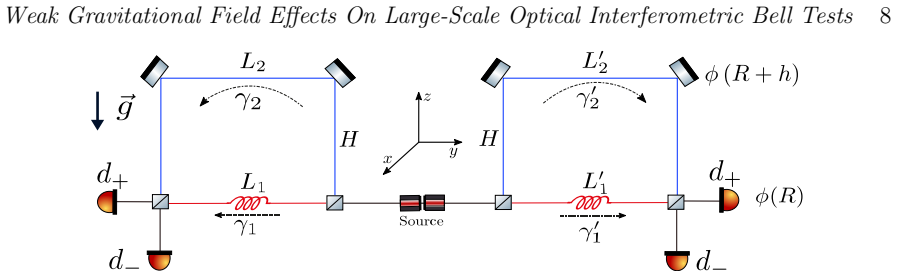
The engine of the argument is the gravitational time delay $\Delta\tau_\gamma = L_2' g H / c^3$ acquired by a photon traversing an interferometer arm at height $H$ above its partner, together with the post-selection constraint that two-photon pairs along $(\gamma_1,\gamma_1')$ and $(\gamma_2,\gamma_2')$ arrive with the same delay. Combined with the balance condition $L_1' = L_2' + 2H$, the delay reduces the intra-interferometer time differences to the gravitational value, so the relative phase between the two post-selected amplitudes is $(\omega_1+\omega_2)\Delta\tau_\gamma$ plus local phases. The second piece of machinery is the Gaussian spectral average: since detectors do not resolve frequency, the cosine term is averaged over $\omega_1,\omega_2$, producing the visibility $V(\Delta\tau_\gamma) = \exp[-\tfrac14 \Delta\tau_\gamma^2(\sigma_1^2+\sigma_2^2)]$ and, at the optimal CHSH settings, the functional quoted in the core discovery.
What would settle it
Compute the Sagnac phase for the proposed proper area $A \approx 10^8$ m$^2$ at optical frequencies: it is hundreds of radians, far exceeding the gravitational phase $\Delta\tau_\gamma(\omega_1+\omega_2) \approx 0.09$ rad, so a terrestrial rotated array without rotation compensation would show no gravitational signature; equivalently, a coincidence window wider than $\Delta\tau_\gamma \approx 3\times10^{-17}$ s would erase the post-selection and reduce the state to a mixture.
Extended reading notes
Core claim
The central discovery is that a weak gravitational field can replace the usual path-length difference in a Franson-type post-selection. Working to first order in the Newtonian potential and using the Schwarzschild metric in isotropic coordinates, the paper finds that the proper-time difference between the two arms of each balanced Mach-Zehnder interferometer is $\Delta\tau_\gamma = L_2' g H / c^3$. For a balanced, geometrically identical Franson array on an equipotential surface, all four path combinations have equal arrival times, so no post-selection can separate them; after a 90-degree rotation in the vertical, pairs $(\gamma_1,\gamma_2')$ and $(\gamma_2,\gamma_1')$ are separated by $\pm\Delta\tau_\gamma$, making the post-selection possible and producing the maximally entangled state. With Gaussian frequency distributions and frequency-insensitive detectors, the detection probability acquires an exponential visibility factor, and the CHSH functional becomes $\Sigma = 2\sqrt{2}\exp[-\tfrac14 \Delta\tau_\gamma^2(\sigma_1^2+\sigma_2^2)]\,|\cos(\Delta\tau_\gamma(\omega_1+\omega_2))|$, so violation is impossible for proper area $A = L_2' H$ beyond $A^* = \sqrt{\ln 4}\,(c^3/g)/\sqrt{\sigma_1^2+\sigma_2^2}$. The paper also shows that for a rotated Hugged array with $\omega_1=\omega_2$, or with suitably redefined local phases, the harmonic oscillation disappears and only the Gaussian decay remains.
Load-bearing premise
The claim stands on the post-selection resolving arrival-time differences of order $\Delta\tau_\gamma = L_2' g H / c^3 \approx 3\times10^{-17}$ s at the proposed 10-km scale, far below any existing single-photon timing resolution, while the static Schwarzschild metric used for the phase also neglects Earth's rotation, which would produce a much larger phase at the proposed interferometer areas.
Editorial extensions
If this is right
- A balanced Franson array that cannot entangle on an equipotential surface becomes a source of maximally entangled photons once rotated so its arms sit at different gravitational potentials.
- With a broadband source, the CHSH violation is restricted to proper areas $A < A^* = \sqrt{\ln 4}\,(c^3/g)/\sqrt{\sigma_1^2+\sigma_2^2}$; beyond $A^*$ the state admits a classical description.
- At the paper's sample scale $H = L_2' = 10\,\mathrm{km}$ with an ultra-broadband SPDC source, $\Sigma \approx 2.55$, so the predicted violation is comfortably above the classical bound of 2.
- For a rotated Hugged array with equal photon frequencies, or with local phases redefined to absorb the gravitational delays, the CHSH functional loses its oscillation and decays purely exponentially with area.
- The effect is at first order only in the temporal component of the metric and is independent of the post-Newtonian parameters $\gamma$ and $\beta$, so the paper stops short of calling it a genuine test of general relativity.
Reading between the lines
- The paper's static-Schwarzschild model omits Earth's rotation; at $A \approx 10^8\,\mathrm{m}^2$ the Sagnac phase for optical photons is hundreds of radians, dwarfing the gravitational phase $\Delta\tau_\gamma(\omega_1+\omega_2) \approx 0.09$ rad, so any terrestrial realization would need rotation compensation or a slowly rotating platform.
- The post-selection that creates the entangled state requires distinguishing time differences of order $10^{-17}$ s at the proposed scale, far beyond single-photon detector jitter; the practical route would be frequency-domain (interferometric) post-selection rather than direct timing.
- The exponential visibility loss parallels the clock-complementarity effect studied for single photons: a gravitational time dilation acting as which-path information. This suggests the formula $V = \exp[-\tfrac14\Delta\tau_\gamma^2(\sigma_1^2+\sigma_2^2)]$ can be read as a decoherence rate for energy-time entanglement, testable at smaller areas with narrowband sources.
- The same machinery could extend to the rotating-mass metric, as the paper notes, or to satellite links where the gravitational potential difference is replaced by the orbital potential; those extensions would need to add Doppler and Sagnac terms before quantitative predictions.
Signed reviews
Editorial analysis
A structured set of objections, weighed in public.
Referee Report
Summary. The manuscript studies Franson and Hugged interferometric arrays placed in a weak gravitational field, modeled by the static Schwarzschild metric in isotropic coordinates. It derives gravitational time delays for the optical paths, imposes balance conditions that make the two 'good' path pairs (γ1,γ'1) and (γ2,γ'2) indistinguishable, and constructs the post-selected two-photon state |Ψ⟩. The authors then compute two-photon detection probabilities and, for Gaussian frequency dispersion, obtain an exponentially damped cosine visibility. The central quantitative results are the CHSH functional Σ = 2√2 exp[-(1/4)Δτγ²(σ1²+σ2²)] |cos(Δτγ(ω1+ω2))| (Eq. 58) and the threshold proper area A* = √(ln 4)(c³/g)/√(σ1²+σ2²) beyond which CHSH violation is impossible. The paper also claims that a balanced, geometrically identical Franson array on an equipotential surface, once rotated so that arms experience different gravitational potentials, can post-select a maximally entangled state that would otherwise be separable.
Significance. If the post-selection step could be physically realized, the paper would provide a clean, internally consistent formalism connecting gravitational time dilation to energy-time entanglement, with explicit closed-form expressions for visibility and CHSH violation. The derivation is transparent and does not fit any data; the A* threshold follows directly from Eq. (58), and the gravitational delay formula is taken from independent treatments (Refs. [10,52]). The proposed effect is falsifiable in principle: the predicted visibility decay and the A* bound are specific and quantitative. However, the significance of the central claim is conditional on the realizability of the post-selection that defines |Ψ⟩; as discussed below, the required timing resolution is not stated and appears unattainable at the proposed scales.
major comments (2)
- [§4, Eqs. (30)–(31), (52), Fig. 6] The post-selection that produces the entangled state |Ψ⟩ in Eqs. (35)–(37) requires separating the two-photon arrival-time differences of the 'good' pairs (γ1,γ'1) and (γ2,γ'2) from those of the 'bad' pairs (γ1,γ'2) and (γ2,γ'1). According to Eqs. (30)–(31), the bad pairs differ from the good pairs by ±Δτγ = ±L2'gH/c³. At the scale advertised in Fig. 6 and Sec. 5 (H = L2' = 10 km), Δτγ ≈ 3.7×10^-17 s. This is an order of magnitude smaller than the coherence time 1/σ ≈ 5×10^-16 s of the ultra-broadband photons used in the same figure, and many orders of magnitude below any realistic single-photon detector jitter. A coincidence window that accepts the good pairs will therefore also accept the bad pairs, so the post-selection on which Eqs. (35)–(37) and the CHSH prediction (58) are based cannot be implemented. This is not a mere practical detector limitation: it is a failure of the distinguishability condition required by the paper's own post-selection logic. The manuscript nowhere states the required timing resolution, and for Earth-bound parameters the gravitational delay is far too small to be resolved.
- [§3.1, Eq. (7), and Sec. 5] The proposed experimental scale in Fig. 6 uses a proper area A = L2'H ≈ 10^8 m², but the static Schwarzschild metric (7) neglects Earth's rotation. For this area, the Sagnac phase is roughly 4πΩA/(λc) ≈ 4×10² rad for λ ≈ 800 nm, which is about three orders of magnitude larger than the gravitational phase Δτγω ≈ 0.2 rad quoted by the manuscript. The gravitational contribution would therefore be completely masked unless the Sagnac phase is actively compensated, and no such compensation is discussed. This omission matters because Sec. 5 explicitly argues that an experimental realization 'might be feasible with current technology'; a rotating Earth breaks the assumed static geometry.
minor comments (4)
- [Title and Abstract] The name 'Shymony' in 'Clauser-Horne-Shymony-Holt' is a typo; the correct spelling is 'Shimony'.
- [Eq. (62)] The prefactor '2√2 4' appears garbled; it should presumably be 2√2/4 (or a similarly explicit fraction). Please check and correct.
- [Fig. 3 caption] The caption says the plotted probability follows Eq. (50), while the text refers to Eq. (53) for the same quantity; clarify which equation is actually used in the figure.
- [§3.2, Eqs. (19)–(24)] The notation Δτab is used for differences of proper times without a single explicit definition (e.g., Δτab ≡ Δτa − Δτb). Since signs matter for Eqs. (28)–(31), defining the convention once would prevent sign ambiguities.
Circularity Check
No significant circularity: the gravitational delay, post-selected state, visibility, and CHSH bound are derived from the stated metric and post-selection rules without fitted inputs or load-bearing self-citations.
full rationale
The derivation is self-contained. The paper computes proper-time intervals from the Schwarzschild metric (Eq. (7)), obtains the gravitational delay Δτγ = L2'gH/c^3 in Eqs. (15)-(26), and cites independent derivations [10,52] for the same standard gravitational time delay. Conditions (20)-(25) are explicit design constraints on proper lengths; they define the balanced Franson/Hugged configuration rather than inserting the target entangled state by definition. The post-selected two-photon state in Eqs. (35)-(37) follows the standard Franson post-selection logic, and the detection probabilities in Eqs. (49)-(54) are obtained by explicit operator transformations in Appendix B plus a Gaussian spectral average. The CHSH functional in Eq. (58), including the exponential visibility factor and the A* = sqrt(ln 4)(c^3/g)/sqrt(σ1^2+σ2^2) bound, is derived algebraically from the Gaussian integral and the standard phase choice; no parameter is fitted to the quoted Σ≈2.55. The only author self-citations (Refs [4,5]) appear in introductory remarks about Gödel-metric Sagnac interferometry and are not load-bearing. The paper even states that the result 'cannot be interpreted as a genuine test of General Relativity,' so the derivation is not being used to smuggle in a conclusion. Concerns about resolving Δτγ ~ 10^-17 s against photon coherence and detector jitter are experimental feasibility or correctness objections, not circularity, and under the hard rules they do not raise the circularity score.
Assumptions & free parameters
assumptions (6)
- standard math Schwarzschild metric in isotropic coordinates to first order in φ/c^2, with Newtonian potential φ(z) = gz + const.
- standard math Geometric-optics phase rule Δφ = ω∞ Δt for stationary spacetimes.
- domain assumption Two-photon source spectral function factorizes as f(ω1,ω2) = f1(ω1)f2(ω2) with identical Gaussian distributions of widths σ1, σ2.
- domain assumption Static, non-rotating weak gravitational field; Earth rotation, tides, and Lense-Thirring terms are neglected.
- domain assumption Ideal post-selection can distinguish events separated by the gravitational time delay Δτγ.
- domain assumption The source emits a pure two-photon state and the interferometers preserve purity.
Cite this review
Pith. "Pith review of Weak Gravitational Field Effects On Large-Scale Optical Interferometric Bell Tests." pith.science (2026). https://pith.science/paper/FUE367PU
@misc{pith2026190808179,
  author       = {Pith},
  title        = {Pith review of: Weak Gravitational Field Effects On Large-Scale Optical Interferometric Bell Tests},
  year         = {2026},
  howpublished = {\url{https://pith.science/paper/FUE367PU}},
  note         = {Machine review of arXiv:1908.08179}
}
read the original abstract
The technological refinement of experimental techniques has recently allowed the generation of two-photon polarization-entangled states at low Earth orbit, which has been subsequently applied to quantum communications. This achievement paves the way to study the interplay between General Relativity and Quantum Mechanics in new setups. Here, we study the generation of two-photon energy-time entangled states via large scale Franson and Hugged interferometric arrays in the presence of a weak gravitational field. We show that for certain configurations of the arrays, an entangled state emerges as a consequence of the gravitational time delay. We also show that the aforementioned arrays generate entanglement and violate the Clauser-Horne-Shymony-Holt inequality under suitable conditions even in the presence of frequency dispersion.
Figures


Figures from the paper (4 more)


Reference graph
Works this paper leans on
-
[1]
Ludlow A, Boyd M M, Ye J, Peik E and Schmidt P O 2015 Rev. Mod. Phys. 87 637
work page 2015
-
[2]
Kaplan E D 1996 Understanding GPS, Principles and Applications (Boston: Artech House)
work page 1996
-
[3]
Overhauser A W and Colella R 1974 Phys. Rev. Lett. 33 1237; R. Colella, Overhauser A W and Werner S A 1975 Phys. Rev. Lett. 34 1472
work page 1974
-
[4]
Delgado A, Schleich W P and S¨ ussmann G 2002New J. Phys. 4 37.1
-
[5]
Kajari E, Walser R, Schleich W P and Delgado A 2004 Gen. Relativ. Gravit. 36 2289
work page 2004
-
[6]
Vallone G, Dequal D, Tomasin M, Vedovato F, Schiavon M, Luceri V, Bianco G and Villoresi P 2016 Phys. Rev. Lett. 116 253601
work page 2016
- [7]
-
[8]
Terno D R, Vedovato F, Schiavon M, Smith A R H, Magnani P, Vallone G and Villoresi P 2019 arXiv:1811.04835v2
work page Pith review arXiv 2019
Show all 63 references
-
[9]
Zych M, Costa F, Pikovski I and Brukner ˇC 2011 Nat. Commun. 2 505
2011
-
[10]
Quantum Grav
Zych M, Costa F, Pikovski I, Ralph T C and Brukner ˇC 2012 Class. Quantum Grav. 29 224010
2012
-
[11]
2017 EPJ Quantum Technol
Pallister S et al. 2017 EPJ Quantum Technol. 4 2
2017
-
[12]
Pikovski I, Zych M, Costa F and Brukner ˇC 2015 Nat. Phys. 11 668
2015
-
[13]
Pfennigbauer M et al. 2005 J. Opt. Netw. 4 549-560
2005
-
[14]
2017 Science 356 6343
Yin J et al. 2017 Science 356 6343
2017
-
[15]
2018 Phys
Liao S K et al. 2018 Phys. Rev. Lett. 120 030501
2018
-
[16]
2017 Nature 549 70-73
Ren J G et al. 2017 Nature 549 70-73
2017
-
[17]
2017 Nature 549 43-47
Liao S K et al. 2017 Nature 549 43-47
2017
-
[18]
2017 EPJ Quantum Technol
Oi D K L et al. 2017 EPJ Quantum Technol. 4 6
2017
-
[19]
Kerstel E, Gardelein A, Barthelemy M, The GSUG team, Fink M, Joshi S K and Ursin R 2018 EPJ Quantum Technol. 5 6
2018
-
[20]
2019 Quantum Sci
Calderato L et al. 2019 Quantum Sci. Technol. 4 015012
2019
-
[21]
2019 Science 366 6461
Xu P et al. 2019 Science 366 6461
2019
-
[22]
Ser.: Earth Environ
Feng D 2019 IOP Conf. Ser.: Earth Environ. Sci. 237 032027
2019
-
[23]
Franson J D 1989 Phys. Rev. Lett. 62 2205
1989
-
[24]
Cabello A, Rossi A, Vallone G, De Martini F and Mataloni P 2009 Phys. Rev. Lett. 102 040401
2009
-
[25]
Friberg S, Hong C K and Mandel L 1985 Phys. Rev. Lett. 54 2011
1985
-
[26]
Hong C K and Mandel L 1985 Phys. Rev. A 31 2409
1985
-
[27]
Hong C K and Mandel L 1986 Phys. Rev. Lett. 569 58
1986
-
[28]
Ghosh R and Mandel L 1987 Phys. Rev. Lett. 59 1903
1987
-
[29]
Ou Z Y 1988 Phys. Rev. Lett. 61 54
1988
-
[30]
Aerts S, Kwiat P, Larsson J A and ˙Zukowski M 1999 Phys. Rev. Lett. 83 2872
1999
-
[31]
Lima G, Vallone G, Chiuri A, Cabello A and Mataloni P 2010 Phys. Rev. A 81 040101(R)
2010
-
[32]
2013 Nat
Cuevas A et al. 2013 Nat. Commun. 4, 2871
2013
-
[33]
Vedovato F, Agnesi C, Tomasin M, Avesani M, Larsson J A , Valone G and Villoresi P 2018 Phys. Rev. Lett. 121 190401
2018
-
[34]
Strekalov D V, Pittman T B, Sergienko A V, Shih Y H and Kwiat P G 1996 Phys. Rev. A 54, R1(R)
1996
-
[35]
Ribordy G, Brendel J, Gautier J D, Gisin N and Zbinden H 2000 Phys. Rev. A 63 012309
2000
-
[36]
2015 New J
Zhong et al. 2015 New J. Phys. 17 022002
2015
-
[37]
2019 Phys
Ecker S et al. 2019 Phys. Rev. X 9 041042
2019
-
[38]
Bell J S 1964 Physics Physique Fizika 1 195
1964
-
[39]
Clauser J F, Horne M A, Shimony A and Holt R A 1969 Phys. Rev. Lett. 23 880
1969
-
[40]
Freedman S J and Clauser J F 1972 Phys. Rev. Lett. 28 938
1972
-
[41]
Aspect A, Grangier P and Roger G 1981 Phys. Rev. Lett. 47 460
1981
-
[42]
Tittel W, Brendel J, Zbiden H and Gisin 1998 N Phys. Rev. Lett. 81 3563
1998
-
[43]
Weihs G, Jennewein T, Simon C, Weinfurter H and Zeilinger A 1998 Phys. Rev. Lett. 81 5039
1998
-
[44]
Horodecki R, Horodecki P, Horodecki M and Horodecki K 2009 Rev. Mod. Phys 81 865
2009
-
[45]
Hensen B et. al. 2015 Nature 526 682-686
2015
-
[46]
2018 Nature 557 212-218
Abell´ an Cet al. 2018 Nature 557 212-218
2018
-
[47]
2017 Phys
Handsteiner J et al. 2017 Phys. Rev. Lett. 118 060401
2017
-
[48]
2018 Phys
Rauch D et al. 2018 Phys. Rev. Lett. 121 080403
2018
-
[49]
Brodutch A, Gilchrist A, Guff T, Smith A R H and Terno D R 2015 Phys. Rev. D 91 064041
2015
-
[50]
Will C M 2010 Theory and Experiment in Gravitational Physics (Cambridge: Cambridge University Press)
2010
-
[51]
Brodutch A, Demarie T F and Terno D R 2011 Phys. Rev. D. 84 104043
2011
-
[52]
Chen S Y and Ralph T C 2019 Phys. Rev. A 99 023803
2019
-
[53]
Lett 44 4638-4641 Weak Gravitational Field Effects On Large-Scale Optical Interferometric Bell Tests 31
Vanselow A, Kaufmann P, Chrzanowski H M, and Ramelow S 2019 Opt. Lett 44 4638-4641 Weak Gravitational Field Effects On Large-Scale Optical Interferometric Bell Tests 31
2019
-
[54]
Dvoyrin V V, Tarasov N and Turitsyn S K 2017 Optical Fiber Communication Conference paper W1F.3
2017
-
[55]
Express 27 59315944
Nakajima Y, Hata Y and Minoshima K 2019 Opt. Express 27 59315944
2019
-
[56]
Gmachl C, Sivco D L, Colombelli R, Capasso F and Cho A Y 2002 Nature 415 883-887
2002
-
[57]
Will C M 2006 Living Rev. Relativ. 9 3
2006
-
[58]
2005 Phys
Peng C Z et al. 2005 Phys. Rev. Lett. 94 150501
2005
-
[59]
2012 Nature 488 182-188
Yin J et al. 2012 Nature 488 182-188
2012
-
[60]
2012 Class
Rideout D et al. 2012 Class. Quantum Grav. 29 224011
2012
-
[61]
Markiewicz M, Kaszlikowski D, Kurzy´ nski P and W´ ojcik A 2019npj Quantum information 5 5
-
[62]
Ou Z Y and Mandel L 1990 J. Opt. Soc. Am. B 7 2127
1990
-
[63]
Kohlrus J, Bruschi D E, Louko J and Fuentes I 2017 EPJ Quantum Technol. 4 7
2017
Reviewed August 14, 2026 · model on record in the stance chip above.
Discussion (0). Continue with ORCID to comment.