REVIEW 2 major objections 4 minor 17 references
Dynamical behaviour of coupled atom-cavity systems in the single excitation limit
T0 review · 2 major / 4 minor · reviewed 2026-08-14 · deepseek-v4-flash
Pith's one-line read Diagonalizing the non-Hermitian Hamiltonian of two coupled atom-cavity systems yields quasi-normal modes whose interference explains small spectral asymmetries that normal modes cannot.
desk verdict Useful analytic quasi-normal-mode paper for coupled cavity-QED; the central quantitative interference claim needs an explicit overlay of the reconstructed spectrum against exact numerics. read the letter →
The pith
A machine-rendered reading of the paper's core claim, the machinery that carries it, and where it could break.
The reading
What carries the argument
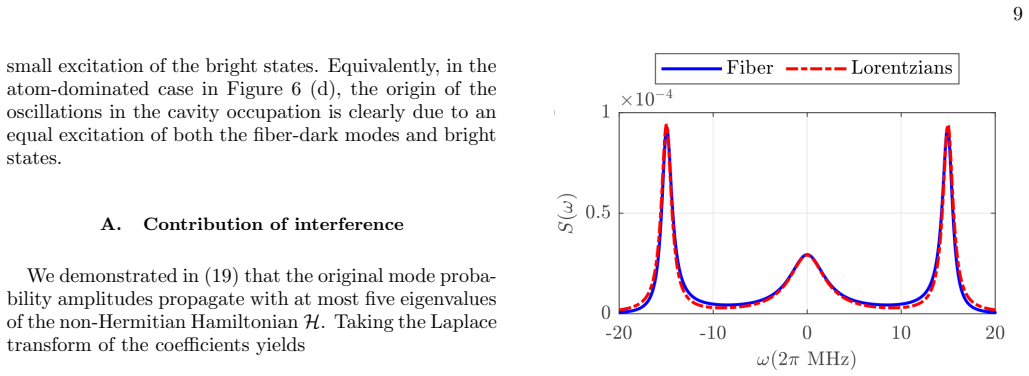
The central object is the quasi-normal mode decomposition of the non-Hermitian Hamiltonian in the single-excitation subspace. In the symmetric case $v_1=v_2=v$ and $g_1=g_2=g$, the five modes split into a symmetric manifold $\{|\mathrm{BS}_+\rangle, |\mathrm{BS}_-\rangle, |\mathrm{CD}\rangle\}$ and an antisymmetric manifold $\{|\mathrm{FD}_+\rangle, |\mathrm{FD}_-\rangle\}$, and the decay terms introduce a coupling $\Gamma_{\mathrm{SD}}$ between the cavity-dark mode and the bright states. Diagonalizing the non-Hermitian Hamiltonian yields right eigenvectors $|\mathrm{QBS}_\pm\rangle$, $|\mathrm{QFD}_\pm\rangle$, $|\mathrm{QCD}\rangle$ with complex eigenvalues $\lambda = \eta + i\delta$, and the paper shows that each output amplitude is a sum $\sum_j \chi_{ij} e^{\lambda_j t}$; taking the Laplace transform turns the spectrum into the squared modulus of a sum of Lorentzians $L(\omega,\lambda_j)$, whose cross terms are exactly the interference functions $W_{jk}$. The perturbative solutions (43)–(45) give explicit coefficients $\chi_{ij}$ showing which interferences are symmetric between the two cavities and which are antisymmetric. This is the machinery that lets the paper attribute the spectral asymmetries to specific pairs of quasi modes.
What would settle it
Measure the spontaneous emission from Cavity 1 and Cavity 2 in the comparable-coupling regime on resonance, first with the fiber decay rate different from half the atomic decay rate, then with them equal; the paper predicts the asymmetry disappears in the equal case. If the asymmetry remains, the quasi-normal-mode interference explanation fails.
Extended reading notes
Core claim
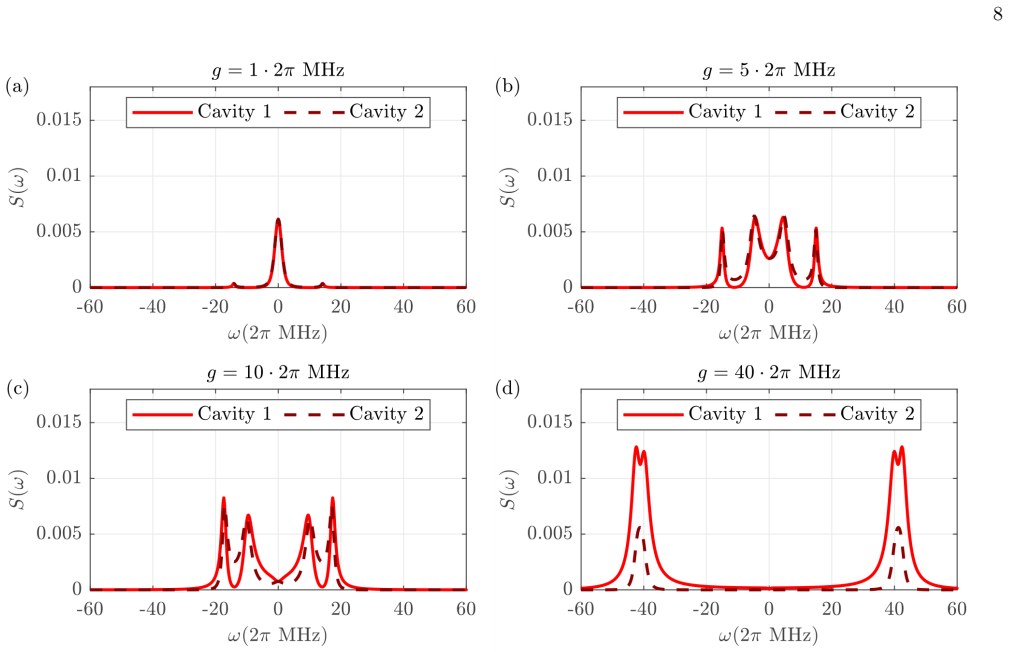
On the paper's own terms, the central discovery is that the emission spectrum of each cavity is not a sum of independent Lorentzian lines from the five normal modes, but a sum of five Lorentzians plus ten interference terms $W_{jk}(\omega)$ arising from the quasi-normal modes—the right eigenvectors of the non-Hermitian Hamiltonian $\mathcal{H} = H - i(\kappa_1 a_1^\dagger a_1 + \kappa_2 a_2^\dagger a_2 + \kappa_b b^\dagger b + \frac{\gamma}{2}(\sigma_1^+\sigma_1^- + \sigma_2^+\sigma_2^-))$. In the comparable-coupling regime, the quasi cavity-dark mode interferes constructively with the quasi fiber-dark and bright modes for Cavity 2 and destructively for Cavity 1, producing the observed drop in Cavity 1's intensity on resonance and the sideband asymmetries near $\pm\zeta$. The same interference vanishes when $\kappa_b = \gamma/2$, which decouples the cavity-dark mode from the bright states, and is negligible when the normal-mode splitting is large enough that the Lorentzians do not overlap. Thus the quasi-normal-mode expansion does explanatory work that the normal-mode expansion cannot.
Load-bearing premise
Everything in the paper depends on the connecting fiber being short enough to act as a single optical mode; if the fiber is long enough that several modes matter, the five-mode model and its quasi-normal-mode prediction no longer apply.
Editorial extensions
If this is right
- In the well-separated regime where the normal-mode splitting $\zeta$ is much larger than the decay-induced widths, the interference terms $W_{jk}$ integrate to negligible values and the spectrum is accurately a sum of Lorentzian lines from the quasi modes.
- The spontaneous-emission asymmetry between Cavity 1 and Cavity 2 on resonance is a direct, measurable signature of quasi-normal-mode interference, so it can be used to test whether a normal-mode description is sufficient in this system.
- Setting the fiber decay rate $\kappa_b$ equal to half the atomic spontaneous emission rate $\gamma/2$ eliminates the coupling $\Gamma_{\mathrm{SD}}$ between the cavity-dark mode and the bright states, and with it the interference features, giving identical cavity outputs on resonance.
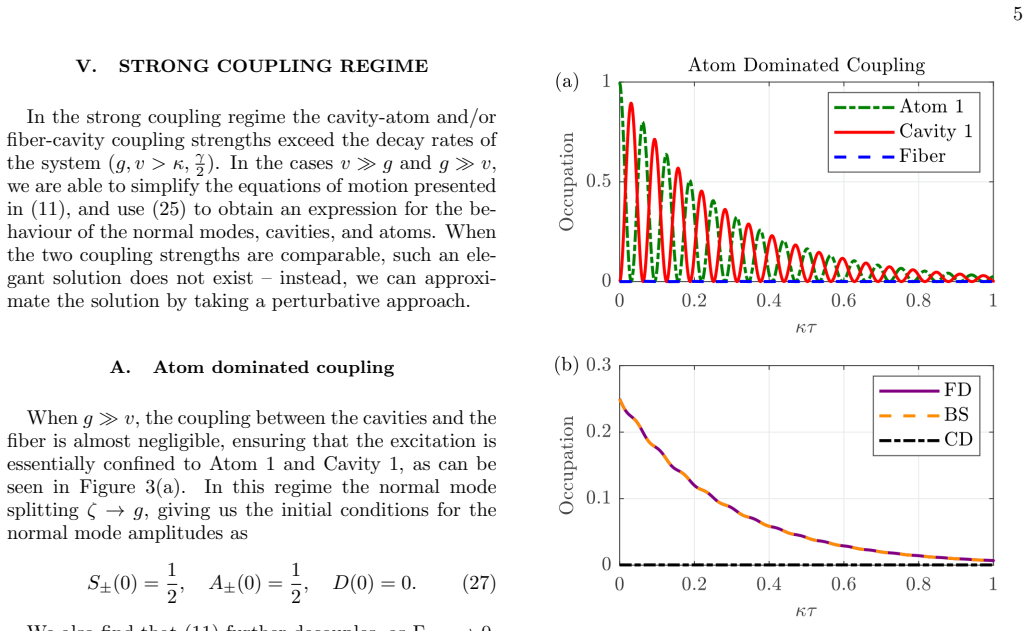
- In the atom-dominated ($g \gg v$) and fiber-dominated ($v \gg g$) limits, the equations decouple and the analytic solutions for the atomic and cavity amplitudes reproduce the oscillations seen in the time-dependent occupations, confirming the normal-mode assignments in those limits.
Reading between the lines
- The same $W_{jk}$ interference mechanism should appear in any open coupled-resonator system with two decay-coupled manifolds of different symmetry, not just nanofiber cavity QED.
- Because the integrated interference depends on the eigenvalue separation $\delta_i - \delta_j$ and on the decay rates, tuning decay rates could serve as a control knob for directional emission between two otherwise identical output ports.
- Extending the analysis to two initially excited atoms or to a long fiber with finite time delay would introduce additional eigenvalues and delayed differential equations; comparing the resulting $W_{jk}$ terms with the single-excitation prediction would test how robust the quasi-normal-mode picture is beyond the Markovian single-mode assumption.
Signed reviews
Editorial analysis
A structured set of objections, weighed in public.
Referee Report
Summary. This paper analyzes the single-excitation dynamics of two nanofiber cavities, each containing an atom, connected by a single-mode optical fiber. Starting from a standard master-equation model, the authors decompose the dynamics into symmetric and antisymmetric manifolds, solve the antisymmetric manifold exactly, and treat the symmetric manifold perturbatively when the two coupling strengths are comparable. They then use the eigenmodes of the non-Hermitian Hamiltonian, which they call quasi-normal modes, to decompose the spontaneous-emission spectrum into Lorentzian and interference contributions, and claim that this decomposition quantitatively explains small but significant asymmetries between the spectra emitted by the two cavities.
Significance. If the central claim is established, the paper adds a useful and physically transparent result: the normal-mode picture alone does not explain certain cavity-output asymmetries, and a minimal quasi-normal-mode decomposition does. The manuscript has real strengths: the antisymmetric-manifold solution is clean and exact, the perturbative treatment is stated with its assumptions, the time-domain results are checked against numerical integration in several parameter regimes, and no parameters are fitted to reproduce the spectra. The main weakness is that the central quantitative spectral claim, namely that summing the five Lorentzians and ten interference terms in Eq. (52) reproduces the exact spectra, is asserted but never exhibited.
major comments (2)
- [Sec. VI.A, Eqs. (52)-(55)] The central quantitative claim is not demonstrated. The paper states that the quasi-normal-mode decomposition with coefficients from Eq. (55) explains the difference in intensity between Cavity 1 and Cavity 2, but it never plots the reconstructed spectrum S(omega) from Eq. (52) on top of the numerically exact spectrum for the same parameters. Figures 8 and 10 show the individual Lorentzians and interference functions separately, not their sum. Without an overlay, the argument remains a sign-based qualitative explanation rather than a quantitative one. I ask the authors to add a direct comparison of the full reconstructed spectrum with the exact spectrum for the parameters of Figure 8, and, if possible, for Figure 10 as well.
- [Sec. V.C and Sec. VI.A, after Eq. (34)] The perturbative coefficients chi_ij in Eq. (55) rely on the assumptions kappa_b approximately 0 and Gamma_{S-} approximately 0, stated in Sec. V.C. For the parameters of Figure 8, [kappa, kappa_b, g, v] = [1, 0.01, 7, 4], one has zeta^2 = 81 and Gamma_{S-} = g^2 gamma/(2 zeta^2) - kappa approximately 0.573, which is not negligible compared with Gamma_{SD} = gamma v g/(2 zeta^2) approximately 0.899; also kappa = 1 satisfies kappa approximately gamma/6 = 0.867 only marginally. The paper does not quantify the resulting error in the coefficients chi_ij. The authors should either state the size of the neglected terms for the parameters used in the spectral figures or validate the reconstructed spectrum against exact numerics for those parameters.
minor comments (4)
- [Eq. (42)] In the expression for |psi_S(t)>, the second term should involve |QBS_->, not |QBS_+>; as written, the same quasi-normal mode appears twice.
- [Sec. VI, after Eq. (48)] The text says 'Figure 6 (a) confirms that the small oscillations in the cavity occupation in the fiber-dominated coupling limit in Figure 3 (a) are due to the small excitation of the bright states'; the fiber-dominated limit is shown in Figure 4, not Figure 3, and Figure 3 shows the atom-dominated regime.
- [Eq. (54)] The index notation in Eq. (54) is inconsistent: the numerator uses chi_ij chi*_ik, while the denominator contains delta_i - delta_j and eta_1 + eta_2. Please clarify which quasi-normal modes are being paired and correct the subscripts.
- [Sec. II, after Eq. (1)] The single-mode-fiber approximation is load-bearing for the five-mode model and the subsequent quasi-normal-mode analysis, but its quantitative validity is not discussed; a sentence on the fiber length/bandwidth condition would help the reader assess the model's range of applicability.
Circularity Check
No significant circularity: the quasi-normal-mode decomposition is derived by algebra from the stated Hamiltonian and is checked against independent numerical simulation; self-citations are background experimental references only.
full rationale
The paper's derivation chain is self-contained. It starts from the single-excitation non-Hermitian Hamiltonian (Eq. 4) and linear equations of motion (Eq. 6), diagonalizes the anti-symmetric manifold explicitly (Sec. IV.A, Eqs. 20-25) and treats the symmetric manifold by first-order perturbation theory (Sec. V.C, Eqs. 35-45). The spontaneous-emission spectra are then defined as the squared modulus of the Laplace transform of the probability amplitudes (Eqs. 47-48), and the expansion into five Lorentzians plus ten interference terms (Eqs. 52-53) is exact algebra once the coefficients chi_ij are known. The coefficients (Eq. 55) come from the analytical amplitudes (25), (43), and (45), with no parameter fitted to match the spectral features; the parameter values are chosen a priori for the strong-coupling regimes. The sign asymmetry between Cavity 1 and Cavity 2 follows from the symmetry relations in Eq. (56), which are a consequence of the symmetric Hamiltonian and the chosen initial condition, not of fitting the observed spectrum. The cited works [8,9] involve overlapping authors, but they are used only to motivate the physical setup and name the normal modes; the computed conclusions do not rest on those citations. The main weakness is evidentiary rather than circular: the paper plots Lorentzians and interference functions separately but does not overlay the full reconstructed sum of Eq. (52) onto the exact numerical spectrum, so the quantitative 'explains the features' claim is asserted rather than demonstrated. This omission raises a correctness/validation concern, not a circularity concern. No load-bearing step reduces by construction to its own input.
Assumptions & free parameters
assumptions (6)
- domain assumption Single-mode treatment of the connecting fiber
- domain assumption Markovian master equation with Lindblad dissipators (Eq. (2))
- domain assumption Resonance condition ωa = ωc
- domain assumption Symmetric couplings v1=v2=v, g1=g2=g
- standard math Existence and use of quantum regression theorem
- ad hoc to paper Perturbative condition ΓS−≈0, i.e., κ≈γ/6
Cite this review
Pith. "Pith review of Dynamical behaviour of coupled atom-cavity systems in the single excitation limit." pith.science (2026). https://pith.science/paper/RRQTGHUE
@misc{pith2026190808181,
  author       = {Pith},
  title        = {Pith review of: Dynamical behaviour of coupled atom-cavity systems in the single excitation limit},
  year         = {2026},
  howpublished = {\url{https://pith.science/paper/RRQTGHUE}},
  note         = {Machine review of arXiv:1908.08181}
}
read the original abstract
We investigate the time evolution of the photon-detection probability at various output ports of an all-fiber coupled cavity-quantum-electrodynamics (cavity-QED) system. The setup consists of two atoms trapped separately in the field of two nanofiber cavities that are connected by a standard optical fiber. We find that the normal-mode picture captures well the main features of the dynamics. However, a more accurate description based on the diagonalization of a non-Hermitian Hamiltonian reveals the origin of small yet significant features in the spontaneous emission spectra.
Figures


Figures from the paper (7 more)




Reference graph
Works this paper leans on
- [1]
-
[2]
(30) The relevant normal mode amplitudes obey the equations of motion ˙A± =− [ ±ig + ΓA+ 2 ] A±− ΓA− 2 A∓, ˙D =−γ 2D. (31) Note that the occupation of the bright states is almost negligible, but produces rapid fluctuations in the occu- pations of Cavity 1 and 2. In the original picture, we ob- serve an approximately exponential decay in the atomic excitati...
-
[3]
Such an effect cannot be explained by the excitation of the quasi cavity-dark mode alone, as there is a net negative contribution to one of the spectral outputs. To quantify these interference effects, we must simply look at the coefficientsχij, which are obtained from (43), (45) and (25) : χC1,BS±≈± 1 2ζ [(g 2−v∆S± )] , χC1,FD± =± g 4p, χC1,CD≈ (∆S+− ∆S−) 2ζ...
- [4]
-
[5]
K. P. Nayak, M. Sadgrove, R. Yalla, F. Le Kien and K. Hakuta, J. Opt. 20, 073001 (2018)
work page 2018
-
[6]
H. J. Kimble, Nature 453, 1023 (2008)
2008
-
[7]
Kato and T
S. Kato and T. Aoki, Phys. Rev. Lett. 115, 093603 (2015)
2015
- [8]
Show all 17 references
-
[10]
S. Kato, N. N´ emet, K. Senga, S. Mizukami, X. Huang, S. Parkins, and T. Aoki, Nature Communications 10, 1038 (2019)
2019
-
[11]
White, S
D. White, S. Kato, N. N´ emet, S. Parkins, and T. Aoki, Phys. Rev. Lett. 122, 253603 (2019)
2019
-
[12]
S. Zeeb, C. Noh, S. Parkins and H. Carmichael, Phys. Rev. A 91, 023829 (2015)
2015
-
[13]
H. J. Carmichael, Statistical Methods in Quantum Optics 2: Non-Classical Fields (Springer-Verlag, Berlin, 2007)
2007
-
[14]
H. J. Carmichael, Statistical Methods in Quantum Op- tics 1: Master Equations and Fokker-Plank Equations (Springer-Berlin, Heidelberg, 1999)
1999
-
[15]
S. M. Hein, F. Schulze, A. Carmele and A. Knorr, Phys. Rev. A. 91, 052321 (2015)
2015
-
[16]
Whalen, Open quantum systems with time-delayed interactions, PhD Thesis, University of Auckland (2015)
S. Whalen, Open quantum systems with time-delayed interactions, PhD Thesis, University of Auckland (2015)
2015
-
[17]
Vermersch, P.-O
B. Vermersch, P.-O. Guimond, H. Pichler and P. Zoller, Phys. Rev. Lett. 118, 133601 (2017)
2017
-
[18]
Sinha, P
K. Sinha, P. Meystre, E. A. Goldschmidt, F. K. Fatemi, S. L. Rolston and P. Solano, arXiv:1907.12017 (2019)
2019 arXiv
Reviewed August 14, 2026 · model on record in the stance chip above.
Discussion (0). Continue with ORCID to comment.