REVIEW 3 major objections 8 minor 49 references
Pro-Cam SSfM: Projector-Camera System for Structure and Spectral Reflectance from Motion
T0 review · 3 major / 8 minor · reviewed 2026-08-14 · deepseek-v4-flash
Pith's one-line read A projector and camera moving around an object can recover both its 3D shape and the per-point light spectrum.
desk verdict Solid system paper with a clean shading model, but the main experiment confounds multi-view averaging with the proposed geometric shading term. read the letter →
The pith
A machine-rendered reading of the paper's core claim, the machinery that carries it, and where it could break.
The reading
What carries the argument
The load-bearing object is the shading model of Eq. (10): s_k = (p_pro - p_k)/||p_pro - p_k||^3 · n_k, which expresses the fraction of projected light that reaches the camera as the dot product of the normalized lighting direction with the surface normal, scaled by inverse-square distance attenuation. It turns the projector's estimated position into a geometric prediction of shading, so the optimization over reflectance coefficients does not have to absorb per-view brightness variations. The second piece is the weighted bundle adjustment (Eqs. 1–2), which gives projector reprojection errors a larger weight (wp=100) so that the estimated projector poses, which feed the shading model, stay stable.
What would settle it
Capture a matte, concave object (such as the inside of a cup) with known spectral reflectance using this system and compare the estimated reflectance in the concave region against a spectrometer reading. A systematic bias that grows toward the concavity, where interreflections are strongest, while convex regions match, would falsify the no-interreflection assumption; a glossy object whose estimated reflectance deviates would falsify the Lambertian assumption.
Extended reading notes
Core claim
The paper's central claim is that the shading factor at a surface point can be computed directly from the estimated geometry as s_k = (p_pro - p_k)/||p_pro - p_k||^3 · n_k, combining the Lambertian cosine law with the inverse-square falloff of a nearby point light source. Substituting this into a linear rendering model y = s C^T L B α lets the system solve for spectral reflectance coefficients α per 3D point while eliminating the shading and shadow effects that single-view methods 'bake in.' The authors demonstrate on real objects (a color chart, a clay sculpture, a stuffed toy) that the resulting reflectance curves match spectrometer ground truth and support relighting under novel light directions and spectra.
Load-bearing premise
The system assumes every surface reflects light diffusely (Lambertian), ambient light is negligible, and light does not interreflect between surface points; any deviation from these is absorbed into the estimated spectral reflectance.
Editorial extensions
If this is right
- Dense spectral 3D acquisition becomes possible with off-the-shelf projector and camera hardware, removing the need for calibrated multispectral cameras or light sources.
- The recovered reflectance is a property of the surface, not of the lighting or viewpoint, so the same model supports relighting under arbitrary light directions and spectra.
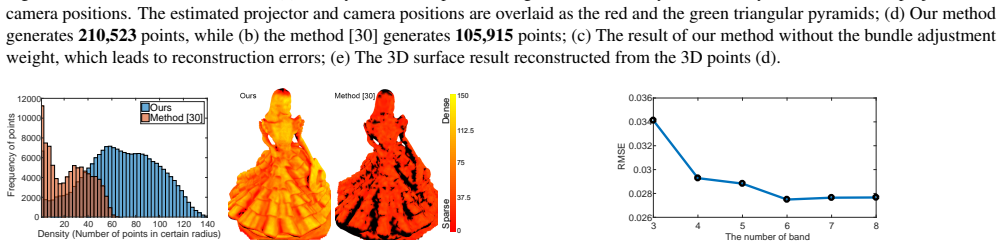
- Including projector pixel correspondences in the SfM bundle adjustment roughly doubles the reconstructed point-cloud density compared with camera-only correspondences.
- The shading-aware estimation reduces the number of spectral bands needed: a six-band subset of the 21 available light-camera combinations already reaches near-minimal error.
Reading between the lines
- The residual between the model's predicted and observed intensities could be mined as a signal for non-Lambertian or interreflection effects, pointing toward a future extension that estimates a per-point BRDF or global illumination rather than assuming Lambertian shading.
- The system's reliance on a known illumination spectrum (measured by a spectrometer) could be relaxed by jointly estimating the projector's spectral power distribution, turning the hardware into a fully self-contained scanner.
- Because the shading model uses the projector as a calibrated moving light source, Pro-Cam SSfM is effectively a self-calibrating photometric-stereo setup; the same geometric term could be used for normal refinement or for estimating the projector's radiometric falloff.
- The method's per-point reflectance estimates, once corrected for interreflections, could serve as ground truth for single-image spectral recovery methods, which currently train on 'baked-in' shading.
Signed reviews
Editorial analysis
A structured set of objections, weighed in public.
Referee Report
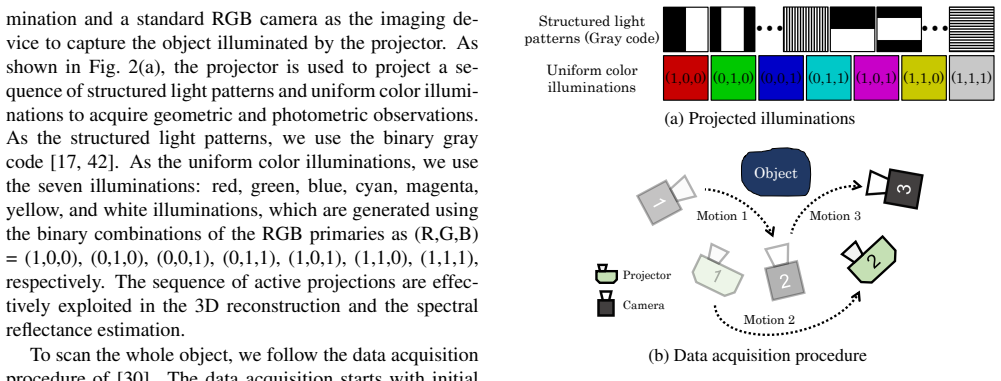
Summary. This paper presents Pro-Cam SSfM, an acquisition system that uses an off-the-shelf RGB camera and an off-the-shelf projector for simultaneous dense 3D reconstruction and per-point spectral reflectance estimation. The camera and projector are alternately moved around the object; structured-light codes are matched across all cameras and projectors and fed to an SfM pipeline with weighted bundle adjustment (Eq. 1). The estimated projector poses and reconstructed 3D points and normals are then used in a physically-motivated shading model (Eq. 10) inside a linear least-squares reflectance estimation with a spectral smoothness regularizer (Eqs. 11-13). Experiments on a color chart and two real objects report denser point clouds than the prior method [30] and lower spectral-reflectance RMSE than two single-view baselines.
Significance. If the central claims hold, this is a practically useful low-cost spectral-3D scanning system: it avoids dedicated multispectral cameras or light sources, and it replaces fitted or ignored shading with a geometry-based shading factor derived from the inverse-square law and a Lambertian assumption. The derivation of Eq. (10) is sound and the reflectance optimization is a standard regularized linear inverse problem. The paper also offers a concrete demonstration that projector poses estimated during SfM can be reused for photometric modeling, which is a nice integration of geometric and photometric pipelines. However, the empirical validation currently conflates the proposed shading model with multi-view averaging, so the central claim that Eq. (10) enables recovery of inherent spectral reflectance is not yet established. The paper does not release code or data, which limits reproducibility, but the experimental protocol is otherwise reasonably standard.
major comments (3)
- [Section 4.3, Fig. 8(d)-(e), Eq. (12)] The comparison is unequal: the proposed method minimizes E_ren over all four projector-camera pairs, whereas the single-view baselines [18] and [5] are applied to projector-camera pair 4 only. This conflates the geometric shading factor of Eq. (10) with the benefit of averaging four independent observations, since each single-view estimate carries a different shading bias and averaging them could reduce RMSE even without a geometric model. To support the central claim, the authors should add an ablation: (i) the proposed method with the shading factor disabled (or set to 1) using the same four pairs; (ii) the proposed method using only pair 4; and, ideally, (iii) the baselines applied to all four pairs and averaged. The paper's own statement in Section 4.3 that without shading its accuracy would be similar to existing methods underscores that isolating the shading model is essential to the novelty claim.
- [Section 3.3.3, Fig. 9(d), Concluding Remarks] The model assumes Lambertian reflectance, negligible ambient light, and no interreflection. These are not merely boundary conditions: because the shading factor in Eq. (10) is computed deterministically from geometry rather than fitted, any violation of these assumptions is absorbed into the estimated reflectance, biasing the 'inherent spectral reflectance' claim. The paper acknowledges that interreflections cause errors in concave skirt regions of the clay sculpture, but it does not quantify the resulting reflectance bias. The authors should either add a controlled experiment on a concave or non-Lambertian target and report reflectance error as a function of concavity or material gloss, or explicitly restrict the claim to weakly interreflective matte scenes.
- [Section 4.3, Fig. 7] The band selection is performed on the same color chart used for the final RMSE evaluation: for each number of bands the paper reports the 'selected best band set' chosen by evaluating all possible band sets, which is a test-set selection and can overstate accuracy. The authors should use a separate validation set or a fixed predefined band set, or at least report the performance of a fixed band set (e.g., the six-band combination) on held-out patches or objects.
minor comments (8)
- [Concluding Remarks] The first sentence contains the typo 'fist' and should read 'first'.
- [Section 3.3.3] The word 'Lambartian' should be 'Lambertian'.
- [Section 4.1, Eq. (11)] The statement that Ceres is used to solve the 'non-linear optimization problem' of Eq. (11) is misleading because with known shading factors the problem is linear in the coefficient vector α_k; please clarify or justify the nonlinearity.
- [Section 4.3] Please clarify how baseline [5] is adapted to this setup: [5] is designed for single RGB images, so it should be stated whether it receives the RGB response under one illumination or the full 21-band vector, since that determines the fairness of the comparison.
- [Section 3.2.1] The threshold for connecting features from different projectors is defined in pixels but the image resolution and scale are not stated; please report the resolution and discuss how the 0.5-pixel threshold affects the number and accuracy of correspondences.
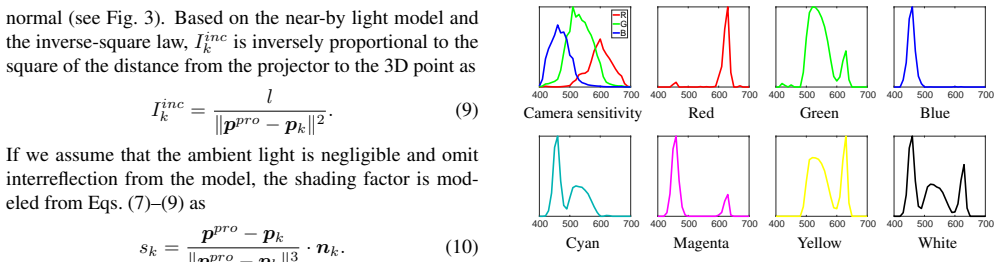
- [Figure 4] Please add axis labels and units to the plots of camera spectral sensitivity and illumination spectral power distributions; the current figure is difficult to interpret without them.
- [Section 4.4] The clay sculpture and stuffed toy results are presented qualitatively; please provide quantitative spectral-reflectance RMSE against ground truth for these objects, or state explicitly that only qualitative evaluation is intended.
- [Eq. (13)] The smoothness term E_ssm should be written with an explicit norm and the operator D should be defined precisely (e.g., a second-difference matrix) so that the dimension of the regularization is unambiguous.
Circularity Check
No significant circularity: the shading factor is computed from geometry rather than fitted, and the central reflectance-estimation result is validated against ground truth without depending on a self-citation chain.
full rationale
The paper's central derivation is self-contained. The shading factor in Eq. (10) is computed from the reconstructed 3D point, the point normal, and the estimated projector position under an explicit Lambertian/inverse-square-law model; it is not fitted to the spectral reflectance data and is not defined in terms of the output reflectance. The reflectance coefficients are then optimized from observed multispectral intensities via the rendering cost in Eqs. (11)-(12), using an external basis model ([18,40]) and independently measured/known illuminant and camera sensitivities. The only author-overlapping citations are [30], [26], and [36]; [30] is used as a baseline and extension point rather than as load-bearing authority, and the paper directly compares against it with density evaluation. The acknowledged limitations (known illumination spectrum and neglected interreflections) are model limitations, not circular reasoning. The comparison of our method using all four projector-camera pairs against single-view baselines using pair 4 is a validation confound that could affect the strength of the empirical claim, but it is not a circularity of the derivation chain, so it does not raise the circularity score. Overall, no prediction reduces by construction to a fitted input or to a self-citation.
Assumptions & free parameters
free parameters (5)
- gamma =
0.06
- wp =
100
- Nb =
8
- feature connection threshold =
0.5 pixels
- spectral band subset (selected in Fig. 7) =
not explicitly stated, but the best six-band set is reported
assumptions (5)
- domain assumption The object surface is Lambertian (reflectance is matte and camera-independent).
- domain assumption Ambient light is negligible and interreflections are omitted.
- domain assumption The spectral power distributions of the seven projected illuminations and the camera spectral sensitivities are known.
- domain assumption Spectral reflectance lies in a low-dimensional linear subspace spanned by basis B.
- domain assumption The projector and camera poses estimated by the SfM pipeline are accurate enough for the shading computation, and the camera response is linear.
Cite this review
Pith. "Pith review of Pro-Cam SSfM: Projector-Camera System for Structure and Spectral Reflectance from Motion." pith.science (2026). https://pith.science/paper/24TA5WGR
@misc{pith2026190808185,
  author       = {Pith},
  title        = {Pith review of: Pro-Cam SSfM: Projector-Camera System for Structure and Spectral Reflectance from Motion},
  year         = {2026},
  howpublished = {\url{https://pith.science/paper/24TA5WGR}},
  note         = {Machine review of arXiv:1908.08185}
}
read the original abstract
In this paper, we propose a novel projector-camera system for practical and low-cost acquisition of a dense object 3D model with the spectral reflectance property. In our system, we use a standard RGB camera and leverage an off-the-shelf projector as active illumination for both the 3D reconstruction and the spectral reflectance estimation. We first reconstruct the 3D points while estimating the poses of the camera and the projector, which are alternately moved around the object, by combining multi-view structured light and structure-from-motion (SfM) techniques. We then exploit the projector for multispectral imaging and estimate the spectral reflectance of each 3D point based on a novel spectral reflectance estimation model considering the geometric relationship between the reconstructed 3D points and the estimated projector positions. Experimental results on several real objects demonstrate that our system can precisely acquire a dense 3D model with the full spectral reflectance property using off-the-shelf devices.
Figures


Figures from the paper (6 more)



Reference graph
Works this paper leans on
-
[18]
Fast spectral reflectance recovery using DLP projector
Shuai Han, Imari Sato, Takahiro Okabe, and Yoichi Sato. Fast spectral reflectance recovery using DLP projector. Int. Journal of Computer Vision, 110(2):172–184, 2014
work page 2014
-
[30]
Robust, precise, and calibration-free shape acquisition with an off- the-shelf camera and projector
Chunyu Li, Akihiko Torii, and Masatoshi Okutomi. Robust, precise, and calibration-free shape acquisition with an off- the-shelf camera and projector. Proc. of IEEE Conf. on Con- sumer Electronics (ICCE), pages 1–6, 2018
work page 2018
-
[5]
Sparse recovery of hyper- spectral signal from natural RGB images
Boaz Arad and Ohad Ben-Shahar. Sparse recovery of hyper- spectral signal from natural RGB images. Proc. of European Conf. on Computer Vision (ECCV), pages 19–34, 2016
work page 2016
-
[1]
http://cs.joensuu.fi/ ˜spectral/databases/ download/munsell spec matt.htm
Munsell colors matt. http://cs.joensuu.fi/ ˜spectral/databases/ download/munsell spec matt.htm
-
[2]
In de- fense of shallow learned spectral reconstruction from RGB images
Jonas Aeschbacher, Jiqing Wu, and Radu Timofte. In de- fense of shallow learned spectral reconstruction from RGB images. Proc. of IEEE Int, Conf. on Computer Vision (ICCV) Workshops, pages 471–479, 2017
work page 2017
- [3]
-
[4]
Daniel G. Aliaga and Yi Xu. Photogeometric structured light: A self-calibrating and multi-viewpoint framework for accurate 3D modeling. Proc. of IEEE Conf. on Computer Vision and Pattern Recognition (CVPR), pages 1–8, 2008
work page 2008
-
[6]
Seung-Hwan Baek, Incheol Kim, Diego Gutierrez, and Min H. Kim. Compact single-shot hyperspectral imaging using a prism. ACM Trans. on Graphics , 36(6):217:1–12, 2017
work page 2017
Show all 49 references
-
[7]
Generation and application of hyperspectral 3D plant models: Methods and challenges
Jan Behmann, Anne-Katrin Mahlein, Stefan Paulus, Jan Dupuis, Heiner Kuhlmann, Erich-Christian Oerke, and Lutz Pl¨umer. Generation and application of hyperspectral 3D plant models: Methods and challenges. Machine Vision and Applications, 27(5):611–624, 2016
2016
-
[8]
A prism-mask system for multispectral video acquisi- tion
Xun Cao, Hao Du, Xin Tong, Qionghai Dai, and Stephen Lin. A prism-mask system for multispectral video acquisi- tion. IEEE Trans. on Pattern Analysis and Machine Intelli- gence, 33(12):2423–2435, 2011
2011
-
[9]
Integration of 3D and multispectral data for cultural heritage applications: Survey and perspectives
Camille Simon Chane, Alamin Mansouri, Franck Marzani, and Frank Boochs. Integration of 3D and multispectral data for cultural heritage applications: Survey and perspectives. Image and Vision Computing, 31(1):91–102, 2013
2013
-
[10]
Multi-spectral imaging by optimized wide band illumination
Cui Chi, Hyunjin Yoo, and Moshe Ben-Ezra. Multi-spectral imaging by optimized wide band illumination. Int. Journal of Computer Vision, 86:140–151, 2010
2010
-
[11]
Meshlab: An open-source mesh processing tool
Paolo Cignoni, Marco Callieri, Massimiliano Corsini, Mat- teo Dellepiane, Fabio Ganovelli, and Guido Ranzuglia. Meshlab: An open-source mesh processing tool. Proc. of Eurographics Italian Chapter Conference , pages 129–136, 2008
2008
-
[12]
Tone reproduction and physically based spectral rendering
Kate Devlin, Alan Chalmers, Alexander Wilkie, and Werner Purgathofer. Tone reproduction and physically based spectral rendering. Eurographics State of The Art Report , pages 1– 23, 2002
2002
-
[13]
Spectral reflectance recovery from a single RGB image
Ying Fu, Yongrong Zheng, Lin Zhang, and Hua Huang. Spectral reflectance recovery from a single RGB image. IEEE Trans. on Computational Imaging , 4(3):382–394, 2018
2018
-
[14]
One- shot entire shape acquisition method using multiple projec- tors and cameras
Ryo Furukawa, Ryusuke Sagawa, Hiroshi Kawasaki, Kazuhiro Sakashita, Yasushi Yagi, and Naoki Asada. One- shot entire shape acquisition method using multiple projec- tors and cameras. Proc. of Pacific-Rim Symposium on Image and Video Technology (PSIVT), pages 107–114, 2010
2010
-
[15]
Accurate, dense, and robust multiview stereopsis.IEEE Trans
Yasutaka Furukawa and Jean Ponce. Accurate, dense, and robust multiview stereopsis.IEEE Trans. on Pattern Analysis and Machine Intelligence, 32(8):1362–1376, 2010
2010
-
[16]
Mar ´ın-Jim´enez
Sergio Garrido-Jurado, Rafael Mu ˜noz-Salinas, Fran- cisco Jos ´e Madrid-Cuevas, and Manuel J. Mar ´ın-Jim´enez. Simultaneous reconstruction and calibration for multi-view structured light scanning. Journal of Visual Communication and Image Representation, 39:120–131, 2016
2016
-
[17]
Structured-light 3D surface imaging: A tutorial
Jason Geng. Structured-light 3D surface imaging: A tutorial. Advances in Optics and Photonics, 3(2):128–160, 2011
2011
-
[19]
Measuring spectral reflectance and 3D shape using multi- primary image projector
Keita Hirai, Ryosuke Nakahata, and Takahiko Horiuchi. Measuring spectral reflectance and 3D shape using multi- primary image projector. Proc. of Int. Conf. on Image and Signal Processing (ICISP), pages 137–147, 2016
2016
-
[20]
Surface reconstruction from unor- ganized points
Hugues Hoppe, Tony DeRose, Tom Duchamp, John McDon- ald, and Werner Stuetzle. Surface reconstruction from unor- ganized points. Proc. of SIGGRAPH, pages 71–78, 1992
1992
-
[21]
A 3D reconstruction method with color reproduction from multi-band and multi-view images
Shuya Ito, Koichi Ito, Takafumi Aoki, and Masaru Tsuchida. A 3D reconstruction method with color reproduction from multi-band and multi-view images. Proc. of Asian Conf. on Computer Vision (ACCV), pages 236–247, 2016
2016
-
[22]
From RGB to spectrum for natural scenes via manifold-based mapping
Yan Jia, Yinqiang Zheng, Lin Gu, Art Subpa-Asa, Antony Lam, Yoichi Sato, and Imari Sato. From RGB to spectrum for natural scenes via manifold-based mapping. Proc. of IEEE Int. Conf. on Computer Vision (ICCV) , pages 4705– 4713, 2017
2017
-
[23]
What is the space of spectral sensitivity functions for digi- tal color cameras? Proc
Jun Jiang, Dengyu Liu, Jinwei Gu, and Sabine S ¨usstrunk. What is the space of spectral sensitivity functions for digi- tal color cameras? Proc. of Workshop on Applications of Computer Vision (WACV), pages 168–179, 2013
2013
-
[24]
Poisson surface reconstruction
Michael Kazhdan, Matthew Bolitho, and Hugues Hoppe. Poisson surface reconstruction. Proc. of Eurographics Sym- posium on Geometry Processing, pages 61–70, 2006
2006
-
[25]
Screened Poisson sur- face reconstruction
Michael Kazhdan and Hugues Hoppe. Screened Poisson sur- face reconstruction. ACM Trans. on Graphics, 32(3):29:1– 13, 2013
2013
-
[26]
Multi-view inverse rendering under arbitrary illumination and albedo
Kichang Kim, Akihiko Torii, and Masatoshi Okutomi. Multi-view inverse rendering under arbitrary illumination and albedo. Proc. of European Conf. on Computer Vision (ECCV), pages 750–767, 2016
2016
-
[27]
Kim, Todd Alan Harvey, David S
Min H. Kim, Todd Alan Harvey, David S. Kittle, Holly Rush- meier, Julie Dorsey, Richard O. Prum, and David J. Brady. 3D imaging spectroscopy for measuring hyperspectral pat- terns on solid objects. ACM Trans. on Graphics, 31(4):38:1– 11, 2012
2012
-
[28]
Kim, Holly Rushmeier, John Ffrench, Irma Passeri, and David Tidmarsh
Min H. Kim, Holly Rushmeier, John Ffrench, Irma Passeri, and David Tidmarsh. Hyper3D: 3D graphics software for examining cultural artifacts. ACM Journal on Computing and Cultural Heritage, 7(3):14:1–19, 2014
2014
-
[29]
Masahiro Kitahara, Takahiro Okabe, Christian Fuchs, and Hendrik P. A. Lensch. Simultaneous estimation of spectral reflectance and normal from a small number of images.Proc. of Int. Conf. on Computer Vision Theory and Applications (VISAPP), pages 303–313, 2015
2015
-
[31]
3D plant modelling via hyperspectral imaging
Jie Liang, Ali Zia, Jun Zhou, and Xavier Sirault. 3D plant modelling via hyperspectral imaging. Proc. of IEEE Int, Conf. on Computer Vision Workshops (ICCVW), pages 172– 177, 2013
2013
-
[32]
Manolis Lourakis and Antonis A. Argyros. SBA: A software package for generic sparse bundle adjustment. ACM Trans. on Mathematical Software, 36(1):2:1–30, 2009
2009
-
[33]
Toward a 3D multispectral scanner: An application to multimedia
Alamin Mansouri, Alexandra Lathuiliere, Franck Marzani, Yvon V oisin, and Pierre Gouton. Toward a 3D multispectral scanner: An application to multimedia. IEEE Multimedia, 14(1):40–47, 2007
2007
-
[34]
Combining shape from shading and stereo: A vari- ational approach for the joint estimation of depth, illumina- tion and albedo
Daniel Maurer, Yong Chul Ju, Michael Breuß, and Andr ´es Bruhn. Combining shape from shading and stereo: A vari- ational approach for the joint estimation of depth, illumina- tion and albedo. Proc. of British Machine Vision Conference (BMVC), pages 76–1–14, 2016
2016
-
[35]
Variational reflectance estimation from multi-view images
Jean M ´elou, Yvain Qu ´eau, Jean-Denis Durou, Fabien Cas- tan, and Daniel Cremers. Variational reflectance estimation from multi-view images. Journal of Mathematical Imaging and Vision, 60(9):1527–1546, 2018
2018
-
[36]
A practical one-shot multispectral imaging system using a single image sensor
Yusuke Monno, Sunao Kikuchi, Masayuki Tanaka, and Masatoshi Okutomi. A practical one-shot multispectral imaging system using a single image sensor. IEEE Trans. on Image Processing, 24(10):3048–3059, 2015
2015
-
[37]
Nayar, Gurunandan Krishnan, Michael D
Shree K. Nayar, Gurunandan Krishnan, Michael D. Gross- berg, and Ramesh Raskar. Fast separation of direct and global components of a scene using high frequency illumi- nation. ACM Trans. on Graphics, 25(3):935–944, 2006
2006
-
[38]
Rang H. M. Nguyen, Dilip K. Prasad, and Michael S. Brown. Training-based spectral reconstruction from a single RGB image. Proc. of European Conf. on Computer Vision (ECCV), pages 186–201, 2014
2014
-
[39]
Hy- perspectral photometric stereo for a single capture
Keisuke Ozawa, Imari Sato, and Masahiro Yamaguchi. Hy- perspectral photometric stereo for a single capture. Journal of the Optical Society of America A, 34(3):384–394, 2018
2018
-
[40]
Grossberg, and Shree K
Jong-Il Park, Moon-Hyun Lee, Michael D. Grossberg, and Shree K. Nayar. Multispectral imaging using multiplexed illumination. Proc. of IEEE Int. Conf. on Computer Vision (ICCV), pages 1–8, 2007
2007
-
[41]
Jussi P. S. Parkkinen, Jarmo Hallikainen, and Timo Jaaske- lainen. Characteristic spectra of Munsell colors. Journal of the Optical Society of America A, 6(2):318–322, 1989
1989
-
[42]
A state of the art in structured light patterns for surface profilometry
Joaquim Salvi, Sergio Fernandez, Tomislav Pribanic, and Xavier Llado. A state of the art in structured light patterns for surface profilometry. Pattern Recognition, 43(8):2666– 2680, 2010
2010
-
[43]
Schonberger and Jan-Michael Frahm
Johannes L. Schonberger and Jan-Michael Frahm. Structure- from-motion revisited. Proc. of IEEE Conf. on Computer Vision and Pattern Recognition (CVPR) , pages 4104–4113, 2016
2016
-
[44]
Seitz, Brian Curless, James Diebel, Daniel Scharstein, and Richard Szeliski
Steven M. Seitz, Brian Curless, James Diebel, Daniel Scharstein, and Richard Szeliski. A comparison and eval- uation of multi-view stereo reconstruction algorithms. Proc. of IEEE Conf. on Computer Vision and Pattern Recognition (CVPR), pages 519–528, 2006
2006
-
[45]
HSCNN+: Advanced CNN-based hyperspectral recov- ery from RGB images
Zhan Shi, Chang Chen, Zhiwei Xiong, Dong Liu, and Feng Wu. HSCNN+: Advanced CNN-based hyperspectral recov- ery from RGB images. Proc. of IEEE Conf. on Computer Vision and Pattern Recognition (CVPR) Workshops , pages 939–947, 2018
2018
-
[46]
Seitz, and Richard Szeliski
Noah Snavely, Steven M. Seitz, and Richard Szeliski. Photo tourism: Exploring photo collections in 3D. ACM Trans. on Graphics, 25(3):835–846, 2006
2006
-
[47]
A multi-camera, multi-projector super- resolution framework for structured light
Michael Weinmann, Christopher Schwartz, Roland Ruiters, and Reinhard Klein. A multi-camera, multi-projector super- resolution framework for structured light. Proc. of Int. Conf. on 3D Imaging, Modeling, Processing, Visualization and Transmission (3DIMPVT), pages 397–404, 2011
2011
-
[48]
Brown, Marc Pollefeys, and Seon Joo Kim
Seoung Wug Oh, Michael S. Brown, Marc Pollefeys, and Seon Joo Kim. Do it yourself hyperspectral imaging with everyday digital cameras. Proc. of IEEE Conf. on Computer Vision and Pattern Recognition (CVPR) , pages 2461–2469, 2016
2016
-
[49]
3D re- construction from hyperspectral images
Ali Zia, Jie Liang, Jun Zhou, and Yongsheng Gao. 3D re- construction from hyperspectral images. Proc. of IEEE Win- ter Conf. on Applications of Computer Vision (WACV), pages 318–325, 2015
2015
Reviewed August 14, 2026 · model on record in the stance chip above.
Discussion (0). Continue with ORCID to comment.