REVIEW 3 major objections 3 minor 45 references
Dynamics and stability of a compound particle -- a theoretical study
T0 review · 3 major / 3 minor · reviewed 2026-08-14 · deepseek-v4-flash
Pith's one-line read This paper derives exact low-Reynolds solutions for a rigid sphere inside a liquid drop, and shows that a pulsatile flow can shuttle the compound particle without rupturing its drop.
desk verdict The exact rotation/translation results are solid and citable, but the breakup-time and pulsatile-flow claims rest on a first-order shape expansion pushed past its validity, plus some concrete sign/transcription errors. read the letter →
The pith
A machine-rendered reading of the paper's core claim, the machinery that carries it, and where it could break.
The reading
What carries the argument
The load-bearing object is the assumed interface shape truncated to a single quadrupole mode, $S(x,t)=r-\alpha a\,(1+b\,Ca\,x\cdot E\cdot x)$, where $E$ is the symmetric part of the imposed velocity-gradient tensor and $b$ is the single time-dependent amplitude. The kinematic boundary condition at the interface turns this shape ansatz into one scalar ordinary differential equation, $Ca\,\mathrm{d}b/\mathrm{d}t=-b\,g(\alpha,\lambda)-f(\alpha,\lambda)/h(\alpha,\lambda)$, whose coefficients are rational functions of the size ratio $\alpha$ and viscosity ratio $\lambda$. All subsequent statements, the exponential relaxation, the critical capillary number, the breakup time, the comparison among shear, uniaxial, and biaxial flows, and the pulsatile-flow protocol, follow algebraically once this scalar equation is accepted.
What would settle it
Measure the time-dependent shape of a compound particle in a steady shear flow at moderate capillary number. If the relaxation from a deformed state is not a single exponential with the predicted time constant $\tau$, and if the steady shape exceeds the quadrupole prediction with noticeable higher-order modes before the critical capillary number is reached, then the central truncation fails.
Extended reading notes
Core claim
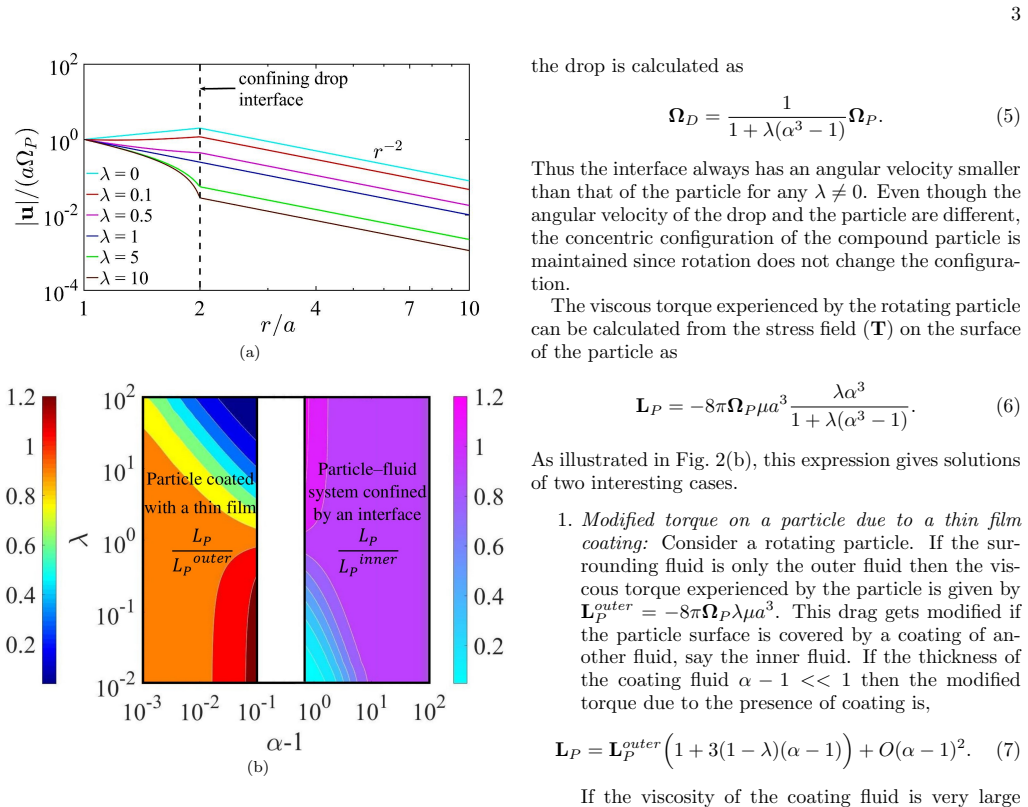
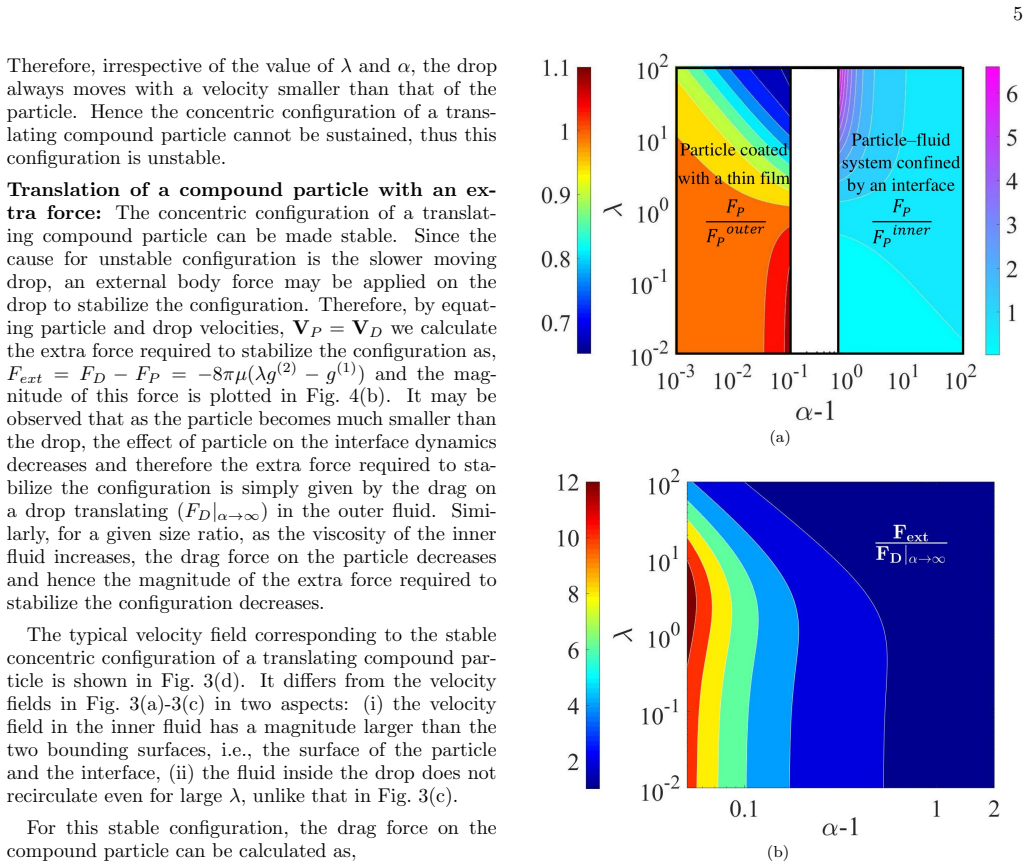
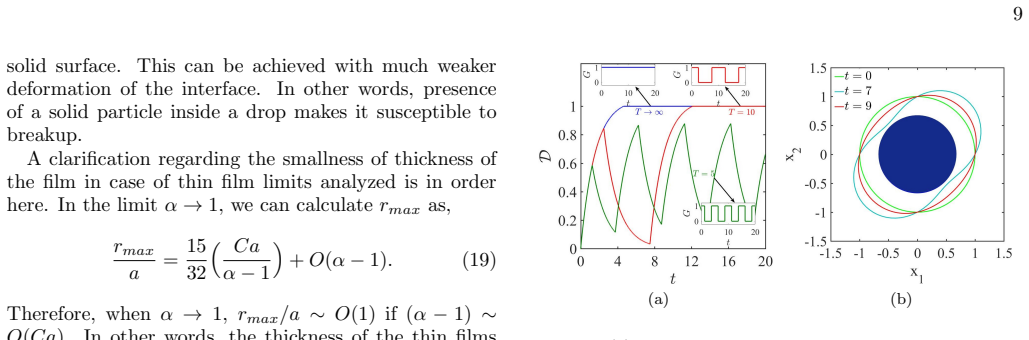
On the paper's own terms, the discovery is that the entire low-Reynolds dynamics of a concentric compound particle reduces to a small set of explicit formulas. For rotation, the spherical interface is an exact solution: the particle and drop rotate at different rates, and the torque on the particle is $L_P=-8\pi\Omega_P\mu a^3 \lambda\alpha^3/[1+\lambda(\alpha^3-1)]$. For translation, the concentric state is not steady because the drop lags behind the solid; the paper calculates the extra force $F_{\mathrm{ext}}$ needed to make $V_P=V_D$ and gives closed-form drag laws for the thin-film and interface-confinement limits. In a general linear flow, the interface shape $S(x,t)=r-\alpha a\,(1+b\,Ca\,x\cdot E\cdot x)$ evolves by $Ca\,\mathrm{d}b/\mathrm{d}t=-b\,g(\alpha,\lambda)-f(\alpha,\lambda)/h(\alpha,\lambda)$, an exponential relaxation with time scale $\tau=Ca\,h(\alpha,\lambda)/g(\alpha,\lambda)$. Setting the deformation parameter $D=1$ marks breakup when the deformed interface touches the solid inclusion, and the resulting critical capillary number and breakup time are tabulated for simple shear, uniaxial, and biaxial flows. Finally, because the interface needs a time $\tau$ to move, a square-wave pulsatile flow with period $T<t_b$ avoids $D=1$ and transports the particle without breaking the drop.
Load-bearing premise
The shape of the deformed drop is assumed to stay a single quadrupole mode, with no higher-order spherical harmonics, so the interface cannot develop more complex wrinkles or bulges during strong deformation.
Editorial extensions
If this is right
- A rotating compound particle keeps a perfectly spherical drop, with drop angular velocity $\Omega_D=\Omega_P/[1+\lambda(\alpha^3-1)]$, so a concentric rotating configuration is a true steady state.
- A translating compound particle drifts apart from its drop unless the drop is pulled by an external force; the required stabilizing force is given in closed form and is large for thin films.
- For any fixed $\alpha$ and $\lambda$ there is a critical capillary number $Ca_{\mathrm{crit}}$ above which the deformed interface touches the solid inclusion ($D=1$); stable operation requires $Ca<Ca_{\mathrm{crit}}$, and thin films require $Ca_{\mathrm{crit}}\sim(\alpha-1)^{-2}$.
- Among simple shear, uniaxial, and biaxial flows, biaxial flow is the most destructive: it gives the smallest $r_{\min}$ and the shortest breakup time because an oblate interface meets the inclusion sooner than a prolate one.
- A square-wave pulsatile flow with period $T$ shorter than the breakup time keeps $D$ below 1 indefinitely, so a compound particle can be transported without rupture.
Reading between the lines
- If the single-quadrupole truncation is reliable, the pulsatile protocol should be robust to waveform shape: any alternating on-off drive with off-time at least $\tau$ and on-time less than $t_b$ should reset the interface between pulses, a prediction that could be tested directly in a microfluidic channel with time-varying pumping.
- The strong thin-film scalings, $Ca_{\mathrm{crit}}\propto(\alpha-1)^{-2}$ and $t_b\propto(\alpha-1)^{-1}$, imply that lubricating films can be made almost indefinitely stable by choosing a favorable viscosity ratio; the same shielding may be undesirable when internal mixing is wanted, since the recirculating flow that aids mixing is suppressed in that limit.
- Applying the same perturbation machinery to an eccentric inclusion would likely reveal an additional translational drift mode needing its own control, but the exponential relaxation and pulsing strategy should carry over in modified form.
- The exponential relaxation law suggests a direct experimental observable: measuring $D(t)$ after switching a steady shear flow off should yield a single-exponential decay with time constant $\tau$, and any systematic deviation would signal that higher harmonics have become important.
Signed reviews
Editorial analysis
A structured set of objections, weighed in public.
Referee Report
Summary. The manuscript studies the low-Reynolds-number hydrodynamics of a concentric compound particle consisting of a rigid spherical inclusion inside a viscous drop. It reports analytical Stokes-flow solutions for rotation, translation, and general linear ambient flows, gives closed-form expressions for the viscous torque and drag, and derives an ordinary differential equation for the time evolution of the confining drop shape in the small-capillary-number limit. On the basis of this evolution equation, the paper predicts a critical capillary number and a breakup time at which the deformed interface touches the solid inclusion, and it proposes pulsatile flow as a method to transport compound particles without breakup. The manuscript also compares simple shear, uniaxial, and biaxial flows and discusses thin-film limits for all computed quantities.
Significance. If the results are valid, the paper provides useful closed-form reference solutions for a class of compound-particle problems that are usually treated numerically or in bispherical series. The derivation is self-contained, has no fitted parameters, and correctly recovers known compound-droplet limits in several places, which are genuine strengths. The pulsatile-flow idea is original and experimentally testable. However, the significance and the practical claims rest on extrapolating a first-order small-deformation calculation to the point of drop-inclusion contact, and that extrapolation is not controlled by the analysis as presented. The correctable nature of the identified problems makes a major revision the appropriate outcome.
major comments (3)
- [Section II.C, Eq. (14) and Fig. 7] The central evolution equation is obtained from the O(Ca) single-quadrupole shape ansatz S(x,t) = r - alpha a (1 + b Ca x.E.x). The paper then integrates this equation up to D = 1, the point at which the interface touches the solid inclusion. At contact, b Ca = 2(alpha - 1)/alpha from the rmin formula in Table I. For the parameters used in Fig. 7 (alpha = 1.5, Ca = 0.2) this gives b Ca = 0.67, and for alpha = 2 it gives b Ca = 1. These values are O(1), so the interface displacement is not small compared with the film thickness, and neither the restriction to a single quadrupole harmonic nor the neglect of O(Ca^2) corrections to the flow is justified. The clarification after Eq. (19) explicitly restricts the thin-film limit to (alpha - 1) ~ O(Ca), yet the same equations are used for alpha = 1.5 and alpha = 2 at Ca = 0.2 to predict Cacrit, tb, and the pulsatile-flow threshold. This is an internal inconsistency in the domain of validity and it undermines the breakup and transport claims.
- [Section II.C, Eq. (18)] The thin-film breakup time is reported as tb/G^-1 = -4/[15 lambda (alpha - 1)] - 4(15 lambda - 7)/(45 lambda) + O(alpha - 1). For alpha -> 1+ and lambda > 0, this expression tends to -infinity, which contradicts the statement in the same paragraph that the breakup time is very large. The sign is also inconsistent with the logarithmic expression for tb in Table I, whose argument gives a positive, large value in the thin-film limit. This equation needs to be re-derived and corrected before the breakup-time predictions can be trusted.
- [Section II.C, Eq. (16) and definition of breakup] The paper equates D = 1, i.e., contact between the deformed interface and the solid inclusion, with breakup of the confining drop. Contact is a geometric condition, not a dynamical rupture condition: whether the film then drains, dewets, or ruptures depends on additional physics that is not part of the model. Since the pulsatile-flow protocol is designed specifically to prevent D = 1, this identification is load-bearing and should be either justified with a separate argument or softened to a statement about onset of contact rather than breakup.
minor comments (3)
- [Section II.B, Eq. (11)] Equation (11) appears to be inconsistent with the expression for V_D in Appendix A: the numerator contains 9 alpha^5 - 5 alpha^5 - 4, while the appendix gives 9 alpha^5 - 5 alpha^3 - 4. This is presumably a typographical error, but it should be corrected and the inequality V_D/V_P < 1 should be verified with the corrected expression.
- [Table I] Several entries in Table I are typeset in a way that is hard to parse; for example, the simple-shear expression for D reads as b Ca/(2 - 2 alpha), which is negative for alpha > 1, and the uniaxial and biaxial D entries are ambiguous. Please reformat the table so that each fraction is unambiguous.
- [Section II.E] The design criterion at the end of the pulsatile-flow section states that stability is maintained when T > tau, but the preceding discussion and Fig. 7 show that large T leads to breakup and small T prevents it. The inequality should read T < tau (or the definition of tau should be clarified), and the statement should be checked against the values used in Fig. 7.
Circularity Check
No significant circularity: the derivation is self-contained and parameter-free.
full rationale
The paper's central results are obtained by solving the steady Stokes equations for a concentric solid-in-drop geometry with only the stated boundary conditions, then using the kinematic interface condition to derive the scalar shape-evolution equation (Eq. 14). No empirical or fitted parameters enter the derivation; the functions f, g, and h are algebraic combinations of the geometric ratio alpha and viscosity ratio lambda obtained from the leading-order flow solution. The breakup criterion D=1 is not an input but a geometric contact condition following from the deformation parameter defined in Eq. 16, and the pulsatile-flow transport proposal follows by integrating the derived relaxation dynamics under the square-wave strain-rate input of Eq. 20, not by imposing the conclusion. Prior compound-droplet results are invoked only as limiting checks or comparisons (e.g., Eq. 10 versus Sadhal and Oguz, Eq. 12 versus Rushton and Davies), and none of these citations is load-bearing for the new transient dynamics or the pulsatile-flow protocol. There are no fitted inputs renamed as predictions, no uniqueness theorem imported from the authors' prior work, and no ansatz smuggled in via citation: the single-mode interface ansatz S = r - alpha a(1 + b Ca x.E.x) is explicitly stated and used consistently in the derivation. The skeptical concern that this O(Ca) quadrupole truncation is uncontrolled when breakup is approached is a domain-of-validity or correctness issue, not a circularity; the derivation does not reduce to its own inputs by construction.
Assumptions & free parameters
assumptions (4)
- domain assumption The flow is governed by steady Stokes equations with negligible inertia.
- domain assumption The droplet deformation is small, with all variables expanded in powers of the capillary number Ca.
- ad hoc to paper The interface shape is described by a single quadrupole mode, r = alpha a (1 + b Ca x.E.x).
- domain assumption Both fluids are Newtonian, the interface has constant surface tension, and no surfactants are present.
Cite this review
Pith. "Pith review of Dynamics and stability of a compound particle -- a theoretical study." pith.science (2026). https://pith.science/paper/OMIM447Y
@misc{pith2026190808202,
  author       = {Pith},
  title        = {Pith review of: Dynamics and stability of a compound particle -- a theoretical study},
  year         = {2026},
  howpublished = {\url{https://pith.science/paper/OMIM447Y}},
  note         = {Machine review of arXiv:1908.08202}
}
read the original abstract
Particles confined in droplets are called compound particles. They are encountered in various biological and soft matter systems. Hydrodynamics can play a decisive role in determining the configuration and stability of these multiphase structures during their preparation and use. Therefore, we investigate the dynamics and stability of a concentric compound particle under external forces and imposed flows. Governing equations are solved analytically in the inertia-less limit using the standard technique of superposition of vector harmonics and the solutions obtained are reported in terms of steady state flow fields, viscous drag on the particle and the time evolution of the confining drop shape. The limiting form of compound particle as a thin film coated rigid particle is analyzed in each case. We find that concentric configuration of a rotating compound particle is a steady state solution, and we calculate the extra force required to stabilize the concentric configuration of a translating compound particle. A comprehensive comparison of drop deformations in various linear ambient flows is also provided. Based on the findings, we propose pulsatile flow as a reliable method to transport compound particles without breakup of the confining drop. Thus, our analysis provides useful guidelines in preparation and transportation of stable compound particles in the context of nucleated cells, aerosols, droplet-based encapsulation of motile organisms and polymer microcapsules.
Figures


Figures from the paper (4 more)


Reference graph
Works this paper leans on
-
[1]
Modified torque on a particle due to a thin film coating: Consider a rotating particle. If the sur- rounding fluid is only the outer fluid then the vis- cous torque experienced by the particle is given by Louter P =−8πΩPλµa3. This drag gets modified if the particle surface is covered by a coating of an- other fluid, say the inner fluid. If the thickness of the c...
-
[2]
Modified torque on a particle when particle-fluid system is confined by an interface: The viscous torque experienced by a particle rotating in the in- ner fluid alone is given by Linner P =−8πΩPµa3. This drag gets modified if the system containing the particle and the inner fluid is confined by an outer fluid. Right hand side of Fig. 2(b) shows this modification t...
-
[3]
Modified Stokes drag on a particle due to a thin film coating: FP = Fouter P ( 1 + (1−λ)(α− 1) ) +O(α− 1)2, (9) where Fouter P =−6πλµaVP and (a) (b) (c) (d) FIG. 3. Flow field generated by the particle translating in- side a droplet for α = 2, (a) λ = 0, (b) λ = 1, (c) λ = 100. The domain is colored according to the magnitude of velocity |u|/VP , on which st...
-
[4]
Modified Stokes drag on a particle when the particle-fluid system is confined by an interface: FP = Finner P ( λα4(1−λ) + 2α5(3 + 2λ) 4 + 6α5 +λZ1 +λ2Z2 ) , (10) where Finner P = −6πµaVP , Z1 = 6α6 + 3α5− 10α3 + 9α− 8 andZ2 = 4α6− 9α5 + 10α3− 9α + 4. Eq. 10 may also be obtained from the analysis of compound droplets studied in Sadhal and Oguz [12]. However, ...
- [5]
-
[6]
G. Choe, J. Park, H. Park, and J. Lee, Polymers 10, 997 (2018)
work page 2018
-
[7]
L. Gasperini, J. F. Mano, and R. L. Reis, J. R. Soc. Interface 11, 20140817 (2014)
work page 2014
-
[8]
H. Wen, Y. Yu, G. Zhu, L. Jiang, and J. Qin, Lab Chip 15, 1905 (2015)
work page 2015
Show all 45 references
-
[9]
Zhang, T
Q. Zhang, T. Wang, Q. Zhou, P. Zhang, Y. Gong, H. Gou, J. Xu, and B. ma, Sci. Rep. 7, 41192 (2017)
2017
-
[10]
R. E. Johnson and S. S. Sadhal, Annu. Rev. Fluid Mech. 17, 289 (1985)
1985
-
[11]
S. Y. Reigh, L. Zhu, F. Gallaire, and E. Lauga, Soft Matter 13, 3161 (2017)
2017
-
[12]
Modification to the drag force in these two cases is illustrated in Fig
may be tedious[28] since the reported solutions are in series form in bispherical coordinates with infinite number of coefficients to be evaluated. Modification to the drag force in these two cases is illustrated in Fig. 4(a). Similar to that in Fig. 2(b), the reduction or increas...
-
[13]
K. M. Wisdom, J. A. Watson, X. Qu, F. Liu, G. S. Wat- son, and C. H. Chen, Proc. Natl. Acad. Sci. U.S.A. 110, 7992 (2013)
2013
-
[14]
Thiele and S
J. Thiele and S. Seiffert, Lab Chip 11, 3188 (2011)
2011
-
[15]
W. Wang, M. J. Zhang, R. Xie, X. J. Ju, C. Yang, C. L. Mou, D. A. Weitz, and L. Y. Chu, Angew. Chem. Int. Ed. 52, 8084 (2013)
2013
-
[16]
Rushton and G
E. Rushton and G. Davies, Int. J. Multiphase Flow 9, 337 (1983)
1983
-
[17]
S. S. Sadhal and H. N. Oguz, J. Fluid Mech. 160, 511 (1985)
1985
-
[18]
Qu and Y
X. Qu and Y. Wang, Phys. Fluids 24, 123302 (2012)
2012
-
[19]
R. E. Johnson and S. S. Sadhal, J. Fluid Mech. 132, 295 (1983). 12
1983
-
[20]
Davis and H
A. Davis and H. Brenner, J. Eng. Mech. Div. ASCE 107, 609 (1981)
1981
-
[21]
H. A. Stone and L. G. Leal, J. Fluid Mech. 211, 123 (1990)
1990
-
[22]
I. B. Bazhlekov, P. J. Shopov, and Z. D. Zapryanov, J. Colloid Interface Sci. 169, 1 (1995)
1995
-
[23]
C. Zhou, P. Yue, and J. J. Feng, Phys. Fluids 18, 092105 (2006)
2006
-
[24]
Mandal, U
S. Mandal, U. Ghosh, and S. Chakraborty, J. Fluid Mech. 803, 200 (2016)
2016
-
[25]
Y. Song, J. Xu, and Y. Yang, Phys. Fluids 22, 072003 (2010)
2010
-
[26]
N. Wang, C. Semprebon, H. Liu, C. Zhang, and H. Kusumaatmaja, arXiv:1906.01034 (2019)
2019 arXiv
-
[27]
P. Soni, R. M. Thaokar, and V. A. Juvekar, Phys. Fluids 30, 032102 (2018)
2018
-
[28]
W. B. Russel, D. A. Saville, and W. R. Schowalter, Col- loidal Dispersions (Cambridge University Press, 1989)
1989
-
[29]
L. G. Leal, Advanced Transport Phenomena: Fluid Me- chanics and Convective Transport Processes , Cambridge Series in Chemical Engineering (Cambridge University Press, 2007)
2007
-
[30]
N. A. Frankel and A. Acrivos, J. Fluid Mech. 44, 65 (1970)
1970
-
[31]
Nadim and H
A. Nadim and H. A. Stone, Stud. Appl. Math. 85, 53 (1991)
1991
-
[32]
Pozrikidis, Boundary Integral and Singularity Meth- ods for Linearized Viscous Flow (Cambridge University Press, 1992)
C. Pozrikidis, Boundary Integral and Singularity Meth- ods for Linearized Viscous Flow (Cambridge University Press, 1992)
1992
-
[33]
Rushton and G
E. Rushton and G. A. Davies, Appl. Sci. Res. 28, 37 (1973)
1973
-
[34]
Choudhuri and B
D. Choudhuri and B. Sri Padmavati, Z. Angew. Math. Phys. 61, 317 (2010)
2010
-
[35]
R. E. Johnson, J. Fluid Mech. 110, 217 (1981)
1981
-
[36]
G. I. Taylor, Proc. R. Soc. London, Ser. A138, 41 (1932)
1932
-
[37]
C. D. Westbrook, Q. J. R. Meteorolog. Soc. 134, 1243 (2008)
2008
-
[38]
H. Chen, Q. Xu, S. Liang, and J. Li, Phys. Rev. Fluids 3, 124003 (2018)
2018
-
[39]
P. M. Geethu, I. Yadav, S. K. Deshpande, V. K. Aswal, and D. K. Satapathy, Macromolecules 50, 6518 (2017)
2017
-
[40]
Aubry, M
G. Aubry, M. Zhan, and H. Lu, Lab Chip 15, 1424 (2015)
2015
-
[41]
M. He, J. S. Edgar, G. D. M. Jeffries, R. M. Lorenz, J. P. Shelby, and D. T. Chiu, Anal. Chem. 77, 1539 (2005)
2005
-
[42]
T. S. Kaminski, O. Scheler, and P. Garstecki, Lab Chip 16, 2168 (2016)
2016
-
[43]
C. H. Chen, A. R. Abate, D. Lee, E. M. Terentjev, and D. A. Weitz, Adv. Mater. 21, 3201 (2009)
2009
-
[44]
A. B. Basset, Treatise on Hydrodynamics (Deighton Bell, 1888)
-
[45]
Proudman and J
I. Proudman and J. R. A. Pearson, J. Fluid Mech. 2, 237 (1957)
1957
Reviewed August 14, 2026 · model on record in the stance chip above.
Discussion (0). Continue with ORCID to comment.