REVIEW 3 major objections 5 minor 1 cited by
Dark matter searches with the IceCube Upgrade
T0 review · 3 major / 5 minor · reviewed 2026-08-14 · deepseek-v4-flash
Pith's one-line read The IceCube Upgrade is projected to make neutrino telescopes sensitive to dark-matter annihilation for masses well below 10 GeV, a regime that current IceCube cannot reach.
desk verdict Honest, preliminary projection of IceCube Upgrade's sub-10 GeV dark matter sensitivity; the key claim is conditional on unvalidated low-energy reconstruction, which the authors themselves flag. read the letter →
The pith
A machine-rendered reading of the paper's core claim, the machinery that carries it, and where it could break.
The reading
What carries the argument
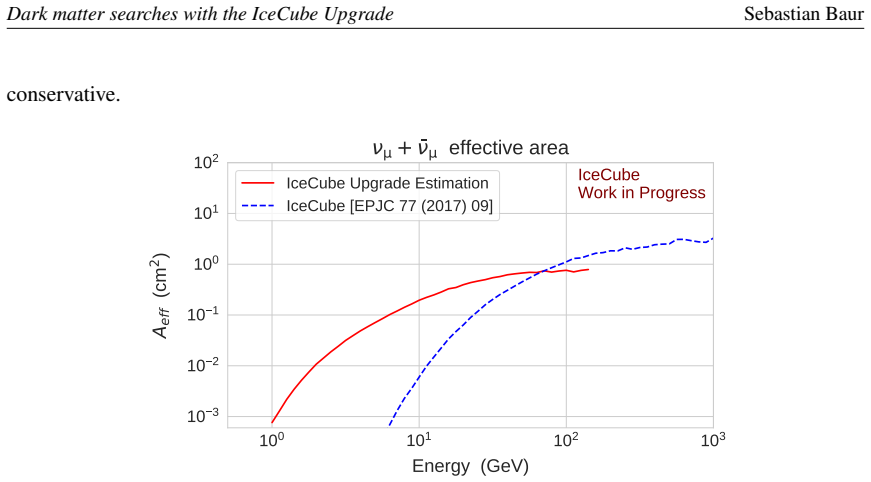
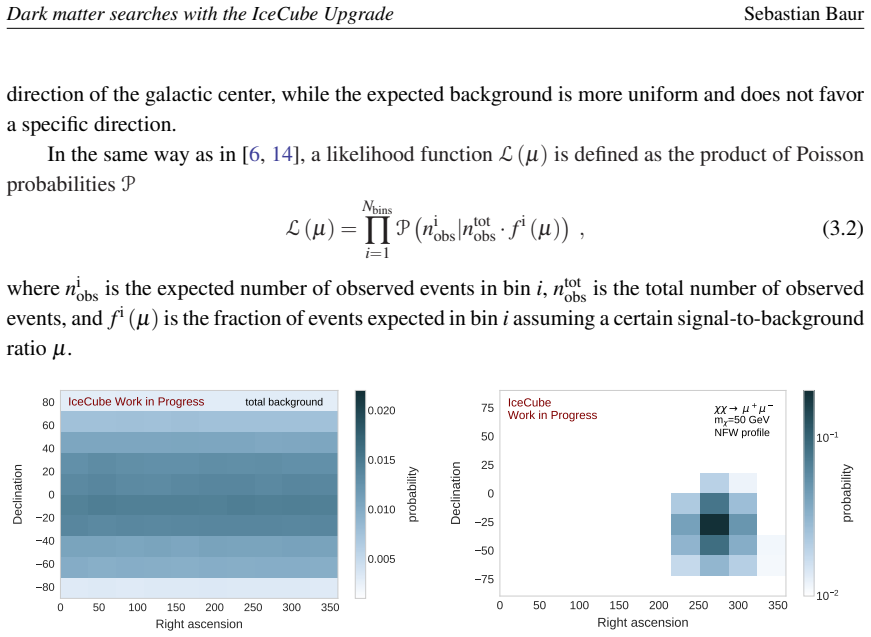
The load-bearing object is the upgraded detector geometry itself: seven additional in-ice strings with roughly 700 optical sensors, spaced about 3 m apart vertically inside the existing DeepCore volume, where current strings are 7 m apart. That denser array lowers the practical neutrino energy threshold to about 1 GeV and improves direction reconstruction for few-GeV events. The analysis pairs this hardware with an event selection that maximizes the rate of atmospheric neutrinos with interaction vertices inside or near the upgraded volume while rejecting atmospheric muons; because the selection is not channel-specific, the same sample serves all considered annihilation channels. Signal and background are then represented as two-dimensional probability density functions in right ascension and declination, and a binned Poisson likelihood with Feldman-Cousins confidence intervals converts expected event counts into 90% confidence sensitivities on $\langle\sigma v\rangle$.
What would settle it
Measure the deployed Upgrade's actual effective area and angular resolution for neutrinos between about 1 and 10 GeV and recompute the Galactic Center sensitivity: if real low-energy performance falls markedly below the parameterized values used here, the claimed reach below 10 GeV will not be attained.
Extended reading notes
Core claim
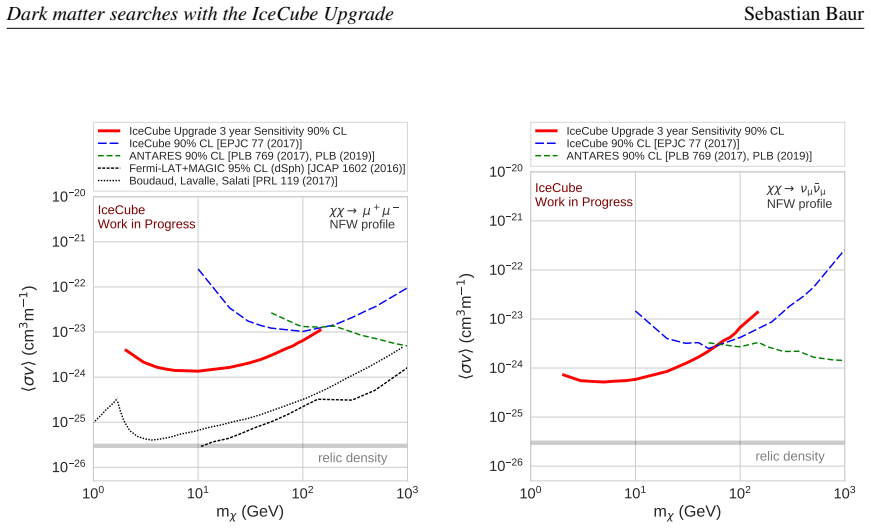
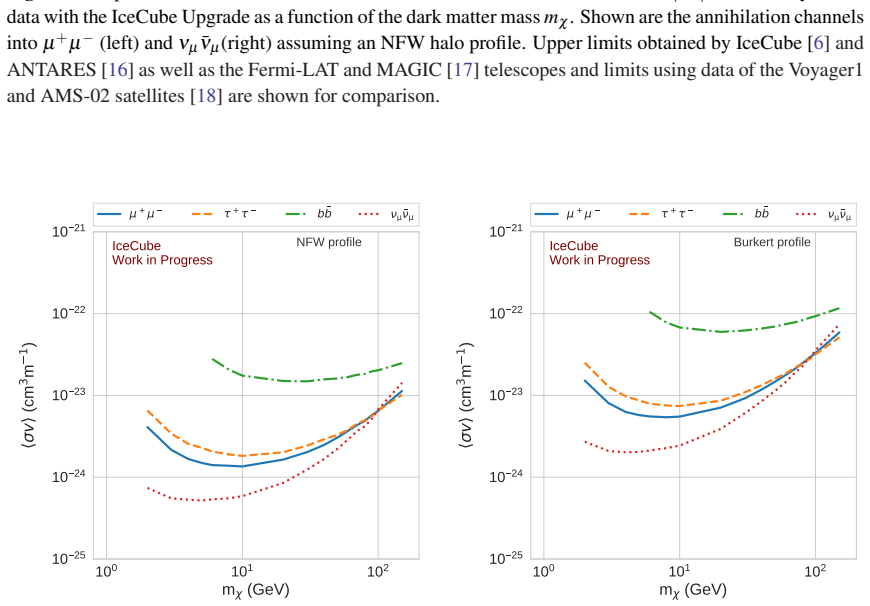
The paper's central claim is a projection, not a detection: once the Upgrade's seven strings and roughly 700 sensors are deployed inside DeepCore, IceCube's effective area for neutrinos below roughly 100 GeV rises well above its current value, and with three years of data a Galactic Center search can set 90% confidence upper limits on $\langle\sigma v\rangle$ for dark-matter masses between 2 and 150 GeV. The new territory is at the bottom of this range: the paper states that 'with the upgrade in place, IceCube will for the first time be able to probe DM annihilation for masses well below 10 GeV.' It also stresses that the assumptions are mostly conservative—reconstruction is parameterized from $\nu_e$ events, whose angular resolution is worse than for $\nu_\mu$, and the event selection is not tuned to any specific annihilation channel—so the quoted sensitivities are realistic estimates of the improvement rather than an optimized best case.
Load-bearing premise
The projected sensitivity below 10 GeV assumes the upgraded detector can reliably detect and reconstruct neutrinos with energies down to about 1 GeV; the paper itself notes that more detailed studies are needed to ensure sub-GeV events can be selected and reconstructed.
Editorial extensions
If this is right
- A three-year run of the IceCube Upgrade should produce the first neutrino-telescope constraints on dark matter annihilating in the Galactic Center for masses between about 2 and 10 GeV.
- For masses below 100 GeV, the projected sensitivity to $\langle\sigma v\rangle$ is stronger than limits from the current IceCube detector, especially for channels that produce many low-energy neutrinos through secondary electroweak processes.
- The same analysis can be applied to dark matter annihilating in the Sun, the Earth, or other sources, with improvements comparable to those shown for the Galactic Center.
- If no signal is found, the resulting upper limits would exclude a meaningful slice of the remaining thermal-relic WIMP parameter space at GeV masses, complementing direct-detection and gamma-ray searches.
Reading between the lines
- Extension: If the parameterized $\nu_e$-based reconstruction is replaced by full event-by-event reconstruction, the low-mass reach could extend below the 2 GeV floor considered here, because the paper's resolution model is deliberately conservative for $\nu_\mu$ events.
- Extension: Because the event selection maximizes general low-energy neutrino acceptance rather than a dark-matter-specific topology, the same upgraded dataset would also serve other few-GeV neutrino science, such as supernova neutrino detection or neutrino oscillation studies.
- Extension: The strength of the sub-10 GeV claim depends as much on the assumed Galactic halo profile as on the detector; a shallower cored profile weakens the projected limits, so better determinations of the Galactic Center dark-matter density would sharpen the test.
Signed reviews
Editorial analysis
A structured set of objections, weighed in public.
Referee Report
Summary. The paper presents a first study of the sensitivity of the planned IceCube Upgrade to dark matter self-annihilation in the Galactic Center, for dark matter masses between 2 and 150 GeV. The analysis uses a binned Poisson likelihood similar to previous IceCube analyses, with signal and background PDFs constructed from annihilation spectra, halo profiles, atmospheric neutrino fluxes, and a preliminary event selection based on simulation of the upgraded detector. The central claimed results are that the Upgrade will significantly improve the sensitivity to the annihilation cross-section for masses below 100 GeV and, for the first time, will allow probing dark matter annihilation for masses well below 10 GeV. The paper is explicitly a work-in-progress proceedings contribution and includes several caveats about the preliminary nature of the detector simulation and reconstruction.
Significance. If the projected sensitivities hold, this work would establish that a neutrino telescope can extend indirect dark matter searches into the sub-10 GeV mass range, complementing gamma-ray and cosmic-ray searches. The paper's methodology is standard and well-referenced: it follows the Feldman-Cousins prescription, uses publicly available annihilation spectra and background models, and compares against existing constraints. The authors are appropriately transparent about the limitations of the study, labeling the effective area an estimation and noting that event-by-event reconstruction is under development. These strengths make the paper a useful benchmark for the IceCube Upgrade science case, even though the central sub-10 GeV claim rests on assumptions that are not yet fully validated.
major comments (3)
- [Section 2, Figs. 4 and 5] The central claim that the Upgrade will probe DM masses well below 10 GeV depends critically on the assumed 1 GeV energy threshold and on the estimated effective area in the 1-10 GeV range. The manuscript itself states that "more detailed studies will be necessary to ensure that sub-GeV events can be reliably selected and reconstructed" and that event-by-event reconstruction "is still under development." No systematic uncertainty is propagated into the sensitivity curves. A modest upward shift of the effective threshold (e.g., to a few GeV) or a reduction in the low-energy acceptance would substantially degrade the reach for masses below about 10 GeV, potentially removing the headline claim. The authors should either validate the low-energy selection and effective area with a full Simulation of the Upgrade geometry or show a robustness test with degraded performance assumptions.
- [Sections 2 and 3, Eq. (3.1)] The analysis combines all neutrino flavors in the signal and background PDFs, yet the only acceptance shown in Fig. 2 is the effective area for νμ and ¯νμ. The manuscript does not state whether flavor-dependent effective areas for νe and ντ are used, or whether the νμ effective area is applied to all flavors. If the latter is the case, the sensitivity would be optimistic, because the effective area for νe and ντ at few-GeV energies is typically lower than for νμ. This point must be clarified, and if a single effective area is used, the authors should quantify the resulting overestimate of the sensitivity.
- [Section 4, Figs. 3-5] The conclusion attributes the expected improvement partly to "the better angular resolution" of the Upgrade, but the analysis uses a 10x10 binning in right ascension and declination, with each bin spanning roughly 36 degrees in RA and 18 degrees in declination. Such coarse bins do not exploit the improved angular resolution; the Galactic Center signal is essentially contained in a single large bin either way, and the background in that bin is correspondingly large. As a result, the projected sensitivity improvement shown in Figs. 4 and 5 is driven entirely by the increased effective area and lower energy threshold, not by angular resolution. The authors should either adopt a finer binning that reflects the Upgrade's expected angular resolution or temper the statement that angular resolution contributes to the projected gain.
minor comments (5)
- [Section 1 and Section 2] The abstract and introduction state that masses between 2 and 150 GeV are considered, while Section 2 reports that the event selection is only effective for neutrino energies below 100 GeV. Please clarify how the mass range 100-150 GeV is treated, since for these masses a significant fraction of the annihilation neutrino spectrum lies above 100 GeV and would be rejected by the selection.
- [Equation (3.2)] The likelihood in Eq. (3.2) is written in terms of the expected fraction f_i(μ) in each bin, but the text does not explicitly define f_i(μ) as the sum of the signal and background PDFs. Please add a definition to make the hypothesis being tested unambiguous.
- [Section 2, Fig. 2] The effective area for the IceCube Upgrade is labeled as an "Estimation." Please specify whether this curve includes the full event selection efficiency and whether the same effective area is used for neutrinos and antineutrinos and for all flavors when computing event rates.
- [Section 2] The sentence "The final event rates after the event selection are estimated to be 2.68 (1.07) mHz for atmospheric muon (electron) neutrinos" is confusing: the parenthetical notation makes it unclear which number corresponds to which flavor. Please rewrite as "2.68 mHz for atmospheric muon neutrinos and 1.07 mHz for atmospheric electron neutrinos."
- [Section 4] The statement "IceCube will for the first time be able to probe DM annihilation for masses well below 10 GeV" is stronger than the analysis supports, given the explicit caveats about the low-energy selection and reconstruction. Consider softening this to "may be able" or adding a qualifier such as "if the assumed low-energy performance is achieved."
Circularity Check
No significant circularity: the projected sensitivities are computed from external astrophysical inputs and detector simulations, with no fitted quantity renamed as a prediction.
full rationale
The paper does not claim to derive any of its inputs from the quantity it predicts. The sensitivity to the dark matter annihilation cross-section is computed by combining external annihilation spectra [7,8], halo profiles [9,10,11], atmospheric neutrino backgrounds [13], and a detector acceptance and reconstruction parameterization that are inputs to the calculation. Equation (3.1) is the standard flux formula, and the likelihood in Eq. (3.2) is used to translate assumed event rates into a 90% CL sensitivity via the Feldman-Cousins method. No parameter is fitted to the data that the sensitivity curves represent. The self-citations to previous IceCube analyses [6,14] are used only for method comparison and benchmarking, not as the source of the central result. The detector-performance assumptions, including the parameterized reconstruction based on νe events, are internal simulation inputs and are explicitly flagged by the authors as preliminary; this is a scientific uncertainty, not circular reasoning. The paper's caveat that more detailed studies are needed to ensure sub-GeV event selection and reconstruction does not make the derivation circular, because the claimed sensitivity below 10 GeV depends on those assumptions but does not redefine them as an output. Overall, the derivation chain is self-contained in the sense that every predicted quantity is computed from stated external inputs and assumptions, with no load-bearing self-citation or fitted-input-called-prediction step.
Assumptions & free parameters
assumptions (5)
- domain assumption Dark matter annihilations produce neutrino spectra as calculated in [7,8] for the considered channels.
- domain assumption The galactic dark matter distribution follows either an NFW or a Burkert profile with parameters from [11].
- domain assumption The atmospheric neutrino background is accurately described by the Honda et al. model [13].
- ad hoc to paper The upgraded detector performance (effective area, angular resolution) is adequately represented by the simulations and parameterizations used.
- standard math Feldman-Cousins method provides valid 90% confidence intervals for the Poisson likelihood used.
Cite this review
Pith. "Pith review of Dark matter searches with the IceCube Upgrade." pith.science (2026). https://pith.science/paper/QC2CG6MZ
@misc{pith2026190808236,
  author       = {Pith},
  title        = {Pith review of: Dark matter searches with the IceCube Upgrade},
  year         = {2026},
  howpublished = {\url{https://pith.science/paper/QC2CG6MZ}},
  note         = {Machine review of arXiv:1908.08236}
}
read the original abstract
Weakly Interacting Massive Particles (WIMPs) are well-motivated candidates for Dark Matter (DM). WIMP models often include self-annihilation into Standard Model particles such as neutrinos which could potentially be detected by the IceCube Neutrino Observatory. Various searches for a dark matter induced signal have been performed with the existing IceCube detector. However, since there is so far no evidence for WIMPs at TeV scales, more attention is brought to DM candidates at GeV masses, for which the IceCube detector is not sensitive due to its energy threshold. The IceCube collaboration is currently preparing the construction of the IceCube Upgrade which is planned to be deployed in the 2022/2023 South Pole summer season. The IceCube Upgrade will consist of 7 new in-ice strings with about 700 additional optical sensors. This dense sensor array inside the IceCube-DeepCore volume will enhance the reconstruction capability of few-GeV neutrinos. We present first studies on the potential improvements of this upgrade on IceCube's sensitivity to Dark Matter annihilating in the Galactic Center.
Figures

Figures from the paper (2 more)
Forward citations
Cited by 1 Pith paper
-
Searching for dark matter annihilation in the Sun with the IceCube Upgrade
Projected IceCube Upgrade sensitivity could set the strongest spin-dependent dark matter limits for masses from about 5 to 1700 GeV when dark matter annihilates to taus or neutrinos.
Reference graph
Works this paper leans on
-
[1]
J. A. A. Sánchez, EPJ Web Conf. 207 (2019) 04006
work page 2019
-
[2]
Battaglieri et al., US Cosmic Visions: New Ideas in Dark Matter 2017: Community Report , in U.S
M. Battaglieri et al., US Cosmic Visions: New Ideas in Dark Matter 2017: Community Report , in U.S. Cosmic Visions: New Ideas in Dark Matter College Park, MD, USA, March 23-25, 2017 , 2017. arXiv:1707.04591
arXiv 2017
-
[3]
IceCube Collaboration, M. G. Aartsen et al., JINST 12 (2017) P03012
2017
-
[4]
IceCube Collaboration, PoS(ICRC2019)1031 (these proceedings)
-
[5]
IceCube Collaboration, PoS(ICRC2019)855 (these proceedings)
-
[6]
IceCube Collaboration, M. G. Aartsen et al., Eur . Phys. J. C77 (2017) 627
work page 2017
-
[7]
M. Cirelli, G. Corcella, A. Hektor, G. Hutsi, M. Kadastik, P. Panci, M. Raidal, F. Sala, and A. Strumia, JCAP 1103 (2011) 051. [Erratum: JCAP1210,E01(2012)]
work page 2011
-
[8]
P. Ciafaloni, D. Comelli, A. Riotto, F. Sala, A. Strumia, and A. Urbano, JCAP 1103 (2011) 019
work page 2011
Show all 18 references
-
[9]
J. F. Navarro, C. S. Frenk, and S. D. M. White, Astrophys. J. 462 (1996) 563
1996
-
[10]
Burkert, Astrophys
A. Burkert, Astrophys. J. 447 (1995) L25
1995
-
[11]
Nesti and P
F. Nesti and P. Salucci, JCAP 1307 (2013) 016
2013
-
[12]
Hütten, C
M. Hütten, C. Combet, and D. Maurin, Comput. Phys. Commun. 235 (2019) 336
2019
-
[13]
Honda, M
M. Honda, M. Sajjad Athar, T. Kajita, K. Kasahara, and S. Midorikawa, Phys. Rev. D92 (2015) 023004
2015
-
[14]
IceCube, ANTARES Collaboration, PoS(ICRC2019)522 (these proceedings)
-
[15]
G. J. Feldman and R. D. Cousins, Phys. Rev. D57 (1998) 3873–3889
1998
-
[16]
Albert et al., Phys
ANTARES Collaboration, A. Albert et al., Phys. Lett. B 769 (2017) 249. [Erratum: Phys. Lett.B(2019)]
2017
-
[17]
MAGIC, Fermi-LA TCollaboration, M. L. Ahnen et al., JCAP 1602 (2016) 039
2016
-
[18]
Boudaud, J
M. Boudaud, J. Lavalle, and P. Salati, Phys. Rev. Lett. 119 (2017) 021103. 7
2017
Reviewed August 14, 2026 · model on record in the stance chip above.
Discussion (0). Continue with ORCID to comment.