REVIEW 3 major objections 4 minor 41 references
Apoptosis of moving, non-orthogonal basis functions in many-particle quantum dynamics
T0 review · 3 major / 4 minor · reviewed 2026-08-14 · deepseek-v4-flash
Pith's one-line read This paper claims that programmed removal of a basis function's motional freedom—apoptosis—when two coherent states approach too closely stabilizes many-particle quantum dynamics enough that small non-orthogonal bases give converged…
desk verdict A simple, practical fix for the linear-dependency bottleneck in multi-coherent-state dynamics, with convincing demonstrations but a heuristic freezing threshold that deserves a sensitivity check. read the letter →
The pith
A machine-rendered reading of the paper's core claim, the machinery that carries it, and where it could break.
The reading
What carries the argument
The central object is the multi Davydov D2 Ansatz wavefunction $|\Psi^M_{D2}(t)\rangle = \sum_{k=1}^M \left(\sum_{n=1}^{N_S} A_{nk}(t)|\varphi_n\rangle\right)|\alpha_k(t)\rangle$, using normalized multi-mode coherent states $|\alpha_k\rangle$; the equations of motion come from the Dirac-Frenkel variational principle and are made explicit by inverting a Hermitian matrix of the form $i\begin{pmatrix} S & B \\ B^\dagger & D \end{pmatrix}$. Apoptosis is the mechanism: when the distance between two coherent states falls below $\varepsilon$, the displacement $\alpha_l$ is constrained to $\alpha_k + C$, deleting the corresponding rows and columns from the inversion problem. Auxiliary variables $X_k = \dot A_k + A_k \sum_j \left[-\tfrac12(\alpha_{kj}\dot\alpha^*_{kj} + \dot\alpha_{kj}\alpha^*_{kj})\right]$ absorb the gauge freedom and keep the linear system in standard form, while regularization of the single-particle density matrix $\rho$ handles the companion instability of nearly vanishing coefficients.
What would settle it
Vary the apoptosis threshold $\varepsilon$ over a range around 0.05 in the $N=150$, $\alpha=0.04$ spin-boson run of Sec. IV.A and compare $P_z(t)$ against the $M=12$ and $N=300$ references of Appendix C; if the converged curves shift by more than the stated line-thickness error, or if propagation breaks down for a nearby $\varepsilon$, the heuristic universality of $\varepsilon=0.05$ fails. Equally decisive: propagate two coherent states in a harmonic oscillator with a coupling that makes them approach, and compare the exact variational solution with and without the D1.5 locking at the encounter; any appreciable growing deviation after the lock falsifies the premise that removing only the displacement equations' linear dependencies is enough.
Extended reading notes
Core claim
The central discovery is that the numerical breakdown caused by nearly linearly dependent coherent states can be forestalled, not by limiting the basis size or re-expanding the wavefunction, but by deliberately reducing the variational freedom of a coherent state that has become too close to another. Starting at time $t_0$, the displacement of state $l$ is slaved to state $k$ by the constraint $\alpha_l(t) = \alpha_k(t) + C$, where $C$ is their separation at $t_0$; this deletes $N$ rows and columns from the linear system and replaces them with the sum of the two states' contributions. The coefficient $A_l$ survives as a free parameter, so the norm of the Ansatz wavefunction is conserved naturally and no re-expansion is needed. The paper shows empirically that removing only the linear dependencies in the displacement equations suffices, with closeness measured by the product metric $d = \sqrt{\sum_j |\alpha_{kj} - \alpha_{lj}|^2}$ and threshold $\varepsilon = 0.05$. With this procedure, spin-boson propagation that previously stopped at $\omega_c t \approx 12.8$ continues for an order of magnitude longer, and converged results for $N = 150$ bath modes are obtained with multiplicity $M = 10$.
Load-bearing premise
The load-bearing assumption is that at the instant two coherent states come within the threshold distance, locking their relative displacement ($\alpha_l(t) = \alpha_k(t) + C$) while keeping the amplitude free does not harm the accuracy of the variational solution; the paper gives no error bound or continuity argument for this abrupt restriction, and the threshold $\varepsilon = 0.05$ is chosen heuristically.
Editorial extensions
If this is right
- For the sub-Ohmic spin-boson model with 150 bath modes, converged population dynamics over several spin oscillation periods is obtained with multiplicity $M = 10$, verified by convergence checks against $M = 12$ and $N = 300$ references.
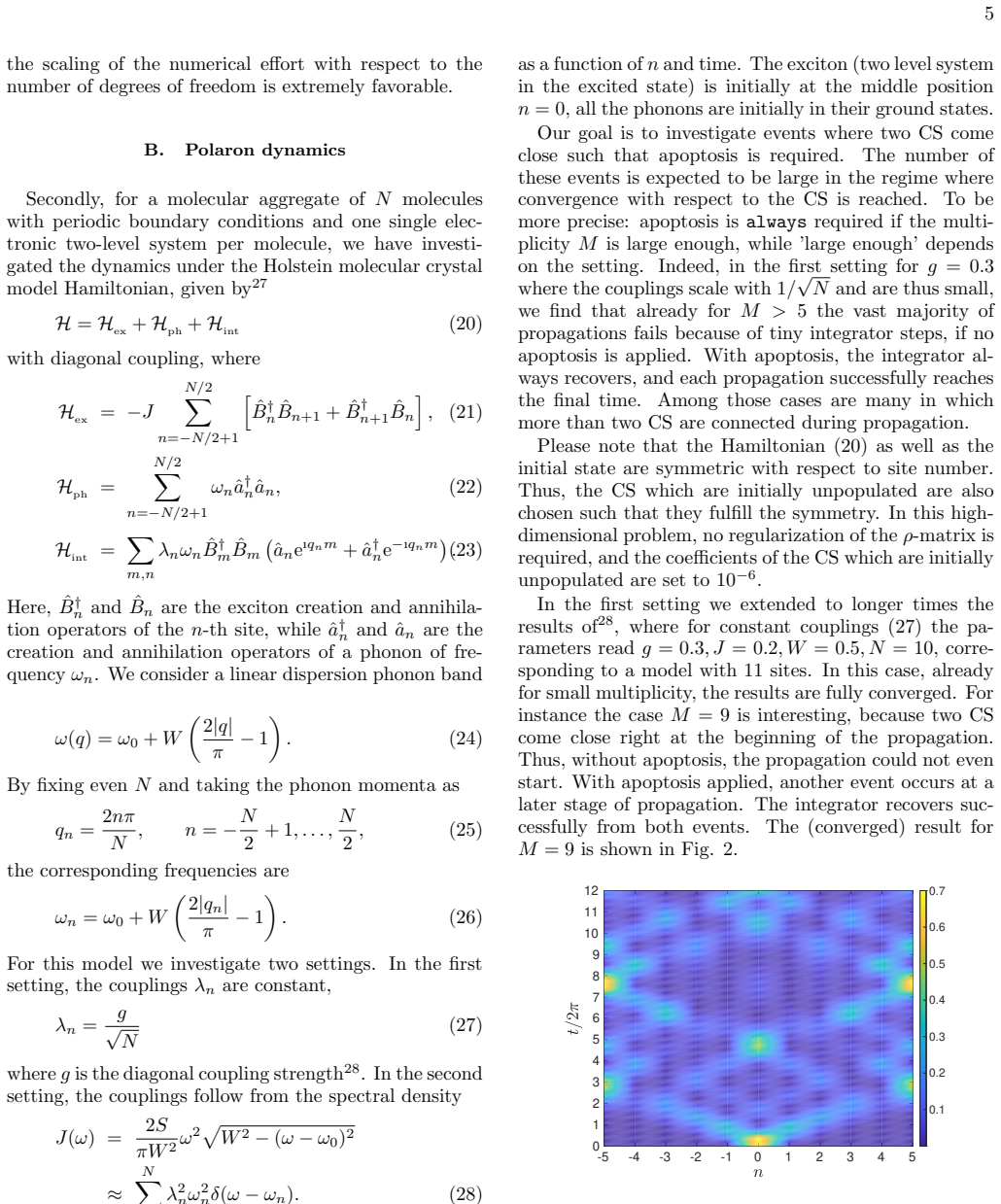
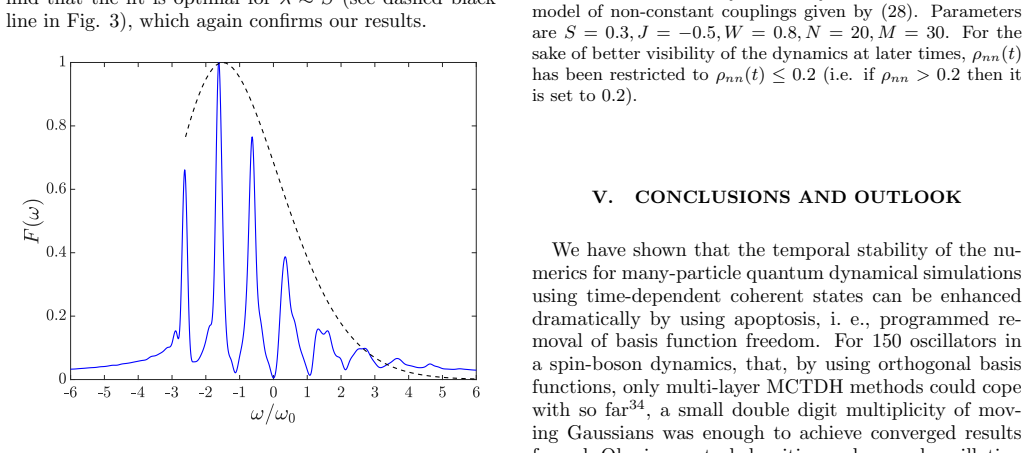
- In the Holstein model with constant couplings and 11 sites, results converge already at $M = 9$, and even when two coherent states collide at the very start of propagation the integrator recovers after apoptosis; the absorption spectrum's phonon sidebands match Huang-Rhys theory.
- Convergence with respect to basis size becomes systematically checkable: because apoptosis removes the instabilities, increasing $M$ in separate runs or spawning new states on the fly yields stable comparisons.
- The procedure is compatible with any adaptive integrator, can be performed on the fly, and costs little because $M \ll N$; the authors state it extends to continuous-variable degrees of freedom and to finite-temperature bath sampling via a $P$-function representation.
- Apoptosis can be applied to more than one coherent state at a time, using a connected-component search in graphs, so it scales to regimes where many states crowd together during propagation.
Reading between the lines
- Editorial inference: because the paper ties the threshold only to a fixed distance ($\varepsilon = 0.05$) and observes that low- and high-dimensional problems need very different $\rho$-regularization strengths, a condition-number-based or dimension-aware apoptosis criterion may be more robust than a universal distance threshold.
- Editorial inference: the outlook's proposed reverse operation—reconnecting two coherent states and freeing them later—could be turned into a fully adaptive birth-and-death basis scheme, effectively combining multiple spawning with apoptosis so an integrator adds and removes basis functions on the fly without re-expansion.
- Editorial inference: the same locking idea likely transfers to any variational method whose explicit equations of motion require inverting an overlap-type matrix, not just coherent-state or Davydov-type bases; the paper's gauge-freedom treatment suggests the mechanism is generic.
- Editorial inference: a quantitative analysis of how much accuracy is lost at the moment of lockdown, as a function of the separation $C$ and the local curvature of the potential, could turn the heuristic threshold into a controlled approximation with an error bound.
Signed reviews
Editorial analysis
A structured set of objections, weighed in public.
Referee Report
Summary. The paper introduces 'apoptosis' as a stabilization device for variational equations of motion of the multi Davydov D2 ansatz with time-dependent coherent states. In Sec. III, when two coherent states come within a threshold ε, their relative displacement is frozen (Eq. (17)), while the associated amplitude remains dynamical, so that the linear-dependency singularity is avoided without re-expansion. The equations are derived from the Dirac-Frenkel principle and applied to the sub-Ohmic spin-boson model (Sec. IV.A) and to two Holstein molecular-crystal settings (Sec. IV.B). The authors report that apoptosis dramatically improves temporal stability, allowing converged dynamics with small multiplicities (e.g., M=10 for N=150 bath modes), validated by self-consistent convergence checks and by comparison with Ref. 33 and Huang-Rhys theory.
Significance. The method targets a well-known bottleneck of vMCG/Davydov-type dynamics: the near-singularity of the overlap/density matrix when non-orthogonal basis functions approach one another. The manuscript is clearly written and provides explicit equations for the linear system and its regularization; it does not ship code, but includes reproducible parameter choices. Its strengths are the external benchmarks (Kast-Ankerhold spin-boson results and the Huang-Rhys sideband prediction) and the M- and N-convergence study in Appendix C. If the threshold-sensitivity concern is resolved, the method could be practically valuable, though the current support for the strongest claim is incomplete.
major comments (3)
- [Sec. IV.A / Eq. (17)] The central claim that apoptosis 'dramatically enhances' temporal stability while preserving accuracy is not yet backed by a sensitivity analysis of the apoptosis threshold ε=0.05. At the switching time t0, the unconstrained variational equations generally assign α_l a different velocity from α_k; imposing Eq. (17) therefore introduces a kink and a restriction of the variational manifold that is not selected by the Dirac-Frenkel principle. Appendix C varies M and N only, and every reported calculation uses the same heuristic ε. I ask the authors to add a systematic ε-study (e.g., ε=0.01, 0.02, 0.05, 0.1, 0.2) for at least one spin-boson and one Holstein case, reporting ΔA or an equivalent error measure, the times of apoptosis events, and the condition numbers of the matrix blocks before and after the constraint. Without such a study, the 'small multiplicity' headline could be an artifact of the particular threshold.
- [Sec. III and Appendix B] The statement that it is sufficient to remove linear dependencies only in the displacement equations (8), not in the coefficient equations, is presented as an empirical observation ('our implementations show'). This is load-bearing because the entire apoptosis construction rests on it. Please provide a diagnostic for representative runs: report the smallest singular values (or condition numbers) of S, D, and the full matrix in Eq. (B6) before and after apoptosis events, and confirm that no instability originates from the B/D coupling block. If such diagnostics are already available, they should be included in the manuscript.
- [Appendix C / Sec. IV.A] The convergence study is performed for a single coupling strength, α=0.04, and the statement that the same M and N values are suitable for the other coupling strengths in Fig. 1, with results coinciding with Ref. 33, is not documented quantitatively. Since the external benchmark provides only one parameter set, please supply convergence data (ΔA or similar) for the other α values in Fig. 1, or explicitly restrict the benchmarked claim to α=0.04.
minor comments (4)
- [Eq. (C1) and Figs. 5 and 6] Please define the plotted quantity in the captions and give the numerical value of ΔA in the converged regime; the text describes the definition of ΔA but the figures do not identify their vertical axis.
- [Sec. IV.B] The claim that the M=30 Holstein result is fully converged would be strengthened by a convergence plot analogous to Fig. 5; no Holstein convergence data are currently shown.
- [Sec. IV.A] The phrase 'the 2 product metric on C^N' should be spelled out as the Euclidean distance; the current wording is confusing.
- [Sec. IV.B, Fig. 3] The Poisson fit with fitted λ≈S is a post-hoc consistency check of the converged dynamics, not an independent prediction of the method, and should be labeled as such.
Circularity Check
No significant circularity: the key stability and small-multiplicity convergence claims are anchored to independent external benchmarks (Kast-Ankerhold and Huang-Rhys), and the self-cited D1.5 ansatz is used transparently as an ansatz rather than as a derived input.
full rationale
The derivation chain does not reduce any claimed result to its own inputs. Eq. (17) introduces apoptosis as a heuristic restriction of the variational manifold (alpha_l = alpha_k + C) once two coherent states approach within epsilon=0.05. This is an algorithmic assumption, not a quantity derived from, or fitted to, the quantities it is used to predict. The central claim of dramatically enhanced temporal stability is validated in Appendix C by systematic convergence checks in both the bath size N and the multiplicity M, with an explicit anchor to the independent results of Ref. 33; the Holstein comparison relies on Huang-Rhys theory as an external benchmark. The only self-citation entering the mechanics is the D1.5 ansatz of Werther and Grossmann (Ref. 30), used in Eq. (17). The paper labels it an ansatz and does not present it as an externally established theorem, so the citation is not a load-bearing self-supporting proof. The heuristic choice of epsilon, and the absence of a threshold-sensitivity analysis, are robustness/correctness concerns rather than circularity. The Poisson fit (lambda approximately S) is a post-hoc consistency check, not a fitted parameter renamed as a prediction.
Assumptions & free parameters
free parameters (4)
- apoptosis distance threshold epsilon =
0.05
- initial coefficient noise for unpopulated coherent states =
1e-6 (Holstein), unspecified small value (spin-boson)
- rho-matrix regularization parameter epsilon_rho =
not specified numerically
- Poisson fit parameter lambda in spectrum validation =
lambda ~ S = 2.56
assumptions (8)
- standard math Dirac-Frenkel variational principle yields the coupled equations of motion (7)-(8).
- standard math Coherent states form an over-complete, non-orthogonal basis with the algebraic properties used in Eqs. (3)-(4).
- domain assumption The bath oscillators are harmonic and the system-bath coupling is linear in bosonic operators, so the Hamiltonian is readily normally ordered.
- domain assumption The multi Davydov D2 ansatz (single-set) with M coherent states is a sufficient variational family for the two models.
- ad hoc to paper When two coherent states approach within epsilon, freezing the relative displacement (Eq. (17)) does not significantly degrade the variational solution.
- ad hoc to paper Removing linear dependencies in the displacement equations only, not in the coefficient equations, is sufficient for numerical stability.
- domain assumption The spectral density discretization via density of frequencies rho_f ~ e^{-omega/omega_c} (ref [13]) faithfully represents the continuum for the tested parameters.
- ad hoc to paper A single global apoptosis threshold epsilon=0.05 is optimal across all tested systems.
Cite this review
Pith. "Pith review of Apoptosis of moving, non-orthogonal basis functions in many-particle quantum dynamics." pith.science (2026). https://pith.science/paper/HSCXX26X
@misc{pith2026190808240,
  author       = {Pith},
  title        = {Pith review of: Apoptosis of moving, non-orthogonal basis functions in many-particle quantum dynamics},
  year         = {2026},
  howpublished = {\url{https://pith.science/paper/HSCXX26X}},
  note         = {Machine review of arXiv:1908.08240}
}
read the original abstract
Due to the exponential increase of the numerical effort with the number of degrees of freedom, moving basis functions have a long history in quantum dynamics. In addition, spawning of new basis functions is routinely applied. Here we advocate the opposite process: the programmed removal of motional freedom of selected basis functions. This is a necessity for converged numerical results with respect to the size of a non-orthogonal basis, because generically two or more states approach each other too closely early on, rendering unstable the matrix inversion, required to make the equations of motion explicit. Applications to the sub-Ohmic spin-boson model as well as to polaron dynamics in a Holstein molecular crystal model demonstrate the power of the proposed methodology.
Figures


Figures from the paper (3 more)


Reference graph
Works this paper leans on
-
[1]
A. Palacios, H. Bachau, and F. Martin, Phys. Rev. Lett. 96 , 143001 (2006)
work page 2006
-
[2]
A. Shimshovitz and D. J. Tannor, Phys. Rev. Lett. 109 , 070402 (2012)
work page 2012
-
[3]
D. V. Shalashilin and I. Burghardt, J. Chem. Phys. 129 , (2008)
work page 2008
- [4]
-
[5]
A. S. Davydov and N. I. Kislukha, Phys. Stat. Sol. (B) 59 , 465 (1973)
work page 1973
-
[6]
A. S. Davydov, J. Theor. Biol. 38 , 559 (1973)
work page 1973
- [7]
-
[8]
M. Beck, A. Jaeckle, G. Worth, and H.-D. Meyer, Phys. Rep. 324 , 1 (2000)
work page 2000
Show all 41 references
-
[9]
Richings, I
G. Richings, I. Polyak, K. E. Spinlove, G. A. Worth, I. Burghardt, and B. Lasorne, Int. Rev. Phys. Chem. 34 , 269 (2015)
2015
-
[10]
Lu and A
H. Lu and A. D. Bandrauk, J. Chem. Phys. 115 , 1670 (2001)
2001
-
[11]
Ben-Nun, J
M. Ben-Nun, J. Quenneville, and T. Martinez, J. Phys. Chem. A 104 , 5161 (2000)
2000
-
[12]
Mignolet and B
B. Mignolet and B. F. E. Curchod, J. Chem. Phys. 148 , 134110 (2018)
2018
-
[13]
Hartmann, M
R. Hartmann, M. Werther, F. Grossmann, and W. T. Strunz, J. Chem. Phys. 150 , 234105 (2019)
2019
-
[14]
Habershon, J
S. Habershon, J. Chem. Phys. 136 , 014109 (2012)
2012
-
[15]
N. Zhou, Z. Huang, J. Zhu, V. Chernyak, and Y. Zhao, J. Chem. Phys. 143 , 014113 (2015)
2015
-
[16]
Bargmann, P
V. Bargmann, P. Butera, L. Girardello, and J. R. Klauder, Rep. Math. Phys. 2 , 221 (1971)
1971
-
[17]
P. A. M. Dirac, Mathematical Proceedings of the Cambridge Philosophical Society 26 , 376 (1930)
1930
-
[18]
Frenkel, Wave Mechanics: Advanced General Theory , 1st ed
J. Frenkel, Wave Mechanics: Advanced General Theory , 1st ed. (Oxford University Press, Oxford, 1934)
1934
-
[19]
W. H. Press, S. A. Teukolsky, W. T. Vetterling, and B. P. Flannery, Numerical recipes in FORTRAN , 2nd ed. (Cambridge University Press, Cambridge, 1992)
1992
-
[20]
Manthe, J
U. Manthe, J. Chem. Phys. 142 , 244109 (2015)
2015
-
[21]
Manthe, H.-D
U. Manthe, H.-D. Meyer, and L. S. Cederbaum, J. Chem. Phys. 97 , 3199 (1992)
1992
-
[22]
G. A. Hagedorn, Ann. Phys. 135 , 58 (1981)
1981
-
[23]
Borrelli and A
R. Borrelli and A. Peluso, J. Chem. Phys. 144 , 114102 (2016)
2016
-
[24]
Poirier and A
B. Poirier and A. Salam, J. Chem. Phys. 121 , 1690 (2004)
2004
-
[25]
H. R. Larsson, B. Hartke, and D. J. Tannor, J. Chem. Phys. 145 , 204108 (2016)
2016
-
[26]
Bonfanti and I
M. Bonfanti and I. Burghardt, Chem. Phys. 515 , 252 (2018)
2018
-
[27]
J. Sun, B. Luo, and Y. Zhao, Phys. Rev. B 82 , 014305 (2010)
2010
-
[28]
Chen and Y
L. Chen and Y. Zhao, The Journal of Chemical Physics 147 , 214102 (2017)
2017
-
[29]
K.-W. Sun, M. F. Gelin, V. Y. Chernyak, and Y. Zhao, J. Chem. Phys. 142 , 212448 (2015)
2015
-
[30]
Werther and F
M. Werther and F. Grossmann, Phys. Scr. 93 , 074001 (2018)
2018
-
[31]
Hopcroft and R
J. Hopcroft and R. Tarjan, Commun. ACM, 16 , 372 (1973)
1973
-
[32]
Makri, E
N. Makri, E. Sim, D. E. Makarov and M. Topaler, Proc. Natl. Acad. Sci. USA 93 , 3926 (1996)
1996
-
[33]
Kast and J
D. Kast and J. Ankerhold, Phys. Rev. Lett. 110 , 010402 (2013)
2013
-
[34]
Wang and M
H. Wang and M. Thoss, Chem. Phys. 370 , 78 (2010)
2010
-
[35]
Bulla, H.-J
R. Bulla, H.-J. Lee, N.-H. Tong, and M. Vojta, Phys. Rev. B 71 , 045122 (2005)
2005
-
[36]
L. Chen, Y. Zhao, and Y. Tanimura, J. Phys. Chem. Lett. 2015, 6 , 3110 (2015)
2015
-
[37]
Borrelli and M
R. Borrelli and M. F. Gelin, Sci. Rep. 7 , 9127 (2017)
2017
-
[38]
A. J. Leggett, S. Chakravarty, A. T. Dorsey, Matthew P. A. Fisher, Anupam Garg, and W. Zwerger, Rev. Mod. Phys. 59 , 1 (1987)
1987
-
[39]
Huang and A
K. Huang and A. Rhys, Proc. R. Soc. London, Ser. A, 204 , 406 (1950)
1950
-
[40]
C. W. Gardiner and P. Zoller, Quantum Noise: A Handbook of Markovian and Non-Markovian Quantum Stochastic Methods with Applications to Quantum Optics , 3rd ed., (Springer-Verlag, Berlin, 2004)
2004
-
[41]
Werther, PhD thesis , Technische Universit\"at Dresden (2020)
M. Werther, PhD thesis , Technische Universit\"at Dresden (2020)
2020
Reviewed August 14, 2026 · model on record in the stance chip above.
Discussion (0). Continue with ORCID to comment.