REVIEW 3 major objections 5 minor 17 references
Uncertainty-Guided Domain Alignment for Layer Segmentation in OCT Images
T0 review · 3 major / 5 minor · reviewed 2026-08-14 · deepseek-v4-flash
Pith's one-line read Repeated stochastic predictions supply an uncertainty map that guides cross-vendor OCT layer segmentation, recovering about 7.3 Dice points on the target domain.
desk verdict The uncertainty-guided UDA idea is plausible, but the missing target-domain train/test split makes Table 1's gains impossible to interpret as true unsupervised adaptation. read the letter →
The pith
A machine-rendered reading of the paper's core claim, the machinery that carries it, and where it could break.
The reading
What carries the argument
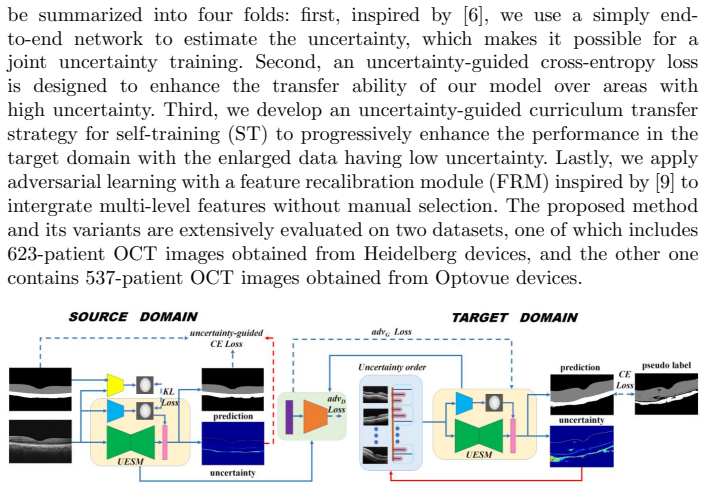
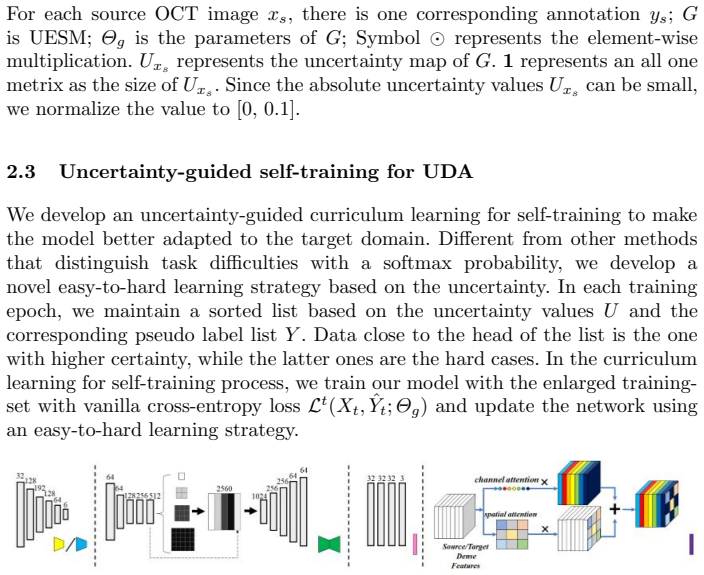
The load-bearing mechanism is the uncertainty estimation and segmentation module (UESM), an end-to-end network that couples a pyramid scene parsing (PSPNet) segmentation backbone with a conditional variational autoencoder. A prior network draws samples from a low-dimensional latent Gaussian; the posterior network is trained on source images with ground truth to shape that latent space; at inference, $N$ Monte Carlo samples produce $N$ segmentation variants whose variance is the per-pixel uncertainty map. That map drives the two named components: the uncertainty-guided cross-entropy loss (UCE) multiplies source cross-entropy with $1+\mathrm{Normalize}(U_x)$, and the uncertainty-guided self-training (UST) sorts target images by uncertainty and trains easy examples first. The feature recalibration module (FRM), built on concurrent spatial and channel attention, recombines multi-scale feature maps before the PatchGAN discriminator so that adversarial training does not rely on manually choosing a single feature level.
What would settle it
Take a small held-out set of target-domain OCT images with manual annotations and compute the per-pixel correlation between the model's uncertainty and its segmentation error before self-training. If low-uncertainty pixels are not systematically more accurate than high-uncertainty pixels, or if the correlation reverses after a few self-training iterations, the uncertainty guidance cannot be doing the work that the paper assigns to it.
Extended reading notes
Core claim
The central claim is that uncertainty, measured as the variance of multiple stochastic segmentation outputs, is a reliable guide for aligning OCT domains. The method combines three components: an uncertainty-weighted cross-entropy loss that up-weights source pixels whose predictions are uncertain; an uncertainty-guided curriculum self-training that progressively adds target pixels starting from those with lowest uncertainty; and adversarial feature alignment through a feature recalibration module that fuses multi-level features. In the authors' experiments the full pipeline raises mean Dice on the target domain from 84.849 with direct source-to-target transfer to 92.182, recovering most of the 94.892 achieved by the target-trained upper bound, and outperforms CycleGAN and AdaptSegNet by 9.416 and 2.713 Dice points respectively. The authors also report that uncertainty decreases during training, which they interpret as the model becoming increasingly confident on target data.
Load-bearing premise
The load-bearing premise is that the uncertainty estimates produced by the source-trained model remain reliable indicators of segmentation correctness in the target domain; if domain shift breaks that correlation, the curriculum will reinforce wrong pseudo-labels and the loss weighting will amplify noise.
Editorial extensions
If this is right
- If the method is correct, a segmentation model trained on one OCT vendor's images can be transferred to another vendor without any manual labels on the target side, recovering most of the performance gap to a target-trained model.
- Uncertainty-based curriculum self-training should be less vulnerable to confirmation bias than probability-based easy-to-hard selection, because low variance indicates agreement across stochastic predictions rather than mere softmax confidence.
- Each added component contributes positively in the reported ablations: adversarial alignment alone gives 90.463 mean Dice, FRM adds about 0.4, UCE adds about 0.5, and UST adds about 0.8, suggesting the gains stack.
- The reported monotonic decrease of uncertainty over training iterations indicates the model's confidence calibration improves while adapting, not just the segmentation metric.
- On this dataset the method surpasses both a translation-based baseline (CycleGAN) and a structured-output adversarial baseline (AdaptSegNet), including all reported sub-metrics for retinal and choroidal layers.
Reading between the lines
- Beyond the paper's claims, the same uncertainty-guided curriculum could be plugged into other UDA pipelines that already use self-training, since it only needs the variance of repeated stochastic forward passes and does not depend on OCT-specific features.
- The inverse uncertainty-error correlation that the paper relies on could be turned into a deployment-time safety monitor: slices with high mean uncertainty could be flagged for human review or excluded from automated thickness measurements.
- A testable extension is to compare the proposed uncertainty ranking against softmax-entropy ranking on the same target data; if uncertainty is truly a better curriculum signal, it should produce higher Dice while using fewer pseudo-labels.
- Because the UST self-training is fully unsupervised, repeated iterations risk confirmation bias if the uncertainty estimates are miscalibrated early; a small labeled target sanity set could be used to stop training at the point where the low-uncertainty pseudo-labels still match manual labels.
Editorial analysis
A structured set of objections, weighed in public.
Referee Report
Summary. The paper proposes an unsupervised domain adaptation (UDA) method for retinal and choroidal layer segmentation in OCT images, using a conditional-VAE-based uncertainty estimation and segmentation module (UESM), an uncertainty-guided cross-entropy loss on the source domain, an uncertainty-guided curriculum self-training step on target-domain pseudo-labels, and adversarial feature alignment with a feature recalibration module (FRM). Experiments are reported on 1,160 patients: 537 Optovue source-domain images and 623 Heidelberg target-domain images. The central quantitative claim is that the full method reaches 92.182 mean Dice on the target domain, improving on source-only training by 7.333 percentage points and on AdaptSegNet by 2.713 percentage points, with ablations showing monotonic gains as each module is added.
Significance. If the results hold, the paper would be a practically useful contribution: adaptation across OCT devices is a real clinical need, and using model uncertainty as an active training signal rather than only as a visualization tool is a sensible and timely idea. The study uses a substantial real clinical dataset, evaluates multiple ablations, and compares with two published UDA baselines, and the monotonic improvement pattern in Table 1 is suggestive. However, the current evidence does not yet establish the central claim because the manuscript never specifies how the 623 target images are divided into adaptation and evaluation sets, no measure of variability is reported for any number, and the reliability of the uncertainty estimates under domain shift is not validated. The paper also does not release code or data, which limits reproducibility.
major comments (3)
- [Section 3, Table 1] The manuscript never states how the 623 Heidelberg target-domain images are divided between adaptation and evaluation. The self-training step (Section 2.3) uses target-domain images with pseudo-labels, and the adversarial feature alignment (Section 2.4) uses target-domain features, while the quantitative evaluation in Table 1 is reported simply as testing on the target OCT data. If the same 623 images are used both for adaptation and for Dice evaluation, Table 1 measures transductive fit to the adaptation set rather than unsupervised domain adaptation to new Heidelberg patients. This is load-bearing for the paper's central claim, so the authors must specify a patient-level split into adaptation and held-out test sets, report results on the held-out set, and ensure that no target test image is used for self-training or feature alignment.
- [Table 1] The ablation increments in Table 1 are small—for example, +0.425 mean Dice from Orig S2T+ADV to Orig S2T+ADV+FRM, +0.452 to add UCE, and +0.842 to add UST—but only a single run is reported, with no error bars, confidence intervals, or significance tests. Without repeated runs or statistical testing, the observed monotonic improvement could be within run-to-run variation. Please report at least three runs with mean and standard deviation, and perform a paired significance test for the key comparisons, or provide a convincing argument that run-to-run variance is negligible.
- [Sections 2.2 and 2.3] The method assumes that uncertainty estimates produced by the source-trained UESM remain reliable indicators of segmentation correctness after domain shift. Low-uncertainty target predictions are used as pseudo-labels for self-training, and high-uncertainty source regions are up-weighted in the source loss. If the source-trained uncertainty is miscalibrated on the target domain, self-training can reinforce wrong pseudo-labels and the loss weighting can amplify noise. Because target ground truth is available for evaluation, the authors should include a quantitative check of the correlation between uncertainty and segmentation error on the target domain, and should verify that the curriculum's easy-to-hard ordering is actually correct rather than assumed.
minor comments (5)
- [Abstract and Conclusion] There are typos in the abstract ('disign' should be 'design') and in the conclusion ('sigficantly' should be 'significantly'); these should be corrected.
- [Equation (4)] In the text below Eq. (4), '1 represents an all one metrix as the size of Uxs' should read 'matrix', and the dimensions of the all-ones matrix and the elementwise multiplication should be defined precisely.
- [Implementation details and Eq. (7)] The implementation details list λ_R as a hyperparameter, but λ_R does not appear in the full objective in Eq. (7); either Eq. (7) should include the FRM loss term with its weight, or the hyperparameter list should be corrected.
- [Figure 1] The caption contains a typo ('Peformance drop' should be 'Performance drop') and the phrase 'an Heidelberg' should be 'a Heidelberg'; the same grammar issue appears in other places.
- [Experimental comparisons] The claim of outperforming state-of-the-art methods is based on only two baselines, CycleGAN and AdaptSegNet, even though curriculum-based UDA methods [14,17] are cited in the introduction; the wording should be qualified, or additional modern UDA baselines should be included.
Circularity Check
No significant circularity: the final evaluation uses manual target annotations and independent comparisons, not the model's own pseudo-labels.
full rationale
The paper's central claim is an empirical improvement in target-domain Dice (Table 1). The uncertainty estimates (Eq. 3) are defined as the variance of Monte Carlo outputs of the UESM, not in terms of the ground truth or of the final Dice; the uncertainty-guided losses (Eqs. 4 and 7) and self-training (Section 2.3) are heuristics whose success is not guaranteed by construction. The final target-domain metric is computed against expert manual annotations ('Experienced experts annotate the retinal layers and choroidal layers manually and elaborately as ground truth'), so the model is not being evaluated on its own pseudo-labels. The method could fail if the uncertainty signal is miscalibrated, which is exactly why the reported gains are an empirical result rather than a tautology. The cited methods (Probabilistic U-Net [6], AdaptSegNet [13], PSPNet [15], CBST [17]) are external prior work or standard components; no self-citation is used as a load-bearing authority. A limitation is that the paper does not explicitly state a target-domain train/test split, which is a validity concern about transductive evaluation but not a circular derivation: the comparison algorithms are evaluated under the same protocol and no equation reduces to its own input.
Assumptions & free parameters
free parameters (6)
- lambda_s (source loss weight) =
1.0
- lambda_t (target self-training loss weight) =
0.1
- lambda_R (adversarial/FRM loss weight) =
0.003
- lambda_D (discriminator loss weight) =
1.0
- N (number of Monte Carlo samples) =
4
- uncertainty normalization bound =
[0, 0.1]
assumptions (3)
- domain assumption Uncertainty from the source-trained UESM is informative in the target domain.
- domain assumption Source and target OCT domains share the same anatomical structures and label space.
- domain assumption Adversarial feature alignment transfers discriminative knowledge between domains.
Cite this review
Pith. "Pith review of Uncertainty-Guided Domain Alignment for Layer Segmentation in OCT Images." pith.science (2026). https://pith.science/paper/JBBJFSTI
@misc{pith2026190808242,
  author       = {Pith},
  title        = {Pith review of: Uncertainty-Guided Domain Alignment for Layer Segmentation in OCT Images},
  year         = {2026},
  howpublished = {\url{https://pith.science/paper/JBBJFSTI}},
  note         = {Machine review of arXiv:1908.08242}
}
read the original abstract
Automatic and accurate segmentation for retinal and choroidal layers of Optical Coherence Tomography (OCT) is crucial for detection of various ocular diseases. However, because of the variations in different equipments, OCT data obtained from different manufacturers might encounter appearance discrepancy, which could lead to performance fluctuation to a deep neural network. In this paper, we propose an uncertainty-guided domain alignment method to aim at alleviating this problem to transfer discriminative knowledge across distinct domains. We disign a novel uncertainty-guided cross-entropy loss for boosting the performance over areas with high uncertainty. An uncertainty-guided curriculum transfer strategy is developed for the self-training (ST), which regards uncertainty as efficient and effective guidance to optimize the learning process in target domain. Adversarial learning with feature recalibration module (FRM) is applied to transfer informative knowledge from the domain feature spaces adaptively. The experiments on two OCT datasets show that the proposed methods can obtain significant segmentation improvements compared with the baseline models.
Figures

Figures from the paper (2 more)


Reference graph
Works this paper leans on
-
[1]
Dong, N., Kampffmeyer, M., et al.: Unsupervised domain adaptation for automatic estimation of cardiothoracic ratio. In: MICCAI. pp. 544–552. Springer (2018)
work page 2018
- [2]
-
[3]
European journal of ophthalmology 27(5), 577–584 (2017)
El-Shazly, A.A., Farweez, Y.A., et al.: Correlation between choroidal thickness and degree of myopia assessed with enhanced depth imaging optical coherence tomography. European journal of ophthalmology 27(5), 577–584 (2017)
work page 2017
-
[4]
Optics express 17(5), 3978–3979 (2009)
Fujimoto, J.G., Drexler, W., et al.: Optical Coherence Tomography (OCT) in ophthalmology: introduction. Optics express 17(5), 3978–3979 (2009)
work page 2009
-
[5]
arXiv preprint arXiv:1511.02680 (2015)
Kendall, A., Badrinarayanan, V., Cipolla, R.: Bayesian segnet: Model uncertainty in deep convolutional encoder-decoder architectures for scene understanding. arXiv preprint arXiv:1511.02680 (2015)
arXiv 2015
-
[6]
Kohl, S., Romera-Paredes, B., et al.: A probabilistic U-Net for segmentation of ambiguous images. In: NeurIPS. pp. 6965–6975 (2018)
work page 2018
-
[7]
Nair, T., Precup, D., et al.: Exploring uncertainty measures in deep networks for multiple sclerosis lesion detection and segmentation. In: MICCAI. pp. 655–663. Springer (2018)
work page 2018
-
[8]
Ren, J., Hacihaliloglu, I., et al.: Adversarial domain adaptation for classification of prostate histopathology whole-slide images. In: MICCAI. pp. 201–209. Springer (2018)
work page 2018
Show all 17 references
-
[9]
In: MICCAI
Roy, A.G., Navab, N., et al.: Concurrent Spatial and Channel Squeeze & Excitationin Fully Convolutional Networks. In: MICCAI. pp. 421–429. Springer (2018)
2018
-
[10]
In: Computational Pathology and Ophthalmic Medical Image Analysis, pp
Sedai, S., Antony, B., et al.: Joint Segmentation and Uncertainty Visualization of Retinal Layers in Optical Coherence Tomography Images Using Bayesian Deep Learning. In: Computational Pathology and Ophthalmic Medical Image Analysis, pp. 219–227. Springer (2018)
2018
-
[11]
Neurocomputing 237, 332–341 (2017)
Sui, X., Zheng, Y., et al.: Choroid segmentation from optical coherence tomography with graph-edge weights learned from deep convolutional neural networks. Neurocomputing 237, 332–341 (2017)
2017
-
[12]
In: NeurIPS
Tarvainen, A., Valpola, H.: Mean teachers are better role models: Weight-averaged consistency targets improve semi-supervised deep learning results. In: NeurIPS. pp. 1195–1204 (2017)
2017
-
[13]
In: CVPR
Tsai, Y.H., Hung, W.C., et al.: Learning to adapt structured output space for semantic segmentation. In: CVPR. pp. 7472–7481 (2018)
2018
-
[14]
In: ICCV
Zhang, Y., David, P., Gong, B.: Curriculum domain adaptation for semantic segmentation of urban scenes. In: ICCV. pp. 2020–2030 (2017)
2017
-
[15]
In: CVPR
Zhao, H., Shi, J., et al.: Pyramid scene parsing network. In: CVPR. pp. 2881–2890 (2017)
2017
-
[16]
In: ICCV
Zhu, J.Y., Park, T., et al.: Unpaired image-to-image translation using cycle- consistent adversarial networks. In: ICCV. pp. 2223–2232 (2017)
2017
-
[17]
In: ECCV
Zou, Y., Yu, Z., et al.: Unsupervised domain adaptation for semantic segmentation via class-balanced self-training. In: ECCV. pp. 289–305 (2018)
2018
Reviewed August 14, 2026 · model on record in the stance chip above.
Discussion (0). Continue with ORCID to comment.