REVIEW 4 major objections 4 minor 36 references
Influence of structure and cation distribution on magnetic anisotropy and damping in Zn/Al doped nickel ferrites
T0 review · 4 major / 4 minor · reviewed 2026-08-14 · deepseek-v4-flash
Pith's one-line read In Zn/Al doped nickel ferrite films, the cation distribution—not strain alone—controls magnetic anisotropy and damping.
desk verdict Solid experimental paper with useful new XMCD cation-distribution data, but the strain-independence claim outruns the two-sample design and the site-fraction fits lack uncertainty analysis. read the letter →
The pith
A machine-rendered reading of the paper's core claim, the machinery that carries it, and where it could break.
The reading
What carries the argument
The load-bearing mechanism is the site occupancy of cations in the inverse spinel structure, extracted from X-ray absorption and X-ray magnetic circular dichroism spectra fitted with multiplet ligand-field calculations. In this model, tetrahedrally coordinated $Ni^{2+}_{Td}$ carries an unquenched orbital moment that increases the g-factor and contributes to magnetic damping, while octahedrally coordinated $Fe^{2+}_{Oh}$ adds damping through electron hopping between Fe2+ and Fe3+. Zinc acts as a control knob because Zn2+ prefers tetrahedral sites and therefore displaces Ni from them; aluminium, substituting for Fe3+, is the strain control. Comparing two films with similar strain isolates the site-occupancy effect.
What would settle it
Measure a series of NiZAF films with the same lattice strain but continuously varied Zn:Ni ratio, extract $Ni^{2+}_{Td}$ from XMCD and Gilbert damping from frequency-dependent FMR; if damping and g-factor do not track the fitted $Ni^{2+}_{Td}$ fraction monotonically, the proposed controlling mechanism is not supported.
Extended reading notes
Core claim
On the paper's own terms, the central discovery is that the cation distribution, quantified by the amount of $Ni^{2+}_{Td}$ and $Fe^{2+}_{Oh}$, has a major impact on magnetic anisotropy and damping independent of strain. A Zn-deficient sputtered NiZAF film with $c/a = 1.047$ exhibits 4% $Ni^{2+}_{Td}$, 33% $Fe^{2+}_{Oh}$, a Gilbert damping of $1 \times 10^{-2}$, two-magnon scattering, and a g-factor of 2.18. A second film with increased Zn and nearly the same strain ($c/a = 1.049$) shows 2.5% $Ni^{2+}_{Td}$, 28% $Fe^{2+}_{Oh}$, damping of $6.8 \times 10^{-3}$, no two-magnon scattering, and $g = 2.109$. Because strain stayed essentially constant while the magnetic properties improved, the authors conclude that cation site occupancy, not strain alone, controls these properties, with Zn content acting as the tuning knob for $Ni^{2+}_{Td}$.
Load-bearing premise
The argument stands on the XMCD fits being accurate enough that the difference between 4% and 2.5% tetrahedral nickel (and the associated iron site fractions) is real, since those fits use hand-set Slater reductions, crystal fields, and exchange fields without reported uncertainty.
Editorial extensions
If this is right
- Raising the Zn:Ni ratio in NiZAF should reduce $Ni^{2+}_{Td}$ and thereby lower intrinsic damping and the g-factor without requiring strain relief.
- Reducing A/B disorder, reflected in lower $Ni^{2+}_{Td}$ and a more balanced Fe3+ tetrahedral/octahedral occupation, removes two-magnon scattering and inhomogeneous linewidth broadening.
- Cation site occupancy is a separate optimization axis from strain: both Zn and Al concentrations need to be mapped together with site occupancies to design low-loss ferrimagnetic insulators.
- The g-factor measured by ferromagnetic resonance can serve as a quick proxy for the amount of tetrahedral Ni and thus for orbital-moment-mediated damping.
Reading between the lines
- A direct extension of the paper's logic is that growth strategies that preserve strain coherence but improve cation order, such as lower-temperature deposition followed by short anneals, could produce low-damping NiZAF on a wider range of substrates.
- If the site-occupancy mechanism is the dominant one, then magnetoelectric or acoustic spintronics devices using NiZAF could tolerate larger lattice mismatch than YIG requires, since strain need not be minimized.
- The reported difference between 4% and 2.5% $Ni^{2+}_{Td}$ is the crux of the causal claim, and it may be within the uncertainty of the multiplet fits; a continuous Zn series would test whether damping falls monotonically with the fitted $Ni^{2+}_{Td}$ fraction.
Signed reviews
Editorial analysis
A structured set of objections, weighed in public.
Referee Report
Summary. The manuscript reports a structural, static-magnetic, dynamic-magnetic, and element-selective study of Zn/Al doped nickel ferrite (NiZAF) thin films grown by reactive magnetron sputtering. The authors determine the lattice constants and strain state by XRD/RSM, the composition by RBS and EDX, the static magnetic properties by SQUID, and the dynamic properties by VNA-FMR. Using XAS/XMCD spectra modeled with CTM4XAS, they extract cation site occupancies for two samples: a nominal-composition film and a Zn-richer film. The central claim is that the cation distribution, specifically the amount of Ni2+ on tetrahedral sites and Fe2+ on octahedral sites, has a major impact on magnetic anisotropy and damping that is independent of strain, and that increased Zn incorporation reduces Ni2+_Td, leading to lower damping, lower g-factor, and reduced two-magnon scattering.
Significance. If the central claim is correct, the paper identifies cation site occupancy, rather than strain alone, as a practical tuning parameter for low-damping insulating ferrite films for spintronic applications. The work is strengthened by a broad experimental characterization: standard FMR analysis including two-magnon and inhomogeneous contributions, element-specific XMCD with site-sensitive hysteresis, composition analysis by ion beams, and references to the deposited raw data in a repository. However, the causal conclusion rests on quantitative site occupancies obtained from multiplet fits that are not accompanied by an uncertainty analysis, and on a two-sample comparison in which strain, growth temperature, composition, and disorder change simultaneously. The significance of the work is therefore conditional on strengthening the site-occupancy reliability and the attribution logic.
major comments (4)
- [Section V, Figs. 5(b)-5(d), and Section VI, Figs. 6(a)-6(b)] The causal conclusions rest on the CTM4XAS-derived site occupancies, but the fits are presented without any uncertainty, uniqueness, or parameter-sensitivity analysis. The decisive difference between the two samples is 4% vs. 2.5% Ni2+_Td and 33% vs. 28% Fe2+_Oh, i.e., small fractions of minority sites extracted from spectra dominated by 94-97.5% octahedral Ni; given the several hand-set parameters (Slater reductions of 70% and 80%, 10Dq values, J = ±48 meV, an energy shift, and Gaussian/Lorentzian broadenings), a 1.5-percentage-point difference in the minority component may lie well within the fitting error. The statement in Section VI that a 'reduction of almost 50% in Ni2+_Td' was found is thus not quantitatively supported unless a parameter sweep or an independent determination of the site fractions is provided.
- [Section V, simulation parameters (page 7)] The printed crystal-field splittings, 10Dq = 1.2 meV for octahedral and -0.6 meV for tetrahedral coordination, are three orders of magnitude smaller than typical 3d transition-metal oxide values (approximately 1 eV). Either the units are misreported or the multiplet calculations are physically unrealistic; please clarify and correct this, since these parameters directly enter the site-occupancy fits that support the central claim.
- [Section VII and Section VI] The claim that the cation distribution affects anisotropy and damping 'independent of strain' is not supported by the experimental design. Only two samples were compared, with c/a = 1.047 and 1.049; strain is nearly constant and actually slightly larger in the improved sample, while growth temperature (525 vs. 600 C), composition, magnetization, and A/B disorder changed simultaneously. Therefore, the attribution of the improved magnetic properties specifically to the reduced Ni2+_Td and Fe2+_Oh contents is underdetermined; additional samples that vary the Zn content at fixed growth temperature, or an explicit quantitative disentangling argument, are needed before such a statement can be made.
- [Section IV, Fig. 4(c) inset, and Section VI, Fig. 7(c) inset] The reported Gilbert damping values are not compared on an equal footing. Sample 1 has a substantial two-magnon scattering contribution and an inhomogeneous broadening (B_inhom = 7.8 mT), while sample 2 shows no detectable two-magnon scattering. Because the extracted alpha differs in the presence of these extrinsic contributions, the conclusion that the reduced intrinsic damping is caused by the changed cation distribution requires an explicit separation and comparison of the intrinsic Gilbert component before the causal claim is made.
minor comments (4)
- [Section V, simulation parameters] The units of 10Dq are given as meV in the text and in the reported values; if these are intended to be eV or if a different convention is being used, please make this consistent throughout the manuscript and figure captions.
- [References] Reference [22], 'Kh. Zhakeri', appears to be a misspelling of the author name; please check and correct to 'K. Zakeri' or the appropriate published form.
- [Section IV, anisotropy values] The static SQUID analysis states an OOP anisotropy field of more than 3 T, while the FMR analysis later gives 2K2⊥/Ms = 2.35 T; please add a sentence reconciling these definitions and values.
- [Figure 6(a)] The inset of Fig. 6(a) is described in the text as a symmetric ω-2θ scan, but the reader must locate this by matching the text to the figure; labeling the inset directly in the figure would improve clarity.
Circularity Check
No significant circularity: cation site occupancies and FMR damping are independent measurements, and the interpretive model is external.
full rationale
The paper's central claim is that the cation distribution, specifically the amounts of Ni2+_Td and Fe2+_Oh, has a major impact on magnetic anisotropy and damping independent of strain. The two load-bearing datasets are (i) site occupancies extracted from CTM4XAS multiplet ligand-field simulations of XAS/XMCD spectra in Section V and Section VI, and (ii) Gilbert damping, g-factor, and anisotropy fields extracted from angle- and frequency-dependent VNA-FMR in Section IV and Section VI. These are independent experimental channels: the site fractions are fitted to X-ray absorption and dichroism spectra, not to the FMR-derived damping or anisotropy values, and the paper provides no equation that converts one fitted quantity into the other. The interpretive link to damping uses an external single-ion model of ferrite magnetism (Ref. [7]) and prior experimental reports (Refs. [6, 10]), not a self-citation chain by the present authors. The Zn-rich comparison sample is an additional experimental control rather than a constructed identity. There is no self-definitional reduction, no fitted parameter renamed as a prediction, and no uniqueness theorem imported from the authors' own prior work. Concerns about the reliability of the CTM4XAS site-occupancy fits, such as the absence of uncertainty analysis for the 4% versus 2.5% Ni_Td contrast and the unusual printed 10Dq units (meV rather than eV), are legitimate correctness or reproducibility risks but are not circularity: the fitted parameters are not the quantities claimed to be predicted. Therefore the derivation chain is self-contained at the level of the claimed correlation, and the appropriate circularity score is 0.
Assumptions & free parameters
free parameters (6)
- Ni site occupancy fractions =
Sample 1: 94% Ni_Oh, 4% Ni_Td; sample 2: 97.5% Ni_Oh, 2.5% Ni_Td
- Fe site occupancy fractions =
Sample 1: 33% Fe2+_Oh, 45% Fe3+_Oh, 22% Fe3+_Td; sample 2: 28% Fe2+_Oh, 28% Fe3+_Oh, 44% Fe3+_Td
- Crystal field splittings 10Dq =
1.2 meV for octahedral, -0.6 meV for tetrahedral
- Exchange field J =
48 meV magnitude, sign chosen by coordination
- Slater integral reduction factors =
70% and 80%
- Energy shift and broadening parameters =
Energy shift to match spectra; Gaussian sigma = 0.25 eV; Lorentzian Gamma in 0.3 to 0.5 eV
assumptions (4)
- domain assumption The single-ion model of ferrite magnetism correctly predicts that tetrahedral Ni2+ increases damping via unquenched orbital moments and that octahedral Fe2+ increases damping via hopping.
- domain assumption CTM4XAS multiplet ligand-field simulations can uniquely decompose the measured XMCD into Ni/Fe site occupancies with the chosen parameters.
- ad hoc to paper Differences in magnetic properties between the two films are due to cation distribution rather than to the higher growth temperature of the Zn-rich sample or other sample-to-sample differences.
- domain assumption Structural characterization (XRD, TEM, AFM) establishes sufficient crystal quality that extended defects can be excluded as the dominant damping mechanism.
Cite this review
Pith. "Pith review of Influence of structure and cation distribution on magnetic anisotropy and damping in Zn/Al doped nickel ferrites." pith.science (2026). https://pith.science/paper/I45OQH7X
@misc{pith2026190808257,
  author       = {Pith},
  title        = {Pith review of: Influence of structure and cation distribution on magnetic anisotropy and damping in Zn/Al doped nickel ferrites},
  year         = {2026},
  howpublished = {\url{https://pith.science/paper/I45OQH7X}},
  note         = {Machine review of arXiv:1908.08257}
}
abstract
An in-depth analysis of Zn/Al doped nickel ferrites grown by reactive magnetron sputtering is relevant due to their promising characteristics for applications in spintronics. The material is insulating and ferromagnetic at room temperature with an additional low magnetic damping. By studying the complex interplay between strain and cation distribution their impact on the magnetic properties, i.e. anisotropy, damping and g-factor is unravelled. In particular, a strong influence of the lattice site occupation of Ni$^{2+}_{\text{Td}}$ and cation coordination of Fe$^{2+}_{\text{Oh}}$ on the intrinsic damping is found. Furthermore, the critical role of the incorporation of Zn$^{2+}$ and Al$^{3+}$ is evidenced by comparison with a sample of altered composition. Especially, the dopant Zn$^{2+}$ is evidenced as a tuning factor for Ni$^{2+}_{\text{Td}}$ and therefore unquenched orbital moments directly controlling the g-factor. A strain-independent reduction of the magnetic anisotropy and damping by adapting the cation distribution is demonstrated.
Figures


Figures from the paper (4 more)



Reference graph
Works this paper leans on
-
[1]
047 ± 0. 001) has a lower cubic anisotropy 2 K4/M s of 4 mT, yet shows a significant increase in magnetocrys- talline anisotropy evidenced by the high 2 K2⊥/M s of
-
[2]
in comparison to a linewidth µ 0∆ Hpp = 35 mT of NiFe2O4[11]. Furthermore, in contrast to a coercivity of Hc = 100 mT [8] for undoped NiFe 2O4 a reduced coer- cive field of ∼ 0. 2 mT [6] has been reported. Zn/Al doping of NiFe2O4 is, therefore, an advantageous trade-off since low damping and coercivity are desired for applications in spintronics. NiZAF was ...
-
[3]
B. M. Howe, S. Emori, H.-M. Jeon, T. M. Oxholm, J. G. Jones, K. Mahalingam,Y. Zhuang, N. X. Sun, and G. J. Brown, IEEE Magn. Lett. 6, 1 (2015)
work page 2015
-
[4]
M. C. Onbasli, A. Kehlberger, D. H. Kim, G. Jakob, M. Klui, A. V. Chumak, B. Hillebrands, and C. A. Ross, APL Mater. 2, 106102 (2014)
work page 2014
-
[5]
Neverthe- less, it is well above 300 K making ferromagnetic appli- cations at RT feasible
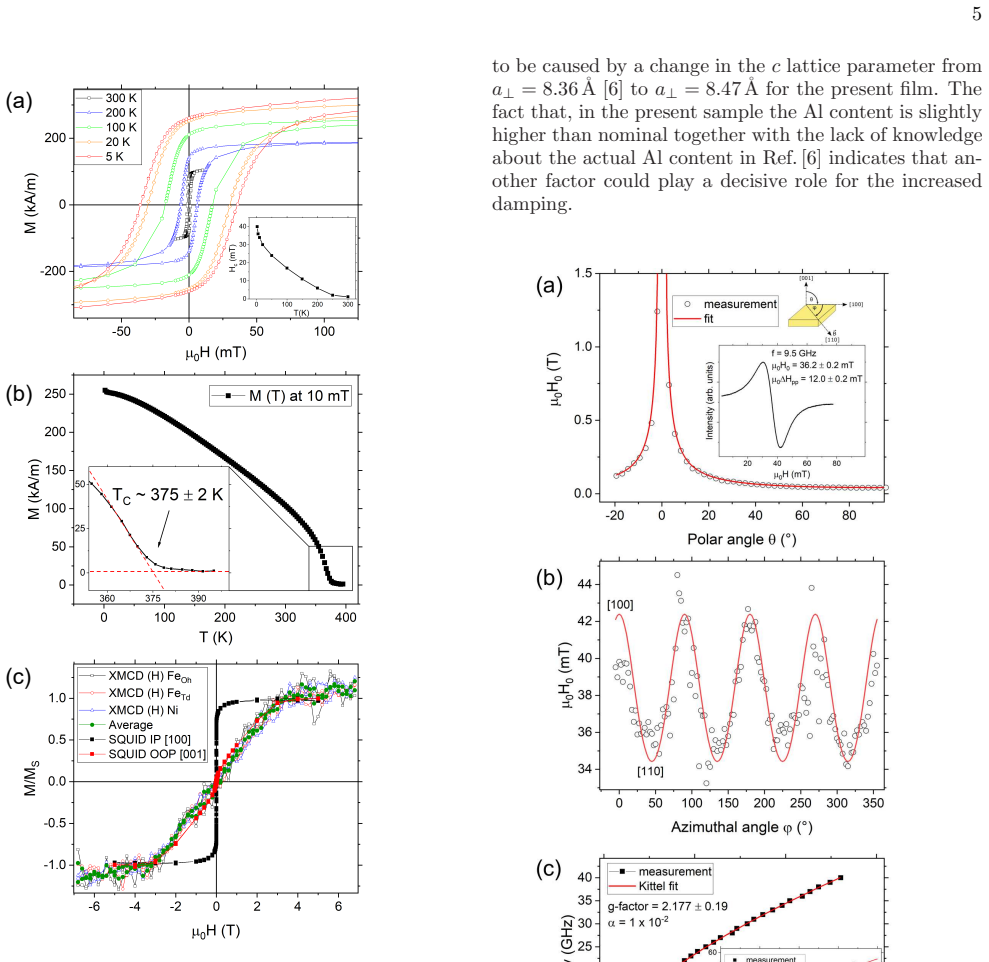
the Curie temperature is slightly reduced. Neverthe- less, it is well above 300 K making ferromagnetic appli- cations at RT feasible. In addition, the directional dependence of the static mag- netic properties was studied. In Fig. 3(c) the difference in saturation field between IP ⟨100⟩ and OOP ⟨001⟩ M (H) curves measured by SQUID is shown in comparison wit...
-
[6]
In turn, NiZAF exhibits a smaller ferro- magnetic resonance (FMR) linewidth down to ∼ 0
compared to undoped NiFe 2O4 with MS up to 300 kA/ m and a significantly higher Curie temperature of TC = 860 K [11]. In turn, NiZAF exhibits a smaller ferro- magnetic resonance (FMR) linewidth down to ∼ 0. 82 mT resulting in a Gilbert damping parameter of α ∼ 3×10⁻³
-
[7]
35 T. In turn, this leads to a broadening of the linewidth and increased damping with a non negligible contribution of TMS at higher frequencies. Even though, the structural analysis shows an excellent crystal struc- ture with a low amount of defects at least on a local scale, a significant inhomogeneous component is detectable by sensitive magnetic measur...
-
[8]
71) obtained by RBS evidenced a rather good stoichio- metric transfer with a slight Zn deficiency. The material is highly, but coherently strained and no indication for defects or dislocations can be observed from a structural analysis. A comparison with bulk [10] shows a shift of the in-plane magnetic easy axis from ⟨111⟩ to the ⟨110⟩ in agreement with th...
work page 2017
Show all 36 references
-
[9]
RIF14-0053) supporting accelerator operation at Uppsala University is gratefully acknowledged
and the Swedish Foundation for Strategic Research (SSF, Contract No. RIF14-0053) supporting accelerator operation at Uppsala University is gratefully acknowledged. The financial support by the Austrian Federal Ministry for Digital and Economic Af- fairs and the National Foundat...
-
[10]
The Curie temperature of TC = (375 ± 2) K was esti- mated from the M (T ) curve at 10 mT shown in the inset of Fig
and previous values for thin films ∼ 120 kA/ m [6]. The Curie temperature of TC = (375 ± 2) K was esti- mated from the M (T ) curve at 10 mT shown in the inset of Fig. 3(b). Compared to PLD samples with TC = 450 K
-
[11]
S. Wolf, D. Awschalom, R. Buhrman, J. Daughton, S. Von Molnar, M. Roukes, A. Y. Chtchelkanova, and D. Treger, Science 294 5546, 1488 (2001)
2001
-
[12]
Tserkovnyak, A
Y. Tserkovnyak, A. Brataas, and G. E. W. Bauer, Phys. Rev. B 66 22, 224403 (2002)
2002
-
[13]
M.V. Moro, R. Hole˘ n´ ak, L. Zendejas Medina, U. Jansson, D. Primetzhofer, Thin Solid Films 686, 137416 (2019)
2019
-
[14]
Chang, P
H. Chang, P. Li, W. Zhang, T. Liu, A. Hoffmann, L. Deng, and M. Wu, IEEE Magn. Lett. 5, 1 (2014)
2014
-
[15]
Emori et al, Adv
S. Emori et al, Adv. Mater. 29, 1701130 (2017)
2017
-
[16]
G. F. Dionne, IEEE: Trans. Magn. 47, 2 (2011)
2011
-
[17]
Klewe, M
C. Klewe, M. Meinert, K. Kuepper, E. Arenholz, A. 11 Gupta, J.-M. Schmalhorst, T. Kuschel, and G. Reiss, J. Appl. Phys. 115, 123903 (2014)
2014
-
[18]
Navrotsky, O
A. Navrotsky, O. J. Kleppa, J. Inorg., Nucl. Chem. 29, 2701 (1967)
1967
-
[19]
M. Li, Z. Zhou, M. Liu, J. Lou, D. E. Oates, G. F. Dionne, M. L. Wang, and N. X. Sun, J. Phys. D: Appl. Phys. 46, 275001 (2013)
2013
-
[20]
V. G. Harris, IEEE: Trans. Magn. 48 3, 1075 (2012)
2012
-
[21]
Mayer, SIMNRA User’s Guide , Report IPP 9/113, Max-Planck-Institut fr Plasmaphysik, Garching, Ger- many (1997)
M. Mayer, SIMNRA User’s Guide , Report IPP 9/113, Max-Planck-Institut fr Plasmaphysik, Garching, Ger- many (1997)
1997
-
[22]
Zhakeri, Phys
Kh. Zhakeri, Phys. Rev. B 76, 214421 (2007)
2007
-
[23]
Sawicki, W
M. Sawicki, W. Stefanowicz, and A. Ney, Semicond. Sci. Techn. 26 6, 064006 (2011)
2011
-
[24]
Buchner, K
M. Buchner, K. H¨ ofler, B. Henne, V. Ney, and A. Ney, J. Appl. Phys. 124, 161101 (2018)
2018
-
[26]
Data repository for Johannes Kepler Uni- versity Linz (Magnetic Oxides Group) at http://doi.org/10.17616/R3C78N; search tag: LBN19
-
[27]
Piamonteze et al, J
C. Piamonteze et al, J. Synchrotron Rad. 19, 661 (2012)
2012
-
[28]
Suzuki, Annu
Y. Suzuki, Annu. Rev. Mater. Res. 31, 265 (2001)
2001
-
[29]
U. S. Alaan, G. Sreenivasulu, K. M. Yu, C. Jenkins, P. Shafer, E. Arenholz, G., Srinivasan, and Y. Suzuki, J. Magn. Magn. Mater. 405, 129 (2016)
2016
-
[30]
Farle, Rep
M. Farle, Rep. Prog. Phys. 61, 755 (1998)
1998
-
[32]
Lindner, K
J. Lindner, K. Lenz, E. Kosubek, and K. Baberschke, D. Spoddig, R. Meckenstock, and J. Pelzl, and Z. Frait, and D. L. Mills, Phys. Rev. B 68, 060102(R) (2003)
2003
-
[33]
K. Lenz, H. Wende, W. Kuch, and K. Baberschke, K. Nagy and A. Jnossy, Phys. Rev. B 73, 144424 (2006)
2006
-
[34]
Stavitski, and F.M.F
E. Stavitski, and F.M.F. de Groot, Micron 41, 687 (2010)
2010
-
[35]
R. A. D. Pattrick, G. van der Laan, M. B. Henderson, P. Kuiper, E. Dudzik, and D. J. Vaughan, Eur. J. Mineral 14, 1095 (2002)
2002
-
[36]
Piamonteze, P
C. Piamonteze, P. Miedema, and F.M.F. de Groot, Phys. Rev. B 80, 184410 (2009)
2009
-
[37]
Hoppe, M
M. Hoppe, M. Gorgoi, C. M. Schneider, and M. M¨ uller, IEEE Trans. Magn. 50, 2506204 (2014)
2014
-
[42]
The film reflection with a small full width at half maximum (FWHM) around 0
67 ◦ with respect to the substrate and show Laue os- cillations. The film reflection with a small full width at half maximum (FWHM) around 0 . 13 ◦ for the 70 nm sample corresponds to a perpendicular lattice parameter of a⊥ = (8 . 47 ± 0. 01) ˚ A. The symmetric RSM along the (00...
Reviewed August 14, 2026 · model on record in the stance chip above.
Discussion (0). Continue with ORCID to comment.