REVIEW 2 major objections 3 minor 1 cited by
Quantum key distribution with correlated sources
T0 review · 2 major / 3 minor · reviewed 2026-08-14 · deepseek-v4-flash
Pith's one-line read The paper shows that arbitrary pulse correlations in QKD can be reduced to a side-channel, so proving security for independent, more-orthogonal states proves security for the actual correlated source.
desk verdict Clever reduction and a solid reference technique, but the general monotonicity step is unproven and the abstract overclaims. read the letter →
The pith
A machine-rendered reading of the paper's core claim, the machinery that carries it, and where it could break.
The reading
What carries the argument
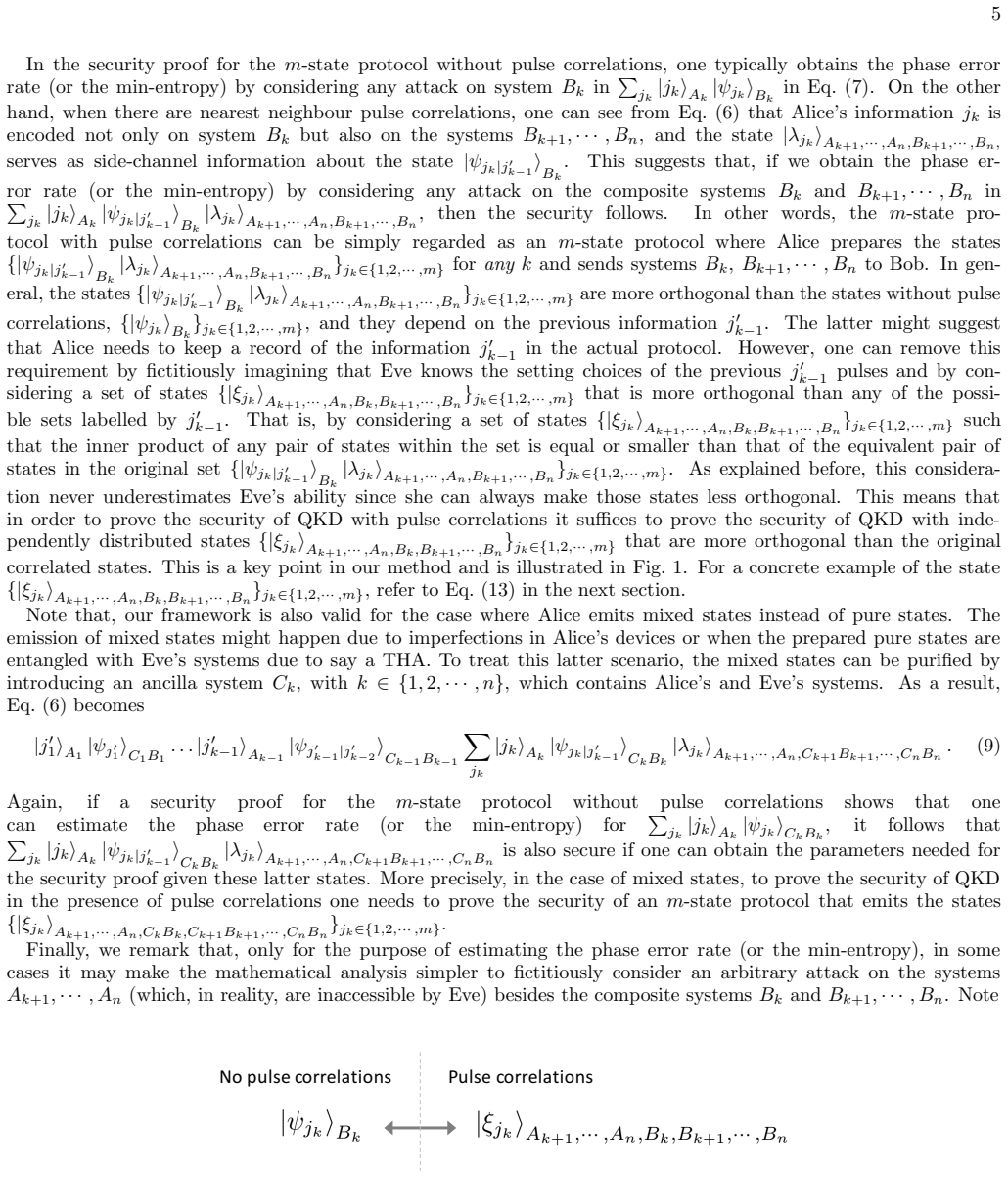
The load-bearing mechanism is the rewriting of the correlated emission so that the $k$-th pulse plus all later pulses become an effective state $|\psi_{j_k|j'_{k-1}}\rangle_{B_k}|\lambda_{j_k}\rangle_{A_{k+1},...,A_n,B_{k+1},...,B_n}$ whose dependence on the setting choice $j_k$ lives in a side-channel. The reduction replaces this by an independent set $\{|\xi_{j_k}\rangle\}$ with pairwise inner products no larger than the originals, so the phase-error bound from an existing security proof applies unchanged. The second mechanism is the reference technique: choose reference states $|\phi_j\rangle$ close to the actual $|\psi_j\rangle$, bound the maximum probability deviation by $1-|\langle\phi_j|\psi_j\rangle|^2$, and inject the resulting offsets $d_j$ into the estimate of phase errors or min-entropy. This turns a closeness-of-states statement into a key-rate formula without reconstructing the full correlation structure.
What would settle it
Search over concrete three-state source models for a set of more-orthogonal uncorrelated states $\{|\xi_j\rangle\}$ and a set of correlated states with pairwise inner products satisfying the paper's inequalities, then test whether a single trace-preserving quantum channel maps each $|\xi_j\rangle\langle\xi_j|$ to the corresponding correlated state; a single instance where no such channel exists would break the reduction, because Eve could not then reproduce the real correlations from the substitute states.
Extended reading notes
Core claim
The central claim, stated in the security analysis section, is that the presence of pulse correlations in QKD can be modelled by considering the preparation of states that are more orthogonal than the original ones but contain no pulse correlations. Concretely, when Alice's setting choice $j_k$ for the $k$-th pulse is correlated with later pulses, the whole emission can be rewritten so that $j_k$ is carried by the $k$-th pulse together with a side-channel state $|\lambda_{j_k}\rangle$ living on the later systems. Because the effective states are more orthogonal than the uncorrelated states used in standard proofs, proving security for any independently distributed set $\{|\xi_{j_k}\rangle\}$ whose pairwise inner products are no larger than those of the correlated states is sufficient for security of the correlated source: Eve can always make states less orthogonal. This collapses pulse correlations into the single parameter $a_j$ of the general source decomposition, including arbitrarily long-range correlations. The paper further claims that its reference technique, which estimates phase errors by comparing the actual states with nearby reference states, outperforms two existing security analyses in all simulated regimes, and that this new framework includes existing security proofs as special cases.
Load-bearing premise
The proof rests on the unproven monotonicity claim that replacing the actual correlated states by more-orthogonal, uncorrelated states never underestimates Eve, because a less-orthogonal set can always be obtained from a more-orthogonal one by an operation Eve can implement; if that monotonicity fails, the security bound does not cover the real source.
Editorial extensions
If this is right
- Security proofs that already tolerate state-preparation flaws, mode dependencies, and Trojan-horse attacks can be extended to pulse correlations by inserting a single correlation parameter into the source decomposition.
- Positive secret-key rates survive even when correlations span ten successive pulses, with rates that degrade as the correlation strength or correlation range grows.
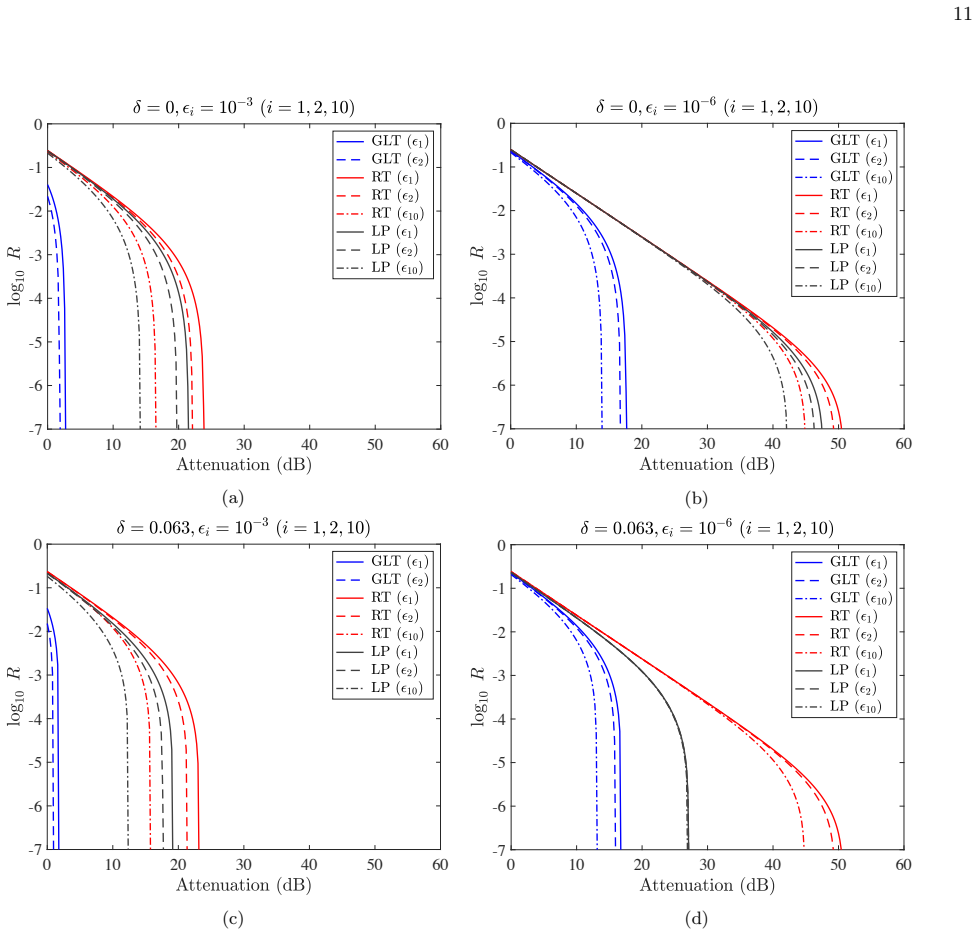
- The reference technique, applied to the loss-tolerant protocol, gives higher key rates than the generalized loss-tolerant protocol and the LP analysis in all simulated combinations of loss, correlation strength, and state-preparation error.
- The reduction applies to a wide family of protocols, including BB84, six-state, SARG04, distributed-phase-reference protocols, and measurement-device-independent QKD, and can be combined with the decoy-state method.
Reading between the lines
- Inference: experimental characterization of pulse correlations could be reduced to measuring pairwise fidelities of the form used in the long-range model, rather than performing full process tomography of the modulator memory.
- Inference: if the monotonicity step holds, source imperfections can be modularly combined, with each imperfection contributing one parameter to a single security proof, instead of treating the device as an uncharacterized black box.
- Inference: the reference technique's deviation bound $1-|\langle\phi_j|\psi_j\rangle|^2$ is likely loose for structured side-channels, so tighter bounds tailored to specific leakage models could further improve the simulated key rates.
- Inference: a direct test of the reduction would be to take a real phase modulator, measure the correlation strength $\epsilon$, and compare the predicted key rate from the more-orthogonal-state proof with an independent numerical security analysis of the actual correlated source.
Signed reviews
Editorial analysis
A structured set of objections, weighed in public.
Referee Report
Summary. This paper proposes a general framework for proving the security of QKD in the presence of classical pulse correlations. The central idea is to regard the information carried by pulse correlations as a side channel, and to replace the actual correlated states by an independent set of states that are 'more orthogonal' than the original ones; the authors claim that security for the more-orthogonal independent states implies security for the actual correlated source. They combine this reduction with the generalized loss-tolerant (GLT) protocol, the Lo-Preskill (LP) analysis, and a new 'reference technique' (RT), which bounds the deviation between actual and reference states. The framework is applied to a three-state loss-tolerant protocol with nearest-neighbour and long-range correlations, and secret key rates are simulated for small correlation parameters. The RT is also presented as a general security-proof framework.
Significance. If the reduction and the RT were valid, this would be a substantial step toward implementation security in QKD: it would reduce arbitrary pulse correlations to a side-channel, make them addressable by existing security proofs, and introduce a flexible proof technique that appears to outperform prior methods. The paper is clearly written, and the explicit construction in Sec. II.C for nearest-neighbour correlations is concrete and checkable. The use of existing proofs as black boxes, with no fitted parameters fed back into the security argument, is appropriate and does not indicate circularity. However, two load-bearing technical steps are currently not justified: the monotonicity principle for replacing states by more-orthogonal ones, and the probability-deviation bound used throughout the RT. These issues must be corrected before the central claims can be accepted.
major comments (2)
- [II.A and II.B] The reduction relies on the assertion, stated after Eq. (1) and repeated in Sec. II.B, that 'a set of less orthogonal states can always be constructed from a set of more orthogonal states with unit probability.' This monotonicity principle is load-bearing and is false as stated. A CPTP map E with E(|ξ_i⟩⟨ξ_i|)=|ψ_i⟩⟨ψ_i| for all i would require a Stinespring isometry V with V|ξ_i⟩=|ψ_i⟩|e_i⟩, which forces the Gram matrices to satisfy G_ξ = G_ψ ⊙ G_e with G_e positive semidefinite. Pairwise inequalities |⟨ξ_i|ξ_j⟩| ≤ |⟨ψ_i|ψ_j⟩| do not imply the existence of such G_e. As a concrete counterexample, take three states with G_ξ off-diagonal entries (0.49, 0.49 e^{2πi/3}, 0.49 e^{4πi/3}) and G_ψ off-diagonal entries all 0.5; both are valid Gram matrices and the pairwise inequalities hold, but the Hadamard quotient G_ξ ⊘ G_ψ is not positive semidefinite, so no such map exists. The particular construction in Sec. II.C with orthogonal side-channel states does admit such a map, so the flaw is repairable, but the general claim that security for arbitrary more-orthogonal independent states implies security for the correlated source is not established.
- [II.D, Eq. (23) and IV.A, Eqs. (39)-(40)] The RT deviation bound is not a valid upper bound. For pure states, the maximum difference between the probabilities of any measurement outcome is the trace distance: max_l |P(l|ψ)-P(l|φ)| = sqrt(1-|⟨ψ|φ⟩|^2), not 1-|⟨ψ|φ⟩|^2. The paper's bound is strictly smaller than the true maximum whenever 0<|⟨ψ|φ⟩|<1. For example, with ψ=|0⟩ and φ=cosθ|0⟩+sinθ|1⟩, the projector onto the positive eigenspace of ψ-φ gives a probability difference of sinθ, which exceeds 1-cos^2θ for θ∈(0,π/2). Consequently, dkey and dj in Eqs. (31)-(32) and d0X in Eq. (23) are too small, so the phase-error estimate and the key rates in Fig. 2 are not justified. Additionally, the normalization in Eq. (31) appears to use |S|^2/pkey where the normalized overlap squared is |S|^2/pkey^2 under the paper's convention ⟨j|i⟩=δ_{j,i}p_j. The RT can likely be repaired by using the trace-distance bound, but the present expressions must be corrected and the simulations redone.
minor comments (3)
- [Eq. (14) and Sec. II.E] The notation for correlation parameters is inconsistent: Eq. (14) uses ϵ_{k-w}, while Sec. II.E refers to ϵ_1, ϵ_2, and ϵ_{10}. Please state explicitly whether these parameters correspond to 1-|overlap|^2 or 1-|overlap| in Eq. (41).
- [Fig. 2] The black lines for the LP analysis are visually indistinguishable in some panels. Consider using markers or separate panels so that the comparison can actually be read.
- [Sec. II.B] The phrase 'more orthogonal' is used informally to mean 'with smaller inner products.' Since the entire reduction hinges on this ordering, a formal definition of the partial order on state sets and a statement of the exact monotonicity assumption would improve clarity.
Circularity Check
No circularity: the pulse-correlation reduction is a forward reduction into prior independent security proofs, and the reference technique's bounds are derived from state closeness rather than assumed from the target result.
full rationale
The paper's central derivation is a reduction: pulse correlations are re-expressed as side-channel information attached to an independent, more-orthogonal state set {|ξ_jk>}, and security is then established by applying externally developed proof frameworks (LT [17], GLT [18], LP [19]) to that set. The security of those base protocols is not derived from the pulse-correlation claim; it is imported as prior independent work whose stated assumptions do not include pulse correlations. The phase-error bound of the reference technique (Sec. II.D and Methods A) is expressed in terms of observed yields plus deviation terms d_key, d_j, and d_0X computed from inner products between actual and reference states, not from the target key rate or phase-error rate; those terms are fed forward into the key-rate expression, not fitted backward from it. No parameter is fitted to outcomes and then renamed as a prediction. The main self-citations (LT and GLT) are load-bearing in that they supply the base security proofs, but each is independently published and does not assume the present paper's reduction; this is ordinary use of prior results, not circularity. The manuscript does assert a monotonicity principle ('a set of less orthogonal states can always be constructed from a set of more orthogonal states with unit probability') without proof; if that principle fails, the reduction would be incomplete or invalid. That is a correctness or completeness concern, not a circularity concern, because the claimed implication is not definitionally identical to its input. Overall, the derivation chain is self-contained with respect to the reduction's target, and no circular step can be identified in the paper's own equations or argument structure.
Assumptions & free parameters
free parameters (2)
- epsilon_i (pulse correlation strength) =
1e-3 or 1e-6 (simulation choices)
- delta (phase modulation error) =
0 and 0.063
assumptions (4)
- domain assumption Asymptotic limit: Alice sends Bob an infinite number of pulses.
- domain assumption Pulse correlations satisfy the overlap lower bound of Eq. (14), |<psi|psi'>|^2 >= 1 - epsilon_{k-w}, uniformly over all setting choices, and a certified epsilon_{k-w} is available.
- domain assumption The base security proof can be generalized to a particular pulse carrying a side-channel.
- ad hoc to paper More-orthogonal replacement states never underestimate Eve: a less-orthogonal set can be constructed from a more-orthogonal set with unit probability.
Cite this review
Pith. "Pith review of Quantum key distribution with correlated sources." pith.science (2026). https://pith.science/paper/UUTUKEYC
@misc{pith2026190808261,
  author       = {Pith},
  title        = {Pith review of: Quantum key distribution with correlated sources},
  year         = {2026},
  howpublished = {\url{https://pith.science/paper/UUTUKEYC}},
  note         = {Machine review of arXiv:1908.08261}
}
read the original abstract
In theory, quantum key distribution (QKD) offers information-theoretic security. In practice, however, it does not due to the discrepancies between the assumptions used in the security proofs and the behaviour of the real apparatuses. Recent years have witnessed a tremendous effort to fill the gap, but the treatment of correlations among pulses has remained a major elusive problem. Here, we close this gap by introducing a simple yet general method to prove the security of QKD with arbitrarily long-range pulse correlations. Our method is compatible with those security proofs that accommodate all the other typical device imperfections, thus paving the way towards achieving implementation security in QKD with arbitrary flawed devices. Moreover, we introduce a new framework for security proofs, which we call the reference technique. This framework includes existing security proofs as special cases and it can be widely applied to a number of QKD protocols.
Figures
Forward citations
Cited by 1 Pith paper
-
Tighter Asymptotic Key Rates for Intensity-Correlated Decoy-State QKD via Nonlinear Programming
Using IPOPT solutions of the full nonlinear CS-constrained problems as linearization points yields tighter, still-valid asymptotic key-rate bounds for decoy-state QKD with intensity correlations.
Reference graph
Works this paper leans on
-
[18]
Pereira, M., Curty, M. & Tamaki, K. Quantum key distribution with flawed and leaky sources. npj Quantum Information 5, 62 (2019)
work page 2019
-
[17]
A., Chan, P., Lucio-Martinez, I
Rubenok, A., Slater, J. A., Chan, P., Lucio-Martinez, I. & Tittel, W. Real-world two-photon interference and proof-of- principle quantum key distribution immune to detector attacks. Phys. Rev. Lett. 111, 130501 (2013)
work page 2013
-
[1]
Assume that the actual protocol can be converted into an entanglement-based virtual protocol, in which Alice’s choicesj and the quantum states|ψj⟩B sent to Bob are the same as those in the actual protocol. In such virtual 13 protocol, Alice sends all the systems B to Bob over a quantum channel, and afterwards they start to measure their systems in order. ...
-
[2]
Unfortunately, there are no quantitative works characterising pulse correlations (i.e., the value of the parameter ϵ) therefore, for illustration purposes, we select the values 10−3 and 10−6 to evaluate this imperfection. Also, in order to investigate how the length of the pulse correlations affects the secret key rate, we consider the nearest neighbour co...
-
[3]
In order to estimate the physical quantity defined in step 2, consider a particular round of Alice’s and Bob’s measurements (say the kth round) in the virtual protocol and assume the most general attack that might be performed by an eavesdropper. Now, we imagine replacing only the kth actual pulses with the reference states, and we select these reference s...
-
[4]
(28) to a relationship in terms of events associated to the actual states
Transform the relationship for the reference states in Eq. (28) to a relationship in terms of events associated to the actual states. This is done by just replacing the probabilities in Eq. (28) with the probabilities in the actual protocol. To be precise, we modify Eq. (28) as 0≤ max ωkey,ωj f(P (k)(qes) +ωkeydkey,{P (k)(qobsγ,j ) +ωjdj}γ=1,2,··· ;j=1,2,...
-
[5]
Employ a security proof where an upper bound on a physical quantity needs to be estimated, such as the number of phase errors within the detected events
-
[6]
Transform Eq. (33) to an inequality in terms of the number of occurrences (instead of probabilities) by exploiting the properties of the function f as well as some probability inequality. First, take a summation over k = 1, 2,··· ,Ndet, where Ndet denotes the number of detected events, and write 0≤f (Ndet∑ k=1 P (k)(qes|det) +ωkey,max Ndet∑ k=1 d(k) key|d...
Show all 58 references
-
[7]
da Silva, T. F. et al. Proof-of-principle demonstration of measurement-device-independent quantum key distribution using polarization qubits. Phys. Rev. A 88, 052303 (2013)
2013
-
[8]
Let us redefine such a round ask, and divide the inequality in Eq
Now, we concentrate on a round that results in a detected event, i.e., when Bob obtains a bit value. Let us redefine such a round ask, and divide the inequality in Eq. (30) by the probability of obtaining a detected event P (k)(qdet): 0≤f(P (k)(qes|det) +ωkey,maxd(k) key|det,{P...
-
[9]
Tang, Z. et al. Experimental demonstration of polarization encoding measurement-device-independent quantum key dis- tribution. Phys. Rev. Lett. 112, 190503 (2014)
2014
-
[10]
(44) corresponds to Eq
Note that, Eq. (44) corresponds to Eq. (6) in the Results section. Now, similarly to our analysis for the nearest neighbour pulse correlations, in order to see how the information jk is encoded in the state |Ψj′ k−1,···,j′ 1⟩AB, defined in Eq. (44), we rewrite it as |Ψj′ k−1,··...
-
[11]
For|Φj′ k−1,···,j′ 1⟩Ak+1,···,An,Bk+1,···,Bn , one may choose a state such that it becomes independent of jk. One of such choices could be |Φj′ k−1,···,j′ 1⟩Ak+1,···,An,Bk+1,···,Bn := ∑ jn ··· ∑ jk+1 n⨂ ζ=k+1 |jζ⟩Aζ |ψjζ|jζ−1,···,jk+1,0X,j′ k−1,···,j′ 1⟩Bζ , (46) which is the ...
2020
-
[12]
& Tamaki, K
Lo, H.-K., Curty, M. & Tamaki, K. Secure quantum key distribution. Nature Photonics 8, 595–604 (2014)
2014
-
[13]
Quantum key distribution with high loss: Toward global secure communication
Hwang, W.-Y. Quantum key distribution with high loss: Toward global secure communication. Phys. Rev. Lett. 91, 057901 (2003)
2003
-
[14]
& Chen, K
Lo, H.-K., Ma, X. & Chen, K. Decoy state quantum key distribution. Phys. Rev. Lett. 94, 230504 (2005)
2005
-
[15]
Beating the photon-number-splitting attack in practical quantum cryptography
Wang, X.-B. Beating the photon-number-splitting attack in practical quantum cryptography. Phys. Rev. Lett. 94, 230503 (2005)
2005
-
[16]
Lo, H.-K., Curty, M. & Qi, B. Measurement-device-independent quantum key distribution. Phys. Rev. Lett. 108, 130503 (2012)
2012
-
[19]
and the GLT protocol [18]. II. RESULTS Pulse correlations occur, for instance, when the emitted signals depend on the previous values of the encoding device (e.g., a phase modulator). In other words, subsequent pulses leak information about Alice’s former encoding choices. The...
-
[20]
Liu, Y. et al. Experimental measurement-device-independent quantum key distribution. Phys. Rev. Lett. 111, 130502 (2013)
2013
-
[21]
Yin, H.-L. et al. Measurement-device-independent quantum key distribution over a 404 km optical fiber. Phys. Rev. Lett. 117, 190501 (2016)
2016
-
[22]
Comandar, L. C. et al. Quantum key distribution without detector vulnerabilities using optically seeded lasers. Nature Photonics 10, 312–315 (2016)
2016
-
[23]
& Ribordy, G
Gisin, N., Fasel, S., Kraus, B., Zbinden, H. & Ribordy, G. Trojan-horse attacks on quantum-key-distribution systems. Phys. Rev. A 73, 022320 (2006)
2006
-
[24]
& Hjelme, D
Vakhitov, A., Makarov, V. & Hjelme, D. R. Large pulse attack as a method of conventional optical eavesdroppong in quantum cryptography. J. Mod. Opt. 48, 2023 (2001)
2001
-
[25]
B., Yuan, J
Lucamarini, M., Choi, I., Ward, M. B., Yuan, J. F. D. Z. L. & Shields, A. J. Practical security bounds against the trojan-horse attack in quantum key distribution. Phys. Rev. X 5, 031030 (2015)
2015
-
[26]
& Lucamarini, M
Tamaki, K., Curty, M. & Lucamarini, M. Decoy-state quantum key distribution with a leaky source. New Journal of Physics 18, 065008 (2016)
2016
-
[27]
& Curty, M
Wang, W., Tamaki, K. & Curty, M. Finite-key security analysis for quantum key distribution with leaky sources. New Journal of Physics 20, 083027 (2018)
2018
-
[28]
& Azuma, K
Tamaki, K., Curty, M., Kato, G., Lo, H.-K. & Azuma, K. Loss-tolerant quantum cryptography with imperfect sources. Phys. Rev. A 90, 052314 (2014)
2014
-
[29]
& Gisin, N
Scarani, V., Ac´ ın, A., Ribordy, G. & Gisin, N. Quantum cryptography protocols robust against photon number splitting attacks for weak laser pulse implementations. Phys. Rev. Lett. 92, 057901 (2004)
2004
-
[30]
& Preskill, J
Lo, H.-K. & Preskill, J. Security of quantum key distribution using weak coherent states with nonrandom phases. Quantum Inf. Comput. 7, 431–458 (2007)
2007
-
[31]
& Preskill, J
Gottesman, D., Lo, H.-K., L¨ utkenhaus, N. & Preskill, J. Security of quantum key distribution with imperfect devices. Quantum Inf. Comput. 7, 431 (2007). 19
2007
-
[32]
W., Lavie, E., Varvitsiotis, A
Wang, Y., Primaatmaja, I. W., Lavie, E., Varvitsiotis, A. & Lim, C. C. W. Characterising the correlations of prepare- and-measure quantum networks. npj Quantum Information 5, 17 (2019)
2019
-
[33]
J., Metodiev, E
Coles, P. J., Metodiev, E. M. & L¨ utkenhaus, N. Numerical approach for unstructured quantum key distribution. Nature Communications 7 (2016)
2016
-
[34]
& Coles, P
Winick, A., L¨ utkenhaus, N. & Coles, P. J. Reliable numerical key rates for quantum key distribution. Quantum 2, 77 (2018)
2018
-
[35]
Nagamatsu, Y. et al. Security of quantum key distribution with light sources that are not independently and identically distributed. Phys. Rev. A 93, 042325 (2016)
2016
-
[36]
Moreover, we assume that the security proof can be generalised such that it applies to a particular pulse with a side-channel
or by applying the techniques in [37, 38]. Moreover, we assume that the security proof can be generalised such that it applies to a particular pulse with a side-channel. That is, it can be used to prove the security of QKD in 4 the presence of active and/or passive information...
-
[37]
Mizutani, A. et al. Quantum key distribution with setting-choice-independently correlated light sources. npj Quantum Information 5, 8 (2019)
2019
-
[38]
Yoshino, K.-i. et al. Quantum key distribution with an efficient countermeasure against correlated intensity fluctuations in optical pulses. npj Quantum Information 4, 8 (2018)
2018
-
[39]
Bennett, C. H. & Brassard, G. Quantum cryptography: Public key distribution and coin tossing. In Proceedings of IEEE International Conference on Computers, Systems, and Signal Processing , 175–179 (1984)
1984
-
[40]
Optimal eavesdropping in quantum cryptography with six states
Bruss, D. Optimal eavesdropping in quantum cryptography with six states. Phys. Rev. Lett. 81, 3018–3021 (1998)
1998
-
[41]
& Yamamoto, Y
Inoue, K., Waks, E. & Yamamoto, Y. Differential phase shift quantum key distribution. Phys. Rev. Lett. 89, 037902 (2002)
2002
-
[42]
Takesue, H. et al. Quantum key distribution over a 40-db channel loss using superconducting single-photon detectors. Nature Photonics 1, 343–348 (2007)
2007
-
[43]
& Zbinden, H
Stucki, D., Brunner, N., Gisin, N., Scarani, V. & Zbinden, H. Fast and simple one-way quantum key distribution. Applied Physics Letters 87, 194108 (2005)
2005
-
[44]
Lydersen, L. et al. Hacking commercial quantum cryptographic systems by tailored bright illumination. Nature Photonics 4, 686–698 (2010)
2010
-
[45]
Gerhardt, I. et al. Full-field implementation of a perfect eavesdropper on a quantum cryptography system. Nature Communications 2, 349 (2011)
2011
-
[46]
F., Tamaki, K., Qi, B., Lo, H.-K
Fung, C.-H. F., Tamaki, K., Qi, B., Lo, H.-K. & Ma, X. Security proof of quantum key distribution with detection efficiency mismatch. Quantum Inf. Comput. 9, 0131–0165 (2009)
2009
-
[47]
Weighted sums of certain dependent random variables
Azuma, K. Weighted sums of certain dependent random variables. Tohoku Mathematical Journal 19, 357–367 (1967)
1967
-
[48]
& Renner, R
Christandl, M., K¨ onig, R. & Renner, R. Postselection technique for quantum channels with applications to quantum cryptography. Phys. Rev. Lett. 102, 020504 (2009)
2009
-
[49]
& Renner, R
Dupuis, F., Fawzi, O. & Renner, R. Entropy accumulation. preprint arXiv:1607.01796 (2016)
2016 arXiv
-
[50]
Cao, Z., Zhang, Z., Lo, H.-K. & Ma, X. Discrete-phase-randomized coherent state source and its application in quantum key distribution. New Journal of Physics 17, 053014 (2015)
2015
-
[51]
& Barnett, S
Chefles, A. & Barnett, S. M. Optimum unambiguous discrimination between linearly independent symmetric states. Physics Letters A 250, 223 – 229 (1998)
1998
-
[52]
& L¨ utkenhaus, N
Duˇ sek, M., Jahma, M. & L¨ utkenhaus, N. Unambiguous state discrimination in quantum cryptography with weak coherent states. Phys. Rev. A 62, 022306 (2000)
2000
-
[53]
& Lo, H.-K
Xu, F., Qi, B. & Lo, H.-K. Experimental demonstration of phase-remapping attack in a practical quantum key distribution system. New J. Phys. 12, 113026 (2010)
2010
-
[54]
& Takahashi, H
Honjo, T., Inoue, K. & Takahashi, H. Differential-phase-shift quantum key distribution experiment with a planar light-wave circuit mach–zehnder interferometer. Opt. Lett. 29, 2797–2799 (2004)
2004
-
[55]
Recent advances in coherent optical communication
Li, G. Recent advances in coherent optical communication. Adv. Opt. Photon. 1, 279–307 (2009)
2009
-
[56]
Jensen, J. L. W. V. Sur les fonctions convexes et les in´ egalit´ es entre les valeurs moyennes.Acta Mathematica 30 (1906)
1906
-
[57]
A measure of asymptotic efficiency for tests of a hypothesis based on the sum of observations
Chernoff, H. A measure of asymptotic efficiency for tests of a hypothesis based on the sum of observations. Ann. Math. Statist. 23, 493–507 (1952)
1952
-
[58]
& Renes, J
Boileau, J.-C., Tamaki, K., Batuwantudawe, J., Laflamme, R. & Renes, J. M. Unconditional security of a three state quantum key distribution protocol. Phys. Rev. Lett. 94, 040503 (2005)
2005
Reviewed August 14, 2026 · model on record in the stance chip above.
Discussion (0). Continue with ORCID to comment.