REVIEW 4 major objections 5 minor 16 references
Experimental Analysis of Harvested Energy and Throughput Trade-off in a Realistic SWIPT System
T0 review · 4 major / 5 minor · reviewed 2026-08-14 · deepseek-v4-flash
Pith's one-line read A realistic SWIPT prototype shows that a power-splitting receiver combined with a superposition signal yields the widest harvested-energy–throughput region.
desk verdict A real SWIPT prototype with useful measurements, but the 'fully validate' claim overshoots: the implemented superposition is disjoint-subcarrier FDM, not the overlapping-cancellation scheme from [6]. read the letter →
The pith
A machine-rendered reading of the paper's core claim, the machinery that carries it, and where it could break.
The reading
What carries the argument
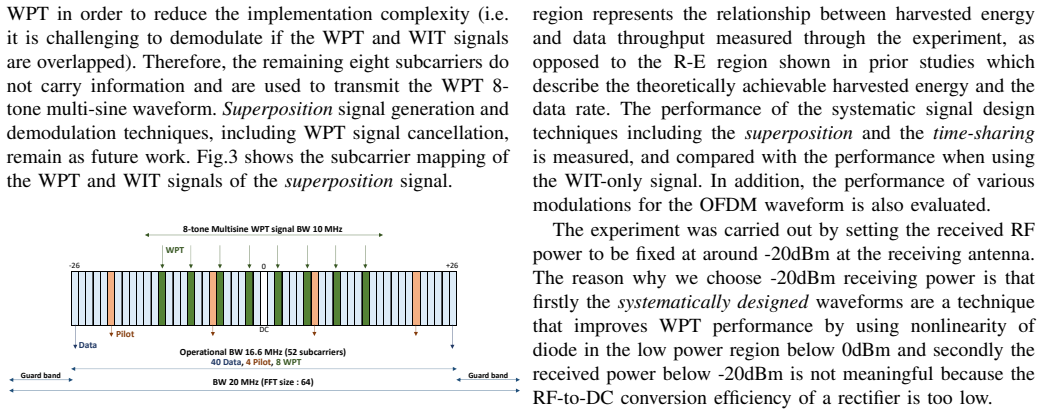
The load-bearing mechanism is the pairing of a power-splitting receiver with a superposition transmission signal. The PS receiver divides the received RF signal into two streams, sending fraction $\rho_{\mathrm{rx}}$ to the energy harvester and $1-\rho_{\mathrm{rx}}$ to the information decoder, which lets both operate on every symbol. The superposition signal combines a WPT waveform and a WIT waveform as $x_{\mathrm{sp}}(t)=\sqrt{\rho_{\mathrm{tx}}}x_P(t)+\sqrt{1-\rho_{\mathrm{tx}}}x_I(t)$, with an 8-tone multisine WPT component chosen because its peaks drive the diode rectifier into its nonlinear region more effectively than a single tone. In this prototype the WPT and WIT waveforms occupy disjoint subcarriers, a simplification of the fully overlapping superposition studied in [6] that avoids the need to cancel the WPT signal at the information decoder. This combination is what carries the argument: it determines the E-T expansion, the measured gains, and the claim of validating [6]. The time-sharing/TS combination serves as the comparison baseline.
What would settle it
Repeat the same prototype measurements at a received RF power near the decoder's sensitivity floor, for example $-50$ dBm, where the information decoder no longer receives enough power for near-zero bit-error rate; if the PS receiver's E-T region no longer dominates TS, or if the superposition gain over WIT-only disappears, the claimed high-SNR validation fails. Alternatively, implement true overlapping subcarriers with WPT cancellation and compare; if no additional E-T expansion appears, the disjoint-subcarrier simplification is not the bottleneck.
Extended reading notes
Core claim
On the authors' own terms, the discovery is that the E-T region of a realistic SWIPT link is governed by the interaction of three choices: receiver architecture, transmission waveform, and information-decoder sensitivity. With the implemented prototype, the power-splitting (PS) receiver achieves a much larger E-T region than time-switching (TS), because even a small power fraction routed to the decoder is enough for reliable demodulation (decoder sensitivity below $-80$ dBm while input is around $-20$ dBm), so the energy harvester can run continuously. The superposition transmission signal — combining an 8-tone multisine WPT signal and an OFDM WIT signal — further expands the E-T region, and the multisine WPT component alone raises maximum harvested energy by 72% over a single-tone signal, an effect attributed to the rectifier's nonlinearity. Higher-order modulations (up to 64QAM) increase throughput at the same harvested energy, since the decoder operates at effectively zero bit-error rate. These experimental results are presented as experimental validation of the high-SNR (>40 dB) predictions of the theoretical superposition/PS analysis in [6].
Load-bearing premise
The central claim depends on the implemented disjoint-subcarrier superposition behaving like the theoretical overlapping-subcarrier superposition in [6], and on the high-SNR operating point fixed by a $-20$ dBm input and a very sensitive decoder; if either premise gives way, the superiority of PS over TS and the claimed validation of theory could reverse.
Editorial extensions
If this is right
- Practical SWIPT receivers with high-sensitivity decoders should use power splitting rather than time switching, because continuous small power splits support reliable decoding while keeping the harvester active.
- Systematic multisine waveform design pays off in hardware: the 8-tone WPT component delivers about 72% more harvested energy than a single tone, so waveform choice belongs in the SWIPT design loop.
- At high SNR, modulation order can be raised to 64QAM without reducing harvested energy, so throughput and energy can be scaled together.
- The E-T region can be tuned by adjusting the transmitter power-combining ratio $\rho_{\mathrm{tx}}$ and the receiver splitting ratio $\rho_{\mathrm{rx}}$, giving a practical knob for energy-throughput trade-offs.
- The coupling of signal design, receiver architecture, and decoder sensitivity means none of the three can be optimized in isolation.
Reading between the lines
- An implication the authors leave implicit: in low-SNR or low-sensitivity-decoder regimes, the ranking may reverse and time-sharing/TS could be preferable, so the design guidance should be read as regime-dependent rather than universal.
- Since the prototype uses disjoint subcarriers rather than the fully overlapping superposition of [6], the measured E-T region is likely a lower bound on what the theoretical superposition could achieve; closing that gap is a concrete next experiment.
- A testable extension would map the E-T region across received power levels and load impedances, since the rectifier nonlinearity that drives the 72% gain is known to be power- and load-dependent.
- The same three-way coupling suggests that multi-antenna SWIPT or waveform-and-receiver co-design could yield further expansions by jointly optimizing the power split, the waveform, and the decoder threshold.
Signed reviews
Editorial analysis
A structured set of objections, weighed in public.
Referee Report
Summary. This paper reports an experimental SWIPT prototype built with NI SDR hardware at 2.4 GHz. The transmitter can generate a WiFi-802.11g-based OFDM information signal, an 8-tone multisine power signal, and combine them either by time-sharing or by a 'superposition' method. The receiver implements both time-switching (TS) and power-splitting (PS) architectures with a single-diode rectifier and a high-sensitivity information decoder. The authors measure harvested DC energy versus throughput at a fixed received power of -20 dBm, for different signal designs and modulation orders, and compare the resulting energy-throughput regions. They report that PS outperforms TS, that multisine-based WPT increases harvested energy by 72% over a single-tone WPT signal, and that the measurements 'fully validate' the theoretical observations of the companion paper [6].
Significance. If the results were fully supported, the paper would be a valuable practical demonstration that nonlinear-rectifier-aware signal design and receiver architecture jointly shape the SWIPT energy-throughput tradeoff. Its strengths include a real hardware testbed, an independent measurement methodology, and a systematic comparison across receiver architectures, signal designs, and modulation schemes. However, the central validation claim is weakened by the mismatch between the implemented 'superposition' signal (disjoint subcarriers for WPT and WIT) and the theoretical superposition of [6] (overlapping subcarriers with WPT cancellation), and by the absence of a quantitative comparison to theory. The experiment is also confined to a single high-SNR operating point, which the authors themselves identify as the regime where PS plus superposition is predicted to win.
major comments (4)
- [Section II.B, Fig. 3, Abstract] The implemented 'superposition' signal is not the superposition scheme analyzed in [6]. In [6], WPT and WIT waveforms occupy the same subcarriers and the WPT signal is cancelled at the information decoder; in this prototype, eight subcarriers are reserved exclusively for the 8-tone WPT multisine and the OFDM WIT uses the other 52 subcarriers, as shown in Fig. 3. The authors explicitly state that this 'differs a bit' from [6] and that overlapping-subcarrier superposition with WPT cancellation remains future work. Consequently, the measured x_sp is a frequency-division-multiplexed signal, not the same-subcarrier superposition of [6]; the rectifier sees a different composite envelope and the information decoder sees no WPT interference. The abstract's claim that the experimental results 'fully validate' the theoretical signal designs is therefore not supported. The manuscript should either temper this claim to 'qualitatively consistent with' or provide an argument or measurement showing that the disjoint-subcarrier version preserves the nonlinear interaction responsible for the E-T expansion in [6].
- [Section III.A, comparison with theory] The validation of [6] is qualitative only. The text states that the PS-plus-superposition advantage is 'consistent with the theoretical analysis' and that the experiment confirms 'the high SNR behavior predicted from theory,' but no theoretical R-E curves from [6] are overlaid on the measured E-T data and no quantitative metric (e.g., normalized error, region area ratio) is computed. Given the structural difference in the implemented superposition signal, this qualitative agreement does not by itself establish that the measured E-T region is the one predicted by [6]. A quantitative comparison under matching signal parameters, or a clear statement of which specific predictions are tested and how, is needed to support the validation claim.
- [Section III.A, 72% improvement claim] The claim that 'the maximum achievable harvested energy is increased by 72% compared to single tone WPT signal' is not supported by the measurements reported in this paper. The baseline in Fig. 4 is the OFDM WIT-only signal, not a single-tone WPT signal, and no single-tone WPT measurement appears in the paper. If the 72% figure is taken from the companion WPT study [7], it should be cited and clearly distinguished from the present results; if it is claimed as a new result, the corresponding single-tone baseline must be measured and reported.
- [Section III.A, operating-point conditioning] The experiment is performed at a fixed received power of about -20 dBm and with an information decoder whose sensitivity is below -80 dBm, so the system operates in the high-SNR regime. The authors themselves note that the theoretical advantage of PS-plus-superposition over TS-plus-time-sharing occurs only at high SNR (>40 dB) and that low-SNR behavior is future work. Therefore the paper's broad statements that the PS receiver 'outperforms' the TS architecture and that systematic signal designs 'significantly improve' the E-T region are conditional on this high-SNR, high-receiver-sensitivity regime. The abstract and conclusion should explicitly state this qualification rather than presenting the results as unconditional.
minor comments (5)
- [Section III.A, Fig. 4] The statement that the E-T region 'almost looks like that of an ideal receiver [5]' is vague; please specify which ideal receiver model is meant and provide a quantitative comparison, since the shape similarity is not formally demonstrated.
- [Figures 4 and 5] The experiments were repeated 300 times and averaged, but no error bars, confidence intervals, or variability measures are shown. Please add them or justify their omission, as they are important for assessing the significance of the reported differences.
- [Section II.C] For reproducibility, the rectifier circuit should be described in more detail, including the diode type, load resistance, matching network, and DC measurement setup. The current description as 'a simple single diode rectifier' is insufficient to replicate the measurements.
- [References] Reference [8] is listed as 'Submitted for publication' with an arXiv link; please update it if it has since been accepted or published, and consider citing a published version.
- [Eq. (2)] In the superposition signal definition, the use of sqrt(rho_tx) and sqrt(1-rho_tx) implies a power-combining ratio, but the average power normalization of x_P(t) and x_I(t) is not stated. Please clarify the normalization so that the power ratio is unambiguous.
Circularity Check
No significant circularity: the paper is an experimental measurement study whose claims rest on independent hardware data, not on fits or self-citation chains.
full rationale
The paper's central contribution is a prototype measurement campaign, not a derivation. The E-T regions in Figures 4 and 5 are obtained by directly measuring rectifier output voltage and bit-error rate, then computing throughput as (1-BER) x maxrate. No parameter in the paper is fitted to the claimed outcome, and no equation is shown to reduce to an earlier equation by construction. The authors compare their measurements with their own prior theoretical results in [6], but this is an external benchmark rather than a circular input: the theory in [6] was published independently of the present measurements, and the experiment could in principle have disagreed with it. The main caveat is not circularity but fidelity: the implemented 'superposition' signal uses disjoint subcarriers for WPT and WIT (Section II.B, Fig. 3), which the authors explicitly acknowledge 'differs a bit from the original superposition approach used in [6],' with true overlapping-subcarrier superposition and WPT cancellation 'remain[ing] as future work.' That mismatch undermines the strength of the 'fully validate' claim, but it is a validity or generalization concern, not a circularity concern, because the measurements are still independent empirical evidence. The self-citations to [6], [7], and [8] justify design choices and explain the observed nonlinear-rectifier benefit, but none of those citations is used to define the measured quantities or to force the experimental outcome. The 72% improvement figure comes from the authors' own experimental comparison of 8-tone versus single-tone WPT signals, not from a fitted curve or from a cited theorem. Under the stated definition of circularity, the derivation chain is self-contained: the claims are supported by measured data, and the acknowledged implementation difference is a limitation flagged in the paper itself rather than a hidden reuse of the conclusion.
Assumptions & free parameters
assumptions (4)
- domain assumption The rectifier nonlinearity model from [6] accurately describes the practical rectenna behavior in the low-power region.
- domain assumption An 8-tone multisine waveform is more effective than a single-tone waveform at -20 dBm received power, as established in the companion WPT paper [8].
- domain assumption The implemented orthogonal-subcarrier superposition is behaviorally equivalent to the theoretical overlapping superposition of [6] for the purpose of validating the E-T region.
- domain assumption The information decoder's sensitivity below -80 dBm puts the experiment in the high-SNR regime where PS is expected to dominate TS.
Cite this review
Pith. "Pith review of Experimental Analysis of Harvested Energy and Throughput Trade-off in a Realistic SWIPT System." pith.science (2026). https://pith.science/paper/2FSXDW2P
@misc{pith2026190808272,
  author       = {Pith},
  title        = {Pith review of: Experimental Analysis of Harvested Energy and Throughput Trade-off in a Realistic SWIPT System},
  year         = {2026},
  howpublished = {\url{https://pith.science/paper/2FSXDW2P}},
  note         = {Machine review of arXiv:1908.08272}
}
read the original abstract
We build a realistic Simultaneous Wireless Information and Power Transfer (SWIPT) prototype and experimentally analyse the harvested energy and throughput trade-off. Both time-switching and power splitting receiver architectures are implemented, and the performance comparison is carried out. Systematic SWIPT transmission signal design methods are also considered and implemented on the prototype. The harvested energy-throughput (E-T) performance with different transmission signal designs, modulation schemes, and receiver architectures are evaluated and compared. The combination of the power splitting receiver architecture and the superposition transmission signal design technique shows significant expansion of the E-T region. The experimental results fully validate the observations predicted from the theoretical signal designs and confirm the benefits of systematic signal designs on the system performance. The observations give important insights on how to design a practical SWIPT system.
Figures


Figures from the paper (2 more)


Reference graph
Works this paper leans on
-
[6]
B. Clerckx, R. Zhang, R. Schober, D. W. K. Ng, D. I. Kim, and H. V. Poor, ``Fundamentals of wireless information and power transfer: From rf energy harvester models to signal and system designs,'' IEEE Journal on Selected Areas in Communications, vol. 37, no. 1, pp. 4--33, Jan 2019
work page 2019
-
[8]
B. Clerckx and E. Bayguzina, ``Waveform design for wireless power transfer,'' IEEE Transactions on Signal Processing, vol. 64, no. 23, pp. 6313--6328, Dec 2016
work page 2016
-
[7]
B. Clerckx, ``Wireless information and power transfer: Nonlinearity, waveform design, and rate-energy tradeoff,'' IEEE Transactions on Signal Processing, vol. 66, no. 4, pp. 847--862, Feb 2018
work page 2018
-
[1]
11em plus .33em minus .07em 4000 4000 100 4000 4000 500 `\.=1000 = #1 \@IEEEnotcompsoconly \@IEEEcompsoconly #1 * [1] 0pt [0pt][0pt] #1 * [1] 0pt [0pt][0pt] #1 * \| ** #1 \@IEEEauthorblockNstyle \@IEEEcompsocnotconfonly \@IEEEauthorblockAstyle \@IEEEcompsocnotconfonly \@IEEEcompsocconfonly \@IEEEauthordefaulttextstyle \@IEEEcompsocnotconfonly \@IEEEauthor...
work page 1999
-
[2]
R. Zhang and C. K. Ho, ``Mimo broadcasting for simultaneous wireless information and power transfer,'' IEEE Transactions on Wireless Communications, vol. 12, no. 5, pp. 1989--2001, May 2013
work page 1989
-
[3]
J. Park and B. Clerckx, ``Joint wireless information and energy transfer in a two-user mimo interference channel,'' IEEE Transactions on Wireless Communications, vol. 12, no. 8, pp. 4210--4221, August 2013
work page 2013
-
[4]
K. Huang and E. Larsson, ``Simultaneous information and power transfer for broadband wireless systems,'' IEEE Transactions on Signal Processing, vol. 61, no. 23, pp. 5972--5986, Dec 2013
work page 2013
-
[5]
X. Zhou, R. Zhang, and C. K. Ho, ``Wireless information and power transfer: Architecture design and rate-energy tradeoff,'' IEEE Transactions on Communications, vol. 61, no. 11, pp. 4754--4767, November 2013
work page 2013
Show all 16 references
-
[9]
J. Kim, B. Clerckx, and P. D. Mitcheson, ``Signal and system design for wireless power transfer : Prototype, experiment and validation,'' Submitted for publication. [Online]. Available: http://arxiv.org/abs/1901.01156
1901 arXiv
-
[10]
Eason, B
G. Eason, B. Noble, and I. N. Sneddon, ``On certain integrals of Lipschitz-Hankel type involving products of Bessel functions,'' Phil. Trans. Roy. Soc. London, vol. A247, pp. 529--551, A pril 1955
1955
-
[11]
Clerk Maxwell, A Treatise on Electricity and Magnetism, 3rd ed., vol
J. Clerk Maxwell, A Treatise on Electricity and Magnetism, 3rd ed., vol. 2. Oxford: Clarendon, 1892, pp.68--73
-
[12]
I. S. Jacobs and C. P. Bean, ``Fine particles, thin films and exchange anisotropy,'' in Magnetism, vol. III, G. T. Rado and H. Suhl, Eds. New York: Academic, 1963, pp. 271--350
1963
-
[13]
Elissa, ``Title of paper if known,'' unpublished
K. Elissa, ``Title of paper if known,'' unpublished
-
[14]
Nicole, ``Title of paper with only first word capitalized,'' J
R. Nicole, ``Title of paper with only first word capitalized,'' J. Name Stand. Abbrev., in press
-
[15]
Yorozu, M
Y. Yorozu, M. Hirano, K. Oka, and Y. Tagawa, ``Electron spectroscopy studies on magneto-optical media and plastic substrate interface,'' IEEE Transl. J. Magn. Japan, vol. 2, pp. 740--741, August 1987 [Digests 9th Annual Conf. Magnetics Japan, p. 301, 1982]
1987
-
[16]
Young, The Technical Writer's Handbook
M. Young, The Technical Writer's Handbook. Mill Valley, CA: University Science, 1989
1989
Reviewed August 14, 2026 · model on record in the stance chip above.
Discussion (0). Continue with ORCID to comment.