REVIEW 2 major objections 5 minor 1 cited by
RadChat: Spectrum Sharing for Automotive Radar Interference Mitigation
T0 review · 2 major / 5 minor · reviewed 2026-08-14 · deepseek-v4-flash
Pith's one-line read RadChat schedules car radars into non-overlapping time slots and shows mutual radar interference falls below 0.1% within 80 ms in dense vehicle networks.
desk verdict RadChat has a solid interference analysis and a clever protocol idea, but its central convergence guarantee is contradicted by the algorithm's equal-strength tie-breaking on simple connected topologies. read the letter →
The pith
A machine-rendered reading of the paper's core claim, the machinery that carries it, and where it could break.
The reading
What carries the argument
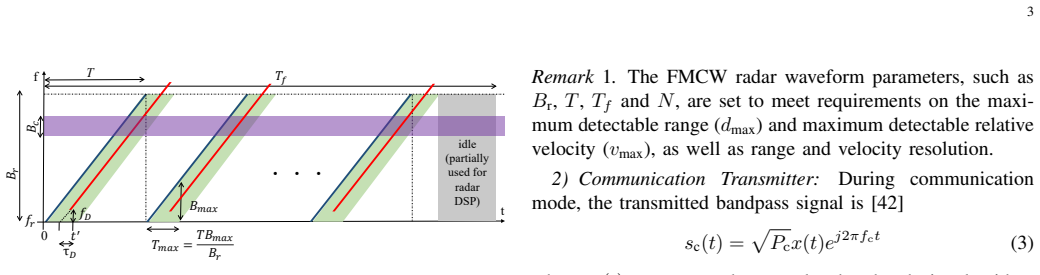
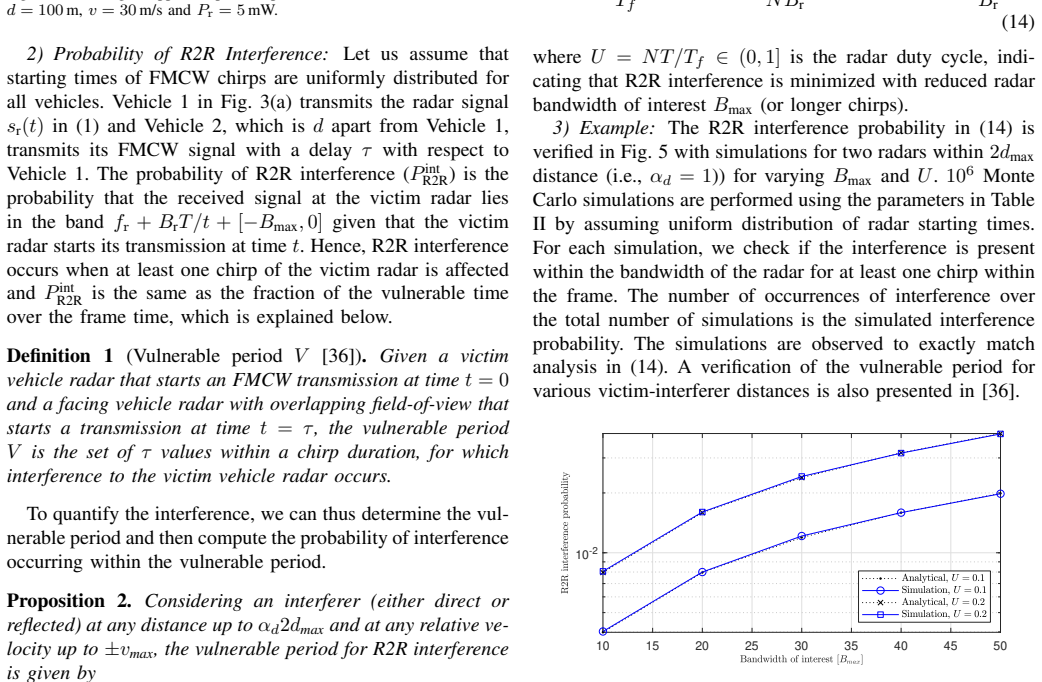
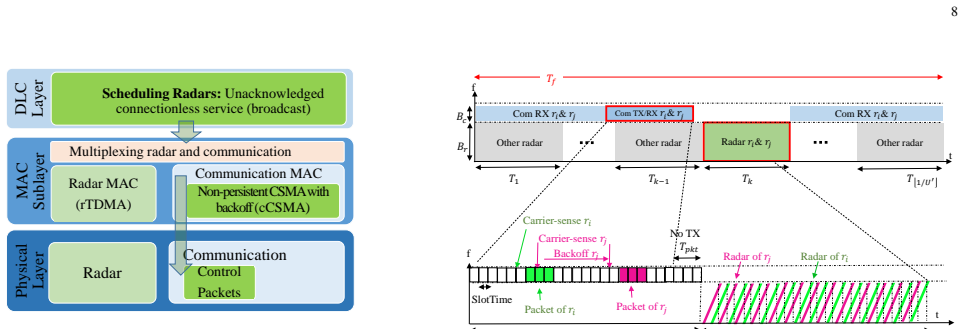
The load-bearing object is the vulnerable period $V$, defined as the set of relative start times $\tau$ between two facing FMCW radars for which one radar's chirps fall inside the victim's bandwidth of interest; for a frame of $N$ chirps it has duration $|V^{(f)}| \approx 2(1+\alpha_d) N T_{\max}$, which directly gives the R2R interference probability $P^{\mathrm{int}}_{\mathrm{R2R}} \approx 2(1+\alpha_d) U B_{\max}/B_r$. RadChat turns this quantity into a scheduling constraint: rTDMA slots are constructed so that no two radars' vulnerable periods overlap, and the MAC layer (FDM for radar and control, rTDMA for radar, CSMA for control packets) lets vehicles negotiate slot assignments in a distributed way using GPS-synchronized timing. The same vulnerable-period geometry also sets the number of supported radars, $M_{\max} = \lfloor 1/U' \rfloor \lfloor B_r/((1+\alpha_d)B_{\max}) \rfloor$, and the synchronization tolerance of $|V|/2$.
What would settle it
Run the paper's own 10,000-run Monte Carlo simulation with the Table II parameters — $T=20\,\mu\mathrm{s}$, $T_f=20\,\mathrm{ms}$, $U'=0.1$, $B_r=0.96$–$1\,\mathrm{GHz}$, $B_{\max}=50\,\mathrm{MHz}$, $M=70$ facing radars, $W_0=64$, synchronization error below $|V|/2\approx1.2\,\mu\mathrm{s}$ — and check whether R2R interference probability falls below $10^{-3}$ within 80 ms and reaches zero in steady state. If it does not, the paper's central performance claim fails.
Extended reading notes
Core claim
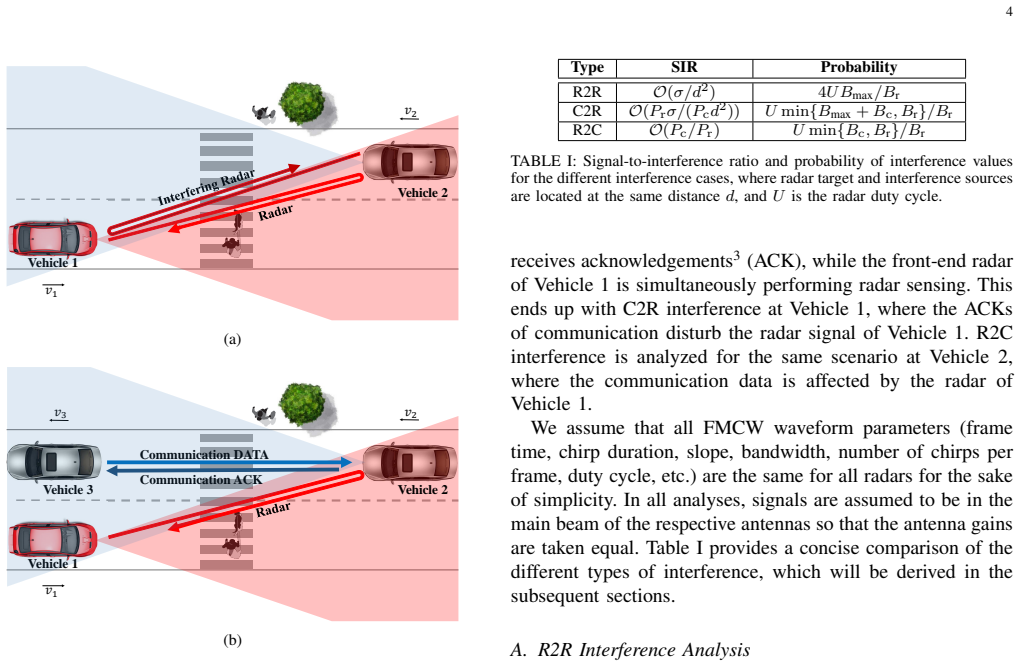
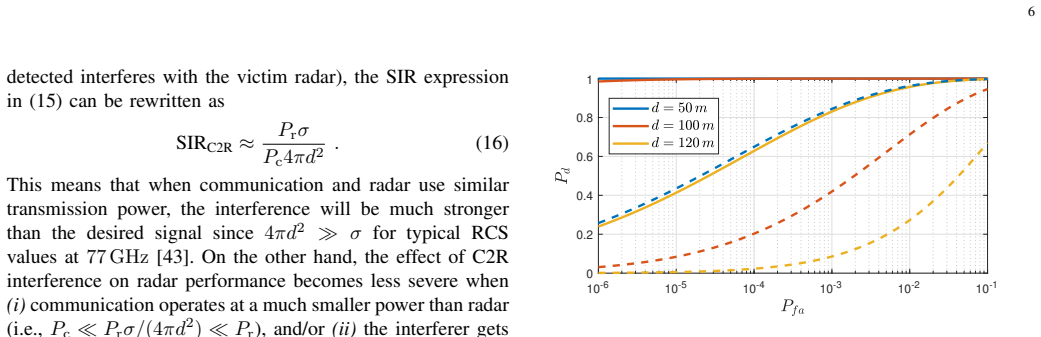
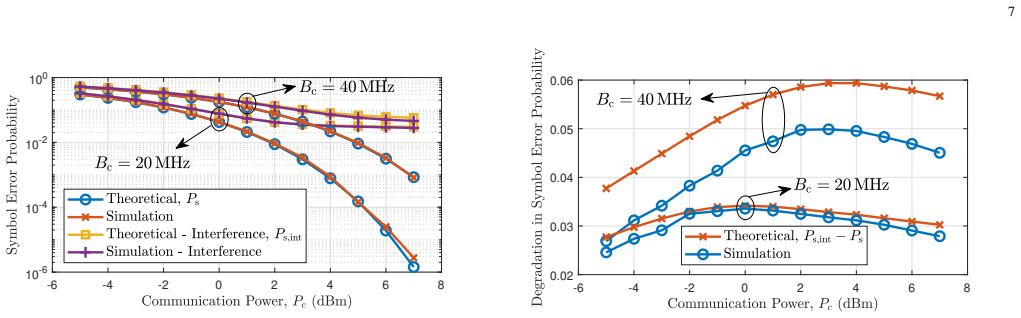
The paper's central claim is that R2R interference in a homogeneous network of FMCW radars is governed by a vulnerable period — the set of start-time offsets between two facing radars for which one radar's chirps corrupt the other's received band — and that this interference can be removed by allocating each radar a distinct rTDMA slot whose vulnerable periods do not overlap. RadChat implements this with a combined FDM/rTDMA/cCSMA MAC: radar transmissions occupy the full radar band in dedicated time slots, while a narrowband control channel carries scheduling packets exchanged through non-persistent CSMA with binary exponential backoff. Under the paper's assumptions, once all facing radars have exchanged information and selected non-overlapping slots, the R2R interference probability vanishes in steady state; in simulation with a 70-vehicle VANET and contention window $W_0=64$, the probability falls below $10^{-3}$ in 80 ms, with an order-of-magnitude reduction within one 20 ms frame. The paper also derives closed-form interference probabilities and time ratios for R2R, C2R, and R2C, showing that coexistence of radar and communication at similar powers is not viable on shared time-frequency resources.
Load-bearing premise
The protocol assumes every radar is identical — same chirp duration, same radar and communication bandwidths, same frame time — so all radars share a single vulnerable period; the simulations do not cover vehicles with different radar models, a case the authors defer to future work.
Editorial extensions
If this is right
- In a steady state where all facing radars have exchanged schedules, R2R interference probability vanishes, provided the number of radars does not exceed $M_{\max}$.
- For the paper's simulation parameters, a newly formed 70-vehicle network reaches R2R interference below $10^{-3}$ within 80 ms when the contention window $W_0$ is set near 64, and within about one frame time for smaller networks.
- RadChat also removes self-interference among multiple RadChat units mounted on the same vehicle by assigning each unit a different rTDMA slot, so vehicles with several radars are covered by the same mechanism.
- Because radar and control communication use separated time-frequency blocks, the protocol avoids C2R and R2C interference between RadChat units by construction, rather than by signal processing.
- Reserving a control bandwidth $B_c$ reduces radar range resolution only slightly (0.63 cm resolution loss and 1.64 cm range error increase in the paper's example), while convergence speed depends on $B_c$ and $W_0$.
Reading between the lines
- The authors leave heterogeneous radars to future work; a natural extension is a negotiation in which each radar reports its own vulnerable period and slots are computed from the union, which would generalize RadChat beyond identical hardware.
- Because the 80 ms guarantee assumes GPS synchronization and single-hop connectivity, multi-hop or GPS-denied environments would likely need a relay or time-source hierarchy; this can be tested by extending the simulations to multi-hop topologies with GPS error models.
- The control packets already broadcast vehicle identity, slot, and timing, so the same channel could plausibly carry lightweight safety messages (e.g., braking warnings) at negligible extra cost; the paper explicitly excludes inter-vehicle data communication from its scope.
- The paper's interference metric counts whether any chirp in a frame is corrupted; an alternative metric such as the fraction of corrupted range-Doppler cells or the ghost-target rate might show a different convergence curve and is worth measuring.
Signed reviews
Editorial analysis
A structured set of objections, weighed in public.
Referee Report
Summary. This paper analyzes mutual interference among FMCW automotive radars and between such radars and a narrowband communication system, and proposes RadChat, a distributed MAC/PHY protocol that combines frequency-division multiplexing between radar and communication, rTDMA scheduling of radar chirp sequences, and CSMA with binary exponential backoff for control packets. The interference analysis covers R2R, C2R, and R2C modes and yields closed-form probabilities and time ratios in Eqs. (14), (23), and (30). The RadChat protocol is intended to assign distinct rTDMA slots so that radar transmissions fall in non-overlapping vulnerable periods, and the paper reports simulations showing that R2R interference falls below 10^-3 within about 80 ms for a 70-vehicle single-hop network.
Significance. If the protocol's convergence guarantee were established, this would be a valuable contribution: a distributed, low-complexity mechanism for automotive radar interference mitigation that is compatible with existing FMCW hardware. The analytical derivation of the R2R interference probability in Eq. (14) is clean and is independently validated by Monte Carlo simulation in Fig. 5. The C2R and R2C analyses also provide useful design guidance, particularly the conclusion that radar and communication at comparable powers should not share the same time-frequency resources. The simulation study is reasonably broad, covering contention-window size, communication bandwidth, synchronization error, and RadChat penetration rate. However, the central claim that RadChat eventually converges to a globally consistent rTDMA schedule is not proved, and Algorithm 1 as written admits non-converging states; this must be fixed before the headline claims can be accepted.
major comments (2)
- [Section V-C and Algorithm 1] The statement in Section V-C that RadChat is 'guaranteed to eventually converge' to a globally consistent rTDMA schedule is not proved and is contradicted by the algorithm as written. Algorithm 1 changes a node's time reference only when ri.strength > rj.strength (line 12); references of equal strength never merge. For example, in a connected four-node line A-B-C-D with only neighbor links, B may have adopted A's reference and C may have adopted D's reference, each with strength 1; this state is reachable when A and D transmit before B and C exchange control packets. When B and C subsequently exchange packets, each sees a different reference of equal strength, the strict inequality fails for both, and neither switches. Both groups can then increment their strengths once per frame, so the tie persists indefinitely. Because rTDMA slot indices are meaningful only within a single time reference, the two halves may still place radar transmissions in overlapping vulnerable periods. Consequently, the convergence guarantee in Section V-C and the steady-state vanishing-interference statement in Section VI-B1 are not supported by the algorithm as written. A tie-breaking rule (for example, adopting the reference with the smaller ID when strengths are equal) together with a proof of convergence, or a substantially weakened claim, is required.
- [Section VI-B5, Figs. 16-17] The headline convergence-time numbers are internally inconsistent. The text discussing Fig. 16 states that for M=70 the maximum t_final decreases from 10Tf to 4Tf when W0 changes from 6 to 64, supporting the '80 ms' claim with Tf=20 ms. The paragraph describing Fig. 17, however, states that t_final=5Tf for M=70 with W0>=48, which is 100 ms. If t_final is the same metric in both places, the 80 ms claim in the abstract and in Section VI-B5 is contradicted; if the metric differs (for example, 'below 10^-3' versus 'no interference among 10,000 simulations'), that difference should be stated explicitly and reported consistently.
minor comments (5)
- [Section VI-A] The abstract and the contribution list credit RadChat with mitigating self-interference among radars mounted on the same vehicle, but the performance evaluation in Section VI uses a single RadChat unit per vehicle. The protocol-level argument for distinct slot assignment is plausible, yet no simulation or analysis of the multi-radar-per-vehicle case is reported; please state this limitation explicitly where the self-interference claim is made.
- [Section VI-A / Fig. 13] In Section VI-A, |V| is given as 2.08 us for Bc=40 MHz, while the discussion of Fig. 13 says V=2.4 us after rounding at a 0.2 us discrete-time resolution; please clarify which value is used in each curve and whether the rounding is applied consistently.
- [Algorithm 1] Algorithm 1 lines 5, 10, and 15 use the notation 'SI in T_k U T_f \ {S_X.SI}' without specifying how a slot is chosen when several are free; if the choice is random, the convergence argument needs to account for that randomness, and if deterministic, the rule should be stated.
- [Section VI-B4] The term 'heterogeneous network' in Section VI-B4 refers to different RadChat penetration rates, while Section VII uses 'heterogeneous FMCW radars' to mean different radar parameters; different terminology would avoid confusion.
- [Fig. 5] The x-axis of Fig. 5 is not labeled in the text; adding the axis label and the parameter values would improve readability.
Circularity Check
No significant circularity: interference probabilities are derived analytically and verified by simulation; RadChat performance is evaluated empirically rather than assumed.
full rationale
The paper's principal quantitative results are not circular. The R2R interference probability in (14) follows from the vulnerable-period calculation in Appendix A, which is derived from the FMCW chirp geometry (Doppler-delay mapping and the receive bandwidth Bmax), and is then checked against independent Monte Carlo simulations in Fig. 5. The C2R and R2C time ratios (23) and (30) are likewise derived from the instantaneous-frequency overlap conditions and are compared with SER simulations. The RadChat convergence and 80 ms claims are simulation outcomes of the proposed Algorithm 1, not parameters fitted to the data being predicted; the selection of W0=64 is an optimization over simulated convergence times, but the statement that interference drops below 10^-3 in 80 ms is a direct simulation result, not a fitted function presented as a prediction. The vulnerable-period concept is attributed to the authors' prior work [36], but Definition 1 is supplemented by an explicit proof in Appendix A, so the self-citation is not load-bearing. The steady-state zero-interference assertion is conditional on successful non-overlapping rTDMA slot selection and is essentially the protocol's design objective; whether Algorithm 1's strict inequality tie-break always converges is a correctness question, not an instance of circular derivation. No equation is shown to reduce to its own input, and no fitted quantity is renamed as a prediction.
Assumptions & free parameters
free parameters (2)
- Maximum contention window size (W0) =
64
- Longest interference path factor (alpha_d) =
1
assumptions (5)
- domain assumption All RadChat units share identical radar and communication parameters (T, Br, Bmax, Tf, modulation).
- domain assumption Vehicles synchronize their clocks using GPS within |V|/2 accuracy.
- domain assumption Communication links are symmetric and Pc=Pr is sufficient to reach all interferers within 2*alpha_d*dmax.
- standard math Maximum detectable relative velocity is vmax = c/(4*f_r*T) (Skolnik).
- domain assumption FMCW receiver operates in the narrowband, slow-target regime: Br << f_r and v*T << lambda_r.
Cite this review
Pith. "Pith review of RadChat: Spectrum Sharing for Automotive Radar Interference Mitigation." pith.science (2026). https://pith.science/paper/IEWOS3ZR
@misc{pith2026190808280,
  author       = {Pith},
  title        = {Pith review of: RadChat: Spectrum Sharing for Automotive Radar Interference Mitigation},
  year         = {2026},
  howpublished = {\url{https://pith.science/paper/IEWOS3ZR}},
  note         = {Machine review of arXiv:1908.08280}
}
read the original abstract
In the automotive sector, both radars and wireless communication are susceptible to interference. However, combining the radar and communication systems, i.e., radio frequency (RF) communications and sensing convergence, has the potential to mitigate interference in both systems. This article analyses the mutual interference of spectrally coexistent frequency modulated continuous wave (FMCW) radar and communication systems in terms of occurrence probability and impact, and introduces RadChat, a distributed networking protocol for mitigation of interference among FMCW based automotive radars, including self-interference, using radar communications. The results show that RadChat can significantly reduce radar mutual interference in single-hop vehicular networks in less than 80 ms.
Figures

Figures from the paper (10 more)


Forward citations
Cited by 1 Pith paper
-
Joint Radar-Communications Strategies for Autonomous Vehicles
A survey that classifies joint radar-communications designs for autonomous vehicles into four strategy families and analyzes their trade-offs.
Reference graph
Works this paper leans on
-
[1]
Automotive radars: A review of signal processing techniques,
S. M. Patole, M. Torlak, D. Wang, and M. Ali, “Automotive radars: A review of signal processing techniques,” IEEE Signal Processing Magazine, vol. 34, no. 2, pp. 22–35, 2017. 13
work page 2017
-
[2]
L. Kong, M. K. Khan, F. Wu, G. Chen, and P. Zeng, “Millimeter-wave wireless communications for IoT-cloud supported autonomous vehicles: Overview, design, and challenges,” IEEE Communications Magazine , vol. 55, no. 1, pp. 62–68, January 2017
work page 2017
-
[3]
Performance of laser and radar ranging devices in adverse environmental conditions,
J. Ryde and N. Hillier, “Performance of laser and radar ranging devices in adverse environmental conditions,” Journal of Field Robotics , vol. 26, no. 9, pp. 712–727, 2009. [Online]. Available: https: //onlinelibrary.wiley.com/doi/abs/10.1002/rob.20310
-
[4]
Project final report, MOSARIM: More safety for all by radar interference mitigation,
I. M. Kunert, “Project final report, MOSARIM: More safety for all by radar interference mitigation,” 2012. [On- line]. Available: http://cordis.europa.eu/docs/projects/cnect/1/248231/ 080/deliverables/001-D611finalreportfinal.pdf
work page 2012
-
[5]
Automotive radar - investigation of mutual interference mechanisms,
M. Goppelt, H.-L. Blöcher, and W. Menzel, “Automotive radar - investigation of mutual interference mechanisms,” Advances in Radio Science, vol. 8, pp. 55–60, Sep. 2010
work page 2010
-
[6]
Analytical investigation of mutual interference between automotive FMCW radar sensors,
M. Goppelt, H.-L. Blöcher, and W. Menzel, “Analytical investigation of mutual interference between automotive FMCW radar sensors,” in GermanMicrowave Conference (GeMIC). IEEE, 2011, pp. 1–4
work page 2011
-
[7]
Phenomenology of mutual interference of FMCW and PMCW automotive radars,
A. Bourdoux, K. Parashar, and M. Bauduin, “Phenomenology of mutual interference of FMCW and PMCW automotive radars,” in IEEE Radar Conference (RadarConf), May 2017, pp. 1709–1714
work page 2017
-
[8]
Mutual interference of millimeter-wave radar systems,
G. M. Brooker, “Mutual interference of millimeter-wave radar systems,” IEEE Transactions on Electromagnetic Compatibility, vol. 49, no. 1, pp. 170–181, 2007
work page 2007
Show all 49 references
-
[9]
Radar congestion study,
W.Buller, B. Wilson, J. Garbarino, J. Kelly, N. Subotic, B. Thelenand, and B. Belzowski, “Radar congestion study,” (Report No. DOT HS 812 632). Washington, DC: National Highway Traffic Safety Administration, Tech. Rep., Sept. 2018
2018
-
[10]
Dedicated short-range communications (dsrc) standards in the united states,
J. B. Kenney, “Dedicated short-range communications (dsrc) standards in the united states,” Proceedings of the IEEE, vol. 99, no. 7, pp. 1162– 1182, 2011
2011
-
[11]
Cooperative intelligent transport systems in europe: Current deployment status and outlook,
K. Sjöberg, P. Andres, T. Buburuzan, and A. Brakemeier, “Cooperative intelligent transport systems in europe: Current deployment status and outlook,” IEEE Vehicular Technology Magazine, vol. 12, no. 2, pp. 89– 97, 2017
2017
-
[12]
60-GHz millimeter-wave automotive radar,
T. Yamawaki and S. Yamano, “60-GHz millimeter-wave automotive radar,” Fujitsu technical review, vol. 15, no. 2, pp. 9–18, 1998
1998
-
[13]
Investigating the IEEE 802.11ad standard for millimeter wave automotive radar,
P. Kumari, N. Gonzalez-Prelcic, and R. W. Heath, “Investigating the IEEE 802.11ad standard for millimeter wave automotive radar,” in IEEE 82nd Vehicular Technology Conference (VTC) , Sept 2015, pp. 1–5
2015
-
[14]
Survey of RF communi- cations and sensing convergence research,
B. Paul, A. R. Chiriyath, and D. W. Bliss, “Survey of RF communi- cations and sensing convergence research,” IEEE Access , vol. 5, pp. 252–270, 2017
2017
-
[15]
Spectrum management and advanced receiver techniques (SMART): Joint radar-communications network per- formance,
A. Herschfelt and D. W. Bliss, “Spectrum management and advanced receiver techniques (SMART): Joint radar-communications network per- formance,” in 2018 IEEE Radar Conference (RadarConf18), April 2018, pp. 1078–1083
2018
-
[16]
Database- aided sensing for radar bands,
F. Paisana, J. P. Miranda, N. Marchetti, and L. A. DaSilva, “Database- aided sensing for radar bands,” in 2014 IEEE International Symposium on Dynamic Spectrum Access Networks (DYSPAN), April 2014, pp. 1–6
2014
-
[17]
Radar spectrum opportunities for cognitive communications transmission,
L. Wang, J. McGeehan, C. Williams, and A. Doufexi, “Radar spectrum opportunities for cognitive communications transmission,” in 2008 3rd International Conference on Cognitive Radio Oriented Wireless Net- works and Communications (CrownCom 2008) , May 2008, pp. 1–6
2008
-
[18]
Spectrum sharing methods for the coexistence of multiple RF systems: A survey,
Y . Han, E. Ekici, H. Kremo, and O. Altintas, “Spectrum sharing methods for the coexistence of multiple RF systems: A survey,” Ad Hoc Networks , vol. 53, pp. 53 – 78, 2016. [Online]. Available: http://www.sciencedirect.com/science/article/pii/S1570870516302153
2016
-
[19]
Coexistence between communications and radar systems: A survey,
M. Labib, V . Marojevic, A. F. Martone, J. H. Reed, and A. I. Zaghloui, “Coexistence between communications and radar systems: A survey,” URSI Radio Science Bulletin , vol. 2017, no. 362, pp. 74–82, Sep. 2017
2017
-
[20]
Survey of spectrum sharing for inter-technology coexistence,
A. M. V oicu, L. Simic, and M. Petrova, “Survey of spectrum sharing for inter-technology coexistence,” IEEE Communications Surveys Tutorials, pp. 1–1, 2018
2018
-
[21]
Spread spectrum joint commu- nication and ranging system using interference cancellation between a roadside and a vehicle,
M. Takeda, T. Terada, and R. Kohno, “Spread spectrum joint commu- nication and ranging system using interference cancellation between a roadside and a vehicle,” in IEEE 48th Vehicular Technology Conference, vol. 3, May 1998, pp. 1935–1939
1998
-
[22]
Radar-communication integration based on MSK-LFM spread spectrum signal,
Z. Dou, X. Zhong, and W. Zhang, “Radar-communication integration based on MSK-LFM spread spectrum signal,” International Journal of Communications, Network and System Sciences , vol. 10, pp. 108–117, 2017
2017
-
[23]
Waveform design and signal processing aspects for fusion of wireless communications and radar sensing,
C. Sturm and W. Wiesbeck, “Waveform design and signal processing aspects for fusion of wireless communications and radar sensing,” Proceedings of the IEEE , vol. 99, no. 7, pp. 1236–1259, July 2011
2011
-
[24]
Inner bounds on performance of radar and communications co-existence
A. R. Chiriyath, B. Paul, G. M. Jacyna, and D. W. Bliss, “Inner bounds on performance of radar and communications co-existence.” IEEE Transactions on Signal Processing , vol. 64, no. 2, pp. 464–474, 2016
2016
-
[25]
Extending joint radar-communications bounds for FMCW radar with doppler estimation,
B. Paul and D. W. Bliss, “Extending joint radar-communications bounds for FMCW radar with doppler estimation,” in 2015 IEEE Radar Con- ference (RadarCon), May 2015, pp. 0089–0094
2015
-
[26]
Optimal spectrum utilization in joint automotive radar and communication networks,
Y . Han, E. Ekici, H. Kremo, and O. Altintas, “Optimal spectrum utilization in joint automotive radar and communication networks,” in 2016 14th International Symposium on Modeling and Optimization in Mobile, Ad Hoc, and Wireless Networks (WiOpt) , May 2016, pp. 1–8
2016
-
[27]
A millimetre communication system for IVC,
I. Yattoun, T. Labia, A. Peden, G. Landrac, M. Ney, M. Resibois, J. Bonnin, A. Baghdadi, N. Montavont, M. Fujise, and Y . Le Roux, “A millimetre communication system for IVC,” in 2007 7th International Conference on ITS Telecommunications , June 2007, pp. 1–6
2007
-
[28]
Combining MIMO radar with OFDM communications,
B. J. Donnet and I. D. Longstaff, “Combining MIMO radar with OFDM communications,” inEuropean Radar Conference, Sept 2006, pp. 37–40
2006
-
[29]
Multifunctional software-defined radar sensor and data communication system,
D. Garmatyuk, J. Schuerger, and K. Kauffman, “Multifunctional software-defined radar sensor and data communication system,” IEEE Sensors Journal, vol. 11, no. 1, pp. 99–106, Jan 2011
2011
-
[30]
Millimeter-wave vehicular communication to support massive automotive sensing,
J. Choi, V . Va, N. Gonzalez-Prelcic, R. Daniels, C. R. Bhat, and R. W. Heath, “Millimeter-wave vehicular communication to support massive automotive sensing,” IEEE Communications Magazine , vol. 54, no. 12, pp. 160–167, December 2016
2016
-
[31]
Multi-carrier mod- ulation on FMCW radar for joint automotive radar and communication,
C. Wang, C. D. Ozkaptan, E. Ekici, and O. Altintas, “Multi-carrier mod- ulation on FMCW radar for joint automotive radar and communication,” in 2018 IEEE Vehicular Networking Conference (VNC) , Dec 2018, pp. 1–2
2018
-
[32]
On mutual interference cancellation in a MIMO OFDM multiuser radar-communication network,
Y . L. Sit, B. Nuss, and T. Zwick, “On mutual interference cancellation in a MIMO OFDM multiuser radar-communication network,” IEEE Transactions on Vehicular Technology , vol. 67, no. 4, pp. 3339–3348, 2018
2018
-
[33]
Experimental results for OFDM WiFi-based passive bistatic radar,
P. Falcone, F. Colone, C. Bongioanni, and P. Lombardo, “Experimental results for OFDM WiFi-based passive bistatic radar,” in IEEE Radar Conference, May 2010, pp. 516–521
2010
-
[34]
Demonstrating the use of the IEEE 802.11p car-to-car communication standard for automo- tive radar,
L. Reichardt, C. Sturm, F. Grunhaupt, and T. Zwick, “Demonstrating the use of the IEEE 802.11p car-to-car communication standard for automo- tive radar,” in 6th European Conference on Antennas and Propagation (EUCAP), March 2012, pp. 1576–1580
2012
-
[35]
Demonstration of interference cancellation in a multiple-user access OFDM MIMO radar- communication network using USRPs,
Y . L. Sit, B. Nuss, S. Basak, M. Orzol, and T. Zwick, “Demonstration of interference cancellation in a multiple-user access OFDM MIMO radar- communication network using USRPs,” in IEEE MTT-S International Conference on Microwaves for Intelligent Mobility (ICMIM), May 2016, pp. 1–4
2016
-
[36]
Radar communication for combating mutual interference of FMCW radars,
C. Aydogdu, N. Garcia, L. Hammarstrand, and H. Wymeersch, “Radar communication for combating mutual interference of FMCW radars,” in IEEE Revolutions in Radar, Boston, USA , 22-26 Apr. 2019
2019
-
[37]
Improved pedestrian detection under mutual interference by FMCW radar communications,
C. Aydogdu, N. Garcia, and H. Wymeersch, “Improved pedestrian detection under mutual interference by FMCW radar communications,” in IEEE International Symposium on Personal, Indoor and Mobile Radio Communications (PIMRC), Workshop on 5G V2X Communications for Connected Autonom...
2018
-
[38]
Automotive radar and communications sharing of the 79-GHz band,
Y . Han, E. Ekici, H. Kremo, and O. Altintas, “Automotive radar and communications sharing of the 79-GHz band,” in Proceedings of the First ACM International Workshop on Smart, Autonomous, and Connected Vehicular Systems and Services , ser. CarSys ’16. New York, NY , USA: ACM,...
2016
-
[39]
On unified vehicular communications and radar sensing in millimeter-wave and low terahertz bands,
V . Petrov, G. Fodor, J. Kokkoniemi, D. Moltchanov, J. Lehtomäki, S. Andreev, Y . Koucheryavy, M. J. Juntti, and M. Valkama, “On unified vehicular communications and radar sensing in millimeter-wave and low terahertz bands,” CoRR, vol. abs/1901.06980, 2019. [Online]. Available:...
1901 arXiv
-
[40]
Linear FMCW radar techniques,
A. G. Stove, “Linear FMCW radar techniques,” IEE Proceedings F - Radar and Signal Processing , vol. 139, no. 5, pp. 343–350, Oct 1992
1992
-
[41]
Using a complex baseband architecture in FMCW radar systems,
K. Ramasubramanian, “Using a complex baseband architecture in FMCW radar systems,” Texas Instruments, Tech. Rep., May 2017
2017
-
[42]
Goldsmith, Wireless Communications
A. Goldsmith, Wireless Communications. Cambridge University Press, 2005
2005
-
[43]
77 GHz ACC radar simulation platform,
C. Karnfelt, A. Paden, A. Bazzi, G. E. H. Shhade, M. Abbas, and T. Chonavel, “77 GHz ACC radar simulation platform,” in 9th Interna- tional Conference on Intelligent Transport Systems Telecommunications (ITST), Oct 2009, pp. 209–214
2009
-
[44]
M. A. Richards, Fundamentals of Radar Signal Processing . Tata McGraw-Hill Education, 2005
2005
-
[45]
A. F. Molisch, Wireless communications. John Wiley & Sons, 2012, vol. 34. 14
2012
-
[46]
A peer-to-peer interference analysis for automotive chirp sequence radars,
G. Kim, J. Mun, and J. Lee, “A peer-to-peer interference analysis for automotive chirp sequence radars,” IEEE Transactions on Vehicular Technology, vol. 67, no. 9, pp. 8110–8117, Sep. 2018
2018
-
[47]
Joint design of overlaid communication systems and pulsed radars,
L. Zheng, M. Lops, X. Wang, and E. Grossi, “Joint design of overlaid communication systems and pulsed radars,” IEEE Transactions on Signal Processing, vol. 66, no. 1, pp. 139–154, Jan 2018
2018
-
[48]
Radar cross section measurement with 77 GHz automotive FMCW radar,
S. Lee, S. Kang, S. C. Kim, and J. E. Lee, “Radar cross section measurement with 77 GHz automotive FMCW radar,” in IEEE 27th Annual International Symposium on Personal, Indoor, and Mobile Radio Communications (PIMRC), Sept 2016, pp. 1–6
2016
-
[49]
M. I. Skolnik, Radar Handbook , 3rd ed. New York: McGraw-Hill Education, 2008. Canan Aydogdu is a Marie Sklodowska-Curie Fel- low at Chalmers, working on cross-layer multi-hop sensing systems for the future energy-efficient self- driving car networks. Formerly, she was an assoc...
1989
Reviewed August 14, 2026 · model on record in the stance chip above.
Discussion (0). Continue with ORCID to comment.