REVIEW 3 major objections 5 minor 43 references
Learning stochastic differential equations using RNN with log signature features
T0 review · 3 major / 5 minor · reviewed 2026-08-14 · deepseek-v4-flash
Pith's one-line read This paper proves that an RNN fed a sequence of log-signature features can approximate the terminal value of any solution to a controlled stochastic differential equation, and that this hybrid model outperforms plain RNNs on…
desk verdict A practically effective signature-RNN hybrid whose universality proof has a genuine compactness gap; worth reviewing and likely fixable. read the letter →
The pith
A machine-rendered reading of the paper's core claim, the machinery that carries it, and where it could break.
The reading
What carries the argument
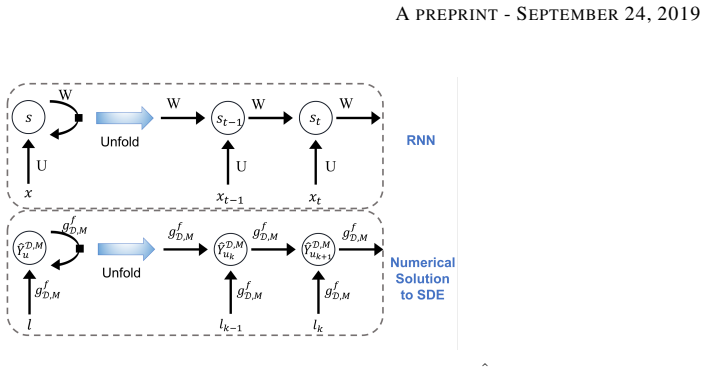
The Log-Signature (Sequence) Layer is the central object: a weight-free differentiable map that takes a fine time series and a coarser partition and outputs the truncated log-signature of the piecewise-linear path on each coarse interval. The load-bearing identity is the parallel between the recursive Taylor scheme, $\hat Y_{u_{k+1}}=\hat Y_{u_k}+\sum_{j=1}^{M}f^{\circ j}(\hat Y_{u_k})l_k^j$, and the RNN update $h_{t+1}=\sigma(Ul_k+Wh_t)$; the proof uses a universal approximation result for shallow networks and a stability estimate for the recursion to show that the RNN update can match the Taylor update uniformly. The log-signature is a Lie-series compression of the signature, so it is more parsimonious while retaining the same information up to tree-like equivalence.
What would settle it
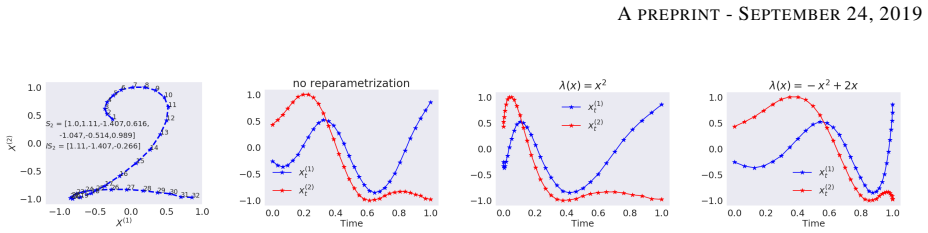
Build two streams that are time reparameterizations of one another (same geometry, different speed) and assign them different labels; since the log-signature is invariant under time reparameterization, the Logsig-RNN receives identical features for both, so its accuracy on this pair cannot exceed chance. A model with this failure would show that the universal approximation claim holds only for SDE solution maps, not for arbitrary functionals on streams.
Extended reading notes
Core claim
This paper establishes a universal approximation theorem for recurrent networks augmented with log-signature features. Theorem 4.1 states that if $Y$ solves a controlled SDE $dY_t=f(Y_t)dX_t$ with $f\in C_b^\infty$ and $X$ of finite $p$-variation, then for every compact set $K$ of signatures and every $\varepsilon>0$ there exists an RNN $R_\sigma(\cdot|\Theta)$ satisfying $\sup_{S(X)\in K}\|Y_T-R_\sigma((l_k)_{k=1}^N|\Theta)\|\le\varepsilon$, where $l_k$ are truncated log-signatures over a coarse partition. The mechanism is that the $M$-step Taylor scheme for the SDE has exactly the recursive structure of an RNN, with the sequence of log-signatures as input, so a neural network can imitate the numerical solver. The paper also reports that the PT-Logsig-RNN variant attains 93.27% accuracy on ChaLearn 2013 gesture data and 65.7% on NTU RGB+D 120 X-Subject, improving over plain LSTM baselines and over the signature-linear model on synthetic SDE data.
Load-bearing premise
The theory presumes that the quantity being learned is the terminal value of a single controlled differential equation $dY_t=f(Y_t)dX_t$ with a smooth vector field $f$, driven by the piecewise-linear lift of the observed stream; if a label depends on trajectory speed, on details the log-signature deletes, or on multiple regime changes, the universality guarantee does not cover it and the empirical success rests on the network fitting the labels rather than on Theorem 4.1.
Editorial extensions
If this is right
- The network can consume high-frequency or continuous streams without downsampling: the log-signature layer compresses each coarse interval to a fixed-dimension feature, so training time drops dramatically (e.g., from 50,930 s to 343 s on the synthetic example).
- The Log-Signature Layer is weight-free and backpropagatable, so it can be inserted before LSTMs, GRUs, or other differentiable layers, not only a plain RNN.
- If Theorem 4.1 is right, Logsig-RNN is an RNN-type model with a proven universality guarantee for controlled SDE solution maps, closing a gap between signature-based linear models and recurrent networks.
- On classification benchmarks, adding path transformation and log-signature layers to LSTM yields concrete gains: 65.7% versus 61.6% baseline on NTU X-Subject, and 93.27% on ChaLearn 2013 with augmentation.
Reading between the lines
- The theorem covers terminal values of a single SDE solution map; for classification labels the guarantee is only a heuristic analogy. A testable extension is to check whether accuracy degrades when labels explicitly depend on speed or on non-smooth functions of the path, where the log-signature erases information.
- Because the log-signature is invariant under time reparameterization, the model cannot by itself distinguish slow from fast versions of the same gesture; fusing in explicit time, as the Time-incorporated Layer does, is a workaround, but the pure log-signature guarantees do not cover that case.
- A likely practical extension is to adapt the log-signature degree or the coarse partition per interval, since the proof only requires the partition mesh to be small; the paper fixes $M$ and $N$.
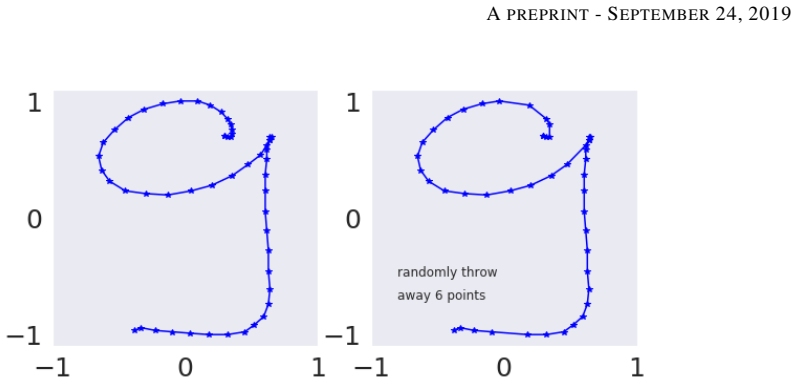
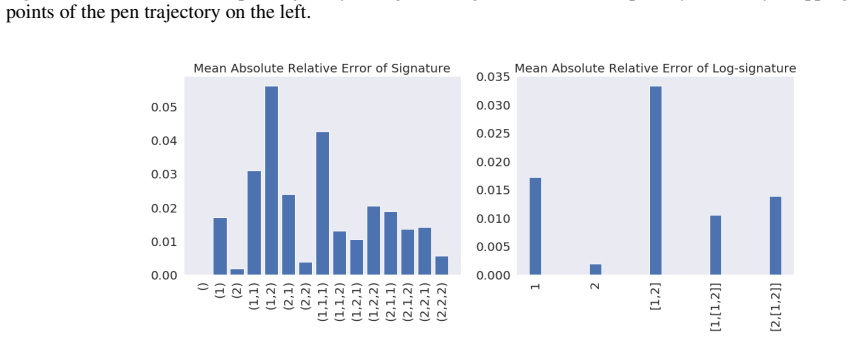
- The reported robustness to missing frames suggests a natural stress test: compare PT-Logsig-RNN against a strong attention-based sequence model on streams with structured missingness, not just random drops.
Editorial analysis
A structured set of objections, weighed in public.
Referee Report
Summary. The paper proposes a sequence-learning architecture, Logsig-RNN, in which a raw discrete stream is lifted to a piecewise linear path, segmented on a coarse grid, and each segment is replaced by its truncated log-signature before being fed into an RNN/LSTM. A variant with additional path-transformation layers (PT-Logsig-RNN) is applied to synthetic SDE regression and to skeleton-based action and gesture classification. The main theoretical claim is Theorem 4.1: for a compact set K of signatures of paths of finite p-variation, the RNN can uniformly approximate the terminal value Y_T of any solution of a controlled SDE dY_t = f(Y_t)dX_t with f in C_b^∞. The empirical sections report that PT-Logsig-RNN achieves 65.7% on NTU RGB+D 120 X-Subject and 93.27% on ChaLearn 2013 gesture recognition, with improved robustness to missing data compared with plain RNN/LSTM baselines.
Significance. If Theorem 4.1 can be repaired, the paper makes a useful conceptual contribution: it provides a principled architectural prior for streamed-data models by connecting the numerical analysis of controlled differential equations with RNN sequence models. The Log-Signature Layer is a clean, differentiable module that can be inserted into existing networks, and the empirical studies, especially the missing-data robustness experiments, are a valuable addition. The authors are also candid that the log-signature alone is not universal and that a nonlinear model is needed. The experimental results are competitive with published baselines, and the availability of a demo and implementation details supports reproducibility. The main reservations concern the proof of the universality theorem, not the overall algorithmic idea.
major comments (3)
- [Appendix B, Eq. (39)] The proof of Theorem 4.1 relies on the assertion (Eq. 39) that for a compact set K of signatures there is a constant C1 with sup_{S(X)∈K} ||X||_{p-var,J} ≤ C1. This assertion is false. For the one-dimensional piecewise linear path X_R that goes from 0 to R on [0,1/2] and back from R to 0 on [1/2,1], we have S(X_R) = exp((X_R(1)-X_R(0))⊗e_1) = 1 for every R, so K = {1} is a compact set of signatures, while ||X_R||_{p-var,J} = 2^{1/p} R is unbounded. Therefore the uniform bound on the Taylor remainder E1 in Eq. (44), obtained via Theorem B.2, is not justified, and the same example shows that the local log-signatures l_k can be unbounded even when the total signature is fixed. The theorem as stated is not established by the given proof; one would need to restrict K to a compact set of rough paths with uniformly bounded p-variation, or prove an explicit tree-like-invariance property of the RNN construction.
- [Theorem B.1, Eq. (40)] The passage from Eq. (37) to Eq. (40) is also not justified. Theorem B.2 bounds the global error by C ∑_{k=1}^N |f|^{tγu+1}_{Lip γ} ||X||^{tγu+1}_{p-var;[t_{k-1},t_k]}. Each interval's p-variation cannot be replaced by a power of the mesh ΔD without a uniform control ω(s,t) ≤ C(t-s) on the path family; finite total p-variation alone gives only ∑_k ||X||^p_{p-var;[t_{k-1},t_k]} ≤ ||X||^p_{p-var,J}, which yields a factor N rather than ΔD^{...}. The claimed order of convergence, and hence the step 'ΔD sufficiently small' in the proof of Theorem 4.1, requires a strengthened regularity assumption on the lifts or a different decomposition.
- [Appendix C, Lemmas C.1 and C.2] Even after a bounded-p-variation restriction is imposed, the compact-domain universal approximation argument needs the set of pairs (l_k, h_k) visited by the recursion to lie in a common compact set for all X with S(X)∈K. The proof does not establish this: the h_k are outputs of the numerical scheme and depend on the local log-signatures, and the compactness of the signature set K was the only mechanism offered. If the path set is unbounded in p-variation, the l_k need not lie in a compact set, so Lemma C.1 cannot be applied. The proof should either show boundedness of the local log-signatures and hidden states or incorporate the bounded-variation assumption explicitly into the statement of Theorem 4.1.
minor comments (5)
- [Theorem 4.1] The statement introduces constants C1 and C2 but only says 'there exist constants C1 and C2 such that M > tpu and ΔD ≤ min(...)'; the intended conditional is missing. Please reformulate, e.g., 'if M > ... and ΔD ≤ ..., then there exists Θ such that ...'.
- [Appendix D.2] The model is referred to as 'LP-Logsig-RNN' in the first sentence of Section D.2, which appears to be a typo for 'PT-Logsig-RNN'; Table 7 also spells 'Table' as 'Tabel'.
- [Table 5] The entry '81.74%' in the row r=30% has an inconsistent percent sign; other entries in the same table omit the percent sign. Please make the formatting uniform.
- [Table 2] The high-frequency RNN0 entry is given as '–' with no explanation of whether training failed to reach the error tolerance within 25k epochs; a footnote or sentence would clarify the comparison.
- [Appendix E, Theorem E.2] The proof of Theorem E.2 is incomplete: after showing that products of linear functionals on linear-vector-field solution maps remain in the same class, it invokes the Stone-Weierstrass theorem without verifying that the algebra separates points on the relevant quotient of path space. Please complete the argument, add the missing separation condition, or cite a reference where this result is proved.
Circularity Check
No significant circularity: the universality proof builds on independent external theorems and the experiments use standard train/test separation.
full rationale
The paper's central theoretical claim, Theorem 4.1, is that a Logsig-RNN can uniformly approximate the solution map of a controlled SDE on a compact set of signatures. The proof does not assume the target result. It decomposes the error as E1 plus E2: E1 is controlled by the Friz-Victoir rough-path Taylor expansion error estimate (Theorem B.2), an external result, and E2 is controlled by Funahashi's shallow-network universal approximation lemma (Lemma C.1) together with the paper's own continuity estimate for the recursive map (Lemma C.2). No parameter is fitted to the target function in the theorem, and the approximation is constructive rather than definitional. The empirical sections use standard supervised training on synthetic and real datasets, with train/test splits, and the reported accuracies are measured on held-out test data rather than being reproduced from training losses. The paper does cite prior work by its own authors, notably Lyons's rough-path theory, the signature-feature paper of Levin, Lyons and Ni, and the Hambly-Lyons uniqueness theorem; however, these are published external results used as mathematical tools, and the main approximation theorem does not reduce to any of them. One notable proof concern is Equation (39), which asserts that a compact set of signatures implies a uniform bound on p-variation; this is false for tree-like loops, since a one-dimensional loop has signature 1 but unbounded p-variation. That is a correctness gap in the proof as written, but it is not a circularity: it does not make the claimed approximation equivalent to an input or to a fitted quantity. Accordingly, no circular step can be exhibited, and the appropriate finding is no significant circularity.
Assumptions & free parameters
free parameters (5)
- Log-signature degree M =
M=2 for ChaLearn and NTU, M=4 for pen-digit
- Number of coarse segments N =
N=4 in reported empirical tables and appendix
- Embedding dimension d1 =
d1=30 for ChaLearn
- LSTM hidden units =
256 for NTU, 128 for ChaLearn
- Dropout rates =
0.8 after LSTM for NTU; 0.3 and 0.5 for ChaLearn embedding and LSTM
assumptions (6)
- standard math Signature and log-signature properties (Chen identity, invariance under time reparametrization, bijection, uniqueness up to tree-like equivalence)
- standard math Friz-Victoir estimate for the local Taylor approximation of controlled differential equations (Theorem B.2)
- standard math Funahashi universal approximation theorem for shallow sigmoid networks (Lemma C.1)
- domain assumption Empirical discrete data can be lifted to piecewise linear geometric rough paths so that log-signatures over coarse partitions are valid inputs
- domain assumption Target labels are functionals representable as terminal values of controlled differential equations dY_t = f(Y_t)dX_t with f in C_b^infinity
- domain assumption Gradient-based training finds parameters close to the universal approximation guarantee
Cite this review
Pith. "Pith review of Learning stochastic differential equations using RNN with log signature features." pith.science (2026). https://pith.science/paper/WDNRPLBW
@misc{pith2026190808286,
  author       = {Pith},
  title        = {Pith review of: Learning stochastic differential equations using RNN with log signature features},
  year         = {2026},
  howpublished = {\url{https://pith.science/paper/WDNRPLBW}},
  note         = {Machine review of arXiv:1908.08286}
}
read the original abstract
This paper contributes to the challenge of learning a function on streamed multimodal data through evaluation. The core of the result of our paper is the combination of two quite different approaches to this problem. One comes from the mathematically principled technology of signatures and log-signatures as representations for streamed data, while the other draws on the techniques of recurrent neural networks (RNN). The ability of the former to manage high sample rate streams and the latter to manage large scale nonlinear interactions allows hybrid algorithms that are easy to code, quicker to train, and of lower complexity for a given accuracy. We illustrate the approach by approximating the unknown functional as a controlled differential equation. Linear functionals on solutions of controlled differential equations are the natural universal class of functions on data streams. Following this approach, we propose a hybrid Logsig-RNN algorithm that learns functionals on streamed data. By testing on various datasets, i.e. synthetic data, NTU RGB+D 120 skeletal action data, and Chalearn2013 gesture data, our algorithm achieves the outstanding accuracy with superior efficiency and robustness.
Figures


Figures from the paper (6 more)



Reference graph
Works this paper leans on
-
[1]
J. P. Bishwal. Parameter estimation in stochastic differential equations. Springer, 2007. 3
work page 2007
-
[2]
F. Black and M. Scholes. The pricing of options and corporate liabilities. Journal of political economy, , 81(3):637–654, 1973. 3
work page 1973
-
[3]
T. Q. Chen, Y . Rubanova, J. Bettencourt, and D. K. Duvenaud. Neural ordinary differential equations. In NIPS, pages 6571–6583, 2018. 1
work page 2018
-
[4]
J. C. Cox and S. A. Ross. The valuation of options for alternative stochastic processes. Journal of financial economics,, 3(1-2):145–166, 1976. 3
work page 1976
-
[5]
D. L. Donoho et al. High-dimensional data analysis: The curses and blessings of dimensionality. AMS math challenges lecture,, 1(2000):32, 2000. 2
work page 2000
-
[6]
W. E. A proposal on machine learning via dynamical systems. Comm. in Math. and Stat.,, 5(1):1–11, 2017. 1
work page 2017
-
[7]
S. Escalera, J. Gonz `alez, X. Bar´o, M. Reyes, O. Lopes, I. Guyon, V . Athitsos, and H. J. Escalante. Multi-modal gesture recognition challenge 2013: dataset and results. In ICMI, 2013. 11
work page 2013
-
[8]
An optimal polynomial approximation of Brownian motion
J. Foster, T. Lyons, and H. Oberhauser. An optimal polynomial approximation of brownian motion. arXiv preprint arXiv:1904.06998, 2019. 2
work page Pith review arXiv 1904
Show all 43 references
-
[9]
P. Friz, P. Gassiat, and T. Lyons. Physical brownian motion in a magnetic field as a rough path. Transactions of the American Mathematical Society, 367(11):7939–7955, 2015. 3
2015
-
[10]
Friz and N
P. Friz and N. Victoir. Multidimensional Stochastic Processes as Rough Paths: Theory and Applications. Cam- bridge Studies in Advanced Mathematics. 2010. 18
2010
-
[11]
Funahashi and Y
K.-i. Funahashi and Y . Nakamura. Approximation of dynamical systems by continuous time recurrent neural networks. Neural networks,, 6(6):801–806, 1993. 1
1993
-
[12]
C. W. Gardiner et al. Handbook of stochastic methods, volume 3. Springer Berlin, 1985. 3
1985
-
[13]
B. Graham. Sparse arrays of signatures for online character recognition. arXiv preprint arXiv:1308.0371, 2013. 3
2013 arXiv
-
[14]
L. G. Gyurk ´o, T. Lyons, M. Kontkowski, and J. Field. Extracting information from the signature of a financial data stream. arXiv preprint arXiv:1307.7244, 2013. 3
2013 arXiv
-
[15]
Hambly and T
B. Hambly and T. Lyons. Uniqueness for the signature of a path of bounded variation and the reduced path group. Annals of Mathematics,, 171(1):109–167, 2010. 14
2010
-
[16]
J. Hu, W. Zheng, J. Lai, and J. Zhang. Jointly learning heterogeneous features for rgb-d activity recognition. IEEE TPAMI,, 39(11):2186–2200, Nov 2017. 11
2017
-
[17]
R. Jeremy. Iterated-Integral Signatures in Machine Learning. PhD thesis, 2019. 7
2019
-
[19]
Q. Ke, M. Bennamoun, S. An, F. Sohel, and F. Boussaid. Learning clip representations for skeleton-based 3d action recognition. IEEE TIP ,, 27(6):2842–2855, June 2018. 11
2018
-
[20]
Levin, T
D. Levin, T. Lyons, and H. Ni. Learning from the past, predicting the statistics for the future, learning an evolving system. arXiv preprint arXiv:1309.0260, 2013. 3, 4, 5, 8, 14, 15
2013 arXiv
-
[21]
C. Li, X. Zhang, and L. Jin. Lpsnet: a novel log path signature feature based hand gesture recognition framework. In CVPR, pages 631–639, 2017. 3
2017
-
[22]
C. Li, X. Zhang, L. Liao, L. Jin, and W. Yang. Skeleton-based gesture recognition using several fully connected layers with path signature features and temporal transformer module. In AAAI, pages 8585–8593, 2019. 11
2019
-
[23]
J. Liu, A. Shahroudy, M. Perez, G. Wang, L.-Y . Duan, and A. C. Kot. Ntu rgb+d 120: A large-scale benchmark for 3d human activity understanding. IEEE TPAMI, 2019. 10
2019
-
[24]
J. Liu, A. Shahroudy, G. Wang, L.-Y . Duan, and A. C. Kot. Skeleton-based online action prediction using scale selection network. IEEE TPAMI, 02 2019. 11
2019
-
[25]
J. Liu, A. Shahroudy, D. Xu, A. C. Kot, and G. Wang. Skeleton-based action recognition using spatio-temporal lstm network with trust gates. IEEE TPAMI,, 40(12):3007–3021, Dec 2018. 11
2018
-
[26]
J. Liu, A. Shahroudy, D. Xu, and G. Wang. Spatio-temporal lstm with trust gates for 3d human action recognition. In ECCV, pages 816–833, 2016. 11
2016
-
[27]
J. Liu, G. Wang, L. yu Duan, K. Abdiyeva, and A. C. Kot. Skeleton-based human action recognition with global context-aware attention lstm networks. IEEE TIP ,, 27:1586–1599, 2018. 11
2018
-
[28]
Liu and J
M. Liu and J. Yuan. Recognizing human actions as the evolution of pose estimation maps. In CVPR, pages 1159–1168, 2018. 11
2018
-
[29]
Y . Lu, A. Zhong, Q. Li, and B. Dong. Beyond finite layer neural networks: Bridging deep architectures and numerical differential equations. arXiv preprint arXiv:1710.10121, 2017. 1 24 A PREPRINT - S EPTEMBER 24, 2019
2017 arXiv
-
[30]
Lyons, T
T. Lyons, T. L ´evy, and M. Caruana. Differential Equation driven by Rough Paths. Springer, 2006. 4, 5, 6, 13, 14, 15
2006
-
[31]
Lyons, H
T. Lyons, H. Ni, and H. Oberhauser. A feature set for streams and an application to high-frequency financial tick data. In ACM International Conference on Big Data Science and Computing, page 5, 2014. 3
2014
-
[32]
T. J. Lyons. Differential equations driven by rough signals.Revista Matem´atica Iberoamericana,, 14(2):215–310,
-
[33]
R. C. Merton et al. Theory of rational option pricing. Theory of Valuation,, pages 229–288, 1973. 3
1973
-
[34]
M ¨uller, R
H.-G. M ¨uller, R. Sen, and U. Stadtm ¨uller. Functional data analysis for volatility. Journal of Econometrics, , 165(2):233–245, 2011. 4
2011
-
[35]
H. Ni. A multi-dimensional stream and its signature representation. arXiv preprint arXiv:1509.03346, 2015. 9
2015 arXiv
-
[36]
Papavasiliou, C
A. Papavasiliou, C. Ladroue, et al. Parameter estimation for rough differential equations.The Annals of Statistics,, 39(4):2047–2073, 2011. 3
2011
-
[37]
Reizenstein and B
J. Reizenstein and B. Graham. The iisignature library: efficient calculation of iterated-integral signatures and log signatures. arXiv preprint arXiv:1802.08252, 2018. 3
2018 arXiv
-
[38]
Reutenauer
C. Reutenauer. Free lie algebras. In Handbook of algebra, volume 3, pages 887–903. Elsevier, 2003. 3, 16
2003
-
[39]
Shahroudy et al
A. Shahroudy et al. Ntu rgb+d: A large scale dataset for 3d human activity analysis. In CVPR, 06 2016. 11
2016
-
[40]
B. W. Silverman et al. Smoothed functional principal components analysis by choice of norm. The Annals of Statistics,, 24(1):1–24, 1996. 4
1996
-
[41]
Wang and L
H. Wang and L. Wang. Modeling temporal dynamics and spatial configurations of actions using two-stream recurrent neural networks. CVPR,, pages 3633–3642, 2017. 11
2017
-
[42]
Z. Xie, Z. Sun, L. Jin, H. Ni, and T. Lyons. Learning spatial-semantic context with fully convolutional recurrent network for online handwritten chinese text recognition. IEEE TPAMI,, 40(8):1903–1917, 2018. 3
1903
-
[43]
W. Yang, T. Lyons, H. Ni, C. Schmid, L. Jin, and J. Chang. Leveraging the path signature for skeleton-based human action recognition. arXiv preprint arXiv:1707.03993, 2017. 3
2017 arXiv
-
[44]
W. Zhu, C. Lan, J. Xing, W. Zeng, Y . Li, L. Shen, and X. Xie. Co-occurrence feature learning for skeleton based action recognition using regularized deep lstm networks. In AAAI, 2016. 22 25
2016
Reviewed August 14, 2026 · model on record in the stance chip above.
Discussion (0). Continue with ORCID to comment.