REVIEW 3 major objections 6 minor 42 references
Trajectory Space Factorization for Deep Video-Based 3D Human Pose Estimation
T0 review · 3 major / 6 minor · reviewed 2026-08-14 · deepseek-v4-flash
Pith's one-line read Video-based 3D human pose estimation can be reduced to regressing a small matrix of trajectory coefficients, and the paper shows the reduction works on standard benchmarks.
desk verdict A solid, well-scoped paper that repackages trajectory-space factorization as a deep output representation; the central claim is plausible, but the missing validation details and a 0.2mm SOTA margin mean the headline should be softer. read the letter →
The pith
A machine-rendered reading of the paper's core claim, the machinery that carries it, and where it could break.
The reading
What carries the argument
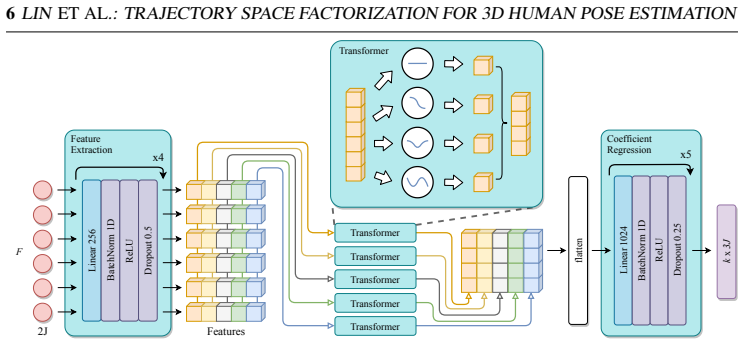
The load-bearing object is the trajectory-space motion matrix factorization $S_{F\times 3J} = \Theta_{F\times K} A_{K\times 3J}$. The columns of $\Theta$ are trajectory basis vectors spanning the temporal column space of the motion matrix; the rows of $A$ are the coefficients that combine them to reconstruct each coordinate trajectory. The network's 'Transformer' computes inner products of temporal feature trajectories with these fixed bases, and a second MLP regresses the final coefficients, after which 3D poses are rebuilt by a linear combination. The key property is that low-order DCT or SVD bases concentrate the energy of human motion, so $K$ can be far smaller than $F$.
What would settle it
On a test set of fast, high-frequency motions such as sprinting, kicking, or abrupt direction changes, compute the ground-truth motion matrix truncated to $K=8$ bases and measure its MPJPE against the full ground truth. If that truncation error is larger than the network's reported MPJPE, the low-rank trajectory assumption fails on those motions.
Extended reading notes
Core claim
The paper's central discovery is that estimating a full sequence of 3D poses can be reduced to estimating the $K$ coefficients of a trajectory-space factorization, $S = \Theta A$, where $S$ collects the $X/Y/Z$ coordinates of $J$ joints over $F$ frames, $\Theta$ is an $F\times K$ matrix of trajectory bases (left singular vectors from SVD on sampled motions, or DCT cosine bases), and $A$ collects $K$ coefficients for each of the $3J$ coordinate trajectories. The network maps 2D pose sequences to $A$, and the 3D poses are read out by linear combination. Using $F=50$ and $K=8$ DCT bases, the method reaches 46.8 mm mean per-joint error on Human3.6M under protocol 1, and with ground-truth 2D input it improves the previous best by 4.4 mm (11.8%).
Load-bearing premise
The whole approach assumes human 3D joint trajectories are so smooth that keeping only a handful of low-frequency bases ($K=2$ to $8$) throws away almost no motion information, even for fast or unusual movements.
Editorial extensions
If this is right
- A single network can output dense per-frame 3D poses for long videos in one pass; on Human3.6M, the $F=50$ setting outperforms the $F=10$ setting, so longer windows help.
- The dimensionality of the regression target is set by $K$, not by sequence length, so extending to longer sequences does not inflate the output space or the training data required.
- Accuracy with ground-truth 2D input improves substantially over prior work, so the trajectory-space formulation itself, not just the 2D detector, drives much of the gain.
- Because SVD and DCT bases give similar accuracy, the framework does not depend on a dataset-specific basis; any reasonable smooth basis should work.
Reading between the lines
- If low-rank trajectory structure holds beyond the tested benchmarks, the same factorization could apply to hands, faces, or whole-body mesh vertices, wherever coordinate trajectories are smooth.
- The error floor implied by truncation can be tested directly: compare the reported MPJPE to the MPJPE of ground-truth motions truncated to $K$ bases, since the network cannot beat that floor.
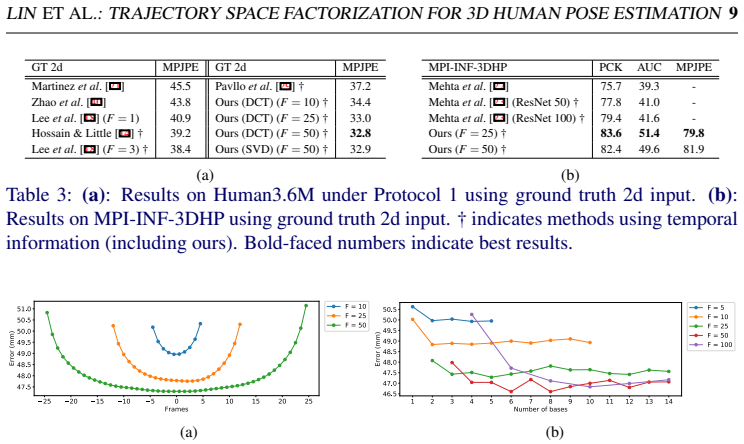
- The end-of-window error visible in the paper's per-frame plots suggests that overlapping-window inference with learned weights, rather than uniform averaging, might tighten the edges.
- Because DCT bases are data-independent, a zero-training-transfer test is plausible: apply the same bases to a new mocap domain and check whether the accuracy gap persists.
Signed reviews
Editorial analysis
A structured set of objections, weighed in public.
Referee Report
Summary. The paper proposes a video-based 3D human pose estimation method that represents a sequence of F 3D poses as a motion matrix S = ΘA, where Θ is a fixed F×K matrix of DCT or SVD trajectory bases and A is a K×3J coefficient matrix. A two-stage network takes 2D joint sequences, extracts per-frame features, applies a DCT-based "Transformer" to map features into trajectory space, and regresses the coefficient matrix; the final 3D poses are reconstructed as a linear combination of the bases. Experiments on Human3.6M under Protocol 1 (46.6 mm MPJPE at F=50) and on MPI-INF-3DHP (83.6 PCK with ground-truth 2D input) show results competitive with or better than prior work, and Figure 4b indicates that performance saturates around K=8 bases. The paper argues that the small number of required bases reduces output dimensionality and avoids the drift/sensitivity problems of RNN-based approaches.
Significance. If the central claim holds, the paper offers a simple and practical alternative to dilated-convolution and RNN temporal models: by fixing the trajectory bases, the network only regresses a low-dimensional coefficient matrix, and the method processes all frames in a window concurrently. The manuscript is clearly written, the source code is released, and the experiments are consistent across several F and K settings. The factorization identity in Eq. (3) is straightforward, the DCT bases are parameter-free external functions, and the SVD bases are computed from training motion data in a standard supervised manner, so there is no circularity in the core pipeline. The significance is somewhat tempered by the fact that the state-of-the-art claim holds only under Protocol 1; under Protocol 2 the method is slightly behind two prior approaches. The main unresolved risk is that the low-rank trajectory premise, which forms the hard accuracy floor of the method, is not quantified on held-out or fast-motion sequences.
major comments (3)
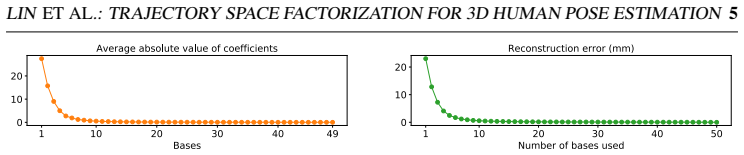
- [§3.2 and Figure 2] The load-bearing premise that K trajectory bases suffice is supported only by a qualitative reconstruction-error panel computed on 100k randomly sampled Human3.6M trajectories. Since Eq. (3) fixes Θ, every output sequence lies in the K-dimensional span of the precomputed bases, so the oracle truncation error ||P_K S − S|| is a hard lower bound on achievable MPJPE regardless of network capacity. Given that the Protocol 1 margin over Pavllo et al. [29] is only 0.2 mm (46.6 vs 46.8 in Table 1), an unquantified truncation tail of even a few millimeters could change the headline comparison. Please tabulate mean per-joint truncation error for K = 2, 5, 8 on held-out subjects and per action (especially fast actions such as SittingDown and Photo), and also on MPI-INF-3DHP, so that the floor is known to be well below the reported margins.
- [§4, Experimental setup and Figure 4b] The paper does not state whether the choices of F and K were made on a validation split or on the test subjects. The final configurations F=10 K=2, F=25 K=5, and F=50 K=8 are used for the main tables, while Figure 4b sweeps both F and K; if test-set performance guided these selections, the conclusion that "a small number of trajectory bases are sufficient" is not an independent finding, and the comparison with prior work may be biased. Please specify the validation protocol (for example, holding out one training subject for hyperparameter selection) and report the chosen hyperparameters under that protocol.
- [§4 Results and Abstract] The abstract claims state-of-the-art performance on multiple benchmark datasets, but under Protocol 2 the best result in Table 2 is 36.8 mm (Ours F=50), which is behind Dabral et al. TP-Net at 36.3 mm and Pavllo et al. at 36.5 mm. The paper's own text says the results are "on par" with the existing state of the art. Please either restrict the state-of-the-art claim to Protocol 1 and MPI-INF-3DHP, or provide an error-bar/variance analysis showing that sub-0.5 mm gaps are not statistically meaningful. Without such analysis, the current abstract overstates the result.
minor comments (6)
- [Table 1] The action label "SitingD" appears to be a typo for "SittingDown"; please correct it.
- [Figure 2] The left panel lacks axis labels and units, and the right panel's y-axis should state the metric and the set over which it is averaged; per-action curves would be more informative than a single pooled curve.
- [Table 3a] The header "GT 2d MPJPE" is duplicated in the table, which makes the column layout confusing; please fix the formatting.
- [References] Reference [22] is formatted inconsistently as "arxiv preprint. pages 506–516"; please provide the full venue information.
- [§3.3] The description of the "Transformer" states that an inner product with each fixed basis is normalized by a scale factor of 2/F; please clarify how this scaling relates to the unnormalized DCT basis in Eqs. (4)–(5), since the basis vectors there are orthogonal but not orthonormal.
- [§4, Experimental setup] The sliding-window step q=5 and the average-pooling window size of 5 are fixed without any sensitivity analysis; a brief statement on why these values are robust would help the reader assess the method's generality.
Circularity Check
No significant circularity: the trajectory-basis factorization uses fixed external bases and a directly supervised coefficient regressor, with no fitted quantity renamed as a prediction.
full rationale
The paper's derivation chain is self-contained. The motion matrix factorization S = ΘA in Eq. (3) uses trajectory bases that are either predefined DCT cosine functions (Eqs. 4-5) or SVD bases computed once from a sample of training motion matrices; this is a standard representation-learning choice rather than a fitted prediction target. The network is trained end-to-end with the L1 loss in Eq. (6) directly on 3D pose ground truth, so the predicted coefficients are not equal by construction to the projection coefficients of the ground-truth motion, and the model must generalize from 2D inputs. The claim that a small number of trajectory bases suffice is supported by the reconstruction analysis in Figure 2 and by the saturation behavior in Figure 4b, which are independent empirical observations rather than definitions of the reported test error. No load-bearing self-citations appear in the argument; the reference to prior trajectory-space factorization supplies background duality, not the experimental conclusions. Consequently, no prediction reduces to an input by construction, and the paper does not exhibit circular reasoning.
Assumptions & free parameters
free parameters (5)
- K (number of trajectory bases) =
2 (F=10), 5 (F=25), 8 (F=50)
- F (input sequence length) =
10, 25, 50 frames
- Sliding window step q =
5 frames
- Average pooling window size =
5
- N (trajectories used for SVD bases) =
10,000
assumptions (5)
- domain assumption Human 3D joint trajectories lie close to a low-dimensional subspace spanned by DCT or SVD trajectory bases.
- standard math DCT basis functions form an orthogonal basis and the inverse transform reconstructs the signal exactly when all bases are used.
- standard math The motion matrix S has rank at most min(F, 3J), so the factorization S = Theta * A is exact for some A.
- domain assumption Off-the-shelf 2D pose detections (CPN) are accurate and temporally consistent enough for 3D regression.
- domain assumption Ground-truth 3D poses in Human3.6M and MPI-INF-3DHP are correctly aligned and provide reliable supervision.
Cite this review
Pith. "Pith review of Trajectory Space Factorization for Deep Video-Based 3D Human Pose Estimation." pith.science (2026). https://pith.science/paper/HT6JPTKK
@misc{pith2026190808289,
  author       = {Pith},
  title        = {Pith review of: Trajectory Space Factorization for Deep Video-Based 3D Human Pose Estimation},
  year         = {2026},
  howpublished = {\url{https://pith.science/paper/HT6JPTKK}},
  note         = {Machine review of arXiv:1908.08289}
}
read the original abstract
Existing deep learning approaches on 3d human pose estimation for videos are either based on Recurrent or Convolutional Neural Networks (RNNs or CNNs). However, RNN-based frameworks can only tackle sequences with limited frames because sequential models are sensitive to bad frames and tend to drift over long sequences. Although existing CNN-based temporal frameworks attempt to address the sensitivity and drift problems by concurrently processing all input frames in the sequence, the existing state-of-the-art CNN-based framework is limited to 3d pose estimation of a single frame from a sequential input. In this paper, we propose a deep learning-based framework that utilizes matrix factorization for sequential 3d human poses estimation. Our approach processes all input frames concurrently to avoid the sensitivity and drift problems, and yet outputs the 3d pose estimates for every frame in the input sequence. More specifically, the 3d poses in all frames are represented as a motion matrix factorized into a trajectory bases matrix and a trajectory coefficient matrix. The trajectory bases matrix is precomputed from matrix factorization approaches such as Singular Value Decomposition (SVD) or Discrete Cosine Transform (DCT), and the problem of sequential 3d pose estimation is reduced to training a deep network to regress the trajectory coefficient matrix. We demonstrate the effectiveness of our framework on long sequences by achieving state-of-the-art performances on multiple benchmark datasets. Our source code is available at: https://github.com/jiahaoLjh/trajectory-pose-3d.
Figures

Figures from the paper (2 more)

Reference graph
Works this paper leans on
-
[29]
3d hu- man pose estimation in video with temporal convolutions and semi-supervised training
Dario Pavllo, Christoph Feichtenhofer, David Grangier, and Michael Auli. 3d hu- man pose estimation in video with temporal convolutions and semi-supervised training. arXiv preprint arXiv:1811.11742, 2018
arXiv 2018
-
[1]
3d human pose from silhouettes by relevance vector regression
Ankur Agarwal and Bill Triggs. 3d human pose from silhouettes by relevance vector regression. In Conference on Computer Vision and Pattern Recognition , volume 2, pages 882–888. IEEE, 2004
work page 2004
-
[2]
Nonrigid structure from motion in trajectory space
Ijaz Akhter, Yaser Sheikh, Sohaib Khan, and Takeo Kanade. Nonrigid structure from motion in trajectory space. In Advances in neural information processing systems , pages 41–48, 2009
work page 2009
-
[3]
Fast algo- rithms for large scale conditional 3d prediction
Liefeng Bo, Cristian Sminchisescu, Atul Kanaujia, and Dimitris Metaxas. Fast algo- rithms for large scale conditional 3d prediction. InConference on Computer Vision and Pattern Recognition, pages 1–8. IEEE, 2008
work page 2008
-
[4]
Keep it smpl: Automatic estimation of 3d human pose and shape from a single image
Federica Bogo, Angjoo Kanazawa, Christoph Lassner, Peter Gehler, Javier Romero, and Michael J Black. Keep it smpl: Automatic estimation of 3d human pose and shape from a single image. In European Conference on Computer Vision , pages 561–578. Springer, 2016
work page 2016
-
[5]
Recovering non-rigid 3d shape from image streams
Christoph Bregler, Aaron Hertzmann, and Henning Biermann. Recovering non-rigid 3d shape from image streams. InConference on Computer Vision and Pattern Recognition, volume 2, page 2690. IEEE, 2000. LIN ET AL.: TRAJECTORY SPACE FACTORIZA TION FOR 3D HUMAN POSE ESTIMA TION11
work page 2000
-
[6]
3d human pose estimation= 2d pose estimation+ matching
Ching-Hang Chen and Deva Ramanan. 3d human pose estimation= 2d pose estimation+ matching. In Conference on Computer Vision and Pattern Recognition , volume 2, page 6. IEEE, 2017
work page 2017
-
[7]
Cascaded pyramid network for multi-person pose estimation
Yilun Chen, Zhicheng Wang, Yuxiang Peng, Zhiqiang Zhang, Gang Yu, and Jian Sun. Cascaded pyramid network for multi-person pose estimation. In Conference on Com- puter Vision and Pattern Recognition, pages 7103–7112. IEEE, 2018
work page 2018
Show all 42 references
-
[8]
Wav2letter: an end-to-end convnet-based speech recognition system
Ronan Collobert, Christian Puhrsch, and Gabriel Synnaeve. Wav2letter: an end-to-end convnet-based speech recognition system. arXiv preprint arXiv:1609.03193, 2016
2016 arXiv
-
[9]
Long short-term memory kalman filters: Recurrent neural estimators for pose regularization
Huseyin Coskun, Felix Achilles, Robert S DiPietro, Nassir Navab, and Federico Tombari. Long short-term memory kalman filters: Recurrent neural estimators for pose regularization. In International Conference on Computer Vision , pages 5525–
-
[10]
Learning 3d human pose from structure and motion
Rishabh Dabral, Anurag Mundhada, Uday Kusupati, Safeer Afaque, Abhishek Sharma, and Arjun Jain. Learning 3d human pose from structure and motion. In European Conference on Computer Vision, pages 668–683, 2018
2018
-
[11]
Language modeling with gated convolutional networks
Yann N Dauphin, Angela Fan, Michael Auli, and David Grangier. Language modeling with gated convolutional networks. In International Conference on Machine Learning, pages 933–941, 2017
2017
-
[12]
Learning pose grammar to encode human body configuration for 3d pose estimation
Haoshu Fang, Yuanlu Xu, Wenguan Wang, Xiaobai Liu, and Song-Chun Zhu. Learning pose grammar to encode human body configuration for 3d pose estimation. In AAAI Conference on Artificial Intelligence, 2018
2018
-
[13]
Convolutional sequence to sequence learning
Jonas Gehring, Michael Auli, David Grangier, Denis Yarats, and Yann N Dauphin. Convolutional sequence to sequence learning. InInternational Conference on Machine Learning, pages 1243–1252, 2017
2017
-
[14]
Exploiting temporal information for 3d human pose estimation
Mir Rayat Imtiaz Hossain and James J Little. Exploiting temporal information for 3d human pose estimation. In European Conference on Computer Vision , pages 69–86. Springer, 2018
2018
-
[15]
Densely connected convolutional networks
Gao Huang, Zhuang Liu, Laurens Van Der Maaten, and Kilian Q Weinberger. Densely connected convolutional networks. In Conference on Computer Vision and Pattern Recognition, volume 1, page 3. IEEE, 2017
2017
-
[16]
Catalin Ionescu, Dragos Papava, Vlad Olaru, and Cristian Sminchisescu. Human3. 6m: Large scale datasets and predictive methods for 3d human sensing in natural en- vironments. IEEE Transactions on Pattern Analysis and Machine Intelligence, 36(7): 1325–1339, 2014
2014
-
[17]
Adam: A method for stochastic optimization
Diederik P Kingma and Jimmy Ba. Adam: A method for stochastic optimization. arXiv preprint arXiv:1412.6980, 2014
2014 arXiv
-
[18]
Propagating lstm: 3d pose estimation based on joint interdependency
Kyoungoh Lee, Inwoong Lee, and Sanghoon Lee. Propagating lstm: 3d pose estimation based on joint interdependency. In European Conference on Computer Vision, pages 119–135, 2018. 12LIN ET AL.: TRAJECTORY SPACE FACTORIZA TION FOR 3D HUMAN POSE ESTIMA TION
2018
-
[19]
3d human pose estimation from monocular images with deep convolutional neural network
Sijin Li and Antoni B Chan. 3d human pose estimation from monocular images with deep convolutional neural network. In Asian Conference on Computer Vision , pages 332–347. Springer, 2014
2014
-
[20]
Recurrent 3d pose sequence machines
Mude Lin, Liang Lin, Xiaodan Liang, Keze Wang, and Hui Cheng. Recurrent 3d pose sequence machines. In Conference on Computer Vision and Pattern Recognition, pages 5543–5552. IEEE, 2017
2017
-
[21]
A simple yet effec- tive baseline for 3d human pose estimation
Julieta Martinez, Rayat Hossain, Javier Romero, and James J Little. A simple yet effec- tive baseline for 3d human pose estimation. In International Conference on Computer Vision, volume 1, page 5. IEEE, 2017
2017
-
[22]
Monocular 3d human pose estimation using transfer learning and improved cnn supervision
Dushyant Mehta, Helge Rhodin, Dan Casas, Oleksandr Sotnychenko, Weipeng Xu, and Christian Theobalt. Monocular 3d human pose estimation using transfer learning and improved cnn supervision. arxiv preprint. pages 506–516, 2017
2017
-
[23]
Vnect: Real-time 3d human pose estimation with a single rgb camera
Dushyant Mehta, Srinath Sridhar, Oleksandr Sotnychenko, Helge Rhodin, Mohammad Shafiei, Hans-Peter Seidel, Weipeng Xu, Dan Casas, and Christian Theobalt. Vnect: Real-time 3d human pose estimation with a single rgb camera. ACM Transactions on Graphics (TOG), 36(4):44, 2017
2017
-
[24]
3d human pose estimation from a single image via distance matrix regression
Francesc Moreno-Noguer. 3d human pose estimation from a single image via distance matrix regression. In Conference on Computer Vision and Pattern Recognition, pages 1561–1570. IEEE, 2017
2017
-
[25]
Recovering 3d human body configurations using shape contexts
Greg Mori and Jitendra Malik. Recovering 3d human body configurations using shape contexts. IEEE Transactions on Pattern Analysis and Machine Intelligence , 28(7): 1052–1062, 2006
2006
-
[26]
Stacked hourglass networks for hu- man pose estimation
Alejandro Newell, Kaiyu Yang, and Jia Deng. Stacked hourglass networks for hu- man pose estimation. In European Conference on Computer Vision , pages 483–499. Springer, 2016
2016
-
[27]
Monocular 3d human pose esti- mation by predicting depth on joints
Bruce Xiaohan Nie, Ping Wei, and Song-Chun Zhu. Monocular 3d human pose esti- mation by predicting depth on joints. In International Conference on Computer Vision. IEEE, 2017
2017
-
[28]
Coarse-to-fine volumetric prediction for single-image 3d human pose
Georgios Pavlakos, Xiaowei Zhou, Konstantinos G Derpanis, and Kostas Daniilidis. Coarse-to-fine volumetric prediction for single-image 3d human pose. In Conference on Computer Vision and Pattern Recognition, pages 1263–1272. IEEE, 2017
2017
-
[30]
Reconstructing 3d human pose from 2d image landmarks
Varun Ramakrishna, Takeo Kanade, and Yaser Sheikh. Reconstructing 3d human pose from 2d image landmarks. In European Conference on Computer Vision, pages 573–
-
[31]
Randomized trees for human pose detection
Grégory Rogez, Jonathan Rihan, Srikumar Ramalingam, Carlos Orrite, and Philip HS Torr. Randomized trees for human pose detection. In Conference on Computer Vision and Pattern Recognition, pages 1–8. IEEE, 2008. LIN ET AL.: TRAJECTORY SPACE FACTORIZA TION FOR 3D HUMAN POSE ESTI...
2008
-
[32]
Compositional human pose regression
Xiao Sun, Jiaxiang Shang, Shuang Liang, and Yichen Wei. Compositional human pose regression. In International Conference on Computer Vision, volume 2, page 7. IEEE, 2017
2017
-
[33]
Structured prediction of 3d human pose with deep neural networks
Bugra Tekin, Isinsu Katircioglu, Mathieu Salzmann, Vincent Lepetit, and Pascal Fua. Structured prediction of 3d human pose with deep neural networks. arXiv preprint arXiv:1605.05180, 2016
2016 arXiv
-
[34]
Direct prediction of 3d body poses from motion compensated sequences
Bugra Tekin, Artem Rozantsev, Vincent Lepetit, and Pascal Fua. Direct prediction of 3d body poses from motion compensated sequences. In Conference on Computer Vision and Pattern Recognition, pages 991–1000. IEEE, 2016
2016
-
[35]
Learning to fuse 2d and 3d image cues for monocular body pose estimation
Bugra Tekin, Pablo Marquez Neila, Mathieu Salzmann, and Pascal Fua. Learning to fuse 2d and 3d image cues for monocular body pose estimation. In International Conference on Computer Vision, pages 3941–3950. IEEE, 2017
2017
-
[36]
Shape and motion from image streams under or- thography: a factorization method
Carlo Tomasi and Takeo Kanade. Shape and motion from image streams under or- thography: a factorization method. International Journal of Computer Vision , 9(2): 137–154, 1992
1992
-
[37]
Wavenet: A generative model for raw audio
Aäron Van Den Oord, Sander Dieleman, Heiga Zen, Karen Simonyan, Oriol Vinyals, Alex Graves, Nal Kalchbrenner, Andrew W Senior, and Koray Kavukcuoglu. Wavenet: A generative model for raw audio. SSW, 125, 2016
2016
-
[38]
3d human pose estimation in the wild by adversarial learning
Wei Yang, Wanli Ouyang, Xiaolong Wang, Jimmy Ren, Hongsheng Li, and Xiaogang Wang. 3d human pose estimation in the wild by adversarial learning. In Conference on Computer Vision and Pattern Recognition, volume 1. IEEE, 2018
2018
-
[39]
A dual- source approach for 3d pose estimation from a single image
Hashim Yasin, Umar Iqbal, Bjorn Kruger, Andreas Weber, and Juergen Gall. A dual- source approach for 3d pose estimation from a single image. In Conference on Com- puter Vision and Pattern Recognition, pages 4948–4956. IEEE, 2016
2016
-
[40]
Semantic graph convolutional networks for 3d human pose regression
Long Zhao, Xi Peng, Yu Tian, Mubbasir Kapadia, and Dimitris N Metaxas. Semantic graph convolutional networks for 3d human pose regression. In Conference on Com- puter Vision and Pattern Recognition, pages 3425–3435. IEEE, 2019
2019
-
[41]
3d shape esti- mation from 2d landmarks: A convex relaxation approach
Xiaowei Zhou, Spyridon Leonardos, Xiaoyan Hu, and Kostas Daniilidis. 3d shape esti- mation from 2d landmarks: A convex relaxation approach. InConference on Computer Vision and Pattern Recognition, pages 4447–4455. IEEE, 2015
2015
-
[42]
Sparseness meets deepness: 3d human pose estimation from monoc- ular video
Xiaowei Zhou, Menglong Zhu, Spyridon Leonardos, Konstantinos G Derpanis, and Kostas Daniilidis. Sparseness meets deepness: 3d human pose estimation from monoc- ular video. In Conference on Computer Vision and Pattern Recognition, pages 4966–
Reviewed August 14, 2026 · model on record in the stance chip above.
Discussion (0). Continue with ORCID to comment.