REVIEW 3 major objections 6 minor 17 references
Image Colorization By Capsule Networks
T0 review · 3 major / 6 minor · reviewed 2026-08-14 · deepseek-v4-flash
Pith's one-line read A shallow capsule network, ColorCapsNet, adapted from the original CapsNet with VGG-19 features and MSE loss, produces automatic colorization results comparable to NTIRE 2019 challenge participants on DIV2K.
desk verdict A modest CapsNet colorization adaptation that honestly reports routing has no effect, but never shows the capsule machinery matters. read the letter →
The pith
A machine-rendered reading of the paper's core claim, the machinery that carries it, and where it could break.
The reading
What carries the argument
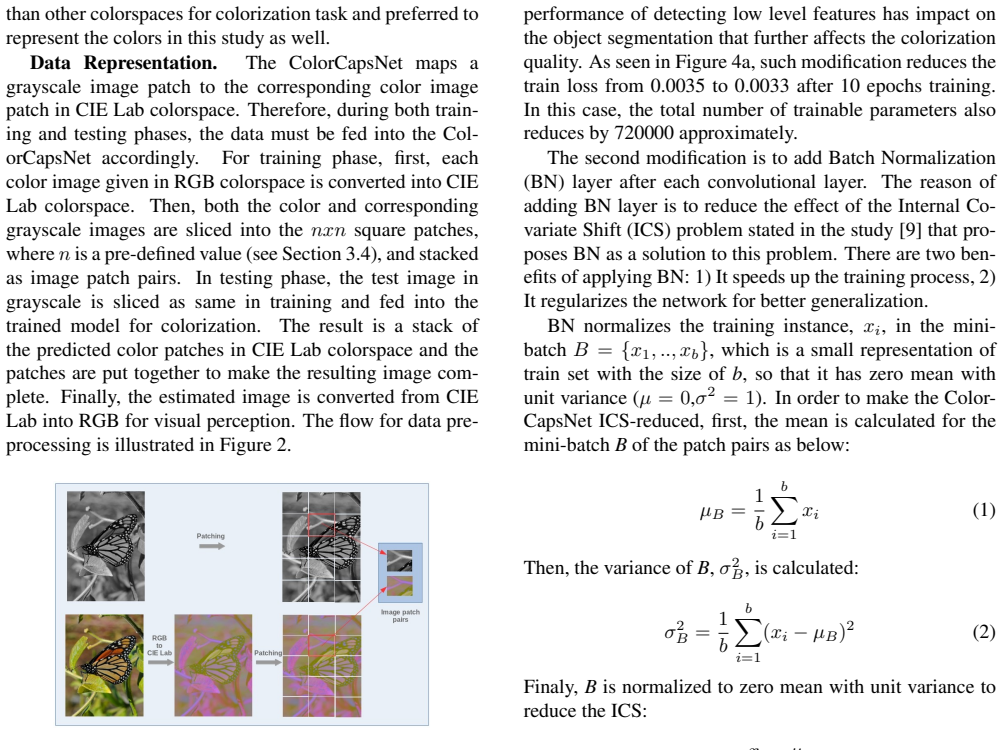
The central object is ColorCapsNet, an autoencoder-like capsule network in which a capsule is a group of neurons whose output vector encodes an entity's instantiation parameters. The encoder starts with the first two convolutional layers of VGG-19 (with transferred weights) followed by batch normalization, a primary capsule layer, and a capsule layer with six capsules. Dynamic routing-by-agreement transfers information between capsule layers and is intended to segment objects internally; the decoder then reconstructs the $a$ and $b$ chrominance channels from the capsule vectors, with the $L$ channel taken from the grayscale input. Patch size and routing iterations are treated as critical hyperparameters, with 9x9 patches and one routing iteration chosen.
What would settle it
Train ColorCapsNet on DIV2K with routing iterations set to zero or with the capsule layer replaced by a plain convolutional layer of similar size, keeping VGG-19 features and MSE loss identical; if validation PSNR and SSIM remain at roughly 22.20 and 0.88, the central role claimed for routing is refuted.
Extended reading notes
Core claim
The paper's central claim is that the generative and segmentation capabilities of the original CapsNet carry over to colorization when the feature detector is replaced with the first two convolutional layers of VGG-19 (initialized with pretrained weights), batch normalization is added, the number of class capsules is reduced to six, and margin loss is exchanged for MSE in CIE Lab space. The resulting ColorCapsNet is patch-based and fully automatic, and it achieves the reported PSNR/SSIM values on DIV2K validation and test sets. The authors interpret this as evidence that capsule networks deserve further investigation for colorization.
Load-bearing premise
The load-bearing premise is that capsule routing-by-agreement, rather than the transferred VGG-19 features and the decoder, is what gives ColorCapsNet its colorization ability; the paper calls routing one of the most critical hyperparameters but offers no ablation that removes or replaces routing to prove that.
Editorial extensions
If this is right
- If ColorCapsNet's results hold, capsule networks are viable for image generation tasks beyond classification, not just for object recognition.
- The reported scores imply that a shallow capsule architecture, combined with transferred VGG-19 features, can compete with more complex automatic colorization models on a standard benchmark.
- Because the network is patch-based and trained in CIE Lab space, the method suggests that local color distribution learning with MSE loss is sufficient for plausible colorization in this setting.
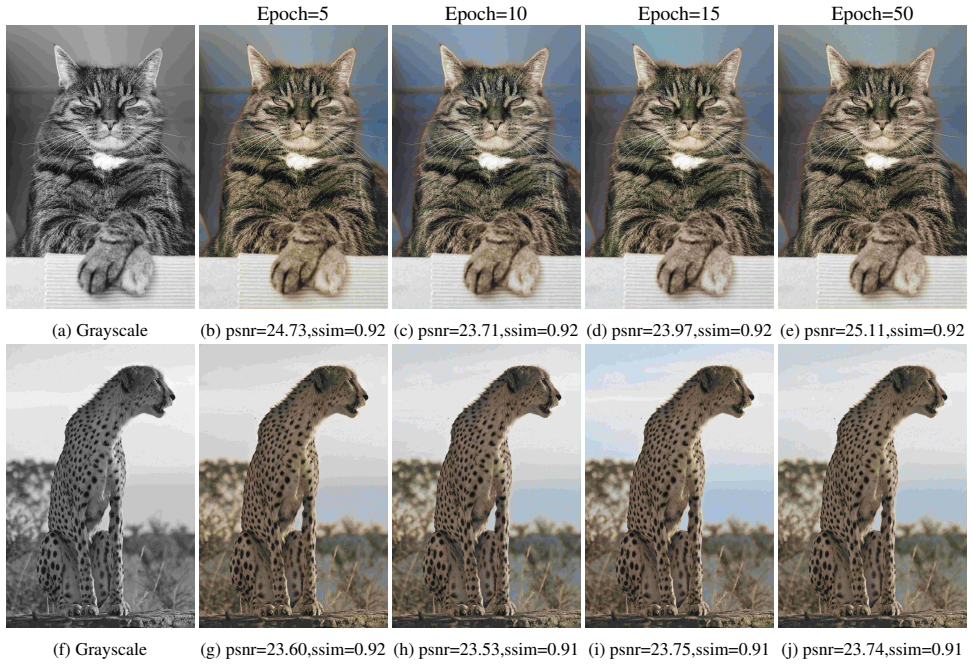
- The authors' observation that loss curves had not plateaued at 50 epochs implies that longer training on DIV2K may push the scores higher, and the paper explicitly leaves this as an open direction.
Reading between the lines
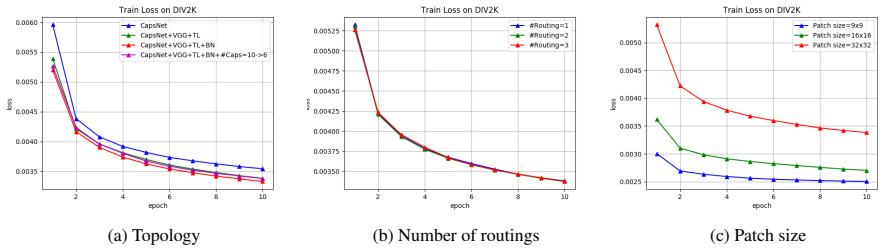
- The paper does not isolate routing's contribution: since changing routing iterations from 1 to 3 barely changed train loss, a plausible inference is that the VGG-19 features and the decoder, not the routing-by-agreement mechanism, drive most of the colorization quality.
- A direct testable extension would replace the capsule decoder with a plain convolutional decoder of similar capacity; if PSNR/SSIM stay near 22.20/0.88, capsule routing is not load-bearing for this task.
- The same architecture could be extended to multimodal colorization by predicting a per-pixel color distribution instead of a single Lab value, which would address the ill-posed ambiguity the paper acknowledges.
- The observed invariance to routing iterations suggests that dynamic routing may matter more for classification-type tasks than for dense prediction; this is an inference beyond the paper's claims.
Signed reviews
Editorial analysis
A structured set of objections, weighed in public.
Referee Report
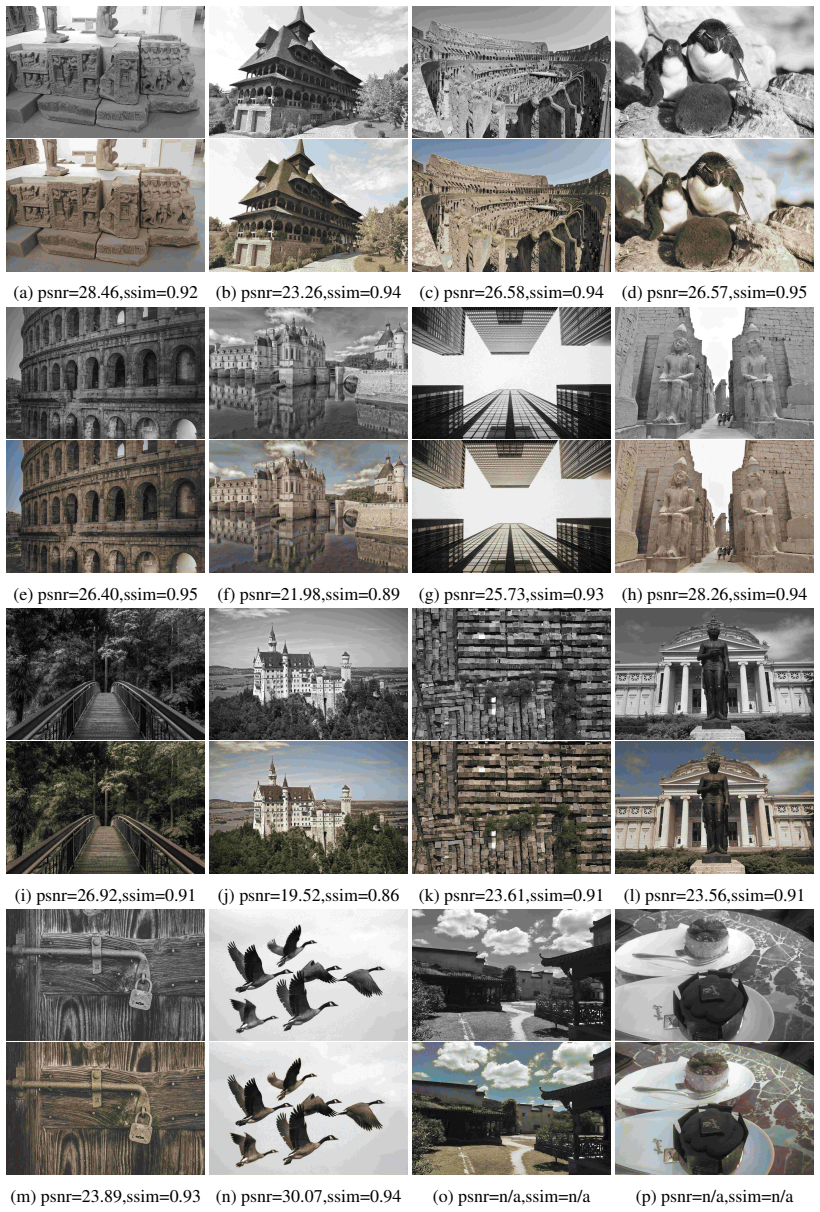
Summary. The paper proposes ColorCapsNet, an adaptation of the original CapsNet to the task of automatic image colorization. The architecture uses a VGG-19-based feature extractor, a primary capsule layer, and a capsule classification layer, with MSE loss in CIE Lab space. The method is trained on ILSVRC 2012 and DIV2K and evaluated on NTIRE 2019 colorization challenge data. The authors report a validation PSNR of 22.20 and SSIM of 0.88 after 50 epochs, and a test PSNR of 21.08 and SSIM of 0.85 after 10 epochs, and claim these results are promising and comparable.
Significance. The application of capsule networks to colorization is a novel and potentially interesting direction. The paper provides a clear description of the architecture and a comparative analysis of patch size, routing iterations, and topology choices. However, the central claim that capsule-specific mechanisms (routing-by-agreement and capsule representations) contribute to the colorization quality is not supported by the evidence: Figure 4b shows no effect of routing iterations, and no non-capsule control is reported. The evaluation protocol also confounds the test numbers by fine-tuning on the validation set. If the authors add a proper ablation and a standardized comparison, the work could be a useful contribution to the community. The manuscript is honest about the observed lack of routing sensitivity.
major comments (3)
- [Section 4.1; Table 1] The test evaluation is confounded by fine-tuning on the validation set. Section 4.1 states that after training on the DIV2K train split, the network is "finally trained on this validation set to colorize the test images," so the test numbers in Table 1 do not follow the standardized NTIRE evaluation protocol and are not directly comparable to the listed worst/best challenge values. Additionally, the validation and test rows come from different training durations (50 vs 10 epochs), so the two numbers should not be presented as a single model's performance.
- [Section 3.4; Figure 4b] The paper's central claim that routing-by-agreement contributes to colorization is contradicted by its own Figure 4b, which shows no effect of varying the number of routing iterations. No ablation is provided that replaces the capsule decoder with a plain convolutional decoder using the same VGG-19 front-end, latent dimensionality, patch size, and MSE loss. Without such a control, the reported PSNR/SSIM values cannot be attributed to capsule mechanisms; they may arise entirely from the pretrained VGG-19 features and the MSE objective. This is a load-bearing gap for the title and Section 3.4 claims.
- [Table 1] The comparison to "Worst" and "Best PSNR/SSIM" from the NTIRE 2019 challenge is not a comparison to named baselines. Since the worst and best values may come from different participants for each metric, the claim that ColorCapsNet has "comparable colorization performance" is not quantitatively supported. The authors should cite specific competing methods from the NTIRE report and evaluate under the identical protocol, including the same training epochs and no validation-set fine-tuning.
minor comments (6)
- [Section 1] There is a typo in Section 1: "These studies may be classified as in two categories:" should read "These studies may be classified into two categories:".
- [Equation (6)] Equation (6) is ambiguous: it writes "1/YX" while the summation bounds are over y=1..Y and x=1..X; this should be written as 1/(XY) or with an explicit double sum.
- [Figure 4(c)] The caption "the train loss decreases with the patch size goes down exponentially" is grammatically incomplete, and the figure does not use a logarithmic scale, so the word "exponentially" is not supported by the displayed data.
- [Section 4.1] The description of DIV2K says the train set has 794 grayscale and 800 RGB images, and then "794 out of 800 images in the train set are used"; the reason for excluding six images is not explained.
- [Section 3.1/3.2] The paper does not specify whether patches are sampled densely or randomly, nor the batch size used for training; these details are needed for reproduction.
- [Table 1] The footnote markers "1" and "2" after the ColorCapsNet numbers are not formatted as superscripts, which makes the table harder to read.
Circularity Check
No circularity: all reported results are empirical evaluations against external benchmarks (DIV2K, NTIRE Challenge), with no fitted parameter renamed as a prediction and no load-bearing self-citations.
full rationale
The paper proposes ColorCapsNet, an adaptation of CapsNet for image colorization, and evaluates it on DIV2K with PSNR/SSIM metrics. The central claims are empirical: the network is trained on ILSVRC 2012 and DIV2K, and results are compared to NTIRE 2019 challenge best/worst values. No equation in the paper defines a predicted quantity in terms of the fitted parameters that allegedly predict it. The loss function (MSE), the metrics (PSNR, SSIM), and the architecture components (CapsNet, VGG-19 features, batch normalization) are all standard and are not derived from the reported outcome. The paper includes no self-citations, no uniqueness theorems from the authors' prior work, and no ansatz smuggled in via citation. The unsupported claim that routing-by-agreement contributes to segmentation is a weakness in experimental validation (no ablation with a non-capsule decoder; Figure 4b even shows routing has no effect), but this is a correctness or evidence concern, not circularity: the reported PSNR/SSIM numbers are not forced by the choice of routing iterations or by any self-referential definition. The fine-tuning on the DIV2K validation set before testing is an unusual protocol but does not make the test numbers a fitted rename of training data. Therefore, no specific circular step can be exhibited, and the honest finding is no significant circularity.
Assumptions & free parameters
free parameters (3)
- number of class capsules =
6
- number of routing iterations =
1
- patch size =
9x9
assumptions (5)
- domain assumption The original CapsNet's generative and segmentation capabilities can be transferred to image colorization by changing the loss and output space.
- domain assumption CIE Lab colorspace with L2/MSE loss is appropriate for colorization.
- standard math Batch normalization reduces internal covariate shift and improves convergence.
- domain assumption Pretrained VGG-19 weights provide useful low-level features for colorization.
- standard math PSNR and SSIM are valid metrics for colorization quality.
Cite this review
Pith. "Pith review of Image Colorization By Capsule Networks." pith.science (2026). https://pith.science/paper/BL37RLUJ
@misc{pith2026190808307,
  author       = {Pith},
  title        = {Pith review of: Image Colorization By Capsule Networks},
  year         = {2026},
  howpublished = {\url{https://pith.science/paper/BL37RLUJ}},
  note         = {Machine review of arXiv:1908.08307}
}
read the original abstract
In this paper, a simple topology of Capsule Network (CapsNet) is investigated for the problem of image colorization. The generative and segmentation capabilities of the original CapsNet topology, which is proposed for image classification problem, is leveraged for the colorization of the images by modifying the network as follows:1) The original CapsNet model is adapted to map the grayscale input to the output in the CIE Lab colorspace, 2) The feature detector part of the model is updated by using deeper feature layers inherited from VGG-19 pre-trained model with weights in order to transfer low-level image representation capability to this model, 3) The margin loss function is modified as Mean Squared Error (MSE) loss to minimize the image-to-imagemapping. The resulting CapsNet model is named as Colorizer Capsule Network (ColorCapsNet).The performance of the ColorCapsNet is evaluated on the DIV2K dataset and promising results are obtained to investigate Capsule Networks further for image colorization problem.
Figures


Figures from the paper (4 more)

Reference graph
Works this paper leans on
-
[1]
Ntire 2017 challenge on single image super-resolution: Dataset and study
Eirikur Agustsson and Radu Timofte. Ntire 2017 challenge on single image super-resolution: Dataset and study. In Pro- ceedings of the IEEE Conference on Computer Vision and Pattern Recognition Workshops, pages 126–135, 2017
work page 2017
-
[2]
Automatic image colorization via multimodal predictions
Guillaume Charpiat, Matthias Hofmann, and Bernhard Sch¨olkopf. Automatic image colorization via multimodal predictions. In European conference on computer vision , pages 126–139. Springer, 2008
work page 2008
-
[3]
Zezhou Cheng, Qingxiong Yang, and Bin Sheng. Deep col- orization. In Proceedings of the IEEE International Confer- ence on Computer Vision, pages 415–423, 2015
work page 2015
-
[4]
Se- mantic colorization with internet images
Alex Yong-Sang Chia, Shaojie Zhuo, Raj Kumar Gupta, Yu- Wing Tai, Siu-Yeung Cho, Ping Tan, and Stephen Lin. Se- mantic colorization with internet images. In ACM Transac- tions on Graphics (TOG), volume 30, page 156. ACM, 2011
work page 2011
-
[5]
Imagenet: A large-scale hierarchical image database
Jia Deng, Wei Dong, Richard Socher, Li-Jia Li, Kai Li, and Li Fei-Fei. Imagenet: A large-scale hierarchical image database. In 2009 IEEE conference on computer vision and pattern recognition, pages 248–255. Ieee, 2009
2009
-
[6]
Ntire 2019 challenge on image colorization: Report
Shuhang Gu, Radu Timofte, Richard Zhang, et al. Ntire 2019 challenge on image colorization: Report. In The IEEE Con- ference on Computer Vision and Pattern Recognition (CVPR) Workshops, June 2019
work page 2019
-
[7]
Image colorization us- ing similar images
Raj Kumar Gupta, Alex Yong-Sang Chia, Deepu Rajan, Ee Sin Ng, and Huang Zhiyong. Image colorization us- ing similar images. In Proceedings of the 20th ACM inter- national conference on Multimedia , pages 369–378. ACM, 2012
work page 2012
-
[8]
Satoshi Iizuka, Edgar Simo-Serra, and Hiroshi Ishikawa. Let there be color!: joint end-to-end learning of global and local image priors for automatic image colorization with simulta- neous classification. ACM Transactions on Graphics (TOG), 35(4):110, 2016
work page 2016
Show all 17 references
-
[9]
Batch normalization: Accelerating deep network training by reducing internal co- variate shift
Sergey Ioffe and Christian Szegedy. Batch normalization: Accelerating deep network training by reducing internal co- variate shift. arXiv preprint arXiv:1502.03167, 2015
2015 arXiv
-
[10]
Col- orization by example
Revital Ironi, Daniel Cohen-Or, and Dani Lischinski. Col- orization by example. In Rendering Techniques, pages 201–
-
[11]
Adam: A method for stochastic optimization
Diederik P Kingma and Jimmy Ba. Adam: A method for stochastic optimization. arXiv preprint arXiv:1412.6980 , 2014
2014 arXiv
-
[12]
Learning representations for automatic colorization
Gustav Larsson, Michael Maire, and Gregory Shakhnarovich. Learning representations for automatic colorization. In European Conference on Computer Vision, pages 577–593. Springer, 2016
2016
-
[13]
Colorization using optimization
Anat Levin, Dani Lischinski, and Yair Weiss. Colorization using optimization. In ACM transactions on graphics (tog), volume 23, pages 689–694. ACM, 2004
2004
-
[14]
Dy- namic routing between capsules
Sara Sabour, Nicholas Frosst, and Geoffrey E Hinton. Dy- namic routing between capsules. In Advances in neural in- formation processing systems, pages 3856–3866, 2017
2017
-
[15]
Very deep convo- lutional networks for large-scale image recognition
Karen Simonyan and Andrew Zisserman. Very deep convo- lutional networks for large-scale image recognition. arXiv preprint arXiv:1409.1556, 2014
2014 arXiv
-
[16]
Fast image and video colorization using chrominance blending
Liron Yatziv and Guillermo Sapiro. Fast image and video colorization using chrominance blending. IEEE transactions on image processing, 15(5):1120–1129, 2006
2006
-
[17]
Colorful image colorization
Richard Zhang, Phillip Isola, and Alexei A Efros. Colorful image colorization. In European conference on computer vision, pages 649–666. Springer, 2016
2016
Reviewed August 14, 2026 · model on record in the stance chip above.
Discussion (0). Continue with ORCID to comment.