REVIEW 3 major objections 4 minor 46 references
Auditing Radicalization Pathways on YouTube
T0 review · 3 major / 4 minor · reviewed 2026-08-14 · deepseek-v4-flash
Pith's one-line read Audit finds measurable migration from milder YouTube channels to Alt-right content.
desk verdict First large-scale quantitative audit of the alleged YouTube radicalization pipeline; the migration claim is plausible but softer than the abstract implies because cohort labels are relative to the sampled channels and the comment-proxy assumption is not fully bounded. read the letter →
The pith
A machine-rendered reading of the paper's core claim, the machinery that carries it, and where it could break.
The reading
What carries the argument
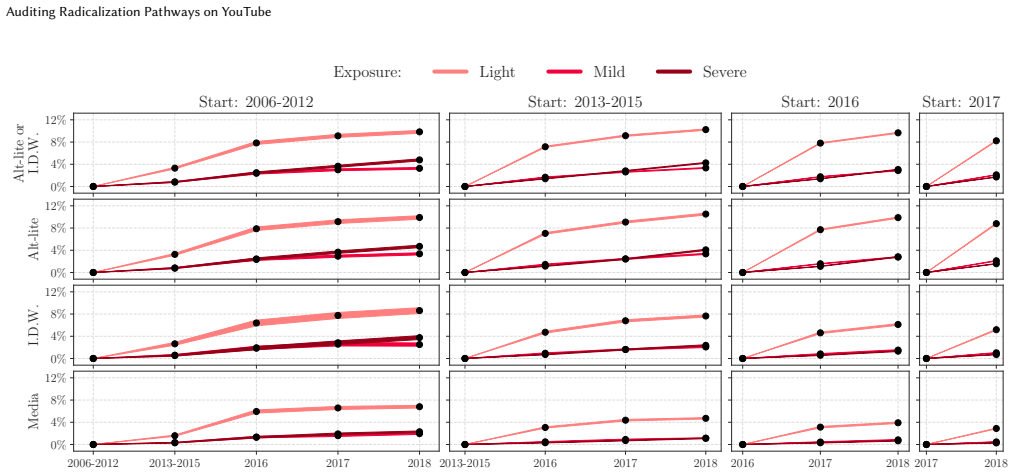
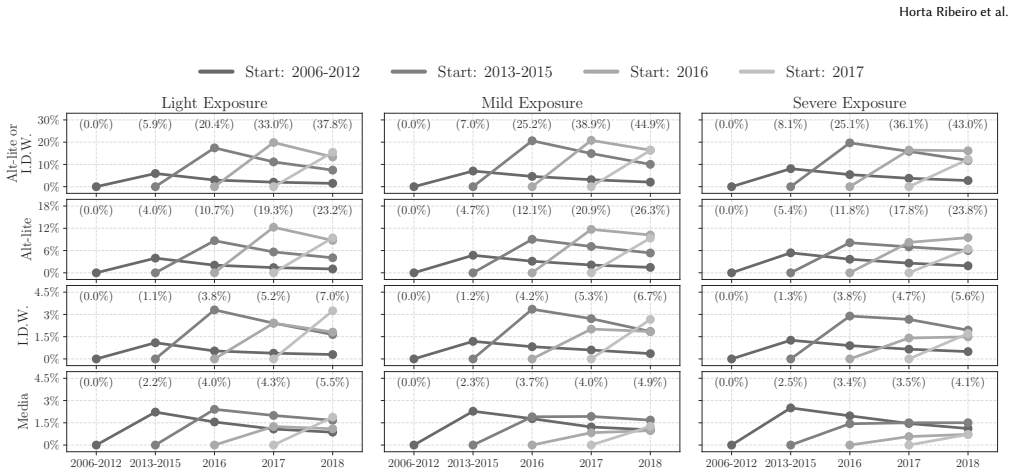
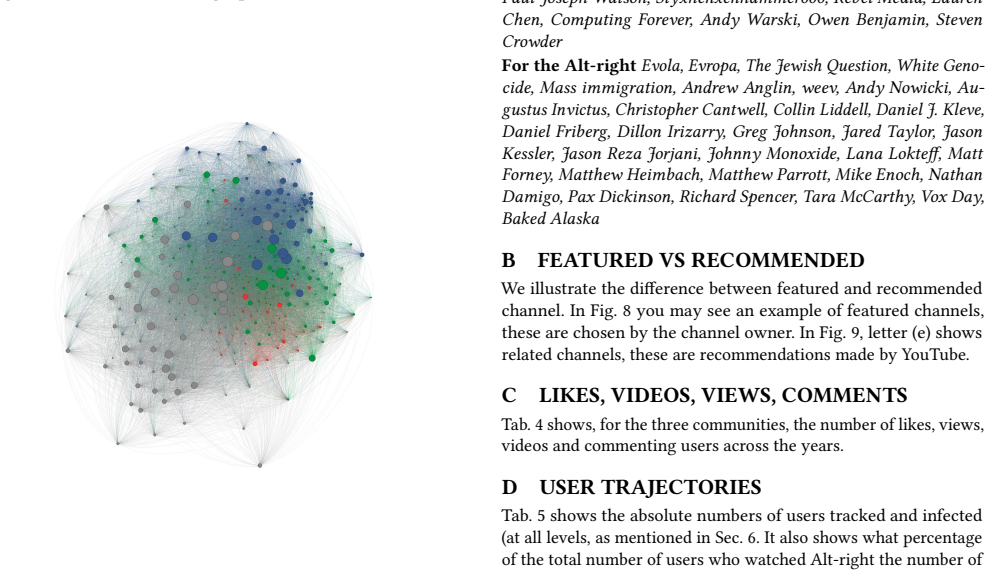
The central mechanism is cohort tracking of commenting users: users are classified by which communities they commented on in a baseline year, and their later first comments on Alt-right videos are counted as exposure, with severity measured by the number of Alt-right videos commented on (1-2 light, 3-5 mild, 6+ severe). This is paired with a recommendation-graph analysis in which channels and videos are nodes, recommendation edges are weighted by observed frequency, and random walks measure how easily a non-personalized walker reaches each community. Together the cohort trajectories and the random walks supply the evidence for the claimed pipeline.
What would settle it
One concrete check: an independent audit with actual watch histories (or a large logged-in panel) could measure whether users who watch Alt-right videos previously watched Alt-lite or I.D.W. videos at the rates the comment data imply; if the true prior-exposure rate among Alt-right viewers were far below the paper's migration percentages, the claim would fail. A cheaper check: re-run the 900-comment validation on the full 72M comment set and compare the share of hostile or critical comments; a share much larger than the observed 5 in 900 would break the proxy assumption.
Extended reading notes
Core claim
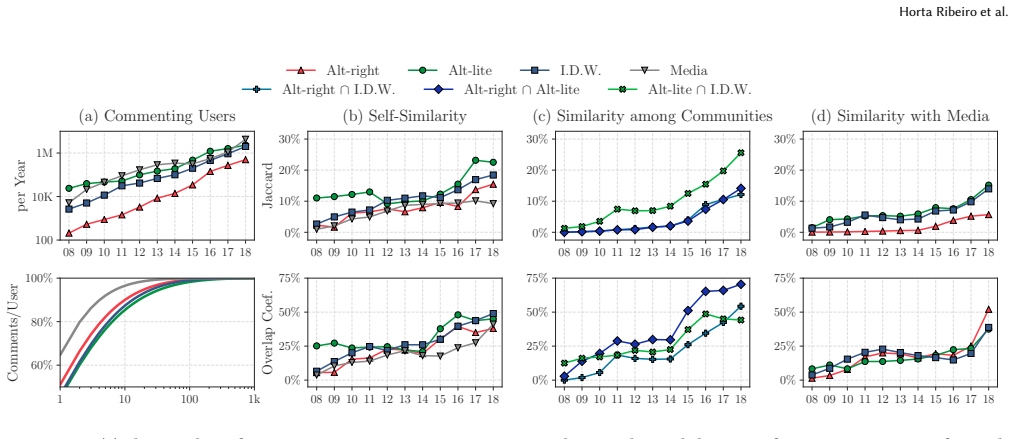
The central claim is that user radicalization on YouTube is measurable in comment data: users systematically migrate from milder to more extreme content, and a large share of those who comment on Alt-right content today previously commented only on Alt-lite or Intellectual Dark Web content. In 2018, roughly 40% of Alt-right commenters could be traced back to cohorts that had earlier commented exclusively on Alt-lite or I.D.W. videos, and consistently about one in ten tracked users who started in those milder communities later commented on Alt-right videos, with the most recent cohorts reaching about 12%. The recommendation audit adds that even without personalization, YouTube's channel recommendations let a random walker reach Alt-right channels from Alt-lite starts about 4% of the time within five steps, and Alt-lite channels are readily reachable from I.D.W. channels. The paper concludes that this is significant evidence that radicalization has occurred and continues on YouTube.
Load-bearing premise
The argument assumes that commenting on a video is a good proxy for consuming and supporting it; if many comments come from critics, bots, or casual passersby, the migration percentages would overstate real radicalization.
Editorial extensions
If this is right
- If the cohort analysis is right, user radicalization has a quantitative signature in comment histories, and the Alt-right audience is partly grown from adjacent communities rather than recruited from outside.
- If the recommendation graph reflects current platform behavior, even a logged-out, non-personalized user can be steered from I.D.W. to Alt-lite and from Alt-lite to Alt-right through channel recommendations alone.
- The Alt-lite, not the I.D.W., carries most of the migration: users who started on Alt-lite channels were roughly three times as likely to later comment on Alt-right content as users who started only on I.D.W. channels.
- Because media-channel users show far lower Alt-right exposure rates, the effect is specific to the studied communities rather than a general property of heavy YouTube commenters.
Reading between the lines
- If the paper is right, an obvious extension is to repeat the cohort analysis on viewing history or logged-in sessions; watch-time data would either confirm or bound the migration rates reported here.
- If the paper is right, the no-personalization recommendation result is a lower bound on algorithmic exposure; personalized recommendations could plausibly make the Alt-right path shorter, which would strengthen the RQ3 picture rather than weaken it.
- If the paper is right, the I.D.W. label may be doing less analytical work than expected: I.D.W.-only users resemble media users in their Alt-right exposure, so future audits should treat Alt-lite and I.D.W. separately rather than pooling them.
- If the paper is right, a testable consequence is that platform changes de-emphasizing channel recommendations between these communities should reduce the measured migration rate in a future replication, providing a natural experiment.
Signed reviews
Editorial analysis
A structured set of objections, weighed in public.
Referee Report
Summary. This paper reports an audit of YouTube radicalization pathways. The authors collect 349 channels classified into Media, Alt-lite, Intellectual Dark Web (I.D.W.), and Alt-right, together with 330,925 videos, over 72 million comments, and more than 2 million video and channel recommendations. They analyze channel growth and engagement (Sec. 4), the overlap of commenting user bases across communities (Sec. 5), and cohort-based user migration from milder to more extreme commenting behavior (Sec. 6). They also simulate random walks on recommendation graphs to assess whether Alt-lite and Alt-right channels are discoverable through YouTube's recommender system (Sec. 7). The paper concludes that users consistently migrate from milder to more extreme content and that this provides significant evidence of user radicalization on YouTube.
Significance. If the central migration claim holds, this is the first large-scale quantitative audit of the alleged YouTube radicalization pipeline and would be an important contribution to the debate about algorithmic amplification of fringe content. The study's strengths include its unusually large dataset, the inclusion of media channels as a baseline, the temporal cohort design with confidence intervals, and the multi-round, multi-location recommendation collection. These design choices go beyond most prior anecdotal work. However, the central claim depends on two unvalidated assumptions: that commenting is a reliable proxy for consumption and endorsement, and that the absence of observed Alt-right comments implies the absence of prior Alt-right consumption. Because the manuscript explicitly acknowledges these assumptions but does not bound their error, the headline quantitative results are conditional on assumptions that the paper does not fully support.
major comments (3)
- [Sec. 6, Figs. 3-4] The cohort labels 'commented only on Alt-lite or I.D.W.' are relative to the 349 collected channels, not to all of YouTube. Since YouTube does not provide full comment histories, a user who watched Alt-right videos without commenting, or commented on Alt-right channels outside the collected pool, is still classified as 'mild-only.' These users were already exposed to extreme content before the supposed migration, so the reported migration rates and the statement that roughly 40% of the Alt-right commenting base came from Alt-lite/I.D.W. cohorts overstate new radicalization by an unknown amount. The 900-comment validation in Sec. 8 addresses whether comments are supportive, not whether non-commenting implies non-consumption. Please provide a sensitivity analysis or otherwise bound the effect of unobserved consumption on Figs. 3 and 4.
- [Sec. 8, RQ2] The load-bearing assumption that 'commenting users are a good enough proxy for radicalization' is defended with 900 hand-checked comments and aggregate like ratios. This is a very small sample relative to 72 million comments, and the like ratios are channel-level aggregates, not per-user measures of endorsement. The manuscript does not show that the commenting behavior of the specific users in the migration cohorts tracks their viewing behavior. Since the abstract and Sec. 8 present the migration findings as evidence of radicalization, this proxy validation is insufficient. Please either provide per-user validation (e.g., a subsample of users whose viewing histories can be checked through other means) or reframe the conclusions as evidence about commenting migration rather than consumption-based radicalization.
- [Sec. 3 and Sec. 7] The channel pool used for both the migration analysis and the recommendation-graph simulations was partially discovered through YouTube's own search and recommended-channel functions, starting from seeds that include reports asserting the existence of a radicalization pipeline. This creates a circularity risk for the recommendation analysis in Sec. 7: the random-walk reachability of Alt-right channels may reflect the fact that the graph was built from channels that YouTube recommended from the initial seeds, rather than from an independent sampling of the platform. A concrete test would be to rerun the Sec. 7 simulations using only Type 1 seed channels, or to compare the recommendation graph against an independently constructed channel pool. Without such a test, the claim that YouTube's recommender provides a 'discoverable pathway' is not fully supported.
minor comments (4)
- [Sec. 8, first sentence] The phrase 'through analysis' should be 'thorough analysis.'
- [Sec. 7, last paragraph] The sentence 'Considering the sheer amount of views the channels in the Alt-lite, the I.D.W. and the Alt-lite' repeats 'Alt-lite' where the second occurrence should presumably be 'Alt-right.'
- [Appendix D, Tables 5 and 6] The terminology 'infected' is loaded and inconsistent with the neutral language used elsewhere in the paper; consider replacing it with 'exposed' or 'migrated.'
- [Fig. 3 caption] The caption states 'Initially, their exposure rates are 0 (as they did not consume any Alt-right content),' but the data only establish that they did not comment on Alt-right content in the collected channels; please adjust the wording to align with the observed data.
Circularity Check
No circular derivation: the migration and recommendation results are measured from comment histories and crawled recommendation edges, not derived from the radicalization hypothesis.
full rationale
The paper's central claims rest on direct measurements rather than on equations that reduce to their inputs. The user-migration analysis in Sec. 6 is computed from observed commenting behavior on the 349 collected channels: users are grouped by which communities they commented on in a start year and then followed across later years; the curves in Figs. 3 and 4 are empirical counts, not outputs of the radicalization hypothesis. The recommendation analysis in Sec. 7 uses independently crawled video and channel recommendation edges, and the distinction between channel and video recommendations (Alt-right reachable via channels but not videos) shows the result is not forced by the node-selection procedure. Channel labels are taken from external sources (ADL, Data & Society, the NYT I.D.W. article, and the unofficial I.D.W. website) rather than from the outcome variable. The acknowledged proxy assumption that commenting indicates consumption and support, defended with 900 manually checked comments and like ratios, is a measurement-validity argument, not a case where the conclusion is definitionally identical to the input. The unobserved-consumption limitation noted in Sec. 6 is a data-availability threat to validity, not circularity. No fitted parameter is renamed as a prediction, and the few self-citations (e.g., Ottoni et al. 2018) are background literature, not load-bearing. Thus no circular step can be exhibited, and the derivation is self-contained relative to the paper's stated assumptions.
Assumptions & free parameters
free parameters (4)
- Exposure thresholds for light/mild/severe Alt-right commenting =
1-2 / 3-5 / 6+ comments
- Random walk length =
5 steps
- Recommendation collection rounds =
22 channel rounds, 19 video rounds
- Keyword search depth =
first 200 results per keyword
assumptions (3)
- domain assumption Comments on a channel's videos indicate consumption and, with high probability, agreement with the content.
- domain assumption The 349 collected channels are a representative enough sample of each community that users who never comment in other sampled channels can be treated as only consuming the milder communities.
- domain assumption Community labels assigned by two annotators, with 75.57% agreement and consensus resolution, are accurate enough for the analysis.
Cite this review
Pith. "Pith review of Auditing Radicalization Pathways on YouTube." pith.science (2026). https://pith.science/paper/YIVDLWSE
@misc{pith2026190808313,
  author       = {Pith},
  title        = {Pith review of: Auditing Radicalization Pathways on YouTube},
  year         = {2026},
  howpublished = {\url{https://pith.science/paper/YIVDLWSE}},
  note         = {Machine review of arXiv:1908.08313}
}
read the original abstract
Non-profits, as well as the media, have hypothesized the existence of a radicalization pipeline on YouTube, claiming that users systematically progress towards more extreme content on the platform. Yet, there is to date no substantial quantitative evidence of this alleged pipeline. To close this gap, we conduct a large-scale audit of user radicalization on YouTube. We analyze 330,925 videos posted on 349 channels, which we broadly classified into four types: Media, the Alt-lite, the Intellectual Dark Web (I.D.W.), and the Alt-right. According to the aforementioned radicalization hypothesis, channels in the I.D.W. and the Alt-lite serve as gateways to fringe far-right ideology, here represented by Alt-right channels. Processing 72M+ comments, we show that the three channel types indeed increasingly share the same user base; that users consistently migrate from milder to more extreme content; and that a large percentage of users who consume Alt-right content now consumed Alt-lite and I.D.W. content in the past. We also probe YouTube's recommendation algorithm, looking at more than 2M video and channel recommendations between May/July 2019. We find that Alt-lite content is easily reachable from I.D.W. channels, while Alt-right videos are reachable only through channel recommendations. Overall, we paint a comprehensive picture of user radicalization on YouTube.
Figures

Figures from the paper (6 more)



Reference graph
Works this paper leans on
-
[1]
[n. d.]. Media Bias/Fact Check - Search and Learn the Bias of News Media. https://mediabiasfactcheck.com/
-
[2]
ADL. [n. d.]. Glossary Terms Alt-Right. https://www.adl.org/resources/glossary- terms/alt-right
- [3]
-
[4]
Swati Agarwal and Ashish Sureka. 2014. A Focused Crawler for Mining Hate and Extremism Promoting Videos on YouTube.. In Proceedings of the 25th ACM Conference on Hypertext and Social Media . ACM
work page 2014
-
[5]
Monica Anderson and Jingjing Jiang. 2018. Teens, Social Media & Technology 2018. Technical Report. Pew Research Center. https://www.pewinternet.org/2018/05/ 31/teens-social-media-technology-2018/
work page 2018
-
[7]
Anonymous. [n. d.]. The Intellectual Dark Web. https://web.archive.org/web/ 20190407170300/http://intellectualdark.website/
- [8]
-
[9]
Khaled A. Beydoun. 2018. US liberal Islamophobia is rising – and more insidious than rightwing bigotry | Khaled A Beydoun. The Guardian (2018). https://www.theguardian.com/commentisfree/2018/may/26/us-liberal- islamophobia-rising-more-insidious
work page 2018
Show all 46 references
-
[10]
Alt-Lite
Tyler Bridges. 2018. "Alt-Lite" Bloggers and the Conservative Ecosystem. https: //shorensteincenter.org/alt-lite-bloggers-conservative-ecosystem/
2018
-
[11]
Paul Covington, Jay Adams, and Emre Sargin. 2016. Deep Neural Networks for YouTube Recommendations. In Proceedings of the 10th ACM Conference on Recommender Systems (RecSys ’16) . ACM
2016
-
[12]
James Davidson, Benjamin Liebald, Junning Liu, Palash Nandy, Taylor Van Vleet, Ullas Gargi, Sujoy Gupta, Yu He, Mike Lambert, Blake Livingston, and Dasarathi Sampath. 2010. The YouTube Video Recommendation System. In Proceedings of the Fourth ACM Conference on Recommender Syst...
2010
-
[13]
Nicholas Diakopoulos. 2014. Algorithmic Accountability Reporting: On the Investigation of Black Boxes. (2014)
2014
-
[14]
Edelman and Michael Luca
Benjamin G. Edelman and Michael Luca. 2014. Digital Discrimination: The Case of Airbnb.com . Technical Report. Social Science Research Network. https: //papers.ssrn.com/abstract=2377353
2014
-
[15]
Foderaro
Lisa W. Foderaro. 2018. Alexandria Ocasio-Cortez Likens $10,000 De- bate Offer by Conservative Columnist to Catcalling. The New York Times (2018). https://www.nytimes.com/2018/08/10/nyregion/alexandria-ocasio- cortez-debate-catcalling-ben-shapiro.html
2018
-
[16]
Giannakopoulos, A
T. Giannakopoulos, A. Pikrakis, and S. Theodoridis. 2010. A Multimodal Approach to Violence Detection in Video Sharing Sites. In2010 20th International Conference on Pattern Recognition
2010
-
[17]
Rosie Gray. 2015. How 2015 Fueled The Rise Of The Freewheeling, White Nation- alist Alt- Movement. https://www.buzzfeednews.com/article/rosiegray/how- 2015-fueled-the-rise-of-the-freewheeling-white-nationali
2015
-
[18]
Keegan Hankes and Alex Amend. 2018. The Alt-Right is Killing People. https: //www.splcenter.org/20180205/alt-right-killing-people
2018
-
[19]
Aniko Hannak, Piotr Sapiezynski, Arash Molavi Kakhki, Balachander Krish- namurthy, David Lazer, Alan Mislove, and Christo Wilson. 2013. Measuring Personalization of Web Search. In Proceedings of the 22Nd International Confer- ence on World Wide Web. ACM
2013
-
[20]
Aniko Hannak, Gary Soeller, David Lazer, Alan Mislove, and Christo Wilson
-
[21]
Mathew Ingram. 2018. Most Americans say they have lost trust in the media. Columbia Journalism Review (2018). https://www.cjr.org/the_media_today/trust- in-media-down.php
2018
-
[22]
Brendan Joel Kelly. 2017. Lauren Southern: The alt-right’s Canadian dog whistler. https://www.splcenter.org/hatewatch/2017/11/07/lauren-southern-alt- right%E2%80%99s-canadian-dog-whistler
2017
-
[23]
Max Kutner. 2016. Roosh V’s journey from pickup artist to right-wing provoca- teur. Newsweek (2016). https://www.newsweek.com/2016/10/21/roosh-v-pickup- artist-right-wing-provocateur-509319.html
2016
-
[24]
Rebecca Lewis. 2018. Alternative influence: Broadcasting the reactionary right on YouTube. Technical Report. Data and Society
2018
-
[25]
Cristina Lopez G. 2019. Stefan Molyneux is MAGA Twitter’s favorite white nationalist. https://www.mediamatters.org/people/stefan-molyneux
2019
-
[26]
Tim Lott. 2017. Jordan Peterson and the transgender wars. https://life.spectator. co.uk/2017/09/jordan-peterson-and-the-transgender-wars/
2017
-
[27]
Alex Mann, Kevin Nguyen, and Katherine Gregory. 2019. ’Emperor Cottrell’: Accused Christchurch shooter had celebrated rise of the Australian far-right
2019
-
[28]
Andrew Marantz. 2017. The Alt-Right Branding War Has Torn the Movement in Two. (2017). https://www.newyorker.com/news/news-desk/the-alt-right- branding-war-has-torn-the-movement-in-two
2017
-
[29]
Clark McCauley and Sophia Moskalenko. 2008. Mechanisms of Political Radical- ization: Pathways Toward Terrorism. Terrorism and Political Violence (2008)
2008
-
[30]
Angela Nagle. 2017. Kill All Normies: Online Culture Wars From 4Chan And Tumblr To Trump And The Alt-Right
2017
-
[31]
Newman Nic, Richard Fletcher, Antonis Kalogeropoulos, David AL Levy, and Rasmus Kleis Nielsen. 2018. Reuters Institute Digital News Report 2018 . Technical Report. Reuters Institute for the Study of Journalism
2018
-
[32]
Raphael Ottoni, Evandro Cunha, Gabriel Magno, Pedro Bernardina, Wagner Meira Jr., and Virgílio Almeida. 2018. Analyzing Right-wing YouTube Channels: Hate, Violence and Discrimination. In Proceedings of the 10th ACM Conference on Web Science (WebSci ’18). ACM
2018
-
[33]
Derek O’Callaghan, Derek Greene, Maura Conway, Joe Carthy, and Pádraig Cunningham. 2015. Down the (White) Rabbit Hole: The Extreme Right and Online Recommender Systems. Social Science Computer Review (2015)
2015
-
[34]
Kostantinos Papadamou, Antonis Papasavva, Savvas Zannettou, Jeremy Black- burn, Nicolas Kourtellis, Ilias Leontiadis, Gianluca Stringhini, and Michael Siri- vianos. 2019. Disturbed YouTube for Kids: Characterizing and Detecting In- appropriate Videos Targeting Young Children. ...
2019 arXiv
-
[35]
PowerfulJRE. 2017. Sargon of Akkad - Joe Rogan Experience #979. https://web.archive.org/web/20190616134332/https://www.youtube.com/ watch?v=xrBCsLsSD2E
2017
-
[36]
Kevin Roose. 2019. The Making of a YouTube Radical. The New York Times (2019). https://www.nytimes.com/interactive/2019/06/08/technology/youtube-radical. html,https://www.nytimes.com/interactive/2019/06/08/technology/youtube- radical.html
2019
-
[37]
Roosh V. 2016. I Do Not Disavow Richard Spencer. https://web.archive.org/web/ 20190331073037/https://www.rooshv.com/i-do-not-disavow-richard-spencer
2016
-
[38]
Andrew Sellars. 2016. Defining Hate Speech. SSRN Scholarly Paper. Social Science Research Network. https://papers.ssrn.com/abstract=2882244
2016
-
[39]
Ashish Sureka, Ponnurangam Kumaraguru, Atul Goyal, and Sidharth Chhabra
-
[40]
The Rubin Report. 2018. Eric Weinstein: The Future of The Intellectual Dark Web. https://www.youtube.com/watch?v=tUl7-SvntQ4
2018
-
[41]
Zeynep Tufekci. 2018. YouTube, the Great Radicalizer. The New York Times (2018). https://www.nytimes.com/2018/03/10/opinion/sunday/youtube-politics- radical.html
2018
-
[42]
Bari Weiss and Damon Winter. 2018. Meet the Renegades of the Intellectual Dark Web. The New York Times (2018). https://www.nytimes.com/2018/05/08/opinion/ intellectual-dark-web.html
2018
-
[43]
Savvas Zannettou, Tristan Caulfield, Jeremy Blackburn, Emiliano De Cristofaro, Michael Sirivianos, Gianluca Stringhini, and Guillermo Suarez-Tangil. 2018. On the Origins of Memes by Means of Fringe Web Communities. In Proceedings of the Internet Measurement Conference 2018 . ACM
2018
-
[44]
Savvas Zannettou, Tristan Caulfield, Emiliano De Cristofaro, Nicolas Kourtelris, Ilias Leontiadis, Michael Sirivianos, Gianluca Stringhini, and Jeremy Blackburn
-
[2010]
In Information Retrieval Technology (Lecture Notes in Computer Science)
Mining YouTube to Discover Extremist Videos, Users and Hidden Commu- nities. In Information Retrieval Technology (Lecture Notes in Computer Science) . Springer Berlin Heidelberg
-
[2014]
In Proceedings of the 2014 Conference on Internet Measurement Conference (IMC ’14)
Measuring Price Discrimination and Steering on E-commerce Web Sites. In Proceedings of the 2014 Conference on Internet Measurement Conference (IMC ’14). ACM
2014
-
[2017]
In Proceedings of the 2017 Internet Measurement Conference
The Web Centipede: Understanding How Web Communities Influence Each Other Through the Lens of Mainstream and Alternative News Sources. In Proceedings of the 2017 Internet Measurement Conference . ACM. Horta Ribeiro et al. Figure 6: Recommendation graph of YouTube channels. Fig...
2017
Reviewed August 14, 2026 · model on record in the stance chip above.
Discussion (0). Continue with ORCID to comment.