REVIEW 3 major objections 6 minor 9 references
LEAP nets for power grid perturbations
T0 review · 3 major / 6 minor · reviewed 2026-08-14 · deepseek-v4-flash
Pith's one-line read The LEAP net predicts power flows for grid topologies never seen in training.
desk verdict A genuinely new latent-modulation architecture with real transfer results on power-flow approximation, but the super-generalization claim is only tested on weakly interacting topology pairs. read the letter →
The pith
A machine-rendered reading of the paper's core claim, the machinery that carries it, and where it could break.
The reading
What carries the argument
The load-bearing component is the latent module $L_\tau: h\mapsto d(e(h)\odot\tau)$, a learned transformation between encoder and decoder. For the reference topology $\tau_\emptyset$, the module contributes nothing and the network reduces to the unperturbed encoding-decoding path; for a nonzero topology vector, each active component multiplies the latent representation $e(h)$, and $d$ maps the product into a flow correction. This multiplicative form is what lets unseen combinations of changes be composed from learned unary leaps, which is the mechanism behind super-generalization.
What would settle it
Select pairs of unary changes with strongly nonlinear combined effects, such as adjacent substation splits that reroute the same bottleneck lines; train a LEAP net on unary changes only and compare its double-change flow predictions against a full AC simulator. If the model's double-change error is comparable to naive linear superposition while its unary errors are small, the latent multiplicative assumption is what failed.
Extended reading notes
Core claim
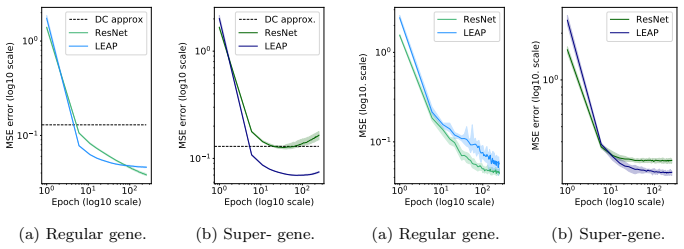
The paper's central claim is that LEAP nets exhibit super-generalization: trained on abundant data in the reference topology and a small number of examples per unary change, they predict flows for double changes without ever seeing a double-change example. The architecture is $\hat{y}=D\circ(I+L_\tau)\circ E(x)$ with $L_\tau: h\mapsto d(e(h)\odot\tau)$, so the topology vector acts by component-wise multiplication on the latent encoding of injections, and the result is added to the unperturbed prediction. The model thus learns only the modulation around the nominal operating point, and combining two changes is approximated by composing their latent multiplicative effects. Experiments on case118 show the LEAP net beating the DC linearization and the residual baseline on super-generalization, and the French-grid experiment shows transfer to future months with lower error than the baseline.
Load-bearing premise
The central assumption is that the combined effect of two or more topology changes on power flows can be captured by multiplying their individual effects in a learned latent space; if real grid interactions are strongly non-multiplicative, double changes will not be predictable from unary changes.
Editorial extensions
If this is right
- If the reported accuracy holds, LEAP nets screen curative topology actions at roughly 300 times the speed of the physical simulator on case118 and 2000 times on Toulouse-area data, bringing real-time assessment within reach.
- Training needs few examples per unary change and none for target domains, so the cost of exploring the exponential topology space is concentrated in the reference topology and single changes.
- The architecture is not tied to power grids: it applies to any system operated near a nominal state with sparse discrete perturbations, a form of transfer learning the paper explicitly anticipates.
- Tolerating line-outage surrogates means the method works with partial topology observability, the situation real operators face when exact substation configurations are not recorded.
Reading between the lines
- A sharper test the paper does not run: evaluate LEAP nets on triple and higher-order changes; if the multiplicative composition remains valid, error should grow slowly with change order rather than jump, supporting its use for screening large topology neighborhoods.
- The model's own latent representation suggests a diagnostic: for a double change, compare the latent leap against the product of the two unary leaps; pairs where the product fails will be exactly the points where power-flow nonlinearity defeats the architecture.
- Recording full substation configuration instead of line outages would likely improve accuracy further and would enable the DC-approximation comparison that is currently impossible on real data.
Signed reviews
Editorial analysis
A structured set of objections, weighed in public.
Referee Report
Summary. The paper proposes LEAP nets, a neural architecture for approximating the power-flow function y=S(x,τ). The network encodes the input x in a latent space and applies a topology-dependent multiplicative modulation, Lτ(h)=d(e(h)⊙τ), so that the LEAP net only needs to learn deviations from the reference topology. Training uses abundant data in the reference topology and relatively few data for unary topology changes; the central claim is 'super-generalization': the model predicts well for unseen double topology changes without having trained on them. The method is evaluated on the synthetic case118 benchmark, where it outperforms the DC approximation and a residual baseline, and on real French grid data (Toulouse area), where it outperforms the baseline on later-month test data. Reported speedups are approximately 300x (synthetic) and 2000x (real data).
Significance. The super-generalization concept is practically valuable for power-grid operators, who need rapid assessment of topology changes. The synthetic evaluation is carefully designed: 30 experimental repeats with error bars, comparison against the physics-based DC approximation and a neural baseline. The paper also honestly states some limitations, such as unrecorded real topologies and the use of line outages as a surrogate. However, the architecture's core assumption—that composition of topology changes is captured by component-wise multiplication in latent space—is only tested in a regime where pairs are mostly electrically distant, and the only theoretical statement is for linear submodules. The real-data result cannot discriminate topology transfer from load/seasonal transfer. The significance is therefore conditional on additional experiments that stress non-additive interactions and on a clearer theoretical or empirical characterization of when the multiplicative leap assumption holds.
major comments (3)
- [§3.1, Target dataset construction] The Target set of 1500 double actions is sampled uniformly from the 4950 pairs of the 100 unary actions. In an 118-node grid, uniformly random substation splits are usually electrically far apart, so their combined flow effect is close to the sum of individual effects. This regime does not discriminate between the LEAP architecture's multiplicative composition in Eq. (1) and a simple additive baseline; it therefore does not support the general claim of super-generalization to arbitrary unseen topology combinations. Please add experiments with electrically close or strongly coupled pairs (e.g., target pairs chosen by electrical distance, or adversarial pairs that maximize non-additivity) and report whether LEAP retains its advantage.
- [§4, Theoretical statement] The statement 'It can easily be proved that a LEAP net architecture with linear submodules d and D exhibits super-generalization with respect to linear superposition of perturbations' is not a proof of super-generalization for the nonlinear networks used in the experiments. For linear d and D, the map τ→d(e(h)⊙τ) is linear in τ, which is exactly the additive regime; the nonlinear case is asserted only on the basis of the random-pair experiment described in the previous comment. Please either supply the proof, state precisely the conditions under which it holds, and explicitly acknowledge that no guarantee is given for strong non-additive interactions, or add a targeted experiment that directly tests the multiplicative assumption (e.g., compare Lτij against a learned combination of Lτi and Lτj for interacting pairs).
- [§3.2, Real-data experiment] The paper states that 'actual grid topologies (specifying line interconnections) are not precisely recorded' and uses line outages as a surrogate for τ. In addition, the target domain (June–July 2017) differs from the source domain (2012–May 2017) not only in topology but also in load, generation mix, and seasonal patterns. The observed improvement of LEAP over the baseline on this dataset may therefore reflect transfer across time/load conditions rather than topology super-generalization. The claim in the abstract and conclusion that LEAP generalizes to 'new target domains' should be calibrated to this limitation, and the real-data experiment should be described as a test of temporal transfer with a topology proxy.
minor comments (6)
- [Abstract] The word 'architeture' is a typo for 'architecture', and the hyphen in 'cu-rative actions' should be removed.
- [§2] The sentence 'The overall arhitecture is given by' contains a typo: 'arhitecture' should be 'architecture'.
- [Reference [7]] The title of the Pan and Yang survey contains a typo: 'Knoweledge' should be 'Knowledge'.
- [Figure 3 caption] The caption says 'Neural nets trained with 15000 injections', but Section 3.1 specifies a training set of 150,000 rows (50,000 reference plus 100×1000 unary). Please correct the number or clarify what 'injections' refers to in the caption.
- [§3.1] The text reports 'dim x = 153 injections' for case118, which is not the standard bus count; please clarify how the 153 input features are defined (e.g., generator setpoints, loads, and reference bus angle).
- [§4, speedup claims] The speedup numbers (≈300x and ≈2000x) are reported without specifying the measurement protocol, such as hardware, batch size, or number of samples; please provide enough detail for reproducibility.
Circularity Check
No circularity: LEAP net's super-generalization is an empirical benchmark result, not a fitted or self-citational artifact.
full rationale
No significant circularity. The central claim—that LEAP nets trained on the reference topology and unary changes predict flows for unseen double changes—is evaluated against held-out target triplets (x, τ_ij, y) computed by the external Hades2 simulator and against held-out months on real RTE data; no target output is used to set the architecture or the trained weights. The multiplicative form Lτ: h → d(e(h)⊙τ) in Eq. (1) is an inductive-bias ansatz, not a quantity fitted to the double-change data: double changes appear only at test time. Self-citations to the authors' earlier work (refs [2,3]) are contextual and play no load-bearing role in the super-generalization claim. Section 4's statement that a LEAP net with linear d and D 'can easily be proved' to exhibit super-generalization under linear superposition is an algebraic identity of the architecture, and the paper explicitly rests the nonlinear case on the reported experiments, so it is an omitted proof sketch rather than a circular derivation. The skeptic's point about uniformly sampled double actions being electrically distant concerns the strength and coverage of the empirical evidence, not whether the prediction reduces by construction to the training data.
Assumptions & free parameters
free parameters (2)
- Neural network weights of E, D, Lτ =
learned via Adam on training triplets (x, τ, y)
- Training hyperparameters (learning rate, layer sizes, epochs) =
not fully reported; baseline optimized by cross-validation
assumptions (4)
- domain assumption Power flows y are a deterministic function S(x, τ) of injections and topology, computed by Kirchhoff's laws.
- domain assumption For each fixed topology, input vectors x are drawn i.i.d. from an unknown distribution.
- ad hoc to paper The effect of topology changes is expressible as a component-wise multiplicative modulation in a learned latent space: Lτ(h)=d(e(h)⊙τ).
- domain assumption In real data, line-outage information is a sufficient surrogate for true grid topology.
invented entities (1)
-
Latent leap module Lτ
Cite this review
Pith. "Pith review of LEAP nets for power grid perturbations." pith.science (2026). https://pith.science/paper/2YOR65XK
@misc{pith2026190808314,
  author       = {Pith},
  title        = {Pith review of: LEAP nets for power grid perturbations},
  year         = {2026},
  howpublished = {\url{https://pith.science/paper/2YOR65XK}},
  note         = {Machine review of arXiv:1908.08314}
}
read the original abstract
We propose a novel neural network embedding approach to model power transmission grids, in which high voltage lines are disconnected and reconnected with one-another from time to time, either accidentally or willfully. We call our architeture LEAP net, for Latent Encoding of Atypical Perturbation. Our method implements a form of transfer learning, permitting to train on a few source domains, then generalize to new target domains, without learning on any example of that domain. We evaluate the viability of this technique to rapidly assess cu-rative actions that human operators take in emergency situations, using real historical data, from the French high voltage power grid.
Figures


Reference graph
Works this paper leans on
-
[1]
O. Alsac and B. Stott. Optimal load flow with steady-state security. IEEE transactions on power apparatus and systems , PAS-93(3):745–751, 1974
work page 1974
- [2]
- [3]
-
[4]
K. He, X. Zhang, S. Ren, and J. Sun. Identity mappings in deep residual networks. In ECCV, pages 630–645. Springer, 2016
work page 2016
- [5]
-
[6]
T. Nguyen. Neural network load-flow. IEE Proceedings - Generation, Trans- mission and Distribution , 142:51–58(7), January 1995
work page 1995
-
[7]
S. J. Pan and Q. Yang. A survey on transfer learning. IEEE Transactions on Knoweledge and Data Engineering , 22(10):1345–1359, October 2010
work page 2010
-
[8]
N. Srivastava, G. E. Hinton, A. Krizhevsky, I. Sutskever, and R. Salakhut- dinov. Dropout: a simple way to prevent neural networks from overfitting. JMLR, 15(1):1929–1958, 2014
work page 1929
Show all 9 references
-
[9]
R. D. Zimmerman and et al. Matpower. IEEE Trans. on Power Systems , pages 12–19, 2011
2011
Reviewed August 14, 2026 · model on record in the stance chip above.
Discussion (0). Continue with ORCID to comment.