REVIEW 3 major objections 6 minor 44 references
LoRAS: An oversampling approach for imbalanced datasets
T0 review · 3 major / 6 minor · reviewed 2026-08-14 · deepseek-v4-flash
Pith's one-line read LoRAS oversampling generates synthetic minority points as convex combinations of noise-augmented neighbourhood points, and the paper claims this improves both F1 score and balanced accuracy over SMOTE and its extensions.
desk verdict LoRAS is a plausible new oversampling method with a real variance argument, but the benchmark supporting its headline claim is not fair to the baselines. read the letter →
The pith
A machine-rendered reading of the paper's core claim, the machinery that carries it, and where it could break.
The reading
What carries the argument
The load-bearing object is the shadowsample: each minority training point is copied and jittered with zero-mean Gaussian noise per feature, and the copies are assumed to remain on the latent data manifold. A LoRAS oversample is a random convex combination of $N_{\text{aff}}$ shadowsamples drawn from a $k$-nearest-neighbour neighbourhood, with positive Dirichlet-distributed weights summing to one; the paper justifies this as sampling from an $(|F|-1)$-dimensional plane that locally approximates the $|F|$-dimensional minority-class manifold. The variance identity $2(\sigma'^2+\sigma_B^2)/(|F|+1)$ is what carries the argument: averaging many noise-augmented points shrinks the estimator variance compared with SMOTE's two-point convex combination, so LoRAS points fall near the local mean instead of stretching toward outlier neighbours.
What would settle it
Take a synthetic minority class with a known local mean and variance, then generate SMOTE and LoRAS samples while sweeping the shadow-noise level $\sigma_B$. The predicted variance ordering is $\frac{2(\sigma'^2+\sigma_B^2)}{|F|+1} < \frac{2\sigma'^2}{3}$ only when $3\sigma_B^2 < (|F|-2)\sigma'^2$; observing LoRAS variance above SMOTE variance under that condition, or observing the F1/balanced-accuracy advantage persist when the condition is violated, would settle where the mechanism holds.
Extended reading notes
Core claim
The paper's central claim is that drawing synthetic minority samples from a locally approximated data manifold, rather than from line segments between raw samples, produces better classifiers because the synthetic points are more concentrated around the true local center of the minority class. The mathematical core is Theorem 1: treating a local minority sample as a shifted t-distribution with location parameter $\mu$, both SMOTE and LoRAS are unbiased estimators of $\mu$, but a LoRAS sample has per-feature variance $2(\sigma'^2+\sigma_B^2)/(|F|+1)$ while a SMOTE sample has variance $2\sigma'^2/3$; since SMOTE is the $|F|=2$ case of the same construction, the paper concludes that for $|F|>2$ LoRAS has lower variance. Empirically, using the best-performing classifier per dataset, LoRAS gives the highest average balanced accuracy (0.783) and F1 score (0.433) across the 14 datasets, compared with 0.775 and 0.352 for SMOTE, and the Wilcoxon signed-rank comparisons are significant at $\alpha=0.05$ for F1 score against every compared method.
Load-bearing premise
The argument stands on the assumption that small Gaussian noise keeps shadowsamples on the true minority-class manifold and that local minority samples are independent draws from a shifted t-distribution with a common mean; if the noise is large enough to leave the manifold, or the local draws are correlated, the variance advantage can disappear.
Editorial extensions
If this is right
- On tabular imbalanced data, LoRAS gives the best average F1 score and balanced accuracy among the compared methods, and unlike the tested SMOTE extensions it does not sacrifice one metric for the other.
- For datasets with imbalance ratios above 25:1, LoRAS raises average balanced accuracy and F1 score more than the other oversampling methods, with the largest relative gains on the most imbalanced datasets.
- For high-dimensional datasets, LoRAS yields the highest average F1 score and close-to-best balanced accuracy, though the balanced-accuracy margin over one extension is small.
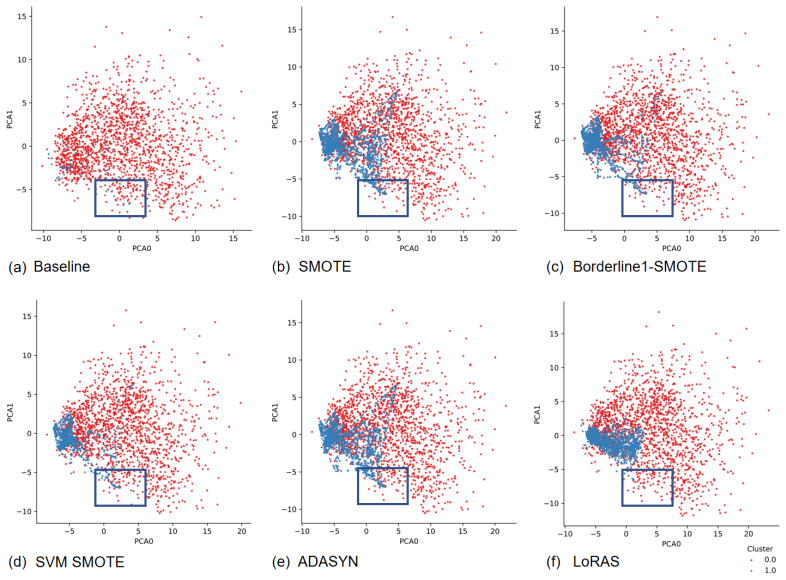
- Because a LoRAS sample estimates the local mean with lower variance, the method should produce synthetic minority points that are less prone to overgeneralizing into majority-class territory, which is the mechanism the paper links to fewer majority-class misclassifications.
- The statistical tests show the F1-score differences between LoRAS and each compared oversampling method are significant at the 0.05 level, with high effect-size ranks in favor of LoRAS.
Reading between the lines
- The paper states Theorem 1 as valid for $|F|>2$, but comparing the displayed variances shows the LoRAS advantage actually requires the additional small-noise condition $3\sigma_B^2 < (|F|-2)\sigma'^2$; without it, the added shadow noise can make LoRAS noisier than SMOTE.
- Not tested in the paper: LoRAS should also extend the framework of algorithms like Borderline-SMOTE or ADASYN by replacing their two-point interpolation step with multi-point affine combinations of shadowsamples, since the paper notes these extensions 'can also be built on the principle of LoRAS.'
- If the variance mechanism is the real driver, LoRAS should be most valuable exactly where SMOTE's two-point interpolation is most unstable: high-dimensional tabular data with sparse local neighbourhoods, where averaging many points stabilises the estimated local mean.
- A testable consequence of the manifold assumption: on synthetic data with a known low-dimensional manifold, the distance of LoRAS oversamples from the true manifold should stay small when the shadow noise is small, and should track the predicted variance formula as $\sigma_B$ grows.
Signed reviews
Editorial analysis
A structured set of objections, weighed in public.
Referee Report
Summary. The paper introduces LoRAS (Localized Random Affine Shadowsampling), an oversampling method for imbalanced classification. For each minority-class parent point, LoRAS generates 'shadowsamples' by adding small Gaussian noise to nearby minority samples, then produces synthetic points as random affine (convex) combinations of multiple shadowsamples, with neighborhoods optionally chosen in a t-SNE embedding. The authors benchmark LoRAS against SMOTE, Borderline-1/2 SMOTE, SVM-SMOTE, and ADASYN on 14 datasets with logistic regression, SVM, and kNN classifiers, reporting F1-Score and Balanced Accuracy. They report that LoRAS has the best average F1-Score and Balanced Accuracy, and they provide a mathematical proof (Theorem 1) intended to show that LoRAS is an unbiased estimator of the local mean of the minority-class distribution with lower variance than SMOTE.
Significance. If the empirical results held under a fair comparison protocol, the paper would make a useful contribution to the imbalanced-learning literature: the variance computation in Theorem 1 is a clean formalization of the intuition that averaging multiple noisy local samples reduces dispersion around the local mean. The benchmark is also unusually broad for this area, with 14 datasets, three classifiers, 5x10-fold stratified cross-validation, and non-parametric significance testing. The paper is honest about the limits of its mathematical framework relative to classification performance. However, the central empirical claim is currently weakened by an asymmetric tuning protocol, and the main theorem is incomplete as stated because it omits the small-noise condition needed for the variance comparison. These issues are load-bearing for the paper's two central assertions: the average performance advantage and the theoretical explanation of that advantage.
major comments (3)
- [Section 3.2 / Table 4] The headline comparison is not a fair test between algorithms. For LoRAS, the authors performed a per-dataset random grid search over Naff, embedding, and perplexity (Table 3 and the supplementary tables), while SMOTE, Borderline-1/2, SVM-SMOTE, and ADASYN were run with a fixed neighborhood rule and no equivalent tuning. Because the paper's central claim is the average F1-Score and Balanced Accuracy advantage reported in Table 4, the tuning budget given only to LoRAS can by itself produce the reported advantage; the experiments do not establish that LoRAS's manifold construction is superior. Please add a comparison in which all methods receive the same tuning budget (for example, randomized grid search over each method's key hyperparameters in an inner cross-validation loop), or report LoRAS with its default parameters alongside the tuned variants.
- [Section 5, Theorem 1 and Eq. (6)] The theorem as stated is false without an additional small-noise condition. Equation (6) gives Var(L_j) = 2(sigma'^2_j + sigma_Bj^2)/(|F|+1) for LoRAS, while the SMOTE variance is 2 sigma'^2 / 3. Comparing these two expressions yields Var(LoRAS) < Var(SMOTE) if and only if 3 sigma_Bj^2 < (|F|-2) sigma'^2_j. This condition is not stated in Theorem 1 and is not verified anywhere in the paper. Since L_sigma is set to a constant 0.005 for all features, the condition can fail on features with small local variance, in which case LoRAS has larger variance than SMOTE. Please add the condition to the theorem, check it empirically on the datasets, or qualify the theoretical claim accordingly.
- [Section 2 and Section 5] The mathematical explanation rests on assumptions that are neither tested nor connected to the observed classification gains. The proof assumes local minority samples are independent draws from a shifted t-distribution with a common mean (Eq. 2) and that adding Gaussian noise produces shadowsamples that still lie on the latent data manifold. Moreover, the abstract claims a proof that LoRAS 'provides a better estimate for the mean of the underlying local data distribution,' but the theorem only compares the variance of the generated samples around that mean; it does not establish that lower variance translates into higher F1-Score or Balanced Accuracy. I recommend stating explicitly that the mathematical result is an explanatory heuristic, and adding a direct check of the distributional assumptions or an experiment that varies sigma_B to demonstrate when the predicted variance advantage actually occurs.
minor comments (6)
- [Section 3.2 and Table 3] The stated neighborhood rule (5 if there are fewer than 100 minority samples, otherwise 30) is contradicted by Table 3, which lists a neighborhood size of 3 for ar1 and ar3; please clarify or correct the rule.
- [Introduction and Abstract] The Introduction says the approach was validated with 12 datasets, while the Abstract and Table 4 report 14 datasets; please unify the count.
- [Section 6] The text refers to an 'ar2' dataset in the Small datasets discussion, but the datasets introduced and listed in Table 2 are ar1 and ar3; this appears to be a typo.
- [Availability of code] The GitHub code is described as preliminary and does not include the t-embedding parameter, although t-embedding is used in many of the reported experiments; please release the full implementation or state explicitly which parts are missing.
- [Section 5, Eq. (5)] The index notation in the covariance computation (Cov[alpha_k S^j_k, alpha_l S^j_l] with j, k, l) is hard to follow and should be cleaned up for readability.
- [Table 6] No multiple-comparison correction is applied to the six paired Wilcoxon tests; with p-values close to 0.05 (e.g., 0.0479 for border-line-1 and SVM-SMOTE in the F1 comparison), the significance statement should be qualified accordingly.
Circularity Check
No significant circularity: Theorem 1 is a self-contained algebraic derivation from explicit distributional assumptions, and the benchmark comparisons are against external published methods.
full rationale
The paper's claimed first-principles result is Theorem 1 (Section 5), which asserts that LoRAS and SMOTE are unbiased estimators of the local mean and that the LoRAS estimator has lower variance for |F|>2. This claim is derived in the text: shadowsamples are defined as S = X + B with B ~ N(0, sigma_B^2), LoRAS samples are defined as Dirichlet-weighted convex combinations of |F| such shadowsamples, SMOTE is treated as the m=2 case with B=0, and Equations (3)-(6) compute E[S], Var[S], E[L], and Var(L_j) directly from these definitions and the stated shifted-t distributional assumption (Eq. 2). The variance comparison follows algebraically from these equations; the conclusion is not assumed in the premises. The empirical headline (Table 4) compares LoRAS against SMOTE and four SMOTE extensions using external, previously published algorithms and public datasets, so no fitted parameter is renamed as a prediction. Two genuine weaknesses exist, but they are not circularity: (i) the variance comparison requires the omitted small-noise condition 3*sigma_B^2 < (|F|-2)*sigma'^2 for LoRAS to beat SMOTE, so the theorem as stated is incomplete; and (ii) LoRAS's extra hyperparameters are tuned per dataset while the comparators are not, which is a benchmark-fairness threat to the empirical claim. Neither weakness makes the derivation equivalent to its inputs or reduces a prediction to a fit, so the circularity score is 0.
Assumptions & free parameters
free parameters (5)
- Naff (number of shadowsamples per affine combination) =
per-dataset, e.g., 10 for abalone19, 100 for arrhythmia, 179 for isolet (Table 3)
- t-SNE perplexity =
per-dataset from grid [0.01, 0.1, 1, 10, 30, 100], e.g., 10 for abalone19, 1 for arrhythmia, 30 for isolet
- Embedding type =
'regular' or 't-embedding' per dataset and model, e.g., 't' for abalone19, 'r' for webpage
- Lσ (noise standard deviation) =
0.005 for all features and datasets
- Oversampling neighborhood size k =
30 if |Cmin|>=100, else 5 (Table 3)
assumptions (5)
- domain assumption Local minority samples follow a shifted t-distribution with k degrees of freedom, location μ, and scaling σ.
- domain assumption Samples in the same k-neighborhood are independent.
- domain assumption Affine weights α are independent of the shadowsamples S.
- ad hoc to paper Shadowsamples lie on the latent data manifold because the added Gaussian noise has low variance.
- domain assumption An |F|-dimensional manifold can be locally approximated by an (|F|-1)-dimensional plane containing |F| affinely independent shadowsamples.
invented entities (1)
-
Shadowsample
Cite this review
Pith. "Pith review of LoRAS: An oversampling approach for imbalanced datasets." pith.science (2026). https://pith.science/paper/NKEXBYJL
@misc{pith2026190808346,
  author       = {Pith},
  title        = {Pith review of: LoRAS: An oversampling approach for imbalanced datasets},
  year         = {2026},
  howpublished = {\url{https://pith.science/paper/NKEXBYJL}},
  note         = {Machine review of arXiv:1908.08346}
}
read the original abstract
The Synthetic Minority Oversampling TEchnique (SMOTE) is widely-used for the analysis of imbalanced datasets. It is known that SMOTE frequently over-generalizes the minority class, leading to misclassifications for the majority class, and effecting the overall balance of the model. In this article, we present an approach that overcomes this limitation of SMOTE, employing Localized Random Affine Shadowsampling (LoRAS) to oversample from an approximated data manifold of the minority class. We benchmarked our algorithm with 14 publicly available imbalanced datasets using three different Machine Learning (ML) algorithms and compared the performance of LoRAS, SMOTE and several SMOTE extensions that share the concept of using convex combinations of minority class data points for oversampling with LoRAS. We observed that LoRAS, on average generates better ML models in terms of F1-Score and Balanced accuracy. Another key observation is that while most of the extensions of SMOTE we have tested, improve the F1-Score with respect to SMOTE on an average, they compromise on the Balanced accuracy of a classification model. LoRAS on the contrary, improves both F1 Score and the Balanced accuracy thus produces better classification models. Moreover, to explain the success of the algorithm, we have constructed a mathematical framework to prove that LoRAS oversampling technique provides a better estimate for the mean of the underlying local data distribution of the minority class data space.
Figures

Reference graph
Works this paper leans on
-
[1]
A. Aditsania , Adiwijaya , and A. L. Saonard . Handling imbalanced data in churn prediction using adasyn and backpropagation algorithm. In 2017 3rd International Conference on Science in Information Technology (ICSITech), pages 533--536, 2017. doi: https://doi.org/10.1109/ICSITech.2017.8257170
-
[2]
A Study of Synthetic Oversampling for Twitter Imbalanced Sentiment Analysis
Julien Ah-Pine, Edmundo-Pavel Soriano-Morales, and Edmundo Pavel Soriano Morales . A Study of Synthetic Oversampling for Twitter Imbalanced Sentiment Analysis . In Workshop on Interactions between Data Mining and Natural Language Processing (DMNLP 2016), volume 1646, pages 17--24, 2016
work page 2016
-
[3]
An approach for classification of highly imbalanced data using weighting and undersampling
Ashish Anand, Ganesan Pugalenthi, Gary Fogel, and Ponnuthurai Suganthan. An approach for classification of highly imbalanced data using weighting and undersampling. Amino acids, 39: 0 1385--91, 11 2010. doi:10.1007/s00726-010-0595-2
-
[4]
Monirul Islam, Xin Yao, and Kazuyuki Murase
Sukarna Barua, Md. Monirul Islam, Xin Yao, and Kazuyuki Murase. Mwmote--majority weighted minority oversampling technique for imbalanced data set learning. IEEE Transactions on Knowledge and Data Engineering, 26 0 (2): 0 405--425, Feb, 2014. doi: https://doi.org/10.1109/TKDE.2012.232 , ISSN: 1041-4347
-
[5]
Manifold-based synthetic oversampling with manifold conformance estimation
C Bellinger, C Drummond, and N Japkowicz. Manifold-based synthetic oversampling with manifold conformance estimation. Machine Learning, 107: 0 605--637, 2018. doi: https://doi.org/10.1007/s10994-017-5670-4
-
[6]
Beyond the boundaries of smote
Colin Bellinger, Christopher Drummond, and Nathalie Japkowicz. Beyond the boundaries of smote. In Paolo Frasconi, Niels Landwehr, Giuseppe Manco, and Jilles Vreeken, editors, Machine Learning and Knowledge Discovery in Databases, pages 248--263, Cham, 2016. Springer International Publishing
work page 2016
-
[7]
Smote for high-dimensional class-imbalanced data
Rok Blagus and Lara Lusa. Smote for high-dimensional class-imbalanced data. BMC Bioinformatics, 14 0 (1): 0 106, Mar 2013. doi: https://doi.org/10.1186/1471-2105-14-106, ISSN: 1471-2105
-
[8]
Chumphol Bunkhumpornpat, Krung Sinapiromsaran, and Chidchanok Lursinsap. Safe-level-smote: Safe-level-synthetic minority over-sampling technique for handling the class imbalanced problem. In Advances in Knowledge Discovery and Data Mining, Lecture notes in Computer Science, volume 5476, pages 475--482. Springer, 2009. doi: https://doi.org/10.1007/978-3-64...
Show all 44 references
-
[9]
A. M. Carvalho and R. C. Prati . Improving knn classification under unbalanced data. a new geometric oversampling approach. In 2018 International Joint Conference on Neural Networks (IJCNN), pages 1--6, July 2018. doi:10.1109/IJCNN.2018.8489411
2018
-
[10]
N. V. Chawla, K. W. Bowyer, L. O. Hall, and W. P. Kegelmeyer. Smote: Synthetic minority over-sampling technique. Journal of Artificial Intelligence Research, 16: 0 321--335, 2002. doi: https://doi.org/10.1613/jair.953
2002 doi
-
[11]
SMOTEBoost: Improving Prediction of the Minority Class in Boosting
Nitesh V Chawla, Aleksandar Lazarevic, Lawrence O Hall, and Kevin Bowyer. SMOTEBoost: Improving Prediction of the Minority Class in Boosting . In European Conference on Principles of Data Mining and Knowledge Discovery, pages 107--119, 2003. doi: https://doi.org/10.1007/978-3-...
2003 doi
-
[12]
Extreme anomalous oversampling technique for class imbalance
C Chiamanusorn and K Sinapiromsaran. Extreme anomalous oversampling technique for class imbalance. In Proceedings of the 2017 International Conference on Information Technology, ICIT 2017, pages 341--345, New York, NY, USA, 2017. ACM. ISBN 978-1-4503-6351-8. doi:10.1145/317665...
2017
-
[13]
Credit card fraud detection: A realistic modeling and a novel learning strategy
Andrea Dal Pozzolo, Giacomo Boracchi, Olivier Caelen, Cesare Alippi, and Gianluca Bontempi. Credit card fraud detection: A realistic modeling and a novel learning strategy. IEEE Transactions on Neural Networks and Learning Systems, 29: 0 1--14, 09 2017. doi: https://doi.org/10...
2017
-
[14]
The relationship between precision-recall and roc curves
Jesse Davis and Mark Goadrich. The relationship between precision-recall and roc curves. In Proceedings of the 23rd International Conference on Machine Learning, ICML '06, pages 233--240, New York, NY, USA, 2006. ACM. ISBN 1-59593-383-2. doi:10.1145/1143844.1143874. URL http:/...
2006
-
[15]
Diversified Ensemble Classifiers for Highly Imbalanced Data Learning and Its Application in Bioinformatics
Zejin Ding. Diversified Ensemble Classifiers for Highly Imbalanced Data Learning and Its Application in Bioinformatics. PhD thesis, Georgia State University, Atlanta, GA, USA, 2011. ISBN: 978-1-267-04661-1
2011
-
[16]
Geometric smote a geometrically enhanced drop-in replacement for smote
Georgios Douzas and Fernando Bacao. Geometric smote a geometrically enhanced drop-in replacement for smote. Information Sciences, 501: 0 118 -- 135, 2019. ISSN 0020-0255. doi:https://doi.org/10.1016/j.ins.2019.06.007. URL http://www.sciencedirect.com/science/article/pii/S00200...
2019 doi
-
[17]
Classification of Imbalance Data using Tomek Link (T-Link) Combined with Random Under-sampling (RUS) as a Data Reduction Method
T Elhassan, M Aljurf, F Al-Mohanna, and M Shoukri. Classification of Imbalance Data using Tomek Link (T-Link) Combined with Random Under-sampling (RUS) as a Data Reduction Method . Global Journal of Technology and Optimization, 1: 0 2--11, 2016. doi: https://doi.org/10.21767/2...
2016
-
[18]
Ming Gao, Xia Hong, Sheng Chen, and Chris J. Harris. On combination of SMOTE and particle swarm optimization based radial basis function classifier for imbalanced problems . In The 2011 International Joint Conference on Neural Networks, pages 1146--1153. IEEE, Jul, 2011. doi: ...
2011
-
[19]
Gosain and S
A. Gosain and S. Sardana . Handling class imbalance problem using oversampling techniques: A review. In 2017 International Conference on Advances in Computing, Communications and Informatics (ICACCI), pages 79--85, Sep 2017. doi: https://doi.org/10.1109/ICACCI.2017.8125820 , I...
2017
-
[20]
Adasyn: Adaptive synthetic sampling approach for imbalanced learning
He Haibo, Bai Yang, E Garcia, and Li Shutao. Adasyn: Adaptive synthetic sampling approach for imbalanced learning. In 2008 IEEE International Joint Conference on Neural Networks, June, 2008. doi: https://doi.org/10.1109/IJCNN.2008.4633969 , ISBN: 2161-4393
2008
-
[21]
Borderline-smote: A new over-sampling method in imbalanced data sets learning
Hui Han, Wen-Yuan Wang, and Bing-Huan Mao. Borderline-smote: A new over-sampling method in imbalanced data sets learning. In Advances in Intelligent Computing. ICIC, volume 3644, pages 878--887. Springer Berlin Heidelberg, 2005. doi: https://doi.org/10.1007/1153805\_91, ISBN: ...
2005 doi
-
[22]
SMOTE Bagging Algorithm for Imbalanced Dataset in Logistic Regression Analysis (Case: Credit of Bank X)
Fithria Siti Hanifah, Hari Wijayanto, and Anang Kurnia. SMOTE Bagging Algorithm for Imbalanced Dataset in Logistic Regression Analysis (Case: Credit of Bank X) . Applied Mathematical Sciences, 9 0 (138): 0 6857--6865, 2015. doi: https://doi.org/10.12988/ams.2015.58562 , ISSN: ...
2015
-
[23]
Geoffrey E Hinton and Sam T. Roweis. Stochastic neighbor embedding. In S. Becker, S. Thrun, and K. Obermayer, editors, Advances in Neural Information Processing Systems 15, pages 857--864. MIT Press, 2003. URL http://papers.nips.cc/paper/2276-stochastic-neighbor-embedding.pdf
2003
-
[24]
B2fse framework for high dimensional imbalanced data: A case study for drug toxicity prediction
Nishtha Hooda, Seema Bawa, and Prashant Singh Rana. B2fse framework for high dimensional imbalanced data: A case study for drug toxicity prediction. Neurocomputing, 276: 0 31 -- 41, 2018. ISSN 0925-2312. doi:https://doi.org/10.1016/j.neucom.2017.04.081. URL http://www.scienced...
2018 doi
-
[25]
MSMOTE: Improving Classification Performance when Training Data is imbalanced
Shengguo Hu, Yanfeng Liang, Lintao Ma, and Ying He. MSMOTE: Improving Classification Performance when Training Data is imbalanced . In Second International Workshop on Computer Science and Engineering, volume 2, pages 13--17, Jan, 2009. doi: https://doi.org/10.1109/WCSE.2009.7...
2009 doi
-
[26]
Simon D. Jackman. Bayesian analysis for the social sciences. WILEY, 2009. doi: https://doi.org/10.1002/9780470686621, ISBN: 9780470011546
2009 doi
-
[27]
Jing , X
X. Jing , X. Zhang , X. Zhu , F. Wu , X. You , Y. Gao , S. Shan , and J. Yang . Multiset feature learning for highly imbalanced data classification. IEEE Transactions on Pattern Analysis and Machine Intelligence, pages 1--1, 2019. ISSN 1939-3539. doi:10.1109/TPAMI.2019.2929166
2019
-
[28]
Visualizing data using t-SNE
D Kobak and P Berens. Visualizing data using t-SNE . Nature Communications, 10, 2019. doi: https://10.1038/s41467-019-13056-x
2019 doi
-
[29]
Smote-variants: A python implementation of 85 minority oversampling techniques
György Kovács. Smote-variants: A python implementation of 85 minority oversampling techniques. Neurocomputing, 366: 0 352 -- 354, 2019. ISSN 0925-2312. doi:https://doi.org/10.1016/j.neucom.2019.06.100. URL http://www.sciencedirect.com/science/article/pii/S0925231219311622
2019 doi
-
[30]
A hybrid approach using oversampling technique and cost-sensitive learning for bankruptcy prediction
T Le, M Thanh Vo, B Vo, Y Lee, and W Baik. A hybrid approach using oversampling technique and cost-sensitive learning for bankruptcy prediction. Complexity, 2019, 03 2019. doi: https://10.1155/2019/8460934
2019 doi
-
[31]
Noisy replication in skewed binary classification
Sauchi Stephen Lee. Noisy replication in skewed binary classification. Comput. Stat. Data Anal., 34 0 (2): 0 165--191, August 2000. ISSN 0167-9473. doi:10.1016/S0167-9473(99)00095-X. URL http://dx.doi.org/10.1016/S0167-9473(99)00095-X. doi: https://10.1016/S0167-9473(99)00095-X
-
[32]
Guillaume Lema \^i tre, Fernando Nogueira, and Christos K. Aridas. Imbalanced-learn: A Python Toolbox to Tackle the Curse of Imbalanced Datasets in Machine Learning . Journal of Machine Learning Research, 18: 0 559--563, Jan, 2017. ISSN: 1532-4435
2017
-
[33]
Abd Elrahman and Ajith Abraham
Shaza M. Abd Elrahman and Ajith Abraham. A review of class imbalance problem. Journal of Network and Innovative Computing, 1: 0 332--340, 2013. ISSN: 2160-2174
2013
-
[34]
Kernel-based smote for svm classification of imbalanced datasets
Josey Mathew, Ming Luo, Chee Khiang Pang, and Hian Leng Chan. Kernel-based smote for svm classification of imbalanced datasets. In IECON 2015 - 41st Annual Conference of the IEEE Industrial Electronics Society, pages 001127--001132. IEEE, Nov, 2015. doi: https://doi.org/10.110...
2015
-
[35]
A pruning-based approach for searching precise and generalized region for synthetic minority over-sampling
Kamthorn Puntumapon and Kitsana Waiyamai. A pruning-based approach for searching precise and generalized region for synthetic minority over-sampling. In Advances in Knowledge Discovery and Data Mining, pages 371--382, Berlin, Heidelberg, 2012. Springer Berlin Heidelberg
2012
-
[36]
Smote-frst: A new resampling method using fuzzy rough set theory
Enislay Ramentol, Nele Verbiest, Rafael Bello, Yaile Caballero, Chris Cornelis, and Francisco Herrera. Smote-frst: A new resampling method using fuzzy rough set theory. In World Scientific Proceedings Series on Computer Engineering and Information Science, volume 7, pages 800-...
2012 doi
-
[37]
Saez, Bartosz Krawczyk, and Micha Wo\' z niak
Jos\' e A. Saez, Bartosz Krawczyk, and Micha Wo\' z niak. Analyzing the oversampling of different classes and types of examples in multi-class imbalanced datasets. Pattern Recognition, 57: 0 164--178, 2016. doi: https://doi.org/10.1016/j.patcog.2016.03.012, ISBN: 978-1-267-04661-1
2016 doi
-
[38]
The precision-recall plot is more informative than the roc plot when evaluating binary classifiers on imbalanced datasets
Takaya Saito and Marc Rehmsmeier. The precision-recall plot is more informative than the roc plot when evaluating binary classifiers on imbalanced datasets. PLOS ONE, 10: 0 1--21, 03 2015. URL https://doi.org/10.1371/journal.pone.0118432. doi: https://doi.org/10.1371/journal.p...
2015 doi
-
[39]
Synthetic over sampling methods for handling class imbalanced problems : A review
B Santoso, H Wijayanto, K A Notodiputro, and B Sartono. Synthetic over sampling methods for handling class imbalanced problems : A review. IOP Conference Series: Earth and Environmental Science , 58: 0 012--031, Mar 2017. doi: https://doi.org/10.1088/1755-1315/58/1/012031, ISS...
2017 doi
-
[40]
A comparison of oversampling methods on imbalanced topic classification of korean news articles
Yirey Suh, Jaemyung Yu, Jonghoon Mo, Leegu Song, and Cheongtag Kim. A comparison of oversampling methods on imbalanced topic classification of korean news articles. Journal of Cognitive Science, 18: 0 391--437, 2017
2017
-
[41]
Visualizing data using t-SNE
Laurens van der Maaten and Geoffrey Hinton. Visualizing data using t-SNE . Journal of Machine Learning Research, 9: 0 2579--2605, 2008. url: http://www.jmlr.org/papers/v9/vandermaaten08a.html
2008
-
[42]
Varmedja , M
D. Varmedja , M. Karanovic , S. Sladojevic , M. Arsenovic , and A. Anderla . Credit card fraud detection - machine learning methods. In 2019 18th International Symposium INFOTEH-JAHORINA (INFOTEH), pages 1--5, March 2019. doi: https://10.1109/INFOTEH.2019.8717766
2019
-
[43]
A hybrid classifier combining SMOTE with PSO to estimate 5-year survivability of breast cancer patients
Kung-Jeng Wang, Bunjira Makond, Kun-Huang Chen, and Kung-Min Wang. A hybrid classifier combining SMOTE with PSO to estimate 5-year survivability of breast cancer patients . Applied Soft Computing, 20: 0 15--24, Jul, 2014. doi: https://doi.org/10.1016/J.ASOC.2013.09.014 , ISSN:...
2014 doi
-
[44]
Young, Ii, Scott L
William A. Young, Ii, Scott L. Nykl, Gary R. Weckman, and David M. Chelberg. Using voronoi diagrams to improve classification performances when modeling imbalanced datasets. Neural Comput. Appl., 26 0 (5): 0 1041--1054, July 2015. ISSN 0941-0643. doi:10.1007/s00521-014-1780-0....
2015 doi
Reviewed August 14, 2026 · model on record in the stance chip above.
Discussion (0). Continue with ORCID to comment.