REVIEW 3 major objections 4 minor 49 references
Encounter rates between bacteria and small sinking particles
T0 review · 3 major / 4 minor · reviewed 2026-08-14 · deepseek-v4-flash
Pith's one-line read Shear around small sinking particles reorients elongated bacteria so strongly that non-motile rods lose encounters by the square of their aspect ratio, while motile rods gain a leeward interception hotspot at comparable sinking and…
desk verdict A careful mechanistic study of microbial encounter with sinking particles, with an experimentally supported alpha^-2 screening result for rods; the motile-cell flux calculation looks faulty and the reported twofold focusing gain may be overstated. read the letter →
The pith
A machine-rendered reading of the paper's core claim, the machinery that carries it, and where it could break.
The reading
What carries the argument
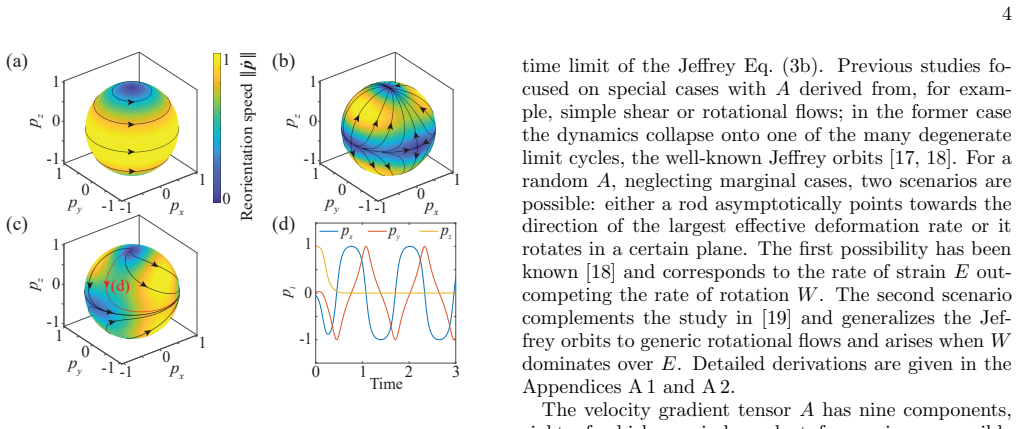
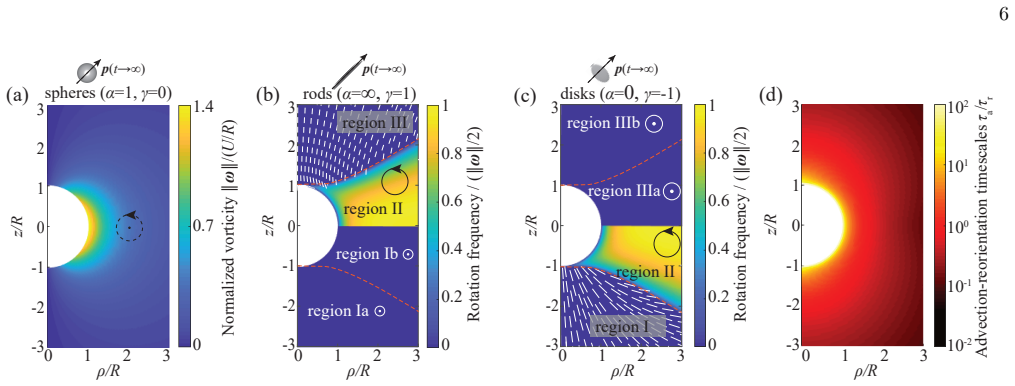
The load-bearing object is the Jeffery equation for the orientation vector $\mathbf p$ of a rigid ellipsoid in a linear flow, $\dot{\mathbf p}=(\mathbf I-\mathbf p\mathbf p^T)(\gamma\mathbf E+\mathbf W)\mathbf p$, where $\mathbf E$ and $\mathbf W$ are the strain-rate and rotation tensors of the ambient flow and $\gamma=(\alpha^2-1)/(\alpha^2+1)$ encodes the aspect ratio $\alpha$; spheres have $\gamma=0$, perfect rods $\gamma=1$. The paper combines this with the Stokes velocity field and its velocity gradient around a sinking sphere, and reduces the encounter problem to a phase-space classification of that gradient: when the weighted gradient $\gamma\mathbf E+\mathbf W$ has three real eigenvalues, a rod points along the eigenvector of the largest eigenvalue; when it has one real negative eigenvalue, the rod rotates on a limiting great circle. The spatial regions of these behaviours upstream and downstream of the particle are exactly what produce hydrodynamic screening and focusing. The machinery converts a computationally heavy many-trajectory problem into a local orientational rule, whose consequences for encounter efficiency and landing position are then integrated over initial positions.
What would settle it
A decisive check would be a direct measurement of the ballistic encounter efficiency of stiff non-motile rods with a sinking sphere: for aspect ratio $\alpha=10$ and particle-to-rod size ratio $R/\ell_b=100$, the paper predicts $\eta_{\rm rods}=\eta_{\rm spheres}/100$, i.e., a collision radius set by the rod width, not its length. If the measured efficiency instead matches the sphere value based on the rod length, the screening mechanism underlying the central claim is wrong.
Extended reading notes
Core claim
On its own terms, the paper's discovery is that the orientational dynamics of nonspherical microorganisms cannot be averaged away in the ballistic encounter problem: a sphere in a Stokes flow simply rotates around the local vorticity, but an elongated rod or a flat disk is driven by the strain and rotation parts of the same velocity gradient to position-dependent asymptotic orientations, breaking the fore-aft symmetry that spherical-colloid filtration theory relies on. Applying the Jeffery equation to the Stokes flow around a sinking sphere, the paper classifies space into regions where strain aligns rods radially, where vorticity spins them, and where compression screens them. This classification implies two population-level mechanisms. Upstream of the particle, shear aligns a rod's long axis tangentially to the surface, so a non-motile rod is carried past the particle with its short dimension facing the collector, cutting the effective collision radius by a factor $\alpha$ and the encounter efficiency by $\alpha^2$. Downstream, shear can rotate swimming rods back toward the surface, producing a leeward attachment hotspot and, for sinking speeds comparable to swimming speeds, an encounter efficiency around two to three times the geometric swept volume. For fast-sinking particles the upstream screening dominates and the motile encounter efficiency can fall orders of magnitude below the non-motile level; rotational diffusion softens but does not erase these effects. Oblate disks behave oppositely, tumbling so their full diameter faces the collector.
Load-bearing premise
The model assumes a bacterium is a rigid, inertia-free ellipsoid that is carried by the flow the sinking particle would create in its absence, with any geometric touch of the rod counting as a capture; it neglects hydrodynamic forces near the particle surface, lubrication effects, flow disturbances from flagella, and any modification of the ambient flow by the swimmer.
Editorial extensions
If this is right
- For non-motile rod-shaped bacteria, the ballistic encounter efficiency obeys $\eta_{\rm rods}=\eta_{\rm spheres}/\alpha^2$, while disks keep the spherical efficiency; over a broad size range, disks are the most efficient non-motile shapes for intercepting sinking particles and rods the least.
- Motile elongated bacteria should attach preferentially to the leeward side of sinking particles: in the quasi-ballistic marine parameter range the model gives more than 75% of interceptions on the leeward hemisphere for small, slow particles, and a fivefold concentration near the downstream stagnation point.
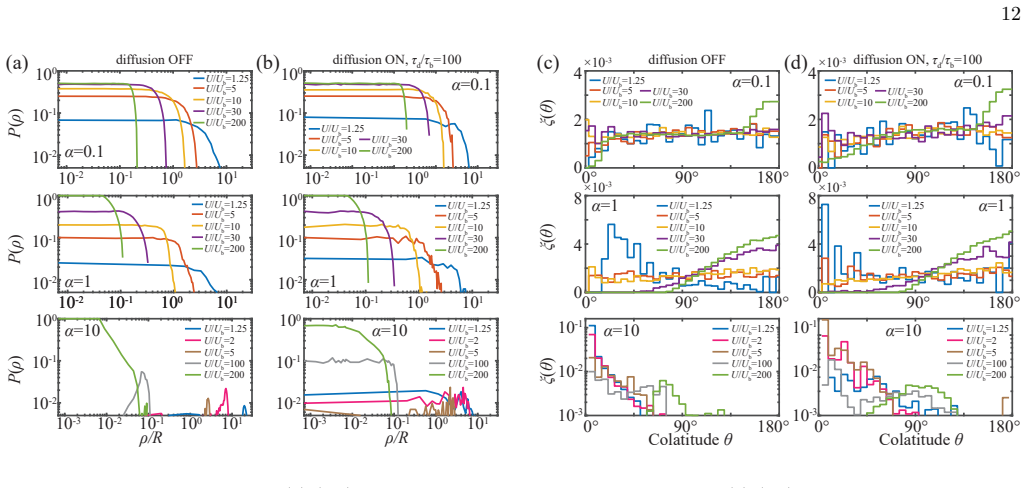
- For particles sinking ten to a hundred times faster than a bacterium swims, shear-induced screening can reduce motile encounter efficiencies by orders of magnitude below the non-motile rate, and for very fast bubbles motility may confer no encounter advantage at all.
- Classical diffusive encounter models overestimate encounter rates for particles of tens to hundreds of microns by up to two orders of magnitude; the overestimate persists for the most abundant marine particle sizes, and accounting for shear reduces the motility enhancement from roughly 100-1000-fold to roughly 10-100-fold in that range.
- Hydrodynamic focusing and screening give a physical explanation for bipolar colonization of sinking aggregates: motile elongated bacteria land on the downstream side while non-motile cells land on the upstream side, potentially influencing which microbes degrade a particle.
Reading between the lines
- If the fore-aft symmetry breaking is a generic property of low-Reynolds-number flow around any no-slip body, as the paper's mechanism suggests, then rough or irregular marine aggregates should show the same screening/focusing bias, with the details set by the body's streamline topology; testing this would require a numerical extension to spheroids or porous aggregates.
- The paper's shape-versus-efficiency results suggest an ecological trade-off that is not spelled out: at fixed cell volume, elongation is a cheap way for a non-motile cell to avoid sinking particles, while flattening is a cheap way to increase encounters; the same physics could be at work in artificial microswimmers designed to capture or avoid moving targets.
- A testable extension is to add chemotaxis or run-and-reverse behaviour as a bias on top of the Jeffery reorientation; the model's maps suggest that chemotactic rods will be most effective on slowly sinking particles where focusing already concentrates them leeward, so their degradation effect should be strongest there.
Signed reviews
Editorial analysis
A structured set of objections, weighed in public.
Referee Report
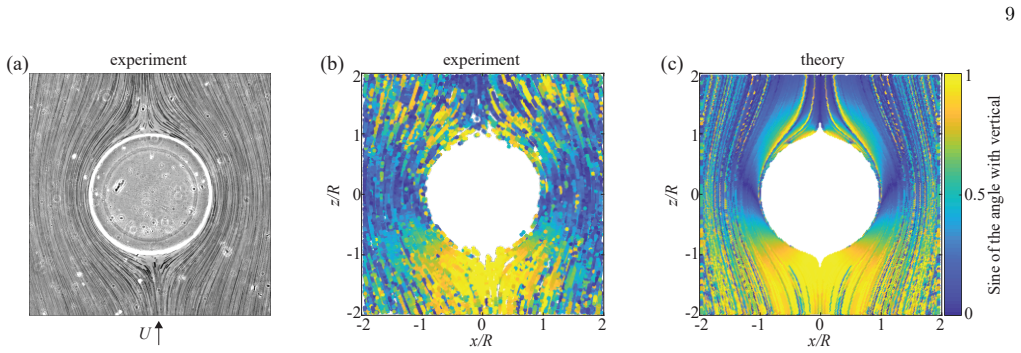
Summary. The manuscript studies ballistic encounter rates between sinking spherical particles and small non-motile or motile ellipsoidal microorganisms. The authors model a microorganism as an inertialess self-propelled ellipsoid advected by the undisturbed Stokes flow around a sinking sphere and oriented by Jeffery's equation. They classify the asymptotic orientations of ellipsoids in the Stokes flow, identify upstream screening and downstream focusing regions, and use numerical trajectory simulations to compute encounter probabilities, efficiencies, and landing distributions. The principal results are: (i) non-motile rods have encounter efficiency reduced by a factor α⁻² relative to spheres, while disks keep the spherical efficiency; (ii) motile elongated bacteria experience a roughly twofold enhancement of encounter rate from hydrodynamic focusing when U/Ub is between 1 and 2, but a strong reduction for faster sinking speeds; and (iii) motile rods attach preferentially leeward, whereas non-motile bacteria attach upstream. Experiments on non-motile diatoms advected past a fixed alginate bead confirm the predicted orientation fields. The paper closes with application maps for marine bacteria and sinking particles.
Significance. If the quantitative results survive scrutiny, this work fills a real gap: prior encounter models are diffusive and valid for large particles, while the most abundant marine particles are smaller than the bacterial run length. The analytical orientation classification (Section III and Appendices A1–A4) is careful, and the non-motile scaling η_rods = η_spheres/α² is a clean, parameter-free prediction. The experimental validation of the orientation field for non-motile diatoms is a strong point: it tests the shear–shape coupling directly, and the robustness to the out-of-plane cutoff is documented in Fig. A.1. The numerical methods are described in enough detail to be reproduced (RK4, spherical-spiral orientation sampling, stated trajectory counts). The main caveats are that the motile encounter-rate predictions are purely numerical and rest on an encounter-rate definition that, as detailed in Major Comment 1, omits the swimming contribution to the upstream flux, and that the marine maps extrapolate to size ratios R/lb below those simulated.
major comments (3)
- [Section II B, Eq. (5)] Equation (5) defines the encounter rate as dN/dt = 2πnU∫P(ρ)ρdρ, with P an average over uniformly sampled initial orientations. For motile bacteria the upstream flux through the plane z = −6R is (U + Ub p_z) times the density for each orientation, so the correct kernel is 2πn∫[U P(ρ) + Ub Q(ρ)]ρdρ with Q(ρ) = (1/4π)∫p_z 1_coll dΩ. Because U/Ub > 1 in all the motile runs, every orientation at the upstream plane has positive axial velocity, and the weight U + Ub p_z is not constant over the colliding subset. The colliding subset is biased toward p_z > 0 in the shear-OFF case (upward swimmers) but is nearly horizontal in the shear-ON focusing case (Fig. 7h), so Q is positive and larger for the shear-OFF baseline. Omitting Ub Q therefore inflates the reported 'approximately twofold' focusing enhancement in Fig. 6 and in the abstract. This is not a small correction at U/Ub ≈ 1.25–2, where Ub Q is comparable to U P. Please recompute the motile encounter rates with flux-weighted initial conditions (or, equivalently, include the Q term) and reassess the twofold claim and the marine maps in Figs. 10–11.
- [Section V C / Fig. 10] The paper assigns a translational diffusivity Dt = 0.43 μm²/s to non-motile spherical bacteria in the caption of Fig. 10, but the quasi-ballistic model stated in Eq. (20) contains only rotational diffusion in the p equation; no translational noise is written in Eq. (20a), and Appendix A5 describes only the rotational-diffusion integrator. Since the non-motile spherical baseline enters the comparisons in Figs. 10–11, the full Langevin equation (including any √(2Dt) noise in x) and the numerical scheme used to produce Fig. 10(c,f) must be specified. Without this, the non-motile baseline is not reproducible and the ratio η_motile/η_non-motile in Fig. 11(a) is not auditable.
- [Section VI / Fig. 10] The marine parameter maps extend to particle radii as small as R ≈ 3 μm with bacterial length lb = 2 μm, i.e., R/lb ≈ 1.5, whereas the systematic simulations in Sections IV–V are carried out at R/lb = 10 (and R/lb = 100 for non-motile rods/disks). At R/lb < 10 the bacterium is not small compared with the particle: evaluating the undisturbed Stokes flow at the cell center and treating the particle as a perfect absorber neglects lubrication forces, finite-body velocity-gradient variation, and flagellar disturbances. Please either restrict the application maps to the validated range, add convergence or sensitivity tests for small R/lb, or explicitly bound the expected error from near-field effects.
minor comments (4)
- [Section III B] The phrase 'the sing change under the square root' should read 'the sign change under the square root'.
- [Section V A] The phrase 'in the the velocity window' contains a duplicated article and should be corrected.
- [Section II] The spelling of Jeffery's equation is inconsistent: 'Jeffrey' appears in Eq. (3b) and elsewhere, while 'Jeffery' appears in Appendix A1 and in reference [17]. Please standardize.
- [Fig. 6 caption] The caption does not identify which lines are meant by 'purple and green' mentioned in the text; please add a legend or describe the color coding explicitly.
Circularity Check
No significant circularity found; the derivation is self-contained and the predictions are not equivalent to their inputs.
full rationale
The paper derives encounter rates from an explicit mechanistic model: Stokes flow around a sphere (Eq. 2) and the Jeffery equation for ellipsoid orientation (Eq. 3), with encounter defined by a geometric interception criterion (Appendix A5). No encounter-rate quantity is fitted to produce the central claims; instead, encounter probabilities and efficiencies are computed by direct numerical integration over initial positions and orientations. The non-motile rod scaling η_rods = η_spheres/α² (Eq. 19) emerges from the simulated collision radius, which is observed to be set by the rod width rather than length, and is rationalized by the analytical shear-alignment picture of Section III B; it is not imposed as an input. The motile focusing and screening results are likewise simulation outputs compared against a shear-off control, not constructed from the claimed conclusion. Parameters such as Dr, Dt, Ub, and lb are taken from prior literature or stated physical values, and the diatom experiments provide independent validation of orientation patterns rather than fitting encounter rates. Self-citations occur, but they are contextual or motivational and are not load-bearing; the dynamical equations and stability analysis cite standard external sources such as Jeffery (1922) and Junk and Illner (2007). Even the possible concern that Eq. (5) omits a swimming-flux contribution is a modeling or correctness issue, not circularity, because the encounter rate definition does not assume the target result. No step reduces, by construction or by self-citation, to the claim being derived.
Assumptions & free parameters
free parameters (3)
- Rotational diffusivity Dr =
0.25 s^-1
- Translational diffusivity Dt =
0.43 µm^2 s^-1
- Out-of-plane cutoff in experiment comparison =
sin(30°) = 0.5
assumptions (7)
- domain assumption Stokes flow around a sphere (Eq. 2) describes the flow field
- standard math Jeffrey equation (Eq. 3b) governs bacterial orientation in flow
- domain assumption Bacteria are passive ellipsoids advected by the flow with self-propulsion Ub p (Eq. 3a)
- domain assumption Perfect absorber interception criterion
- domain assumption Uniform random initial orientations and uniform concentration
- domain assumption Quasi-static reorientation approximation for advected bacteria
- domain assumption Rotational diffusion modeled as white noise (Eq. 20b)
invented entities (2)
-
Hydrodynamic screening
independent evidence
-
Hydrodynamic focusing
independent evidence
Cite this review
Pith. "Pith review of Encounter rates between bacteria and small sinking particles." pith.science (2026). https://pith.science/paper/4J3Z4C45
@misc{pith2026190808376,
  author       = {Pith},
  title        = {Pith review of: Encounter rates between bacteria and small sinking particles},
  year         = {2026},
  howpublished = {\url{https://pith.science/paper/4J3Z4C45}},
  note         = {Machine review of arXiv:1908.08376}
}
read the original abstract
Bacteria in aquatic environments often interact with particulate matter. A key example is bacterial degradation of marine snow responsible for carbon export from the upper ocean in the biological pump. The ecological interaction between bacteria and sinking particles is regulated by their encounter rate, which is therefore important to predict accurately in models of bacteria-particle interactions. Models available to date cover the diffusive encounter regime, valid for sinking particles larger than the typical run length of a bacterium. The majority of sinking particles, however, are small, and the encounter process is then ballistic rather than diffusive. In the ballistic regime, the shear generated by the particle's motion can be important in reorienting bacteria and thus determining the encounter rate, yet the effect of shear is not captured in current encounter rate models. Here, we combine analytical and numerical calculations to quantify the encounter rate between sinking particles and non-motile or motile microorganisms in the ballistic regime, explicitly accounting for the hydrodynamic shear created by the particle and its coupling with microorganism shape. We complement results with selected experiments on non-motile diatoms. We find that the shape-shear coupling has a considerable effect on the encounter rate and encounter location through the mechanisms of hydrodynamic focusing and screening, whereby elongated microorganisms preferentially orient normally to the particle surface downstream of the particle (focusing) and tangentially to the particle surface upstream of the particle (screening). We study these mechanisms as a function of the key dimensionless parameters: the ratio of particle sinking speed to microorganism swimming speed, the ratio of particle radius to microorganism length, and the microorganism's aspect ratio.
Figures

Figures from the paper (8 more)





Reference graph
Works this paper leans on
-
[1]
Stability analysis of the fixed points of the Jeffrey equation In this section, we analyze the linear stability of the fixed points of the Jeffrey Eq. (9) ˙p = (I−ppT)Aγp. (A1) This analysis will also yield the characteristic timescales of the convergence onto the asymptotically stable solutions. As discussed in Section III A and in [18], the fixed points of E...
-
[2]
(A1) is given by the real eigenvector λ3
In this case, the only fixed point of the Jeffrey Eq. (A1) is given by the real eigenvector λ3. We estimate the linear stability of this fixed point. The eigenvalues of the linearized system (A4) become λ Mλ3 ± = 1 2[−3λ3± √ (λ1−λ∗ 1)2] =−3 2λ3±i|λi 1|. (A20) We see that, if the only real eigenvalue λ3 is positive, thenλ3 is an attractive spiral. Otherwise, ...
-
[3]
(A1) is given by a limit cycle
Limit cycle case In the case whenAγ has complex eigenvaluesλ1,2 and the real eigenvalue is negativeλ< 0, the asymptotic solution to the Jeffrey Eq. (A1) is given by a limit cycle. The limit cycle is the great circle perpendicular to the real eigenvector p∗ of Aγ. To show this, we introduce the orthonormal basis n1 =w×p∗/‖w×p∗‖, n2 =n1×p∗, (A22) wherew is a...
-
[4]
(13) due to the Stokes flow around a sinking particle
Velocity gradient of the Stokes flow around a sphere In this section, we compute the velocity gradient in Eq. (13) due to the Stokes flow around a sinking particle. We first carry out the calculation in the curvilinear orthogonal coordinate basis {∂r,∂θ,∂φ} with the metric tensor gij = diag(1,r 2,r 2 sin2θ) and then transform to the usual orthonormal system{...
-
[5]
Ellipsoids in the Stokes flow: stagnation lines and particle surface The eigenvalues of the velocity gradient A [Eq. (13)] on the stagnation line ( θ = 0,π ) and the particle surface (r = 1) have multiplicity greater than one. In this case, the analysis of Section III A does not directly apply, yet these special locations will be important for the encounte...
-
[6]
To numerically integrate the ballistic model [Eq
Methods: numerical simulations Time stepping. To numerically integrate the ballistic model [Eq. (3)], we discretized the equations of motion using the classical Runge–Kutta method (RK4). Depending on the sinking speed, the time-step was chosen between ∆t = 0.075τb for U∼Ub and ∆t = 0.005τb for U∼ 100Ub, where τb =lb/Ub is the time needed for the bacterium...
-
[7]
Methods: experiments Cell cultured. Phaeodactylum tricornutum cells (strain CCMP2561) were cultured in f/2 medium (Guillard and Ryther 1962) mixed with artificial seawater. Artificial seawater was prepared by dissolving 35 g of artificial sea salt (Instant Ocean, Spectrum Brands) in 1 L double distilled water, filtered through a 0 .2 µm filter and autoclaved. ...
work page 2017
-
[8]
F. Lundell, L. D. S¨ oderberg, and P. H. Alfredsson. Fluid mechanics of papermaking. Annu. Rev. Fluid Mech. , 43(1):195– 217, 2011
work page 2011
Show all 49 references
-
[9]
Falkovich, A
G. Falkovich, A. Fouxon, and M. G. Stepanov. Acceleration of rain initiation by cloud turbulence. Nature, 419(6903):151– 154, 2002
2002
-
[10]
G. A. Jackson, A. M. Waite, and P. W. Boyd. Role of algal aggregation in vertical carbon export during SOIREE and in other low biomass environments. Geophys. Res. Lett. , 32(13):L13607, 2005
2005
-
[11]
J. S. Guasto, R. Rusconi, and R. Stocker. Fluid mechanics of planktonic microorganisms. Annu. Rev. Fluid Mech. , 44(1):373–400, 2012
2012
-
[12]
A. R. Longhurst and W. G. Harrison. The biological pump: profiles of plankton production and consumption in the upper ocean. Prog. Oceanogr., 22(1):47–123, 1989
1989
-
[13]
H. W. Ducklow, D. K. Steinberg, and K. O. Buesseler. Upper ocean carbon export and the biological pump. Oceanography, 14(4):50–58, 2001
2001
-
[14]
Karp-Boss, E
L. Karp-Boss, E. Boss, and P. A. Jumars. Nutrient fluxes to planktonic osmotrophs in the presence of fluid motion. Oceanogr. Mar. Biol. Annu. Rev. , 34:71–107, 1996
1996
-
[15]
Kiørboe, H.-P
T. Kiørboe, H.-P. Grossart, H. Ploug, and K. Tang. Mechanisms and rates of bacterial colonization of sinking aggregates. Appl. Environ. Microbiol. , 68(8):3996–4006, 2002
2002
-
[16]
S. K. Friedlander. Mass and heat transfer to single spheres and cylinders at low Reynolds numbers. AIChE J., 3(1):43–48, 1957
1957
-
[17]
K. Son, F. Menolascina, and R. Stocker. Speed-dependent chemotactic precision in marine bacteria. Proc. Natl. Acad. Sci. U.S.A., 113(31):8624–8629, 2016
2016
-
[18]
A. B. Bochdansky, M. A. Clouse, and G. J. Herndl. Dragon kings of the deep sea: marine particles deviate markedly from the common number-size spectrum. Sci. Rep., 6:22633, 2016
2016
-
[19]
Kiørboe and G
T. Kiørboe and G. A. Jackson. Marine snow, organic solute plumes, and optimal chemosensory behavior of bacteria. Limnol. Oceanogr., 46(6):1309–1318, 2001. 26
2001
-
[20]
Marcos, H. C. Fu, T. R. Powers, and R. Stocker. Separation of microscale chiral objects by shear flow. Phys. Rev. Lett. , 102(15):158103, 2009
2009
-
[21]
Rusconi, J
R. Rusconi, J. S. Guasto, and R. Stocker. Bacterial transport suppressed by fluid shear. Nat. Phys. , 10(3):212–217, 2014
2014
-
[22]
M. T. Barry, R. Rusconi, J. S. Guasto, and R. Stocker. Shear-induced orientational dynamics and spatial heterogeneity in suspensions of motile phytoplankton. J. Royal Soc. Interface , 12(112):20150791, 2015
2015
-
[23]
A. L. Alldredge and C. C. Gotschalk. Direct observations of the mass flocculation of diatom blooms: characteristics, settling velocities and formation of diatom aggregates. Deep Sea Res. A , 36(2):159–171, 1989
1989
-
[24]
G. B. Jeffery. The motion of ellipsoidal particles immersed in a viscous fluid. Proc. R. Soc. Lond. A , 102(715):161–179, 1922
1922
-
[25]
Junk and R
M. Junk and R. Illner. A new derivation of Jeffery’s equation. J. Math. Fluid Mech. , 9(4):455–488, 2007
2007
-
[26]
F. P. Bretherton. The motion of rigid particles in a shear flow at low Reynolds number. J. Fluid Mech. , 14(2):284–304, 1962
1962
-
[27]
G. K. Batchelor. Mass transfer from a particle suspended in fluid with a steady linear ambient velocity distribution. J. Fluid Mech., 95(2):369–400, 1979
1979
-
[28]
Kiørboe and A
T. Kiørboe and A. W. Visser. Predator and prey perception in copepods due to hydromechanical signals. Mar. Ecol. Prog. Ser., 179:81–95, 1999
1999
-
[29]
S. Hess, L. Eme, A. J. Roger, and A. G. B. Simpson. A natural toroidal microswimmer with a rotary eukaryotic flagellum. Nat. microbiol., 2019
2019
-
[30]
Raina, V
J.-B. Raina, V. I. Fernandez, B. Lambert, R. Stocker, and J. R. Seymour. The role of microbial motility and chemotaxis in symbiosis. Nat. Rev. Microbiol. , 17:284–294, 2019
2019
-
[31]
A. W. Visser and T. Kiørboe. Plankton motility patterns and encounter rates. Oecologia, 148(3):538–546, 2006
2006
-
[32]
T. Kiørboe. A mechanistic approach to plankton ecology . Princeton University Press, 2008
2008
-
[33]
Chandrasekhar
S. Chandrasekhar. Stochastic problems in physics and astronomy. Rev. Mod. Phys. , 15(1):1–89, 1943
1943
-
[34]
Saintillan and M
D. Saintillan and M. J. Shelley. Instabilities and pattern formation in active particle suspensions: kinetic theory and continuum simulations. Phys. Rev. Lett. , 100(17):178103, 2008
2008
-
[35]
R. N. Bearon and A. L. Hazel. The trapping in high-shear regions of slender bacteria undergoing chemotaxis in a channel. J. Fluid Mech. , 771:R3, 2015
2015
-
[36]
H. C. Berg and E. M. Purcell. Physics of chemoreception. Biophys. J. , 20(2):193–219, 1977
1977
-
[37]
Secchi, A
E. Secchi, A. Vitale, G. L. Mi˜ no, V. Kantsler, L. Eberl, R. Rusconi, and R. Stocker. The effect of flow on swimming bacteria controls the initial colonization of curved surfaces (submitted). 2019
2019
-
[38]
G. L. Mi˜ no, M. Baabour, R. Chertcoff, G. Gutkind, E. Cl´ ement, H. Auradou, and I. Ippolito.E. coli accumulation behind an obstacle. Adv. Microbiol., 8:451–464, 2018
2018
-
[39]
Bechinger, R
C. Bechinger, R. Di Leonardo, H. L¨ owen, C. Reichhardt, G. Volpe, and G. Volpe. Active particles in complex and crowded environments. Rev. Mod. Phys. , 88(4):045006, 2016
2016
-
[40]
K. W. Bruland and M. W. Silver. Sinking rates of fecal pellets from gelatinous zooplankton (Salps, Pteropods, Doliolids). Mar. Biol. , 63(3):295–300, 1981
1981
-
[41]
P. D. Komar, A. P. Morse, L. F. Small, and S. W. Fowler. An analysis of sinking rates of natural copepod and euphausiid fecal pellets. Limnol. Oceanogr., 26(1):172–180, 1981
1981
-
[42]
M. E. Weber, D. C. Blanchard, and L. D. Syzdek. The mechanism of scavenging of waterborne bacteria by a rising bubble. Limnol. Oceanogr., 28(1):101–105, 1983
1983
-
[43]
Persat, H
A. Persat, H. A. Stone, and Z. Gitai. The curved shape of Caulobacter crescentus enhances surface colonization in flow. Nat. Commun. , 5:3824, 2014
2014
-
[44]
B. S. Lambert, V. I. Fernandez, and R. Stocker. Motility drives bacterial encounter with particles responsible for carbon export throughout the ocean. Limnol. Oceanogr. Lett., in press, 2019
2019
-
[45]
H. C. Berg. Random walks in biology . Princeton University Press, 1993
1993
-
[46]
Stemmann and E
L. Stemmann and E. Boss. Plankton and particle size and packaging: From determining optical properties to driving the biological pump. Ann. Rev. Mar. Sci. , 4(1):263–290, 2012
2012
-
[47]
X. Mari, U. Passow, C. Migon, A. B. Burd, and L. Legendre. Transparent exopolymer particles: Effects on carbon cycling in the ocean. Prog. Oceanogr., 151:13–37, 2017
2017
-
[48]
Wang and W
J. Wang and W. Gao. Nano/microscale motors: biomedical opportunities and challenges. ACS Nano , 6(7):5745–5751, 2012
2012
-
[49]
Gao and J
W. Gao and J. Wang. The environmental impact of micro/nanomachines: a review. ACS Nano , 8(4):3170–3180, 2014
2014
Reviewed August 14, 2026 · model on record in the stance chip above.
Discussion (0). Continue with ORCID to comment.