REVIEW 3 major objections 6 minor 21 references
SCF2 -- an Argumentation Semantics for Rational Human Judgments on Argument Acceptability: Technical Report
T0 review · 3 major / 6 minor · reviewed 2026-08-14 · deepseek-v4-flash
Pith's one-line read This paper defines SCF2, an argumentation semantics that provably satisfies two newly introduced principles — Irrelevance of Necessarily Rejected Arguments and Strong Completeness Outside Odd Cycles — plus the established Directionality…
desk verdict SCF2 is a genuinely new semantics with a nice principle-based motivation, but the proof that it satisfies INRA rests on a sketched Lemma 3(b) that needs to be fully worked out before the central claim is safe. read the letter →
The pith
A machine-rendered reading of the paper's core claim, the machinery that carries it, and where it could break.
The reading
What carries the argument
The central object is the composed semantic operator nsa(scc(SCOOC-naive)). 'nsa' deletes all self-attacking arguments before evaluation; 'scc' is the SCC-recursive scheme that splits a framework into strongly connected components and evaluates them in topological order, deleting arguments attacked by accepted sets from later components; 'SCOOC-naive' is the base semantics applied inside each single SCC, picking subset-maximal conflict-free sets that are strongly complete outside odd cycles. This composition is what carries the argument: nsa yields INRA, scc yields Directionality, and SCOOC-naive yields SCOOC, and the paper proves no other combination of these switches achieves all three.
What would settle it
Run a brute-force search over all finite argumentation frameworks with up to, say, five arguments, looking for a framework in which some argument is attacked by every SCF2 extension yet deleting that argument changes the set of extensions. A single such framework refutes Theorem 8; if none exists, the open gap in Lemma 3(b) becomes a clear target for a full rewrite of the proof.
Extended reading notes
Core claim
SCF2 is defined as nsa(scc(SCOOC-naive)): delete all self-attacking arguments, then run the SCC-recursive scheme that CF2 uses, but replace naive semantics inside each single SCC with SCOOC-naive semantics, which selects subset-maximal conflict-free sets that are strongly complete outside odd cycles. The paper proves that among seven semantics formed by switching the nsa, scc, and SCOOC-naive ingredients on and off, SCF2 alone satisfies Directionality, INRA, and SCOOC (Theorems 6–8 and Table 1), and that every finite AF has at least one SCF2 extension (Theorem 5). The proofs rest on a lemma showing that nsa(scc(σ)) satisfies INRA whenever σ is SCC-semi-rich, a condition it establishes for SCOOC-naive semantics. The empirical section reports that 27 coherent non-grounded participants in a cognitive study judged most frameworks in line with SCF2, including the six-cycle framework where CF2 accepts two opposite arguments but SCF2 does not.
Load-bearing premise
The proof that SCF2 satisfies INRA depends on an induction step that is not fully written out in Lemma 3(b): after deleting an argument attacked by every extension, the graph's strongly connected parts may split, and the proof says 'we continue as in the proof of part (a)' without supplying that induction; if it fails for some graph, SCF2 would not actually satisfy INRA.
Editorial extensions
If this is right
- Every finite argumentation framework has at least one SCF2 extension, so SCF2 never leaves a framework without an evaluation.
- Deleting a universally rejected argument leaves the SCF2 verdicts unchanged, so such arguments can be omitted from the evaluation without affecting the outcome.
- Within every SCF2 extension, an argument whose attackers are all rejected must be accepted unless it lies on an odd cycle, so SCF2 eliminates unexplained undecidedness outside paradox zones.
- Among the seven naive-based variants, SCF2 is the only one satisfying Directionality, INRA, and SCOOC simultaneously.
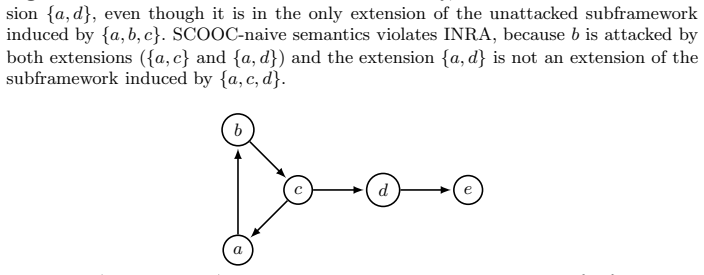
- The six-cycle case in which CF2 accepts two opposite arguments is repaired in SCF2, since SCOOC forces one of them to be rejected.
Reading between the lines
- The nsa-then-scc recipe is a general design template: any SCC-semi-rich base semantics could be turned into an INRA-satisfying recursive semantics in the same way, so the technique may outlive SCF2 itself.
- INRA gives SCF2 a clean dynamic behaviour — universally rejected arguments can be dropped without revisiting earlier conclusions — which the paper does not explore but which matters for incremental argumentation systems.
- The empirical case is still open: the study's improvement of SCF2 over CF2 and grounded semantics was not statistically significant, so a larger experiment with frameworks that separate these semantics is the decisive test of the descriptive claim.
- A brute-force check for INRA counterexamples would settle whether the omitted part of Lemma 3(b) is a harmless abbreviation or a real gap.
Signed reviews
Editorial analysis
A structured set of objections, weighed in public.
Referee Report
Summary. The paper proposes a new abstract argumentation semantics, SCF2, defined as nsa(scc(SCOOC-naive)), and claims it satisfies three principles: Directionality, Irrelevance of Necessarily Rejected Arguments (INRA), and Strong Completeness Outside Odd Cycles (SCOOC). The authors introduce INRA and SCOOC, show which of several existing semantics satisfy them, and prove that SCF2 satisfies all three, that every argumentation framework has at least one SCF2 extension, and that among seven related naive-based semantics only SCF2 satisfies all three principles (Table 1, Theorems 5-8). They also discuss two cognitive studies by Cramer and Guillaume that they interpret as providing preliminary empirical support for SCF2. The theoretical part is largely detailed, but a load-bearing proof step in Lemma 3(b) is only sketched, and the abstract's claim that no semantics from the literature satisfies the two new principles overreaches the considered list of semantics.
Significance. If the central theorems are correct, SCF2 is a genuine new semantics that provably combines Directionality, INRA, and SCOOC, and it comes with a systematic comparison of seven related semantics in Table 1. The paper also makes a falsifiable empirical prediction that SCF2 matches human judgments better than other semantics, which is a strength given the paper's stated goal of combining normative and descriptive approaches. The theoretical contribution is significant for the principle-based analysis of argumentation semantics, though its scope is narrower than the abstract suggests. The main weakness is that the proof of Lemma 3(b), on which Theorem 8 (SCF2 satisfies INRA) entirely depends, is not fully carried out; this is a fixable but load-bearing gap.
major comments (3)
- [§3, Lemma 3(b)] The proof of Lemma 3(b) is incomplete and begins with the wrong antecedent. The proof states 'let a ∈ Ar be an argument such that for every E ∈ nsa(scc(σ))(F), a /∈ E', but the INRA principle (Definition 11) requires 'every E attacks a'; these are not equivalent, and the later use of SCC-semi-richness to rule out the single-SCC case relies on the stronger 'does not attack a' condition. After defining F′ = NSA(F), the proof says only 'we continue as in the proof of part (a), just with F′ in place of F' and stops. Part (a)'s hard step is the induction over the SCC partition after deleting a, because a's SCC can split; the manuscript itself calls this 'the main difficulty' in the proof of Lemma 3. Since Lemma 3(b) is the sole support for Theorem 8, this omitted argument is load-bearing; the proof must be completed (or Theorem 8 proven directly) before the claimed conjunction of Directionality, INRA and SCOOC is established.
- [Abstract and §1] The abstract claims that 'no semantics from the literature satisfies both' of the two new principles, but the body only shows this for the nine semantics listed in Section 1 plus nsa(CF2), and Table 1 covers seven variants of naive semantics. Many other extension-based semantics from the literature—including ideal, eager, and semantics definable in SESAME [6]—are not considered. The novelty claim should be restricted to the considered semantics, or the survey must be broadened; as written, the claim overreaches the evidence.
- [§5] The empirical support for SCF2 over CF2 is not statistically significant after 12 of 61 participants are excluded, and the decisive comparison rests on a single six-cycle framework in which SCF2, stage2, preferred and semi-stable coincide. The conclusion appropriately calls the findings preliminary, but the abstract's statement that the results 'suggest that SCF2 is more in line with the judgments of participants than any existing semantics' is not supported by the reported data. In addition, the cognitive studies are conducted by the paper's first author; the potential conflict should be disclosed in a journal version.
minor comments (6)
- [§3, Lemma 3(b)] The notation 'a /∈ E' in the proof should read 'E attacks a' to match Definition 11; the current wording makes the proof appear to prove a different statement.
- [§4, Theorem 6 proof] The line 'Since F′ = NSA(F′)' should be 'Since F′ = NSA(F)', and the expression 'F′ Ar\U \ DF′(E1)' should use the restriction notation F′|(...) to avoid ambiguity.
- [§4, Lemma 4 proof] The expression '|SCCs(F) = 1|' should be '|SCCs(F)| = 1', and 'attakers' should be 'attackers'.
- [§5] The phrase 'they disconsider them' should be 'they exclude them' or 'they discard them', and 'can by found' should be 'can be found'.
- [§5 and References] The text cites 'Rahwan et al. [18]' for the behavioral experiments on reinstatement, but reference [18] is the edited volume 'Argumentation in Artificial Intelligence'; the relevant cognitive-science study appears to be reference [17], so the citation should be corrected.
- [§5] The paper should mention that the binomial tests are not corrected for multiple comparisons, and it would be helpful to report effect sizes or confidence intervals for the non-significant SCF2-versus-CF2 comparison.
Circularity Check
No significant circularity: SCF2's formal properties are proved from its definition, and the empirical self-citations are not load-bearing.
full rationale
The formal derivation chain is self-contained rather than circular. SCF2 is defined in Definition 18 as nsa(scc(SCOOC-naive)), and the paper proves existence, Directionality, SCOOC and INRA from that definition via Lemmas 3 and 4 and Theorems 5-8. No parameter is fitted to data and no principle is assumed as its own conclusion. The name 'SCOOC-naive' and the SCOOC principle are closely related by construction, but the scc-recursive and nsa steps still require nontrivial arguments to show that the local property survives at the level of whole frameworks; the proof is not simply the restatement of a definition. Lemma 3(b), on which Theorem 8 depends, is abbreviated with 'we continue as in the proof of part (a), just with F′ in place of F', and the adaptation is arguably a proof gap, but a proof gap is not an equation-level circularity. The empirical support from Cramer and Guillaume [12,13] is presented as motivation and corroboration, not as a premise of the formal proofs, and the paper explicitly states that the empirical findings are preliminary and need further testing. There is therefore no load-bearing self-citation and no fitted input renamed as a prediction.
Assumptions & free parameters
assumptions (5)
- ad hoc to paper The three principles Directionality, INRA and SCOOC are normatively desirable for a semantics meant to match rational human judgments.
- domain assumption The identities grounded = scc(grounded) and complete = scc(complete), used in the proof of Theorem 1, are accepted without proof.
- ad hoc to paper Lemma 3(b), whose proof is only sketched, correctly establishes that nsa(scc(σ)) satisfies INRA for every SCC-semi-rich σ.
- ad hoc to paper Strong completeness outside odd cycles can always be enforced while preserving conflict-freeness; Lemma 4's non-deterministic construction is valid.
- domain assumption The exclusion of 12 of 61 participants as 'incoherent' in the cognitive study does not bias the comparison in favor of SCF2.
Cite this review
Pith. "Pith review of SCF2 -- an Argumentation Semantics for Rational Human Judgments on Argument Acceptability: Technical Report." pith.science (2026). https://pith.science/paper/75EAFS6Q
@misc{pith2026190808406,
  author       = {Pith},
  title        = {Pith review of: SCF2 -- an Argumentation Semantics for Rational Human Judgments on Argument Acceptability: Technical Report},
  year         = {2026},
  howpublished = {\url{https://pith.science/paper/75EAFS6Q}},
  note         = {Machine review of arXiv:1908.08406}
}
read the original abstract
In abstract argumentation theory, many argumentation semantics have been proposed for evaluating argumentation frameworks. This paper is based on the following research question: Which semantics corresponds well to what humans consider a rational judgment on the acceptability of arguments? There are two systematic ways to approach this research question: A normative perspective is provided by the principle-based approach, in which semantics are evaluated based on their satisfaction of various normatively desirable principles. A descriptive perspective is provided by the empirical approach, in which cognitive studies are conducted to determine which semantics best predicts human judgments about arguments. In this paper, we combine both approaches to motivate a new argumentation semantics called SCF2. For this purpose, we introduce and motivate two new principles and show that no semantics from the literature satisfies both of them. We define SCF2 and prove that it satisfies both new principles. Furthermore, we discuss findings of a recent empirical cognitive study that provide additional support to SCF2.
Figures


Figures from the paper (7 more)




Reference graph
Works this paper leans on
-
[6]
P. Besnard, S. Doutre, V. H. Ho, and D. Longin. SESAME - A Sys tem for Speci- fying Semantics in Abstract Argumentation. In M. Thimm, F. C erutti, H. Strass, and M. Vallati, editors, Proceedings of the First International Workshop on Sys- tems and Algorithms for Formal Argumentation (SAF A) co-loc ated with the 6th International Conference on Computationa...
work page 2016
-
[1]
L. Amgoud and J. Ben-Naim. Ranking-Based Semantics for Ar gumentation Frame- works. In W. Liu, V. S. Subrahmanian, and J. Wijsen, editors, Scalable Uncertainty Management, pages 134–147, Berlin, Heidelberg, 2013. Springer Berlin Heidelberg
work page 2013
- [2]
-
[3]
P. Baroni and M. Giacomin. On principle-based evaluation of extension-based argumentation semantics. Artificial Intelligence , 171(10):675–700, 2007. Argu- mentation in Artificial Intelligence
work page 2007
- [4]
-
[5]
R. Baumann. Normal and strong expansion equivalence for a rgumentation frame- works. Artif. Intell. , 193:18–44, 2012. 20 Marcos Cramer and Leendert van der Torre
work page 2012
-
[7]
G. Boella, S. Kaci, and L. W. N. van der Torre. Dynamics in Ar gumentation with Single Extensions: Abstraction Principles and the Grounde d Extension. In C. Sos- sai and G. Chemello, editors, Symbolic and Quantitative Approaches to Reasoning with Uncertainty, 10th European Conference, ECSQARU 2009, Verona, Italy, July 1-3, 2009. Proceedings, volume 5590 o...
work page 2009
- [8]
Show all 21 references
-
[9]
M. W. A. Caminada, W. A. Carnielli, and P. E. Dunne. Semi-st able semantics. J. Log. Comput., 22(5):1207–1254, 2012
2012
-
[10]
Cayrol, F
C. Cayrol, F. D. de Saint-Cyr, and M. Lagasquie-Schiex. R evision of an Argu- mentation System. In G. Brewka and J. Lang, editors, Principles of Knowledge Representation and Reasoning: Proceedings of the Eleventh International Confer- ence, KR 2008, Sydney, Australia, Septembe...
2008
-
[11]
Cramer and M
M. Cramer and M. Guillaume. Directionality of attacks in natural language ar- gumentation. In C. Schon, editor, Proceedings of the Workshop on Bridging the Gap between Human and Automated Reasoning , volume 2261, pages 40–46. R WTH Aachen University, CEUR-WS.org, 2018. http://...
2018
-
[12]
Cramer and M
M. Cramer and M. Guillaume. Empirical Cognitive Study on Abstract Argu- mentation Semantics. Frontiers in Artificial Intelligence and Applications , pages 413–424, 2018
2018
-
[13]
Cramer and M
M. Cramer and M. Guillaume. Empirical Study on Human Eval uation of Complex Argumentation Frameworks. In Proceedings of JELIA 2019 , 2019. Full paper available at http://icr.uni.lu/mcramer/downloads/2019_JELIA.pdf
2019
-
[14]
P. M. Dung. On the acceptability of arguments and its fund amental role in non- monotonic reasoning, logic programming and n-person games . Artificial Intelli- gence, 77(2):321–357, 1995
1995
-
[15]
Dvoˇ r´ ak and S
W. Dvoˇ r´ ak and S. A. Gaggl. Stage semantics and the SCC-r ecursive schema for argumentation semantics. Journal of Logic and Computation , 26(4):1149–1202, Aug 2016
2016
-
[16]
Oikarinen and S
E. Oikarinen and S. Woltran. Characterizing strong equi valence for argumentation frameworks. Artificial Intelligence , 175(14-15):1985–2009, 2011
1985
-
[17]
Rahwan, M
I. Rahwan, M. I. Madakkatel, J.-F. Bonnefon, R. N. Awan, a nd S. Abdallah. Be- havioral Experiments for Assessing the Abstract Argumenta tion Semantics of Re- instatement. Cognitive Science, 34(8):1483–1502, 2010
2010
-
[18]
Rahwan and G
I. Rahwan and G. R. Simari. Argumentation in Artificial Intelligence . Springer Publishing Company, Incorporated, 1st edition, 2009
2009
-
[19]
Rienstra, C
T. Rienstra, C. Sakama, and L. W. N. van der Torre. Persist ence and Monotony Properties of Argumentation Semantics. In E. Black, S. Modg il, and N. Oren, edi- tors, Theory and Applications of Formal Argumentation – Revised S elected Papers, volume 9524 of Lecture Notes in Com...
2015
-
[20]
van der Torre and S
L. van der Torre and S. Vesic. The principle-based approa ch to abstract argumen- tation semantics. In P. Baroni, D. Gabbay, M. Giacomin, and L . van der Torre, editors, Handbook of Formal Argumentation . College Publications, 2018
2018
-
[21]
B. Verheij. Two Approaches to Dialectical Argumentatio n: Admissible Sets and Argumentation Stages. In In Proceedings of the biannual International Conference on Formal and Applied Practical Reasoning (F APR) workshop , pages 357–368. Universiteit, 1996
1996
Reviewed August 14, 2026 · model on record in the stance chip above.
Discussion (0). Continue with ORCID to comment.