REVIEW 2 major objections 4 minor 57 references
Coordination Through Shared Randomness
T0 review · 2 major / 4 minor · reviewed 2026-08-14 · deepseek-v4-flash
Pith's one-line read This paper proves that with an omniscient coordinator and individually shared randomness, the optimal broadcast rate is a min-max of two mutual information quantities.
desk verdict Strong paper: gives relaxed Wyner's common information an operational interpretation and nails the oblivious-coordinator rate region; worth a serious referee. read the letter →
The pith
A machine-rendered reading of the paper's core claim, the machinery that carries it, and where it could break.
The reading
What carries the argument
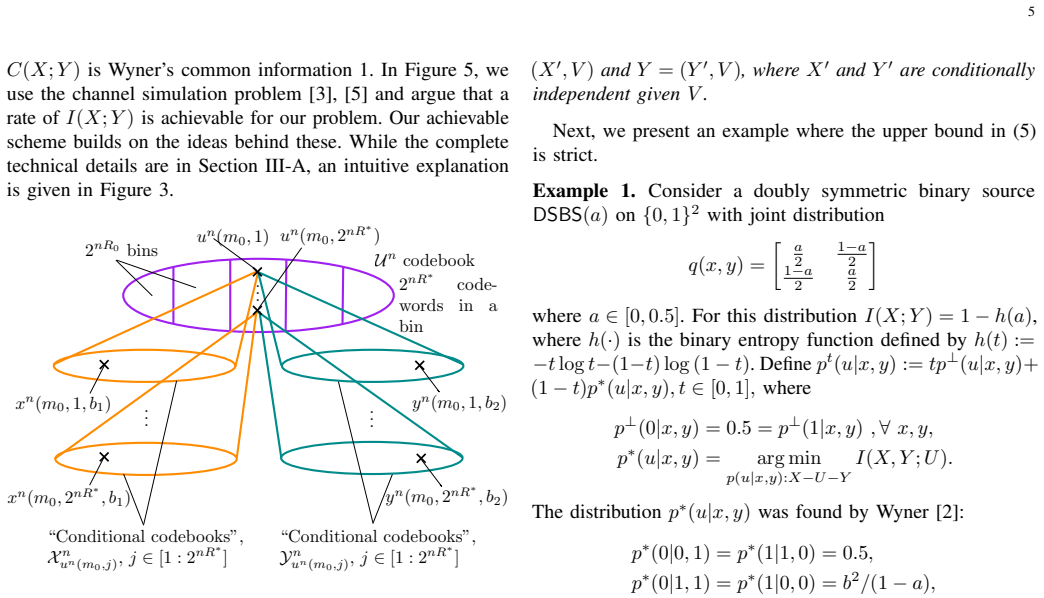
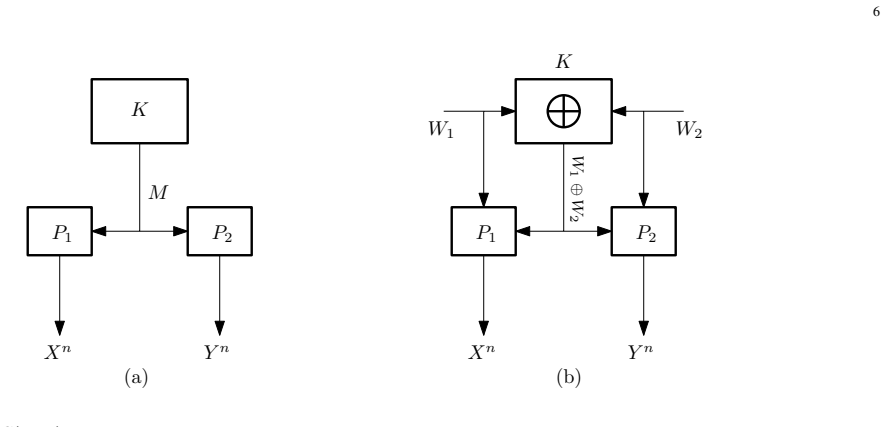
The load-bearing object is the min-max mutual-information expression $R_{\mathrm{opt}} = \min_{p(u|x_{[1:t]})} \max\{I(X_1;\ldots;X_t|U), I(X_1,\ldots,X_t;U)\}$, together with the two-processor identity $R_{\mathrm{opt}} = C_{\gamma^*}$, where $C_\gamma$ is relaxed Wyner's common information and $\gamma^*$ is its fixed point. The first term, Watanabe's total correlation, measures how much the outputs remain correlated after conditioning on the auxiliary variable; the second term measures how much information the auxiliary variable carries about the joint outputs. Achievability is carried by the Output Statistics of Random Binning (OSRB) framework: random binning indices are split into a common part, distributed to all processors by network-coding XOR, and private parts used jointly by the coordinator and one processor, and OSRB approximation lemmas show the induced output distribution approaches the target. The converse turns on the observation that the conditional mutual information $I(X^n;Y^n|M)$ is not zero, as in Wyner's model, but is upper bounded by the message rate $nR$, forcing the min-max formula.
What would settle it
Find a joint distribution $q_{XY}$ and a sequence of simulation codes whose broadcast rate is strictly below $\min_{p(u|x,y)} \max\{I(X;Y|U), I(X,Y;U)\}$ while achieving vanishing total variation; such a code would refute Theorem 2. Alternatively, compute the fixed point $C_{\gamma^*}$ for a small alphabet exhaustively and verify that no lower-rate protocol exists; a lower-rate protocol is a direct counterexample.
Extended reading notes
Core claim
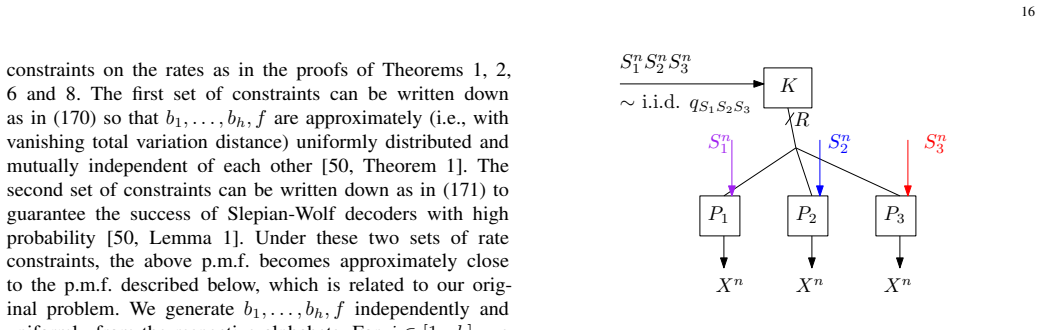
The central claim is Theorem 6: with an omniscient coordinator, unlimited individually shared randomness, and $t$ processors, the optimal transmission rate is $R_{\mathrm{Indv}}^{\mathrm{opt}} = \min_{p(u|x_{[1:t]})} \max\{I(X_1;\ldots;X_t|U), I(X_1,\ldots,X_t;U)\}$, where $I(X_1;\ldots;X_t|U) = \sum_i H(X_i|U) - H(X_{[1:t]}|U)$ is Watanabe's total correlation and the minimum is over auxiliary variables with $|U| \le \prod_i |X_i| + t$. For $t=2$ this reduces to $\min_{p(u|x,y)} \max\{I(X;Y|U), I(X,Y;U)\}$, which the paper shows coincides with the fixed point of relaxed Wyner's common information $C_\gamma(X;Y) = \min_{p_{U|XY}: I(X;Y|U) \le \gamma} I(X,Y;U)$; thus relaxed Wyner's common information is not merely an optimization device but the exact communication cost of two-party coordination with private shared randomness. On the converse side, the proof bounds $I(X^n;Y^n|M)$ by the message rate $nR$, showing that the coordinator's message limits how much shared randomness can leak through the outputs. The paper further proves the full simulation rate region in the oblivious-coordinator case: a rate tuple is achievable exactly when $R + R_S \ge I(X_{[1:t]};U,U_S)$ for every $S \subseteq [1:h]$ over product-form distributions, a region that reduces to multi-user Wyner's common information when all shared-randomness rates vanish.
Load-bearing premise
The achievability proofs depend on external random-binning lemmas, namely the Output Statistics of Random Binning framework, holding exactly for the particular binning and Slepian-Wolf decoders used here; if those approximation lemmas fail for these schemes, the single-letter rate formulas are not established.
Editorial extensions
If this is right
- When two processors share private randomness and an omniscient coordinator broadcasts, the optimal rate is computable as the fixed point of relaxed Wyner's common information, giving a concrete way to evaluate coordination costs for any finite-alphabet distribution.
- Neither pure network coding at rate $C(X;Y)/2$ nor pure channel simulation at rate $I(X;Y)$ is generally optimal; the min-max formula can be strictly smaller than both, as the doubly symmetric binary source example shows.
- In the oblivious-coordinator setting, the full trade-off between broadcast rate and shared-randomness rates is known, so a designer can decide how much shared randomness to install to reduce the coordinator's load.
- With no shared randomness, the oblivious-coordinator region reduces to multi-user Wyner's common information, so the paper's results extend that classical notion to settings with partial randomness.
- When all processors must output the same sequence, exact rate regions are available for both individually shared and randomness-on-the-forehead access structures, and the general structure reduces to a linear trade-off describable by network coding.
Reading between the lines
- The fixed-point reading of the two-processor rate suggests that relaxed Wyner's common information may be the right quantity for other coordination problems where encoders hold private side information, not just the caching context in which it was introduced.
- The mixed strategy of splitting shared randomness into a network-coded common part and a private per-processor part is likely the general pattern for optimal coordination; one could test whether the same split appears in minimal schemes for empirical coordination or for more general network topologies.
- The oblivious-coordinator rate region is a linear program in the rates once auxiliary variables are fixed, so it can be evaluated numerically; comparing it to the omniscient-coordinator bound on small instances could quantify the value of coordinator access to shared randomness.
- The paper leaves open whether the randomness-on-the-forehead upper bound is tight in general; a matching converse for three processors would complete that picture.
Signed reviews
Editorial analysis
A structured set of objections, weighed in public.
Referee Report
Summary. The paper studies strong coordination of i.i.d. outputs in a star network where a coordinator sends a common message to processors that also have access to subsets of independent shared-randomness sources. Two settings are considered: the omniscient coordinator, which observes all shared randomness, and the oblivious coordinator, which observes none. The main contributions are a complete characterization of the optimal transmission rate for two processors (Theorem 2), which is shown to equal a fixed point of relaxed Wyner's common information; a characterization for the multi-processor individually shared randomness model in terms of Watanabe's total correlation (Theorem 6); an upper bound for the randomness-on-the-forehead model (Theorem 8); complete rate regions when all outputs are equal (Theorems 7, 9, 10); a characterization for the correlated shared randomness model with identical outputs (Theorem 11); and a complete characterization of the rate region in the oblivious coordinator setting for arbitrary subset structures (Theorems 12 and 13). The proofs use the Output Statistics of Random Binning framework and channel-resolvability-style second-moment analysis.
Significance. If the results are correct, this is a significant contribution to coordination theory. The two-processor result (Theorem 2) gives an operational meaning to relaxed Wyner's common information, and the oblivious-coordinator rate region (Theorem 13) extends multi-user Wyner common information to settings with shared randomness, which is a natural and useful generalization. The paper contains detailed and convincing proofs for the two-processor setting (Theorems 1 and 2) and for the three-processor oblivious case (Theorem 12), and the converse arguments are standard single-letterizations. The DSBS example (Example 1) illustrates, under a stated conjecture, that the optimal rate can be strictly better than both the network-coding-based scheme and the channel-simulation scheme. The authors are explicit about which results are bounds (Theorem 8) and which are complete characterizations. The main weakness is that the proofs of two central multi-processor theorems (Theorems 6 and 13) are presented only as outlines in Appendices B and D, which detracts from the rigor expected for a full characterization; this is a fixable issue rather than a demonstrated error.
major comments (2)
- [Section IV-B and Appendix B] The achievability proof of Theorem 6 is given only as an outline. The rate constraints in (159)-(161) are stated without deriving them from the OSRB framework, and the elimination from these constraints to the two inequalities in (163) is not carried out. In addition, the intuitive scheme described in Section IV-B includes a network-coded common-randomness index m0 of rate R0 and a resulting message rate R = (t-1)R0/t + R*, but the formal constraints in Appendix B contain no R0 and conclude R = R*. The paper should explain why R0 can be set to zero (or otherwise justify the reduction). Furthermore, the non-negativity regularization for \hat{R0} when R* > H(U), which is handled for Theorem 1 in Appendix E-B, is not mentioned for the multi-processor case. Since Theorem 6 is a central characterization, the proof should be completed or the omitted steps explicitly identified as routine.
- [Appendix D and Theorem 13] The proof of Theorem 13, which claims a complete characterization of the oblivious-coordinator rate region for arbitrary number of processors and arbitrary subset structures, is only an outline. It refers to the second-moment analysis of Theorem 12 but does not display the exponent bounds for the 2^h + 1 cases for general h, the typicality arguments, or the final summation step for arbitrary V_i. Because this theorem is a headline result in the abstract, the authors should either provide a full proof or explicitly present the theorem as a proof sketch and include the detailed derivation in a supplementary document.
minor comments (4)
- [Theorem 13 statement] The rate region in Theorem 13 is written for non-negative rate tuples (R,R_1,...,R_t), but the subset condition S ⊆ [1:h] refers to h shared-randomness variables; the tuple should be (R,R_1,...,R_h). This is a notational error that should be corrected.
- [Appendix D] In the proof outline of Theorem 13, the target distribution is written as q(x[1t3]) instead of q(x[1:t]); this is a typo.
- [Appendix C and Theorem 8] The proof of Theorem 8 is presented only for t = 3, with the statement that a similar proof works for any t. Since Theorem 8 is only an upper bound, this is acceptable, but the paper should at least sketch how the definitions of r_i in (61) arise from the elimination step for general t.
- [Section IV-B] The intuitive explanation of the achievability for Theorem 6 uses a rate R = (t-1)R0/t + R*, while the formal outline in Appendix B uses R = R*. The relation between these two descriptions should be clarified to avoid confusion.
Circularity Check
No significant circularity; the derivations are self-contained achievability and converse arguments against external benchmarks.
full rationale
The paper's central results (Theorems 2 and 6 for the omniscient coordinator, and Theorem 13 for the oblivious coordinator) are obtained by explicit achievability schemes based on the external Output Statistics of Random Binning framework and by single-letter converse bounds derived from the simulation-code definition, not by assuming the claimed rate expressions. The relaxed Wyner common information C_gamma is introduced only in Remark 1 as a post-hoc equivalence: Theorem 2 first derives Ropt = min max{I(X;Y|U), I(X,Y;U)} through the OSRB-based achievability and the converse bounding I(X^n;Y^n|M) <= nR, and only then observes that this equals the fixed point C_gamma* = gamma*. Similarly, Theorem 6 derives the total-correlation expression from a multi-processor generalization of the same converse and an outlined OSRB achievability, with the cardinality bound from the Convex Cover Method. The oblivious coordinator region in Theorem 13 is proved by the second-moment channel-resolvability analysis in Theorem 12 and a converse using n(R+R_S) >= H(W,W_S) >= I(W,W_S;X^n), again without fitting parameters or importing a uniqueness theorem from the authors' prior work. The paper contains no self-citations that carry a load-bearing argument; the cited prior results (Wyner, Cuff, Yassaee et al., Gastpar and Sula, Xu et al.) are external and are either used as standard tools or shown to be recovered as special cases. The only explicitly open items, such as the optimality of p_{t*} for DSBS in Example 1, are stated as conjectures and do not enter the derivations. Hence there is no identifiable circular step: the claimed characterizations are not equivalent by construction to their inputs.
Assumptions & free parameters
assumptions (6)
- standard math Output Statistics of Random Binning (OSRB) theorem and related lemmas from Yassaee et al. hold and apply to the binning schemes used in Theorems 1, 6, 8, 11, 12, and 13.
- standard math Wyner's common information characterization for the no-common-randomness two-processor problem is correct and extends to the asymptotic setting considered here.
- standard math Network coding multicast with receiver side information achieves the rate max_i sum_{j: j not in V_i} r_j for delivering all shared sources to all processors.
- standard math The Convex Cover Method provides the cardinality bounds |U| <= |X||Y|+2 or product+t while preserving the relevant mutual informations and Markov structure.
- domain assumption Finite alphabets, independent and uniform shared random sources, asymptotically vanishing total variation, and private randomization at coordinator and processors define the model.
- standard math Channel resolvability results used in the oblivious achievability proofs are valid for the codebook generation here.
Cite this review
Pith. "Pith review of Coordination Through Shared Randomness." pith.science (2026). https://pith.science/paper/YKPBBYN2
@misc{pith2026190808407,
  author       = {Pith},
  title        = {Pith review of: Coordination Through Shared Randomness},
  year         = {2026},
  howpublished = {\url{https://pith.science/paper/YKPBBYN2}},
  note         = {Machine review of arXiv:1908.08407}
}
read the original abstract
We study a distributed sampling problem where a set of processors want to output (approximately) independent and identically distributed samples from a joint distribution with the help of a common message from a coordinator. Each processor has access to a subset of sources from a set of independent sources of "shared" randomness. We consider two cases -- in the "omniscient coordinator setting", the coordinator has access to all these sources of shared randomness, while in the "oblivious coordinator setting", it has access to none. All processors and the coordinator may privately randomize. In the omniscient coordinator setting, when the subsets at the processors are disjoint (individually shared randomness model), we characterize the rate of communication required from the coordinator to the processors over a multicast link. For the two-processor case, the optimal rate matches a special case of relaxed Wyner's common information proposed by Gastpar and Sula (2019), thereby providing an operational meaning to the latter. We also give an upper bound on the communication rate for the "randomness-on-the-forehead" model where each processor observes all but one source of randomness and we give an achievable strategy for the general case where the processors have access to arbitrary subsets of sources of randomness. Also, we consider a more general model where the processors observe components of correlated sources (with the coordinator observing all the components), where we characterize the communication rate when all the processors wish to output the same random sequence. In the oblivious coordinator setting, we completely characterize the trade-off region between the communication and shared randomness rates for the general case where the processors have access to arbitrary subsets of sources of randomness.
Figures


Figures from the paper (4 more)


Reference graph
Works this paper leans on
-
[1]
P. Cuff, H. Permuter, and T. Cover, “Coordination capacity,” IEEE Transactions on Information Theory , vol. 56, no. 9, pp. 4181–4206, 2010
work page 2010
-
[2]
The common information of two dependent random variables,
A. Wyner, “The common information of two dependent random variables,” IEEE Transactions on Information Theory , vol. 21, no. 2, pp. 163–179, 1975
work page 1975
-
[3]
Entanglement-assisted capacity of a quantum channel and the reverse shannon theorem,
C. Bennett, P. Shor, J. Smolin, and A. Thapliyal, “Entanglement-assisted capacity of a quantum channel and the reverse shannon theorem,” IEEE Transactions on Information Theory , vol. 48, no. 10, pp. 2637–2655, 2002
work page 2002
-
[4]
Compression of sources of probability distributions and density operators,
A. Winter, “Compression of sources of probability distributions and density operators,” arXiv preprint quant-ph/0208131 , 2002
arXiv 2002
-
[5]
Distributed channel synthesis,
P. Cuff, “Distributed channel synthesis,” IEEE Transactions on Informa- tion Theory, vol. 59, no. 11, pp. 7071–7096, 2013
work page 2013
-
[6]
The quantum reverse Shannon theorem and resource tradeoffs for simulating quantum channels,
C. Bennett, I. Devetak, A. Harrow, P. Shor, and A. Winter, “The quantum reverse Shannon theorem and resource tradeoffs for simulating quantum channels,” IEEE Transactions on Information Theory , vol. 60, no. 5, pp. 2926–2959, 2014
work page 2014
-
[7]
The information- theoretic costs of simulating quantum measurements,
M. Wilde, P. Hayden, F. Buscemi, and M.-H. Hsieh, “The information- theoretic costs of simulating quantum measurements,” Journal of Physics A: Mathematical and Theoretical , vol. 45, no. 45, p. 453001, 2012
work page 2012
-
[8]
The commu- nication complexity of correlation,
P. Harsha, R. Jain, D. McAllester, and J. Radhakrishnan, “The commu- nication complexity of correlation,” IEEE Transactions on Information Theory, vol. 56, no. 1, pp. 438–449, 2010
work page 2010
Show all 57 references
-
[9]
Secure cascade channel synthesis,
S. Satpathy and P. Cuff, “Secure cascade channel synthesis,” in IEEE International Symposium on Information Theory , 2013, pp. 2955–2959
2013
-
[11]
On non-interactive simulation of joint distributions,
S. Kamath and V . Anantharam, “On non-interactive simulation of joint distributions,” IEEE Transactions on Information Theory , vol. 62, no. 6, pp. 3419–3435, 2016
2016
-
[12]
Common randomness and distributed control: A counterexample,
V . Anantharam and V . Borkar, “Common randomness and distributed control: A counterexample,” Systems & Control Letters , vol. 56, no. 7, pp. 568 – 572, 2007
2007
-
[13]
Exact common information,
G. Kumar, C. Li, and A. El Gamal, “Exact common information,” in 2014 IEEE International Symposium on Information Theory , 2014, pp. 161–165
2014
-
[14]
Sufficient conditions for the equality of exact and Wyner common information,
B. Vellambi and J. Kliewer, “Sufficient conditions for the equality of exact and Wyner common information,” in 54th Annual Allerton Conference on Communication, Control, and Computing (Allerton) , 2016, pp. 370–377
2016
-
[15]
New results on the equality of exact and Wyner common information rates,
——, “New results on the equality of exact and Wyner common information rates,” in 2018 IEEE International Symposium on Information Theory, 2018, pp. 151–155
2018
-
[16]
Fixed-length strong coordination,
G. Cervia, T. Oechtering, and M. Skoglund, “Fixed-length strong coordination,” in IEEE Information Theory Workshop , 2019
2019
-
[17]
Empirical processes, typical sequences, and coordinated actions in standard borel spaces,
M. Raginsky, “Empirical processes, typical sequences, and coordinated actions in standard borel spaces,” IEEE Transactions on Information Theory, vol. 59, no. 3, pp. 1288–1301, 2013
2013
-
[18]
Correlation between channel state and information source with empirical coordination constraint,
M. Le Treust, “Correlation between channel state and information source with empirical coordination constraint,” in IEEE Information Theory Workshop, 2014, pp. 272–276
2014
-
[19]
Empirical coordination with two-sided state information and correlated source and state,
——, “Empirical coordination with two-sided state information and correlated source and state,” in IEEE International Symposium on Information Theory, 2015, pp. 466–470
2015
-
[20]
Empirical coordination with channel feedback and strictly causal or causal encoding,
——, “Empirical coordination with channel feedback and strictly causal or causal encoding,” in IEEE International Symposium on Information Theory, 2015, pp. 471–475
2015
-
[21]
Empirical coordination, state masking and state amplification: Core of the decoder’s knowledge,
M. Le Treust and M. Bloch, “Empirical coordination, state masking and state amplification: Core of the decoder’s knowledge,” in IEEE International Symposium on Information Theory , 2016, pp. 895–899
2016
-
[22]
Polar coding for empirical coordination of signals and actions over noisy channels,
G. Cervia, L. Luzzi, M. R. Bloch, and M. Le Treust, “Polar coding for empirical coordination of signals and actions over noisy channels,” in IEEE Information Theory Workshop , 2016, pp. 81–85
2016
-
[23]
Empirical coordination with multiple descriptions,
M. Mylonakis, P. Stavrou, and M. Skoglund, “Empirical coordination with multiple descriptions,” in Allerton Conference, 2019
2019
-
[24]
Empirical coordination subject to a fidelity criterion,
——, “Empirical coordination subject to a fidelity criterion,” in IEEE Information Theory Workshop, 2019
2019
-
[25]
Common information is far less than mutual information,
P. Gacs and J. K ¨orner, “Common information is far less than mutual information,” Problems of Control and Information Theory , vol. 2, 1973
1973
-
[26]
On sequences of pairs of dependent random variables,
H. Witsenhausen, “On sequences of pairs of dependent random variables,” SIAM Journal on Applied Mathematics , vol. 28, no. 1, pp. 100–113, 1975
1975
-
[27]
Non- interactive correlation distillation, inhomogeneous Markov chains, and the reverse bonami-beckner inequality,
E. Mossel, R. O’Donnell, O. Regev, J. Steif, and B. Sudakov, “Non- interactive correlation distillation, inhomogeneous Markov chains, and the reverse bonami-beckner inequality,” Israel Journal of Mathematics , vol. 154, pp. 299–336, 2006
2006
-
[28]
On the (im)possibility of non-interactive correlation distillation,
K. Yang, “On the (im)possibility of non-interactive correlation distillation,” Theor. Comput. Sci., vol. 382, no. 2, pp. 157–166, Aug. 2007
2007
-
[29]
On extracting common random bits from correlated sources,
A. Bogdanov and E. Mossel, “On extracting common random bits from correlated sources,” IEEE Transactions on Information Theory , vol. 57, no. 10, pp. 6351–6355, 2011
2011
-
[30]
Common randomness in information theory and cryptography. II. CR capacity,
R. Ahlswede and I. Csisz ´ar, “Common randomness in information theory and cryptography. II. CR capacity,” IEEE Transactions on Information Theory, vol. 44, no. 1, pp. 225–240, 1998
1998
-
[31]
Common randomness and secret key generation with a helper,
I. Csisz ´ar and P. Narayan, “Common randomness and secret key generation with a helper,” IEEE Transactions on Information Theory , vol. 46, no. 2, pp. 344–366, 2000
2000
-
[32]
Common randomness in information theory and cryptography. I. secret sharing,
R. Ahlswede and I. Csisz ´ar, “Common randomness in information theory and cryptography. I. secret sharing,” IEEE Transactions on Information Theory, vol. 39, no. 4, pp. 1121–1132, 1993
1993
-
[33]
Secret key agreement by public discussion from common information,
U. Maurer, “Secret key agreement by public discussion from common information,” IEEE Transactions on Information Theory , vol. 39, no. 3, pp. 733–742, 1993
1993
-
[34]
Common information and secret key capacity,
H. Tyagi, “Common information and secret key capacity,” IEEE Transactions on Information Theory , vol. 59, no. 9, pp. 5627–5640, 2013
2013
-
[35]
Secret key generation with one communica- tor and a one-shot converse via hypercontractivity,
J. Liu, P. Cuff, and S. Verd´u, “Secret key generation with one communica- tor and a one-shot converse via hypercontractivity,” in IEEE International Symposium on Information Theory , 2015, pp. 710–714
2015
-
[36]
On the public communication needed to achieve SK capacity in the multiterminal source model,
M. Mukherjee, N. Kashyap, and Y . Sankarasubramaniam, “On the public communication needed to achieve SK capacity in the multiterminal source model,” IEEE Transactions on Information Theory , vol. 62, no. 7, pp. 3811–3830, 2016
2016
-
[37]
On the optimality of secret key agreement via omniscience,
C. Chan, M. Mukherjee, N. Kashyap, and Q. Zhou, “On the optimality of secret key agreement via omniscience,”IEEE Transactions on Information Theory, vol. 64, no. 4, pp. 2371–2389, 2018
2018
-
[38]
Privacy amplification by public discussion,
C. Bennett, G. Brassard, and J. Robert, “Privacy amplification by public discussion,” SIAM Journal on Computing , vol. 17, no. 2, pp. 210–229, 1988
1988
-
[39]
Generalized privacy amplification,
C. Bennett, G. Brassard, C. Crepeau, and U. Maurer, “Generalized privacy amplification,” IEEE Transactions on Information Theory , vol. 41, no. 6, pp. 1915–1923, 1995
1915
-
[40]
Privacy amplification secure against active adversaries,
U. Maurer and S. Wolf, “Privacy amplification secure against active adversaries,” in Annual International Cryptology Conference . Springer, 1997, pp. 307–321
1997
-
[41]
Linking information reconciliation and privacy amplification,
C. Cachin and U. Maurer, “Linking information reconciliation and privacy amplification,” Journal of Cryptology , vol. 10, pp. 97–110, 1997
1997
-
[42]
Coordination with clustered common randomness in a three-terminal line network,
I. Kadampot and M. Bloch, “Coordination with clustered common randomness in a three-terminal line network,” in IEEE International Symposium on Information Theory , 2017, pp. 1828–1832
2017
-
[43]
A lossy source coding interpretation of Wyner’s common information,
G. Xu, W. Liu, and B. Chen, “A lossy source coding interpretation of Wyner’s common information,” IEEE Transactions on Information Theory, vol. 62, no. 2, pp. 754–768, 2016
2016
-
[44]
Information-theoretic caching: Sequential coding for computing,
C. Wang, S. Lim, and M. Gastpar, “Information-theoretic caching: Sequential coding for computing,” IEEE Transactions on Information Theory, vol. 62, no. 11, pp. 6393–6406, 2016
2016
-
[45]
Relaxed Wyner’s common information,
M. Gastpar and E. Sula, “Relaxed Wyner’s common information,” in IEEE Information Theory Workshop , 2019. 27
2019
-
[46]
General nonasymptotic and asymptotic formulas in channel resolvability and identification capacity and their application to the wiretap channel,
M. Hayashi, “General nonasymptotic and asymptotic formulas in channel resolvability and identification capacity and their application to the wiretap channel,” IEEE Transactions on Information Theory , vol. 52, no. 4, pp. 1562–1575, 2006
2006
-
[47]
Strong coordination over multi-hop line networks using channel resolvability codebooks,
B. Vellambi, J. Kliewer, and M. Bloch, “Strong coordination over multi-hop line networks using channel resolvability codebooks,” IEEE Transactions on Information Theory, vol. 64, no. 2, pp. 1132–1162, 2018
2018
-
[48]
Information theoretical analysis of multivariate correlation,
S. Watanabe, “Information theoretical analysis of multivariate correlation,” IBM Journal of Research and Development , vol. 4, no. 1, pp. 66–82, 1960
1960
-
[49]
Linear dependence structure of the entropy space,
T. Han, “Linear dependence structure of the entropy space,” Information and Control, vol. 29, no. 4, pp. 337 – 368, 1975
1975
-
[50]
Achievability proof via output statistics of random binning,
M. Yassaee, M. Aref, and A. Gohari, “Achievability proof via output statistics of random binning,” IEEE Transactions on Information Theory , vol. 60, no. 11, pp. 6760–6786, 2014
2014
-
[51]
Relaxed Wyner’s common information,
E. Sula and M. Gastpar, “Relaxed Wyner’s common information,” CoRR, vol. abs/1912.07083v1, 2019
1912 arXiv
-
[52]
El Gamal and Y .-H
A. El Gamal and Y .-H. Kim, Network Information Theory . Cambridge University Press, 2012
2012
-
[53]
Channel simulation via interactive communications,
M. Yassaee, A. Gohari, and M. Aref, “Channel simulation via interactive communications,” IEEE Transactions on Information Theory , vol. 61, no. 6, pp. 2964–2982, 2015
2015
-
[54]
Yeung, Information Theory and Network Coding
R. Yeung, Information Theory and Network Coding . Springer Science & Business Media, 2008
2008
-
[55]
Network coding fundamentals,
C. Fragouli and E. Soljanin, “Network coding fundamentals,”Foundations and Trends in Networking , vol. 2, no. 1, pp. 1–133, 2007
2007
-
[56]
Computation over multiple-access channels,
B. Nazer and M. Gastpar, “Computation over multiple-access channels,” IEEE Transactions on Information Theory, vol. 53, no. 10, pp. 3498–3516, 2007
2007
-
[57]
Cover and J
T. Cover and J. Thomas, Elements of Information Theory . Wiley- Interscience, 2006. Gowtham R. Kurri (Member, IEEE) graduated from the International Institute of Information Technology, Hyderabad, India, with a B. Tech. degree in Electronics and Communication Engineering, in 2...
2006
-
[2014]
His research interests include information theory, machine learning, signal processing, optimization, and privacy and security
He was previously a Research Assistant Professor from 2011 to 2013 with the Toyota Technological Institute at Chicago; prior to this, he was a Postdoctoral Researcher from 2008 to 2011 with the University of California, San Diego, CA. His research interests include information...
2011
Reviewed August 14, 2026 · model on record in the stance chip above.
Discussion (0). Continue with ORCID to comment.