REVIEW 3 major objections 4 minor 36 references
Data Context Adaptation for Accurate Recommendation with Additional Information
T0 review · 3 major / 4 minor · reviewed 2026-08-14 · deepseek-v4-flash
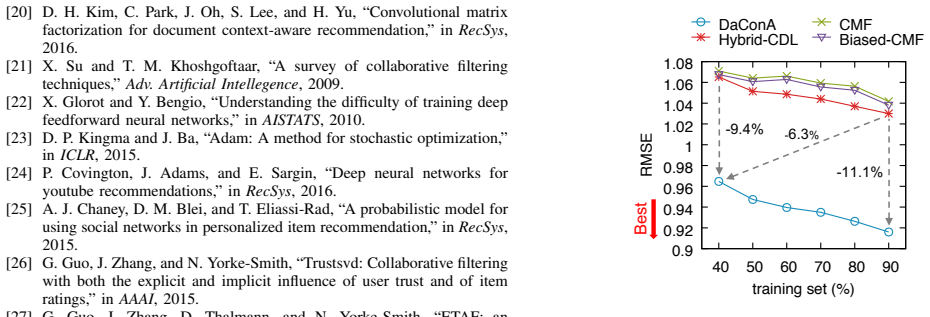
Pith's one-line read DaConA claims the best rating accuracy, up to 5.2% lower RMSE than the second-best method, by learning a separate linear projection for each data context before combining shared latent factors.
desk verdict A clean, well-specified deep CMF variant with a plausible architecture and reproducible code; the 'state-of-the-art' claim needs error bars or significance tests before it is fully convincing. read the letter →
The pith
A machine-rendered reading of the paper's core claim, the machinery that carries it, and where it could break.
The reading
What carries the argument
The data context adaptation layer: two learnable projection matrices, $D_X$ for the rating context and $D_Y$ for the auxiliary context, that map shared user, item, and auxiliary-entity interaction vectors into context-appropriate representations. These projected vectors are combined by element-wise product, concatenated with latent independence vectors, and fed into fully-connected networks with Tanh activations, which lets the model capture non-linear interactions.
What would settle it
Construct a synthetic dataset with known ground truth where the rating process uses per-entity rotations between contexts, e.g., $r_{ij} = g((W_i u_i) \circ (W_j v_j))$ with different $W$ per entity. If DaConA's single-shared-projection model cannot beat a per-entity projection baseline or DaConA-withoutCA on this dataset, the shared linear projection assumption is falsified.
Extended reading notes
Core claim
The central claim is that a data context adaptation layer resolves the context mismatch in collective matrix factorization. DaConA learns $D_X$ and $D_Y$, two linear projections that map shared latent interaction vectors into the rating context and the auxiliary context, then computes element-wise products of the projected vectors, concatenates them with per-context independence vectors, and predicts ratings and auxiliary entries through two multilayer perceptrons. The paper further shows that setting the projections to identities, removing independence vectors, and using a single linear layer reduces DaConA exactly to MF and CMF, so the new method is a strict generalization with richer modeling capacity.
Load-bearing premise
The method assumes that a single shared linear projection per data context is enough to translate every user, item, and auxiliary entity's interaction vector into that context; if the needed translation differs sharply per entity or is non-linear, the core adaptation idea loses its justification.
Editorial extensions
If this is right
- If DaConA is correct, collective recommendation methods can treat data context as a learned linear map in latent space rather than retraining separate embeddings per matrix.
- Replacing scalar bias terms with vector-valued independence factors increases modeling capacity for user and item idiosyncrasies.
- Non-linear scoring through neural networks outperforms inner-product scoring on both user-coupled and item-coupled auxiliary data.
- Because DaConA generalizes MF, biased-MF, CMF, and biased-CMF, any improvement it demonstrates transfers to those classical frameworks as special cases.
- The architecture extends to multiple auxiliary matrices, such as combining item-genre and user-trust information simultaneously.
Reading between the lines
- The shared-per-context projection is a testable symmetry assumption: in datasets where users and items occupy very different latent subspaces, per-entity-type projections might outperform the single shared $D_X$, an experiment the paper does not run.
- A natural extension the paper leaves implicit is cold-start recommendation, where a new entity's latent interaction vector could be initialized from its auxiliary features and immediately projected into the rating context.
- The data context adaptation idea is not specific to ratings: it applies to any paired relational matrices, such as document-word and author-venue, wherever the same entities appear in two semantically different relations.
Signed reviews
Editorial analysis
A structured set of objections, weighed in public.
Referee Report
Summary. The paper proposes DaConA, a neural-network method for rating prediction using both a rating matrix and an auxiliary matrix (user-coupled or item-coupled). The architecture has three main ingredients: (i) a data context adaptation layer that projects shared latent interaction vectors into the rating context and the auxiliary context with per-context linear matrices D_X and D_Y; (ii) separate latent interaction and latent independence vectors per entity, with the independence vectors not restricted to scalars; and (iii) non-linear scoring via fully-connected networks f_X and f_Y on the element-wise product of adapted interaction vectors and the concatenated independence vectors. The paper shows that DaConA reduces to MF, biased-MF, CMF, and biased-CMF under specific parameter settings, and reports RMSE/MAE comparisons on six real-world datasets, claiming state-of-the-art accuracy with up to 5.2% lower RMSE than the second-best method.
Significance. If the performance claims hold, the paper makes a useful and clearly explained contribution: the context-adaptation layer is a simple yet plausible extension of collective matrix factorization, the independence-vector generalization is more expressive than the scalar biases of biased-MF/biased-CMF, and the non-linear scoring function is a natural fit with modern recommender models. The paper also deserves credit for giving explicit special-case reductions to MF and CMF, which are correct by construction, and for providing a source-code/dataset link. However, the significance is conditional: the headline accuracy claim rests entirely on single-point comparisons without variance or significance testing, so the empirical advantage over strong baselines is not yet established at the level claimed.
major comments (3)
- [§IV-B, Table IV and Fig. 1] The central claim that DaConA achieves state-of-the-art accuracy rests entirely on single-point RMSE/MAE comparisons. Table IV reports one value per method and dataset with no standard deviations, no repeated data splits, and no significance tests; the reported gains over the second-best method range from 1.5% to 5.2% in RMSE, which may be within run-to-run or split-to-split noise. This is not a hypothetical concern: Section IV-C reports results averaged over ten runs, so the authors have the machinery to produce variance estimates, and the main table should include them. Please report standard deviations (or confidence intervals) and significance tests for the differences in Table IV, or alternatively soften the state-of-the-art claim to a conditional one.
- [§III-F, Algorithm 1 and Eq. (1)] The stated objective is the weighted sum L = (1−α)lossX + α lossY, but Algorithm 1 does not minimize this objective. In lines 7–8 the shared parameter block V is updated using only (1−α)lossX, and in lines 14–15 using only α lossY, so no update step ever forms the gradient of the combined loss with respect to V. This matters because V appears in both lossX and lossY. Please either provide an optimization-theoretic justification for the alternating procedure as a solver for Eq. (1), or revise the exposition to state that the algorithm minimizes the two terms in an alternating fashion rather than the weighted sum.
- [§IV-D, Figure 4] The ablation comparison between DaConA, DaConA-withoutCA, and DaConA-sep sets all hyperparameters to the optimal settings of the full DaConA model. If the ablation variants have different optimal hyperparameters (for instance, a different ds or α), the reported differences in Figure 4 may partly reflect mistuned ablations rather than the effect of the context-adaptation layer. Please re-tune the ablations independently and report their optimal hyperparameters, or justify why the full model's settings are appropriate for all variants.
minor comments (4)
- [§IV-C, Figure 3] In the dimension sweep, dc is set to 40−2ds, so varying ds changes both the independence capacity and the interaction capacity simultaneously; the conclusion about balancing the two factors should be stated with this coupling in mind.
- [Table V] The hyperparameter table is difficult to parse because per-dataset values are packed into single rows; please format it as a method-by-dataset table or add explicit column headers so that each value can be traced to its dataset.
- [§III-G] For the MF and CMF special-case reductions, please state explicitly that the one-layer network is a sum layer, so that the element-wise product followed by summation equals the inner product; the phrase 'all weights of the layer to 1' is ambiguous about whether it also sums over the element-wise product dimension.
- [Figure 1] The caption uses 'N/A' without explaining what it refers to; the text says FM is omitted, but the N/A markers appear to indicate that SREPS is unavailable for the item-coupled datasets. Please clarify the caption.
Circularity Check
No significant circularity: DaConA's accuracy claims rest on held-out test ratings, and its MF/CMF special-case results are explicit parameter restrictions, not fitted inputs presented as predictions.
full rationale
The paper's derivation chain is self-contained. The predictive model in Eqs. (5)-(6) defines predictions from latent interaction vectors, latent independence vectors, and learned context projection matrices, and the objective in Eqs. (1)-(3) is minimized on observed entries only, with test ratings held out (80/20 split, Section IV-A). The central accuracy claim (Table IV, Figure 1) is an empirical comparison against external baselines on held-out ratings, so no prediction is defined in terms of fitted parameters. The generalization claims in Section III-G are explicit parameter choices (alpha=0, identity projection, ds=0, unit weights, no activation) that reduce DaConA to MF, Biased-MF, CMF, and Biased-CMF; these are mathematical special-case reductions, not evidence for predictive performance, and thus not circular. The effectiveness of the data context adaptation layer is tested by an independent ablation (DaConA-withoutCA, DaConA-sep, Section IV-D) under fixed hyperparameters, and the paper reports that sharing the projection matrix per context improves results. Citations are to external prior work (e.g., NeuMF, CMF, SREPS, Hybrid-CDL); there is no load-bearing self-citation chain or imported uniqueness theorem. The absence of error bars in the main comparison is a statistical-reporting concern, not a circularity concern.
Assumptions & free parameters
free parameters (5)
- alpha (context balance) =
0.4 / 0.8 / 0.9 / 0.2 / 0.9 / 0.6
- lambda (L2 regularization) =
1e-5 for all DaConA runs
- ds (independence vector dimension) =
13 / 14 / 11 / 7 / 10 / 11
- learning rate =
1e-3 or 1e-4 depending on dataset
- network depth =
[40, 20, 10] hidden units
assumptions (5)
- domain assumption Shared latent interaction vectors U, V, C can represent both rating and auxiliary contexts after multiplication by a per-context projection matrix.
- domain assumption Entries of the auxiliary matrix Y (trust, genre) can be modeled as real-valued targets with squared error.
- domain assumption A random 80/20 split of ratings approximates the deployment setting for measuring recommendation accuracy.
- standard math Alternating optimization with Adam converges to a solution good enough for comparing methods.
- domain assumption The element-wise product of projected interaction vectors plus concatenated independence vectors is a sufficient input representation for the scoring network.
Cite this review
Pith. "Pith review of Data Context Adaptation for Accurate Recommendation with Additional Information." pith.science (2026). https://pith.science/paper/M6VTG2UH
@misc{pith2026190808469,
  author       = {Pith},
  title        = {Pith review of: Data Context Adaptation for Accurate Recommendation with Additional Information},
  year         = {2026},
  howpublished = {\url{https://pith.science/paper/M6VTG2UH}},
  note         = {Machine review of arXiv:1908.08469}
}
read the original abstract
Given a sparse rating matrix and an auxiliary matrix of users or items, how can we accurately predict missing ratings considering different data contexts of entities? Many previous studies proved that utilizing the additional information with rating data is helpful to improve the performance. However, existing methods are limited in that 1) they ignore the fact that data contexts of rating and auxiliary matrices are different, 2) they have restricted capability of expressing independence information of users or items, and 3) they assume the relation between a user and an item is linear. We propose DaConA, a neural network based method for recommendation with a rating matrix and an auxiliary matrix. DaConA is designed with the following three main ideas. First, we propose a data context adaptation layer to extract pertinent features for different data contexts. Second, DaConA represents each entity with latent interaction vector and latent independence vector. Unlike previous methods, both of the two vectors are not limited in size. Lastly, while previous matrix factorization based methods predict missing values through the inner-product of latent vectors, DaConA learns a non-linear function of them via a neural network. We show that DaConA is a generalized algorithm including the standard matrix factorization and the collective matrix factorization as special cases. Through comprehensive experiments on real-world datasets, we show that DaConA provides the state-of-the-art accuracy.
Figures


Figures from the paper (2 more)

Reference graph
Works this paper leans on
-
[1]
Matrix factorization techniques for recommender systems,
Y . Koren, R. M. Bell, and C. V olinsky, “Matrix factorization techniques for recommender systems,” IEEE Computer, 2009
work page 2009
-
[2]
Probabilistic matrix factorization,
R. Salakhutdinov and A. Mnih, “Probabilistic matrix factorization,” in NIPS, 2007
work page 2007
-
[3]
Neural network matrix factorization,
G. K. Dziugaite and D. M. Roy, “Neural network matrix factorization,” CoRR, 2015
work page 2015
-
[4]
Neural collaborative filtering,
X. He, L. Liao, H. Zhang, L. Nie, X. Hu, and T. Chua, “Neural collaborative filtering,” in WWW, 2017
work page 2017
-
[5]
Relational learning via collective matrix factorization,
A. P. Singh and G. J. Gordon, “Relational learning via collective matrix factorization,” in SIGKDD, 2008
work page 2008
- [6]
-
[7]
Factorization machines with libfm,
S. Rendle, “Factorization machines with libfm,” ACM TIST, 2012
work page 2012
-
[8]
Higher-order factor- ization machines,
M. Blondel, A. Fujino, N. Ueda, and M. Ishihata, “Higher-order factor- ization machines,” in NIPS, 2016
work page 2016
Show all 36 references
-
[9]
Social recommendation with an essential preference space,
C. Liu, C. Zhou, J. Wu, Y . Hu, and L. Guo, “Social recommendation with an essential preference space,” in AAAI, 2018
2018
-
[10]
A hybrid collab- orative filtering model with deep structure for recommender systems,
X. Dong, L. Yu, Z. Wu, Y . Sun, L. Yuan, and F. Zhang, “A hybrid collab- orative filtering model with deep structure for recommender systems,” in AAAI, 2017
2017
-
[11]
Sorec: social recommendation using probabilistic matrix factorization,
H. Ma, H. Yang, M. R. Lyu, and I. King, “Sorec: social recommendation using probabilistic matrix factorization,” in CIKM, 2008
2008
-
[12]
Learning to recommend with social trust ensemble,
H. Ma, I. King, and M. R. Lyu, “Learning to recommend with social trust ensemble,” in SIGIR, 2009
2009
-
[13]
A matrix factorization technique with trust propagation for recommendation in social networks,
M. Jamali and M. Ester, “A matrix factorization technique with trust propagation for recommendation in social networks,” in RecSys, 2010
2010
-
[14]
Recommender systems with social regularization,
H. Ma, D. Zhou, C. Liu, M. R. Lyu, and I. King, “Recommender systems with social regularization,” in WSDM, 2011
2011
-
[15]
Social collaborative filtering by trust,
B. Yang, Y . Lei, D. Liu, and J. Liu, “Social collaborative filtering by trust,” in IJCAI, 2013
2013
-
[16]
Recommendation with social dimensions,
J. Tang, S. Wang, X. Hu, D. Yin, Y . Bi, Y . Chang, and H. Liu, “Recommendation with social dimensions,” in AAAI, 2016
2016
-
[17]
Deep collaborative filtering via marginal- ized denoising auto-encoder,
S. Li, J. Kawale, and Y . Fu, “Deep collaborative filtering via marginal- ized denoising auto-encoder,” in CIKM, 2015
2015
-
[18]
Collaborative topic modeling for recommend- ing scientific articles,
C. Wang and D. M. Blei, “Collaborative topic modeling for recommend- ing scientific articles,” in SIGKDD, 2011
2011
-
[19]
Collaborative deep learning for recommender systems,
H. Wang, N. Wang, and D. Yeung, “Collaborative deep learning for recommender systems,” in SIGKDD, 2015
2015
-
[20]
Convolutional matrix factorization for document context-aware recommendation,
D. H. Kim, C. Park, J. Oh, S. Lee, and H. Yu, “Convolutional matrix factorization for document context-aware recommendation,” in RecSys, 2016
2016
-
[21]
A survey of collaborative filtering techniques,
X. Su and T. M. Khoshgoftaar, “A survey of collaborative filtering techniques,” Adv. Artificial Intellegence, 2009
2009
-
[22]
Understanding the difficulty of training deep feedforward neural networks,
X. Glorot and Y . Bengio, “Understanding the difficulty of training deep feedforward neural networks,” in AISTATS, 2010
2010
-
[23]
Adam: A method for stochastic optimization,
D. P. Kingma and J. Ba, “Adam: A method for stochastic optimization,” in ICLR, 2015
2015
-
[24]
Deep neural networks for youtube recommendations,
P. Covington, J. Adams, and E. Sargin, “Deep neural networks for youtube recommendations,” in RecSys, 2016
2016
-
[25]
A probabilistic model for using social networks in personalized item recommendation,
A. J. Chaney, D. M. Blei, and T. Eliassi-Rad, “A probabilistic model for using social networks in personalized item recommendation,” in RecSys, 2015
2015
-
[26]
Trustsvd: Collaborative filtering with both the explicit and implicit influence of user trust and of item ratings,
G. Guo, J. Zhang, and N. Yorke-Smith, “Trustsvd: Collaborative filtering with both the explicit and implicit influence of user trust and of item ratings,” in AAAI, 2015
2015
-
[27]
ETAF: an extended trust antecedents framework for trust prediction,
G. Guo, J. Zhang, D. Thalmann, and N. Yorke-Smith, “ETAF: an extended trust antecedents framework for trust prediction,” in ASONAM, 2014
2014
-
[28]
Circle-based recommendation in online social networks,
X. Yang, H. Steck, and Y . Liu, “Circle-based recommendation in online social networks,” in SIGKDD, 2012
2012
-
[29]
An experimental study on implicit social recommendation,
H. Ma, “An experimental study on implicit social recommendation,” in SIGIR, 2013
2013
-
[30]
Dynamic connection-based social group recommendation,
D. Qin, X. Zhou, L. Chen, G. Huang, and Y . Zhang, “Dynamic connection-based social group recommendation,” IEEE TKDE, 2018
2018
-
[31]
Integrating collaborative filtering and sentiment analysis: A rating inference approach,
C. W. Leung, S. C. Chan, and F.-l. Chung, “Integrating collaborative filtering and sentiment analysis: A rating inference approach,” in Pro- ceedings of the ECAI 2006 workshop on recommender systems , 2006
2006
-
[32]
Integrating reviews into personalized ranking for cold start recommendation,
G. Hu and X. Dai, “Integrating reviews into personalized ranking for cold start recommendation,” in PAKDD, 2017
2017
-
[33]
Aspect based recommendations: Recommending items with the most valuable aspects based on user reviews,
K. Bauman, B. Liu, and A. Tuzhilin, “Aspect based recommendations: Recommending items with the most valuable aspects based on user reviews,” in SIGKDD, 2017
2017
-
[34]
Recommender systems based on user reviews: the state of the art,
L. Chen, G. Chen, and F. Wang, “Recommender systems based on user reviews: the state of the art,” User Model. User-Adapt. Interact. , 2015
2015
-
[35]
Stacked denoising autoencoders: Learning useful representations in a deep network with a local denoising criterion,
P. Vincent, H. Larochelle, I. Lajoie, Y . Bengio, and P. Manzagol, “Stacked denoising autoencoders: Learning useful representations in a deep network with a local denoising criterion,” JMLR, 2010
2010
-
[36]
Deep hybrid recommender systems via exploiting document context and statistics of items,
D. H. Kim, C. Park, J. Oh, and H. Yu, “Deep hybrid recommender systems via exploiting document context and statistics of items,” Inf. Sci., 2017. APPENDIX A. Using Multiple Auxiliary Information Extension. DACONA supports using multiple auxiliary ma- trices. Assume we are give...
2017
Reviewed August 14, 2026 · model on record in the stance chip above.
Discussion (0). Continue with ORCID to comment.