REVIEW 4 major objections 4 minor 55 references
On the Close Correspondence between Storm-time ULF Wave Power and the POES VLF Chorus Wave Amplitude Proxy
T0 review · 4 major / 4 minor · reviewed 2026-08-14 · deepseek-v4-flash
Pith's one-line read Storm-time ULF wave power and the POES VLF chorus proxy track each other through all 33 storms, challenging the claim that chorus waves alone drive radiation belt acceleration.
desk verdict A genuinely useful multi-event comparison showing ULF power and the POES VLF chorus proxy track each other storm-by-storm; the interpretation is carefully hedged but the potential self-correlation from ULF-driven precipitation is not quantified. read the letter →
The pith
A machine-rendered reading of the paper's core claim, the machinery that carries it, and where it could break.
The reading
What carries the argument
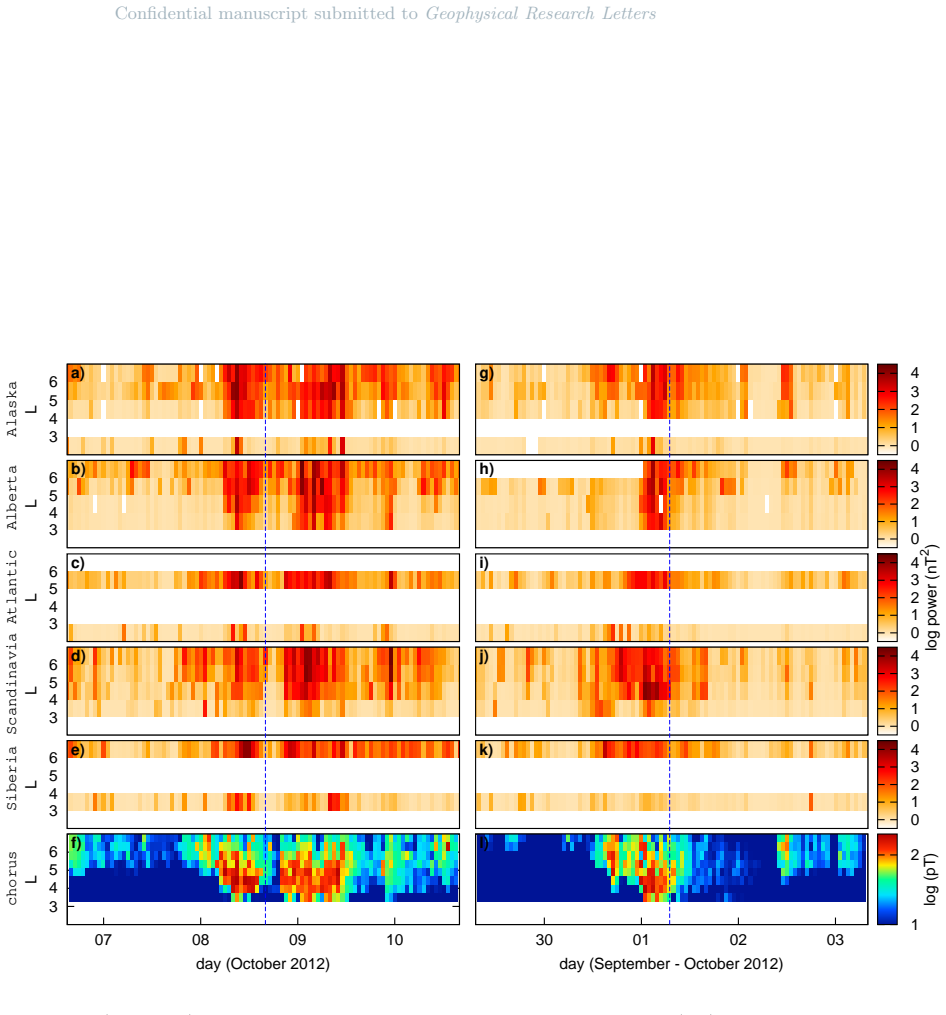
The central tool is the multi-meridian ULF wave power map: hourly integrated Pc5 power in the 1.68\,mHz to 7\,mHz band, computed from ground magnetometer stations in five longitudinal chains and binned by dipole L-shell, superimposed across seven days around the electron phase-space-density minimum for each storm. These ULF maps are compared directly to the VLF chorus wave amplitude proxy, which is formed from the ratio of POES-observed 30\,keV to 100\,keV loss-cone to trapped electron fluxes averaged over magnetic local time. The superposed epoch analysis of both quantities for efficient and inefficient acceleration events is the mechanism that exposes the common L-shell and time envelopes, while the cross-meridian coherence of ULF power is what supports the claim that a small number of meridians can yield storm-time radial diffusion coefficients.
What would settle it
Compare the POES VLF proxy with direct in-situ chorus wave amplitude measurements, for example from spacecraft wave instruments, during a storm with strong ULF wave power but weak chorus. If the proxy remains high while in-situ chorus amplitudes are low, the proxy is being contaminated by ULF-driven precipitation; conversely, if in-situ chorus tracks the proxy even when ULF power is low, the correspondence is not a proxy artifact.
Extended reading notes
Core claim
The paper's central claim is that ground-based Pc5 ULF wave power and the VLF chorus wave amplitude proxy derived from POES electron precipitation share a common L-shell and time dependence in every one of the 33 storms examined, especially inward of $L = 6$, and that both quantities discriminate identically between efficient and inefficient radiation belt electron acceleration. Because the proxy was previously used to argue that chorus waves play an essential role in acceleration, the identical discrimination means that the proxy alone cannot identify chorus waves as the dominant mechanism. The paper offers four explanations: chorus waves could drive ULF waves (judged energetically implausible), ULF waves could drive chorus waves, both could share a common driver with near-identical L-shell and time profiles, or ULF waves could directly drive precipitation that pollutes the proxy. The authors conclude that the correspondence complicates causative assessments and that care is required when using POES precipitation to infer VLF wave amplitudes.
Load-bearing premise
The load-bearing premise is that the POES-derived VLF chorus wave amplitude proxy accurately represents chorus wave intensity; if ULF-driven electron precipitation contaminates the proxy, the observed correspondence with ULF power becomes partly trivial and the inference that chorus waves drive acceleration is undermined.
Editorial extensions
If this is right
- The VLF chorus proxy alone cannot uniquely identify chorus waves as the dominant radiation belt acceleration agent during storms.
- Ground-based ULF observations can provide data-driven radial diffusion coefficients from only a few longitudinal meridians, potentially in near-real time.
- The observed ULF-VLF correspondence supports either ULF-driven precipitation contaminating the POES proxy, ULF waves driving or modulating chorus waves, or a common driver producing both with nearly identical L-shell and time profiles.
- Simulations of radiation belt dynamics that use the POES proxy for chorus intensity may need to account for ULF wave power to avoid overestimating chorus-driven acceleration.
- The relative lack of VLF proxy activity above $L = 6$, despite strong ULF power there, points to a limit in the seed electron population available for precipitation rather than an absence of waves.
Reading between the lines
- If the POES proxy is partially a ULF-driven precipitation signal, then event-specific chorus amplitudes estimated from POES during ULF-active storms may be biased high; a direct test would compare the proxy against in-situ chorus wave measurements during storms with high ULF power and weak chorus.
- The identical discrimination between efficient and inefficient acceleration could mean that a single solar wind driver, such as a high-speed stream, produces both wave populations, implying that correlating electron flux response to either wave type may conflate correlation with causation.
- The strong global coherence of ULF power suggests that sparse ground magnetometer networks could support real-time radial diffusion estimates, but this requires validation against in-situ electric field measurements before being used for forecasting.
- The $L > 6$ mismatch between ULF power and the VLF proxy may offer a natural control: if the proxy tracks ULF power only where the seed population is present, then the spatial envelope of the proxy is set by particle availability, not wave generation.
Signed reviews
Editorial analysis
A structured set of objections, weighed in public.
Referee Report
Summary. The paper compares ground-based Pc5 ULF wave power from five SuperMAG longitudinal chains with the POES-derived VLF chorus wave amplitude proxy of Li et al. (2015) for the same 33 storms, classified into 16 efficient and 17 inefficient radiation belt electron acceleration events. The authors report a close L-shell-time morphological correspondence between ULF power and the VLF proxy in every event, a similar correspondence in superposed-epoch analyses for both event classes, correlation coefficients peaking at zero time offset (r = 0.65–0.84), and a global longitudinal coherence of ULF power. They interpret these results as indicating that the VLF proxy may be contaminated by ULF-driven precipitation, that ULF waves may drive chorus waves, or that both have a common driver, and they argue that the correspondence complicates the L15 interpretation that the proxy identifies chorus waves as the dominant acceleration agent.
Significance. If the reported correspondence is robust, this is a significant contribution because it provides a multi-event, multi-meridian comparison that directly challenges the interpretive framework of Li et al. (2015) and highlights a previously underappreciated ambiguity in the POES precipitation-based VLF proxy. The authors are explicit about the alternative physical explanations, including the possibility that ULF waves directly drive precipitation and thereby contaminate the proxy, which is a strength of the presentation. The use of public SuperMAG data, the availability of the derived data in an OSF repository, and the reproduction of the L15 event set are assets for reproducibility. However, the significance hinges on the proxy being a meaningful measure of chorus amplitude; if the proxy is dominated by ULF-driven precipitation, the observed correspondence becomes partially trivial and the main conclusion reduces to a cautionary note about the proxy, which is already well recognized in the discussion.
major comments (4)
- [Section 3, second paragraph; Abstract] The claim that the correspondence is maintained in 'essentially every single event' (and the abstract's 'for every single storm') is supported only by visual inspection of the supplementary figures; no per-event quantitative metric, such as an event-specific correlation coefficient or a normalized pattern similarity score, is reported. Because this is the paper's central claim, the authors should provide a quantitative per-event measure and report its distribution across the 33 storms.
- [Section 3, supplementary material; Section 4, Case 4] The Pearson correlation coefficients (r = 0.65–0.84 at zero offset) are computed between ULF power and the VLF proxy. As the authors acknowledge in Section 4, the proxy may be contaminated by ULF-driven precipitation (citing Rae et al. 2018), in which case a zero-offset correlation would be expected even without any chorus contribution. The manuscript does not quantify the degree to which ULF-driven precipitation contributes to the proxy variance for these events, for example by comparing the proxy with independent in-situ chorus measurements (e.g., Van Allen Probes EMFISIS/WAVES data) for a subset of the 33 storms. Without such a control, the correlation cannot support an independent ULF-chorus relationship or an estimate of the physical chorus fraction in the proxy.
- [Section 3, Figures 3 and 4; Key Points] The key-point claim that ULF power and the VLF proxy 'discriminate identically between efficient and inefficient acceleration events' is based on visual inspection of superposed-epoch plots and probability distributions; no statistical measure of discrimination (e.g., separability of EA and IA distributions, a ROC curve, or a contingency-table test) is provided. Since this claim appears in the abstract and key points, it should be backed by a quantitative discrimination analysis for both quantities.
- [Section 4, last paragraph; Figure S36] The proposal that 'a small number of meridians can be used to estimate storm-time radial diffusion coefficients' rests on Figure S36, which compares only the Alberta and Scandinavia meridians. A single two-meridian comparison does not establish global longitudinal coherence across all MLT sectors; the claim should be either supported with additional meridian-pair comparisons or explicitly framed as a preliminary suggestion.
minor comments (4)
- [Section 4, Case 2] After stating that compressional Pc4-5 pulsations 'have been found to produce conditions that encourage the production or modulation of chorus waves' (citing Li et al. 2011), the text says 'we are not aware of any processes through which ULF waves can directly produce chorus emissions.' This is confusing; please clarify the distinction between direct production and modulation or conditioning of chorus waves.
- [Section 3, supplementary description] The sentence 'The fractional variance is consistent in log-log space' is unclear; please rephrase it to state precisely what is plotted and what the consistency implies.
- [Section 2, Methodology] The description of the VLF proxy would benefit from explicitly noting that the proxy is a diagnostic of precipitation, not a direct wave measurement, and that the assumption of a one-to-one relation to chorus amplitude is the key premise being challenged.
- [Introduction] The reference to Ma et al. [2018] 'but without a discussion on morphological similarities' is vague; please specify what Ma et al. presented and which point is being contrasted.
Circularity Check
No significant circularity: the ULF–proxy comparison uses independent datasets and explicitly leaves causation open.
full rationale
The paper's central comparison is between independently measured ground-based Pc5 ULF power (SuperMAG magnetometers) and the POES precipitation-derived VLF chorus proxy from Li et al. (2015); no parameter is fitted to force the correspondence, and the L15 proxy is externally constructed. The reuse of L15's storm list, zero epochs, and EA/IA categorization is a deliberate controlled comparison, not a derivation of those categories from ULF data. The paper's main interpretive claim is explicitly non-committal: it lists four possible explanations, including ULF-driven precipitation polluting the proxy (Case 4), so the observed correlation is not presented as proof of a ULF-chorus causal relation. The acknowledged contamination pathway is a physical confound and a limitation, not a definitional equivalence: the proxy is not constructed from ULF wave power, and no equation in the paper reduces ULF power to the proxy. Self-citations (Rae et al. 2012 for spectral methods, Rae et al. 2018 for the Case 4 mechanism, Ozeke et al. 2014 for radial diffusion coefficients) are used as standard methods or external mechanisms, and none is a uniqueness theorem or an ansatz smuggled in to force the result. Consequently no circular step can be exhibited.
Assumptions & free parameters
assumptions (3)
- domain assumption The POES VLF chorus wave amplitude proxy from Li et al. (2015) represents actual chorus wave intensity.
- domain assumption Ground-based Pc5 ULF power at the selected stations is representative of magnetospheric ULF wave power at corresponding L-shells.
- domain assumption The EA/IA event classification and zero epoch times defined by Li et al. (2015) are correct.
Cite this review
Pith. "Pith review of On the Close Correspondence between Storm-time ULF Wave Power and the POES VLF Chorus Wave Amplitude Proxy." pith.science (2026). https://pith.science/paper/IO64O7WQ
@misc{pith2026190808480,
  author       = {Pith},
  title        = {Pith review of: On the Close Correspondence between Storm-time ULF Wave Power and the POES VLF Chorus Wave Amplitude Proxy},
  year         = {2026},
  howpublished = {\url{https://pith.science/paper/IO64O7WQ}},
  note         = {Machine review of arXiv:1908.08480}
}
abstract
Ground-based Pc5 ULF wave power in multiple ground-based meridians is compared to the VLF wave amplitude proxy, derived from POES precipitation, for the 33 storms studied by Li et al. [2015]. The results reveal common L-shell and time profiles for the ULF waves and VLF proxy for every single storm, especially at $L\leq 6$, and identical discrimination between efficient and inefficient radiation belt electron acceleration. The observations imply either ULF waves play a role in driving precipitation which is falsely interpreted as VLF wave power in the proxy, ULF waves drive VLF waves (the reverse being energetically unfeasible), or both have a common driver with nearly identical L-shell and time-dependence. Global ground-based ULF wave power coherence implies a small number of meridians can be used to estimate storm-time radial diffusion coefficients. However, the strong correspondence between ULF wave power and VLF wave proxy complicates causative assessments of electron acceleration.
Figures


Figures from the paper (1 more)

Reference graph
Works this paper leans on
-
[1]
\@lbibitem[#1]#2 [\@biblabel #1 ] @filesw \@auxout #2 #1 \@bibitem#1 @filesw \@auxout #1 \@listctr \@donoparitem \@noparitemfalse \@labels - \@labels @minipage \@tempskipa - \@tempskipa\@outerparskip \@tempskipa - \@tempskipa \@item[#1] @noparitem \@donoparitem @inlabel @newlist @nobreak \@nbitem \@beginparpenalty \@topsep - \@itempenalty \@inlabeltrue \@...
work page 2001
-
[2]
NAT@ctr \@lbibitem[ NAT@ctr ] \@lbibitem[#1]#2 \@extra@b@citeb \@ifundefined br@#2\@extra@b@citeb \@namedef br@#2 \@nameuse br@#2\@extra@b@citeb \@ifundefined b@#2\@extra@b@citeb @num @parse #2 [ @natanchorstart #2\@extra@b@citeb \@biblabel @num @natanchorend] @ifcmd#1(@)(@)\@nil #2 @lbibitem\@undefined @lbibitem\@lbibitem \@lbibitem[#1]#2 @lbibitem[#1] #...
work page 2009
-
[3]
Anderson , B. J., M. J. Engebretson , S. P. Rounds , L. J. Zanetti , and T. A. Potemra (1990), A statistical study of Pc 3-5 pulsations observed by the AMPTE/CCE magnetic fields experiment. I - Occurrence distributions , Journal of Geophysical Research, 95, 10,495--10,523, doi:10.1029/JA095iA07p10495
-
[4]
Baker , D. N. (1998), What is space weather? , Advances in Space Research, 22, 7--16, doi:10.1016/S0273-1177(97)01095-8
-
[5]
Baker , D. N., S. G. Kanekal , V. C. Hoxie , S. Batiste , M. Bolton , X. Li , S. R. Elkington , S. Monk , R. Reukauf , S. Steg , J. Westfall , C. Belting , B. Bolton , D. Braun , B. Cervelli , K. Hubbell , M. Kien , S. Knappmiller , S. Wade , B. Lamprecht , K. Stevens , J. Wallace , A. Yehle , H. E. Spence , and R. Friedel (2013), The Relativistic Electro...
work page 2013
-
[6]
Brautigam , D. H., and J. M. Albert (2000), Radial diffusion analysis of outer radiation belt electrons during the October 9, 1990, magnetic storm , Journal of Geophysical Research, 105, 291--310, doi:10.1029/1999JA900344
-
[7]
Cahill , L. J., Jr., and J. R. Winckler (1992), Periodic magnetopause oscillations observed with the GOES satellites on March 24, 1991 , Journal of Geophysical Research, 97, 8239--8243, doi:10.1029/92JA00433
-
[8]
Choi , H.-S., J. Lee , K.-S. Cho , Y.-S. Kwak , I.-H. Cho , Y.-D. Park , Y.-H. Kim , D. N. Baker , G. D. Reeves , and D.-K. Lee (2011), Analysis of GEO spacecraft anomalies: Space weather relationships , Space Weather, 9, 06001, doi:10.1029/2010SW000597
Show all 55 references
-
[9]
Cunningham , G. S. (2016), Radial diffusion of radiation belt particles in nondipolar magnetic fields , Journal of Geophysical Research (Space Physics), 121, 5149--5171, doi:10.1002/2015JA021981
2016 doi
-
[10]
Baker , J
Daglis , I., D. Baker , J. Kappenman , M. Panasyuk , and E. Daly (2004), Effects of space weather on technology infrastructure , Space Weather, 2, S02004, doi:10.1029/2003SW000044
2004 doi
-
[11]
Takahashi , R
Dai , L., K. Takahashi , R. Lysak , C. Wang , J. R. Wygant , C. Kletzing , J. Bonnell , C. A. Cattell , C. W. Smith , R. J. MacDowall , S. Thaller , A. Breneman , X. Tang , X. Tao , and L. Chen (2015), Storm time occurrence and spatial distribution of Pc4 poloidal ULF waves in...
2015 doi
-
[12]
Elkington , S. R., M. K. Hudson , and A. A. Chan (1999), Acceleration of relativistic electrons via drift-resonant interaction with toroidal-mode Pc-5 ULF oscillations , Geophysical Research Letters, 26, 3273--3276, doi:10.1029/1999GL003659
1999 doi
-
[13]
(1965), Effects of Time-Dependent Electric Fields on Geomagnetically Trapped Radiation , Journal of Geophysical Research, 70, 2503--2516, doi:10.1029/JZ070i011p02503
F \"a lthammar , C.-G. (1965), Effects of Time-Dependent Electric Fields on Geomagnetically Trapped Radiation , Journal of Geophysical Research, 70, 2503--2516, doi:10.1029/JZ070i011p02503
1965 doi
-
[14]
Fei , Y., A. A. Chan , S. R. Elkington , and M. J. Wiltberger (2006), Radial diffusion and MHD particle simulations of relativistic electron transport by ULF waves in the September 1998 storm , Journal of Geophysical Research (Space Physics), 111, A12209, doi:10.1029/2005JA011211
2006 doi
-
[15]
Evans (2000), Radiation damage ofthe proton meped detector on poes (tiros/noaa) satellites, NOAA Technical Report OAR
Galand, M., and D. Evans (2000), Radiation damage ofthe proton meped detector on poes (tiros/noaa) satellites, NOAA Technical Report OAR
2000
-
[16]
Gjerloev , J. W. (2009), A Global Ground-Based Magnetometer Initiative , EOS Transactions, 90, 230--231, doi:10.1029/2009EO270002
2009 doi
-
[17]
Gjerloev , J. W. (2012), The SuperMAG data processing technique , Journal of Geophysical Research (Space Physics), 117, A09213, doi:10.1029/2012JA017683
2012 doi
-
[18]
Glassmeier , K.-H., and M. Stellmacher (2000), Concerning the local time asymmetry of Pc5 wave power at the ground and field line resonance widths , Journal of Geophysical Research, 105, 18, doi:10.1029/2000JA900037
2000 doi
-
[19]
B., and R
Horne , R. B., and R. M. Thorne (1998), Potential waves for relativistic electron scattering and stochastic acceleration during magnetic storms , Geophysical Research Letters, 25, 3011--3014, doi:10.1029/98GL01002
1998 doi
-
[20]
Horne , R. B., R. M. Thorne , Y. Y. Shprits , N. P. Meredith , S. A. Glauert , A. J. Smith , S. G. Kanekal , D. N. Baker , M. J. Engebretson , J. L. Posch , M. Spasojevic , U. S. Inan , J. S. Pickett , and P. M. E. Decreau (2005), Wave acceleration of electrons in the Van Alle...
2005 doi
-
[21]
Huang , C.-L., H. E. Spence , M. K. Hudson , and S. R. Elkington (2010), Modeling radiation belt radial diffusion in ULF wave fields: 2. Estimating rates of radial diffusion using combined MHD and particle codes , Journal of Geophysical Research (Space Physics), 115, A06216, d...
2010 doi
-
[22]
Hudson , M. K., S. R. Elkington , J. G. Lyon , C. C. Goodrich , and T. J. Rosenberg (1999), Simulation of radiation belt dynamics driven by solar wind variations , Washington DC American Geophysical Union Geophysical Monograph Series, 109, 171--182, doi:10.1029/GM109p0171
1999 doi
-
[23]
A., D.-Y
Hwang , J. A., D.-Y. Lee , L. R. Lyons , A. J. Smith , S. Zou , K. W. Min , K.-H. Kim , Y.-J. Moon , and Y. D. Park (2007), Statistical significance of association between whistler-mode chorus enhancements and enhanced convection periods during high-speed streams , Journal of ...
2007 doi
-
[24]
Katsavrias , C., I. A. Daglis , W. Li , S. Dimitrakoudis , M. Georgiou , D. L. Turner , and C. Papadimitriou (2015), Combined effects of concurrent Pc5 and chorus waves on relativistic electron dynamics , Annales Geophysicae, 33, 1173--1181, doi:10.5194/angeo-33-1173-2015
2015 doi
-
[25]
Li , W., R. M. Thorne , J. Bortnik , Y. Nishimura , and V. Angelopoulos (2011), Modulation of whistler mode chorus waves: 1. Role of compressional Pc4-5 pulsations , Journal of Geophysical Research (Space Physics), 116, A06205, doi:10.1029/2010JA016312
2011 doi
-
[26]
Li , W., B. Ni , R. M. Thorne , J. Bortnik , J. C. Green , C. A. Kletzing , W. S. Kurth , and G. B. Hospodarsky (2013), Constructing the global distribution of chorus wave intensity using measurements of electrons by the POES satellites and waves by the Van Allen Probes , Geop...
2013 doi
-
[27]
Li , W., R. M. Thorne , Q. Ma , B. Ni , J. Bortnik , D. N. Baker , H. E. Spence , G. D. Reeves , S. G. Kanekal , J. C. Green , C. A. Kletzing , W. S. Kurth , G. B. Hospodarsky , J. B. Blake , J. F. Fennell , and S. G. Claudepierre (2014), Radiation belt electron acceleration b...
2014 doi
-
[28]
Li , W., R. M. Thorne , J. Bortnik , D. N. Baker , G. D. Reeves , S. G. Kanekal , H. E. Spence , and J. C. Green (2015), Solar wind conditions leading to efficient radiation belt electron acceleration: A superposed epoch analysis , Geophysical Research Letters, 42, 6906--6915,...
2015 doi
-
[29]
Li , W., Q. Ma , R. M. Thorne , J. Bortnik , X.-J. Zhang , J. Li , D. N. Baker , G. D. Reeves , H. E. Spence , C. A. Kletzing , W. S. Kurth , G. B. Hospodarsky , J. B. Blake , J. F. Fennell , S. G. Kanekal , V. Angelopoulos , J. C. Green , and J. Goldstein (2016), Radiation be...
2016 doi
-
[30]
R., D.-Y
Lyons , L. R., D.-Y. Lee , R. M. Thorne , R. B. Horne , and A. J. Smith (2005), Solar wind-magnetosphere coupling leading to relativistic electron energization during high-speed streams , Journal of Geophysical Research (Space Physics), 110, A11202, doi:10.1029/2005JA011254
2005 doi
-
[31]
L., and D.-H
Lysak , R. L., and D.-H. Lee (1992), Response of the dipole magnetosphere to pressure pulses , Geophysical Research Letters, 19, 937--940, doi:10.1029/92GL00625
1992 doi
-
[32]
Ma, Q., W. Li, J. Bortnik, R. M. Thorne, X. Chu, L. G. Ozeke, G. D. Reeves, C. A. Kletzing, W. S. Kurth, G. B. Hospodarsky, M. J. Engebretson, H. E. Spence, D. N. Baker, J. B. Blake, J. F. Fennell, and S. G. Claudepierre (2018), Quantitative evaluation of radial diffusion and ...
2018 doi
-
[33]
Mann , I. R., A. N. Wright , K. J. Mills , and V. M. Nakariakov (1999), Excitation of magnetospheric waveguide modes by magnetosheath flows , Journal of Geophysical Research, 104, 333--354, doi:10.1029/1998JA900026
1999 doi
-
[34]
Mann , I. R., L. G. Ozeke , K. R. Murphy , S. G. Claudepierre , D. L. Turner , D. N. Baker , I. J. Rae , A. Kale , D. K. Milling , A. J. Boyd , H. E. Spence , G. D. Reeves , H. J. Singer , S. Dimitrakoudis , I. A. Daglis , and F. Honary (2016), Explaining the dynamics of the u...
2016 doi
-
[35]
A., and I
Mathie , R. A., and I. R. Mann (2000), A correlation between extended intervals of Ulf wave power and storm-time geosynchronous relativistic electron flux enhancements , Geophysical Research Letters, 27, 3261--3264, doi:10.1029/2000GL003822
2000 doi
-
[36]
Murphy , K. R., I. R. Mann , I. J. Rae , D. G. Sibeck , and C. E. J. Watt (2016), Accurately characterizing the importance of wave-particle interactions in radiation belt dynamics: The pitfalls of statistical wave representations , Journal of Geophysical Research (Space Physic...
2016 doi
-
[37]
Ni , B., W. Li , R. M. Thorne , J. Bortnik , J. C. Green , C. A. Kletzing , W. S. Kurth , G. B. Hospodarsky , and M. Soria-Santacruz Pich (2014), A novel technique to construct the global distribution of whistler mode chorus wave intensity using low-altitude POES electron data...
2014 doi
-
[38]
degaard , L.-K. G., H. N. Tyss y , M. I. Jakobsen Sandanger , J. Stadsnes , and F. S raas (2016), Space Weather impact on the degradation of NOAA POES MEPED proton detectors , Journal of Space Weather and Space Climate, 6(27), A26, doi:10.1051/swsc/2016020
2016
-
[39]
Ozeke , L. G., I. R. Mann , K. R. Murphy , I. Jonathan Rae , and D. K. Milling (2014), Analytic expressions for ULF wave radiation belt radial diffusion coefficients , Journal of Geophysical Research (Space Physics), 119, 1587--1605, doi:10.1002/2013JA019204
2014 doi
-
[40]
Perry , K. L., M. K. Hudson , and S. R. Elkington (2005), Incorporating spectral characteristics of Pc5 waves into three-dimensional radiation belt modeling and the diffusion of relativistic electrons , Journal of Geophysical Research (Space Physics), 110, A03215, doi:10.1029/...
2005 doi
-
[41]
Rae , I. J., I. R. Mann , K. R. Murphy , L. G. Ozeke , D. K. Milling , A. A. Chan , S. R. Elkington , and F. Honary (2012), Ground-based magnetometer determination of in situ Pc4-5 ULF electric field wave spectra as a function of solar wind speed , Journal of Geophysical Resea...
2012 doi
-
[42]
Rae , I. J., K. R. Murphy , C. E. J. Watt , A. J. Halford , I. R. Mann , L. G. Ozeke , D. G. Sibeck , M. A. Clilverd , C. J. Rodger , A. W. Degeling , C. Forsyth , and H. J. Singer (2018), The Role of Localized Compressional Ultra-low Frequency Waves in Energetic Electron Prec...
2018 doi
-
[43]
Reeves , G. D., H. E. Spence , M. G. Henderson , S. K. Morley , R. H. W. Friedel , H. O. Funsten , D. N. Baker , S. G. Kanekal , J. B. Blake , J. F. Fennell , S. G. Claudepierre , R. M. Thorne , D. L. Turner , C. A. Kletzing , W. S. Kurth , B. A. Larsen , and J. T. Niehof (201...
2013 doi
-
[44]
Ruohoniemi , J. M., R. A. Greenwald , K. B. Baker , and J. C. Samson (1991), HF radar observations of Pc 5 field line resonances in the midnight/early morning MLT sector , Journal of Geophysical Research, 96, 15, doi:10.1029/91JA00795
1991 doi
-
[45]
Sarno-Smith , L. K., B. A. Larsen , R. M. Skoug , M. W. Liemohn , A. Breneman , J. R. Wygant , and M. F. Thomsen (2016), Spacecraft surface charging within geosynchronous orbit observed by the Van Allen Probes , Space Weather, 14, 151--164, doi:10.1002/2015SW001345
2016 doi
-
[46]
Schulz , M., and L. J. Lanzerotti (1974), Particle Diffusion in the Radiation Belts , Physics and Chemistry in Space, 7, doi:10.1007/978-3-642-65675-0
1974 doi
-
[47]
Smith , A. J., M. P. Freeman , M. G. Wickett , and B. D. Cox (1999), On the relationship between the magnetic and VLF signatures of the substorm expansion phase , Journal of Geophysical Research, 104, 12,351--12,360, doi:10.1029/1998JA900184
1999 doi
-
[48]
Spence , H. E., G. D. Reeves , D. N. Baker , J. B. Blake , M. Bolton , S. Bourdarie , A. A. Chan , S. G. Claudepierre , J. H. Clemmons , J. P. Cravens , S. R. Elkington , J. F. Fennell , R. H. W. Friedel , H. O. Funsten , J. Goldstein , J. C. Green , A. Guthrie , M. G. Henders...
2013
-
[49]
Summers , D., C. Ma , N. P. Meredith , R. B. Horne , R. M. Thorne , D. Heynderickx , and R. R. Anderson (2002), Model of the energization of outer-zone electrons by whistler-mode chorus during the October 9, 1990 geomagnetic storm , Geophysical Research Letters, 29, 2174, doi:...
2002 doi
-
[50]
Tao , X., J. M. Albert , and A. A. Chan (2009), Numerical modeling of multidimensional diffusion in the radiation belts using layer methods , Journal of Geophysical Research (Space Physics), 114, A02215, doi:10.1029/2008JA013826
2009 doi
-
[51]
Thorne , R. M., W. Li , B. Ni , Q. Ma , J. Bortnik , L. Chen , D. N. Baker , H. E. Spence , G. D. Reeves , M. G. Henderson , C. A. Kletzing , W. S. Kurth , G. B. Hospodarsky , J. B. Blake , J. F. Fennell , S. G. Claudepierre , and S. G. Kanekal (2013), Rapid local acceleration...
2013 doi
-
[52]
Tu , W., G. S. Cunningham , Y. Chen , S. K. Morley , G. D. Reeves , J. B. Blake , D. N. Baker , and H. Spence (2014), Event-specific chorus wave and electron seed population models in DREAM3D using the Van Allen Probes , Geophysical Research Letters, 41, 1359--1366, doi:10.100...
2014 doi
-
[53]
Turner , D. L., Y. Shprits , M. Hartinger , and V. Angelopoulos (2012), Explaining sudden losses of outer radiation belt electrons during geomagnetic storms , Nature Physics, 8, 208--212, doi:10.1038/nphys2185
2012 doi
-
[54]
Ukhorskiy , A. Y., M. I. Sitnov , K. Takahashi , and B. J. Anderson (2009), Radial transport of radiation belt electrons due to stormtime Pc5 waves , Annales Geophysicae, 27, 2173--2181, doi:10.5194/angeo-27-2173-2009
2009 doi
-
[55]
Allen (2004), Spacecraft and Ground Anomalies Related to the October-November 2003 Solar Activity , Space Weather, 2, S03008, doi:10.1029/2004SW000075
Webb , D., and J. Allen (2004), Spacecraft and Ground Anomalies Related to the October-November 2003 Solar Activity , Space Weather, 2, S03008, doi:10.1029/2004SW000075
2004 doi
Reviewed August 14, 2026 · model on record in the stance chip above.
Discussion (0). Continue with ORCID to comment.