REVIEW 2 major objections 5 minor 43 references
The double traveling salesman problem with partial last-in-first-out loading constraints
T0 review · 2 major / 5 minor · reviewed 2026-08-14 · deepseek-v4-flash
Pith's one-line read The paper introduces the Double Traveling Salesman Problem with Partial Last-In-First-Out loading constraints and provides two ILP formulations plus a biased random-key genetic algorithm that finds high-quality solutions on almost all…
desk verdict The DTSPPL is a genuinely new and well-motivated routing variant, but both ILP formulations undercount rearrangement costs by omitting the top stack position, so the claimed 'valid' formulations and the resulting optimal values do not match the stated problem. read the letter →
The pith
A machine-rendered reading of the paper's core claim, the machinery that carries it, and where it could break.
The reading
What carries the argument
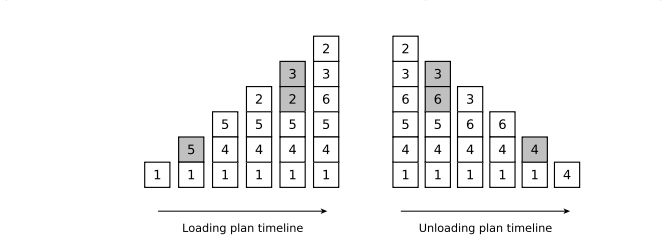
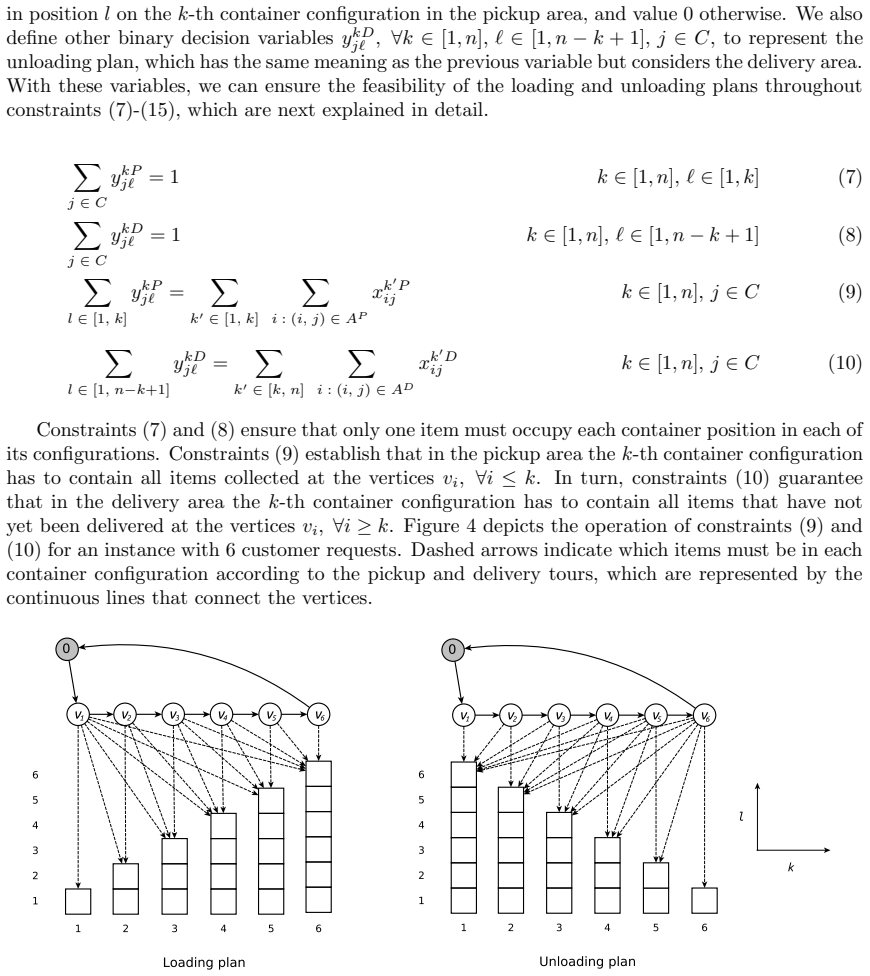
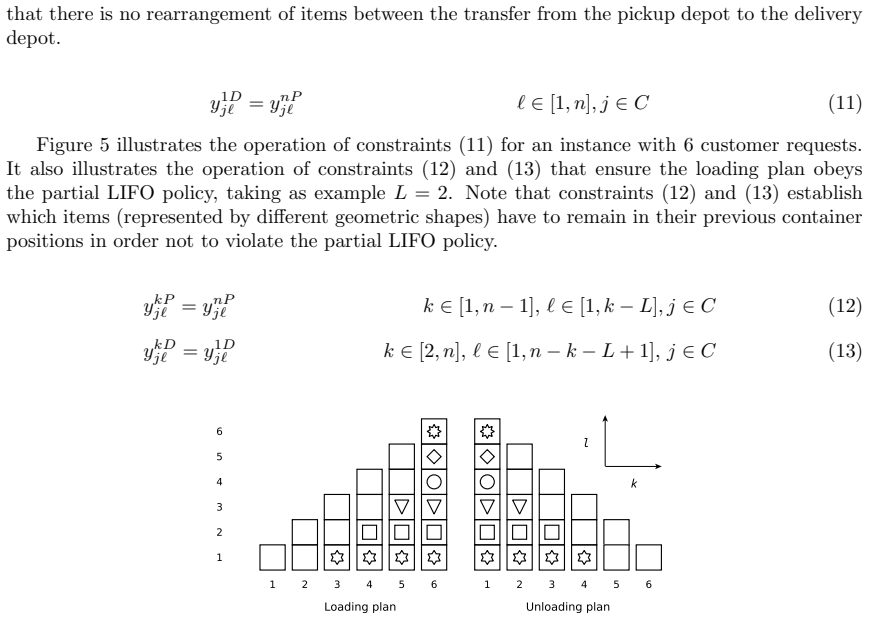
The central object is the reloading-depth mechanism: in a single horizontal stack of n items, positions 1 through L from the top can be permuted freely between two consecutive loading or unloading operations, but every item in a deeper position must stay exactly where it is. The paper encodes this with constraints (12) and (13), which equate the occupant of each frozen position across adjacent container configurations, and constraints (16) and (17), which define the rearrangement count as the depth of the deepest position whose occupant changes. This depth-based counting is what makes the objective function combine travel distance and handling cost in a single linear expression. The heuristic's corresponding machinery is a random-key chromosome whose three partitions encode the pickup route, the loading plan, and the combined unloading plan and delivery route; decoding the keys into sorted item orders produces feasible loading plans without any repair mechanism.
What would settle it
For an instance with three items and L=1, the models require the bottom-position item to stay frozen in constraints (12)-(13); observing a feasible real-world handling process in which that bottom item is removed and replaced without touching the item above it would directly contradict the models. A computational check on the same instance class, comparing the ILP optimum against exhaustive enumeration of all valid reloading sequences, would settle whether the depth-based cost formula counts rearrangements correctly.
Extended reading notes
Core claim
On its own terms, the paper's discovery is that a routing problem with partial LIFO reloading can be stated as an ILP in two different compact ways, and that a random-key genetic algorithm is a workable way to solve the larger cases. The first ILP indexes every arc by its position in the tour; the second uses standard MTZ-style subtour elimination constraints. Both share the same loading-plan variables, which record, for each container configuration during pickups and during deliveries, which item occupies which stack position. The partial LIFO policy is imposed by constraints that freeze every position below the top L, while the number of rearrangements is counted through constraints that charge for the deepest position whose occupant changes between consecutive configurations. The paper reports that these formulations prove optimality for all tested 6-customer instances and almost all 8-customer instances, while larger instances remain open; the BRKGA outperforms the exact methods on most instances with reloading depth up to 3, and the exact models do better when L is large and rearrangement is cheap.
Load-bearing premise
The load-bearing premise is that the partial LIFO operating rule is completely described by 'only the top L items may move, and every movement is charged once according to the deepest changed position'; if a real handling process allows moving an item below the top L without first removing the items above it, or charges rearrangements differently, then both ILP models describe a different problem.
Editorial extensions
If this is right
- If the models are right, then DTSPPL is a well-defined optimization problem whose optimal cost can be approached by two compact ILP models, giving future exact methods a clear benchmark.
- The reported experiments show that even a small reloading depth yields measurable improvements over the strict-LIFO baseline, such as roughly 10 percent cost improvement for L=2, n=8, and h=5, so the handling-versus-routing trade-off is worth modeling in practice.
- The BRKGA's decoding of the delivery route from the unloading plan means that a single feasible loading and unloading plan determines the delivery tour, a structural simplification that helps heuristics navigate the feasible space.
- The observation that exact models solve only small instances quickly, while the heuristic handles almost all instances, suggests that a hybrid exact-heuristic pipeline with an initial incumbent plus branch-and-bound is a natural next step.
Reading between the lines
- If the depth-based rearrangement count faithfully models real handling costs, the same counting principle could transfer to multi-stack containers, giving a DTSPMSPL formulation in which each stack has its own reloading depth.
- A testable extension is a local-search heuristic that swaps the order of the top L items at a single pickup or delivery visit, since the decoding already reduces route construction to sorting small blocks and might reach similar quality with far less memory.
- The benchmark instances are all Euclidean and symmetric, so the paper's conclusions about when rearrangement pays might shift on asymmetric or clustered networks, where the delivery route cannot simply mirror the pickup route.
Signed reviews
Editorial analysis
A structured set of objections, weighed in public.
Referee Report
Summary. The paper introduces the Double Traveling Salesman Problem with Partial Last-In-First-Out Loading Constraints (DTSPPL), a single-vehicle pickup-and-delivery problem in which all pickup operations occur before deliveries, the container is a single horizontal stack, and at any time at most L top items may be rearranged. The total cost combines travel distance and a cost h per rearranged item. The authors propose two compact ILP formulations, ILP1 and ILP2, which differ in how the routes are modeled (position-indexed arc variables versus standard Miller-Tucker-Zemlin subtour-elimination variables), and a Biased Random-Key Genetic Algorithm (BRKGA) with a three-part chromosome encoding and a deterministic decoder. Computational experiments on 1080 instances derived from DTSPMS benchmark areas show that both ILPs solve only the smallest instances within one hour and that the BRKGA is competitive with the ILPs on some instance classes but clearly worse on others. The paper also provides a public repository with code and detailed results.
Significance. If the formulation issue discussed below is corrected, the paper would be a useful contribution: it names and studies a natural variant of the DTSPMS that has apparently not been treated before, it gives two concrete compact models that can serve as a starting point for exact methods, and it provides a reproducible heuristic with code and results. The motivating trade-off between routing cost and handling cost is clearly explained. The strength of the experimental section is the systematic coverage of n, L, and h combinations and the use of standard DTSPMS benchmark areas. However, the central claim that the ILP formulations exactly describe the DTSPPL is currently undermined by an error in the rearrangement-counting constraints, and the heuristic-quality claim is stronger than the evidence in the paper supports.
major comments (2)
- [Section 2.2.3, constraint (16)] Constraint (16) bounds z_k^P only for positions l in [1, k-1], omitting the top position l = k. This omission means that a transition in which only the current top item is displaced is never charged a rearrangement. For example, the transition from configuration [1] to [2,1] requires removing item 1, loading item 2, and replacing item 1, which is exactly one rearrangement, but for k=1 the index range [1,k-1] is empty. For general k the same situation has its deepest changed old-configuration slot at l = k, which is also outside the range. This is not a hypothetical corner case: the paper's own illustrative solution in Figures 1-2 contains this operation when customer 4 is picked up and item 5 is removed, so the text's count of one rearrangement is not enforced by the model. Because z_k^P understates the objective, both ILP1 with objective (19) and ILP2 with objective (28) can certify as optimal solutions that are not optimal for the stated DTSPPL objective, contradicting the assertion in Section 2.2.4 that constraints (1)-(18) represent all feasible solutions. The fix is to extend the range in (16) to l in [1,k]; after doing so the authors should re-examine the analogous delivery constraint (17) and rerun the computational experiments, since the reported optimality results for small instances may change.
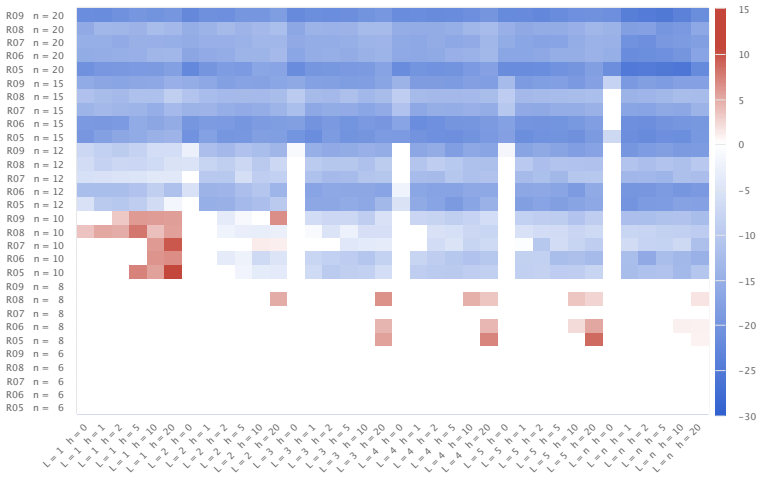
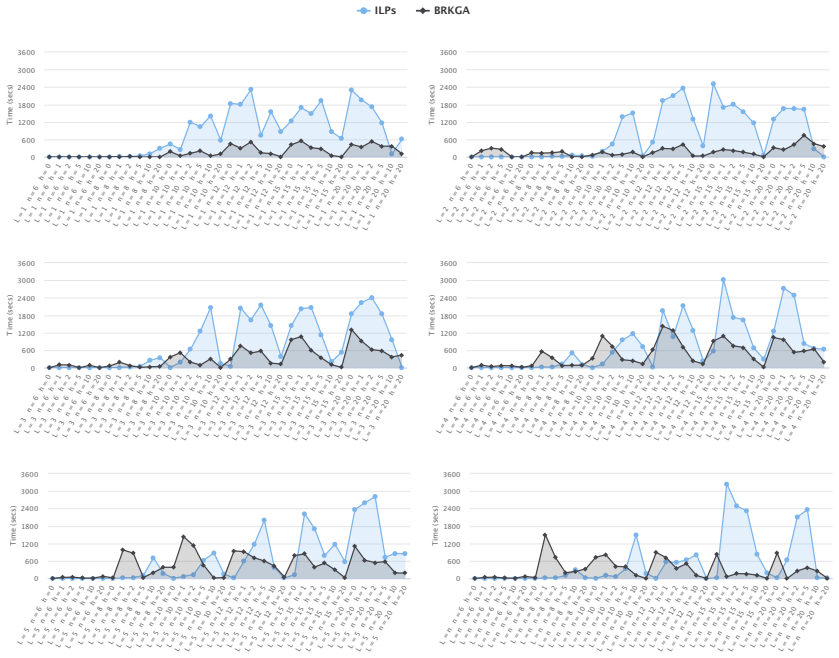
- [Section 4.4 and Figure 13] The abstract and the conclusions state that the BRKGA obtained good quality solutions for almost all instances, but the evidence in Figure 13 does not support this for deeper reloading depths. For L = 4, L = 5, and L = n with small h, many cells show the BRKGA average be substantially worse than the ILP upper bound, with the text reporting differences that can exceed 50 percent. Since the ILP upper bound is not an optimality certificate for instances with n >= 10, the comparison establishes relative performance against the ILPs rather than solution quality in an absolute sense. The claim would be calibrated by reporting BRKGA gaps against the best lower bounds max(ILP1_LB, ILP2_LB), by comparing with the no-rearrangement baseline used in Figure 15, or by testing against known optimal solutions for the small instances. As written, the conclusion that the BRKGA found good quality solutions for all instances is an overstatement of the reported data.
minor comments (5)
- [Figure 14] Figure 14 contains unrelated chart text reading 'Temperature (°C) Monthly Average Temperature Source: WorldClimate.com', which appears to be a chart-generation artifact that should be removed.
- [Section 4.2] The I/F-Race tuning uses a 10 percent sample of the same 1080 instances that are later used in the final evaluation; the paper should state explicitly that the reported BRKGA results are tuned rather than out-of-sample, or use a separate test set.
- [Equations (26)-(27)] The right-hand sides of constraints (26) and (27) appear to contain fractions, but the rendering is ambiguous; explicit parentheses and display formatting would make the intended expressions clear.
- [Section 2.2.3] The text describing constraints (16) and (17) would be clearer if it stated explicitly that each constraint gives a lower bound on z_k^r and that minimization forces z_k^r to equal the largest positive such bound rather than merely being bounded below.
- [Section 1] The attribution of the DTSPMSPL idea to Petersen's thesis would benefit from a more specific citation, since the reloading-depth definition is load-bearing for the whole paper; a page or section reference would help the reader verify the modeling choice.
Circularity Check
No significant circularity; the ILP formulations and BRKGA are self-contained, and the computational claims are empirically benchmarked rather than derived from fitted inputs.
full rationale
The paper's central contributions are two ILP formulations of the DTSPPL and a BRKGA heuristic. The formulations directly encode the stated routing, loading/unloading, and partial-LIFO constraints, and the rearrangement cost appears as the objective to be minimized rather than as a quantity manufactured by the model. Optimality on small instances is certified by the Gurobi solver, and the BRKGA is evaluated against those upper bounds and against the no-rearrangement LIFO baseline, so the heuristic's reported quality is an empirical result rather than a consequence of the model's definitions. Self-citations, such as Chagas et al. (2016, 2020) and Santos and Chagas (2018), are used for background and comparison and are not load-bearing for the validity of the DTSPPL formulations. The only fit-to-benchmark element is the tuning of BRKGA hyperparameters on a 10% sample of the same 1080 instances used for evaluation; this weakens the external generalization of the heuristic comparison, but it does not make any claimed prediction or derivation circular, since the models themselves are not fitted. The skeptic's observation that constraint (16) uses the index range [1, k-1] and may fail to charge for a rearrangement affecting only the top slot (l=k) is a possible correctness or validity issue in the formulation, not a circularity issue: the claimed reduction would be flawed, but it would not be equivalent to its inputs by construction. Overall, the derivation chain is self-contained and no circular step is present.
Assumptions & free parameters
free parameters (4)
- Population size N =
Not stated (selected by I/F-Race from tested values 1M to 500M)
- Elite population size Ne =
Not stated (as proportion of N, tested 0.05N to 0.30N)
- Mutant population size Nm =
Not stated (as proportion of N, tested 0.05N to 0.30N)
- Elite allele inheritance probability rho_e =
Not stated (tested 0.55 to 0.90)
assumptions (6)
- domain assumption Distances in the pickup and delivery graphs are metric and follow TSPLIB rounding conventions.
- domain assumption The vehicle has a single horizontal stack; all pickup operations precede all delivery operations; no rearrangements are allowed at the depots.
- domain assumption Gurobi Optimizer 9.0.1, with default settings, is a correct solver for the ILP models.
- standard math The two-index TSP model with iteratively added subtour elimination constraints provides a valid solution for the L=0 case.
- domain assumption The partial LIFO policy means exactly that only the top L items of the stack may be relocated at any time.
- ad hoc to paper The number of rearranged items at a step equals the depth of the deepest position whose occupant changes between consecutive container configurations.
Cite this review
Pith. "Pith review of The double traveling salesman problem with partial last-in-first-out loading constraints." pith.science (2026). https://pith.science/paper/Z4UAKWXM
@misc{pith2026190808494,
  author       = {Pith},
  title        = {Pith review of: The double traveling salesman problem with partial last-in-first-out loading constraints},
  year         = {2026},
  howpublished = {\url{https://pith.science/paper/Z4UAKWXM}},
  note         = {Machine review of arXiv:1908.08494}
}
read the original abstract
In this paper, we introduce the Double Traveling Salesman Problem with Partial Last-In-First-Out Loading Constraints (DTSPPL). It is a pickup-and-delivery single-vehicle routing problem, where all pickup operations must be performed before any delivery one because the pickup and delivery areas are geographically separated. The vehicle collects items in the pickup area and loads them into its container, a horizontal stack. After performing all pickup operations, the vehicle begins delivering the items in the delivery area. Loading and unloading operations must obey a partial Last-In-First-Out (LIFO) policy, i.e., a version of the LIFO policy that may be violated within a given reloading depth. The objective of the DTSPPL is to minimize the total cost, which involves the total distance traveled by the vehicle and the number of items that are unloaded and then reloaded due to violations of the standard LIFO policy. We formally describe the DTSPPL through two Integer Linear Programming (ILP) formulations and propose a heuristic algorithm based on the Biased Random-Key Genetic Algorithm (BRKGA) to find high-quality solutions. The performance of the proposed solution approaches is assessed over a broad set of instances. Computational results have shown that both ILP formulations have been able to solve only the smaller instances, whereas the BRKGA obtained good quality solutions for almost all instances, requiring short computational times.
Figures


Figures from the paper (13 more)








Reference graph
Works this paper leans on
-
[1]
M. A. Alba Mart \' nez, J.-F. Cordeau, M. Dell'Amico, and M. Iori. A branch-and-cut algorithm for the double traveling salesman problem with multiple stacks. INFORMS Journal on Computing, 25 0 (1): 0 41--55, 2013
work page 2013
-
[2]
D. L. Applegate, R. E. Bixby, V. Chvatal, and W. J. Cook. The traveling salesman problem: a computational study. Princeton University Press, 2006
work page 2006
-
[3]
M. Barbato, R. Grappe, M. Lacroix, and R. W. Calvo. Polyhedral results and a branch-and-cut algorithm for the double traveling salesman problem with multiple stacks. Discrete Optimization, 21: 0 25--41, 2016
work page 2016
-
[4]
M. Battarra, J.-F. Cordeau, and M. Iori. Pickup and delivery problems for goods transportation. In P. Toth and D. Vigo, editors, Vehicle Routing: Problems, Methods, and Applications, MOS-SIAM Series on Optimization, pages 161--192. SIAM, 2nd edition, 2014
work page 2014
-
[5]
M. Birattari, Z. Yuan, P. Balaprakash, and T. St \"u tzle. F-race and iterated f-race: An overview. In Experimental methods for the analysis of optimization algorithms, pages 311--336. Springer, 2010
work page 2010
-
[6]
B. Bruck and M. Iori. Non-elementary formulations for single vehicle routing problems with pickups and deliveries. Operations Research, 65: 0 1597--1614, 2017
work page 2017
-
[7]
F. Carrabs, R. Cerulli, and J.-F. Cordeau. An additive branch-and-bound algorithm for the pickup and delivery traveling salesman problem with LIFO or FIFO loading. INFOR: Information Systems and Operational Research, 45 0 (4): 0 223, 2007 a
work page 2007
-
[8]
F. Carrabs, J.-F. Cordeau, and G. Laporte. Variable neighborhood search for the pickup and delivery traveling salesman problem with LIFO loading. INFORMS Journal on Computing, 19 0 (4): 0 618--632, 2007 b
work page 2007
Show all 43 references
-
[9]
Carrabs, R
F. Carrabs, R. Cerulli, and M. G. Speranza. A branch-and-bound algorithm for the double TSP with two stacks. Networks, 61 0 (1): 0 58--75, 2010
2010
-
[10]
Casazza, A
M. Casazza, A. Ceselli, and M. Nunkesser. Efficient algorithms for the double traveling salesman problem with multiple stacks. Computers & Operations Research, 39 0 (5): 0 1044--1053, 2012
2012
-
[11]
J. B. C. Chagas, U. E. F. Silveira, M. P. L. Benedito, and A. G. Santos. Simulated annealing metaheuristic for the double vehicle routing problem with multiple stacks. In 19th International Conference on Intelligent Transportation Systems (ITSC), pages 1311--1316, Rio de Janei...
2016
-
[12]
J. B. C. Chagas, U. E. F. Silveira, A. G. Santos, and M. J. F. Souza. A variable neighborhood search heuristic algorithm for the double vehicle routing problem with multiple stacks. International Transactions in Operational Research, 27: 0 112–137, 2020
2020
-
[13]
Cordeau, M
J.-F. Cordeau, M. Iori, G. Laporte, and J. J. Salazar Gonz \'a lez. A branch-and-cut algorithm for the pickup and delivery traveling salesman problem with LIFO loading. Networks, 55 0 (1): 0 46--59, 2010
2010
-
[14]
C \^o t \'e , C
J.-F. C \^o t \'e , C. Archetti, M. G. Speranza, M. Gendreau, and J.-Y. Potvin. A branch-and-cut algorithm for the pickup and delivery traveling salesman problem with multiple stacks. Networks, 60 0 (4): 0 212--226, 2009
2009
-
[15]
Doerner and J.-J
K. Doerner and J.-J. Salazar-Gonz\'alez. Pickup and delivery routing problems for people transportation. In P. Toth and D. Vigo, editors, Vehicle Routing: Problems, Methods, and Applications, MOS-SIAM Series on Optimization, pages 193--212. SIAM, 2nd edition, 2014
2014
-
[16]
Felipe, M
\'A . Felipe, M. T. Ortu \ n o, and G. Tirado. The double traveling salesman problem with multiple stacks: A variable neighborhood search approach. Computers & Operations Research, 36 0 (11): 0 2983--2993, 2009
2009
-
[17]
J. F. Gon c alves and M. G. Resende. Biased random-key genetic algorithms for combinatorial optimization. Journal of Heuristics, 17 0 (5): 0 487--525, 2011
2011
-
[18]
J. F. Gon c alves and M. G. Resende. A parallel multi-population biased random-key genetic algorithm for a container loading problem. Computers & Operations Research, 39 0 (2): 0 179--190, 2012
2012
-
[19]
J. F. Gon c alves and M. G. Resende. A biased random key genetic algorithm for 2d and 3d bin packing problems. International Journal of Production Economics, 145 0 (2): 0 500--510, 2013
2013
-
[20]
J. F. Gon c alves and M. G. Resende. A biased random-key genetic algorithm for the unequal area facility layout problem. European Journal of Operational Research, 246 0 (1): 0 86--107, 2015
2015
-
[21]
Gutin and A
G. Gutin and A. P. Punnen. The traveling salesman problem and its variations, volume 12. Springer Science & Business Media, 2006
2006
-
[22]
Iori and S
M. Iori and S. Martello. Routing problems with loading constraints. Top, 18 0 (1): 0 4--27, 2010
2010
-
[23]
Iori and J
M. Iori and J. Riera-Ledesma. Exact algorithms for the double vehicle routing problem with multiple stacks. Computers & Operations Research, 63: 0 83--101, 2015
2015
-
[24]
Kherbash and M
O. Kherbash and M. L. Mocan. A review of logistics and transport sector as a factor of globalization. Procedia Economics and Finance, 27: 0 42--47, 2015
2015
-
[25]
S. P. Ladany and A. Mehrez. Optimal routing of a single vehicle with loading and unloading constraints. Transportation Planning and Technology, 8 0 (4): 0 301--306, 1984
1984
-
[26]
Lalla-Ruiz, J
E. Lalla-Ruiz, J. L. Gonz \'a lez-Velarde, B. Meli \'a n-Batista, and J. M. Moreno-Vega. Biased random key genetic algorithm for the tactical berth allocation problem. Applied Soft Computing, 22: 0 60--76, 2014
2014
-
[27]
Y. Li, A. Lim, W.-C. Oon, H. Qin, and D. Tu. The tree representation for the pickup and delivery traveling salesman problem with LIFO loading. European Journal of Operational Research, 212 0 (3): 0 482--496, 2011
2011
-
[28]
L \'o pez-Ib \'a \ n ez, L
M. L \'o pez-Ib \'a \ n ez, L. P. C \'a ceres, J. Dubois-Lacoste, T. St \"u tzle, and M. Birattari. The irace package: User guide. IRIDIA, Universit \'e Libre de Bruxelles, Belgium, Tech. Rep. TR/IRIDIA/2016-004 , 2016 a
2016
-
[29]
L \'o pez-Ib \'a \ n ez, J
M. L \'o pez-Ib \'a \ n ez, J. Dubois-Lacoste, L. P. C \'a ceres, M. Birattari, and T. St \"u tzle. The irace package: Iterated racing for automatic algorithm configuration. Operations Research Perspectives, 3: 0 43--58, 2016 b
2016
-
[30]
R. M. Lusby, J. Larsen, M. Ehrgott, and D. Ryan. An exact method for the double TSP with multiple stacks. International Transactions in Operational Research, 17 0 (5): 0 637--652, 2010
2010
-
[31]
Mitchell
M. Mitchell. An introduction to genetic algorithms. MIT press, 1998
1998
-
[32]
A. H. Pereira and S. Urrutia. Formulations and algorithms for the pickup and delivery traveling salesman problem with multiple stacks. Computers & Operations Research, 93: 0 1--14, 2018
2018
-
[33]
H. L. Petersen. Decision Support for Planning of Multimodal Transportation with Multiple Objectives. PhD thesis, Technical University of Denmark (DTU), 2009
2009
-
[34]
H. L. Petersen and O. B. Madsen. The double travelling salesman problem with multiple stacks--formulation and heuristic solution approaches. European Journal of Operational Research, 198 0 (1): 0 139--147, 2009
2009
-
[35]
H. L. Petersen, C. Archetti, and M. G. Speranza. Exact solutions to the double travelling salesman problem with multiple stacks. Networks, 56 0 (4): 0 229--243, 2010
2010
-
[36]
M. G. Resende. Biased random-key genetic algorithms with applications in telecommunications. Top, 20 0 (1): 0 130--153, 2012
2012
-
[37]
A. H. Sampaio and S. Urrutia. New formulation and branch-and-cut algorithm for the pickup and delivery traveling salesman problem with multiple stacks. International Transactions in Operational Research, 24: 0 77--98, 2016
2016
-
[38]
A. G. Santos and J. B. C. Chagas. The thief orienteering problem: Formulation and heuristic approaches. In 2018 IEEE Congress on Evolutionary Computation (CEC), pages 1191--1199, Rio de Janeiro, Brasil, 2018. IEEE
2018
-
[39]
U. E. F. Silveira, M. P. L. Benedito, and A. G. Santos. Heuristic approaches to double vehicle routing problem with multiple stacks. In 15th International Conference on Intelligent Systems Design and Applications (ISDA), pages 231--236, Marrakesh, Marocco, 2015. IEEE
2015
-
[40]
E.-G. Talbi. Metaheuristics: from design to implementation, volume 74. John Wiley & Sons, 2009
2009
-
[41]
R. F. Toso and M. G. Resende. A C++ application programming interface for biased random-key genetic algorithms. Optimization Methods and Software, 30 0 (1): 0 81--93, 2015
2015
-
[42]
Urrutia, A
S. Urrutia, A. Milan \'e s, and A. L kketangen. A dynamic programming based local search approach for the double traveling salesman problem with multiple stacks. International Transactions in Operational Research, 22 0 (1): 0 61--75, 2015
2015
-
[43]
Veenstra, K
M. Veenstra, K. J. Roodbergen, I. F. Vis, and L. C. Coelho. The pickup and delivery traveling salesman problem with handling costs. European Journal of Operational Research, 257 0 (1): 0 118--132, 2017
2017
Reviewed August 14, 2026 · model on record in the stance chip above.
Discussion (0). Continue with ORCID to comment.